Semiconductor Manufacturing AI Market Insights
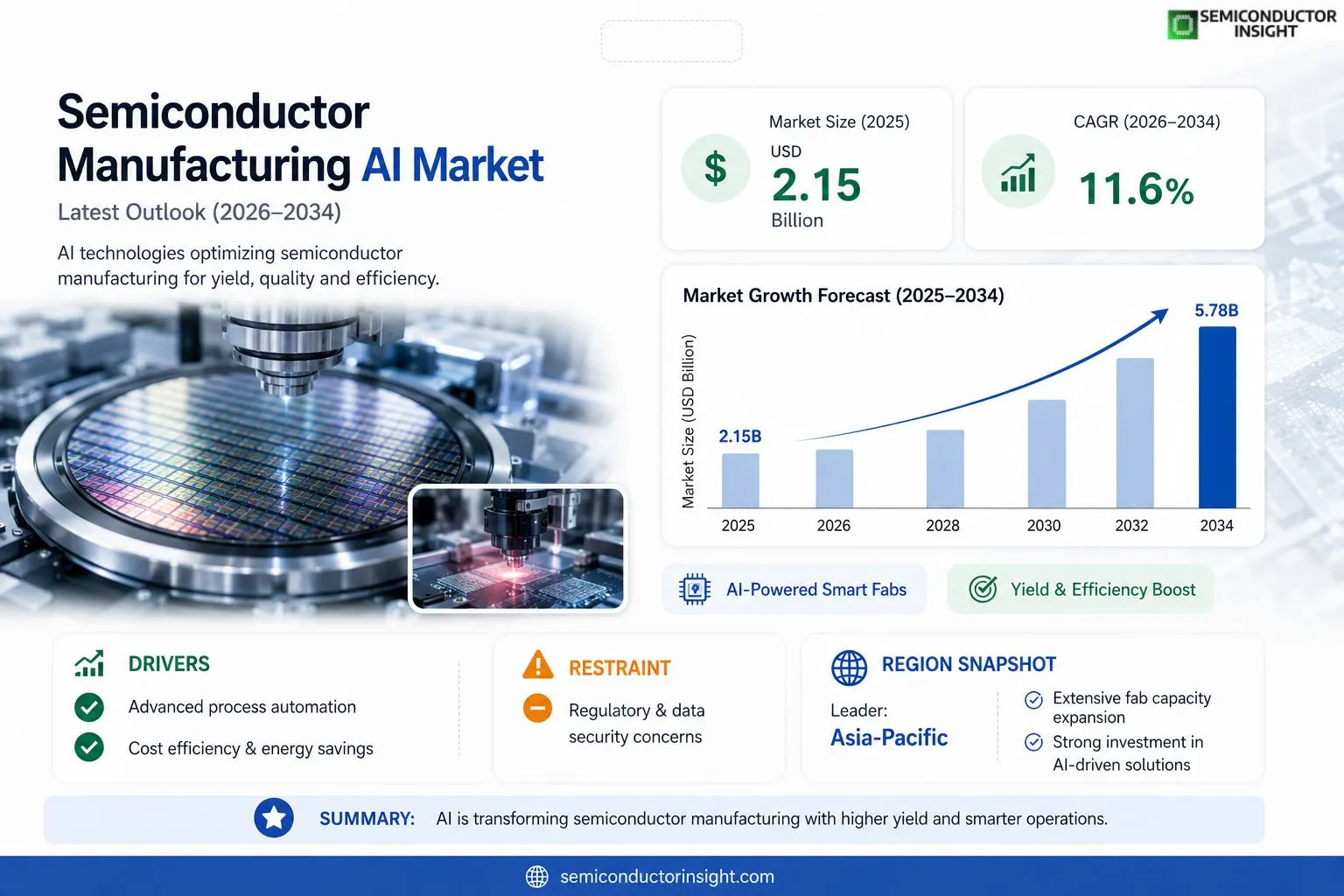
Global semiconductor manufacturing AI market size was valued at USD 2.15 billion in 2025. The market is projected to grow from USD 3.02 billion in 2026 to USD 5.78 billion by 2034, exhibiting a CAGR of 11.6% during the forecast period.Semiconductor manufacturing AI encompasses artificial‑intelligence technologies,including machine‑learning algorithms, deep‑learning models, computer‑vision systems and predictive analytics,applied to wafer‑fab processes such as lithography optimization, defect inspection, yield prediction, equipment predictive maintenance and supply‑chain orchestration.
The market is accelerating because chipmakers are investing heavily in advanced nodes that demand tighter process control, while rising fab automation costs drive adoption of AI‑driven solutions.Furthermore, collaborations between major equipment suppliers such as Applied Materials and AI specialists accelerate innovation; leading players like Intel AI Foundry Services, IBM Research and TSMC’s “Smart Manufacturing” initiatives are expanding their portfolios.
MARKET DRIVERS
Advanced Process Automation
Semiconductor Manufacturing AI Market is being propelled by the need for ultra‑precise process control. AI‑enabled predictive models reduce defect rates by up to 30 % and enable real‑time recipe adjustments, which accelerates yield improvement across 7‑nm and smaller nodes.
Cost Efficiency and Energy Savings
AI‑driven equipment scheduling cuts idle time, delivering an estimated 12 % reduction in operational electricity consumption. Manufacturers that deploy these solutions report capital‑expenditure (CAPEX) savings of roughly $45 million per fab over a three‑year horizon.
➤ “Integrating AI into lithography has shortened cycle time by 18 % while maintaining sub‑10 nm critical dimension uniformity.”
These efficiencies combine to strengthen the overall competitiveness of Semiconductor Manufacturing AI Market, encouraging broader adoption across both mature and leading‑edge fabs.
MARKET CHALLENGES
Integration Complexity
Legacy equipment architectures often lack open interfaces, making AI integration a multi‑year engineering effort. Companies must invest in custom middleware, which can inflate project budgets by 20 % and delay time‑to‑value.
Other Challenges
Talent Shortage
The scarcity of data‑science professionals with semiconductor domain expertise forces firms to rely on external consultants, adding to project overhead and limiting in‑house knowledge transfer.
MARKET RESTRAINTS
Regulatory and Data Security Concerns
Stringent export‑control regulations on advanced manufacturing technologies restrict cross‑border AI software transfers. Additionally, the confidential nature of wafer‑level data raises cybersecurity risks that many fabs are hesitant to expose to cloud‑based AI platforms.
MARKET OPPORTUNITIES
Edge AI for On‑Device Inspection
Deploying miniature AI accelerators directly on inspection tools enables sub‑millisecond defect detection, opening a new revenue stream for vendors that combine hardware and software solutions. Early adopters forecast a 22 % CAGR for edge‑AI enabled inspection over the next five years.
AI‑Powered Design‑For‑Manufacturability (DFM)
Integrating AI into electronic design automation (EDA) tools helps engineers anticipate manufacturability issues before tape‑out, reducing redesign cycles by an estimated 15 %. This capability is expected to broaden the addressable market for AI solutions beyond pure fabs to the entire semiconductor supply chain.
Semiconductor Manufacturing AI Market Trends
AI‑Driven Yield Optimization
Semiconductor Manufacturing AI Market is seeing rapid adoption of machine‑learning and deep‑learning models to increase wafer yield across advanced nodes. Chipmakers are deploying computer‑vision systems that analyze lithography pattern fidelity in real time, allowing immediate process adjustments that reduce defect density. Predictive analytics now feed historical process data into adaptive control loops, ensuring tighter critical dimension control without manual intervention. This shift toward data‑centric process optimization reduces cycle time and supports the economic viability of sub‑7 nm production, where even marginal yield improvements translate into significant cost avoidance.
Other Trends
Defect Inspection Advances
Modern defect inspection tools integrate AI algorithms that differentiate true pattern anomalies from noise with confidence levels exceeding traditional rule‑based methods. By training convolutional neural networks on millions of defect images, equipment suppliers enable fab lines to prioritize high‑impact anomalies, accelerating root‑cause analysis. The result is a measurable decline in re‑work rates and a smoother flow of wafers through downstream testing stations. Collaborative projects between leading equipment manufacturers and AI specialists are expanding the library of recognized defect signatures, further strengthening the reliability of autonomous inspection platforms.
Predictive Maintenance and Supply‑Chain Integration
Predictive maintenance has become a cornerstone of Semiconductor Manufacturing AI Market, as fabs increasingly rely on AI‑powered condition monitoring to anticipate equipment failure before it disrupts production. Sensors capture vibration, temperature, and power consumption data, which feed into time‑series forecasting models that schedule maintenance during low‑impact windows. Simultaneously, AI‑enabled supply‑chain orchestration aligns material delivery with predicted equipment availability, minimizing inventory buffers while safeguarding throughput. These intertwined capabilities reduce unplanned downtime and improve overall fab efficiency, reinforcing the strategic value of AI investments across the semiconductor manufacturing ecosystem.
COMPETITIVE LANDSCAPEKey Industry Players
Semiconductor Manufacturing AI Market: A Highly Competitive and Innovation-Driven Arena Shaped by Leading Technology Giants and Specialized AI Solution Providers
Global semiconductor manufacturing AI market is characterized by intense competition among a diverse mix of established semiconductor equipment manufacturers, integrated device manufacturers, and dedicated AI technology companies. TSMC leads the landscape through its widely recognized Smart Manufacturing initiative, leveraging AI across lithography optimization, defect inspection, and yield enhancement at advanced process nodes. Similarly, Intel AI Foundry Services and IBM Research maintain prominent positions by embedding machine learning and deep learning capabilities directly into fabrication workflows, enabling real-time process control and predictive equipment maintenance. Applied Materials has emerged as a critical force by forming strategic collaborations with AI specialists, accelerating the deployment of AI-driven process optimization tools across wafer fabrication environments. The competitive intensity is further amplified by chipmakers investing aggressively in sub-3nm process technologies, where tighter process control requirements make AI adoption not merely advantageous but operationally essential. NVIDIA and Synopsys have also reinforced their market standing by offering AI-powered simulation, electronic design automation, and computational lithography platforms that serve as foundational infrastructure for smart semiconductor manufacturing.Beyond the dominant tier-one players, a number of specialized and niche companies are carving out significant competitive positions within targeted segments of the semiconductor manufacturing AI value chain. KLA Corporation has established strong footing in AI-enhanced defect review and process control metrology, while Lam Research integrates intelligent analytics within its etch and deposition equipment portfolios. Onto Innovation and Onto’s peers focus on AI-driven optical inspection and advanced process control solutions tailored for high-volume manufacturing environments. PDF Solutions and Veeco Instruments contribute AI-enabled yield management and equipment intelligence capabilities respectively. Meanwhile, cloud and hyperscaler platforms from companies such as Siemens Digital Industries and Palantir Technologies are increasingly being adopted by fabs for AI-based supply chain orchestration and manufacturing execution system optimization, reflecting a broadening competitive perimeter that extends well beyond traditional semiconductor equipment suppliers into the enterprise software and data analytics domain.
List of Key Semiconductor Manufacturing AI Companies Profiled
- Taiwan Semiconductor Manufacturing Company (TSMC)
- Intel Corporation (AI Foundry Services)
- Applied Materials, Inc.
- IBM Research
- NVIDIA Corporation
- Synopsys, Inc.
- KLA Corporation
- Lam Research Corporation
- Onto Innovation Inc.
- PDF Solutions, Inc.
- Veeco Instruments Inc.
- Siemens Digital Industries Software
- Palantir Technologies Inc.
- ASML Holding N.V.
- Samsung Electronics Co., Ltd.
Segment Analysis:
| Segment Category | Sub-Segments | Key Insights |
| By Type |
|
Machine Learning drives intelligent process control and anomaly detection.
|
| By Application |
|
Yield Prediction is pivotal for cost‑effective fab operation.
|
| By End User |
|
Fab Operators leverage AI to streamline daily workflows.
|
| By Technology |
|
Hardware Accelerators underpin high‑throughput model inference.
|
| By Process Stage |
|
Process Control benefits from AI‑enhanced monitoring.
|
Regional Analysis: North America
North America
North America is witnessing a growing emphasis on smart factory concepts, where AI plays a crucial role in connecting various aspects of the manufacturing process. This includes real-time data analysis, process optimization, and predictive analytics to ensure seamless and efficient operations.
The implementation of AI-driven predictive maintenance systems is gaining traction, enabling manufacturers to anticipate equipment failures and schedule maintenance proactively. This minimizes downtime, reduces repair costs, and enhances overall operational reliability within semiconductor plants.
AI algorithms are being deployed to optimize semiconductor supply chains, addressing challenges related to demand forecasting, inventory management, and logistics. This helps manufacturers to improve responsiveness, reduce lead times, and minimize disruptions.
AI-powered vision systems and machine learning algorithms are being used for enhanced quality control, enabling automated defect detection and process refinement in semiconductor manufacturing.
Europe
Europe presents a significant market for Semiconductor Manufacturing AI Market. Driven by strong government support for technological advancement and a highly skilled workforce, Europe is keen on leveraging AI to enhance its manufacturing capabilities. The focus is on integrating AI in areas like process control, yield optimization, and predictive analytics to bolster competitiveness in Global semiconductor industry. Several European initiatives aim to foster collaboration between research institutions, industry players, and startups, accelerating the development and adoption of AI-based solutions.
Asia-Pacific
Asia-Pacific is a dominant force in Semiconductor Manufacturing AI Market, particularly driven by China, Japan, and South Korea. The region’s massive semiconductor manufacturing base and significant investments in AI research and development create a substantial demand for AI-powered solutions. Strong government policies encouraging automation and intelligent manufacturing further fuel market growth. The emphasis is on improving production efficiency, reducing waste, and enhancing product quality through the integration of AI technologies.
United States
The United States represents a vital segment of Semiconductor Manufacturing AI Market, bolstered by considerable private sector investment and a thriving ecosystem of AI companies. Government initiatives focused on supporting domestic semiconductor manufacturing and promoting AI innovation are accelerating market growth. The focus includes AI applications in areas like advanced process control, defect analysis, and supply chain optimization to strengthen competitive advantage.
South America
South America is an emerging market for Semiconductor Manufacturing AI Market, with growing investments in the electronics and technology sectors. While currently a smaller market compared to other regions, there is increasing interest in adopting AI-based solutions to improve manufacturing efficiency and reduce costs. The focus is on basic AI applications in areas like process monitoring and predictive maintenance to enhance operational performance.
Middle East & Africa
The Middle East & Africa region is an evolving market for Semiconductor Manufacturing AI Market. With growing investments in technology and infrastructure, there is increasing awareness and adoption of AI-powered solutions in manufacturing. The initial focus is on implementing AI in areas like predictive maintenance and quality control to improve operational efficiency and reliability within the semiconductor industry. Region-specific challenges and opportunities will shape market growth in the coming years.
Report Scope
This market research report provides a comprehensive analysis of the Semiconductor Manufacturing AI Market , covering the forecast period 2026–2034. It offers detailed insights into market dynamics, technological advancements, competitive landscape, and key trends shaping the industry.
Key focus areas of the report include:
- Market Overview: The report begins with an overview outlining its current market scenario, key growth indicators, and industry transformation drivers. It discusses macroeconomic factors, demand–supply balance, regulatory landscape, and the strategic role of semiconductors in powering advancements across industries such as automotive, telecommunications, consumer electronics, and industrial automation.
- Market Size & Forecast: Historical data and future projections for revenue, unit shipments, and market value across major regions and segments.
- Segmentation Analysis: Detailed breakdown by product type, technology, application, and end-user industry to identify high-growth segments and investment opportunities.
- Regional Insights: Insights into market performance across North America, Europe, Asia-Pacific, Latin America, and the Middle East & Africa, including country-level analysis where relevant.
- Competitive Landscape: Profiles of leading market participants, including their product offerings, R&D focus, manufacturing capacity, pricing strategies, and recent developments such as mergers, acquisitions, and partnerships.
- Technology Trends & Innovation: Assessment of emerging technologies, integration of AI/IoT, semiconductor design trends, fabrication techniques, and evolving industry standards.
- Market Drivers & Restraints: Evaluation of factors driving market growth along with challenges, supply chain constraints, regulatory issues, and market-entry barriers.
- Stakeholder Insights: Insights for component suppliers, OEMs, system integrators, investors, and policymakers regarding the evolving ecosystem and strategic opportunities.
Primary and secondary research methods are employed, including interviews with industry experts, data from verified sources, and real-time market intelligence to ensure the accuracy and reliability of the insights presented.
FREQUENTLY ASKED QUESTIONS:
What is the current market size of Semiconductor Manufacturing AI Market?
-> Semiconductor Manufacturing AI Market was valued at USD 2.15 billion in 2025 and is expected to reach USD 5.78 billion by 2034.
Which key companies operate in Semiconductor Manufacturing AI Market?
-> Key players include Intel AI Foundry Services, IBM Research, TSMC, Applied Materials and other leading equipment and AI specialists.
What are the key growth drivers?
-> Key growth drivers include investment in advanced nodes, tighter process control requirements, rising fab automation costs, and adoption of AI‑driven predictive maintenance and yield optimization.
Which region dominates the market?
-> Asia‑Pacific shows the fastest growth due to extensive fab capacity expansion, while North America remains a dominant market for AI‑enabled semiconductor solutions.
What are the emerging trends?
-> Emerging trends include AI‑IoT integration for smart fabs, AI‑optimized lithography and defect inspection, and collaborative innovation between semiconductor OEMs and AI technology firms.

Get Sample Report PDF for Exclusive Insights
Report Sample Includes
- Table of Contents
- List of Tables & Figures
- Charts, Research Methodology, and more...
 Download Sample Report PDF