
Radar Transceivers Market Insights
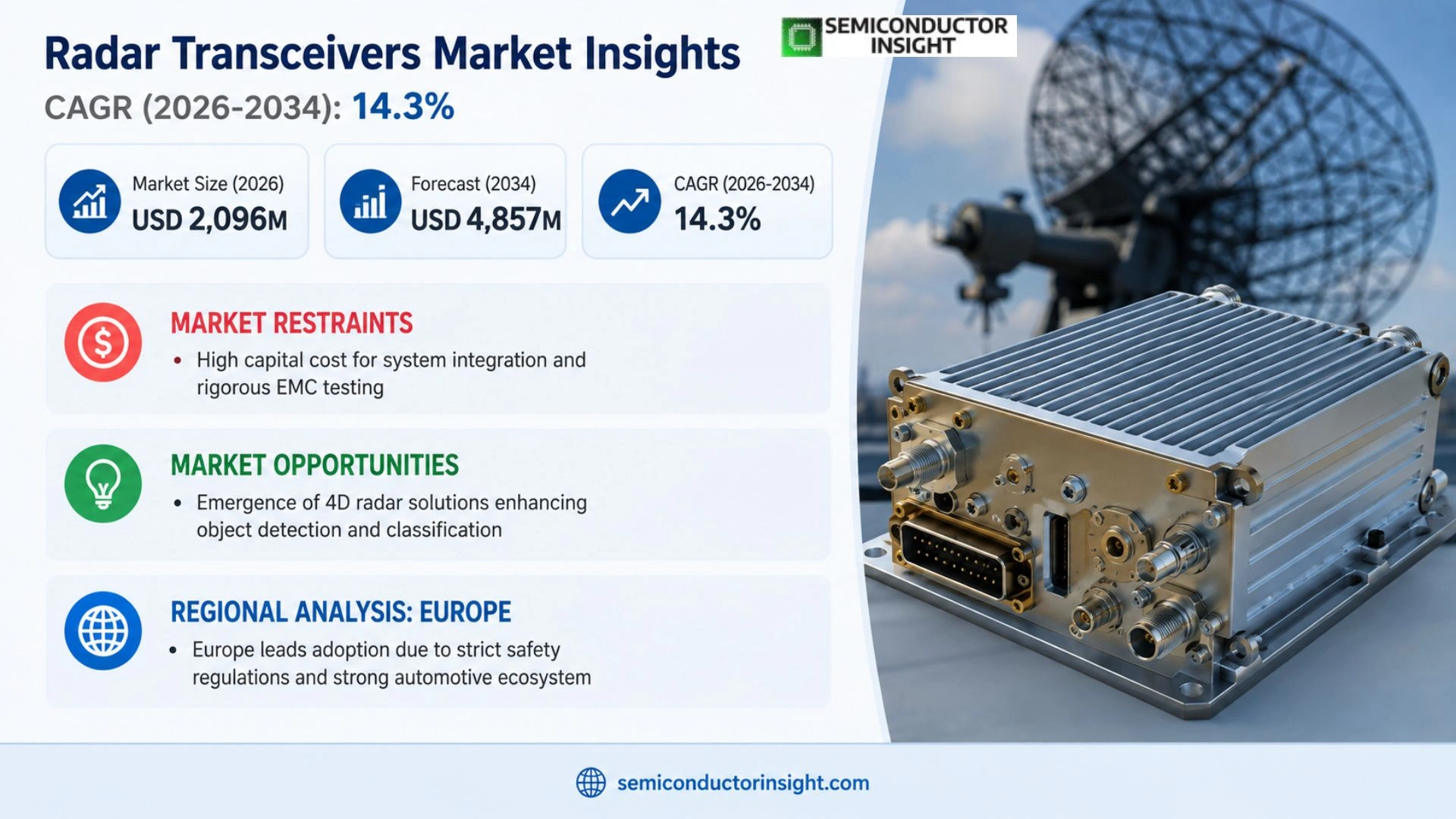
Radar Transceivers market will grow from USD 2,096 million in 2026 to USD 4,857 million by 2034, reflecting a compound annual growth rate of 14.3% over the forecast horizon.
A Radar Transceiver is a single‑chip integrated circuit produced with semiconductor technologies such as RFCMOS and SiGe BiCMOS. It consolidates core RF functions,power amplifiers, low‑noise amplifiers, voltage‑controlled oscillators, mixers, filters and transmit/receive switches,onto one silicon die. In transmit mode the chip up‑converts baseband signals and amplifies them for antenna radiation; in receive mode it provides low‑noise amplification, down‑conversion and filtering of weak echo returns before delivering baseband or IF outputs. External components like antennas, high‑frequency filters and processors complete the radar front‑end.
The expansion of automotive advanced driver‑assistance systems (ADAS) has heightened demand for compact 77–80 GHz transceivers capable of supporting four‑dimensional imaging. Simultaneously, industrial testing rigs and medical imaging equipment are adopting millimeter‑wave solutions for higher resolution sensing. Companies such as NXP Semiconductors and Infineon Technologies have announced new SiP packaging lines that improve thermal performance while reducing footprint. Moreover, collaborations between semiconductor firms and AI algorithm providers are embedding edge processing directly into transceiver modules, which enhances detection accuracy and lowers system power consumption.
MARKET DRIVERS
Rising Demand for Autonomous Navigation
The surge in autonomous vehicle projects across North America and Europe has intensified the need for precise ranging solutions. Radar transceiver modules now serve as the backbone of collision‑avoidance systems, delivering millimeter‑level resolution in adverse weather. Manufacturers are allocating up to 15% of their R&D budgets to integrate these units into next‑generation platforms, a move that directly fuels market expansion.
Growth of Advanced Air‑Traffic Management
Modern air‑traffic control frameworks rely on high‑frequency radar transceivers to monitor increasingly congested airspace. The adoption of UTM (Unmanned Traffic Management) protocols has added a new layer of complexity, prompting airlines and UAV operators to upgrade legacy systems. This transition is projected to lift overall market revenue by several hundred million dollars within the next three years.
➤ “Integrating low‑power, solid‑state transceivers reduces overall system weight, extending aircraft range by up to 5%.”
Simultaneously, defense establishments are modernizing perimeter‑defense radars to counter emerging threats. The shift from mechanically steered antennas to electronically scanned arrays hinges on compact, high‑performance transceivers, reinforcing long‑term demand across the sector.
MARKET CHALLENGES
Stringent Regulatory Environments
Global regulators have tightened emission limits for radio‑frequency equipment, compelling suppliers to redesign front‑end circuitry. Certification cycles now extend beyond 18 months, inflating time‑to‑market and squeezing profit margins for newcomers.
Other Challenges
Supply‑Chain Volatility
Component shortages, particularly for gallium‑nitride substrates, have introduced lead‑time uncertainties. Companies that lack multiple sourcing strategies risk inventory gaps, which can stall large‑scale deployments in critical sectors.
MARKET RESTRAINTS
High Capital Expenditure for System Integration
Embedding radar transceivers into existing platforms often demands extensive redesign of power‑distribution and signal‑processing architectures. The upfront investment can exceed $10 million for a single aerospace platform, deterring smaller OEMs from pursuing upgrades.
Moreover, the necessity for rigorous electromagnetic compatibility testing adds another cost layer, limiting rapid adoption in price‑sensitive markets such as consumer‑grade drones.
These financial barriers create a selective landscape where only firms with deep cash reserves or strategic partnerships can capture sizable market share.
MARKET OPPORTUNITIES
Emergence of 4D Radar Solutions
4D radar technology, which adds elevation data to traditional range‑angle measurements, is gaining traction in automotive safety suites. Early adopters report a 20% improvement in object classification accuracy, positioning this capability as a premium differentiator for OEMs seeking regulatory compliance.
Another promising avenue lies in the rollout of high‑throughput satellite constellations, which require compact, low‑power transceivers to manage inter‑satellite links. Companies that can deliver miniaturized, radiation‑hard designs stand to secure multi‑year contracts worth billions.
Finally, the convergence of AI‑driven signal processing with traditional radar hardware opens a new revenue stream. By offering software‑defined transceiver platforms, vendors can license update cycles, creating recurring‑revenue models that extend beyond one‑time hardware sales.
Radar Transceivers Market Trends
Technological Integration and Packaging Advances
Radar Transceivers Market is being reshaped by the convergence of SiP packaging and next‑generation RFCMOS processes. By embedding power amplifiers, low‑noise amplifiers, VCOs, mixers and filters onto a single silicon die, manufacturers have cut bill‑of‑materials costs while delivering tighter phase noise specifications. The 77‑80 GHz band, now the de‑facto standard for automotive radar, benefits from these advances, enabling 4D imaging chips that support lane‑keeping and high‑resolution object classification. Integrated AI edge‑processing blocks further refine echo interpretation, raising signal‑to‑noise ratios and permitting lower transmit power without sacrificing detection range. As a result, original equipment manufacturers can design slimmer sensor housings, a prerequisite for electric‑vehicle platforms where space and weight are premium.
Other Trends
Application Diversification
Beyond automotive, Radar Transceivers Market is witnessing a broadening of end‑use scenarios. Industrial testing rigs are adopting millimeter‑wave transceivers to monitor material integrity, while medical imaging systems exploit the high‑frequency precision of 57‑71 GHz devices for non‑invasive diagnostics. Consumer electronics, particularly gesture‑control interfaces, are leveraging low‑cost 24 GHz chips that can be mass‑produced on SiGe BiCMOS lines. This shift is reflected in sales data: while automotive units still dominate at roughly 60 % of volume, non‑automotive segments together account for more than one‑third, indicating a meaningful reallocation of R&D budgets toward multi‑band product families.
Ecosystem Collaboration and Multi‑Band Development
Strategic partnerships are becoming a hallmark of Radar Transceivers Market. Chip designers are aligning with sensor manufacturers, AI algorithm providers and vehicle‑platform integrators to deliver holistic radar solutions rather than isolated components. The emergence of digital‑beamforming architectures, which require tight synchronization across multiple frequency bands, has prompted joint development programs that share silicon IP and verification platforms. This collaborative model shortens time‑to‑market for 4D radar modules and reduces the total cost of ownership for OEMs, who can now source a single, vertically integrated solution that spans automotive, aerospace and maritime applications. The cumulative effect is a more resilient supply chain and a faster feedback loop between field performance and silicon iteration.
COMPETITIVE LANDSCAPE
Key Industry Players
Radar Transceivers Market – Competitive Overview
The upper tier of Radar Transceivers market is dominated by a handful of semiconductor powerhouses that have built deep expertise in SiGe BiCMOS and advanced RFCMOS processes. NXP Semiconductors, Infineon Technologies, Texas Instruments and Analog Devices together command more than half of the 2025 revenue, largely because they supply the 77‑81 GHz automotive chip sets that underpin Level‑2+ to Level‑4 autonomy. Their product portfolios span single‑chip MMIC solutions to digital‑beamforming architectures, allowing automotive OEMs to shrink radar modules while preserving detection range and signal‑to‑noise performance. These firms also integrate on‑chip AI inference blocks, a move that improves clutter rejection and enables more aggressive power budgeting. The concentration of design talent and capital investment in high‑volume fabs creates a barrier to entry that keeps the competitive field relatively tight at the top.
Beyond the leaders, a diverse set of specialists is carving out niche positions across frequency bands and application domains. RFbeam Microwave GmbH and Lytid focus on millimeter‑wave modules for industrial testing and high‑resolution imaging, while Calterah Semiconductor and Uhnder, Inc. target low‑cost, multi‑band designs for consumer‑grade sensors. Mitsubishi Electric and Renesas Electronics leverage long‑standing defense relationships to supply ruggedized transceivers for aerospace and maritime platforms. Companies such as Asahi Kasei, Possumic Technology, SGR Semiconductors, AirTouch (Shanghai) Intelligent Technology and Magnichip pursue differentiated value propositions,ranging from terahertz‑band prototypes to vertically integrated sensor‑AI ecosystems. Their agility allows them to respond quickly to emerging standards, but they must balance R&D intensity against modest scale, which often translates into partnership models with larger foundries.
List of Key Radar Transceivers Companies Profiled
- NXP Semiconductors
- Infineon Technologies
- Texas Instruments
- Analog Devices
- STMicroelectronics
- RFbeam Microwave GmbH
- Bosch
- Lytid
- Calterah Semiconductor
- Uhnder, Inc.
- Mitsubishi Electric
- Renesas Electronics
- Asahi Kasei
- Possumic Technology Co., Ltd.
- SGR Semiconductors Inc.
- AirTouch (Shanghai) Intelligent Technology Co., Ltd.
- Magnichip Co., Ltd.
Segment Analysis:
| Segment Category | Sub-Segments | Key Insights |
| By Type |
|
Millimeter‑Wave
|
| By Application |
|
Automotive
|
| By End User |
|
Vehicle manufacturers
|
| By Frequency Band |
|
76‑81 GHz
|
| By Architecture |
|
Single‑Chip MMIC Transceiver
|
Regional Analysis: Radar Transceivers Market
Europe
The European Union’s mandatory inclusion of radar modules in new vehicle safety packages forces OEMs to secure compliant suppliers early in the design cycle. Harmonised testing protocols reduce entry barriers for niche players, yet enforce rigorous electromagnetic compatibility standards that elevate component robustness.
Localised silicon foundries and a resurgence of consortium‑driven procurement have shortened lead times. Firms are reshaping logistics to balance just‑in‑time delivery with strategic stockpiles of high‑frequency substrates, mitigating geopolitical shocks.
Beyond passenger cars, rail signalling and maritime collision‑avoidance systems are expanding the addressable base. Each sector values the same precision but tailors transceiver bandwidth to distinct clutter environments, prompting diversification of product portfolios.
Legacy defense manufacturers are joining forces with pure‑play semiconductor startups, creating hybrid entities that blend heritage reliability with cutting‑edge integration techniques. This convergence reshapes market share calculations and elevates the importance of intellectual property licensing.
North America
The United States remains a hotbed for radar transceiver innovation, largely propelled by its autonomous‑vehicle testing corridors and defense procurement budgets. Companies benefit from a culture that rewards rapid prototyping, allowing them to push frequency‑hopping capabilities into production cycles that would be slower elsewhere. However, fragmented state‑level safety mandates compel manufacturers to adopt scalable designs that can be tuned to diverse regulatory thresholds, a factor that fuels investment in software‑defined radar architectures. The combination of venture capital enthusiasm and a mature supply chain for high‑frequency components keeps the market nimble, yet firms must navigate tariff exposure on imported substrates, prompting a gradual shift toward domestic wafer fabs.
Asia‑Pacific
Asia‑Pacific’s trajectory is shaped by aggressive vehicle electrification targets and a burgeoning smart‑city agenda that incorporates traffic‑management radars. Nations such as China and Japan are integrating radar transceivers into both mass‑market sedans and high‑speed rail networks, leveraging government subsidies to offset development costs. The region’s cost‑sensitive manufacturing base drives a focus on ASIC efficiency, while the competitive pressure from local chipmakers accelerates time‑to‑market for next‑generation modules. Although intellectual‑property enforcement varies, the sheer volume of deployments creates a feedback loop that refines design standards across disparate applications.
South America
In South America, Brazil leads the dialogue as the foremost consumer of radar‑enabled automotive platforms, spurred by a growing middle‑class seeking advanced safety features. The market’s modest scale encourages joint ventures between regional assemblers and European technology providers, facilitating technology transfer while preserving local content ratios. Infrastructure projects, such as intelligent highway systems, introduce radar sensors into logistics and public‑transport fleets, expanding the addressable market beyond cars. Supply‑side constraints, notably limited domestic semiconductor fabrication, necessitate reliance on imported modules, which in turn drives negotiations around long‑term licensing agreements.
Middle East & Africa
The Middle East‑Africa corridor witnesses radar transceiver uptake primarily through defense modernization programs and luxury‑vehicle imports. Oil‑rich economies invest heavily in border‑security radars that require high‑resolution detection, prompting collaborations with established European vendors. Simultaneously, a nascent automotive aftermarket emerges in South Africa, where fleet operators adopt collision‑avoidance upgrades to meet corporate risk‑management policies. Limited local manufacturing capacity pushes the region toward assembly‑only models, creating opportunities for contract manufacturers to add value through bespoke integration services.
Report Scope
This market research report provides a comprehensive analysis of the Radar Transceivers Market , covering the forecast period 2026–2034. It offers detailed insights into market dynamics, technological advancements, competitive landscape, and key trends shaping the industry.
Key focus areas of the report include:
- Market Overview: The report begins with an overview outlining its current market scenario, key growth indicators, and industry transformation drivers. It discusses macroeconomic factors, demand–supply balance, regulatory landscape, and the strategic role of semiconductors in powering advancements across industries such as automotive, telecommunications, consumer electronics, and industrial automation.
- Market Size & Forecast: Historical data and future projections for revenue, unit shipments, and market value across major regions and segments.
- Segmentation Analysis: Detailed breakdown by product type, technology, application, and end-user industry to identify high-growth segments and investment opportunities.
- Regional Insights: Insights into market performance across North America, Europe, Asia-Pacific, Latin America, and the Middle East & Africa, including country-level analysis where relevant.
- Competitive Landscape: Profiles of leading market participants, including their product offerings, R&D focus, manufacturing capacity, pricing strategies, and recent developments such as mergers, acquisitions, and partnerships.
- Technology Trends & Innovation: Assessment of emerging technologies, integration of AI/IoT, semiconductor design trends, fabrication techniques, and evolving industry standards.
- Market Drivers & Restraints: Evaluation of factors driving market growth along with challenges, supply chain constraints, regulatory issues, and market-entry barriers.
- Stakeholder Insights: Insights for component suppliers, OEMs, system integrators, investors, and policymakers regarding the evolving ecosystem and strategic opportunities.
Primary and secondary research methods are employed, including interviews with industry experts, data from verified sources, and real-time market intelligence to ensure the accuracy and reliability of the insights presented.
FREQUENTLY ASKED QUESTIONS:
What is the current market size of Radar Transceivers Market?
-> Radar Transceivers market will grow from USD 2,096 million in 2026 to USD 4,857 million by 2034, reflecting a compound annual growth rate of 14.3%
Which key companies operate in Radar Transceivers Market?
-> Key players include NXP Semiconductors, Infineon Technologies, Analog Devices, Texas Instruments, STMicroelectronics, RFbeam Microwave GmbH, Bosch, Lytid, Calterah Semiconductor, Uhnder, Inc., Mitsubishi Electric, Renesas Electronics, Asahi Kasei, Possumic Technology Co., Ltd., SGR Semiconductors Inc., AirTouch (Shanghai) Intelligent Technology Co., Ltd., Magnichip Co., Ltd..
What are the key growth drivers?
-> Key growth drivers include technological upgrading (SiP packaging, advanced RFCMOS), scenario expansion such as automotive 4D radar for L2+ to L4 autonomous driving, and ecosystem collaboration integrating AI edge processing with sensors.
Which region dominates the market?
-> Asia shows strong activity due to widespread automotive 4D radar adoption, while other regions also present significant opportunities.
What are the emerging trends?
-> Emerging trends include multi‑band and multi‑form product development, integration of AI‑driven signal processing, and deployment of 4D imaging architectures in automotive radar.

Get Sample Report PDF for Exclusive Insights
Report Sample Includes
- Table of Contents
- List of Tables & Figures
- Charts, Research Methodology, and more...
