Defense Antenna Market Insights
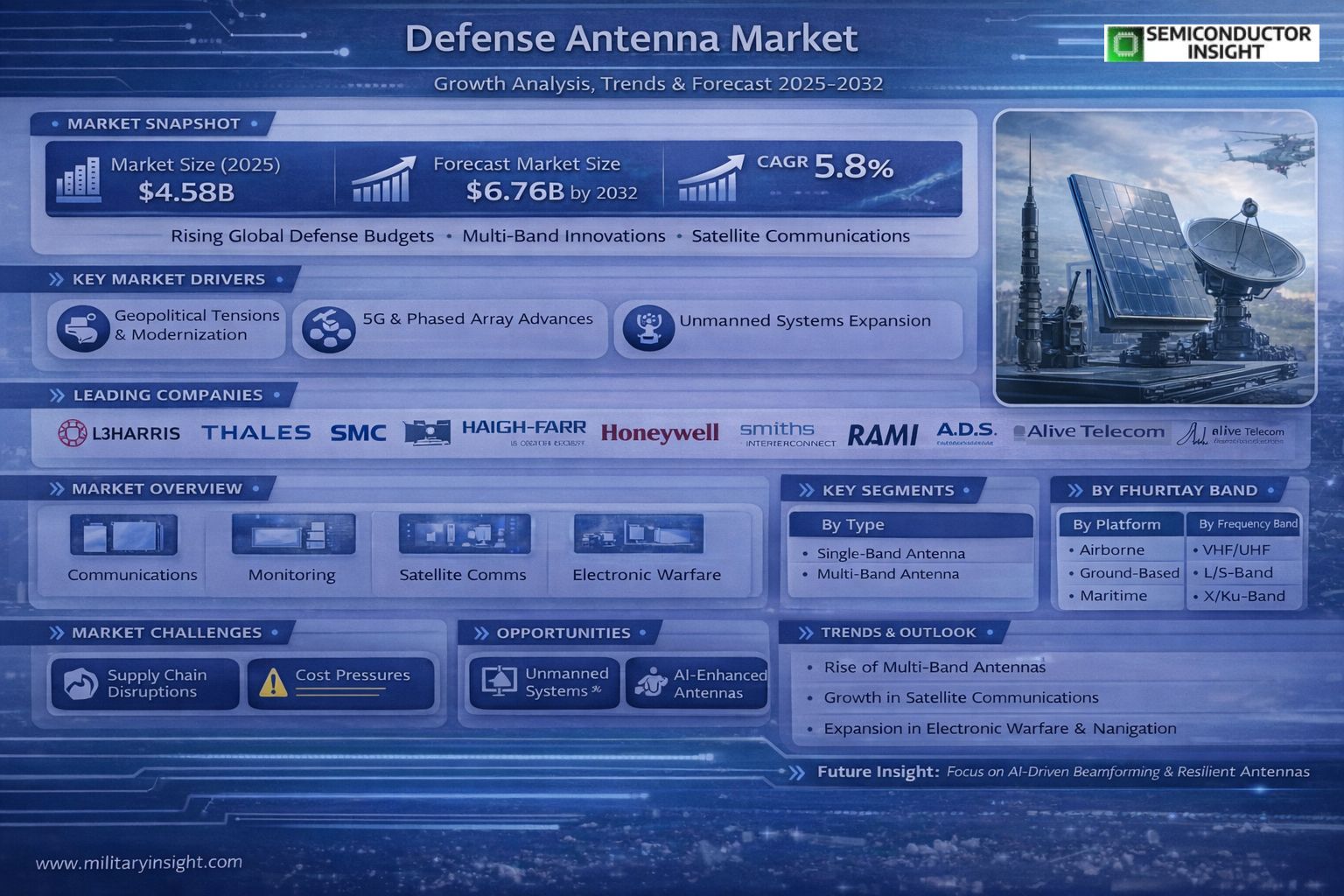
Global Defense Antenna market size was valued at USD 4.58 billion in 2025. The market is projected to reach USD 6.76 billion by 2032, exhibiting a CAGR of 5.8% during the forecast period.
Defense antennas, also known as military antennas, are devices that directly transmit or receive radio waves, divided into two types: transmitting antennas and receiving antennas. They serve as critical components in military communications, radar systems, electronic countermeasures, and navigation equipment, enabling reliable signal propagation in harsh environments.
The market is experiencing steady growth driven by escalating geopolitical tensions, surging global defense budgets,which reached $2.44 trillion in 2023,and advancements in multi-band and phased array technologies. Furthermore, rising demand for satellite communications, electronic warfare capabilities, and unmanned systems accelerates expansion. Key players like L3Harris, Thales Group, Smiths Interconnect, Honeywell International Inc., and Haigh-Farr operate with diverse portfolios, investing in next-gen designs. For instance, in early 2024, L3Harris secured U.S. Army contracts for enhanced tactical radios incorporating advanced antennas, bolstering secure battlefield connectivity.
MARKET DRIVERS
Geopolitical Tensions and Defense Modernization
Defense antenna market is propelled by escalating geopolitical conflicts worldwide, prompting nations to upgrade communication systems for secure and reliable operations. Rising investments in military infrastructure, particularly in advanced radar and satellite technologies, have accelerated demand for high-performance antennas capable of withstanding harsh environments.
Technological Advancements in Phased Array and 5G Integration
Innovation in phased array antennas and integration with 5G networks are key drivers, enabling real-time data transmission for unmanned aerial vehicles (UAVs) and naval vessels. The market benefits from a projected growth at a CAGR of approximately 7.2% through 2030, fueled by the need for multi-band capabilities in modern warfare scenarios.
➤ Government spending on defense electronics reached over $150 billion globally in 2023, with antennas forming a critical segment for enhanced situational awareness.
Furthermore, the shift toward electronic warfare systems underscores the importance of compact, low-profile antennas, driving sustained expansion in Defense antenna market.
MARKET CHALLENGES
Supply Chain Disruptions and Material Shortages
Defense antenna market faces significant hurdles from global supply chain volatility, particularly shortages of rare earth materials essential for high-frequency components. These disruptions have led to production delays, increasing costs by up to 20% for key manufacturers.
Other Challenges
Cybersecurity Vulnerabilities
Antenna systems integrated with networked platforms are prone to cyber threats, requiring robust encryption that complicates design and deployment in the defense sector.
Integration complexities with legacy systems also pose barriers, as modern antennas must interface seamlessly with older military hardware, slowing adoption rates across various platforms.
Additionally, stringent testing protocols for electromagnetic compatibility extend development timelines, challenging market players to balance innovation with compliance.
MARKET RESTRAINTS
High Development Costs and Budget Limitations
Prohibitive R&D expenses for next-generation antennas, often exceeding $500 million per program, restrain growth in Defense antenna market. Budgetary constraints in several regions limit procurement of advanced systems despite evident needs.
Export regulations and international trade barriers further impede market expansion, as controlled technologies face lengthy approval processes that deter potential collaborations.
Technological miniaturization challenges persist, with performance trade-offs in size reduction affecting reliability in extreme operational conditions.
MARKET OPPORTUNITIES
Expansion in Unmanned Systems and Space Defense
Defense antenna market holds promise through surging demand for antennas in UAV swarms and hypersonic platforms, where conformal designs offer superior aerodynamics and signal integrity. Market projections indicate a 25% rise in UAV-related antenna deployments by 2028.
Opportunities in space-based defense, including low-earth orbit satellites, drive need for resilient, wideband antennas to support global surveillance networks.
Strategic partnerships between defense contractors and tech firms are opening avenues for AI-enhanced beamforming antennas, potentially capturing emerging contracts worth billions.
Defense Antenna Market Trends
Rise of Multi-Band Antennas
In Defense antenna market, multi-band antennas are emerging as a dominant segment due to their ability to operate across multiple frequency ranges, enhancing flexibility in military communications and radar systems. Unlike single-band antennas limited to specific frequencies, multi-band designs support seamless integration in diverse applications such as electronic warfare and navigation, addressing the evolving needs of modern defense platforms. This shift reflects broader industry dynamics where platforms require versatile signal handling to counter sophisticated threats, with key manufacturers like L3Harris and Thales Group advancing technologies for wider bandwidth coverage.
Other Trends
Growth in Satellite Communications Applications
Satellite communications represent a critical application driving demand in Defense antenna market, enabling secure, long-range data links for global military operations. Antennas optimized for this segment facilitate high-throughput connectivity essential for real-time intelligence sharing and command/control functions, particularly in remote theaters. Industry surveys highlight increasing adoption among major defense forces, propelled by the need for resilient networks amid contested environments, with players such as Honeywell International Inc. and Smiths Interconnect developing compact, high-gain solutions tailored for airborne and naval platforms.
Expansion in Electronic Warfare and Regional Markets
Electronic warfare applications are fueling innovation in Defense antenna market, where specialized antennas enable signal jamming, detection, and countermeasures vital for spectrum dominance. Concurrently, regional dynamics show robust growth in Asia, particularly China and India, alongside North America’s leadership through the U.S., as nations modernize fleets with advanced monitoring and navigation capabilities. Leading firms including Haigh-Farr and Rami are responding with ruggedized designs for harsh operational conditions, while competitive landscapes indicate strategic partnerships to bolster supply chains and technological edges in communications and other segments.
COMPETITIVE LANDSCAPE
Key Industry Players
Leading Manufacturers Shaping Defense antenna market
Defense antenna market is characterized by a concentrated structure dominated by a handful of established players, with the global top five manufacturers accounting for a significant revenue share in 2025. L3Harris Technologies and Thales Group emerge as leading entities, leveraging their extensive portfolios in military communications, radar, and electronic warfare systems. These firms benefit from long-standing government contracts, particularly in North America and Europe, where stringent performance standards and integration with complex defense platforms drive demand. The market’s high entry barriers, including advanced RF engineering expertise and MIL-STD certifications, reinforce the oligopolistic nature, with the overall sector valued at $4,581 million in 2025 and projected to grow to $6,755 million by 2032 at a 5.8% CAGR.
Beyond the frontrunners, niche players like Haigh-Farr, Smiths Interconnect, and Honeywell International Inc. hold substantial positions through specialized offerings in multi-band and single-band antennas for satellite communications, navigation, and monitoring applications. Companies such as Rami Dielectrics and A.D.S. International cater to specific segments like electronic countermeasures, while emerging contributors including SMC and Alive Telecom provide innovative solutions amid rising geopolitical tensions. This tier of competitors focuses on customization and agility, capturing growth in Asia-Pacific and emerging markets, though they face challenges from supply chain constraints and R&D investments required to match the scale of top-tier incumbents.
List of Key Defense Antenna Companies Profiled
- L3Harris Technologies
- Thales Group
- Honeywell International Inc.
- Smiths Interconnect
- Haigh-Farr Technology
- Rami Dielectrics
- SMC
- A.D.S. International
- Alive Telecom
- Antenna Research Associates (ARA)
- Cobham Antenna Systems
- Lockheed Martin Corporation
- RTX (Raytheon Technologies)
- BAE Systems
- Northrop Grumman
Segment Analysis:
| Segment Category | Sub-Segments | Key Insights |
| By Type |
|
Multi-band Antenna
|
| By Application |
|
Communications
|
| By End User |
|
Air Force
|
| By Platform |
|
Airborne
|
| By Frequency Band |
|
VHF/UHF
|
Regional Analysis: Defense Antenna Market
North America
Robust defense modernization initiatives drive Defense antenna market, with emphasis on next-generation warfare capabilities. Heightened focus on electronic warfare resilience fuels adoption of wideband antennas. Strategic procurement prioritizes interoperability across platforms, boosting demand for advanced designs.
Cutting-edge R&D in metamaterials and adaptive arrays propels Defense antenna market forward. Innovations in miniaturization enable seamless integration into drones and wearables. Software integration allows dynamic frequency agility, critical for spectrum-congested operations.
Dominant firms leverage extensive expertise in Defense antenna market, delivering customized solutions for naval and airborne applications. Strong government contracts support sustained investment in high-reliability components, enhancing market leadership through proven performance.
Expanding unmanned systems and space defense programs open avenues in Defense antenna market. Hypersonic vehicle integration demands ultra-high-frequency antennas, while joint ventures promise collaborative advancements in global interoperability standards.
Europe
Europe exhibits steady growth in Defense antenna market, propelled by collaborative defense frameworks like NATO initiatives. Nations prioritize enhanced situational awareness through advanced radar and communication antennas. Focus on dual-use technologies bridges civilian and military sectors, accelerating innovations in compact, multi-functional designs. Stringent regulatory standards ensure high-quality, interoperable systems across allied forces. Key challenges include supply chain dependencies, addressed via strategic stockpiling and local production incentives. Emerging trends emphasize cyber-secure antennas for networked warfare, with investments in gallium nitride-based components improving efficiency. Regional consortia drive joint R&D, fostering competitiveness against global leaders while aligning with sustainability goals in defense manufacturing.
Asia-Pacific
The Asia-Pacific Defense Antenna Market surges amid rising territorial tensions and military buildups. Rapid modernization of air and naval forces heightens demand for long-range, stealth-compatible antennas. Indigenous development programs reduce reliance on imports, spurring local innovation in active electronically scanned arrays. Diverse geopolitical dynamics encourage versatile, ruggedized solutions for varied terrains. Government-backed clusters nurture startups alongside established players, enhancing technological self-sufficiency. Trends toward hypersonic and swarm drone technologies necessitate ultra-wideband antennas, promising dynamic market evolution. Collaborative regional forums facilitate knowledge sharing, positioning Asia-Pacific as a pivotal growth hub in the global Defense Antenna Market.
South America
South America’s Defense Antenna Market grows modestly, driven by border security enhancements and naval upgrades. Focus on cost-effective, reliable systems suits budget constraints, favoring modular antenna architectures. Regional alliances promote technology transfers, bolstering local assembly capabilities. Harsh environmental demands shape designs for durability in tropical and high-altitude conditions. Emerging investments in surveillance networks expand opportunities for VHF/UHF antennas. Capacity-building initiatives integrate advanced features like beam steering, aligning with international standards. This measured expansion reflects strategic priorities in regional stability, gradually elevating South America’s role within the broader Defense Antenna Market landscape.
Middle East & Africa
In the Middle East & Africa, Defense antenna market expands due to security imperatives and counter-terrorism efforts. Desert and urban warfare needs drive demand for low-observable, high-gain antennas. Oil-rich economies fund sophisticated imports and joint ventures, introducing cutting-edge satellite communication solutions. African nations emphasize affordable yet robust designs for peacekeeping missions. Regional conflicts accelerate adoption of jam-resistant technologies. Strategic partnerships with global leaders transfer know-how, nurturing nascent industries. Trends in mobile command systems favor portable, deployable antennas, unlocking potential amid infrastructure modernization drives in Defense antenna market.
Report Scope
This market research report provides a comprehensive analysis of Defense antenna market, covering the forecast period 2025–2032. It offers detailed insights into market dynamics, technological advancements, competitive landscape, and key trends shaping the industry.
Key focus areas of the report include:
- Market Overview: The report begins with an overview outlining its current market scenario, key growth indicators, and industry transformation drivers. It discusses macroeconomic factors, demand–supply balance, regulatory landscape, and the strategic role of defense antennas in powering advancements across industries such as military communications, radar, electronic countermeasures, and navigation equipment.
- Market Size & Forecast: Historical data and future projections for revenue, unit shipments, and market value across major regions and segments.
- Segmentation Analysis: Detailed breakdown by product type, technology, application, and end-user industry to identify high-growth segments and investment opportunities.
- Regional Insights: Insights into market performance across North America, Europe, Asia-Pacific, Latin America, and the Middle East & Africa, including country-level analysis where relevant.
- Competitive Landscape: Profiles of leading market participants, including their product offerings, R&D focus, manufacturing capacity, pricing strategies, and recent developments such as mergers, acquisitions, and partnerships.
- Technology Trends & Innovation: Assessment of emerging technologies, integration of AI/IoT, semiconductor design trends, fabrication techniques, and evolving industry standards.
- Market Drivers & Restraints: Evaluation of factors driving market growth along with challenges, supply chain constraints, regulatory issues, and market-entry barriers.
- Stakeholder Insights: Insights for component suppliers, OEMs, system integrators, investors, and policymakers regarding the evolving ecosystem and strategic opportunities.
Primary and secondary research methods are employed, including interviews with industry experts, data from verified sources, and real-time market intelligence to ensure the accuracy and reliability of the insights presented.
FREQUENTLY ASKED QUESTIONS:
What is the current market size of Defense Antenna Market?
-> Defense antenna market was valued at USD 4,581 million in 2025 and is expected to reach USD 6,755 million by 2032, at a CAGR of 5.8% during the forecast period.
Which key companies operate in Defense Antenna Market?
-> Key players include SMC, Haigh-Farr, Smiths Interconnect, Honeywell International Inc., Rami, L3Harris, Alive Telecom, RadioWaves, A.D.S. International, Thales Group, among others.
What are the key growth drivers?
-> Key growth drivers include demand for military communications, radar, electronic countermeasures, and navigation equipment.
Which region dominates the market?
-> North America dominates the market, with significant contributions from the U.S.
What are the emerging trends?
-> Emerging trends include multi-band antennas, satellite communications, electronic warfare, and navigation applications.

Get Sample Report PDF for Exclusive Insights
Report Sample Includes
- Table of Contents
- List of Tables & Figures
- Charts, Research Methodology, and more...
 Download Sample Report PDF