Software Defined Radio (SDR) Chipset Market Insights
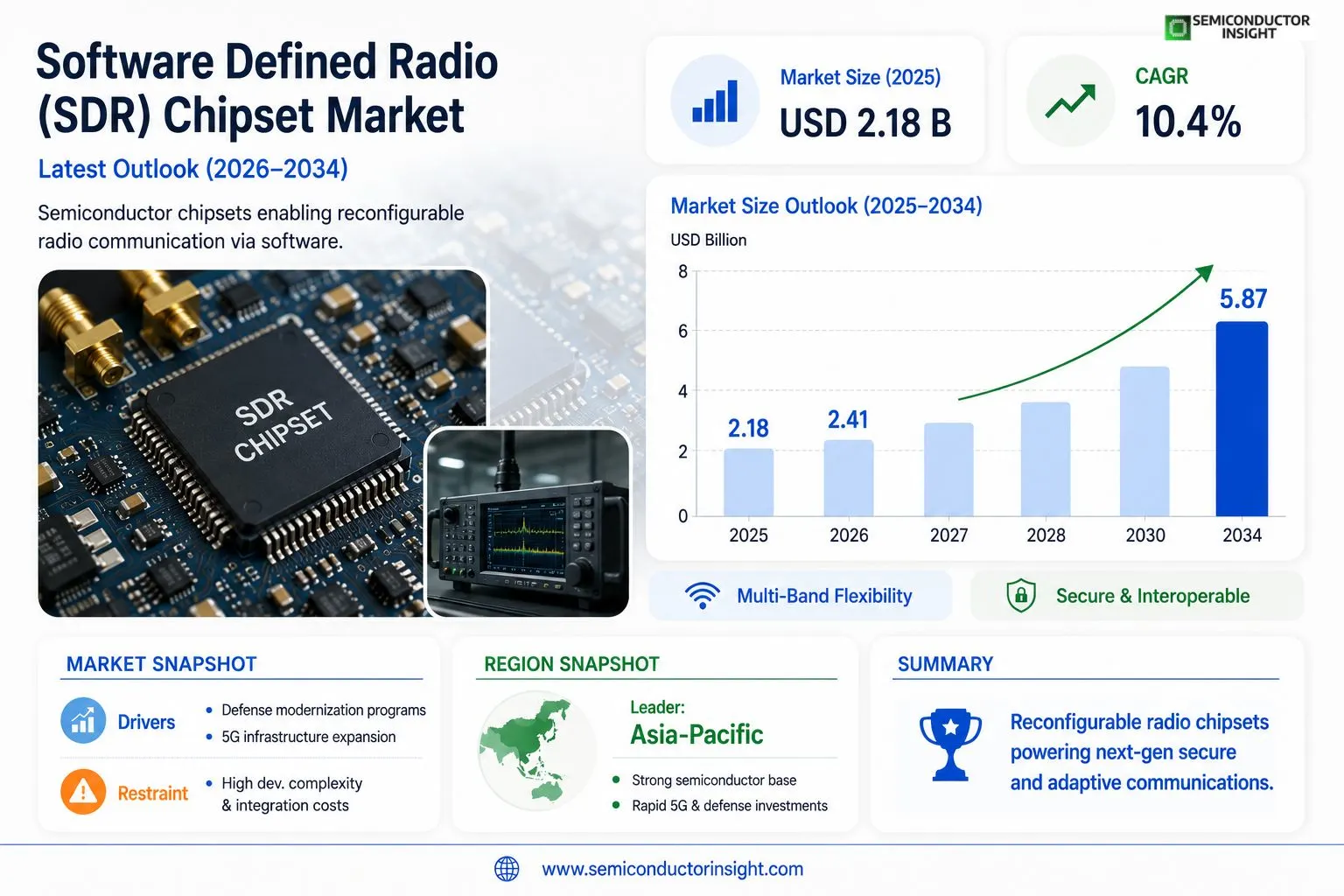
Global Software Defined Radio (SDR) Chipset market size was valued at USD 2.18 billion in 2025. The market is projected to grow from USD 2.41 billion in 2026 to USD 5.87 billion by 2034, exhibiting a CAGR of 10.4% during the forecast period.
Software Defined Radio (SDR) chipsets are semiconductor components that enable radio communication systems to be configured and reconfigured through software rather than hardware modifications. These chipsets facilitate flexible, multi-band, and multi-protocol wireless communication by integrating key functions such as analog-to-digital conversion, digital signal processing, field-programmable logic, and RF front-end management into a unified architecture. The chipset category encompasses field-programmable gate arrays (FPGAs), application-specific integrated circuits (ASICs), digital signal processors (DSPs), and system-on-chip (SoC) solutions designed for wideband frequency operation.
The market is experiencing robust growth driven by rising defense modernization programs, increasing adoption of cognitive radio technologies, and the expanding deployment of 5G infrastructure worldwide. Furthermore, the growing need for interoperable communication systems across military, public safety, and commercial sectors is significantly accelerating SDR chipset demand. Key industry participants such as Analog Devices, Inc., Xilinx (AMD), and Intel Corporation continue to advance chipset capabilities, supporting broader adoption across aerospace, telecommunications, and emergency response applications.
MARKET DRIVERS
Rising Defense and Military Modernization Programs Fueling Demand for SDR Chipsets
Global defense agencies are accelerating investment in next-generation communication infrastructure, positioning the Software Defined Radio (SDR) Chipset Market as a critical pillar of military modernization. Unlike traditional hardware-defined radios, SDR-based systems enable reprogrammable waveforms and multi-band communication capabilities through firmware updates alone, significantly reducing lifecycle costs for defense operators. Nations across North America, Europe, and the Asia-Pacific region are actively replacing legacy radio platforms with SDR-enabled architectures to improve interoperability across joint and coalition forces.
Expansion of 5G Infrastructure and Wireless Communication Ecosystems
Global rollout of 5G networks is creating substantial momentum for the Software Defined Radio (SDR) Chipset Market, as SDR platforms offer the flexibility required to support dynamic spectrum access and multi-protocol communication environments. Telecom operators and network equipment manufacturers are increasingly integrating SDR chipsets into base stations and small cell deployments to handle diverse frequency bands and evolving wireless standards without replacing physical hardware. This architectural adaptability is proving essential as networks simultaneously support legacy 4G LTE, emerging 5G NR, and future 6G research protocols.
➤ The convergence of cognitive radio capabilities with SDR chipset technology is enabling autonomous spectrum sensing and real-time frequency agility, transforming how both civilian and defense communication networks manage increasingly congested radio frequency environments.
Beyond defense and telecommunications, the proliferation of Internet of Things (IoT) devices and connected infrastructure is amplifying demand for flexible, low-power SDR chipset solutions capable of supporting multiple communication standards. Smart grid deployments, connected vehicle ecosystems, and industrial automation platforms increasingly rely on SDR-based radio modules to maintain seamless connectivity across heterogeneous networks, reinforcing the market’s long-term growth trajectory.
MARKET CHALLENGES
High Development Complexity and Design Integration Barriers in SDR Chipset Ecosystems
One of the foremost challenges confronting the Software Defined Radio (SDR) Chipset Market is the significant engineering complexity associated with designing, validating, and deploying SDR-based systems. Developing waveform software that reliably performs across diverse frequency bands and communication protocols demands highly specialized expertise in both digital signal processing and embedded software engineering. Smaller manufacturers and new market entrants often face prohibitive development timelines and validation costs, particularly when targeting regulated frequency bands that require formal certification from agencies such as the FCC or ETSI.
Other Challenges
Spectrum Regulatory Constraints
Navigating spectrum allocation regulations across different national jurisdictions remains a persistent operational burden for SDR chipset vendors and system integrators. While SDR technology inherently supports reconfigurability, transmitting on unauthorized frequencies , even inadvertently , can result in regulatory penalties, limiting the practical flexibility that SDR solutions theoretically offer. Vendors must invest in geofencing capabilities and jurisdiction-specific compliance frameworks, adding engineering overhead and cost to product development cycles.
Cybersecurity Vulnerabilities in Software-Defined Architectures
The software-centric nature of SDR platforms introduces cybersecurity risks that are less prevalent in conventional hardware radio systems. Reprogrammable firmware and open interfaces, while operationally advantageous, can become attack vectors if not rigorously secured. Defense and critical infrastructure operators in the SDR chipset ecosystem are therefore imposing increasingly stringent security certification requirements, including cryptographic authentication of waveform software, which adds both technical and commercial complexity for chipset vendors.
MARKET RESTRAINTS
Power Consumption and Thermal Management Limitations Constraining Portable SDR Deployments
A significant technical restraint for the Software Defined Radio (SDR) Chipset Market is the relatively high power consumption associated with field-programmable gate array (FPGA) and digital signal processor (DSP)-based SDR chipset architectures. Portable and man-portable military radio systems, as well as battery-powered IoT nodes, require radio solutions that balance wideband signal processing performance with stringent power budgets. Current SDR chipset generations frequently struggle to match the power efficiency of purpose-built, hardware-optimized radio solutions, limiting adoption in applications where size, weight, and power (SWaP) constraints are critical design parameters.
High Initial Capital Expenditure and Total Cost of Ownership Deterring Small-Scale Adoption
While the Software Defined Radio (SDR) Chipset ecosystem offers long-term cost advantages through software upgradability, the upfront capital expenditure associated with procuring advanced SDR hardware platforms, development toolchains, and waveform software licenses remains substantially higher than equivalent fixed-function radio solutions. This cost differential acts as a meaningful restraint for smaller government agencies, regional telecom operators, and commercial enterprises operating with constrained procurement budgets. The total cost of ownership calculation, which must account for ongoing software maintenance, security patching, and re-certification cycles, further complicates the business case for cost-sensitive buyers, tempering the pace of market expansion in price-sensitive segments.
MARKET OPPORTUNITIES
Emergence of Cognitive Radio and AI-Integrated SDR Chipset Platforms Opening New Frontiers
The integration of artificial intelligence and machine learning algorithms directly into SDR chipset architectures represents one of the most consequential emerging opportunities within the Software Defined Radio (SDR) Chipset Market. AI-enabled cognitive radio functions , including autonomous interference detection, adaptive modulation, and intelligent spectrum sharing , are transitioning from research prototypes to commercial productization, enabling SDR systems to self-optimize in real time without operator intervention. Chipset vendors that can embed inference acceleration capabilities alongside traditional DSP processing cores are well-positioned to capture premium design wins in both defense and commercial wireless infrastructure segments.
Growing Adoption of SDR Chipsets in Commercial Aviation, Maritime, and Critical Infrastructure Sectors
Beyond defense and telecommunications, significant untapped demand is emerging for Software Defined Radio (SDR) Chipset solutions across commercial aviation communications, maritime vessel tracking, and utility grid management applications. Aviation authorities globally are pursuing modernization of air traffic control communication systems toward SDR-based platforms to consolidate VHF, UHF, and data link functions onto unified reconfigurable hardware. Similarly, the maritime sector’s migration toward integrated bridge communication systems presents a scalable addressable market for multi-band SDR chipsets capable of simultaneously supporting AIS, GMDSS, and broadband satellite connectivity, expanding the total available market well beyond traditional defense-centric demand pools.
Trends
Defense Modernization Programs Driving SDR Chipset Adoption
One of the most prominent trends shaping the Software Defined Radio (SDR) Chipset Market is the accelerating pace of defense modernization initiatives across major economies. Military agencies worldwide are transitioning from legacy hardware-defined radio systems to software-configurable architectures, enabling real-time frequency agility, multi-mission adaptability, and enhanced battlefield interoperability. SDR chipsets, including FPGAs, ASICs, DSPs, and SoC solutions, are increasingly embedded in tactical communication platforms, airborne systems, and naval vessels. This shift is reinforcing the strategic importance of the Software Defined Radio (SDR) Chipset Market as governments prioritize secure, software-upgradeable communication frameworks over costly hardware replacements.
Other Trends
5G Infrastructure Expansion Accelerating Chipset Demand
Global rollout of 5G networks is emerging as a significant growth catalyst within the Software Defined Radio (SDR) Chipset Market. Telecommunications operators are deploying SDR-based base stations that leverage wideband chipset architectures to support multi-band and multi-protocol wireless communication simultaneously. This flexibility reduces infrastructure costs and simplifies network upgrades as standards evolve. Industry leaders such as Analog Devices, Inc., Xilinx (AMD), and Intel Corporation are actively advancing chipset performance to meet the demanding signal processing requirements of 5G deployments, further solidifying SDR chipsets as foundational components across commercial telecommunications infrastructure.
Cognitive Radio Technology Integration
The integration of cognitive radio capabilities into SDR chipset architectures represents a growing trend within the market. Cognitive radio systems leverage advanced digital signal processing and machine learning algorithms to autonomously detect, analyze, and adapt to spectrum conditions in real time. This enables dynamic spectrum access, minimizing interference and maximizing bandwidth efficiency. The Software Defined Radio (SDR) Chipset Market is witnessing increasing investments in SoC and FPGA-based platforms capable of supporting cognitive radio functions, particularly in public safety communications and emergency response networks where reliable, interference-resistant connectivity is operationally critical.
Interoperability Requirements Across Multi-Sector Applications
Interoperability across military, public safety, aerospace, and commercial sectors continues to shape product development priorities within the Software Defined Radio (SDR) Chipset Market. Organizations operating across these verticals increasingly demand chipset solutions capable of seamlessly switching between multiple communication protocols and frequency bands without hardware modification. This requirement is driving chipset manufacturers to prioritize unified, reconfigurable architectures that support wideband frequency operation and cross-platform compatibility. As interoperable communication frameworks become a regulatory and operational standard across sectors, the Software Defined Radio (SDR) Chipset Market is positioned to sustain strong momentum throughout the forecast period.
COMPETITIVE LANDSCAPE
Key Industry Players
Software Defined Radio (SDR) Chipset Market: Competitive Dynamics and Leading Innovators
Global Software Defined Radio (SDR) Chipset market is characterized by a moderately consolidated competitive structure, with a handful of technologically advanced semiconductor and defense electronics companies commanding significant market share. Analog Devices, Inc. (ADI) stands out as a dominant force, offering high-performance RF transceivers and mixed-signal ICs widely integrated into military-grade and commercial SDR platforms. AMD (formerly Xilinx) holds a commanding position in the FPGA segment, with its RFSoC devices increasingly adopted in wideband SDR architectures for both defense modernization and 5G infrastructure deployments. Intel Corporation contributes through its programmable solutions division, delivering FPGAs and DSP-capable SoCs suited for cognitive radio and multi-protocol communication systems. Texas Instruments and Qualcomm Technologies further strengthen the competitive field by providing DSP and SoC solutions that address the growing interoperability requirements across aerospace, public safety, and commercial telecommunications verticals.
Beyond the tier-one leaders, several niche and mid-tier players exert meaningful influence on the SDR chipset landscape. Ettus Research (a National Instruments company) has carved out a strong position in the research and prototyping segment through its USRP hardware platforms. Epiq Solutions and Per Vices Corporation serve specialized defense and government SDR use cases with purpose-built chipset and module solutions. Thales Group and L3Harris Technologies bring deep domain expertise in military communication systems, integrating proprietary SDR chipset designs into tactical radio platforms. Additionally, companies such as Pentek, Inc. and Lime Microsystems offer differentiated FPGA-based and RF transceiver chipset products that cater to both commercial and defense-oriented SDR deployments. The competitive intensity is further amplified by ongoing R&D investments aimed at advancing wideband frequency agility, lower power consumption, and enhanced cybersecurity resilience across SDR chipset architectures.
List of Key Software Defined Radio (SDR) Chipset Companies Profiled
- Analog Devices, Inc.
- AMD (Xilinx)
- Intel Corporation
- Texas Instruments Incorporated
- Qualcomm Technologies, Inc.
- Ettus Research (National Instruments)
- Epiq Solutions
- Per Vices Corporation
- Thales Group
- L3Harris Technologies, Inc.
- Pentek, Inc.
- Lime Microsystems
- Microchip Technology Inc.
- NXP Semiconductors
- Cobham Advanced Electronic Solutions
Segment Analysis:
| Segment Category | Sub-Segments | Key Insights |
| By Type |
|
Field-Programmable Gate Arrays (FPGAs) represent the leading chipset type in the SDR market, owing to their inherent reprogrammability and adaptability across diverse communication protocols and frequency bands.
|
| By Application |
|
Military & Defense Communications remains the dominant application segment, underpinned by intensifying global defense modernization programs and the critical operational need for secure, interoperable, and jam-resistant communication systems.
|
| By End User |
|
Defense & Government Agencies constitute the leading end user segment, driven by sustained and large-scale procurement programs aimed at upgrading national communication infrastructure and ensuring battlefield communication superiority.
|
| By Frequency Band |
|
Very High Frequency (VHF) & Ultra High Frequency (UHF) emerges as the leading frequency band segment, given its widespread use across both defense tactical communications and public safety networks where reliable medium-range signal propagation is essential.
|
| By Platform |
|
Ground-Based Platforms represent the leading platform segment in the SDR chipset market, as the broadest and most diverse deployment base for software-defined radio systems continues to reside in terrestrial communication networks and land-based tactical operations.
|
Regional Analysis: Software Defined Radio (SDR) Chipset Market
North America
North America’s defense establishment remains the single largest consumer of SDR chipset technology in the region. Programs targeting joint interoperability, encrypted battlefield communications, and cognitive radio capabilities are pushing procurement agencies to prioritize highly adaptable chipset architectures. Government-funded research initiatives further strengthen the region’s technical leadership and ensure a sustained pipeline of SDR chipset innovation well into the next decade.
The rapid rollout of next-generation wireless networks across major North American cities is creating compelling demand for SDR chipsets capable of supporting dynamic spectrum access. Public safety agencies, utilities, and logistics operators are embracing software-defined radio architectures to enable seamless, reconfigurable communication without costly hardware overhauls, reinforcing the region’s commercial traction in the Software Defined Radio (SDR) Chipset Market.
North America hosts a dense concentration of fabless semiconductor firms, integrated device manufacturers, and electronic design automation tool providers, all of which collectively accelerate SDR chipset development cycles. This ecosystem advantage reduces time-to-market for new chipset generations and enables rapid prototyping of application-specific SDR solutions, giving regional players a durable competitive edge in Global Software Defined Radio (SDR) Chipset Market landscape.
Progressive spectrum management policies and proactive regulatory frameworks in North America are enabling broader commercial deployment of SDR chipset-based devices. Agencies actively supporting dynamic spectrum sharing and cognitive radio trials are laying the groundwork for market expansion. This regulatory clarity encourages long-term investment commitments from both domestic and international chipset developers targeting the North American market.
Europe
Europe occupies a strategically significant position in Global Software Defined Radio (SDR) Chipset Market, characterized by a balanced interplay of defense modernization, civilian communications advancement, and a strong emphasis on regulatory standardization. Nations such as Germany, France, and the United Kingdom are at the forefront of integrating SDR chipset technologies into their national defense communication networks, driven by NATO interoperability commitments and evolving threat landscapes. The European Union’s focus on digital sovereignty and secure communication infrastructure has further elevated the importance of domestically developed or allied-sourced SDR chipset solutions. The region’s aerospace and satellite communication sectors present additional growth avenues, as software-defined architectures are increasingly favored for their adaptability to evolving frequency bands and protocols. European chipset developers are also leveraging the continent’s strong academic research networks to drive innovation in low-power, high-efficiency SDR chipset designs suitable for IoT and industrial wireless applications. Stringent electromagnetic compatibility standards in Europe ensure that SDR chipset products entering the market maintain rigorous quality benchmarks, adding credibility to European-origin solutions in global procurement processes.
Asia-Pacific
Asia-Pacific is emerging as one of the most dynamic growth regions within the Software Defined Radio (SDR) Chipset Market, propelled by accelerating military modernization programs, large-scale telecommunications infrastructure investments, and a rapidly maturing domestic semiconductor manufacturing base. China is making substantial strides in developing indigenous SDR chipset capabilities aligned with its broader ambitions for communication technology self-reliance, while countries such as India, South Korea, Japan, and Australia are increasing defense communication budgets that explicitly prioritize software-defined radio solutions. The region’s commercial sector is equally active, with telecom operators embracing SDR chipset platforms to support multi-standard network deployments across densely populated urban corridors. Additionally, Asia-Pacific governments are investing in border surveillance, maritime domain awareness, and disaster response communication systems , all of which benefit significantly from the flexible, reconfigurable nature of SDR chipset technology. The expanding electronics manufacturing ecosystem across the region further supports cost-competitive chipset production, making Asia-Pacific a compelling hub for both supply and demand in Global SDR chipset landscape through 2034.
South America
South America represents a steadily developing market within Global Software Defined Radio (SDR) Chipset Market, with growth opportunities anchored primarily in public safety communications, border security, and gradual military modernization across key economies including Brazil, Colombia, and Argentina. Governments in the region are increasingly recognizing the operational advantages of SDR chipset-enabled communication systems, particularly for managing vast and geographically diverse territories where adaptable, multi-frequency radio capabilities offer distinct advantages over rigid legacy systems. Brazil’s defense sector, in particular, has shown consistent interest in adopting advanced communication technologies as part of broader armed forces modernization efforts. Commercial adoption, while still in earlier stages compared to North America or Europe, is gaining momentum as regional telecom operators explore software-defined architectures for rural connectivity expansion. Infrastructure investment programs supported by international development institutions are also beginning to introduce SDR chipset solutions into emergency management and disaster response communication frameworks, gradually building a foundation for broader market penetration in the coming years.
Middle East & Africa
The Middle East and Africa region presents a distinctive growth profile in the Software Defined Radio (SDR) Chipset Market, shaped by elevated defense procurement activity in Gulf Cooperation Council nations, growing investments in national communication infrastructure, and rising demand for interoperable public safety radio systems. Countries such as Saudi Arabia, the United Arab Emirates, and Israel are among the most active adopters of advanced SDR chipset solutions in the region, driven by defense modernization strategies, counter-terrorism communication requirements, and smart city development initiatives. The African continent, while at an earlier stage of SDR chipset adoption, is beginning to explore software-defined radio architectures for remote connectivity, wildlife surveillance, and humanitarian communication applications, particularly in regions where traditional communication infrastructure remains underdeveloped. The Middle East’s willingness to invest in cutting-edge defense and security communication technologies, combined with increasing private sector interest in flexible wireless network solutions, positions the region as a meaningful contributor to Global Software Defined Radio (SDR) Chipset Market trajectory through the 2026–2034 forecast period.
Report Scope
This market research report provides a comprehensive analysis of the Software Defined Radio (SDR) Chipset Market , covering the forecast period 2026–2034. It offers detailed insights into market dynamics, technological advancements, competitive landscape, and key trends shaping the industry.
Key focus areas of the report include:
- Market Overview: The report begins with an overview outlining its current market scenario, key growth indicators, and industry transformation drivers. It discusses macroeconomic factors, demand–supply balance, regulatory landscape, and the strategic role of semiconductors in powering advancements across industries such as automotive, telecommunications, consumer electronics, and industrial automation.
- Market Size & Forecast: Historical data and future projections for revenue, unit shipments, and market value across major regions and segments.
- Segmentation Analysis: Detailed breakdown by product type, technology, application, and end-user industry to identify high-growth segments and investment opportunities.
- Regional Insights: Insights into market performance across North America, Europe, Asia-Pacific, Latin America, and the Middle East & Africa, including country-level analysis where relevant.
- Competitive Landscape: Profiles of leading market participants, including their product offerings, R&D focus, manufacturing capacity, pricing strategies, and recent developments such as mergers, acquisitions, and partnerships.
- Technology Trends & Innovation: Assessment of emerging technologies, integration of AI/IoT, semiconductor design trends, fabrication techniques, and evolving industry standards.
- Market Drivers & Restraints: Evaluation of factors driving market growth along with challenges, supply chain constraints, regulatory issues, and market-entry barriers.
- Stakeholder Insights: Insights for component suppliers, OEMs, system integrators, investors, and policymakers regarding the evolving ecosystem and strategic opportunities.
Primary and secondary research methods are employed, including interviews with industry experts, data from verified sources, and real-time market intelligence to ensure the accuracy and reliability of the insights presented.
FREQUENTLY ASKED QUESTIONS:
What is the current market size of Software Defined Radio (SDR) Chipset Market?
-> Global Software Defined Radio (SDR) Chipset Market was valued at USD 2.18 billion in 2025 and is expected to reach USD 5.87 billion by 2034, growing at a CAGR of 10.4% during the forecast period 2026–2034.
Which key companies operate in Software Defined Radio (SDR) Chipset Market?
-> Key players include Analog Devices, Inc., Xilinx (AMD), and Intel Corporation, among others, who continue to advance chipset capabilities supporting broader adoption across aerospace, telecommunications, and emergency response applications.
What are the key growth drivers?
-> Key growth drivers include rising defense modernization programs, increasing adoption of cognitive radio technologies, and the expanding deployment of 5G infrastructure worldwide. Additionally, the growing need for interoperable communication systems across military, public safety, and commercial sectors is significantly accelerating SDR chipset demand.
Which region dominates the market?
-> Asia-Pacific is among the fastest-growing regions driven by rapid 5G deployment and defense investments, while North America remains a dominant market owing to robust defense modernization programs and strong presence of leading chipset manufacturers.
What are the emerging trends?
-> Emerging trends include cognitive radio technologies, multi-band and multi-protocol wireless communication, integration of FPGAs, ASICs, DSPs, and SoC solutions for wideband frequency operation, along with the increasing convergence of SDR chipsets with 5G infrastructure and AI-driven signal processing capabilities.

Get Sample Report PDF for Exclusive Insights
Report Sample Includes
- Table of Contents
- List of Tables & Figures
- Charts, Research Methodology, and more...
 Download Sample Report PDF