Radar Transceiver (FMCW) MMIC Market Insights
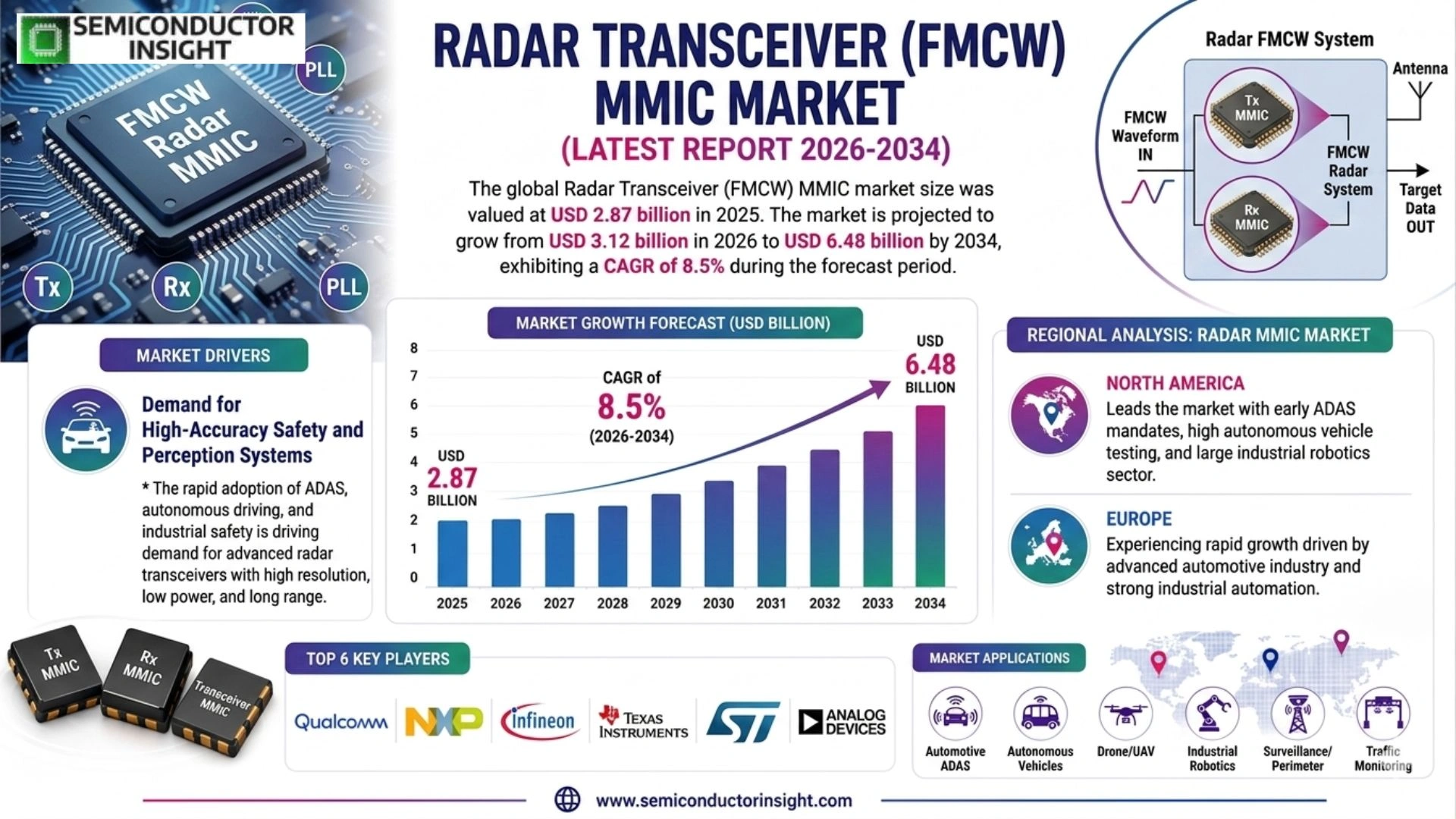
Global Radar Transceiver (FMCW) MMIC Market size was valued at USD 2.87 billion in 2025. The market is projected to grow from USD 3.12 billion in 2026 to USD 6.48 billion by 2034, exhibiting a CAGR of 8.5% during the forecast period.
Radar Transceiver Frequency-Modulated Continuous Wave (FMCW) Monolithic Microwave Integrated Circuits (MMICs) are highly integrated semiconductor devices that combine transmit and receive functions within a single chip, enabling precise distance, velocity, and angle measurements. These components operate across frequency bands including 24 GHz, 77 GHz, and 79 GHz, and are widely deployed across automotive advanced driver-assistance systems (ADAS), industrial sensing, aerospace and defense, and smart infrastructure applications.
The market is witnessing robust expansion driven by the accelerating adoption of autonomous and semi-autonomous vehicles, rising defense modernization programs, and growing investments in industrial automation. Furthermore, the proliferation of 77 GHz radar platforms in next-generation ADAS solutions has significantly broadened the addressable market. Key industry participants such as Infineon Technologies AG, Texas Instruments Incorporated, NXP Semiconductors N.V., Analog Devices, Inc., and STMicroelectronics N.V. continue to advance FMCW MMIC portfolios, reinforcing competitive momentum across the global landscape.
MARKET DRIVERS
Rising Adoption of ADAS and Autonomous Vehicle Technologies Fueling Demand
Radar Transceiver (FMCW) MMIC Market is experiencing robust growth, driven significantly by the rapid proliferation of Advanced Driver Assistance Systems (ADAS) across the global automotive sector. Frequency Modulated Continuous Wave (FMCW) radar transceivers, implemented as Monolithic Microwave Integrated Circuits (MMICs), offer precise range, velocity, and angular resolution capabilities that are essential for applications such as adaptive cruise control, automatic emergency braking, and blind-spot detection. As automakers accelerate their transition toward higher levels of vehicle autonomy, the integration of 77 GHz and 79 GHz FMCW MMIC radar modules has become a standard design requirement in modern vehicle platforms.
Expanding Defense and Aerospace Applications Accelerating Market Penetration
Defense modernization programs across North America, Europe, and Asia-Pacific are serving as a substantial driver for Radar Transceiver (FMCW) MMIC Market. Military applications including airborne surveillance, drone detection, perimeter security, and missile guidance systems increasingly rely on compact, high-frequency FMCW MMIC radar transceivers due to their superior performance in cluttered electromagnetic environments. Governments in the United States, Germany, India, and South Korea have substantially increased defense procurement budgets, stimulating demand for next-generation radar subsystems that incorporate advanced MMIC technology. The miniaturization enabled by MMIC architecture allows these systems to be deployed in size-constrained platforms such as unmanned aerial vehicles (UAVs) and man-portable sensing equipment.
➤ The convergence of automotive safety mandates, defense modernization, and industrial automation is positioning FMCW MMIC radar transceivers as a foundational sensing technology across multiple high-growth end-use verticals, establishing a durable and multi-cycle demand trajectory for market participants.
Industrial automation and smart infrastructure are also emerging as significant demand drivers withRadar Transceiver (FMCW) MMIC Market. Applications such as level sensing in process industries, occupancy detection in smart buildings, gesture recognition in human-machine interfaces, and robotic proximity sensing are increasingly adopting FMCW MMIC-based radar modules due to their ability to operate reliably in harsh environmental conditions where optical and ultrasonic sensors face limitations. The scalability of MMIC fabrication processes, particularly in silicon germanium (SiGe) and complementary metal-oxide-semiconductor (CMOS) technologies, is enabling cost-effective mass production that further supports broad industrial adoption.
MARKET CHALLENGES
High Design Complexity and Integration Challenges Constraining Faster Market Adoption
Despite strong demand fundamentals, Radar Transceiver (FMCW) MMIC Market faces meaningful challenges related to the technical complexity inherent in designing and integrating high-frequency MMIC components. Operating at millimeter-wave frequencies between 24 GHz and 79 GHz, FMCW MMIC transceivers require sophisticated antenna design, precise impedance matching, and robust signal processing algorithms to deliver reliable performance. System integrators, particularly in emerging markets and among smaller Tier 2 automotive suppliers, often lack the specialized RF engineering expertise required to effectively incorporate these components into end products. This skill gap can prolong development timelines and increase non-recurring engineering costs, slowing the pace of new product introductions.
Other Challenges
Supply Chain Vulnerabilities and Semiconductor Fab Capacity Constraints
Radar Transceiver (FMCW) MMIC Market remains exposed to supply chain disruptions affecting the broader semiconductor industry. FMCW MMIC components are predominantly fabricated in specialized compound semiconductor fabs utilizing SiGe BiCMOS or III-V process nodes, which represent a relatively limited subset of global semiconductor manufacturing capacity. Geopolitical tensions, export control regulations, and fab capacity constraints can introduce lead time volatility and pricing pressure that challenge procurement planning for radar system OEMs and their customers across automotive, defense, and industrial segments.
Intense Price Competition and Margin Pressure Among Component Suppliers
As Radar Transceiver (FMCW) MMIC Market matures in the automotive segment, intensifying competition among established suppliers and new entrants is compressing average selling prices. Automotive OEMs exert significant downward pricing pressure through competitive tendering processes, requiring MMIC suppliers to continuously invest in process optimization and design efficiency to protect margins while meeting stringent automotive-grade qualification standards such as AEC-Q100. Balancing cost reduction imperatives with the ongoing R&D investment necessary to deliver next-generation radar performance represents a persistent operational challenge for market participants.
MARKET RESTRAINTS
Stringent Regulatory and Spectrum Allocation Frameworks Limiting Deployment Flexibility
Regulatory constraints related to spectrum allocation and electromagnetic compatibility represent a notable restraint on Radar Transceiver (FMCW) MMIC Market. The use of radar frequency bands, particularly around 24 GHz, 60 GHz, 77 GHz, and 79 GHz, is subject to national and regional regulatory frameworks administered by bodies such as the Federal Communications Commission (FCC) in the United States and the European Telecommunications Standards Institute (ETSI) in Europe. Variations in permitted power levels, frequency allocations, and antenna gain restrictions across different jurisdictions can complicate global product certification strategies, increasing compliance costs and potentially restricting the deployment of certain FMCW radar configurations in specific geographic markets.
Elevated Capital Requirements for Advanced MMIC Process Node Development
The capital-intensive nature of advanced millimeter-wave MMIC process development acts as a structural restraint withRadar Transceiver (FMCW) MMIC Market. Achieving competitive performance at 77 GHz and beyond requires access to advanced SiGe BiCMOS or GaAs process nodes with transistor transition frequencies well above 200 GHz. Establishing or maintaining such fabrication capabilities demands sustained capital investment in both process development and specialized test and characterization equipment. This creates a significant barrier to entry that limits competition to a relatively small number of vertically integrated semiconductor companies and fabless design firms with access to advanced foundry partnerships, potentially constraining overall market supply flexibility during periods of elevated demand.
Cybersecurity and Interference Concerns in Dense Radar Deployment Scenarios
As FMCW radar transceivers become more pervasive across automotive and infrastructure applications, concerns regarding radar interference in dense deployment environments and the cybersecurity integrity of radar-based sensing systems are emerging as market restraints. In urban environments with high concentrations of vehicles equipped with 77 GHz radar systems, inter-vehicle radar interference can degrade sensor performance and create reliability concerns that may prompt regulatory scrutiny or require additional mitigation measures. Furthermore, as radar data becomes increasingly integrated into safety-critical decision-making pipelines, ensuring the resilience of these systems against electronic countermeasures and spoofing attacks adds engineering complexity and cost that can temper adoption rates in cost-sensitive application segments within the broader Radar Transceiver (FMCW) MMIC Market.
MARKET OPPORTUNITIES
4D Imaging Radar Development Creating High-Value Growth Opportunities
The emergence of 4D imaging radar technology represents one of the most compelling near-term opportunities withRadar Transceiver (FMCW) MMIC Market. Unlike conventional three-dimensional radar systems, 4D imaging radar adds high-resolution elevation measurement to range, velocity, and azimuth data, enabling point-cloud-like environmental representations that approach the fidelity of LiDAR systems at significantly lower cost and with superior all-weather performance. Achieving 4D imaging capability requires dense MMIC transceiver arrays with tight phase coherence and high channel counts, driving demand for advanced FMCW MMIC solutions with integrated digital beamforming capabilities. Multiple automotive OEMs and Tier 1 suppliers have publicly committed to incorporating 4D imaging radar into next-generation ADAS platforms, creating a well-defined and growing demand pipeline for advanced MMIC transceiver components.
Smart City Infrastructure and Traffic Management Applications Unlocking New End Markets
Investments in smart city infrastructure across developed and developing economies are opening a substantial new addressable market for Radar Transceiver (FMCW) MMIC Market. Roadside units for vehicle speed monitoring, pedestrian detection at intersections, traffic flow analytics, and tunnel safety systems are increasingly adopting FMCW radar sensing due to its ability to operate continuously without illumination requirements, maintain performance in adverse weather, and provide accurate velocity data. Municipal governments and transportation authorities in Europe, North America, and East Asia have deployed or announced large-scale smart infrastructure programs that create durable, multi-year procurement opportunities for radar sensor manufacturers and their MMIC component suppliers.
Healthcare and Vital Sign Monitoring Applications Emerging as a Nascent Growth Vector
Non-contact vital sign monitoring using FMCW radar technology represents an emerging and largely untapped opportunity withRadar Transceiver (FMCW) MMIC Market. Research and early commercial deployments have demonstrated that FMCW radar operating at 60 GHz and 77 GHz can accurately detect respiration rate, heart rate, and body movement through clothing and at distances of several meters, without requiring physical contact or wearable devices. Applications in hospital patient monitoring, elderly care, sleep disorder diagnostics, and in-cabin automotive vital sign sensing for driver drowsiness detection are attracting growing investment from medical device companies and automotive safety technology providers. As clinical validation and regulatory pathways for radar-based health monitoring mature, this segment is expected to contribute meaningful incremental demand to the broader FMCW MMIC radar transceiver ecosystem.
Trends
Rising Adoption of 77 GHz FMCW MMICs in Automotive ADAS Platforms
One of the most defining trends Radar Transceiver (FMCW) MMIC Market is the accelerating integration of 77 GHz FMCW MMIC technology within automotive advanced driver-assistance systems (ADAS). As automakers worldwide intensify their push toward semi-autonomous and fully autonomous vehicles, radar-based sensing has become a foundational technology for functions such as adaptive cruise control, automatic emergency braking, blind-spot detection, and lane-change assistance. The 77 GHz frequency band has emerged as the preferred standard due to its superior range resolution, compact antenna size, and ability to accurately measure distance, velocity, and angle simultaneously. Leading semiconductor manufacturers including Infineon Technologies AG, NXP Semiconductors N.V., and Texas Instruments Incorporated have significantly expanded their 77 GHz FMCW MMIC portfolios to address this growing automotive demand. Regulatory mandates in major markets requiring the inclusion of collision avoidance and pedestrian detection features in new vehicles have further reinforced this trend, ensuring sustained momentum for FMCW MMIC adoption across passenger and commercial vehicle segments.
Other Trends
Defense Modernization Programs Driving Demand for High-Performance FMCW MMICs
Increased defense spending and modernization initiatives across North America, Europe, and Asia-Pacific are creating substantial demand withRadar Transceiver (FMCW) MMIC Market. Defense agencies are actively upgrading radar systems used in surveillance, target acquisition, missile guidance, and border security applications. FMCW MMICs offer the high integration density, reliability, and multi-function capability required for next-generation airborne, ground-based, and naval radar platforms. Companies such as Analog Devices, Inc. and STMicroelectronics N.V. have been actively developing radiation-hardened and wide-temperature-range FMCW MMIC solutions tailored to meet stringent defense specifications, positioning themselves as critical suppliers to defense prime contractors globally.
Industrial Automation and Smart Infrastructure Expanding the Addressable Market
Beyond automotive and defense, Radar Transceiver (FMCW) MMIC Market is witnessing growing traction in industrial automation and smart infrastructure applications. FMCW radar sensors operating at 24 GHz and 79 GHz frequency bands are increasingly deployed for level measurement in tanks and silos, conveyor monitoring, people counting in smart buildings, and traffic flow management in intelligent transportation systems. The non-contact, all-weather sensing capability of FMCW MMICs makes them particularly suited for harsh industrial environments where optical or ultrasonic sensors face performance limitations. This diversification of end-use applications is broadening the market’s customer base and reducing dependency on a single vertical.
Semiconductor Integration Advances Reinforcing Competitive Intensity
Continuous advances in semiconductor process technologies, including SiGe BiCMOS and advanced CMOS nodes, are enabling FMCW MMIC vendors to deliver higher levels of integration, lower power consumption, and improved signal processing performance within a single chip. This ongoing miniaturization trend is lowering system-level costs and simplifying radar module design, which in turn accelerates adoption across cost-sensitive applications in both consumer and industrial segments. Key participants Radar Transceiver (FMCW) MMIC Market continue to invest in research and development to maintain differentiation, as the competitive landscape intensifies with both established players and emerging fabless semiconductor firms vying for design wins across automotive, defense, and industrial radar programs.
COMPETITIVE LANDSCAPE
Key Industry Players
Radar Transceiver (FMCW) MMIC Market: Competitive Dynamics and Leading Participants
Global Radar Transceiver (FMCW) MMIC Market is characterized by a moderately consolidated competitive structure, with a handful of established semiconductor giants commanding significant revenue shares. Infineon Technologies AG stands out as a dominant force, leveraging its comprehensive portfolio of 77 GHz and 79 GHz FMCW radar ICs tailored for automotive ADAS, industrial sensing, and safety applications. Texas Instruments Incorporated and NXP Semiconductors N.V. closely follow, each offering highly integrated radar transceiver chipsets that address the surging demand for next-generation autonomous vehicle platforms and smart infrastructure solutions. Analog Devices, Inc. and STMicroelectronics N.V. further reinforce the competitive intensity by delivering advanced FMCW MMIC solutions optimized for both high-resolution imaging radar and long-range detection, cementing their positions across automotive, aerospace, and defense verticals. The collective R&D investments of these leading players continue to accelerate silicon and silicon-germanium (SiGe) process innovations, driving performance improvements in range resolution, power efficiency, and system integration at the chip level.
Beyond the market leaders, a growing number of specialized and emerging players are carving out meaningful niches within the Radar Transceiver (FMCW) MMIC landscape. Companies such as Mediatek Inc. and Renesas Electronics Corporation have expanded their radar IC portfolios to address cost-sensitive automotive and consumer IoT segments, while IMEC and Calterah Semiconductor are gaining traction with innovative CMOS-based FMCW radar solutions targeting industrial automation and smart building applications. Aerospace and defense-focused players, including Qorvo, Inc. and MACOM Technology Solutions, continue to supply high-performance GaAs and GaN-based FMCW MMICs for military-grade radar systems, unmanned aerial vehicles, and electronic warfare platforms. Additionally, Smartmicro, Silicon Radar GmbH, Arbe Robotics, and Uhnder Inc. represent a new wave of radar-specialized firms delivering differentiated 4D imaging radar and digital radar architectures, intensifying competition and broadening the technological frontier across the global FMCW MMIC ecosystem.
List of Key Radar Transceiver (FMCW) MMIC Companies Profiled
- Infineon Technologies AG
- Texas Instruments Incorporated
- NXP Semiconductors N.V.
- Analog Devices, Inc.
- STMicroelectronics N.V.
- Renesas Electronics Corporation
- Qorvo, Inc.
- MACOM Technology Solutions Holdings, Inc.
- Mediatek Inc.
- Silicon Radar GmbH
- Calterah Semiconductor
- Smartmicro
- Arbe Robotics
- Uhnder Inc.
- IMEC
Segment Analysis:
| Segment Category | Sub-Segments | Key Insights |
| By Type |
|
77 GHz FMCW MMIC is the leading segment, commanding widespread adoption across the radar transceiver landscape due to its superior resolution and long-range detection capabilities.
|
| By Application |
|
Advanced Driver Assistance Systems (ADAS) represents the dominant application segment, propelled by the global momentum toward autonomous and semi-autonomous vehicle development.
|
| By End User |
|
Automotive OEMs and Tier-1 Suppliers constitute the foremost end-user category within the Radar Transceiver FMCW MMIC market, underpinned by the automotive industry’s accelerating electrification and autonomous mobility roadmaps.
|
| By Technology Platform |
|
Silicon Germanium (SiGe) BiCMOS technology platform leads the Radar Transceiver FMCW MMIC market, offering an optimal balance between high-frequency performance, integration density, and cost efficiency.
|
| By Integration Level |
|
Single-Chip Integrated FMCW Transceiver is the dominant and fastest-evolving segment by integration level, reflecting the broader industry imperative toward miniaturization, cost reduction, and system simplification.
|
Regional Analysis: Radar Transceiver (FMCW) MMIC Market
North America
North America’s defense sector remains the most significant end-use driver for FMCW MMIC technology. Continuous modernization programs targeting airborne early warning systems, precision-guided munitions, and battlefield surveillance platforms are fueling consistent procurement of high-performance radar transceiver MMICs. Long-term defense budgets allocate considerable resources toward radar hardware upgrades, ensuring sustained commercial momentum for FMCW MMIC manufacturers operating in the region.
The North American automotive industry is undergoing a profound transformation toward vehicle intelligence, with FMCW radar transceivers embedded across ADAS platforms for functions such as adaptive cruise control, blind-spot detection, and collision avoidance. Major original equipment manufacturers headquartered in the United States and Canada are standardizing radar-based sensing, creating a high-volume commercial avenue for FMCW MMIC chipset suppliers operating in this region.
North America hosts several of the world’s most advanced gallium arsenide and gallium nitride foundry operations, which are critical for producing high-frequency FMCW MMIC components. Academic research institutions and government-funded R&D programs are accelerating breakthroughs in chip integration density, power efficiency, and thermal management , all vital performance parameters for next-generation radar transceiver applications across both commercial and defense domains.
Regulatory bodies in North America, including the FCC, have established clear millimeter-wave spectrum allocation frameworks that facilitate commercial deployment of FMCW radar systems in automotive and industrial settings. This regulatory clarity reduces market entry uncertainty for MMIC developers and system integrators, encouraging greater investment in radar transceiver product development and accelerating time-to-market for new FMCW-based solutions across multiple verticals.
Europe
Europe represents a highly mature and strategically significant region withRadar Transceiver (FMCW) MMIC Market, underpinned by the continent’s formidable automotive heritage, sophisticated defense procurement frameworks, and active participation in collaborative research initiatives. Germany, France, and the United Kingdom collectively anchor European demand, with leading automotive OEMs and Tier-1 suppliers driving extensive adoption of FMCW radar transceivers for next-generation vehicle safety architectures. European defense programs, including those coordinated through NATO and the European Defence Agency, are stimulating investment in advanced radar systems that utilize FMCW MMIC technology for surveillance and threat detection. The continent’s strong emphasis on industrial automation and smart infrastructure further broadens the addressable market for FMCW radar solutions. Stringent vehicle safety regulations mandated by Euro NCAP standards are compelling automakers to embed radar-based sensing as standard equipment, creating durable long-term demand for FMCW MMIC chipsets manufactured by both European and global semiconductor suppliers serving this market.
Asia-Pacific
Asia-Pacific is emerging as the fastest-evolving region Radar Transceiver (FMCW) MMIC Market, propelled by rapid industrialization, escalating defense modernization programs, and the explosive growth of the regional automotive sector. China, Japan, South Korea, and India are at the forefront of this expansion, each investing heavily in domestic radar technology capabilities to reduce reliance on foreign MMIC suppliers. China’s ambitious military modernization agenda and its growing domestic electric vehicle industry are generating parallel streams of demand for advanced FMCW radar transceivers. Japan and South Korea contribute through their world-class semiconductor manufacturing capabilities and close integration with global automotive supply chains. India’s rising defense budget and its ambitions under indigenous defense production initiatives are further amplifying regional demand. The Asia-Pacific Radar Transceiver (FMCW) MMIC Market is expected to sustain strong momentum through 2034 as governments and private enterprises alike accelerate investments in radar-enabled sensing and communication infrastructure.
South America
South America occupies a developing but gradually expanding position in Global Radar Transceiver (FMCW) MMIC Market. Brazil leads regional demand, supported by its comparatively advanced defense industrial base and growing commercial automotive sector. Investments in border surveillance, maritime patrol, and airspace monitoring are creating selective but meaningful procurement opportunities for FMCW radar systems that rely on high-performance MMIC components. The region’s automotive market, while smaller in volume relative to North America and Europe, is increasingly incorporating ADAS features as international vehicle safety standards gain traction among regulators and consumers. Economic volatility and import dependency for advanced semiconductor components remain structural challenges that temper near-term growth. Nevertheless, as infrastructure investment increases and regional governments prioritize technological modernization, South America is expected to gradually deepen its engagement with Radar Transceiver (FMCW) MMIC Market over the forecast horizon.
Middle East & Africa
The Middle East and Africa region presents a strategically important, defense-oriented demand base for Radar Transceiver (FMCW) MMIC Market. Gulf Cooperation Council nations, particularly Saudi Arabia and the United Arab Emirates, are substantially increasing defense procurement budgets and investing in advanced surveillance, border security, and air defense capabilities that incorporate sophisticated FMCW radar systems. These nations are also emerging as attractive destinations for radar technology partnerships and technology transfer agreements, which could catalyze regional MMIC ecosystem development over time. Africa’s contribution to the market remains nascent, though select nations are beginning to invest in radar-based infrastructure for aviation, maritime, and security applications. The region’s overall market trajectory for Radar Transceiver (FMCW) MMIC technology is shaped primarily by geopolitical dynamics, defense modernization priorities, and the gradual development of commercial technology adoption frameworks across both the Middle East and African sub-regions through 2034.
Report Scope
This market research report provides a comprehensive analysis of the Radar Transceiver (FMCW) MMIC Market , covering the forecast period 2026–2034. It offers detailed insights into market dynamics, technological advancements, competitive landscape, and key trends shaping the industry.
Key focus areas of the report include:
- Market Overview: The report begins with an overview outlining its current market scenario, key growth indicators, and industry transformation drivers. It discusses macroeconomic factors, demand–supply balance, regulatory landscape, and the strategic role of semiconductors in powering advancements across industries such as automotive, telecommunications, consumer electronics, and industrial automation.
- Market Size & Forecast: Historical data and future projections for revenue, unit shipments, and market value across major regions and segments.
- Segmentation Analysis: Detailed breakdown by product type, technology, application, and end-user industry to identify high-growth segments and investment opportunities.
- Regional Insights: Insights into market performance across North America, Europe, Asia-Pacific, Latin America, and the Middle East & Africa, including country-level analysis where relevant.
- Competitive Landscape: Profiles of leading market participants, including their product offerings, R&D focus, manufacturing capacity, pricing strategies, and recent developments such as mergers, acquisitions, and partnerships.
- Technology Trends & Innovation: Assessment of emerging technologies, integration of AI/IoT, semiconductor design trends, fabrication techniques, and evolving industry standards.
- Market Drivers & Restraints: Evaluation of factors driving market growth along with challenges, supply chain constraints, regulatory issues, and market-entry barriers.
- Stakeholder Insights: Insights for component suppliers, OEMs, system integrators, investors, and policymakers regarding the evolving ecosystem and strategic opportunities.
Primary and secondary research methods are employed, including interviews with industry experts, data from verified sources, and real-time market intelligence to ensure the accuracy and reliability of the insights presented.
FREQUENTLY ASKED QUESTIONS:
What is the current market size of Radar Transceiver (FMCW) MMIC Market?
-> Radar Transceiver (FMCW) MMIC Market was valued at USD 2.87 billion in 2025 and is expected to reach USD 6.48 billion by 2034, growing at a CAGR of 8.5% during the forecast period from 2026 to 2034.
Which key companies operate Radar Transceiver (FMCW) MMIC Market?
-> Key players include Infineon Technologies AG, Texas Instruments Incorporated, NXP Semiconductors N.V., Analog Devices, Inc., and STMicroelectronics N.V., among others.
What are the key growth drivers?
-> Key growth drivers include accelerating adoption of autonomous and semi-autonomous vehicles, rising defense modernization programs, growing investments in industrial automation, and the proliferation of 77 GHz radar platforms in next-generation ADAS solutions.
Which region dominates the market?
-> Asia-Pacific is the fastest-growing region, driven by rapid automotive production growth and industrial automation investments, while North America and Europe remain dominant markets due to strong ADAS adoption and defense spending.
What are the emerging trends?
-> Emerging trends include integration of FMCW MMIC technology in 77 GHz and 79 GHz radar platforms, expansion of autonomous vehicle ecosystems, adoption of smart infrastructure applications, and increasing use of radar sensing in industrial automation and aerospace and defense sectors.

Get Sample Report PDF for Exclusive Insights
Report Sample Includes
- Table of Contents
- List of Tables & Figures
- Charts, Research Methodology, and more...
 Download Sample Report PDF