Projector Chip Market Insights
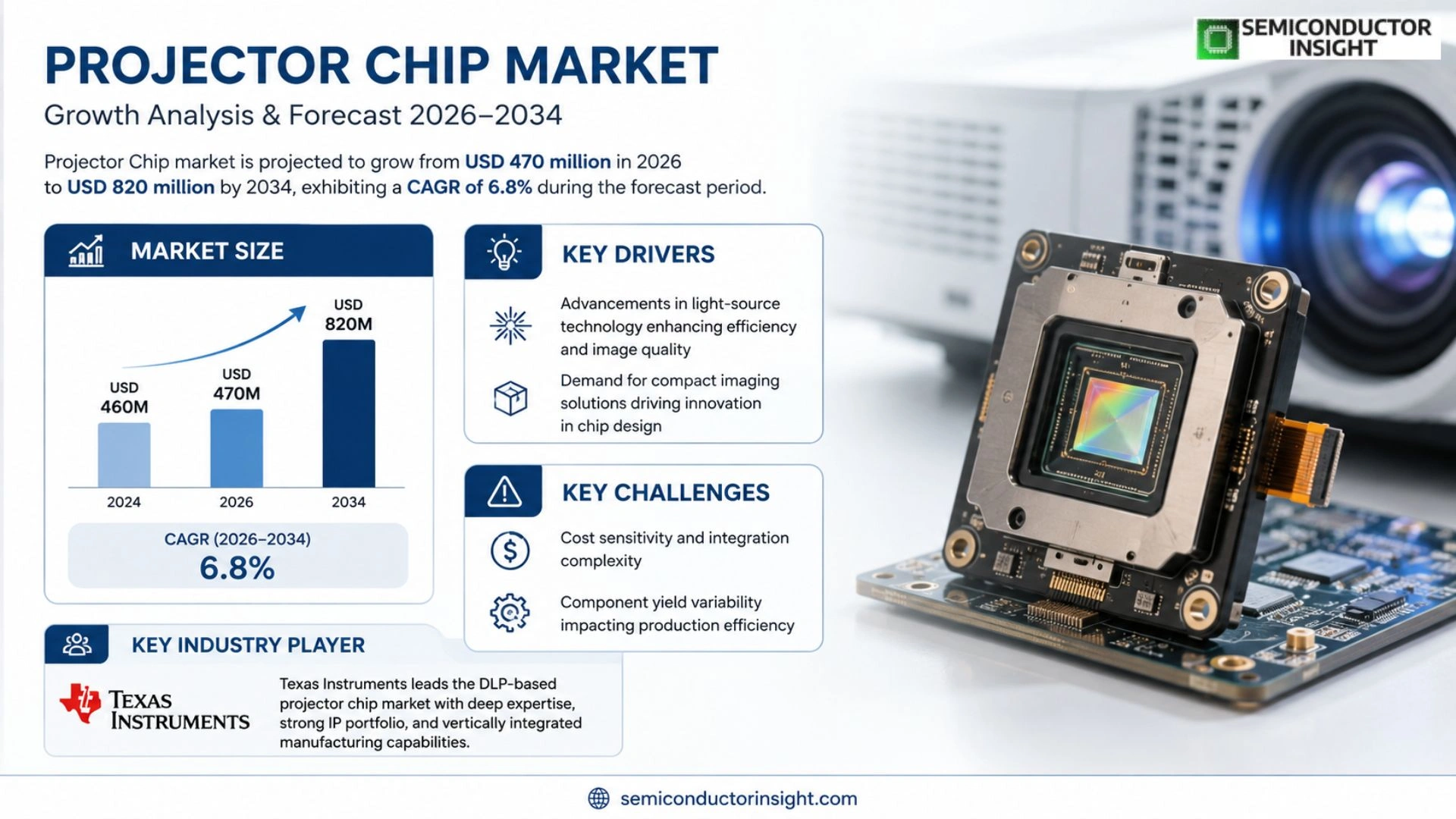
Global Projector Chip market size was valued at USD 460 million in 2024. The market is projected to grow from USD 470 million in 2026 to USD 820 million by 2034, exhibiting a CAGR of 6.8% during the forecast period.
Projector chips are micro‑electronic light‑valve components that modulate illumination within projection systems. The technology splits into three principal routes,Digital Light Processing (DLP), three‑LCD (3LCD), and Liquid Crystal on Silicon (LCoS),each serving distinct segments such as consumer‑grade household projectors and high‑performance commercial projectors.
The upward trajectory of the sector stems from several converging forces: expanding demand for ultra‑high‑definition visual experiences, broader adoption of IoT‑enabled smart classrooms and conference rooms, and continuous improvements in chip efficiency that lower power consumption while boosting brightness. Recent product announcements from leading manufacturers,including TI’s next‑generation DLP engine and Epson’s enhanced LCoS module,illustrate how innovation is translating into higher image fidelity and longer device lifespans, thereby reinforcing market expansion.
MARKET DRIVERS
Advancements in Light‑Source Technology
The transition from traditional lamps to laser‑diode and LED sources has sharpened image uniformity while cutting power consumption. Manufacturers that integrate these sources into their projector chips report faster time‑to‑market, because fewer thermal‑management components are required. This engineering shift fuels a broader adoption of high‑resolution projection across education, corporate, and entertainment venues, reinforcing the overall health of Projector Chip market.
Demand for Compact Imaging Solutions
Clients increasingly seek projectors that fit on a desk or can be mounted discreetly in conference rooms. Shrinking the chip footprint while preserving brightness levels forces silicon‑photonic innovators to adopt advanced wafer‑scale integration techniques. The resulting form‑factor advantage unlocks new revenue streams for OEMs that can deliver portable, battery‑operated devices, thereby lifting the volume of chip shipments.
➤ Analysts note that each 10% reduction in chip size translates into roughly a 7% uplift in device margin for mid‑range projection systems.
Beyond size, the rise of AI‑assisted image processing within the chip architecture creates differentiated products that can upscale content in real time. Brands that embed these capabilities are positioning themselves as technology leaders, a stance that can reshape competitive dynamics in Projector Chip market for the next fiscal cycle.
MARKET CHALLENGES
Cost Sensitivity and Integration Complexity
End‑users remain highly price‑aware, especially in the education sector where budget cycles are tight. Integrating advanced driver ICs and thermal solutions onto a single die raises bill‑of‑materials costs, forcing system integrators to negotiate delicate trade‑offs between performance and affordability. This tension hampers broader adoption of next‑generation chips despite their technical merits.
Other Challenges
Component Yield Variability
Manufacturing yields for high‑resolution pixel arrays continue to fluctuate due to tighter lithography tolerances. Lower yields inflate per‑unit costs and delay product roll‑outs, which can deter smaller OEMs from committing capital to new chip designs.
MARKET RESTRAINTS
Regulatory and Environmental Constraints
Stringent RoHS and REACH regulations limit the use of certain rare‑earth phosphors and lead‑based solder alloys in projector chip assemblies. Compliance requirements add testing overhead and may compel manufacturers to redesign supply chains, thereby slowing the introduction of innovative chip variants into the market.
MARKET OPPORTUNITIES
Emerging Applications in Augmented Reality
AR headsets increasingly rely on micro‑projector chips to overlay high‑definition imagery onto the user’s field of view. The convergence of miniaturized optics with ultra‑low latency chipsets creates a niche where performance premium translates directly into user experience gains. Companies that align their R&D pipelines with AR standards stand to capture a sizable share of this fast‑moving segment, expanding the overall addressable market for projector chips.
Projector Chip Market Trends
Shift Toward High‑Resolution Light‑Valve Technologies
The projection ecosystem is gravitating to light‑valve chips that support 4K and beyond, because end‑users increasingly demand cinema‑grade sharpness for both home entertainment and corporate presentations. DLP, 3LCD and LCoS families each offer a pathway, yet DLP’s binary micromirror architecture is gaining preference where pixel‑level control directly translates to brighter, more contrast‑rich images. This technical tilt is reflected in procurement patterns: OEMs reporting higher bill‑of‑materials allocation for DLP modules, while 3LCD retains a niche in cost‑sensitive consumer devices. The move amplifies the importance of chip yield and thermal management, prompting manufacturers to invest in advanced wafer‑scale processes that minimize defect density.
Other Trends
Consolidation Among Tier‑One Suppliers
Strategic acquisitions and joint ventures have reshaped the competitive map. Companies such as TI and EPSON are locking in supply chains by co‑developing proprietary driver ICs, while newer entrants like Jiangsu Huixinchen Technology leverage foundry partnerships to scale volume without heavy capital outlay. This re‑alignment reduces entry barriers for niche players but raises the bar for differentiation, pushing firms to bundle software calibration tools with hardware to create end‑to‑end solutions for the commercial projector segment.
Emergence of IoT‑Enabled Projection Platforms
Projection devices are no longer isolated display units; they are increasingly integrated into smart‑room ecosystems. The rise of IoT‑based control panels and analytics dashboards fuels demand for chips that can handle real‑time video processing alongside low‑power networking functions. As a result, hybrid MPUs that marry image rendering with edge‑computing capabilities are entering pilot programs in large‑scale corporate campuses. This trend nudges designers to prioritize chips with built‑in security enclaves, ensuring that firmware updates and content streams remain protected against emerging cyber threats.
COMPETITIVE LANDSCAPE
Key Industry Players
Projector Chip Market: Competitive Dynamics and Player Landscape
Texas Instruments dominates the DLP‑based projector chip segment, leveraging its deep semiconductor expertise and an extensive IP portfolio that underpins most high‑luminosity DLP solutions. The company’s vertically integrated production line,spanning wafer fabrication, chip testing, and packaging,creates cost advantages that translate into attractive pricing for OEMs. Epson, a long‑time pioneer in both consumer and commercial projection, has built a robust ecosystem around its proprietary DLP modules, pairing them with sophisticated firmware to deliver consistent color gamut and low latency. Sony, while historically stronger in LCoS technology, has been expanding its presence in premium home‑theater projectors by integrating high‑resolution LCoS chips that emphasize pixel density and contrast fidelity. Collectively, these incumbents command a sizeable share of global shipments, shape pricing benchmarks, and set the technical roadmap for resolution, brightness, and power efficiency.
Beyond the headline makers, a cluster of specialized firms is shaping niche segments of the market. Jiangsu Huixinchen Technology focuses on cost‑effective 3LCD chips for entry‑level and educational projectors, capitalising on the rising demand for affordable visual tools in emerging regions. Himax Technologies supplies micro‑display drivers that enhance the performance of both 3LCD and LCoS modules, while LG Innotek concentrates on hybrid light‑valve solutions that bridge the gap between DLP speed and LCoS image quality. Companies such as ViewSonic, Optoma, and BenQ have leveraged strategic partnerships with chip manufacturers to differentiate their product lines through bundled software ecosystems, targeting sectors ranging from corporate conferencing to immersive entertainment. This layered competitive fabric creates both opportunities for differentiation and pressure on margins as customers weigh feature sets against total cost of ownership.
List of Key Projector Chip Companies Profiled
- Texas Instruments
- Epson America Inc.
- Sony Corporation
- Jiangsu Huixinchen Technology Co., Ltd.
- Himax Technologies, Inc.
- Samsung Electro-Mechanics
- LG Innotek
- Canon Inc.
- Sharp Electronics
- ViewSonic
- BenQ
- Optoma
- Acer
- Barco
Segment Analysis:
| Segment Category | Sub-Segments | Key Insights |
| By Type |
|
DLP Chip emerges as the leading technology driven by its robust image contrast and reliability.
|
| By Application |
|
Commercial Projector dominates the application landscape due to its demand for high brightness and durability.
|
| By End User |
|
Business Professionals shape the market by seeking seamless connectivity and consistent performance.
|
| By Integration Level |
|
Integrated Light‑Valve Modules are gaining traction as system designers move toward compact, turnkey solutions.
|
| By Innovation Focus |
|
Color Accuracy & Gamut Expansion drives the next wave of premium projector experiences.
|
Regional Analysis: Projector Chip Market
Companies in the leading region are fast‑tracking chip designs that embed AI‑driven image enhancement, a capability that differentiates high‑end projectors in boardrooms and lecture halls. The convergence of edge‑computing and projection optics is reshaping product cycles, encouraging earlier refreshes of hardware lines.
Recent disruptions have motivated North American firms to diversify wafer suppliers and to invest in on‑shoring fabs. This strategic shift reduces lead times for critical components, safeguarding Projector Chip market against global bottlenecks.
Tightening energy‑efficiency standards are compelling manufacturers to prioritize low‑power silicon. Compliance with federal green‑tech guidelines not only avoids penalties but also opens eligibility for sustainability‑linked contracts with large institutions.
The migration toward hybrid meeting formats has elevated the need for projectors that support rapid content switching and multi‑device mirroring, prompting chip vendors to embed versatile codec suites directly into their silicon.
Europe
European manufacturers are capitalizing on the region’s strong standards‑driven environment, which encourages interoperability across diverse audiovisual ecosystems. German and French firms, in particular, are integrating precision‑control chips that enhance colour fidelity for museum installations and high‑end retail displays. The prevalence of public‑sector procurement guidelines accelerates adoption of energy‑conserving projector solutions, while the EU’s emphasis on circular‑economy practices leads vendors to design chips that support modular upgrades, extending product lifespans and reducing electronic waste. Collaborative research programmes financed by Horizon Europe further stimulate breakthroughs in nanometer‑scale fabrication, positioning the continent as a hotbed for next‑generation projection technology.
Asia‑Pacific
Asia‑Pacific’s rapid urbanization fuels demand for affordable, high‑performance projection devices in education and small‑business settings. Chinese and Indian firms dominate volume manufacturing, leveraging economies of scale to produce cost‑effective chips that meet baseline performance criteria. Simultaneously, Japan’s legacy of high‑precision engineering drives niche markets for ultra‑bright, large‑format projectors used in entertainment venues. The region’s divergent market tiers encourage a dual‑track development strategy: mass‑market chips focus on price, while premium silicon targets specialized applications such as augmented‑reality interfaces. Trade agreements that lower tariff barriers are further integrating supply chains across the region, allowing designers to source critical IP from multiple countries.
South America
In South America, modest GDP growth is tempered by a mounting appetite for digital classroom tools, prompting governments to allocate budgets toward portable projection solutions. Local assemblers often partner with North American chip designers to embed sophisticated image‑processing units into devices that meet regional price sensitivities. Brazil’s regulatory push for energy‑efficiency labeling has nudged manufacturers toward low‑power chips, while Argentina’s emerging start‑up scene experiments with open‑source silicon platforms to reduce licensing costs. The market’s fragmented nature rewards companies that can navigate diverse import policies and provide localized technical support.
Middle East & Africa
The Middle East & Africa region is witnessing a gradual transition from legacy projection systems to smart, network‑enabled units, driven by investments in conference infrastructure and tourism‑related venues. UAE firms are early adopters of chips that incorporate cloud‑based content management, aligning with broader digital‑transformation agendas. In Africa, limited broadband penetration spurs interest in projector chips that can operate offline yet still deliver high‑resolution output for community learning centers. Partnerships with international OEMs enable the region to access advanced silicon without substantial R&D outlays, while government incentives aimed at technology transfer foster modest home‑grown design capabilities.
Report Scope
This market research report provides a comprehensive analysis of the Projector Chip Market , covering the forecast period 2026–2034. It offers detailed insights into market dynamics, technological advancements, competitive landscape, and key trends shaping the industry.
Key focus areas of the report include:
- Market Overview: The report begins with an overview outlining its current market scenario, key growth indicators, and industry transformation drivers. It discusses macroeconomic factors, demand–supply balance, regulatory landscape, and the strategic role of semiconductors in powering advancements across industries such as automotive, telecommunications, consumer electronics, and industrial automation.
- Market Size & Forecast: Historical data and future projections for revenue, unit shipments, and market value across major regions and segments.
- Segmentation Analysis: Detailed breakdown by product type, technology, application, and end-user industry to identify high-growth segments and investment opportunities.
- Regional Insights: Insights into market performance across North America, Europe, Asia-Pacific, Latin America, and the Middle East & Africa, including country-level analysis where relevant.
- Competitive Landscape: Profiles of leading market participants, including their product offerings, R&D focus, manufacturing capacity, pricing strategies, and recent developments such as mergers, acquisitions, and partnerships.
- Technology Trends & Innovation: Assessment of emerging technologies, integration of AI/IoT, semiconductor design trends, fabrication techniques, and evolving industry standards.
- Market Drivers & Restraints: Evaluation of factors driving market growth along with challenges, supply chain constraints, regulatory issues, and market-entry barriers.
- Stakeholder Insights: Insights for component suppliers, OEMs, system integrators, investors, and policymakers regarding the evolving ecosystem and strategic opportunities.
Primary and secondary research methods are employed, including interviews with industry experts, data from verified sources, and real-time market intelligence to ensure the accuracy and reliability of the insights presented.
FREQUENTLY ASKED QUESTIONS:
What is the current market size of Projector Chip Market?
-> Projector Chip market size is projected to grow from USD 470 million in 2026 to USD 820 million by 2034, exhibiting a CAGR of 6.8%
Which key companies operate in Projector Chip Market?
-> Key players include TI, EPSON, SONY, Jiangsu Huixinchen Technology.
What are the key growth drivers?
-> Key growth drivers include rising demand for high‑resolution and lifelike visual experiences, increased adoption of light‑valve chips in consumer and commercial projectors, and the broader IoT‑enabled electronics trend.
Which region dominates the market?
-> The market exhibits strong activity across North America, Europe, and Asia, with no single region explicitly dominating according to the available data.
What are the emerging trends?
-> Emerging trends include advancements in DLP, 3LCD and LCoS light‑valve technologies, integration of AI‑driven image processing, and the push toward ultra‑high‑definition projection solutions.
Get Sample Report PDF for Exclusive Insights
Report Sample Includes
- Table of Contents
- List of Tables & Figures
- Charts, Research Methodology, and more...
 Download Sample Report PDF