Programmable Logic Controller (PLC) Market Insights
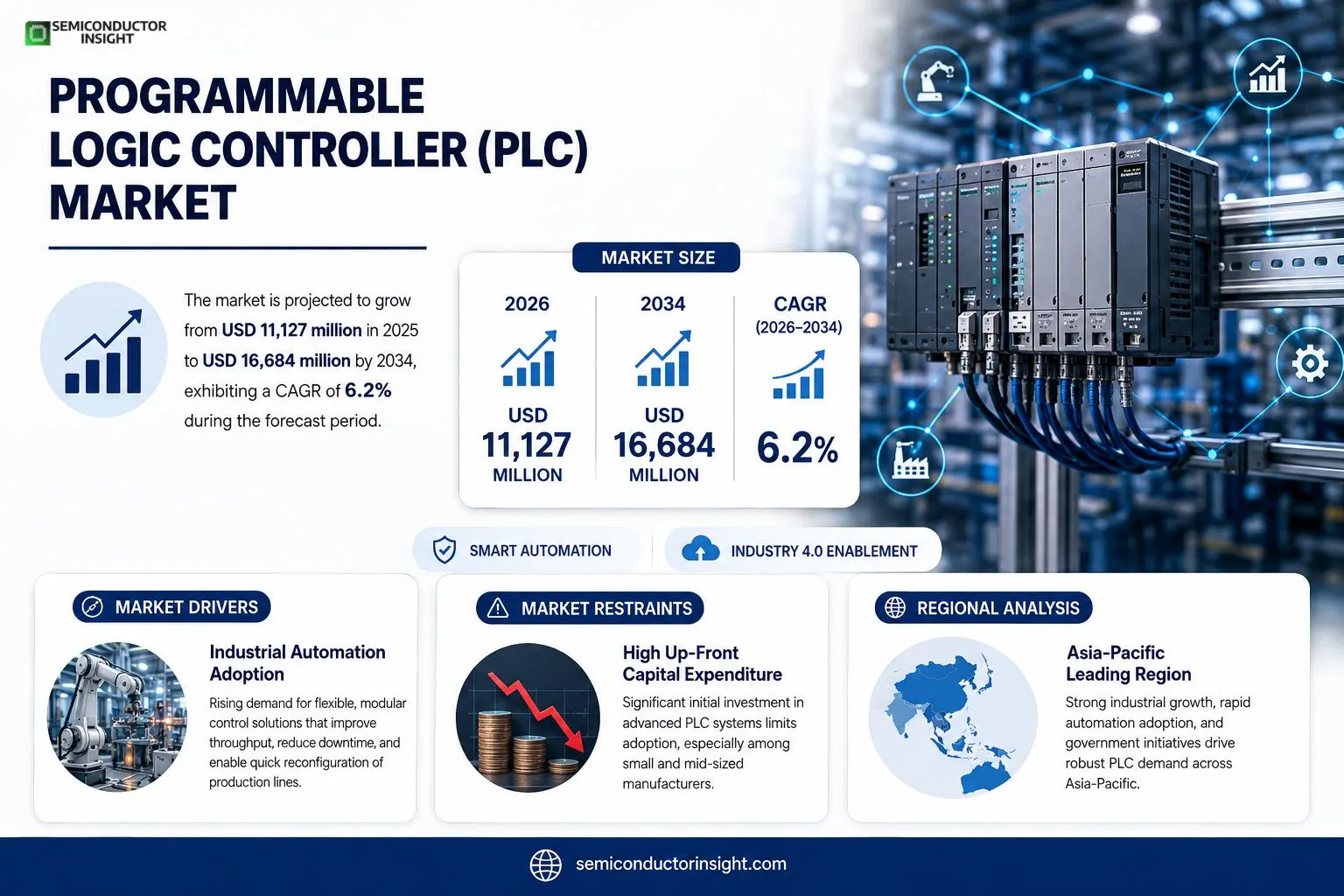
Programmable Logic Controller (PLC) market size was valued at USD 11,127 million in 2025 and is forecasted to reach USD 16,684 million by 2034, exhibiting a CAGR of 6.2% during the forecast period.
A programmable logic controller is a rugged digital computer designed for real‑time automation of electromechanical processes such as assembly‑line machinery, amusement rides or lighting systems. PLCs accommodate diverse configurations of digital and analog I/O, operate across wide temperature ranges, resist electrical noise and vibration, and store control programs in battery‑backed or non‑volatile memory. Because output must be generated within strict timing windows, PLCs exemplify “hard” real‑time systems where delayed responses can cause unintended operation.The market momentum stems from several technology trends. Traditional DCS architectures are increasingly complemented by PLCs acting as edge data gateways, enabling decentralized decision‑making aligned with Industry 4.0 and emerging Industry 5.0 principles. Cloud and edge integration allows remote monitoring and the application of machine‑learning algorithms for optimal control strategies. At the same time, demand for compact and nano‑form factor PLCs is rising as manufacturers seek space‑efficient solutions without sacrificing performance. Energy‑efficiency initiatives and heightened cybersecurity requirements further shape product development, pushing vendors toward sustainable designs and advanced protection protocols.
MARKET DRIVERS
Industrial Automation Adoption
Programmable Logic Controller (PLC) Market is benefiting from manufacturers’ push to replace legacy relays with modular, software‑centric control solutions. As factories pursue higher throughput, PLCs provide the flexibility to reconfigure production lines without costly hardware changes, a factor that makes capital investment more palatable.
Connectivity and IoT Integration
Embedding Ethernet/IP and OPC-UA stacks into PLCs has opened pathways for real‑time data exchange across the enterprise. This connectivity enables predictive maintenance algorithms to flag component wear before failure, translating into measurable reductions in downtime for end users.
➤ “Enterprises that align PLC upgrades with broader digital initiatives often see a 10‑15% improvement in overall equipment effectiveness.”
Beyond equipment gains, Programmable Logic Controller (PLC) Market is seeing heightened interest from the aftermarket services sector, which leverages remote diagnostics to offer subscription‑based support packagesan emerging revenue stream that reshapes traditional OEM business models.
MARKET CHALLENGES
Talent Shortage in Embedded Engineering
Deploying advanced PLC firmware demands engineers fluent in both control theory and modern programming languages. The scarcity of such cross‑trained talent inflates project timelines, compelling firms to outsource development and thereby increasing overall solution costs.
Other Challenges
Legacy System Integration
Many plant owners operate mixed environments where new PLCs must coexist with decades‑old hardware. Harmonizing protocols without compromising reliability often requires bespoke middleware, adding complexity and expense to upgrade projects.
MARKET RESTRAINTS
High Up‑Front Capital Expenditure
While PLCs reduce long‑term operating costs, the initial purchase priceespecially for high‑performance, safety‑rated unitsremains a barrier for small‑ to medium‑sized manufacturers that operate on thin margins.Financing options are still evolving, and many enterprises hesitate to allocate budget to automation projects when alternative cost‑saving measures appear more immediate.Consequently, Programmable Logic Controller (PLC) Market experiences a slower adoption curve in regions where access to low‑interest capital is limited.
MARKET OPPORTUNITIES
Edge Computing Deployment
Embedding analytics at the PLC level enables processing of sensor streams without relying on centralized cloud resources. This edge capability reduces latency for time‑critical control loops, a proposition that resonates strongly with sectors such as robotics and high‑speed packaging.As manufacturers pursue zero‑downtime strategies, Programmable Logic Controller (PLC) Market stands to capture demand for integrated edge solutions that combine control, security, and data aggregation in a single chassis.Vendors that bundle modular expansion kits with standardized software APIs are positioned to serve both legacy retrofits and greenfield projects, unlocking revenue from a broader customer base.
Programmable Logic Controller (PLC) Market Trends
Shift Towards Decentralized Edge Control
The adoption of edge‑oriented architectures is reshaping how manufacturers orchestrate production lines. By positioning PLCs as localized decision nodes rather than relying solely on centralized Distributed Control Systems, plants gain the ability to react within milliseconds to sensor inputs. This configuration dovetails with Industry 4.0 initiatives that emphasize real‑time data exchange and adaptive process tuning. Companies that restructure their control topology report lower latency in fault detection, a measurable reduction in downtime, and a clearer path to integrating emerging robotics solutions. For Programmable Logic Controller (PLC) Market, the move toward decentralized control translates into higher demand for modular firmware packages and plug‑in communication adapters that can be programmed on site without extensive re‑engineering.
Other Trends
Integration with Cloud and Edge Platforms
Cloud‑enabled PLCs are becoming the connective tissue between shop‑floor equipment and enterprise analytics suites. When control data streams to secure cloud environments, operators can apply predictive algorithms that anticipate wear patterns or energy spikes before they materialize. Moreover, remote firmware updates simplify lifecycle management, cutting the need for on‑site service visits. The benefit for end users is twofold: operational costs shrink and performance baselines rise, prompting OEMs to embed secure APIs and lightweight virtualization layers directly into the controller hardware.
Rise of Compact and Nano PLCs
Space constraints in modern automation cells are driving a migration toward ultra‑compact controller formats. Nano‑scale PLCs retain full I/O diversity while fitting into enclosures previously reserved for discrete relays. Their reduced footprint allows equipment designers to increase machine density on the factory floor, a tactic that aligns with the push for higher throughput without expanding plant footprints. Despite their diminutive size, these devices maintain robust temperature tolerance and vibration resistance, ensuring reliability in harsh industrial environments. For Programmable Logic Controller (PLC) Market, this trend opens a niche where high‑performance yet low‑profile hardware can command premium pricing, especially in sectors such as semiconductor assembly and high‑speed packaging.
COMPETITIVE LANDSCAPE
Key Industry Players
Programmable Logic Controller (PLC) Market Competitive Overview
The PLC arena is still concentrated around a handful of integrators whose breadth of product portfolios enables them to serve end‑users from heavy‑industry petrochemical plants to high‑mix automotive lines. Siemens leads the segment with a robust modular rack‑mounted line that couples legacy reliability with edge‑ready communication stacks, allowing customers to migrate legacy DCS environments to hybrid PLC‑centric architectures. Rockwell Automation’s Allen‑Bradley family, while smaller in outright revenue, commands a premium niche in North America thanks to deep ties with system integrators and a software ecosystem that locks in recurring service fees. The dominance of these two powerhouses creates a high barrier to entry for newcomers, but also drives a competitive pressure to innovate around compact form factors, cloud‑native diagnostics, and cybersecurity hardening.Beyond the flagship players, a vibrant set of specialist manufacturers is reshaping the mid‑tier landscape. Mitsubishi Electric and Schneider Electric continue to leverage strong regional dealer networks in Asia‑Pacific and Europe respectively, offering compact and nano PLCs that meet the space constraints of modern assembly equipment. Omron and ABB (B&R) focus on high‑performance motion control, targeting semiconductor and robotics applications where deterministic response time is critical. Smaller but technically agile firms such as Fuji Electric, Toshiba, Keyence, IDEC and Panasonic provide niche solutions for food‑processing and packaging lines, where hygiene and rapid change‑over are paramount. Chinese innovators including Inovance, Wuxi Xinje Electric, Delta Electronics, Atekon Technology and Zhejiang Supcon Technology are rapidly expanding their footprint by delivering cost‑effective modular stacks that integrate directly with local cloud platforms, thereby appealing to cost‑sensitive manufacturers in emerging markets.
List of Key Programmable Logic Controller (PLC) Companies Profiled
- Siemens AG
- Rockwell Automation
- Mitsubishi Electric Corporation
- Schneider Electric (Modicon)
- Omron Corporation
- Emerson (GE Fanuc)
- ABB (B&R)
- Bosch Rexroth
- Fuji Electric Co., Ltd.
- Toshiba Corporation
- Keyence Corporation
- IDEC Corporation
- Panasonic Industrial Devices
- JTEKT Electronics
- Inovance Technology
- Wuxi Xinje Electric
- Delta Electronics, Inc.
- Atekon Technology Co., Ltd.
- Zhejiang Supcon Technology
Segment Analysis:
| Segment Category | Sub-Segments | Key Insights |
| By Type |
|
Discrete PLCs
|
| By Application |
|
Manufacturing & Assembly
|
| By End User |
|
Automotive Manufacturers
|
| By Functional Grade |
|
Mid‑range
|
| By Integration Level |
|
Hybrid PLC‑IoT Platforms
|
Regional Analysis: Programmable Logic Controller (PLC) Market
Manufacturers across the United States and Canada are consolidating legacy relay logic into PLC‑based architectures to improve line flexibility. The shift is catalyzed by the need for rapid product changeovers and tighter quality control loops. As a result, system integrators are offering turnkey packages that embed PLCs with vision sensors and advanced motion controllers, shortening time‑to‑production.
Leading PLC vendors allocate a sizable portion of their R&D budget to modular hardware designs that cater to both discrete and process industries. By standardizing communication stacks, they lower integration barriers for equipment manufacturers seeking to embed intelligence directly into machinery. This investment philosophy fuels a steady stream of next‑generation controllers that support both on‑premise and cloud‑based orchestration.
Safety certifications such as IEC 61508 and UL 508A remain non‑negotiable for North American end users. Compliance pressures compel OEMs to embed redundant processing cores and secure boot mechanisms within PLCs. The rigorous audit cadence in regulated sectors, notably pharmaceuticals and aerospace, incentivizes vendors to provide detailed compliance documentation alongside firmware updates.
The region benefits from a robust pipeline of control engineers graduating from technical universities and community colleges. Employers supplement this talent pool with certification programs offered by PLC manufacturers, ensuring that field technicians possess the requisite programming and diagnostic expertise. Consequently, project timelines experience fewer delays linked to skill shortages, reinforcing customer confidence in adopting sophisticated control solutions.
Europe
Europe’s PLC market is shaped by a strong emphasis on sustainability and energy efficiency. Manufacturers in Germany and France are integrating PLCs with smart‑grid interfaces to optimize power consumption across production facilities. The EU’s circular‑economy directives push OEMs to design controllers that can be reconfigured for multiple product cycles, extending equipment lifespan. While the market is fragmented among numerous mid‑sized vendors, collaborative standards such as PROFINET facilitate interoperability, allowing customers to assemble bespoke automation stacks without vendor lock‑in. This regulatory and cultural backdrop encourages a steady evolution toward modular, eco‑friendly PLC solutions.
Asia‑Pacific
In Asia‑Pacific, rapid digitization of heavy‑industry clusters in China, South Korea, and Japan fuels demand for PLCs that can operate under extreme temperature and vibration conditions. Local equipment manufacturers prioritize cost‑effective designs that still meet international safety standards, prompting a surge in domestically produced controllers. The region’s expansive supply chain ecosystem, encompassing semiconductor fabs and component distributors, shortens lead times for hardware upgrades. Moreover, emerging smart‑factory initiatives in Southeast Asia encourage smaller firms to adopt PLCs as gateways to broader Industry 4.0 ecosystems, even though overall integration maturity varies widely across economies.
South America
South America presents a nuanced PLC landscape where Brazil’s mature automotive sector leads adoption, while Argentina and Colombia focus on incremental upgrades of existing control infrastructure. Economic volatility spurs companies to favor PLCs with extendable firmware, allowing incremental functionality gains without large capital expenditures. Local distributors often bundle training services with hardware, mitigating skill gaps and fostering a culture of continuous improvement. Although the region trails peers in cloud‑connected automation, growing interest in remote monitoring driven by logistics challenges is nudging manufacturers toward PLCs that support secure MQTT or OPC UA gateways.
Middle East & Africa
The Middle East & Africa region experiences PLC growth primarily through large‑scale oil‑and‑gas projects and emerging renewable‑energy installations. Operators demand controllers that can withstand harsh desert environments while delivering precise process control for refining and water‑treatment facilities. Partnerships between multinational OEMs and regional system integrators facilitate technology transfer, ensuring that local firms can maintain and upgrade sophisticated PLC networks. Meanwhile, African markets such as South Africa are exploring modular PLC architectures to support mining automation, where equipment reliability directly impacts production costs. The confluence of infrastructure investment and a rising focus on operational resilience creates a fertile ground for advanced PLC deployments.
Report Scope
This market research report provides a comprehensive analysis of the Programmable Logic Controller (PLC) Market , covering the forecast period 2026–2034. It offers detailed insights into market dynamics, technological advancements, competitive landscape, and key trends shaping the industry.
Key focus areas of the report include:
- Market Overview: The report begins with an overview outlining its current market scenario, key growth indicators, and industry transformation drivers. It discusses macroeconomic factors, demand–supply balance, regulatory landscape, and the strategic role of semiconductors in powering advancements across industries such as automotive, telecommunications, consumer electronics, and industrial automation.
- Market Size & Forecast: Historical data and future projections for revenue, unit shipments, and market value across major regions and segments.
- Segmentation Analysis: Detailed breakdown by product type, technology, application, and end-user industry to identify high-growth segments and investment opportunities.
- Regional Insights: Insights into market performance across North America, Europe, Asia-Pacific, Latin America, and the Middle East & Africa, including country-level analysis where relevant.
- Competitive Landscape: Profiles of leading market participants, including their product offerings, R&D focus, manufacturing capacity, pricing strategies, and recent developments such as mergers, acquisitions, and partnerships.
- Technology Trends & Innovation: Assessment of emerging technologies, integration of AI/IoT, semiconductor design trends, fabrication techniques, and evolving industry standards.
- Market Drivers & Restraints: Evaluation of factors driving market growth along with challenges, supply chain constraints, regulatory issues, and market-entry barriers.
- Stakeholder Insights: Insights for component suppliers, OEMs, system integrators, investors, and policymakers regarding the evolving ecosystem and strategic opportunities.
Primary and secondary research methods are employed, including interviews with industry experts, data from verified sources, and real-time market intelligence to ensure the accuracy and reliability of the insights presented.
FREQUENTLY ASKED QUESTIONS:
What is the current market size of Programmable Logic Controller (PLC) Market?
-> Programmable Logic Controller (PLC) Market was valued at USD 11,127 million in 2025 and is expected to reach USD 16,684 million by 2034, growing at a CAGR of 6.2% during the forecast period.
Which key companies operate in Programmable Logic Controller (PLC) Market?
-> Key players include Siemens, Rockwell Automation, Mitsubishi Electric, Schneider Electric, Omron, Emerson, ABB, Bosch Rexroth, Fuji Electric, Toshiba, Keyence, IDEC, Panasonic, JTEKT Electronics, Inovance, Wuxi Xinje Electric, Delta Electronics, Atekon Technology, Zhejiang Supcon Technology, among others.
What are the key growth drivers?
-> Key growth drivers include increasing automation across manufacturing, adoption of Industry 4.0 and Industry 5.0 principles, demand for energy‑efficient and compact PLC solutions, and rising integration of cloud and edge computing for real‑time decision making.
Which region dominates the market?
-> Asia-Pacific dominates the PLC market, driven by strong industrial automation investments in China, Japan, South Korea, and India, while Europe and North America also hold significant shares.
What are the emerging trends?
-> Emerging trends include the rise of compact and nano PLCs, enhanced cybersecurity features for cyber‑physical systems, deeper integration with cloud and edge platforms, and the application of AI/ML algorithms for predictive control and optimization.
Get Sample Report PDF for Exclusive Insights
Report Sample Includes
- Table of Contents
- List of Tables & Figures
- Charts, Research Methodology, and more...
 Download Sample Report PDF