Processing In Memory (PIM) DRAM Market Insights
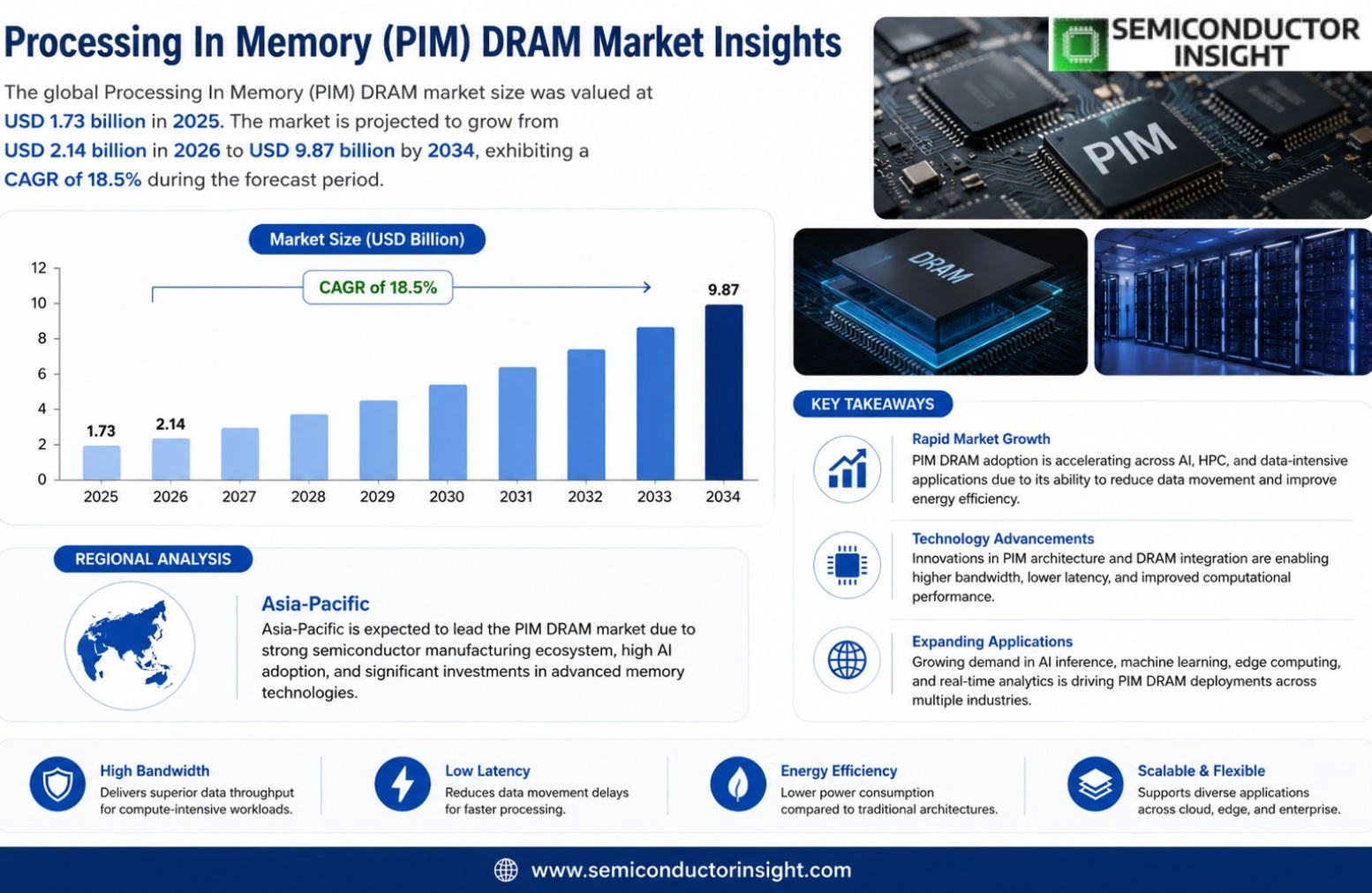
Global Processing In Memory (PIM) DRAM Market size was valued at USD 1.73 billion in 2025. The market is projected to grow from USD 2.14 billion in 2026 to USD 9.87 billion by 2034, exhibiting a CAGR of 18.5% during the forecast period.
Processing In Memory (PIM) DRAM is an advanced semiconductor architecture that integrates computational logic directly within or near the memory array, fundamentally reducing the data movement bottleneck between the processor and memory. This technology encompasses various implementations, including near-memory computing, in-memory processing cores, and hybrid memory cube designs, enabling significantly higher bandwidth utilization and lower power consumption compared to conventional DRAM architectures.
The market is experiencing robust growth driven by the surging demand for high-performance computing in artificial intelligence, machine learning workloads, and data-intensive applications. Furthermore, the proliferation of large language models and neural network inference tasks has intensified the need for memory solutions capable of processing data locally, reducing latency and energy overhead. Key industry players such as Samsung Electronics, SK Hynix, and UPMEM are actively advancing PIM DRAM commercialization, with Samsung having introduced its HBM-PIM product integrated into high-bandwidth memory stacks, marking a significant milestone in mainstream adoption of this transformative memory technology.
MARKET DRIVERS
Surging Demand for AI and Machine Learning Workloads Accelerating PIM DRAM Adoption
Processing In Memory (PIM) DRAM Market is witnessing accelerated growth driven by the exponential rise in artificial intelligence, deep learning, and high-performance computing workloads. Traditional von Neumann architectures increasingly face memory bandwidth bottlenecks as data volumes scale beyond the capacity of conventional processor-memory interfaces. PIM DRAM technology directly addresses this challenge by embedding computational logic within or adjacent to memory arrays, substantially reducing data movement latency and improving energy efficiency. Hyperscale data center operators and cloud service providers are actively evaluating and deploying PIM-enabled memory solutions to sustain throughput demands across large language model inference and training pipelines.
Rising Data Center Energy Efficiency Mandates Fueling Investment in PIM Architectures
Energy consumption concerns in large-scale computing environments are compelling infrastructure operators to pursue architectures that minimize unnecessary data transfers between processors and memory. PIM DRAM solutions demonstrate measurable reductions in power draw for memory-intensive operations by executing computations closer to stored data, directly at the memory level. As regulatory and corporate sustainability frameworks demand more energy-efficient data center designs, procurement decisions are increasingly favoring memory technologies that deliver performance-per-watt advantages. This trend is reinforcing the strategic relevance of the Processing In Memory DRAM market across enterprise and cloud computing segments.
➤ Industry analyses indicate that memory bandwidth limitations account for a significant share of total computational latency in AI inference tasks, making PIM DRAM a strategically critical component for next-generation accelerator architectures.
The convergence of big data analytics, real-time database processing, and graph computing applications further strengthens the market case for PIM DRAM adoption. Workloads characterized by irregular memory access patterns and low arithmetic intensity derive disproportionate performance gains from in-memory processing architectures. Leading semiconductor manufacturers including Samsung Electronics and SK Hynix have commercialized HBM-PIM and AiM (Accelerator-in-Memory) product lines, validating the technology’s transition from research to production-grade deployment and reinforcing growth momentum across the Processing In Memory DRAM market.
MARKET CHALLENGES
Programming Complexity and Ecosystem Immaturity Constraining Mainstream PIM DRAM Deployment
Despite compelling architectural benefits, the Processing In Memory DRAM market confronts meaningful adoption barriers rooted in software ecosystem fragmentation. Existing application frameworks, compilers, and operating system memory management subsystems were architected around conventional processor-centric memory hierarchies. Porting or recompiling workloads to exploit PIM DRAM computational capabilities requires significant developer effort, specialized toolchains, and architectural expertise that remains scarce across the broader software engineering community. The absence of standardized programming abstractions for in-memory processing continues to elongate enterprise evaluation cycles and delays volume adoption across commercial deployments.
Other Challenges
Integration and Compatibility Constraints
Embedding processing elements within DRAM arrays introduces thermal, power delivery, and signal integrity challenges that complicate system-level integration. PIM DRAM modules must conform to established memory interface standards while simultaneously managing heat dissipation from in-situ compute logic, creating engineering trade-offs that increase bill-of-materials costs and demand close collaboration between memory vendors and system architects.
High Manufacturing Complexity and Cost Premiums
The fabrication of Processing In Memory DRAM devices requires process modifications or 3D stacking techniques that add manufacturing steps relative to standard DRAM production. These complexities translate into cost premiums over conventional memory solutions, limiting initial deployment to performance-sensitive segments such as HPC, AI accelerators, and advanced networking, while constraining penetration into cost-sensitive consumer and mid-range enterprise markets.
Lack of Unified Industry Standards
The PIM DRAM market currently operates without a universally adopted interface or programming standard governing how host processors communicate with and offload computation to in-memory processing units. This standardization gap creates vendor lock-in risk, fragments the developer ecosystem, and complicates procurement decisions for enterprises seeking interoperable, multi-vendor memory infrastructure.
MARKET RESTRAINTS
Limited Standardization and Interoperability Hampering Broad Market Penetration
One of the most significant structural restraints facing Processing In Memory (PIM) DRAM Market is the absence of cross-vendor interoperability standards. Each major memory supplier has developed proprietary in-memory computing architectures and instruction sets, resulting in a fragmented landscape where software optimized for one vendor’s PIM DRAM platform cannot be readily ported to a competing solution. This incompatibility increases total cost of ownership for end users, discourages broad-based software investment, and slows ecosystem development,collectively restraining market expansion beyond early adopter segments.
Elevated Production Costs Restricting Adoption Across Price-Sensitive Market Segments
The specialized manufacturing processes required to produce PIM DRAM devices,including logic-on-memory integration and advanced 3D stacking,result in unit costs that significantly exceed those of standard DRAM modules. While hyperscale operators and defense or research institutions can justify the premium through total system performance gains, the broader commercial market encompassing mid-tier enterprises, telecommunications infrastructure, and edge computing deployments remains constrained by budget considerations. Until manufacturing yields improve and economies of scale reduce per-unit pricing, cost will continue to act as a meaningful restraint on Processing In Memory DRAM market growth velocity.
Dependency on a Concentrated Supplier Base Creating Supply Chain Vulnerabilities
The PIM DRAM market currently depends on a small number of vertically integrated memory manufacturers with the technical capability and capital resources to develop and produce in-memory computing solutions at commercial scale. This concentration introduces supply chain risks including geopolitical disruptions, capacity constraints during periods of elevated DRAM demand, and limited competitive pricing pressure. Customers in critical infrastructure, defense, and enterprise AI segments face procurement risks associated with single or dual sourcing, which may dampen long-term deployment commitments and constrain overall Processing In Memory DRAM market scalability.
MARKET OPPORTUNITIES
Expansion of Generative AI Infrastructure Creating Sustained Demand for PIM DRAM Solutions
The rapid scaling of generative AI model deployments,spanning large language models, multimodal AI systems, and real-time recommendation engines,presents a substantial and durable growth opportunity for Processing In Memory (PIM) DRAM Market. These workloads are inherently memory-bandwidth-bound, and conventional GPU-DRAM architectures are increasingly constrained by interconnect bottlenecks. PIM DRAM technology offers a compelling architectural response by enabling computation to occur within the memory subsystem, reducing round-trip data movement and improving effective throughput per watt. As AI infrastructure investment continues to scale across cloud providers and national AI initiatives, demand for memory solutions with embedded compute capabilities is expected to intensify materially.
Edge AI and Autonomous Systems Emerging as High-Growth Verticals for PIM DRAM Deployment
Beyond centralized data center applications, the proliferation of edge AI inference, autonomous vehicle computing platforms, and intelligent IoT devices represents a growing addressable market for power-efficient PIM DRAM architectures. Edge deployments impose strict constraints on power budgets, thermal envelopes, and physical form factors, making the energy efficiency advantages of Processing In Memory DRAM particularly relevant. As automotive OEMs, industrial automation vendors, and consumer electronics manufacturers integrate more sophisticated on-device AI capabilities, the demand for memory solutions that combine high bandwidth with low-power in-situ processing is projected to expand the PIM DRAM market into new and strategically important verticals.
Standardization Initiatives and Open Ecosystem Development Unlocking Broader Commercial Adoption
Emerging industry consortium activities aimed at establishing open programming models and interface specifications for PIM DRAM architectures represent a pivotal opportunity to accelerate mainstream market adoption. Collaborative efforts involving memory manufacturers, processor vendors, and hyperscale customers to define common APIs and memory-side computation frameworks would substantially lower software integration barriers. Successful standardization would enable a broader developer community to build optimized applications for Processing In Memory DRAM platforms, expand the addressable customer base beyond specialized early adopters, and catalyze a competitive multi-vendor ecosystem that drives pricing improvements and accelerates overall PIM DRAM market maturation.
Trends
AI and Machine Learning Workloads Driving Demand for PIM DRAM Solutions
Processing In Memory (PIM) DRAM Market is witnessing a significant shift in demand dynamics, primarily fueled by the rapid expansion of artificial intelligence and machine learning applications across industries. As large language models and neural network inference tasks grow more complex, conventional memory architectures face mounting pressure to deliver higher bandwidth with lower latency. PIM DRAM technology addresses this challenge by integrating computational logic directly within or near the memory array, fundamentally reducing the data movement bottleneck that has long constrained processor-memory performance. This architectural innovation enables significantly higher bandwidth utilization and lower power consumption compared to traditional DRAM designs, making it a strategic priority for hyperscalers, cloud service providers, and enterprise data center operators investing in next-generation AI infrastructure.
Other Trends
Commercialization Milestones by Leading Semiconductor Players
Key industry participants are accelerating the transition of PIM DRAM from research-stage concepts to commercially viable products. Samsung Electronics has made notable strides with its HBM-PIM product, which integrates processing capability directly into high-bandwidth memory stacks. This development marks a meaningful inflection point in the mainstream adoption of Processing In Memory (PIM) DRAM technology. SK Hynix and UPMEM are also actively advancing their respective PIM DRAM architectures, intensifying competitive innovation across the semiconductor memory landscape. These commercialization efforts are reinforcing market confidence and encouraging broader enterprise and research adoption.
Near-Memory and In-Memory Computing Architectures Gaining Traction
Processing In Memory (PIM) DRAM Market is seeing growing interest in diverse architectural implementations, including near-memory computing, in-memory processing cores, and hybrid memory cube designs. Each approach offers distinct trade-offs in terms of integration complexity, power efficiency, and computational throughput. As data-intensive workloads such as genomics, graph analytics, and real-time inference continue to expand, enterprises are evaluating these architectures for their ability to process data locally, minimizing energy overhead and reducing latency at scale.
Energy Efficiency Requirements Reshaping Memory Technology Priorities
Power consumption has emerged as a defining constraint in modern data center and edge computing environments. Processing In Memory (PIM) DRAM Market is benefiting directly from this trend, as its architecture substantially reduces the energy cost associated with repeated data transfers between processors and external memory modules. As regulatory and operational pressures on energy efficiency intensify globally, system architects and hardware designers are increasingly prioritizing PIM DRAM-based solutions that align computational performance with sustainability objectives, positioning this technology as a cornerstone of future high-performance and energy-conscious computing platforms.
COMPETITIVE LANDSCAPE
Key Industry Players
Processing In Memory (PIM) DRAM Market: Competitive Dynamics and Leading Innovators Shaping the Future of High-Performance Memory Computing
Global Processing In Memory (PIM) DRAM Market is characterized by the dominant presence of established semiconductor giants alongside emerging specialized innovators. Samsung Electronics leads the competitive landscape, having commercially introduced its HBM-PIM product , an industry-first integration of AI processing capabilities directly within high-bandwidth memory stacks. This milestone has positioned Samsung as the foremost pioneer in mainstream PIM DRAM adoption. SK Hynix follows closely, leveraging its deep expertise in DRAM and HBM technologies to develop next-generation near-memory computing architectures targeted at AI accelerator and data center workloads. Micron Technology, another Tier-1 memory manufacturer, is actively investing in compute-near-memory research, exploring PIM-enabled solutions designed to address the memory bandwidth bottleneck increasingly prevalent in large language model inference and high-performance computing environments. These dominant players benefit from vertically integrated manufacturing capabilities, extensive R&D budgets, and established relationships with hyperscale cloud providers and AI hardware vendors, creating formidable barriers to entry for smaller competitors.
Beyond the leading memory conglomerates, a growing number of specialized firms are carving out significant niches within the PIM DRAM ecosystem. UPMEM, a France-based semiconductor company, has emerged as a notable disruptor, offering commercially available PIM DRAM modules purpose-built for data-parallel workloads such as genomics, database acceleration, and neural network inference. Alibaba’s DAMO Academy and various fabless semiconductor startups are also exploring proprietary PIM architectures tailored for cloud-native AI infrastructure. Additionally, companies such as Tetramer Technologies and academic-industry consortia are contributing to the standardization and ecosystem development required for broader PIM DRAM adoption. As the market expands at a projected CAGR of 18.5% through 2034, competitive differentiation is increasingly centered on energy efficiency, memory bandwidth per watt, software stack maturity, and compatibility with existing AI accelerator platforms including GPUs and TPUs.
List of Key Processing In Memory (PIM) DRAM Companies Profiled
- Samsung Electronics Co., Ltd.
- SK Hynix Inc.
- Micron Technology, Inc.
- UPMEM SAS
- Intel Corporation
- IBM Corporation
- Alibaba DAMO Academy
- Qualcomm Technologies, Inc.
- NVIDIA Corporation
- AMD (Advanced Micro Devices, Inc.)
- Tsinghua Unigroup (CXMT)
- Synopsys, Inc.
- Cadence Design Systems, Inc.
- Rambus Inc.
- Movellus Circuits Inc.
Segment Analysis:
| Segment Category | Sub-Segments | Key Insights |
| By Type |
|
High Bandwidth Memory PIM (HBM-PIM) stands as the leading segment within the PIM DRAM market by type, driven by its exceptional ability to co-locate processing cores directly within high-bandwidth memory stacks.
|
| By Application |
|
Artificial Intelligence and Machine Learning represents the dominant application segment propelling PIM DRAM adoption across the global market.
|
| By End User |
|
Cloud Service Providers and Hyperscalers constitute the leading end-user segment, as these organizations operate the most memory-intensive and AI-heavy workloads at global scale.
|
| By Architecture |
|
Near-Memory Processing (NMP) leads within the architectural segmentation of PIM DRAM, owing to its greater commercial maturity and compatibility with existing memory controller ecosystems.
|
| By Deployment Mode |
|
Cloud-Based Deployment emerges as the dominant mode through which PIM DRAM technology is being adopted and scaled across enterprise and commercial environments.
|
Regional Analysis: Processing In Memory (PIM) DRAM Market
Asia-Pacific
South Korea and Taiwan serve as the technological nerve centers of Processing In Memory (PIM) DRAM Market in Asia-Pacific. South Korean memory giants have pioneered commercial PIM DRAM solutions targeting AI inference and data-intensive workloads. Taiwan’s advanced foundry ecosystem provides critical manufacturing support, enabling seamless integration of PIM DRAM architectures into next-generation chip designs for global customers.
China’s Processing In Memory (PIM) DRAM landscape is being actively shaped by national semiconductor self-sufficiency initiatives and substantial state-backed funding. Domestic players are advancing research into in-memory computing solutions to reduce dependence on foreign technology. The country’s vast data center buildout and expanding AI application base create a compelling demand environment for locally developed PIM DRAM solutions over the forecast horizon.
Japan contributes meaningfully to the Asia-Pacific Processing In Memory (PIM) DRAM market through its mastery of precision semiconductor fabrication and materials science. Japanese research institutions and established chipmakers are exploring next-generation memory architectures suited for robotics, industrial automation, and autonomous systems , application areas where PIM DRAM’s low-latency, high-bandwidth characteristics deliver compelling performance benefits.
Southeast Asian nations, including Malaysia, Vietnam, and India, are emerging as supplementary contributors to the Asia-Pacific Processing In Memory (PIM) DRAM value chain. Growing investments in semiconductor packaging, testing infrastructure, and electronics manufacturing are gradually positioning these markets as attractive destinations for supply chain diversification, supporting the broader regional growth narrative for PIM DRAM adoption through 2034.
North America
North America represents one of the most strategically significant regions in Global Processing In Memory (PIM) DRAM Market, anchored by the United States’ unparalleled concentration of hyperscale cloud providers, AI research institutions, and fabless semiconductor design firms. The region’s demand for PIM DRAM is being propelled by the explosive growth of large language models, generative AI platforms, and data-intensive analytics workloads that strain conventional memory-compute architectures. Leading technology companies headquartered across California, Texas, and the Pacific Northwest are actively integrating Processing In Memory (PIM) DRAM solutions to address the memory wall bottleneck in AI accelerator design. The United States government’s semiconductor investment programs and export control policies are simultaneously accelerating domestic innovation and reshaping global supply dependencies. Canada’s growing AI research cluster and a vibrant startup ecosystem further augment North America’s position as a critical demand hub and innovation center for Processing In Memory (PIM) DRAM Market through the 2026–2034 forecast window.
Europe
Europe occupies a notable position Processing In Memory (PIM) DRAM Market, characterized by strong academic research foundations, rising semiconductor sovereignty ambitions, and a growing high-performance computing infrastructure. The European Chips Act has catalyzed renewed interest in advanced memory technologies, including PIM DRAM architectures, as the region seeks to reduce strategic dependency on external semiconductor suppliers. Nations such as Germany, the Netherlands, France, and Finland are at the forefront of Europe’s in-memory computing research agenda, with institutional collaborations bridging academia and industry. European hyperscale data center operators and automotive technology companies , particularly those developing next-generation ADAS and autonomous driving platforms , represent key end-user segments driving demand for Processing In Memory (PIM) DRAM solutions. The region’s emphasis on energy efficiency and green computing aligns well with PIM DRAM’s inherent advantage of reduced data movement and lower power consumption, making it an attractive proposition for Europe’s sustainability-conscious technology sector.
South America
South America represents an emerging frontier in Global Processing In Memory (PIM) DRAM Market, with growth primarily concentrated in Brazil, Chile, and Colombia. The region’s digital transformation agenda, expanding cloud adoption among enterprises, and increasing investments in telecommunications infrastructure are gradually creating foundational demand for advanced memory technologies. While South America currently lacks a robust local semiconductor manufacturing base, the region’s technology sector is actively engaging with global PIM DRAM suppliers to modernize data center capabilities and support AI-driven application development. Brazil, as the region’s largest technology market, is witnessing growing interest from hyperscale cloud providers establishing local infrastructure, which indirectly stimulates demand for high-performance Processing In Memory (PIM) DRAM solutions. Government-led digitization programs and academic partnerships with global semiconductor research institutions are expected to progressively elevate South America’s engagement with the PIM DRAM market over the forecast period.
Middle East & Africa
The Middle East & Africa region is at an early but promising stage of engagement with Processing In Memory (PIM) DRAM Market, underpinned by ambitious smart city initiatives, sovereign AI strategies, and rapid data center infrastructure expansion , particularly across the Gulf Cooperation Council nations. Saudi Arabia and the United Arab Emirates are spearheading the region’s technology modernization efforts, with large-scale investments in AI research centers, cloud infrastructure, and next-generation computing platforms creating nascent but growing demand for advanced memory solutions including PIM DRAM. Africa’s digital economy, though still developing, is witnessing accelerating mobile and cloud adoption that lays the groundwork for future memory technology integration. The region’s reliance on technology imports from Asia-Pacific and North America means that Processing In Memory (PIM) DRAM adoption will be driven primarily by end-user demand rather than domestic manufacturing in the near term, with strategic partnerships and technology transfer agreements expected to shape the market’s evolution through 2034.
Report Scope
This market research report provides a comprehensive analysis of the Processing In Memory (PIM) DRAM Market , covering the forecast period 2026–2034. It offers detailed insights into market dynamics, technological advancements, competitive landscape, and key trends shaping the industry.
Key focus areas of the report include:
- Market Overview: The report begins with an overview outlining its current market scenario, key growth indicators, and industry transformation drivers. It discusses macroeconomic factors, demand–supply balance, regulatory landscape, and the strategic role of semiconductors in powering advancements across industries such as automotive, telecommunications, consumer electronics, and industrial automation.
- Market Size & Forecast: Historical data and future projections for revenue, unit shipments, and market value across major regions and segments.
- Segmentation Analysis: Detailed breakdown by product type, technology, application, and end-user industry to identify high-growth segments and investment opportunities.
- Regional Insights: Insights into market performance across North America, Europe, Asia-Pacific, Latin America, and the Middle East & Africa, including country-level analysis where relevant.
- Competitive Landscape: Profiles of leading market participants, including their product offerings, R&D focus, manufacturing capacity, pricing strategies, and recent developments such as mergers, acquisitions, and partnerships.
- Technology Trends & Innovation: Assessment of emerging technologies, integration of AI/IoT, semiconductor design trends, fabrication techniques, and evolving industry standards.
- Market Drivers & Restraints: Evaluation of factors driving market growth along with challenges, supply chain constraints, regulatory issues, and market-entry barriers.
- Stakeholder Insights: Insights for component suppliers, OEMs, system integrators, investors, and policymakers regarding the evolving ecosystem and strategic opportunities.
Primary and secondary research methods are employed, including interviews with industry experts, data from verified sources, and real-time market intelligence to ensure the accuracy and reliability of the insights presented.
FREQUENTLY ASKED QUESTIONS:
What is the current market size of Processing In Memory (PIM) DRAM Market?
-> Global Processing In Memory (PIM) DRAM Market was valued at USD 1.73 billion in 2025 and is expected to reach USD 9.87 billion by 2034, exhibiting a CAGR of 18.5% during the forecast period.
Which key companies operate Processing In Memory (PIM) DRAM Market?
-> Key players include Samsung Electronics, SK Hynix, and UPMEM, among others. Samsung has notably introduced its HBM-PIM product integrated into high-bandwidth memory stacks, marking a significant milestone in mainstream adoption of this transformative memory technology.
What are the key growth drivers?
-> Key growth drivers include surging demand for high-performance computing in artificial intelligence, machine learning workloads, and data-intensive applications. The proliferation of large language models and neural network inference tasks has further intensified the need for memory solutions capable of processing data locally, reducing latency and energy overhead.
Which region dominates the market?
-> Asia-Pacific is a dominant region Processing In Memory (PIM) DRAM Market, driven by the presence of leading semiconductor manufacturers such as Samsung Electronics and SK Hynix, along with strong investments in advanced memory technology research and development.
What are the emerging trends?
-> Emerging trends include near-memory computing architectures, in-memory processing cores, and hybrid memory cube designs, enabling significantly higher bandwidth utilization and lower power consumption compared to conventional DRAM architectures.

Get Sample Report PDF for Exclusive Insights
Report Sample Includes
- Table of Contents
- List of Tables & Figures
- Charts, Research Methodology, and more...
 Download Sample Report PDF