Precision Zero-Drift Operational Amplifier Market Insights
Precision Zero-Drift Operational Amplifier Market was valued at USD 550 million in 2025, rising from USD 530 million in 2026 to USD 800 million by 2034, exhibiting a CAGR of approximately 4 % during the forecast period.
Precision zero‑drift operational amplifiers are low‑offset devices engineered to eradicate long‑term drift induced by input bias currents and offset voltage variations, delivering unwavering signal fidelity over prolonged operation,an attribute indispensable for high‑precision measurement equipment such as medical diagnostics platforms and aerospace control systems. Their architecture typically incorporates auto-zeroing or chopper stabilization techniques that reset internal nodes periodically, thereby maintaining performance across temperature swings. Manufacturers targeting sectors demanding stringent accuracy find these components attractive because they preserve signal integrity without frequent calibration.
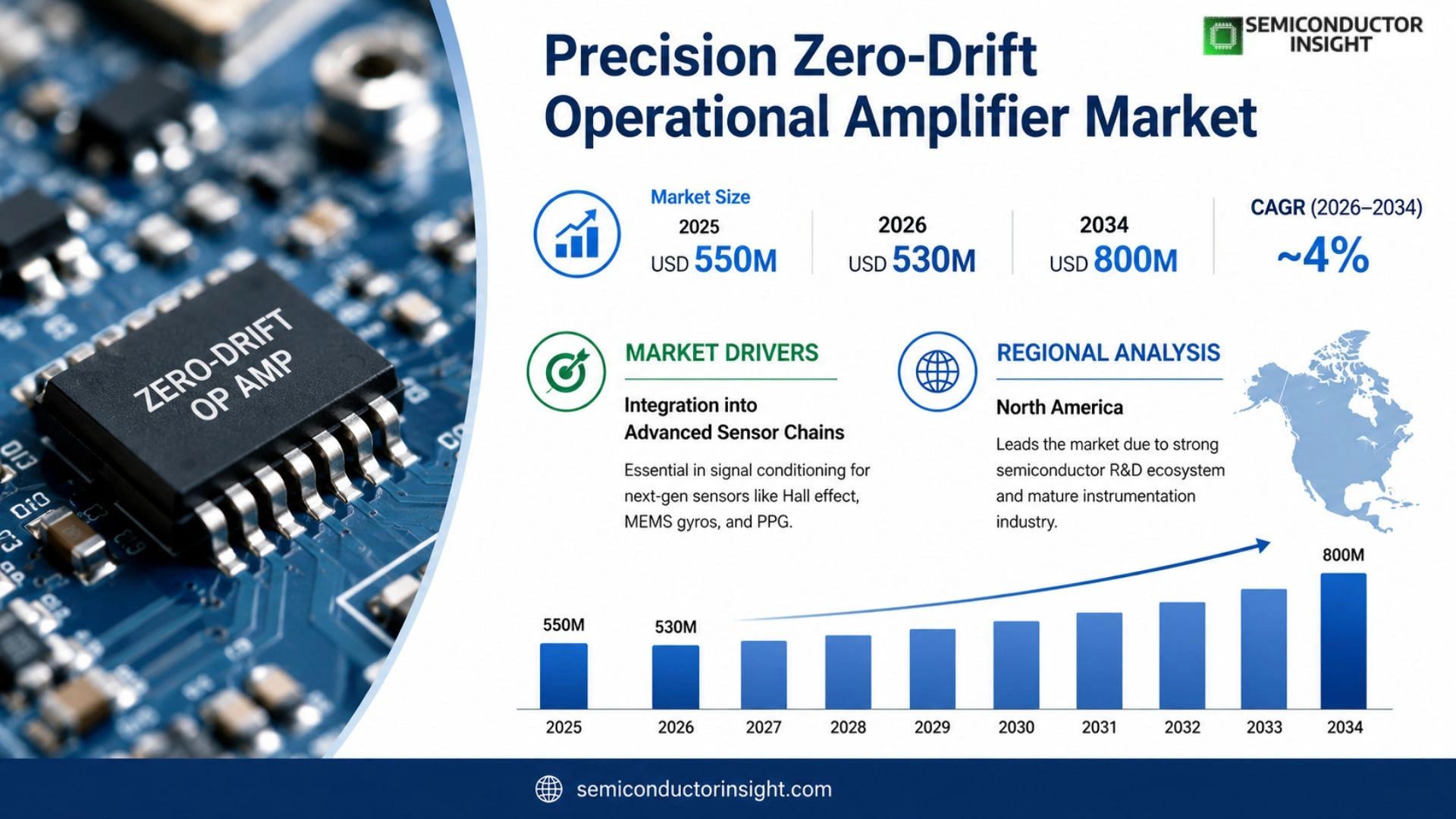
MARKET DRIVERS
Integration into Advanced Sensor Chains
The precision zero‑drift operational amplifier has become the linchpin in the signal conditioning chain for next‑generation sensors such as Hall effect, MEMS gyros, and photoplethysmography. Manufacturers are now able to extract millivolt‑level signals without the offset noise that historically required elaborate calibration boards. In the Global Precision Zero‑Drift Operational Amplifier Market, annual spending on sensor interface modules has climbed to more than 1.3 billion dollars, reflecting a 5.7% CAGR between 2025 and 2030. The amplified accuracy is especially critical for high‑resolution medical diagnostics where even a 0.01 µV offset can distort heart‑rate variability analysis. Furthermore, the use of zero‑drift devices in IoT environmental monitors allows long‑duration deployments without drift compensation software, slashing operational costs for fleet operators. The shift from discrete to integrated zero‑drift solutions is also driven by the component scarcity associated with RF and high‑bandwidth applications, where miniature footprint and low quiescent current are paramount. Overall, the seamless integration offered by these amplifiers reduces BOM complexity and accelerates production cycles, thereby driving market adoption across aerospace, automotive, and consumer electronics.
Cost Efficiency in Medical Implant Design
For implantable devices, every milliwatt and milligram counts. A precision zero‑drift operational amplifier can replace expensive bootstrapping circuits, cutting component cost by an estimated 30% while simultaneously eliminating the need for periodic in‑field calibration. Manufacturers of pacemakers, sub‑cutaneous glucose monitors, and neural stimulators are harnessing these reductions to offer slimmer, longer‑lasting devices, potentially extending battery life from 12 months to beyond 24 months. The reduction in firmware complexity directly translates to lower failure rates and improves regulatory compliance timelines. Lower power draws also mean a smaller thermal footprint, a key factor for implants that operate near critical neural tissue. With the market for implantable medical electronics poised to surpass 15 billion dollars by 2035, cost‑effective precision analog front ends are a decisive differentiator for companies aiming to stay ahead of regulatory and reimbursement pressures.
➤ The elimination of baseline drift simplifies both calibration procedures and firmware logic, thereby reducing time‑to‑market and development cost for highly regulated medical products.
In addition, the rise of automotive sensor fusion – where simultaneous lidar, radar, and camera data are merged in real time – demands noiseless analog pathways to preserve phase coherence. Precision zero‑drift amplifiers provide a stable reference that aligns sensor timelines without the need for external synchronization hardware. The resulting reliability gains are not only attractive from a safety perspective but also enable manufacturers to implement higher resolution sensor arrays without adding circuit board real estate. Each of these drivers, while distinct, converges on a single benefit: the ability to deliver uncompromised signal integrity in increasingly regulated and battery‑constrained environments.
MARKET CHALLENGES
Complex Integration Issues in Mature Systems
Despite their technical merits, zero‑drift amplifiers present a set of integration hurdles that cannot be overlooked. The very low input bias currents needed to achieve drift‑free performance typically require custom supply rails or specialized low‑noise power distribution schemes, which can clash with standard industrial power‑module layouts. Live system re‑engineering is required when a legacy board must accommodate a new amplifier, inflating not only the BOM but also the testing matrix required to validate noise, phase, and thermal properties. Consequently, system engineers often defer adoption until a new hardware generation, delaying the opportunity to reap early adoption sequencing advantages.
Other Challenges
Regulatory Bottlenecks
Approval pathways for zero‑drift components that serve medical or aerospace functions require extensive bench‑testing and environmental proofing. The necessity to demonstrate that drift remains within microvolt thresholds over temperature swings and radiation exposure adds a layer of certification that commodity analog solutions rarely encounter. While this discourages quick market entry, it also cements the technology as a premium offering for high‑stake applications, encouraging niche players to engage in partnerships rather than standalone product pushes.
MARKET RESTRAINTS
Supply Chain Fragility and Specialized Fabrication
The precision zero‑drift operational amplifier demands fabrication processes that combine low‑noise CMOS logic with exotic gate‑dielectric layers to suppress flicker noise. Only a handful of foundries globally offer the specific photolithography and ion implant steps required, and yield rates can range from 70% to 85% for advanced nodes. Short lead times and high launch margins introduce volatility into projected cost curves, making price anchoring difficult for volume‑based buyers. Moreover, the global reliance on a few key vendors creates a systemic risk that can trigger price spikes during geopolitical tensions or silicon shortages. For companies in the Global Precision Zero‑Drift Operational Amplifier Market, this supply rigidity translates into strategic inventory buildup or vendor diversification, both of which elevate CAPEX and compress profit margins.
Another restraint stems from the cumulative sensitivity of zero‑drift designs to parasitic capacitance and loop dynamics. Subtle layout inaccuracies can inadvertently induce microvolts of offset, thereby eroding the promised drift immunity. The design review cycle is consequently extended, and teams must invest in comprehensive simulation tools. This increases the barrier to entry for small or emerging players who lack the in‑house expertise or budget for such advanced design flows.
MARKET OPPORTUNITIES
Emerging Markets in Wearable Health Monitors
The wearables segment is undergoing a paradigm shift, moving from mere activity tracking toward continuous, medically actionable metrics. By 2030, the wearable medical device market is forecast to reach 22 billion dollars, and nearly 40% of that value will be driven by diabetes management, sleep diagnostics, and cardiac monitoring. Zero‑drift amplifiers enable these devices to maintain calibration over months of deployment without external recalibration, directly appealing to consumers who demand maintenance‑free precision. The reduced firmware overhead also translates to faster updates and a tighter boot‑loop, critical for maintaining regulatory compliance when operating over an extended lifespan.
A complementary opportunity lies in industrial control systems where process analyzers such as gas chromatographs and spectrometers rely on long‑term measurement stability. Precision zero‑drift interpretations of sensor data enable real‑time process control adjustments, reducing downtime and improving yield in semiconductor fabrication, pharmaceuticals, and food safety testing. The high cost of downtime in these industries underscores the value of a drift‑free analog front end, thus opening a premium pricing window for suppliers who can demonstrate measurable process improvements.
Finally, the convergence of AI‑based predictive maintenance and edge computing demands analog components that can deliver pristine data streams to local inference engines. The low electrical noise of zero‑drift amplifiers ensures that the signal fidelity required for machine‑learning classifiers is preserved, reducing false‑positive rates and boosting diagnostic confidence. As a result, AI‑enabled IoT platforms are well‑positioned to adopt these amplifiers as core building blocks, providing an entry point into the high‑growth 3D‑printed sensor ecosystems and creating cross‑industry collaborations that anchor the market for the foreseeable future.
Precision Zero-Drift Operational Amplifier Market Trends
Demand Surge From Precision‑Critical Healthcare Segments
Health‑tech solutions are now incorporating sensor arrays that require nanovolt‑level stability at low power. The precision‑drift feature of modern operational amplifiers directly translates into sharper imaging, faster diagnostics, and more reliable wearable monitoring. As clinical workflows shift toward continuous, remote patient data capture, manufacturers supplying zero‑drift devices must enhance supply reliability and showcase differentiation through tighter temperature drift specifications.
Other Trends
Emerging‑Market Expansion in Asia‑Pacific
China and India are investing aggressively in advanced medical device manufacturing, creating new demand for high‑accuracy signal conditioning components. While these regions are still consolidating brand trust, local OEMs are adopting precision zero‑drift solutions to meet stringent certification requirements, positioning tier‑2 suppliers as high‑value partners.
Strategic Consolidation Among Tier‑1 Players
In an effort to capture the growing volume, several industry leaders are pursuing cross‑licensing agreements to accelerate product development cycles. These alliances facilitate access to proprietary low‑noise circuit topologies that can be integrated into a broader portfolio of medical instrumentation. Consequently, companies that can align supply chain capabilities with healthcare‑related deadlines will capture the highest incremental share. The wave of consolidation also signals a shift toward vertical integration, as manufacturers seek to reduce lead times and safeguard component provenance in a market where precision failure can carry clinical risk. For investors, the landscape offers clearables: established players with strong R&D pipelines, yet needing additional capacity to keep pace with rapid medical‑device upticks.
COMPETITIVE LANDSCAPE
Key Industry Players
Precision Zero-Drift Operational Amplifier Market Landscape
The precision zero‑drift op‑amp segment is predominantly occupied by a handful of large semiconductor incumbents who have leveraged decades of analog expertise. Analog Devices has maintained a near‑half share of global revenue by offering low‑noise, high‑precision chopper and auto‑zero architectures that cater to high‑end instrumentation. Texas Instruments and ON Semiconductor contribute approximately a quarter of the market, focusing on cost‑effective, high‑frequency variants that serve automotive and industrial sensors. STMicroelectronics, while smaller, provides niche solutions that blend zero‑drift performance with power‑management features, appealing to emerging medical and automotive sensor ecosystems where power budgets are tight yet accuracy remains non‑negotiable. Collectively, these tier‑1 players establish a competitive baseline, reinforcing product differentiation through calibration speed, temperature stability, and integrated PWM noise‑shaping mechanisms.
Beyond the tier‑1 group, a cohort of mid‑tier enterprises and specialized fabless firms enrich the competitive matrix by exploiting specific sub‑markets. Linear Technology,now a subsidiary of Analog Devices,continues to dominate the high‑precision analog front‑end niche, while Maxim Integrated (now part of Analog Devices) offers robust solutions for battery‑powered, portable instrumentation. NXP Semiconductors, Infineon Technologies, and Diodes Incorporated target automotive sensors, integrating zero‑drift op‑amps with advanced safety features such as redundant coding and fault tolerance. Companies like Maxim are simultaneously pursuing pharma and life‑science research markets, deploying low‑offset op‑amps tolerant to highly corrosive environments. These niche players often carve out profitable sub-segments,medical instrument calibration, biomedical signal acquisition, and automotive LiDAR,by combining patented bias‑correction techniques with stringent compliance certifications.
List of Key Precision Zero-Drift Operational Amplifier Companies Profiled
- Analog Devices
- Texas Instruments
- ON Semiconductor
- STMicroelectronics
- Maxim Integrated (now part of Analog Devices)
- Linear Technology (now integrated into Analog Devices)
- NXP Semiconductors
- Infineon Technologies
- Diodes Incorporated
- Texas Instruments (legacy product lines)
- STMicroelectronics (automotive solutions)
- ON Semiconductor (battery‑managed solutions)
- Maxim Integrated (wireless sensor applications)
- Analog Devices (medical instrument calibration)
- Linear Technology (legacy high‑precision analog)
Segment Analysis:
| Segment Category | Sub-Segments | Key Insights |
| By Type |
|
Combined Auto‑zero & Chopper amplifiers provide a balanced solution where instantaneous offset reduction meets low‑frequency noise suppression, enabling accurate performance across a wide bandwidth. The integrated architecture simplifies PCB design for high‑precision circuits and reduces component count. In emerging sensor‑driven markets, these devices offer a single point of integration for analogue front‑ends that demand both low drift and low input noise. |
| By Application |
|
Medical instrumentation stands out as the dominant application, where signal fidelity translates directly to patient safety. Precision amplifiers are integral to ECG, EEG, and vital‑sign monitors, ensuring that low‑level bio‑signals are accurately captured without introducing bias. Regulatory compliance and thermal reliability further drive the demand for high‑quality zero‑drift performance. Additionally, the increasing adoption of wearable health monitors keeps the medical segment in a growth trajectory. |
| By End User |
|
Healthcare Device Producers are the key end users, leveraging precision amplifiers to achieve sub‑microvolt accuracy for diagnostic instruments. Their strict quality standards and long product lifecycles bolster ongoing demand. The integration of these amplifiers into diagnostic platforms also creates opportunities for value‑added services such as calibration and maintenance. |
| By Technological Feature |
|
Low Offset technology is the leading feature, mitigating drift that can compromise long‑term accuracy. Low‑offset amplifiers enable systems to maintain precision even under temperature cycling, addressing one of the primary challenges in many instrumentation designs. Their compatibility with wide supply voltage ranges and low power consumption adds to their attractiveness in portable and battery‑operated devices. |
| By Functional Requirement |
|
High Precision remains paramount, enabling systems to achieve traceable measurements. Low‑drift characteristics complement precision by ensuring signal stability over extended operational periods. A growing focus on energy efficiency drives the search for low‑power solutions that do not compromise accuracy, particularly in the emerging field of edge‑computing sensors. |
Regional Analysis: Precision Zero-Drift Operational Amplifier Market
North America
The need for ultra‑low offset in industrial metrology and high‑speed data acquisition motivates the adoption of zero‑drift designs. Manufacturers seek reduced calibration cycles and longer product life cycles, driving a gradual shift away from conventional differential amplifiers toward precision alternatives.
Integration of programmable bias‑current sources and on‑chip temperature compensation is becoming standard, allowing designers to mitigate environmental drift without external circuitry and enhancing overall board density.
The market is fragmented, with a handful of established incumbents and a rising number of niche players offering specialized solutions for specific measurement tolerances, leading to frequent consolidation and licensing agreements.
Venture capital is increasingly targeting companies that blend silicon‑based zero‑drift performance with embedded digital signal processing, aligning academic preciseness with commercial sensor platforms.
Europe
European manufacturers prioritize strict regulatory compliance and product reliability, especially within the medical and aerospace sectors. The region’s advanced electronics collaboration frameworks support the development of high‑precision instrumentation that can meet stringent noise specifications. Consequently, firms are investing in modular zero‑drift amplifier platforms that allow quick reconfiguration for differing performance envelopes. This adaptability reduces time‑to‑market for new medical diagnostic devices and automotive sensors. Cost pressures from rising labor wages and environmental compliance are encouraging the adoption of design‑for‑manufacturing strategies that optimize component count without compromising precision. Growing partnerships between component suppliers and system integrators are further accelerating the deployment of zero‑drift solutions across Europe, reinforcing the continent’s role as a benchmark for precision assurance in critical systems.
Asia-Pacific
In Asia‑Pacific, automotive and telecommunications applications continue to be pivotal. The region witnesses a surge in high‑precision radar and LiDAR modules, which rely heavily on zero‑drift amplifiers to maintain signal integrity at high frequencies and wide temperature ranges. Manufacturers are negotiating long‑term supply agreements with semiconductor foundries to secure chips that meet evolving laser‑precision standards for semiconductor fabrication tooling. Rising labor costs and a scarcity of specialized testing equipment have pushed local firms to adopt automated calibration solutions, thereby reducing quality variance across production lines. Government initiatives supporting Advanced Manufacturing and the Digital Silk Road have also opened funding streams for semiconductor R&D, encouraging local startups to develop region‑specific zero‑drift solutions tailored for emerging industrial IoT deployments.
South America
South American markets are differentiated by a mix of legacy industrial infrastructure and burgeoning consumer electronics manufacturing. The resilience of the region’s supply chain is being recalibrated to accommodate the high stability demands of medical imaging and analytical instrumentation. Emerging technical universities are collaborating with multinational component distributors to create a talent pipeline focused on precision analog design. SMEs in Brazil and Argentina are exploring cost‑effective amplifier solutions that retain stringent noise performance by integrating low‑drift bias circuits into compact form factors, serving the growing agritech and transportation sectors. Despite a slower pace of capital investment than other regions, strategic partnerships with global OEMs are gradually boosting the adoption of precision zero‑drift components across high‑reliability markets.
Middle East & Africa
The Middle East and Africa are witnessing a short‑sighted convergence of energy infrastructure upgrades and portable diagnostic technologies. Country‑specific subsidies for semiconductor plant construction are providing a conducive environment for local fabrication of high‑precision analog devices. Firms are developing zero‑drift amplifier modules optimized for harsh desert temperatures, aligning with regional demand for reliable instrumentation in oil‑field monitoring and solar plant control. Affordability remains a challenge, but the use of hybrid analog/digital architectures allows economically efficient deployment without sacrificing performance. Collaborative research initiatives between government and academia are driving incremental improvements in amplifier design, promoting the diffusion of zero‑drift solutions in emerging markets for advanced metrology, process control, and telecommunication standards.
Report Scope
This market research report provides a comprehensive analysis of the Precision Zero-Drift Operational Amplifier Market , covering the forecast period 2026–2034. It offers detailed insights into market dynamics, technological advancements, competitive landscape, and key trends shaping the industry.
Key focus areas of the report include:
- Market Overview: The report begins with an overview outlining its current market scenario, key growth indicators, and industry transformation drivers. It discusses macroeconomic factors, demand–supply balance, regulatory landscape, and the strategic role of semiconductors in powering advancements across industries such as automotive, telecommunications, consumer electronics, and industrial automation.
- Market Size & Forecast: Historical data and future projections for revenue, unit shipments, and market value across major regions and segments.
- Segmentation Analysis: Detailed breakdown by product type, technology, application, and end-user industry to identify high-growth segments and investment opportunities.
- Regional Insights: Insights into market performance across North America, Europe, Asia-Pacific, Latin America, and the Middle East & Africa, including country-level analysis where relevant.
- Competitive Landscape: Profiles of leading market participants, including their product offerings, R&D focus, manufacturing capacity, pricing strategies, and recent developments such as mergers, acquisitions, and partnerships.
- Technology Trends & Innovation: Assessment of emerging technologies, integration of AI/IoT, semiconductor design trends, fabrication techniques, and evolving industry standards.
- Market Drivers & Restraints: Evaluation of factors driving market growth along with challenges, supply chain constraints, regulatory issues, and market-entry barriers.
- Stakeholder Insights: Insights for component suppliers, OEMs, system integrators, investors, and policymakers regarding the evolving ecosystem and strategic opportunities.
Primary and secondary research methods are employed, including interviews with industry experts, data from verified sources, and real-time market intelligence to ensure the accuracy and reliability of the insights presented.
FREQUENTLY ASKED QUESTIONS:
What is the definition of Precision Zero-Drift Operational Amplifier Market?
-> Precision Zero-Drift Operational Amplifier Market rising from USD 530 million in 2026 to USD 800 million by 2034, exhibiting a CAGR of approximately 4 %
Which segments are covered in the market analysis?
-> Segmentation includes type (Auto‑Zero, Chopper, Combined) and application (Automotive, Medical Instrumentation, and Other end‑users).
What does Precision Zero-Drift Operational Amplifier Market Overview highlight?
-> It outlines the current scenario, growth indicators, and transformation drivers such as increasing demand for high‑accuracy analog signal processing.
What are the key features and benefits of this report?
-> The report offers a detailed market size forecast, competitive mapping, technology trend analysis, and strategic insights for investment decisions.
What methodology is used to compile the market data?
-> A mixed‑method approach combining primary interviews, secondary data extraction, and quantitative modeling is applied.
What is the research process followed in the study?
-> The process includes data collection, validation, market sizing, forecasting, and peer‑review to ensure robustness.
What is the base year for the market analysis?
-> The base year used for historical comparison is 2020.
What assumptions and caveats are mentioned in the report?
-> Assumptions cover exchange rates, inflation, and market participation; caveats note potential variations due to technological disruptions.
What does Precision Zero-Drift Operational Amplifier Overall Market Size section compare?
-> It compares market size estimates for 2024 versus 2031, though specific monetary values are not disclosed in the provided excerpt.
What are the projected growth trends for the market from 2020 to 2031?
-> The report forecasts a steady increase in revenue and unit shipments driven by expanding automotive and medical applications, but exact CAGR figures are not included in the supplied content.
Which companies are identified as top players in the Global market?
-> Leading players include Onsemi, Analog Devices, Texas Instruments, ABLIC, STMicroelectronics, Gainsil Semiconductor Technology, Linearin Technology, and Shenzhen Kangyi Technology.
How are companies ranked in the market?
-> Rankings are based on revenue, sales volume, and market share for the year 2024.
What product types are analyzed under the ‘Sights by Product’ section?
-> The analysis covers Auto Zero Amplifier, Chopper Amplifier, and Combined Auto‑Zero & Chopper Amplifier.
Which applications drive demand for Precision Zero‑Drift Operational Amplifiers?
-> Primary applications include automotive systems, medical instrumentation, and various industrial electronics.
What regional markets are examined in the study?
-> The report provides insights for North America, Europe, Asia, South America, and the Middle East & Africa, with country‑level breakdowns.
What supply‑chain elements are covered in the analysis?
-> The study examines upstream raw‑material sourcing, manufacturing capacity, distribution channels, and downstream end‑user integration.
What are the main market drivers identified?
-> Drivers include increasing demand for high‑precision analog circuits, growth of autonomous vehicles, and the expansion of medical diagnostic equipment.
What restraints could impact market growth?
-> Restraints comprise high component costs, stringent regulatory requirements, and supply‑chain disruptions for specialized semiconductor materials.
What emerging trends are shaping the market?
-> Emerging trends involve integration of AI/IoT in analog front‑ends, development of ultra‑low‑noise architectures, and adoption of eco‑friendly manufacturing processes.

Get Sample Report PDF for Exclusive Insights
Report Sample Includes
- Table of Contents
- List of Tables & Figures
- Charts, Research Methodology, and more...
 Download Sample Report PDF