Power Integration IC (PMIC) for Consumer Electronics Market Insights
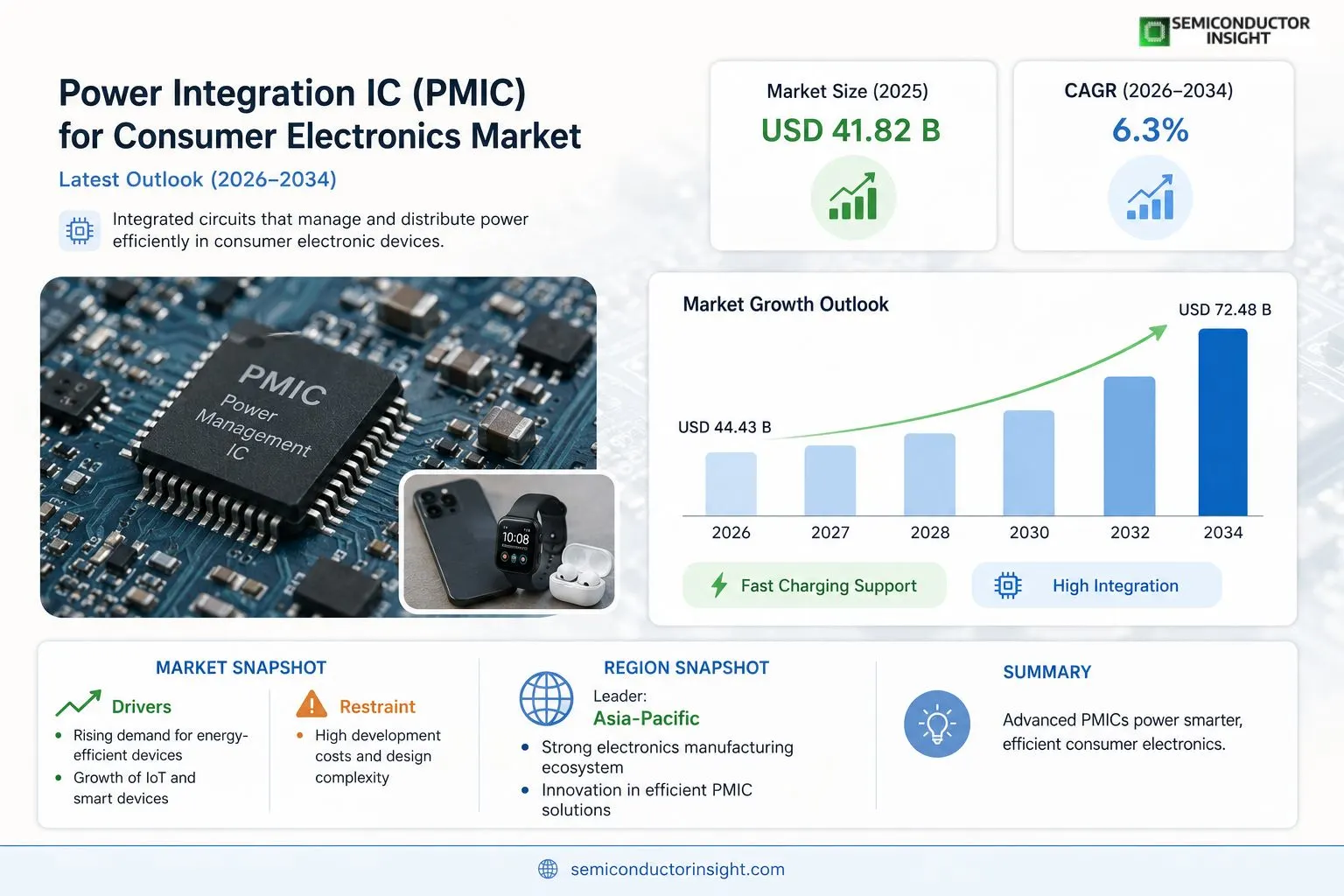
Global Power Integration IC (PMIC) for Consumer Electronics market size was valued at USD 41.82 billion in 2025. The market is projected to grow from USD 44.43 billion in 2026 to USD 72.48 billion by 2034, exhibiting a CAGR of 6.3% during the forecast period.
Power Integration ICs, commonly known as PMICs, are specialized semiconductor devices designed to manage and distribute electrical power efficiently within electronic systems. In consumer electronics, these integrated circuits play a vital role in optimizing battery life, regulating voltage levels, and ensuring thermal management across various devices. They handle multiple power rails, support fast charging protocols, and enable sophisticated power sequencing required by modern processors, displays, and sensors.
The market is experiencing robust growth due to several factors, including the proliferation of portable devices such as smartphones, tablets, wearables, and laptops, which demand highly efficient power solutions. Rising consumer expectations for longer battery runtime, faster charging, and compact designs continue to drive innovation in PMIC technology. Furthermore, advancements in 5G connectivity, AI-powered features, and high-resolution displays increase power complexity, making advanced PMICs essential components. Initiatives by key players in the market are also expected to fuel the market growth. Major companies such as Texas Instruments, Qualcomm, and Analog Devices maintain strong portfolios tailored for consumer electronics applications, focusing on integration, efficiency, and miniaturization to meet evolving device requirements.
MARKET DRIVERS
Rising Demand for Energy-Efficient Consumer Electronics
Power Integration IC (PMIC) for Consumer Electronics Market is primarily driven by the exponential growth in portable devices such as smartphones, tablets, laptops, and wearables. These devices require advanced power management solutions to optimize battery life, support faster charging protocols, and handle multiple voltage rails efficiently while maintaining compact form factors. As global shipments of such devices continue to rise, PMICs play a critical role in enhancing performance and reducing energy consumption.
Proliferation of IoT and Smart Devices
Integration of IoT technologies in consumer electronics has accelerated the need for sophisticated Power Integration IC (PMIC) solutions. Smart home devices, fitness trackers, and connected appliances demand ultra-low power consumption and efficient power distribution to enable always-on functionality. This trend supports sustained market expansion as manufacturers prioritize energy optimization in next-generation products.
➤ The consumer electronics segment continues to hold a dominant share in the broader PMIC market, driven by the need for longer battery life and enhanced device performance in high-volume portable applications.
Technological advancements in semiconductor processes, including finer nodes and higher integration levels, further propel demand for Power Integration IC (PMIC) in consumer electronics by enabling more efficient and compact designs that align with evolving device requirements.
MARKET CHALLENGES
Design Complexity and Integration Issues
Developing advanced Power Integration IC (PMIC) for Consumer Electronics Market involves significant technical challenges related to managing multiple power domains, thermal performance, and signal integrity within increasingly miniaturized devices. Designers must balance efficiency, size, and cost while ensuring compatibility with diverse chipsets and battery technologies.
Other Challenges
Supply Chain Volatility
Fluctuations in semiconductor manufacturing capacity and raw material availability can impact production timelines and pricing stability for PMIC components targeted at consumer electronics applications.
Rapid Technological Evolution
The fast pace of innovation in consumer devices requires continuous updates to PMIC architectures to support new features like wireless charging and AI-driven power optimization, increasing development pressures on manufacturers.
MARKET RESTRAINTS
High Development Costs and Complexity
Power Integration IC (PMIC) for Consumer Electronics Market faces restraints from elevated costs associated with research, design, and qualification of new solutions. Creating highly integrated, application-specific PMICs demands substantial investment in engineering resources and advanced fabrication technologies, which can limit participation by smaller players and slow innovation cycles in price-sensitive segments.
MARKET OPPORTUNITIES
Advancements in Battery Management and Fast Charging
Significant opportunities exist in Power Integration IC (PMIC) for Consumer Electronics Market through innovations in battery management systems and support for ultra-fast charging standards. As consumers demand quicker recharge times and extended usage, PMIC providers can differentiate through integrated solutions that enhance safety, efficiency, and longevity of lithium-based batteries in smartphones, tablets, and wearables.
Expansion in Wearables and Emerging Device Categories
The growing adoption of smartwatches, AR/VR headsets, and other wearable technologies presents strong growth avenues. These devices require specialized, ultra-compact Power Integration IC (PMIC) solutions capable of managing diverse power needs in constrained spaces, opening doors for tailored product development and market penetration in high-growth consumer segments.
Power Integration IC (PMIC) for Consumer Electronics Market Trends
Rising Demand for Energy-Efficient Power Management in Portable Devices
Power Integration IC (PMIC) for Consumer Electronics Market continues to evolve as manufacturers prioritize advanced power management solutions to meet consumer demands for extended battery life and optimal performance. PMICs play a critical role in regulating voltage levels, managing multiple power rails, and supporting efficient thermal management in devices such as smartphones, tablets, laptops, and wearables. The proliferation of portable electronics has accelerated the need for highly integrated circuits that minimize energy consumption while handling complex power sequencing requirements for modern processors, high-resolution displays, and various sensors.
Other Trends
Support for Fast Charging and Advanced Connectivity Features
In Power Integration IC (PMIC) for Consumer Electronics Market, a key trend involves the integration of fast charging protocols and enhanced support for 5G connectivity. As devices incorporate more power-hungry features, PMICs enable sophisticated power delivery systems that maintain stability during high-performance operations. This development addresses consumer expectations for rapid charging capabilities without compromising device safety or longevity, driving innovation among leading semiconductor providers focused on consumer applications.
Miniaturization and Higher Integration Levels
Another significant trend in Power Integration IC (PMIC) for Consumer Electronics Market is the push toward greater miniaturization and functional integration. PMICs are being designed to combine multiple power management functions into smaller packages, allowing for more compact device designs. This supports the development of slimmer form factors in consumer electronics while maintaining high efficiency standards essential for battery-powered devices.
Advancements Driven by AI and High-Resolution Displays
The integration of AI-powered features and high-resolution displays in consumer electronics has further increased power complexity, making advanced PMIC solutions indispensable. These circuits optimize power distribution to support intensive processing tasks and vibrant visuals without excessive drain on battery resources. Companies such as Texas Instruments, Qualcomm, and Analog Devices continue to develop specialized portfolios emphasizing efficiency, integration, and miniaturization tailored specifically for the evolving requirements of consumer electronics applications. This focus ensures PMICs remain at the forefront of enabling next-generation device capabilities across the market.
COMPETITIVE LANDSCAPE
Key Industry Players
Competitive Landscape of Power Integration IC (PMIC) for Consumer Electronics Market
Power Integration IC (PMIC) Market for consumer electronics is moderately concentrated, with leading players such as Texas Instruments and Qualcomm commanding significant shares through their extensive portfolios and technological innovations. Texas Instruments stands out as a dominant force, offering highly integrated PMICs optimized for voltage regulation, battery management, and power sequencing in smartphones, tablets, wearables, and laptops. The competitive structure emphasizes miniaturization, energy efficiency, and support for advanced features like fast charging and AI-driven power optimization, enabling leaders to maintain strong positions amid rising demand for portable devices.
Other significant players carve niches through specialized solutions, including Analog Devices for precision power management, Infineon Technologies for robust thermal performance, and STMicroelectronics for cost-effective integrated designs. Companies like Renesas Electronics, NXP Semiconductors, and MediaTek further intensify competition by focusing on system-level integration tailored to 5G-enabled and high-resolution consumer devices, driving continuous advancements in efficiency and compact form factors.
List of Key Power Integration IC (PMIC) for Consumer Electronics Companies Profiled
- Texas Instruments
- Texas Instruments
- Qualcomm
- Analog Devices
- Infineon Technologies
- NXP Semiconductors
- STMicroelectronics
- Renesas Electronics
- ON Semiconductor (onsemi)
- Microchip Technology
- ROHM Semiconductor
- Diodes Incorporated
- MediaTek
- Monolithic Power Systems
- Semtech Corporation
Segment Analysis:
| Segment Category | Sub-Segments | Key Insights |
| By Type |
|
Multi-Channel PMICs stand out as the leading segment due to their ability to efficiently manage multiple power rails simultaneously in compact consumer devices.
|
| By Application |
|
Smartphones and Tablets represent the dominant application segment owing to the high complexity of power requirements in these multifunctional devices.
|
| By End User |
|
Portable Device Manufacturers emerge as the leading end user category driven by continuous innovation cycles and consumer demand for enhanced mobility.
|
| By Technology |
|
Mixed-Signal Solutions lead this segment by combining the precision of analog power management with the flexibility of digital control.
|
| By Form Factor |
|
Chip Scale Packages (CSP) dominate due to their superior suitability for space-constrained consumer electronics designs.
|
Regional Analysis: Power Integration IC (PMIC) for Consumer Electronics Market
Asia-Pacific
Asia-Pacific’s extensive network of specialized foundries and assembly facilities provides unmatched scale for PMIC production. This infrastructure supports rapid prototyping and high-volume manufacturing of power integration circuits optimized for consumer electronics, reducing lead times and enabling quick response to shifting design requirements in smartphones and IoT devices.
The region leads in developing PMIC solutions that enhance battery performance and thermal management in compact consumer products. Manufacturers focus on integrating advanced power-saving features that meet demands for longer usage times in wearables and portable electronics while maintaining sleek form factors.
Strong partnerships between PMIC suppliers, consumer electronics brands, and component providers create efficient value chains. These collaborations drive customization of power management ICs to specific device architectures, accelerating adoption across diverse product categories from audio devices to smart displays.
Growing emphasis on energy-efficient designs pushes development of eco-friendly PMIC technologies. Regional players prioritize low-power consumption features that align with consumer preferences for sustainable electronics, positioning Asia-Pacific as a key influencer in green power management trends.
North America
North America maintains a significant position in Power Integration IC (PMIC) for Consumer Electronics Market through its focus on high-performance design and premium product segments. The region excels in research and development of intelligent power management solutions that emphasize reliability and advanced features for flagship consumer devices. Companies prioritize integration of PMIC with AI-driven power optimization to deliver enhanced user experiences in smart gadgets and entertainment systems. Strong intellectual property frameworks support innovation while strategic partnerships with Asian manufacturers ensure efficient production scaling. Demand remains robust for specialized PMIC applications in high-end wearables and home automation products where performance and efficiency are paramount.
Europe
Europe demonstrates steady progress in Power Integration IC (PMIC) for Consumer Electronics Market with particular attention to regulatory compliance and sustainable technologies. The region emphasizes development of energy-efficient PMIC solutions that meet stringent environmental standards for consumer electronics. Innovation centers across key countries drive advancements in power optimization for electric smart devices and eco-conscious gadgets. European manufacturers focus on quality and precision engineering, creating opportunities for premium PMIC integration in audio equipment, smart appliances, and mobile accessories. Collaborative efforts between industry and research institutions accelerate adoption of next-generation power management approaches tailored to regional consumer preferences.
South America
South America shows emerging potential in Power Integration IC (PMIC) for Consumer Electronics Market as consumer electronics adoption expands across urban centers. Local markets increasingly demand affordable yet efficient power management solutions for smartphones and basic smart devices. The region benefits from growing assembly operations and distribution networks that facilitate PMIC integration in cost-sensitive consumer products. While infrastructure development continues, opportunities arise in localized customization of power circuits to suit tropical climate challenges and varying power conditions. Rising digital inclusion initiatives support gradual market expansion for PMIC-enabled electronics.
Middle East & Africa
The Middle East and Africa region presents developing opportunities within Power Integration IC (PMIC) for Consumer Electronics Market fueled by expanding digital infrastructure and consumer technology access. Urban growth drives demand for reliable power management in mobile devices and entry-level smart electronics. Strategic investments in technology hubs encourage partnerships for PMIC deployment in consumer applications suited to regional needs such as dust-resistant and power-efficient designs. While the market remains nascent compared to other regions, increasing smartphone penetration and smart home initiatives create foundations for future growth in power integration solutions tailored for diverse environmental conditions.
Report Scope
This market research report provides a comprehensive analysis of the Power Integration IC (PMIC) for Consumer Electronics Market , covering the forecast period 2026–2034. It offers detailed insights into market dynamics, technological advancements, competitive landscape, and key trends shaping the industry.
Key focus areas of the report include:
- Market Overview: The report begins with an overview outlining its current market scenario, key growth indicators, and industry transformation drivers. It discusses macroeconomic factors, demand–supply balance, regulatory landscape, and the strategic role of semiconductors in powering advancements across industries such as automotive, telecommunications, consumer electronics, and industrial automation.
- Market Size & Forecast: Historical data and future projections for revenue, unit shipments, and market value across major regions and segments.
- Segmentation Analysis: Detailed breakdown by product type, technology, application, and end-user industry to identify high-growth segments and investment opportunities.
- Regional Insights: Insights into market performance across North America, Europe, Asia-Pacific, Latin America, and the Middle East & Africa, including country-level analysis where relevant.
- Competitive Landscape: Profiles of leading market participants, including their product offerings, R&D focus, manufacturing capacity, pricing strategies, and recent developments such as mergers, acquisitions, and partnerships.
- Technology Trends & Innovation: Assessment of emerging technologies, integration of AI/IoT, semiconductor design trends, fabrication techniques, and evolving industry standards.
- Market Drivers & Restraints: Evaluation of factors driving market growth along with challenges, supply chain constraints, regulatory issues, and market-entry barriers.
- Stakeholder Insights: Insights for component suppliers, OEMs, system integrators, investors, and policymakers regarding the evolving ecosystem and strategic opportunities.
Primary and secondary research methods are employed, including interviews with industry experts, data from verified sources, and real-time market intelligence to ensure the accuracy and reliability of the insights presented.
FREQUENTLY ASKED QUESTIONS:
What is the current market size of Power Integration IC (PMIC) for Consumer Electronics Market?
-> Power Integration IC (PMIC) for Consumer Electronics Market was valued at USD 41.82 billion in 2025 and is expected to reach USD 72.48 billion by 2034.
Which key companies operate in Power Integration IC (PMIC) for Consumer Electronics Market?
-> Key players include Texas Instruments, Qualcomm, and Analog Devices, among others.
What are the key growth drivers?
-> Key growth drivers include proliferation of portable devices such as smartphones, tablets, wearables, and laptops demanding efficient power solutions, rising expectations for longer battery runtime, faster charging, and compact designs.
Which region dominates the market?
-> Asia-Pacific is the fastest-growing region, while North America remains a dominant market.
What are the emerging trends?
-> Emerging trends include advanced integration for multiple power rails, support for fast charging protocols, miniaturization, and efficiency improvements for 5G, AI-powered features, and high-resolution displays.

Get Sample Report PDF for Exclusive Insights
Report Sample Includes
- Table of Contents
- List of Tables & Figures
- Charts, Research Methodology, and more...
 Download Sample Report PDF