Point-of-Care (POC) Diagnostic Reader SoC Market Insights
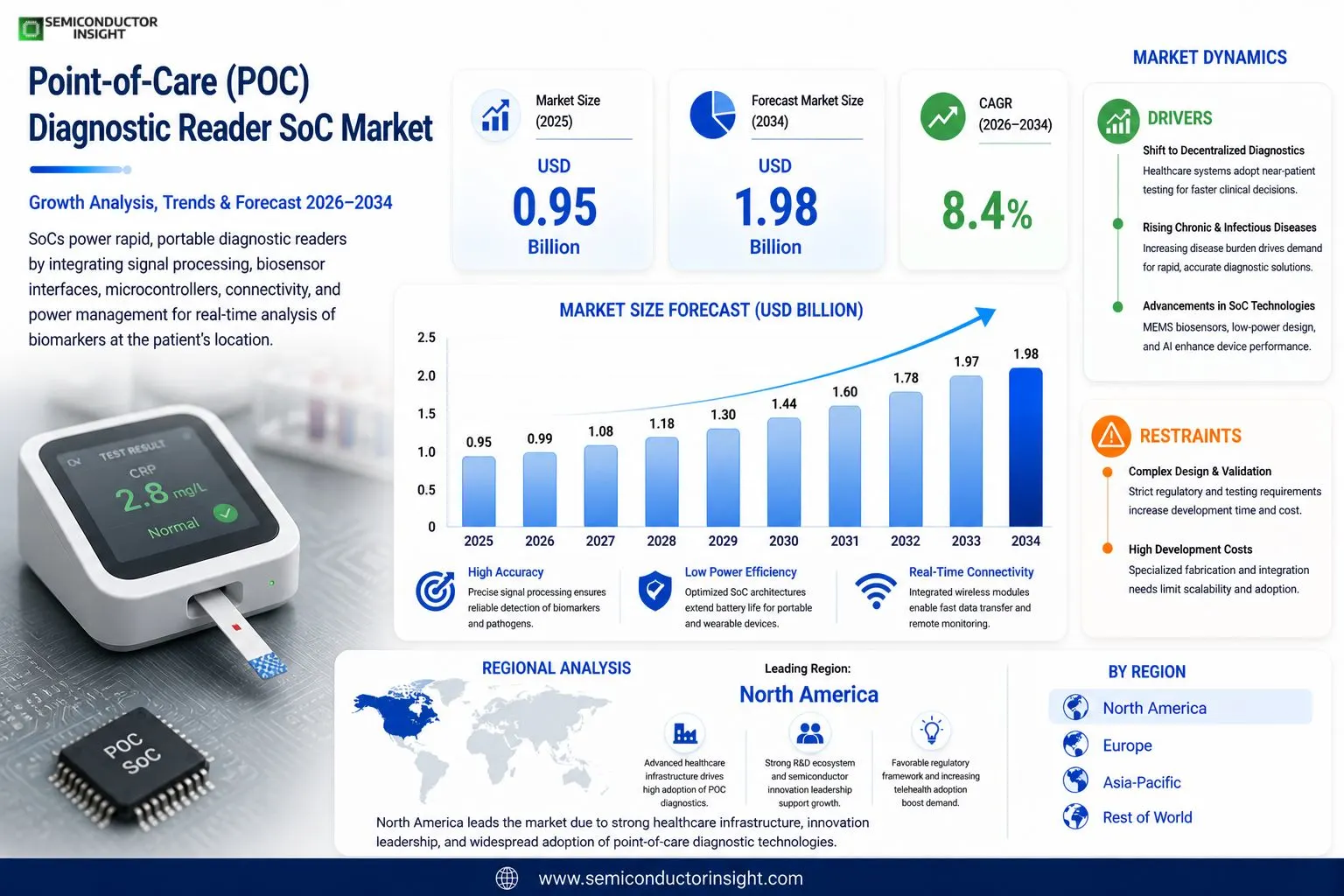
Global Point-of-Care (POC) Diagnostic Reader SoC Market size was valued at USD 0.95 billion in 2025. The market is projected to grow from USD 0.99 billion in 2026 to USD 1.98 billion by 2034, exhibiting a CAGR of 8.4% during the forecast period.
POC diagnostic reader system-on-chips (SoCs) are highly integrated semiconductor solutions designed to power rapid, portable, and microfluidics-based diagnostic devices. These SoCs combine signal processing units, biosensor interfaces, microcontrollers, connectivity modules, and power management systems into a single compact architecture, enabling real-time analysis of biomarkers, infectious agents, and metabolic indicators directly at the patient’s location. Because they minimize latency and enhance the accuracy of diagnostic workflows, SoCs are now foundational to next-generation POC platforms used across infectious disease screening, chronic disease monitoring, and emergency care diagnostics.
The market is experiencing accelerated growth because healthcare systems worldwide are shifting toward decentralized diagnostics, driven by rising demand for rapid testing and the increasing prevalence of chronic and infectious diseases. Furthermore, advancements in MEMS biosensors, low‑power semiconductor design, and AI-enabled embedded processing are strengthening adoption. Recent developments, such as improved integration of optical and electrochemical sensing components within diagnostic SoCs and expanded production of microfluidic-enabled chipsets by leading semiconductor manufacturers, are supporting market momentum. Key technology providers,including companies advancing lab-on-chip architectures and embedded biosensing semiconductors,are expanding their portfolios to meet the rising need for faster, more reliable POC diagnostic readers.
MARKET DRIVERS
Growing Demand for Rapid Diagnostic Solutions
Point-of-Care (POC) Diagnostic Reader SoC Market is experiencing strong acceleration as healthcare providers prioritize rapid testing capabilities in both clinical and decentralized settings. The increasing emphasis on immediate diagnostic insights for infectious diseases, chronic condition monitoring, and emergency medicine continues to push demand for compact and integrated system-on-chip technologies. Many healthcare systems are shifting toward near-patient testing models to reduce delays and improve clinical decision-making, helping SoC-based readers gain broader acceptance.
Advances in Miniaturized Semiconductor Technologies
Technological progress in low-power processors, sensor integration, and edge computing capabilities has significantly strengthened adoption across Point-of-Care (POC) Diagnostic Reader SoC Market. Modern semiconductor architectures now allow more functionalities, such as signal processing and wireless data transmission, to be embedded directly into compact diagnostic platforms. These enhancements support higher testing accuracy, reduced device size, and improved connectivity, aligning with evolving clinical and home-testing workflows.
➤ Integration of AI-driven analytics into SoC architectures enhances diagnostic speed and supports improved patient triage.
Broader digitization across healthcare systems also contributes to market expansion, as SoC-based diagnostic readers play a critical role in seamless data capture and connectivity with electronic health systems. The combination of compact hardware, advanced firmware, and improved interoperability remains a central driver of sustained market growth.
MARKET CHALLENGES
Complexity of SoC Design and Validation
Point-of-Care (POC) Diagnostic Reader SoC Market faces notable challenges related to the intricate design and testing requirements of integrated semiconductor platforms. Ensuring compliance with stringent medical device regulatory frameworks adds further complexity, particularly as manufacturers must validate device accuracy, durability, and performance under varied environmental conditions. Prolonged validation cycles can slow time-to-market and increase development costs.
Other Challenges
Supply Chain Vulnerabilities
Global semiconductor supply inconsistencies and material shortages continue to affect production timelines. These constraints can limit manufacturers’ ability to scale production and meet rising demand across clinical, consumer, and resource-limited markets.
MARKET RESTRAINTS
High Development Costs for Advanced SoC Architectures
Despite increasing demand, high R&D expenses remain a substantial restraint within Point-of-Care (POC) Diagnostic Reader SoC Market. Sophisticated semiconductor nodes, multilayer integration, and stringent regulatory testing contribute to elevated upfront investments. These financial pressures can hinder new entrants and limit diversification of product portfolios, especially for companies operating in cost-sensitive markets.
MARKET OPPORTUNITIES
Expansion of Connected and Home-Based Diagnostics
Point-of-Care (POC) Diagnostic Reader SoC Market is positioned for strong opportunity growth as remote patient monitoring and home-based diagnostic ecosystems expand. Increasing adoption of telehealth and digitally connected care models is driving demand for SoC-enabled devices capable of secure wireless communication, cloud integration, and real-time analytics. This shift enables more scalable and continuous monitoring for chronic diseases, infectious conditions, and preventive care. The growing alignment of IoT-enabled healthcare infrastructure with compact SoC-driven testing platforms presents significant potential for innovation and long-term market expansion.
Point-of-Care (POC) Diagnostic Reader SoC Market Trends
Integration of Advanced Biosensing and Embedded Processing
Point-of-Care (POC) Diagnostic Reader SoC Market is experiencing steady momentum as diagnostic platforms increasingly incorporate highly integrated semiconductor architectures to support real-time analysis in decentralized healthcare settings. Market activity is being shaped by rapid improvements in signal processing, microfluidic handling, and low‑power embedded computation, which together enhance the precision and responsiveness of POC diagnostic workflows. The convergence of biosensor interfaces with on‑chip processing enables faster biomarker assessment and supports diverse use cases ranging from infectious disease screening to routine metabolic monitoring. As healthcare providers expand adoption of rapid testing modalities, SoC-driven diagnostic readers continue to play a central role in strengthening clinical decision-making at the patient’s location.
Other Trends
Growth in MEMS Biosensor and Microfluidic Integration
Advances in microelectromechanical systems (MEMS) biosensors and microfluidic architectures are influencing the evolution of next-generation diagnostic reader SoCs. Improved integration of optical and electrochemical sensing components is enhancing signal fidelity and lowering detection thresholds, enabling more reliable identification of biomarkers and infectious agents. Semiconductor manufacturers are ramping development of chipsets capable of managing precise fluid manipulation and multiplexed sensing, resulting in more compact and efficient diagnostic devices. These enhancements also support broader testing capabilities without increasing device complexity, reinforcing strong adoption across decentralized care models.
Adoption Driven by Decentralized and Rapid Testing Demand
The growing emphasis on decentralized healthcare is reinforcing demand for SoC-enabled POC diagnostic readers, particularly as providers seek rapid, accurate testing solutions that reduce reliance on centralized laboratories. Increasing prevalence of chronic and infectious diseases is elevating the need for diagnostics that deliver immediate, actionable insights. Improved on-chip connectivity modules further streamline data transmission to digital health ecosystems, supporting clinical monitoring and integrated care pathways. Collectively, these factors are shaping consistent investment in SoC-based POC technology across both established and emerging healthcare markets.
Expansion of Lab-on-Chip and Embedded Biosensing Architectures
Lab-on-chip platforms are influencing POC diagnostic reader SoC development by enabling compact architectures that support multiple analytical functions within a single device. Semiconductor providers advancing embedded biosensing technologies are broadening their portfolios to accommodate more sensitive detection mechanisms and lower power profiles. Enhanced fabrication methods and improved component integration are enabling greater scalability for high-volume production of microfluidic-enabled chipsets. These advancements collectively strengthen the market’s trajectory as healthcare environments increasingly depend on portable diagnostic solutions capable of delivering rapid, high‑accuracy results.
COMPETITIVE LANDSCAPE
Key Industry Players
Point-of-Care (POC) Diagnostic Reader SoC Market: Competitive Dynamics and Leading Semiconductor Innovators
The global Point-of-Care (POC) Diagnostic Reader SoC market is characterized by intense competition among established semiconductor giants and specialized medical-grade chipset developers. Texas Instruments Incorporated holds a prominent position in this landscape, offering highly integrated analog front-end and microcontroller solutions tailored for biosensor interfaces and portable diagnostic readers. Similarly, Analog Devices, Inc. commands significant market share through its precision signal processing ICs and low-power mixed-signal SoCs that underpin electrochemical and optical sensing platforms used in rapid POC testing devices. STMicroelectronics and NXP Semiconductors N.V. further anchor the competitive field with their robust microcontroller and embedded processing portfolios, supporting the miniaturization and connectivity requirements of next-generation diagnostic readers. The market structure reflects a blend of vertically integrated semiconductor leaders and agile fabless design companies, all competing to deliver higher integration density, lower power consumption, and AI-enabled embedded analytics within a single compact SoC architecture.
Beyond the dominant players, several niche and emerging companies are making notable inroads into the POC Diagnostic Reader SoC segment. Maxim Integrated Products (now part of Analog Devices) has contributed specialized biosensing and power management ICs widely adopted in wearable and handheld diagnostic platforms. Microchip Technology Inc. and Silicon Laboratories Inc. serve the market with cost-effective, low-power microcontroller and wireless connectivity SoCs suited for point-of-care applications in resource-limited settings. Qualcomm Incorporated is leveraging its expertise in mobile processing and connectivity to explore embedded diagnostic computing solutions. Meanwhile, companies such as ams-OSRAM AG specialize in optical sensing components increasingly integrated within diagnostic SoC architectures for fluorescence and colorimetric detection. Renesas Electronics Corporation and Infineon Technologies AG round out the competitive field, offering automotive-grade reliability and security features now being adapted for medical-grade POC diagnostics. The continued convergence of MEMS biosensor technology, microfluidics, and AI-driven embedded processing is intensifying competition, prompting players to expand their intellectual property portfolios and forge strategic partnerships with diagnostic device OEMs to secure long-term market positioning.
List of Key Point-of-Care (POC) Diagnostic Reader SoC Companies Profiled
- Texas Instruments Incorporated
- Analog Devices, Inc.
- STMicroelectronics
- NXP Semiconductors N.V.
- Microchip Technology Inc.
- Silicon Laboratories Inc.
- Qualcomm Incorporated
- ams-OSRAM AG
- Renesas Electronics Corporation
- Infineon Technologies AG
- Maxim Integrated Products (Analog Devices)
- Nordic Semiconductor ASA
- Espressif Systems
- MediaTek Inc.
Segment Analysis:
| Segment Category | Sub-Segments | Key Insights |
| By Type |
|
Electrochemical Sensing SoCs represent the leading segment within the type classification, driven by their superior compatibility with a broad range of biological analytes and their inherent suitability for miniaturized, low-power diagnostic platforms.
|
| By Application |
|
Infectious Disease Diagnostics dominates the application landscape, propelled by persistent global demand for rapid, accurate identification of bacterial, viral, and parasitic infections at the point of patient care.
|
| By End User |
|
Hospitals and Clinics constitute the leading end-user segment, as they represent the primary institutional environments where decentralized diagnostic capabilities are being most rapidly integrated into existing clinical workflows.
|
| By Connectivity Technology |
|
Bluetooth-Enabled SoCs lead the connectivity technology segment, reflecting the broad industry preference for low-energy wireless transmission protocols that align with the power management constraints inherent to portable POC diagnostic reader devices.
|
| By Processing Architecture |
|
AI-Embedded Processing SoCs represent the fastest-growing and increasingly dominant segment within the processing architecture category, as the integration of machine learning inference engines within POC diagnostic chipsets transforms the analytical capabilities of portable diagnostic readers.
|
Regional Analysis: Point-of-Care (POC) Diagnostic Reader SoC Market
North America
North America leads global innovation in the POC Diagnostic Reader SoC Market, with semiconductor companies and diagnostics OEMs collaborating to advance chip designs that integrate signal processing, wireless connectivity, and AI-driven analytics. University research consortiums and federally funded programs continue to accelerate breakthroughs in ultra-low-power SoC architectures suited for portable and wearable diagnostic readers across diverse clinical settings.
The U.S. FDA’s Emergency Use Authorization mechanisms and De Novo pathways have significantly reduced time-to-market for POC diagnostic devices incorporating advanced SoC technology. This favorable regulatory climate has attracted global players to establish North American operations, further intensifying competition and driving continuous performance improvements in reader SoC platforms across infectious disease, chronic condition, and wellness monitoring segments.
The ongoing shift from centralized laboratory testing toward decentralized, near-patient diagnostics is a powerful structural driver in North America’s POC Diagnostic Reader SoC Market. Retail pharmacy chains, urgent care networks, and telehealth platforms are increasingly deploying compact SoC-powered diagnostic readers, generating sustained demand for chips capable of delivering laboratory-grade accuracy within space- and power-constrained device formats.
North America’s POC Diagnostic Reader SoC ecosystem is characterized by active mergers, acquisitions, and strategic alliances between semiconductor leaders and diagnostics platform developers. Venture-backed startups are increasingly targeting niche clinical applications such as multiplex infectious disease panels and metabolic monitoring, while established players pursue capacity expansions and co-development agreements to secure their positions across the evolving POC value chain.
Europe
Europe represents a strategically significant region within the global Point-of-Care (POC) Diagnostic Reader SoC Market, distinguished by its harmonized regulatory landscape under the In Vitro Diagnostic Regulation (IVDR) and a deeply rooted culture of precision medicine. Countries including Germany, the United Kingdom, France, and the Netherlands are at the forefront of integrating advanced SoC-enabled diagnostic readers into primary care and community health frameworks. European semiconductor design firms and diagnostics manufacturers are increasingly collaborating on low-power, high-sensitivity chip architectures that align with the continent’s stringent quality and sustainability mandates. The region’s emphasis on universal healthcare access drives demand for cost-effective yet analytically robust POC diagnostic solutions. Additionally, the European Innovation Council and Horizon Europe funding initiatives are channeling substantial resources into next-generation diagnostic technologies, positioning the region as a fertile ground for POC Diagnostic Reader SoC commercialization throughout the 2026–2034 forecast period.
Asia-Pacific
Asia-Pacific is emerging as the fastest-growing region in Point-of-Care (POC) Diagnostic Reader SoC Market, propelled by a rapidly expanding middle class, escalating healthcare expenditure, and aggressive government investments in domestic semiconductor manufacturing capabilities. China, Japan, South Korea, and India are each pursuing distinct yet complementary strategies to build self-sufficient POC diagnostics ecosystems. China’s national semiconductor initiatives are catalyzing local SoC design capabilities specifically targeted at affordable diagnostic reader applications, while Japan’s precision engineering heritage continues to influence the development of high-reliability chips for clinical environments. India’s large and geographically dispersed population presents a compelling case for POC diagnostic deployment in rural and semi-urban settings, driving demand for ruggedized, low-power SoC platforms. South Korea’s advanced electronics industry further strengthens the region’s competitive standing in the global POC Diagnostic Reader SoC Market landscape.
South America
South America occupies a growing yet still emerging position in the global Point-of-Care (POC) Diagnostic Reader SoC Market, with Brazil and Colombia leading regional adoption efforts. The region’s persistent burden of infectious diseases , including dengue, Chagas disease, and tuberculosis , creates a clinically compelling need for rapid, field-deployable POC diagnostic solutions powered by integrated reader SoCs. While local semiconductor manufacturing capacity remains limited, increasing foreign direct investment and technology transfer agreements are beginning to bridge capability gaps. Public health authorities across South America are partnering with international diagnostics firms to deploy SoC-enabled POC readers in underserved communities, leveraging the technology’s portability and reduced dependence on centralized laboratory infrastructure. As regional healthcare budgets expand and regulatory frameworks mature, South America is expected to contribute meaningfully to global POC Diagnostic Reader SoC market growth through the forecast period.
Middle East & Africa
The Middle East & Africa region presents a dual-natured opportunity landscape within Point-of-Care (POC) Diagnostic Reader SoC Market. Gulf Cooperation Council nations , particularly the UAE and Saudi Arabia , are investing substantially in advanced healthcare infrastructure modernization, creating receptive markets for premium SoC-enabled POC diagnostic platforms aligned with their Vision 2030-era health transformation agendas. In contrast, Sub-Saharan Africa’s vast underserved populations and high infectious disease burden present a humanitarian and commercial imperative for ultra-affordable, solar-compatible, and connectivity-independent POC reader SoC designs. Multilateral development organizations and global health initiatives are actively funding POC diagnostic deployments across the African continent, stimulating demand for durable, low-power reader SoC solutions. As local regulatory capacity strengthens and mobile health integration expands, the Middle East & Africa region is anticipated to demonstrate progressive, if uneven, growth within the global POC Diagnostic Reader SoC Market through 2034.
Report Scope
This market research report provides a comprehensive analysis of the Point-of-Care (POC) Diagnostic Reader SoC Market , covering the forecast period 2026–2034. It offers detailed insights into market dynamics, technological advancements, competitive landscape, and key trends shaping the industry.
Key focus areas of the report include:
- Market Overview: The report begins with an overview outlining its current market scenario, key growth indicators, and industry transformation drivers. It discusses macroeconomic factors, demand–supply balance, regulatory landscape, and the strategic role of semiconductors in powering advancements across industries such as automotive, telecommunications, consumer electronics, and industrial automation.
- Market Size & Forecast: Historical data and future projections for revenue, unit shipments, and market value across major regions and segments.
- Segmentation Analysis: Detailed breakdown by product type, technology, application, and end-user industry to identify high-growth segments and investment opportunities.
- Regional Insights: Insights into market performance across North America, Europe, Asia-Pacific, Latin America, and the Middle East & Africa, including country-level analysis where relevant.
- Competitive Landscape: Profiles of leading market participants, including their product offerings, R&D focus, manufacturing capacity, pricing strategies, and recent developments such as mergers, acquisitions, and partnerships.
- Technology Trends & Innovation: Assessment of emerging technologies, integration of AI/IoT, semiconductor design trends, fabrication techniques, and evolving industry standards.
- Market Drivers & Restraints: Evaluation of factors driving market growth along with challenges, supply chain constraints, regulatory issues, and market-entry barriers.
- Stakeholder Insights: Insights for component suppliers, OEMs, system integrators, investors, and policymakers regarding the evolving ecosystem and strategic opportunities.
Primary and secondary research methods are employed, including interviews with industry experts, data from verified sources, and real-time market intelligence to ensure the accuracy and reliability of the insights presented.
FREQUENTLY ASKED QUESTIONS:
What is the current market size of Point-of-Care (POC) Diagnostic Reader SoC Market?
-> Global Point-of-Care (POC) Diagnostic Reader SoC Market size was valued at USD 0.95 billion in 2025 and is expected to reach USD 1.98 billion by 2034, exhibiting a CAGR of 8.4% during the forecast period from 2026 to 2034.
Which key companies operate in Point-of-Care (POC) Diagnostic Reader SoC Market?
-> Key players include companies advancing lab-on-chip architectures, embedded biosensing semiconductors, microfluidic-enabled chipsets, and leading semiconductor manufacturers expanding their POC diagnostic reader portfolios, among others.
What are the key growth drivers?
-> Key growth drivers include the global shift toward decentralized diagnostics, rising demand for rapid testing, increasing prevalence of chronic and infectious diseases, advancements in MEMS biosensors, low-power semiconductor design, and AI-enabled embedded processing.
Which region dominates the market?
-> Asia-Pacific is among the fastest-growing regions, while North America remains a dominant market, driven by strong healthcare infrastructure and high adoption of advanced POC diagnostic technologies.
What are the emerging trends?
-> Emerging trends include improved integration of optical and electrochemical sensing components within diagnostic SoCs, expanded production of microfluidic-enabled chipsets, AI-enabled embedded processing, and the evolution of lab-on-chip architectures powering next-generation POC diagnostic readers.

Get Sample Report PDF for Exclusive Insights
Report Sample Includes
- Table of Contents
- List of Tables & Figures
- Charts, Research Methodology, and more...
 Download Sample Report PDF