PFC (Power Factor Correction) Controller IC Market Insights
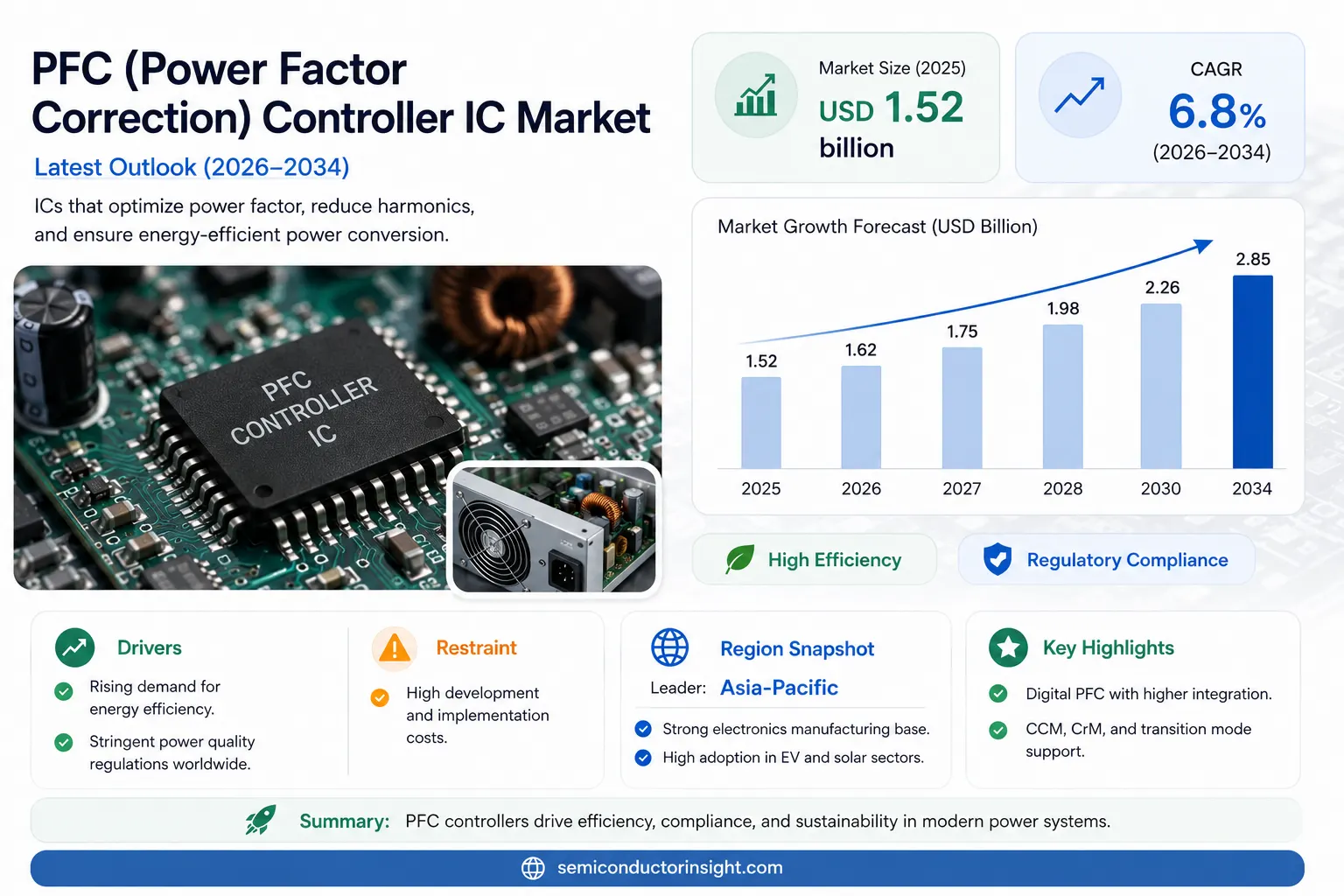
Global PFC (Power Factor Correction) Controller IC market size was valued at USD 1.52 billion in 2025. The market is projected to grow from USD 1.62 billion in 2026 to USD 2.85 billion by 2034, exhibiting a CAGR of 6.8% during the forecast period.
PFC (Power Factor Correction) Controller ICs are specialized semiconductor devices designed to optimize the power factor in AC-DC power supplies by shaping the input current waveform to align closely with the input voltage. These integrated circuits play a critical role in modern electronics by reducing harmonic distortion, improving energy efficiency, and ensuring compliance with international power quality standards. They typically support various operating modes including continuous conduction mode (CCM), critical conduction mode (CrM), and transition mode, making them suitable for applications ranging from consumer electronics and LED lighting to industrial equipment, data centers, and electric vehicle chargers.
The market is experiencing steady growth due to several factors, including rising global emphasis on energy efficiency, stringent regulatory requirements for power quality, and the proliferation of electronic devices with switching power supplies. Furthermore, the expansion of renewable energy systems, data centers, and electric vehicles continues to drive demand for advanced power management solutions. Initiatives by key players in the market are also expected to fuel the market growth. For instance, leading semiconductor manufacturers have introduced new families of digital and analog PFC controllers featuring higher integration, better efficiency at light loads, and enhanced protection features. Infineon Technologies, STMicroelectronics, Texas Instruments, ON Semiconductor, and Renesas Electronics are some of the key players that operate in the market with a wide range of portfolios.
MARKET DRIVERS
ising Demand for Energy-Efficient Power Solutions
PFC (Power Factor Correction) Controller IC Market is propelled by Global push toward higher energy efficiency in electronic devices and power systems. As industries seek to minimize power losses and optimize energy consumption, PFC controller ICs play a critical role in improving power factor and reducing harmonic distortion in AC-DC conversion applications.
Stringent Regulatory Standards and Compliance Requirements
Governments and international bodies continue to enforce stricter regulations on power quality and energy efficiency, such as IEC 61000-3-2 standards, driving widespread adoption of advanced PFC solutions across consumer electronics, industrial equipment, and automotive sectors. PFC controller ICs enable manufacturers to meet these mandates while enhancing overall system performance.
➤ The integration of PFC controller ICs supports the growing deployment of renewable energy systems, electric vehicles, and data centers where efficient power management is essential for operational reliability and cost savings.
Technological advancements in digital control and integration with smart power management systems further accelerate market expansion, allowing for more compact and high-performance designs that align with modern application needs.
MARKET CHALLENGES
Design Complexity and Integration Issues
Implementing effective power factor correction in diverse applications presents significant engineering challenges, particularly in balancing efficiency, size, and cost constraints while maintaining stable operation across varying load conditions.
Other Challenges
Intense Market Competition and Pricing Pressure
The presence of numerous established semiconductor manufacturers leads to competitive pricing dynamics, which can impact profit margins and necessitate continuous innovation in PFC (Power Factor Correction) Controller IC development.
Supply Chain Vulnerabilities for Critical Components
Fluctuations in semiconductor availability and raw material costs create uncertainties in production planning and can delay the rollout of new PFC controller IC solutions to meet rising demand.
MARKET RESTRAINTS
High Development and Implementation Costs
PFC (Power Factor Correction) Controller IC Market faces limitations from elevated costs associated with advanced active PFC designs, including sophisticated control ICs and supporting components. These expenses can deter adoption, especially among smaller manufacturers or in cost-sensitive applications.Additionally, the technical expertise required for seamless integration into existing power systems adds to overall project expenses, slowing penetration in certain market segments despite the long-term energy savings potential.
MARKET OPPORTUNITIES
Expansion in Emerging Applications and Technologies
Rapid growth in electric vehicles, data center infrastructure, and renewable energy integration creates substantial prospects for innovative PFC controller IC solutions. These sectors demand high-efficiency power management to support sustainable operations and higher power densities.Advancements in wide-bandgap semiconductors and digital PFC control techniques offer pathways for next-generation products with superior performance characteristics, enabling market players to capture new revenue streams through differentiated offerings.
PFC (Power Factor Correction) Controller IC Market Trends
Rising Emphasis on Energy Efficiency and Power Quality Standards
PFC (Power Factor Correction) Controller ICs continue to see strong adoption as industries prioritize energy-efficient power management solutions. These specialized semiconductor devices optimize the power factor in AC-DC power supplies by aligning input current waveforms with voltage, significantly reducing harmonic distortion. This capability helps manufacturers meet stringent international power quality standards while improving overall system efficiency across various applications including consumer electronics, LED lighting, industrial equipment, and data centers.
Other Trends
Growth in Renewable Energy and Electric Vehicle Applications
The expansion of renewable energy systems and electric vehicle chargers is creating sustained demand for advanced PFC (Power Factor Correction) Controller IC solutions. These ICs play a vital role in power management for high-efficiency converters used in solar inverters, wind power systems, and EV charging infrastructure. Their support for operating modes such as continuous conduction mode (CCM), critical conduction mode (CrM), and transition mode makes them highly versatile for modern power electronics requirements.
Technological Advancements by Leading Semiconductor Manufacturers
Innovation remains a key driver in PFC (Power Factor Correction) Controller IC Market with major players introducing new digital and analog controllers featuring higher integration levels and improved performance. Companies such as Infineon Technologies, STMicroelectronics, Texas Instruments, ON Semiconductor, and Renesas Electronics are enhancing their portfolios with solutions that deliver better efficiency at light loads and advanced protection features. These developments address the evolving needs of data centers and other high-demand environments where reliable power factor correction is essential for minimizing energy losses and ensuring compliance with regulatory requirements.
The proliferation of electronic devices incorporating switching power supplies further accelerates the need for effective PFC (Power Factor Correction) Controller IC implementations. As global focus on sustainability intensifies, these integrated circuits enable better energy utilization and reduced operational costs across industrial and commercial sectors. Market participants continue to invest in research and development to create more sophisticated solutions that balance performance, cost-effectiveness, and ease of integration in next-generation power systems.
COMPETITIVE LANDSCAPE
Key Industry Players
Dynamic Competition Among Semiconductor Leaders in PFC Controller IC Market
PFC (Power Factor Correction) Controller IC Market is moderately consolidated, with leading global semiconductor companies holding significant market shares through extensive product portfolios and technological innovation. Infineon Technologies and Texas Instruments stand out as dominant players, leveraging their broad range of analog and digital PFC controllers optimized for high efficiency, compliance with stringent energy standards, and diverse applications including consumer electronics, industrial power supplies, and electric vehicle charging systems. These leaders benefit from strong R&D capabilities, global manufacturing scale, and strategic partnerships that enable them to capture substantial portions of the growing demand driven by energy efficiency regulations and the expansion of data centers and renewable energy infrastructure.
Other significant players, including STMicroelectronics, ON Semiconductor, and Renesas Electronics, maintain competitive positions by focusing on niche innovations such as transition-mode and continuous conduction mode controllers with enhanced light-load efficiency and integrated protection features. Additional contributors like NXP Semiconductors, ROHM Semiconductor, Analog Devices, Microchip Technology, and Power Integrations further intensify competition through specialized solutions tailored for LED lighting, automotive, and high-power industrial segments, fostering a vibrant ecosystem of technological advancements in power management.
List of Key PFC (Power Factor Correction) Controller IC Companies Profiled
- Infineon Technologies
- Texas Instruments
- STMicroelectronics
- ON Semiconductor
- Renesas Electronics
- NXP Semiconductors
- ROHM Semiconductor
- Analog Devices
- Microchip Technology
- Power Integrations
- Toshiba Electronic Devices
- Monolithic Power Systems
- Richtek Technology
- Diodes Incorporated
- Fuji Electric
Segment Analysis:
| Segment Category | Sub-Segments | Key Insights |
| By Type |
|
Digital PFC Controllers are gaining prominence due to their superior flexibility in adapting to varying load conditions and enabling advanced features like real-time monitoring and adaptive control algorithms. These controllers excel in providing precise power factor correction across wide input voltage ranges while optimizing efficiency at both heavy and light loads. Their programmability allows system designers to fine-tune performance parameters, resulting in better compliance with stringent harmonic standards and enhanced system reliability in dynamic environments. |
| By Application |
|
EV Chargers represent a rapidly evolving area where PFC controller ICs play a pivotal role in managing high-power conversion while maintaining excellent power quality. These applications demand robust performance under fluctuating loads and high efficiency to minimize energy losses during charging cycles. PFC solutions in this segment support seamless integration with renewable energy sources and smart grid interfaces, facilitating faster charging times and improved thermal management in compact designs. |
| By End User |
|
Industrial Equipment benefits significantly from PFC controller ICs through enhanced energy efficiency and reduced harmonic distortion in motor drives, automation systems, and heavy machinery. These controllers enable stable operation in harsh industrial environments with variable power demands. Their implementation leads to lower operational costs, extended equipment lifespan, and better adherence to industrial power quality regulations, making them indispensable for modern smart factories and process control applications. |
| By Operating Mode |
|
Continuous Conduction Mode (CCM) is preferred in high-power applications where stable current flow and minimal ripple are critical for maintaining high efficiency and low electromagnetic interference. This mode offers excellent performance across full load ranges and supports higher power density designs. Designers value CCM-based controllers for their robustness in demanding scenarios such as data center power supplies and industrial inverters, where consistent power factor correction enhances overall system stability and thermal performance. |
| By Power Level |
|
High Power applications drive innovation in PFC controller ICs by requiring advanced thermal management, superior current handling capabilities, and integrated protection features. These solutions optimize energy transfer in large-scale systems while minimizing losses and ensuring compliance with global efficiency mandates. The focus on high-power segments encourages development of controllers with enhanced scalability, allowing seamless adaptation to evolving demands in renewable energy integration and large infrastructure projects. |
Regional Analysis: PFC (Power Factor Correction) Controller IC Market
Asia-Pacific
Asia-Pacific’s unparalleled electronics manufacturing base supports seamless production and customization of PFC controller ICs. Clusters in China and Southeast Asia facilitate rapid prototyping and scaling, while investments in advanced fabrication technologies enhance yield and performance consistency for next-generation devices.
Proactive policies across the region emphasize energy conservation and carbon reduction targets, boosting adoption of PFC solutions. This creates fertile ground for businesses to deploy intelligent power factor correction technologies in smart grids and industrial sectors.
The region leads in R&D for digital and hybrid PFC controller ICs optimized for AI-driven power systems and 5G infrastructure. Collaborative ecosystems between academia and industry speed up breakthroughs in efficiency and miniaturization.
Growing middle-class demand for energy-efficient appliances and electric mobility infrastructure continues to expand addressable opportunities, encouraging strategic partnerships and localized production strategies.
North America
North America maintains a strong position in PFC (Power Factor Correction) Controller IC Market through technological innovation and focus on high-reliability applications. The United States leads with substantial investments in data centers, renewable energy integration, and advanced industrial automation. Emphasis on compliance with strict energy efficiency regulations drives demand for sophisticated PFC solutions that minimize energy waste and improve system stability. Enterprises prioritize premium ICs featuring enhanced digital control and monitoring capabilities for mission-critical power systems.
Europe
Europe exhibits steady growth in PFC (Power Factor Correction) Controller IC Market, supported by ambitious climate goals and the transition toward sustainable energy sources. Key markets including Germany, France, and the UK emphasize integration of PFC controllers in wind and solar power electronics as well as electric vehicle infrastructure. Stringent EU directives on power quality and harmonic distortion encourage widespread adoption across industrial and commercial sectors. The region benefits from collaborative research initiatives that advance eco-friendly semiconductor designs.
South America
South America represents an emerging frontier for PFC (Power Factor Correction) Controller IC Market with increasing infrastructure development and industrial expansion. Brazil and Argentina show rising interest in energy-efficient technologies for mining operations, manufacturing facilities, and urban power networks. While adoption lags behind mature regions, growing awareness of power quality issues and potential for renewable projects creates gradual opportunities for PFC controller solutions tailored to local grid conditions and cost sensitivities.
Middle East & Africa
The Middle East and Africa region demonstrates promising potential in PFC (Power Factor Correction) Controller IC Market fueled by diversification efforts and smart city initiatives. Gulf countries invest heavily in modernizing power infrastructure and expanding data centers, creating demand for reliable PFC ICs. Africa’s focus on electrification projects and renewable energy adoption opens avenues for cost-effective solutions suited to challenging operating environments. Market participants explore partnerships to address unique regional requirements in power stability and efficiency.
Report Scope
This market research report provides a comprehensive analysis of the PFC (Power Factor Correction) Controller IC Market , covering the forecast period 2026–2034. It offers detailed insights into market dynamics, technological advancements, competitive landscape, and key trends shaping the industry.
Key focus areas of the report include:
- Market Overview: The report begins with an overview outlining its current market scenario, key growth indicators, and industry transformation drivers. It discusses macroeconomic factors, demand–supply balance, regulatory landscape, and the strategic role of semiconductors in powering advancements across industries such as automotive, telecommunications, consumer electronics, and industrial automation.
- Market Size & Forecast: Historical data and future projections for revenue, unit shipments, and market value across major regions and segments.
- Segmentation Analysis: Detailed breakdown by product type, technology, application, and end-user industry to identify high-growth segments and investment opportunities.
- Regional Insights: Insights into market performance across North America, Europe, Asia-Pacific, Latin America, and the Middle East & Africa, including country-level analysis where relevant.
- Competitive Landscape: Profiles of leading market participants, including their product offerings, R&D focus, manufacturing capacity, pricing strategies, and recent developments such as mergers, acquisitions, and partnerships.
- Technology Trends & Innovation: Assessment of emerging technologies, integration of AI/IoT, semiconductor design trends, fabrication techniques, and evolving industry standards.
- Market Drivers & Restraints: Evaluation of factors driving market growth along with challenges, supply chain constraints, regulatory issues, and market-entry barriers.
- Stakeholder Insights: Insights for component suppliers, OEMs, system integrators, investors, and policymakers regarding the evolving ecosystem and strategic opportunities.
Primary and secondary research methods are employed, including interviews with industry experts, data from verified sources, and real-time market intelligence to ensure the accuracy and reliability of the insights presented.
FREQUENTLY ASKED QUESTIONS:
What is the current market size of PFC (Power Factor Correction) Controller IC Market?
-> PFC (Power Factor Correction) Controller IC Market was valued at USD 1.52 billion in 2025 and is expected to reach USD 2.85 billion by 2034.
Which key companies operate in PFC (Power Factor Correction) Controller IC Market?
-> Key players include Infineon Technologies, STMicroelectronics, Texas Instruments, ON Semiconductor, and Renesas Electronics, among others.
What are the key growth drivers?
-> Key growth drivers include rising emphasis on energy efficiency, stringent regulatory requirements for power quality, and proliferation of electronic devices with switching power supplies.
Which region dominates the market?
-> Asia-Pacific is the fastest-growing region with strong demand from consumer electronics and industrial sectors.
What are the emerging trends?
-> Emerging trends include digital PFC controllers with higher integration, better light-load efficiency, enhanced protection features, and support for CCM, CrM, and transition modes.

Get Sample Report PDF for Exclusive Insights
Report Sample Includes
- Table of Contents
- List of Tables & Figures
- Charts, Research Methodology, and more...
 Download Sample Report PDF