Pellicle for EUV (Transmissive) Market Insights
Global Pellicle for EUV (Transmissive) market size was valued at USD 210 million in 2025. The market is projected to grow from USD 225 million in 2026 to USD 420 million by 2034, exhibiting a CAGR of 7.9% during the forecast period.Pellicles for extreme‑ultraviolet lithography are ultra‑thin transmissive membranes that shield photomasks from particle contamination while allowing >13 nm wavelength light to pass with minimal loss. Typically fabricated from silicon‑nitride or advanced polymer composites, they must endure high photon flux without deformation.The market is accelerating because semiconductor fabs are expanding EUV tool capacity, driving demand for reliable transmissive pellicles. Furthermore, development of higher numerical‑aperture EUV systems pushes suppliers to enhance durability and transmission efficiency. Key players such as ASML Holding, Toppan Printing, JSR Corporation and Hoya continue substantial R&D investment, reinforcing growth prospects.
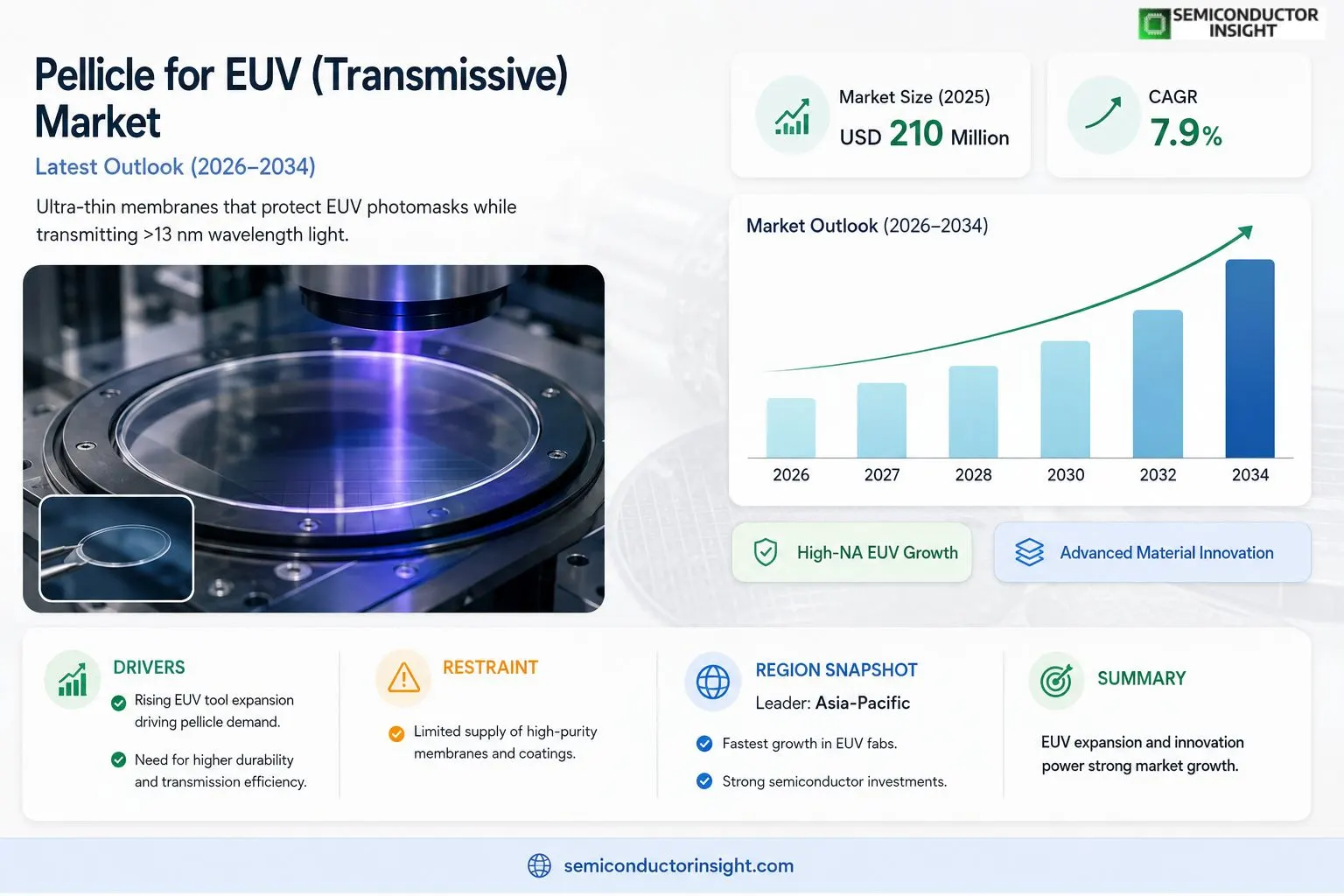
MARKET DRIVERS
Technology Adoption and Yield Improvement
Pellicle for EUV (Transmissive) Market is gaining traction as semiconductor fabs seek to reduce defectivity on EUV lithography tools. Advanced transmissive pellicles enable higher patterning fidelity, directly supporting yield enhancement objectives across 7 nm and sub‑5 nm nodes.
Cost Efficiency of Throughput
Manufacturers are prioritizing equipment that minimizes downtime. Pellicles that can withstand higher photon flux without degradation lower replacement cycles, delivering measurable cost savings per wafer.
➤ Industry analysts project that effective pellicle integration could improve overall fab throughput by up to 12 % within the next three years.
In addition, the push for green manufacturing makes low‑power, transmissive solutions attractive, aligning with sustainability targets while maintaining performance.
MARKET CHALLENGES
Material Compatibility and Process Integration
Integrating a new pellicle material into existing EUV scanner workflows poses significant hurdles. Compatibility with photoresist chemistries and the need for precise tension control add complexity to process lines.
Other Challenges
Thermal Stability
The intense EUV photon flux generates localized heating. Maintaining optical clarity under thermal stress requires advanced substrate engineering, which can increase development timelines.
MARKET RESTRAINTS
Supply Chain Constraints
Production of high‑purity silica membranes and specialized coating materials is limited to a few capable suppliers. Any disruption in this niche supply chain can delay fab upgrades and slow adoption rates.
Regulatory and Safety Concerns
Handling of ultra‑thin membranes requires stringent cleanroom protocols. Regulatory scrutiny over particle generation and long‑term reliability introduces additional compliance costs for fab operators.
MARKET OPPORTUNITIES
Emerging High‑NA EUV Platforms
Next‑generation High‑NA (Numerical Aperture) EUV scanners demand pellicles with superior transmission and minimal distortion. This creates a clear growth window for innovators who can deliver compliant, high‑performance pellicle solutions.
Strategic Partnerships
Collaborations between pellicle manufacturers and EUV tool vendors are accelerating technology roadmaps. Joint development programs enable faster validation and market entry, expanding the addressable customer base.Finally, regional investment incentives in key semiconductor hubs are encouraging fabs to upgrade to transmissive pellicle systems, further bolstering demand for Pellicle for EUV (Transmissive) Market.
Pellicle for EUV (Transmissive) Market Trends
Increasing Demand from EUV Lithography Expansion
Pellicle for EUV (Transmissive) Market is experiencing a clear upward trajectory as semiconductor manufacturers expand extreme‑ultraviolet tool capacity across advanced nodes. Fab operators are integrating more EUV scanners to meet technology roadmaps, which directly raises the requirement for reliable transmissive pellicles that can protect photomasks without compromising the >13 nm wavelength throughput. This demand shift is reinforced by the industry’s push toward higher productivity and lower defectivity, prompting equipment suppliers to prioritize pellicle durability and optical performance in their product pipelines.
Other Trends
Material Innovation
Advances in silicon‑nitride formulations and emerging polymer composites are redefining the performance envelope of pellicles used in EUV lithography. Modern membranes achieve sub‑nanometer thickness while maintaining mechanical resilience against high photon flux, reducing mask damage risk. Suppliers are leveraging atomic layer deposition and plasma‑enhanced processes to deliver uniform coatings that improve transmission efficiency and mitigate thermal deformation. These material breakthroughs enable thinner pellicles that support tighter process windows, a critical factor for high‑volume production.
Shift Toward Higher Numerical Aperture Systems
Another pivotal trend shaping Pellicle for EUV (Transmissive) Market is the transition to higher numerical‑aperture (NA) EUV platforms. As chipmakers adopt NA 0.55 and beyond, pellicle specifications must evolve to sustain higher illumination intensities and broader angular spreads. This evolution drives R&D investments from key players such as ASML, Toppan Printing, JSR Corporation, and Hoya, who are engineering pellicles with enhanced thermal conductivity and reduced absorbance. The cumulative effect is a more robust supply chain that can meet the stringent demands of next‑generation patterning while preserving yield targets.
COMPETITIVE LANDSCAPEKey Industry Players
Pellicle for EUV (Transmissive) Market Competitive Overview
EUV Transmissive Pellicle Market is dominated by a handful of technologically advanced firms that couple deep‑ultraviolet lithography expertise with high‑precision materials engineering. ASML Holding leads the ecosystem by integrating pellicle specifications into its next‑generation NA‑EUV tools, while Japanese suppliers such as Toppan Printing, JSR Corporation and Hoya Corporation command the majority of the material supply chain through proprietary silicon‑nitride and polymer composite processes. Their substantial R&D budgets enable rapid iteration on durability, transmission efficiency and thermal stability, positioning them as the primary vendors for semiconductor fabs expanding EUV capacity worldwide.
Beyond the tier‑one group, several niche players contribute critical capabilities that diversify the supply base. Nikon and Canon leverage decades of photomask experience to offer customized pellicle designs for specialty nodes. Dai Nippon Printing and Shanghai Nanotai focus on high‑volume manufacturing of thin‑film membranes, while Toray Industries supplies advanced polymer substrates for emerging high‑NA EUV architectures. Additionally, Intel, Samsung and TSMC maintain in‑house development programs that drive co‑innovation with material suppliers, reinforcing a collaborative landscape that balances scale, specialization and innovation.
List of Key Pellicle for EUV (Transmissive) Companies Profiled
- ASML Holding
- Toppan Printing
- JSR Corporation
- Hoya Corporation
- Nikon Corporation
- Canon Inc.
- Dai Nippon Printing
- Intel Corporation
- Samsung Electronics
- Taiwan Semiconductor Manufacturing Co. (TSMC)
- Shanghai Nanotai
- Toray Industries
- NEC Corporation
- Applied Materials (Materials Division)
Segment Analysis:
| Segment Category | Sub-Segments | Key Insights |
| By Type |
|
Silicon‑nitride pellicles are favored for their proven mechanical robustness and reliable transmission performance.
|
| By Application |
|
High NA EUV lithography drives demand for pellicles that can cope with tighter diffraction limits and higher illumination angles.
|
| By End User |
|
Semiconductor manufacturers prioritize reliability and cost‑effectiveness in high‑throughput fab environments.
|
| By Technology Maturity |
|
Mature solutions dominate current EUV mask lines, offering proven performance and predictable supply.
|
| By Performance Requirement |
|
Superior durability is a critical differentiator as EUV sources become more powerful.
|
Regional Analysis: Europe
Europe
Europe possesses a well-established semiconductor manufacturing ecosystem, with a concentration of leading equipment and materials suppliers. This strong industrial base provides a solid foundation for the development and deployment of pellicle films. The region’s commitment to precision engineering and high-quality standards aligns well with the stringent requirements of EUV optics.
Ongoing research and development efforts in Europe are focused on enhancing the performance and reliability of pellicle films. This includes exploring new materials and designs to improve optical clarity, reduce contamination, and extend the lifespan of EUV optics. Collaboration between industry and academia is driving these advancements.
European Union regulations related to environmental sustainability and product safety are influencing the development and adoption of pellicle films. Focus on minimizing waste and promoting circular economy principles are becoming increasingly important considerations for manufacturers.
The European market for pellicle films is characterized by a mix of established players and emerging companies, fostering healthy competition and innovation. Strategic partnerships and collaborations are becoming increasingly common as companies seek to expand their market reach and develop advanced solutions.
North America
North America, particularly the United States, presents a substantial market for Pellicle for EUV (Transmissive) Market. The region’s robust semiconductor industry, driven by companies like Intel and TSMC’s presence in the US, is a key factor. The strong emphasis on technological innovation and government support for domestic chip manufacturing create a favorable environment for pellicle adoption. Demand is particularly high for advanced packaging and leading-edge chip production. The focus on high-performance computing, artificial intelligence, and data centers further propels market growth. However, geopolitical factors and supply chain concerns could influence market dynamics. The strong R&D investments in North America are consistently driving innovation in pellicle film technology. The increasing complexity of EUV optics necessitates advanced protection solutions, enhancing the demand for pellicle.
Asia-Pacific
Asia-Pacific is expected to experience the fastest growth in Pellicle for EUV (Transmissive) Market. Driven by the rapid expansion of semiconductor manufacturing in countries like Taiwan, South Korea, and China, the region is a critical market. The increasing investment in advanced chip fabrication facilities, particularly those utilizing EUV lithography, is creating a significant demand for high-quality pellicle films. Government initiatives promoting semiconductor industry development are further fueling this growth. The region’s competitive landscape is characterized by a large number of players, both established and emerging, driving innovation and cost competitiveness. The focus on high-volume chip production and the growing demand for advanced displays contribute to the increasing adoption of pellicle technology. Geopolitical tensions and trade policies could present challenges to market growth.
South America
South America represents a relatively nascent market for Pellicle for EUV (Transmissive) Market, but it holds potential for future growth. The increasing adoption of electronics and the gradual development of local semiconductor industries are creating a small but growing demand. The region’s focus on industrial automation and telecommunications could drive future growth in the market. However, the market is currently limited by the relatively small scale of semiconductor manufacturing and the availability of advanced equipment. Government initiatives to promote technological development and attract foreign investment could stimulate market growth. The cost of pellicle films could be a barrier to adoption in the region.
Middle East & Africa
The Middle East & Africa region represents the smallest market for Pellicle for EUV (Transmissive) Market currently, but it has potential for growth in the long term. The increasing investment in technology and infrastructure in some countries within the region could drive demand for advanced semiconductor solutions. The development of local electronics manufacturing industries could also contribute to market growth. However, the market is currently limited by the relatively small scale of semiconductor manufacturing and the economic challenges faced by some countries in the region. Future growth will likely be dependent on broader economic development and technological advancements in the region.
Report Scope
This market research report provides a comprehensive analysis of the Pellicle for EUV (Transmissive) Market , covering the forecast period 2026–2034. It offers detailed insights into market dynamics, technological advancements, competitive landscape, and key trends shaping the industry.
Key focus areas of the report include:
- Market Overview: The report begins with an overview outlining its current market scenario, key growth indicators, and industry transformation drivers. It discusses macroeconomic factors, demand–supply balance, regulatory landscape, and the strategic role of semiconductors in powering advancements across industries such as automotive, telecommunications, consumer electronics, and industrial automation.
- Market Size & Forecast: Historical data and future projections for revenue, unit shipments, and market value across major regions and segments.
- Segmentation Analysis: Detailed breakdown by product type, technology, application, and end-user industry to identify high-growth segments and investment opportunities.
- Regional Insights: Insights into market performance across North America, Europe, Asia-Pacific, Latin America, and the Middle East & Africa, including country-level analysis where relevant.
- Competitive Landscape: Profiles of leading market participants, including their product offerings, R&D focus, manufacturing capacity, pricing strategies, and recent developments such as mergers, acquisitions, and partnerships.
- Technology Trends & Innovation: Assessment of emerging technologies, integration of AI/IoT, semiconductor design trends, fabrication techniques, and evolving industry standards.
- Market Drivers & Restraints: Evaluation of factors driving market growth along with challenges, supply chain constraints, regulatory issues, and market-entry barriers.
- Stakeholder Insights: Insights for component suppliers, OEMs, system integrators, investors, and policymakers regarding the evolving ecosystem and strategic opportunities.
Primary and secondary research methods are employed, including interviews with industry experts, data from verified sources, and real-time market intelligence to ensure the accuracy and reliability of the insights presented.
FREQUENTLY ASKED QUESTIONS:
What is the current market size of Pellicle for EUV (Transmissive) Market?
-> Pellicle for EUV (Transmissive) Market was valued at USD 210 million in 2025 and is expected to reach USD 420 million by 2034.
Which key companies operate in Pellicle for EUV (Transmissive) Market?
-> Key players include ASML Holding, Toppan Printing, JSR Corporation, and Hoya, among others.
What are the key growth drivers?
-> Key growth drivers include expansion of EUV tool capacity in semiconductor fabs, development of higher numerical‑aperture EUV systems, and the need for more durable and high‑transmission pellicles.
Which region dominates the market?
-> The reference does not specify a dominant region for Pellicle for EUV (Transmissive) Market.
What are the emerging trends?
-> Emerging trends include advancements in high‑NA EUV technology, improved material composites for greater durability, and enhanced transmission efficiency for >13 nm wavelength light.

Get Sample Report PDF for Exclusive Insights
Report Sample Includes
- Table of Contents
- List of Tables & Figures
- Charts, Research Methodology, and more...
 Download Sample Report PDF