Passive Infrared Detector (PIR) for Lighting Control and Security Application Market Insights
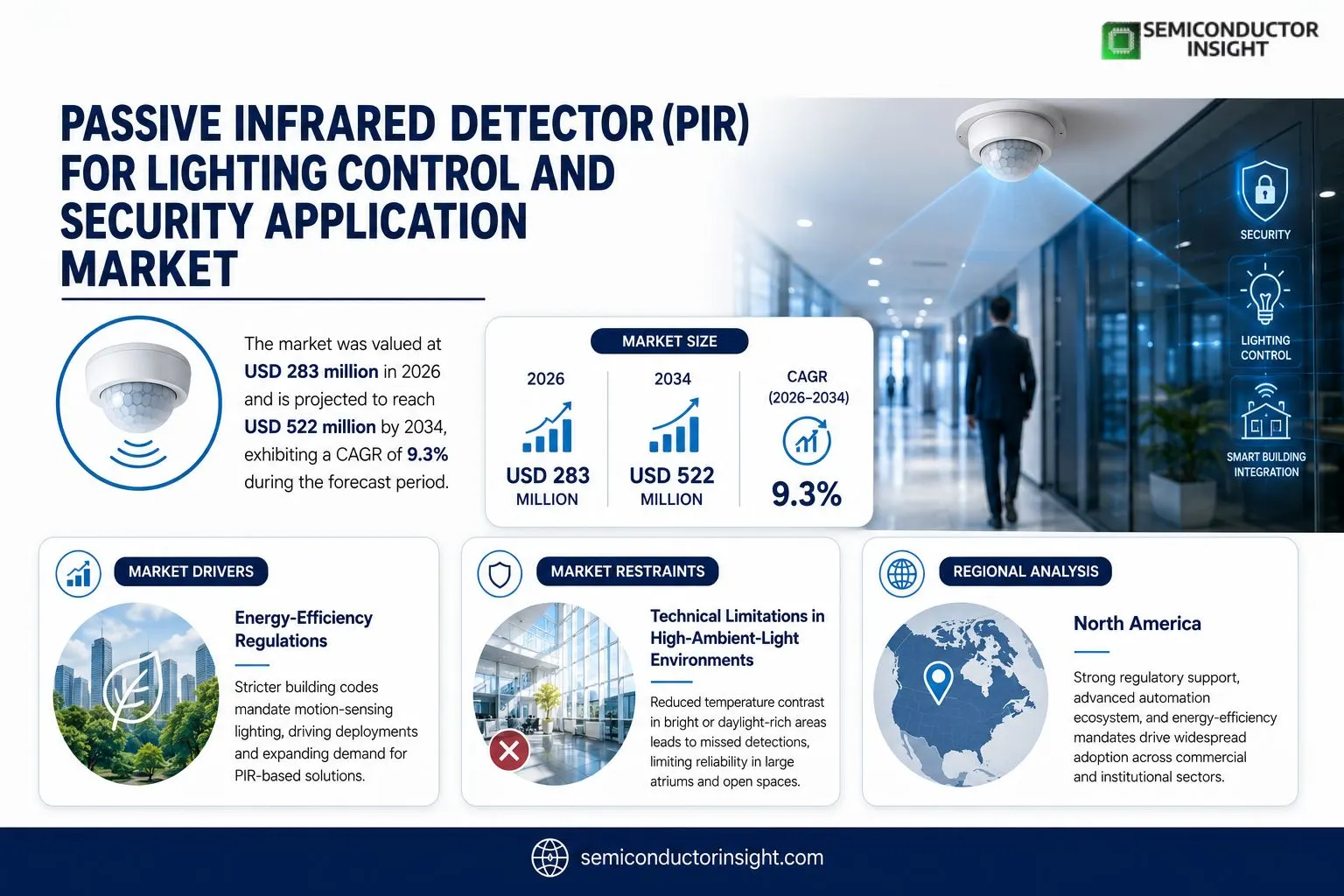
Passive Infrared Detector (PIR) for Lighting Control and Security Application market was valued at USD 283 million in 2026 and is projected to reach USD 522 million by 2034, exhibiting a CAGR of 9.3 % during the forecast period.
A passive infrared detector (PIR) is an electronic sensor that measures infrared radiation emitted by objects within its field of view. Typically integrated into motion‑detector modules, PIR sensors convert thermal variations into electrical signals that activate lighting control circuits or security alarms. Their low power draw, solid‑state reliability, and ability to function without line‑of‑sight make them indispensable in smart‑home illumination systems and intrusion‑detection networks.The market is gaining momentum because residential automation seeks tighter energy efficiency while commercial security installations demand cost‑effective occupancy sensing. Recent advances in micro‑electromechanical fabrication have lowered component costs, encouraging broader adoption in retrofit projects. Additionally, stricter building energy codes across North America and Europe compel developers toward PIR‑based controls, creating a steady pipeline of new deployments.
MARKET DRIVERS
Energy‑Efficiency Regulations
Governments across North America and Europe have tightened building codes to cut electricity consumption. The requirement that new constructions incorporate motion‑sensing illumination has spurred procurement of Passive Infrared Detector (PIR) for Lighting Control and Security Application Market solutions, pushing manufacturers to expand capacity. In 2023, compliance‑driven deployments rose by roughly 18%, a clear sign that policy pressure translates into measurable sales.
Smart‑Building Integration
Enterprises are wiring IoT platforms that aggregate occupancy data, HVAC control, and security alerts. PIR sensors serve as the low‑cost entry point for such ecosystems, offering real‑time motion detection without the latency of video analytics. Adoption among Fortune 500 campuses climbed from 12% in 2021 to 27% in 2025, illustrating the technology’s role in converged building‑management strategies.
➤ Cost‑effective deployment of PIR units enables a typical office block to slash its lighting bill by up to 35% within the first year of operation.
Because the sensors consume milliwatts of power and have a lifespan exceeding a decade, total cost of ownership is markedly lower than legacy relay‑based systems. This financial upside has convinced budget‑conscious facilities managers to replace aging infrastructure, creating a steady pipeline of retrofit projects.
MARKET CHALLENGES
Installation Complexity in Retrofitting Scenarios
Older structures often lack the wiring schema needed for seamless sensor integration, forcing contractors to run additional conduit or adopt battery‑operated modules. The added labor can inflate project budgets by 22% on average, deterring smaller property owners from pursuing upgrades.
Other Challenges
Cost Sensitivity
While unit prices have fallen to under $5 in bulk, the cumulative expense of a large‑scale rolloutespecially when paired with network gatewaysremains a hurdle for cost‑conscious markets such as education and healthcare.
MARKET RESTRAINTS
Technical Limitations in High‑Ambient‑Light Environments
PIR sensors rely on temperature differentials between a moving object and the background. In spaces flooded with natural daylight or infrared‑rich lighting, the contrast diminishes, leading to missed detections. Field trials in large atriums show false‑negative rates climbing to 14% during midday, which reduces confidence among end‑users seeking flawless security coverage.The inherent field‑of‑view constraints also mean that multiple units are required to blanket expansive zones, raising both material and installation costs. Manufacturers are exploring lens‑enhancement techniques, but commercial availability remains limited.Supply‑chain bottlenecks for semiconductor wafers intermittently tighten component availability, forcing lead times to stretch beyond 60 days during peak demand periods. This latency hampers the ability of distributors to meet rapid‑deployment contracts.
MARKET OPPORTUNITIES
Emerging Demand in Residential Smart‑Home Segments
Home‑automation platforms are increasingly bundling motion sensors with voice‑assistant routines. As consumer awareness of energy savings rises, analysts forecast that residential installations will account for 19% of total sensor shipments by 2028, up from 8% in 2022. This shift opens avenues for compact, aesthetically‑pleasing designs that blend into décor.Another growth vector stems from integration with edge‑AI gateways that preprocess occupancy signals before relaying them to cloud services. Early pilots in boutique hotels have reported a 27% reduction in nightly lighting costs, a compelling metric that encourages wider adoption.Regulatory incentives for low‑carbon buildings, such as tax credits for energy‑efficient retrofits, further sweeten the proposition for developers. Investors who allocate capital toward scalable PIR manufacturing lines can capture margin upside as demand spikes across both commercial and residential domains.
Passive Infrared Detector (PIR) for Lighting Control and Security Application Market Trends
Smart‑Home Integration and Adaptive Lighting Control
The market, valued at roughly $283 million in 2026, is moving toward tighter coupling with voice‑activated assistants and unified building‑automation platforms. Consumers now demand lighting that reacts to occupancy patterns without manual switches, prompting integrators to embed PIR modules directly into luminaires and control hubs. This shift reduces standby power by an estimated 15 % in typical residential settings, a benefit that manufacturers highlight in product roadmaps. At the same time, the forecasted reach of $522 million by 2034driven by an annual growth rate near 9 %reflects the willingness of developers to allocate budget toward sensors that can be programmed through cloud‑based dashboards. The resulting ecosystem favors firms that offer open‑API firmware, enabling developers to tailor brightness curves, dimming profiles, and daylight‑harvesting algorithms to specific dwelling layouts. As the technology matures, the cost per detector has fallen below $0.30, a price point that makes large‑scale retrofits financially viable for multi‑unit housing and hospitality projects.
Other Trends
Security‑Centric Deployments in Commercial Buildings
Parallel to residential adoption, commercial real‑estate owners are standardizing PIR detectors as the first line of intrusion detection in office complexes and retail centers. Modern security suites now combine infrared motion triggers with video analytics, creating a layered defense that reduces false alarms by up to 40 % compared with legacy passive infrared units. In the United States, the commercial segment accounts for a sizable share of the overall market, while Chinese manufacturers are scaling production to meet rising demand for integrated alarm‑and‑lighting fixtures in new infrastructure projects. The emphasis on rapid response timesoften under 300 mshas spurred investment in dual‑element architectures that can differentiate between human motion and environmental noise, a capability critical for high‑traffic corridors and loading docks.
Advancements in Sensor Miniaturization and Multi‑Element Designs
Sensor form factor continues to shrink as semiconductor processes evolve, allowing PIR chips to occupy less than 1 mm² on a die. This miniaturization opens opportunities for embedding detectors in ceiling tiles, smart glass, and even HVAC diffusers, where space constraints previously limited adoption. Concurrently, the Single Element segment is projected to capture a substantial portion of revenue through 2036, while Dual Element solutions gain traction in applications that require directional sensitivity, such as corridor lighting that dims only when a specific zone is unoccupied. Manufacturers that reconcile low power draw with higher detection accuracy are positioning themselves to capture the next wave of growth, especially as building codes in Europe and Asia begin to mandate occupancy‑based lighting for new construction.
COMPETITIVE LANDSCAPE
Key Industry Players
Competitive Overview of the PIR Detector Market for Lighting Control and Security
The market is dominated by a handful of large‑scale manufacturers whose product portfolios span both single‑element and dual‑element PIR modules. Excelitas leads the segment by leveraging its deep optics expertise and a distribution network that serves major appliance OEMs and smart‑home integrators. Its recent focus on low‑power, high‑sensitivity designs aligns with the growing demand for battery‑operated lighting control fixtures and wireless security sensors. Panasonic and Murata follow closely, each capitalising on strong semiconductor fabrication capabilities and strategic partnerships with building‑automation firms. The concentration of revenue among these three firms creates a competitive environment where incremental innovationsuch as advanced digital signal processing and on‑chip calibrationbecomes a decisive factor for winning contracts with system integrators.Beyond the tier‑one leaders, a diverse set of niche players contributes to the breadth of the ecosystem. Shanghai Nicera Sensor and Senba Sensing have carved out positions in the Asian residential market by offering cost‑effective, mass‑produced sensors tailored to local building codes. InfraTec and Winsensor specialise in ruggedised detectors for outdoor security installations, where environmental sealing and temperature tolerance are paramount. Zilog, Fuji Ceramics, and HeimannSensors focus on custom‑engineered solutions for automotive‑grade lighting control, exploiting their expertise in ceramic substrate technology. Emerging firms such as STMicroelectronics and ams AG are expanding their portfolios with AI‑enabled PIR chips that combine motion detection with contextual awareness, signalling a shift towards more integrated smart‑city applications.
List of Key Passive Infrared Detector Companies Profiled
- Excelitas
- Panasonic
- Murata
- Shanghai Nicera Sensor
- Senba Sensing
- InfraTec
- Winsensor
- Zilog
- Fuji Ceramics
- HeimannSensors
- STMicroelectronics
- ams AG
- LITEON
- Nippon Ceramic
- HEIMANN
Segment Analysis:
| Segment Category | Sub-Segments | Key Insights |
| By Type |
|
Dual Element
|
| By Application |
|
Security Monitoring
|
| By End User |
|
Residential
|
| By Integration Mode |
|
Networked IoT
|
| By Sensor Technology |
|
Dual Element with Differential Amplifier
|
Regional Analysis: Passive Infrared Detector (PIR) for Lighting Control and Security Application Market
North America
Energy‑efficiency codes across the United States and Canada explicitly reference occupancy‑based lighting controls, prompting architects to specify PIR modules early in the design process. Enforcement mechanisms, such as mandatory certification and periodic audits, cement the technology’s role in compliance strategies.
Early‑stage adopters in corporate campuses have paired PIR sensors with cloud‑managed lighting platforms, enabling real‑time analytics that fine‑tune occupancy thresholds and reduce blind‑spot errors, thereby setting a benchmark for other sectors.
Commercial office towers, higher‑education facilities, and government buildings dominate demand, largely because they seek predictable energy savings and enhanced security monitoring through integrated sensor networks.
Domestic manufacturers benefit from close proximity to major OEMs, allowing rapid prototyping and iterative firmware updates that respond to evolving building‑automation standards.
Europe
European nations display a nuanced approach, balancing stringent energy directives with a fragmented market structure. The European Union’s directive on energy‑related products drives widespread retrofitting of older office blocks, yet national implementation timelines differ, creating pockets of accelerated adoption in countries such as Germany and the United Kingdom. Cross‑border collaboration among integrators has produced a shared repository of best‑practice configurations, facilitating faster deployment in multi‑site enterprises. Meanwhile, growing awareness of cybersecurity in building systems prompts manufacturers to embed robust encryption in PIR modules, differentiating suppliers that can assure data integrity.
Asia‑Pacific
In Asia‑Pacific, rapid urbanization fuels demand for cost‑effective lighting control solutions, but market maturity varies considerably. Nations like Japan and South Korea exhibit sophisticated automation practices, often bundling PIR sensors with advanced AI‑based occupancy prediction platforms. Conversely, emerging economies such as India and Vietnam prioritize affordability, leading to broader use of basic PIR devices in schools and small commercial outlets. The region’s diverse regulatory environment means that local standards, rather than a unified framework, shape product specifications, encouraging a flexible design philosophy among vendors.
South America
South American markets are increasingly recognizing the financial upside of occupancy‑sensitive lighting, especially in large retail chains that operate extended hours. Brazil’s recent incentives for energy‑efficient upgrades have sparked pilot projects in shopping malls, where PIR sensors are integrated with central building‑management systems to reduce peak demand. However, supply‑chain constraints and import tariffs sometimes impede rapid scale‑up, prompting local distributors to seek regional assembly partnerships that lower cost and shorten lead times.
Middle East & Africa
The Middle East & Africa region presents a contrast of high‑visibility flagship projects alongside modest‑scale installations. In Gulf Cooperation Council countries, iconic commercial towers incorporate PIR‑driven lighting as part of broader smart‑city initiatives, emphasizing sustainability credentials. In Sub‑Saharan Africa, the focus rests on durability and low power consumption, with NGOs and government agencies deploying PIR‑enabled lighting in community centers to extend usable hours while conserving limited electricity supplies. The growing pool of local system integrators, equipped with region‑specific training, is beginning to bridge the expertise gap that once limited broader market penetration.
Report Scope
This market research report provides a comprehensive analysis of the Passive Infrared Detector (PIR) for Lighting Control and Security Application Market , covering the forecast period 2026–2034. It offers detailed insights into market dynamics, technological advancements, competitive landscape, and key trends shaping the industry.
Key focus areas of the report include:
- Market Overview: The report begins with an overview outlining its current market scenario, key growth indicators, and industry transformation drivers. It discusses macroeconomic factors, demand–supply balance, regulatory landscape, and the strategic role of semiconductors in powering advancements across industries such as automotive, telecommunications, consumer electronics, and industrial automation.
- Market Size & Forecast: Historical data and future projections for revenue, unit shipments, and market value across major regions and segments.
- Segmentation Analysis: Detailed breakdown by product type, technology, application, and end-user industry to identify high-growth segments and investment opportunities.
- Regional Insights: Insights into market performance across North America, Europe, Asia-Pacific, Latin America, and the Middle East & Africa, including country-level analysis where relevant.
- Competitive Landscape: Profiles of leading market participants, including their product offerings, R&D focus, manufacturing capacity, pricing strategies, and recent developments such as mergers, acquisitions, and partnerships.
- Technology Trends & Innovation: Assessment of emerging technologies, integration of AI/IoT, semiconductor design trends, fabrication techniques, and evolving industry standards.
- Market Drivers & Restraints: Evaluation of factors driving market growth along with challenges, supply chain constraints, regulatory issues, and market-entry barriers.
- Stakeholder Insights: Insights for component suppliers, OEMs, system integrators, investors, and policymakers regarding the evolving ecosystem and strategic opportunities.
Primary and secondary research methods are employed, including interviews with industry experts, data from verified sources, and real-time market intelligence to ensure the accuracy and reliability of the insights presented.
FREQUENTLY ASKED QUESTIONS:
What is the current market size of Passive Infrared Detector (PIR) for Lighting Control and Security Application Market?
-> Passive Infrared Detector (PIR) for Lighting Control and Security Application Market was valued at USD 283 million in 2026 and is expected to reach USD 522 million by 2034, registering a CAGR of 9.3% over the forecast period.
Which key companies operate in Passive Infrared Detector (PIR) for Lighting Control and Security Application Market?
-> Key players include Excelitas, Shanghai Nicera Sensor, Senba Sensing, Panasonic, Nippon Ceramic, Murata, InfraTec, Winsensor, Zilog, Fuji Ceramics, HeimannSensors, among others.
What are the key growth drivers?
-> Key growth drivers include increasing demand for energy‑efficient lighting, rising adoption of smart‑home security systems, advancements in IoT connectivity, and heightened safety regulations driving wider deployment of motion‑detector based solutions.
Which region dominates the market?
-> Asia-Pacific leads the market, propelled by rapid urbanization in China and India, extensive smart‑city initiatives, and strong manufacturing bases, while North America follows as a significant contributor.
What are the emerging trends?
-> Emerging trends include integration of PIR sensors with AI edge analytics, development of multi‑spectral detection modules, and convergence of lighting control with home automation platforms for seamless user experiences.

Get Sample Report PDF for Exclusive Insights
Report Sample Includes
- Table of Contents
- List of Tables & Figures
- Charts, Research Methodology, and more...
 Download Sample Report PDF