Key Statistics
Key Takeaways
- Capacitors are the largest type because they are indispensable for decoupling, filtering, energy storage and power conversion across nearly every electronic platform.
- Automotive electronics is the fastest-growing application as electric powertrains, ADAS, domain controllers and 48 V electrical systems raise voltage, reliability and component-density requirements.
- Asia Pacific is the largest regional market and the center of global supply, combining Japanese materials expertise with Chinese, Korean, Taiwanese and Southeast Asian manufacturing scale.
- Miniaturization and higher capacitance density are central product-development themes as designers seek more electrical function from constrained PCB area.
- Qualification and reliability protect premium automotive and industrial niches from the price compression that affects standard commodity passives.
- Supply regionalization creates opportunities for local distributors and second-source manufacturers even as the most demanding automotive-grade products remain concentrated among established suppliers.
Passive Components Market Overview
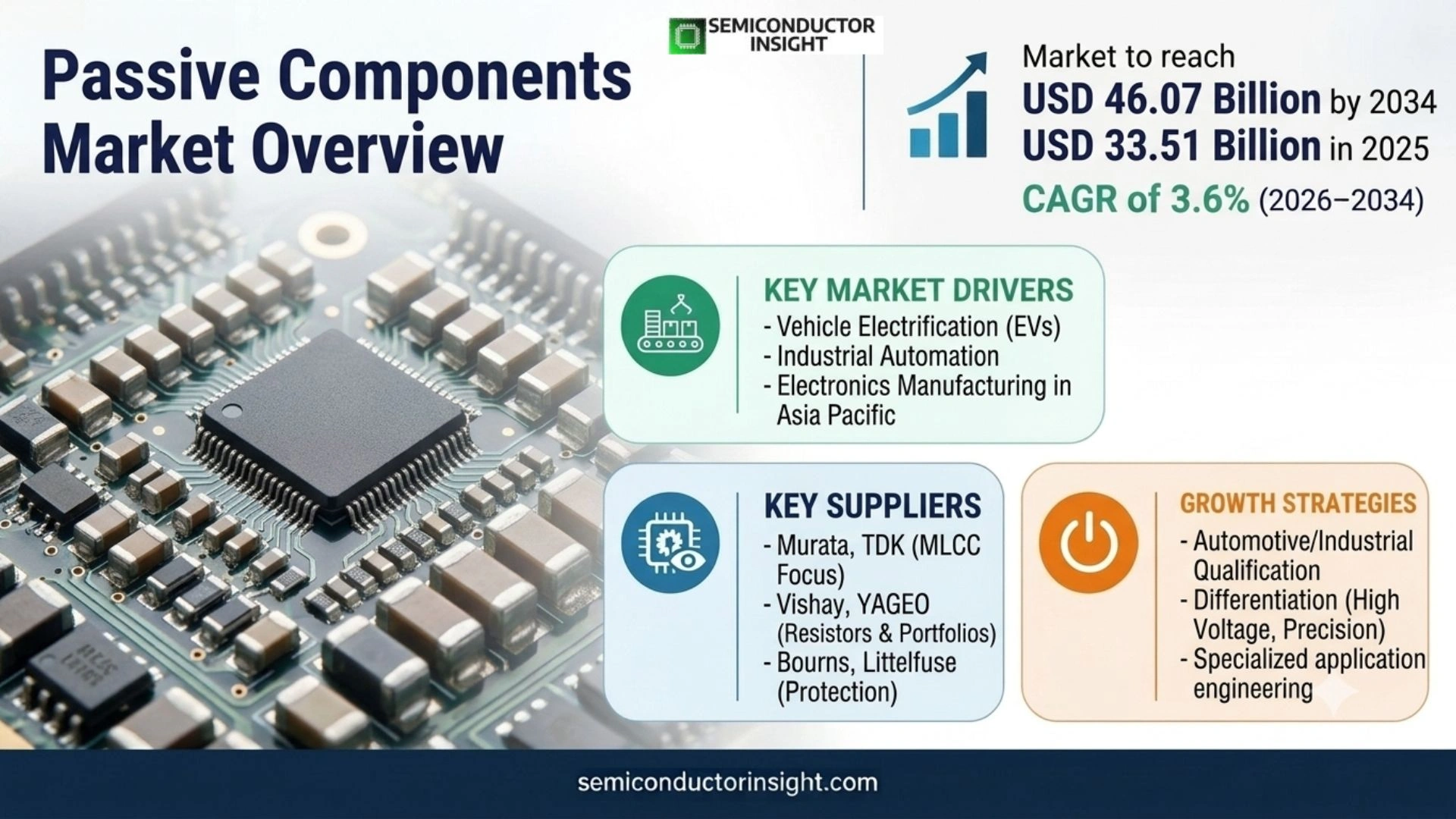
Passive Components Market was valued at USD 33.51 billion in 2025. Rebased from the report page’s published size anchors, the standardized series reaches USD 46.07 billion by 2034, equal to a 3.6% CAGR during 2026–2034. The 2026 estimated value is USD 34.72 billion. Asia Pacific is the largest market, supported by the concentration of electronics assembly, component manufacturing and fast-growing vehicle electrification across China, Japan, South Korea and Southeast Asia.
Passive components are electronic devices that shape current, voltage, impedance, timing and electromagnetic behavior without providing signal gain. The report scope centers on capacitors, resistors and inductors, together with the certification, mounting-technology and end-user structures that determine how those products are specified. Their role is foundational: virtually every power rail, analog interface, radio subsystem and digital board requires multiple passive elements before an active semiconductor can operate reliably.
The value mix is shifting away from undifferentiated standard parts toward components that tolerate higher temperature, voltage, frequency and mechanical stress. Automotive systems illustrate this shift clearly. AEC-Q200 qualification, tighter lot traceability and long product-availability commitments raise the cost of entry, but they also make supplier positions more durable once a device has been designed into an ECU, battery-management system, inverter or safety controller.
Demand is also becoming more application-specific. Smartphones and wearables reward ultra-small case sizes and high volumetric efficiency, communication equipment requires low-loss and high-frequency behavior, while industrial drives and renewable-energy converters need higher voltage and thermal endurance. This fragmentation favors suppliers with broad materials platforms because the commercial advantage comes from serving many electrical requirements without sacrificing consistency at scale.
Segment Analysis: By Type
By type, the report segments the market into capacitors, resistors and inductors. Capacitors hold the leading revenue position because filtering, decoupling and energy-storage functions occur repeatedly across power and signal paths, while higher-voltage and high-capacitance automotive designs are increasing value per placement.
| Type | Technical / purchasing role | Market position |
|---|---|---|
| Capacitors | Store and release electrical charge for decoupling, filtering, timing, DC-link and transient-control functions. MLCCs dominate high-volume surface-mount usage, while film and electrolytic technologies address higher energy and voltage needs. | Largest type. The segment benefits from rising capacitance density, more power rails and higher electronic content in vehicles, servers, communications hardware and industrial equipment. Automotive qualification and high-voltage requirements support a premium mix. |
| Resistors | Control current, divide voltage, sense current and set bias conditions. Thin-film, thick-film, shunt and precision technologies address very different accuracy, power and temperature-coefficient requirements. | A broad, high-volume segment where standard chip resistors face strong price competition, but precision, high-power and automotive-grade products retain attractive differentiation because tolerance, pulse capability and long-term stability directly affect system reliability. |
| Inductors | Store magnetic energy and suppress noise in power conversion, RF filtering and signal conditioning. Power inductors and ferrite devices are critical around DC-DC converters and high-current processors. | A value-rich growth area as switching regulators, EV power electronics and high-performance computing demand higher current handling, lower loss and smaller footprints. Material selection and thermal performance become increasingly important as power density rises. |
Certification, end-user and mounting-technology mix
The source page defines additional segmentation by end user, certification and technology. These axes matter commercially because the same nominal capacitance, resistance or inductance can carry very different qualification burdens and pricing depending on where it is installed. Automotive-grade parts are sold through long approval cycles, while commercial-grade surface-mount parts compete more directly on size, availability and cost.
| Axis | Source-defined segments | Commercial implication |
|---|---|---|
| End user | OEMs; Electronics Manufacturers; System Integrators | OEMs and tier-one suppliers impose the strictest design-in, traceability and lifecycle requirements. Contract manufacturers and system integrators place greater weight on cross-reference availability, distributor stocking and multi-source resilience because they must keep assembly lines running across many customer programs. |
| Certification | Automotive Grade; Industrial Grade; Commercial Grade | Automotive Grade commands the highest qualification burden through requirements such as AEC-Q200, extended temperature ranges and vibration endurance. Industrial grades prioritize reliability and life under harsh electrical loads, while commercial grades optimize cost, size and high-volume assembly compatibility. |
| Technology | Surface Mount; Through Hole; Hybrid | Surface-mount technology dominates modern high-density electronics because automated placement and compact footprints reduce board area and assembly cost. Through-hole parts remain important for high-power, high-voltage or mechanically stressed applications, and hybrid architectures combine both where power handling and density must coexist. |
Segment Analysis: By Application
By application, the market is segmented into Automotive Electronics, Mobile Phones & Tablets, Communication Equipment, Industrial Control and Others. Automotive electronics is the fastest-growing application because electrification and advanced driver-assistance functions increase both the number of passive placements and the technical value of each qualified component.
| Application | Demand characteristics |
|---|---|
| Automotive Electronics | The fastest-growing application. EV inverters, onboard chargers, battery-management systems, ADAS controllers, infotainment and zonal electrical architectures use large numbers of capacitors, resistors and inductors. Buyers prioritize AEC-Q200 qualification, high-temperature stability, long-term availability and failure-rate evidence, which supports higher average selling prices than equivalent commercial-grade parts. |
| Mobile Phones & Tablets | A high-volume, miniaturization-led segment where board area is the governing constraint. Suppliers compete on ultra-small case sizes, high capacitance per footprint, low-profile inductors and precise RF behavior. Demand is cyclical with device launches, but each generation continues to compress more functions and power rails into limited space. |
| Communication Equipment | Base stations, routers, optical transport and edge systems require low-loss RF passives, high-reliability power components and stable filtering networks. The move to higher frequencies and greater processing density shifts purchasing toward specialized dielectric materials, power inductors and tightly controlled precision parts rather than purely commodity components. |
| Industrial Control | Motor drives, PLCs, robotics, factory sensors and power supplies demand wide temperature ranges, surge endurance and long operating life. Replacement cycles are long, so design-ins can persist for many years. The segment rewards suppliers that offer stable specifications and support across multiple package sizes rather than frequent product churn. |
| Others | Medical electronics, aerospace, energy storage, renewable-power conversion and instrumentation form a diverse tail of the market. These applications often use lower volumes but place a higher value on reliability, documentation, voltage capability or precision, creating profitable niches for specialty capacitor, resistor and magnetic-component suppliers. |
Regional Analysis
Asia Pacific leads the passive components market because it combines the largest electronics manufacturing base with the deepest supplier clusters for ceramic materials, electrodes, ferrites, precision resistive films and high-volume assembly. North America and Europe remain important high-value demand markets, particularly for automotive, industrial, aerospace and data-center applications.
How does regional demand differ across the passive components market?
Regional differences are defined less by whether passives are needed-they are universal-and more by what systems are being manufactured and how buyers qualify supply. Asia Pacific is both the production center and the largest consumption base. North America is more server, industrial and aerospace weighted, Europe is strongly automotive and industrial, while South America and Middle East & Africa depend more heavily on imported finished components and distribution availability.
| Region | Position | Growth outlook | Demand profile | What decides supplier selection |
|---|---|---|---|---|
| Asia Pacific | Largest | Highest structural growth | Manufacturing and export led | Scale, local technical support, automotive qualification, cost and supply continuity |
| North America | High-value market | Moderate | Data center, industrial, aerospace and automotive | Reliability, authorized distribution, lifecycle support and specialty performance |
| Europe | Major mature market | Moderate | Automotive and industrial led | AEC-Q200, traceability, environmental compliance and long platform lifecycles |
| South America | Smaller base | Selective growth | Automotive assembly and industrial replacement | Landed cost, distributor inventory, currency exposure and second-source availability |
| Middle East & Africa | Emerging | Project dependent | Telecom, power, mobility and infrastructure | Supply reliability, harsh-environment performance and channel support |
Key Passive Components Manufacturers and Competitive Landscape
Competition spans global diversified suppliers, category specialists and regional value manufacturers. Murata Manufacturing, TDK, YAGEO, Samsung Electro-Mechanics, Vishay, KYOCERA AVX and Taiyo Yuden combine scale with strong positions in selected capacitor, resistor or inductor families, while Chinese and Taiwanese suppliers intensify price competition in high-volume surface-mount products.
The market is not won by a single technology. Murata, TDK, Samsung Electro-Mechanics and Taiyo Yuden have deep MLCC capabilities; Vishay, YAGEO and KOA are strong across resistors and broader passive portfolios; Bourns and Littelfuse add protection and specialty component strengths. The strategic advantage is the ability to support customers across many values, package sizes and qualification grades while maintaining consistent availability.
Automotive and industrial design-ins create the most defensible positions. Qualification requires electrical testing, thermal cycling, vibration and long-term reliability evidence, and the OEM expects the part to remain available throughout a platform life that can extend well beyond consumer-electronics cycles. This slows supplier switching and rewards vendors with mature quality systems and global application engineering.
Standard commercial passives remain more exposed to commoditization. High-volume buyers can cross-reference common chip sizes among multiple vendors, making cost, lead time and distribution depth decisive. That pushes established suppliers toward differentiated product families-high voltage, high capacitance, precision, low loss, high current and miniaturized formats-where engineering value is clearer.
Regional challengers can still gain share without displacing global leaders everywhere. Shenzhen Sunlord, Guangdong Fenghua and other Asian suppliers can establish positions first in domestic consumer and industrial designs, then use improved quality systems and broader certifications to move into export markets. This creates sustained pricing pressure while widening the second-source options available to OEMs.
Tier structure
| Competitive tier | Representative companies | Strategic position |
|---|---|---|
| Tier 1 – global multi-category leaders | Murata Manufacturing, TDK Corporation, YAGEO Corporation, Vishay Intertechnology, KYOCERA AVX | Broad product portfolios, global qualification support, strong materials know-how and large authorized-distribution networks. These suppliers are best positioned where customers need many part families under one commercial relationship. |
| Tier 2 – technology and application specialists | Samsung Electro-Mechanics, Taiyo Yuden, Panasonic Electronic Components, KOA Corporation, Littelfuse, Bourns | Strong positions in selected MLCC, resistor, inductor, protection or automotive niches. Differentiation comes from product performance and application fit rather than full-market breadth. |
| Tier 3 – regional / cost-competitive suppliers | Walsin Technologies, Shenzhen Sunlord Electronics, Guangdong Fenghua Advanced Technology and other regional manufacturers | Compete through local availability, cost and increasingly capable technology. The strongest opportunities are in standard SMT, consumer electronics and regional OEM programs before moving into longer-qualification automotive and industrial designs. |
Key companies profiled
Murata Manufacturing; TDK Corporation; YAGEO Corporation; Samsung Electro-Mechanics; Vishay Intertechnology; KYOCERA AVX; Taiyo Yuden; Walsin Technologies Corporation; ROHM Semiconductor; Shenzhen Sunlord Electronics; Guangdong Fenghua Advanced Technology; Panasonic Electronic Components; KOA Corporation; Littelfuse; and Bourns.
Passive Components Production Capacity Analysis
Passive-component capacity is concentrated in Asia Pacific because production depends on specialized ceramic powders, electrode materials, ferrites, resistive films, precision printing, sintering and high-volume automated testing. Japan remains a technology center for advanced MLCC and material processes, while China, Taiwan and South Korea provide substantial manufacturing scale. Southeast Asia increasingly supports assembly, finishing and new capacity built closer to electronics customers.
Capacity should be evaluated by qualified output rather than only factory floor space. Automotive-grade MLCCs, precision resistors and high-current inductors require tighter process control and longer customer approval than standard commercial parts. A supplier can therefore have unused commodity capacity while still facing a bottleneck in the exact high-voltage, high-capacitance or high-temperature product family customers need.
Recent product introductions show where manufacturers are spending engineering capacity. TDK’s 100 V, 10 µF automotive MLCC and Murata’s 2026 AEC-Q200 lineup both target higher capacitance at constrained footprint, while Samsung Electro-Mechanics is raising voltage and capacitance density for in-vehicle infotainment. These moves indicate that future capacity value will depend increasingly on advanced product mix rather than raw unit count.
Passive Components Market Dynamics: Drivers, Restraints and Opportunities
Passive-component demand grows with electronic content, but the market’s economics depend on product mix. Standard chip parts can face price erosion even while automotive, high-frequency and high-power categories expand. The strongest suppliers therefore convert unit growth into value growth by moving designs toward higher qualification, greater capacitance or current density, and application-specific materials.
MARKET DRIVERS
Drivers Impact Analysis*
| Driver | Relative impact* | Primary horizon |
|---|---|---|
| Automotive electrification and ADAS | High | 2026–2034 |
| Higher power density in computing and communications | High | 2026–2034 |
| Miniaturization in mobile and connected devices | Medium | 2026–2030 |
| Industrial electrification and renewable power conversion | Medium | 2026–2034 |
Automotive electrification and ADAS
Electric vehicles, advanced driver-assistance systems and zonal electrical architectures increase the number of ECUs, power rails and conversion stages in a vehicle. Each stage requires decoupling, filtering, current sensing and magnetic energy storage. Automotive qualification also raises value per part because suppliers must demonstrate thermal, vibration and lifetime performance over long platform cycles.
Higher power density in computing and communications
AI servers, network equipment and edge systems place larger currents close to processors and accelerators. That increases demand for low-loss inductors, high-capacitance decoupling and precision current-sense resistors. As voltage rails multiply and transient response becomes harder, the passive network becomes a design constraint rather than a low-cost afterthought.
Miniaturization in mobile and connected devices
Smartphones, wearables, IoT nodes and compact industrial sensors continue to compress more functions into limited PCB area. Suppliers respond with smaller case sizes, thinner profiles and greater electrical value per package. Successful miniaturization can reduce component count and free board area, giving higher-performance passives an economic benefit beyond their unit price.
Industrial electrification and renewable power conversion
Motor drives, solar inverters, energy storage, charging systems and factory automation require higher-voltage capacitors, power resistors and magnetics that tolerate repeated thermal and electrical stress. These systems have long service lives, so purchasing emphasizes reliability and stable supply, supporting a more resilient mix than short-cycle consumer electronics.
MARKET RESTRAINTS
Restraints Impact Analysis*
| Restraint | Relative impact* | Primary horizon |
|---|---|---|
| Commodity price pressure | High | Ongoing |
| Raw-material and process concentration | Medium | Ongoing |
| Qualification slows switching | Medium | Long term |
Commodity price pressure
Common chip capacitors and resistors are available from many qualified manufacturers, giving large buyers considerable bargaining power. When capacity is abundant, average selling prices can fall even as unit shipments rise. Suppliers must protect margins by increasing the share of specialty, automotive, precision and high-power products that are harder to cross-reference.
Raw-material and process concentration
Ceramic powders, nickel electrodes, ferrites, specialty films and precision manufacturing steps are concentrated among a limited set of Asian suppliers and plants. Disruptions can therefore affect multiple passive categories at once. OEMs respond with second sourcing and higher inventories, but duplicating qualification adds time and engineering cost.
Qualification slows switching
Long approval cycles can restrain adoption of technically superior alternatives because a passive change may require electrical validation, reliability testing and system requalification. The effect is strongest in automotive, industrial and medical products. This protects incumbents but also slows market penetration for newer suppliers and new materials.
MARKET OPPORTUNITIES
High-voltage automotive MLCCs and power passives
Vehicle 48 V architectures, traction inverters and onboard chargers increase demand for capacitors and magnetics with higher voltage capability and smaller footprints. Suppliers that combine AEC-Q200 qualification with reduced component count can capture value because OEMs gain both electrical margin and board-space savings.
AI-server power delivery
Accelerator systems require high-current voltage regulation close to processors, creating opportunities for low-loss power inductors, polymer and ceramic capacitors, and precision current-sense resistors. The addressable value grows with rack power density, and qualification is driven by electrical performance and supply continuity rather than consumer-style price competition.
Localized second-source programs
OEMs are widening approved supplier bases after years of logistics and geopolitical disruption. Regional manufacturers that can demonstrate stable quality, documentation and equivalent electrical characteristics can enter mature part families first, then move into higher-value designs. Local warehousing and application support become important commercial differentiators.
Higher-frequency communications and industrial sensing
RF front ends, 5G/6G infrastructure, industrial wireless links and precision sensors require components with controlled impedance, low loss and stable temperature behavior. These needs create premium niches for specialty capacitors, inductors and resistive networks where materials engineering matters more than pure manufacturing scale.
Passive Components Supply Chain Analysis
The passive-component supply chain runs from engineered materials through component fabrication, qualification and distribution into electronics assembly. Value capture shifts upstream for specialized ceramics, ferrites and films, then returns downstream at the qualification stage where application knowledge and reliable availability determine whether a part becomes a long-lived design-in.
Materials & powders
Upstream suppliers provide dielectric powders, ferrites, conductive metals, polymers and specialty films whose purity and particle control determine electrical performance. Advanced MLCC and high-frequency components require tighter materials specifications than standard commercial parts, so a material change can trigger process requalification and limit how quickly component makers can substitute inputs.
Component fabrication
Manufacturers convert engineered materials into capacitors, resistors and inductors through highly automated processes. Yield, layer uniformity, electrode geometry and thermal control determine both cost and reliability. The most competitive plants pair high throughput with inline inspection and statistical process control because a small defect rate can become significant across billions of units.
Qualification & distribution
Before volume production, OEMs and tier-one suppliers qualify component families for electrical performance, environmental stress and long-term availability. Authorized distributors then hold inventory and provide traceability. This stage is commercially important because a physically identical-looking part may not be acceptable if its channel provenance or qualification record is uncertain.
Electronics assembly
EMS providers and OEM factories place passive components at very high counts per board. Purchasing balances approved-vendor lists, reel availability, placement efficiency and total landed cost. Because a missing low-cost passive can stop an expensive assembly line, supply continuity often justifies dual sourcing and local buffer inventory.
Recent Developments in the Passive Components Market
Murata announced mass production of seven AEC-Q200-qualified automotive MLCCs covering low-voltage IC peripheral circuits and vehicle power-line applications. The launch shows how leading suppliers are using materials and process refinement to increase capacitance within smaller case sizes, directly addressing ADAS board-density and power-stability constraints. Source: Murata Manufacturing.
The IEA reported that one in four new cars sold worldwide in 2025 was electric, with China above 13 million units and Europe above 4 million. The scale of vehicle electrification broadens the installed base for automotive-grade capacitors, resistors and inductors across traction, charging, battery, safety and infotainment systems. Source: International Energy Agency.
TDK expanded its CGA series with a 3225-size 10 µF MLCC rated at 100 V and qualified to AEC-Q200. The product targets 48 V automotive power lines and demonstrates how suppliers are reducing component count while increasing capacitance and voltage capability in a fixed board footprint. Source: TDK.
Samsung Electro-Mechanics started mass production of a 0603-inch X6S 22 µF, 10 V MLCC for in-vehicle infotainment. The release reflects the automotive shift toward higher voltage stability and greater capacitance density as displays, connectivity and centralized computing raise electronic content inside the cabin. Source: Samsung Electro-Mechanics.
REPORT SCOPE & SEGMENTATION
The standardized report scope preserves the source page’s segmentation while aligning all headline financial figures to a 2025 base year, a 2026 estimated year and a 2034 forecast end. The market includes discrete passive electronic components across commercial, industrial and automotive qualification classes rather than active semiconductors or complete electronic assemblies.
| Report attribute | Coverage |
|---|---|
| Report title | Passive Components Market Size, Trends, Business Strategies 2026-2034 |
| Base year | 2025 – USD 33.51 billion |
| Estimated year | 2026 – USD 34.72 billion |
| Forecast end | 2034 – USD 46.07 billion |
| CAGR | 3.6% for 2026–2034, derived from the published 2025 and 2034 size anchors |
| By Type | Capacitors; Resistors; Inductors |
| By Application | Automotive Electronics; Mobile Phones & Tablets; Communication Equipment; Industrial Control; Others |
| By End User | OEMs; Electronics Manufacturers; System Integrators |
| By Certification | Automotive Grade; Industrial Grade; Commercial Grade |
| By Technology | Surface Mount; Through Hole; Hybrid |
| Regions | North America; Europe; Asia Pacific; South America; Middle East & Africa |
| Companies Profiled | Murata Manufacturing; TDK Corporation; YAGEO Corporation; Samsung Electro-Mechanics; Vishay Intertechnology; KYOCERA AVX; Taiyo Yuden; Walsin Technologies Corporation; ROHM Semiconductor; Shenzhen Sunlord Electronics; Guangdong Fenghua Advanced Technology; Panasonic Electronic Components; KOA Corporation; Littelfuse; Bourns |
Frequently Asked Questions
What is the current size of the passive components market?
The standardized global passive components market is USD 33.51 billion in 2025. Using the report page’s published 2025 and 2034 size anchors, the corresponding 2026 estimate is USD 34.72 billion and the 2034 forecast is USD 46.07 billion. The resulting compound annual growth rate for 2026–2034 is 3.6%.
What CAGR is used for the 2026–2034 passive components forecast?
The forecast uses a 3.6% CAGR for 2026–2034 because that rate is implied by the published USD 33.51 billion 2025 market size and USD 46.07 billion 2034 endpoint. Using one internally consistent growth series keeps the base year, estimated year and forecast-end value aligned throughout the article and workbook.
Which passive-component type is the largest?
Capacitors are the largest type in the report scope. They are used repeatedly for decoupling, filtering, energy storage, timing and power conversion, and the value mix is strengthened by higher-voltage, higher-capacitance and automotive-qualified designs that are more difficult to manufacture and substitute than standard commodity parts.
Which application is growing fastest?
Automotive electronics is the fastest-growing application in the report scope. Electric powertrains, onboard charging, battery management, ADAS, infotainment and zonal architectures increase the number of power rails and control circuits, which raises demand for qualified capacitors, precision resistors and power inductors across each vehicle platform.
Which region leads the passive components market?
Asia Pacific is the largest regional market because it combines the biggest electronics manufacturing base with major passive-component suppliers and materials ecosystems. China provides exceptional end-product and EV demand, while Japan, South Korea, Taiwan and Southeast Asia add high-end manufacturing, materials expertise and export-oriented electronics assembly.
Why are automotive-grade passive components more valuable?
Automotive-grade parts must satisfy tighter temperature, vibration, lifecycle and traceability requirements, and many product families are qualified under AEC-Q200. Once approved, they often remain on a vehicle platform for years. This raises the commercial value of reliable supply and makes switching slower than for standard commercial-grade chip components.
How does AI infrastructure affect passive-component demand?
AI servers increase power density and transient current near CPUs, GPUs and accelerators. Power-delivery networks therefore require more low-loss inductors, high-capacitance decoupling and precision current-sense resistors. The opportunity is concentrated in higher-performance products because server designers prioritize electrical behavior, thermal management and supply continuity over lowest unit price.
What are the main restraints on market growth?
The main restraints are commodity price pressure, concentrated materials and manufacturing supply, and long qualification cycles in higher-reliability applications. These forces can limit revenue growth even when unit demand rises. Suppliers respond by shifting product mix toward high voltage, high current, precision, miniaturized and automotive-grade families with stronger differentiation.
Where are the clearest opportunities?
The clearest opportunities are automotive power electronics and ADAS, AI-server power delivery, localized second-source programs and higher-frequency communication systems. Each area increases performance requirements rather than simply unit count, allowing component suppliers to capture more value through materials engineering, qualification support and reduction of board space or component count.
Which companies are profiled in the passive components market?
The profiled companies are Murata Manufacturing, TDK Corporation, YAGEO Corporation, Samsung Electro-Mechanics, Vishay Intertechnology, KYOCERA AVX, Taiyo Yuden, Walsin Technologies Corporation, ROHM Semiconductor, Shenzhen Sunlord Electronics, Guangdong Fenghua Advanced Technology, Panasonic Electronic Components, KOA Corporation, Littelfuse and Bourns.
Research Sources & Evidence Base
Get Sample Report PDF for Exclusive Insights
Report Sample Includes
- Table of Contents
- List of Tables & Figures
- Charts, Research Methodology, and more...
 Download Sample Report PDF