
Market Insights
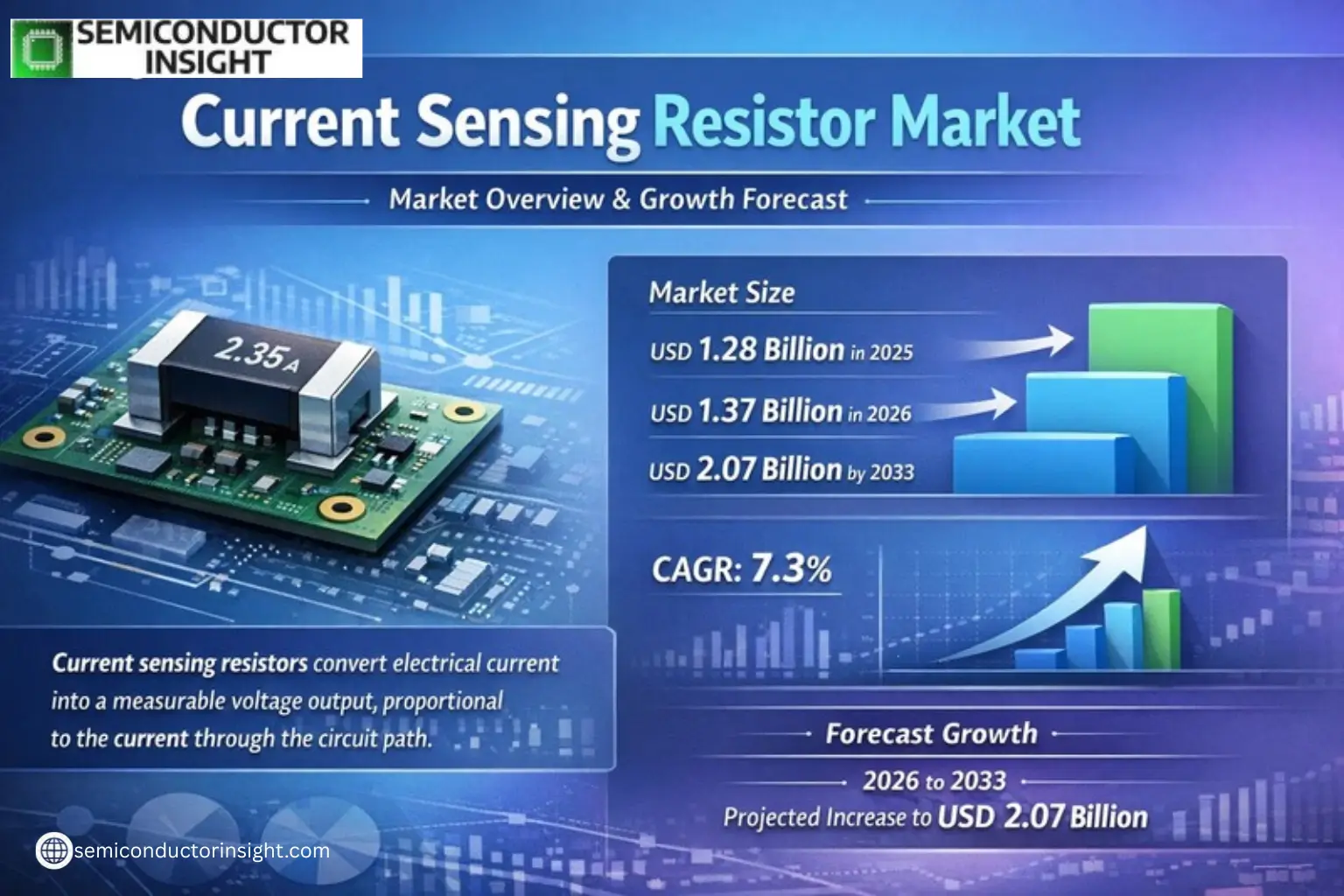
Global Current Sensing Resistor Market size was valued at USD 1.28 billion in 2025 and is projected to grow from USD 1.37 billion in 2026 to USD 2.07 billion by 2033, exhibiting a CAGR of 7.3% during the forecast period.
Current sensing resistors are specialized components that detect and convert electrical current into a measurable voltage output, proportional to the current passing through the circuit path. These resistors play a critical role in power regulation and monitoring across various electronic applications, including industrial automation, automotive systems, telecommunications, and consumer electronics.
The market is experiencing steady growth due to increasing demand for energy-efficient devices, advancements in automotive electrification, and the rising adoption of IoT-enabled smart technologies. Key players such as Yageo, VISHAY, Samsung, KOA Speer, and Panasonic dominate the market with a combined share exceeding 55%. Geographically, China leads with over 45% market share, followed by Europe and Japan at approximately 25% each. Film resistors account for more than half of the product segment demand.
MARKET DRIVERS
Growing Demand for Energy-Efficient Electronics
Global Current Sensing Resistor Market is experiencing significant growth due to increasing demand for energy-efficient electronic devices. With power consumption becoming a critical factor, manufacturers are adopting precise current sensing solutions to optimize performance. The rise of IoT and smart devices further accelerates market expansion, requiring accurate current measurement for reliable operation.
Automotive Electrification Trend
Electric vehicle adoption is creating strong demand for current sensing resistors in battery management systems and power electronics. The EV market is projected to grow at 22% CAGR through 2030, directly impacting component requirements. High-precision current measurement is essential for safety and efficiency in automotive applications.
Regulatory standards emphasizing energy efficiency continue to push manufacturers toward advanced current sensing solutions across multiple industries.
MARKET CHALLENGES
Precision Manufacturing Constraints
Current sensing resistor production requires extremely tight tolerances, often below 1%, creating manufacturing challenges. Maintaining consistency in low-resistance values while ensuring thermal stability adds complexity to the production process. These technical requirements limit the number of qualified suppliers in the market.
Other Challenges
Cost Sensitivity in Consumer Applications
Price competition remains intense for consumer electronics applications, forcing manufacturers to balance performance with cost-efficiency. This pressure impacts margins while maintaining the required specifications for current measurement accuracy.
MARKET RESTRAINTS
Alternative Current Sensing Technologies
The adoption of Hall-effect sensors and other contactless measurement technologies presents competition for traditional current sensing resistors. While resistors maintain advantages in cost and simplicity for many applications, alternative solutions are gaining traction in high-current environments.
MARKET OPPORTUNITIES
Renewable Energy Infrastructure Expansion
Growing investments in solar and wind energy systems create significant opportunities for current sensing resistor manufacturers. These applications require robust, high-precision components for power conversion and monitoring systems. Global renewable energy market is expected to exceed USD 1.5 trillion by 2030, with substantial demand for associated electronic components.
Current Sensing Resistor Market Trends
Robust Market Growth Projected Through 2033
Global Current Sensing Resistor Market, valued at USD 1284 million in 2025, is projected to reach USD 2072 million by 2033, growing at a CAGR of 7.3%. This growth is driven by increasing demand for power monitoring solutions across industries and the rapid expansion of electronic device manufacturing. Current sensing resistors are becoming essential components in modern power management systems, particularly in energy-sensitive applications.
Other Trends
Regional Market Dominance
China currently leads the Current Sensing Resistor Market with 45% share, followed by Europe and Japan at approximately 25% each. The Asia-Pacific region’s dominance stems from its robust electronics manufacturing sector and government initiatives supporting industrial automation. North America shows steady growth due to its advanced automotive and telecommunications sectors adopting precision current measurement technologies.
Product Type Segmentation
Film resistors capture over 50% market share among current sensing resistor types, favored for their stability and precision. Metal resistors follow in adoption due to their durability in high-power applications. The industrial segment remains the largest end-user (35% share), with automotive applications showing the fastest growth rate as electric vehicles require sophisticated current monitoring systems.
Competitive Landscape and Technological Advancements
Five major manufacturers (Yageo, VISHAY, Samsung, KOA Speer, Panasonic) collectively hold 55% market share, with increasing R&D investments in low-resistance, high-precision components. Recent developments focus on miniaturization and improved thermal stability to meet the demands of next-generation electronics. The market sees growing adoption of current sensing resistors in IoT devices and renewable energy systems.
COMPETITIVE LANDSCAPE
Key Industry Players
Global Current Sensing Resistor Market Dominated by Asian Electronics Giants
Global Current Sensing Resistor Market remains highly concentrated, with Yageo, Vishay, and Samsung collectively controlling over 45% market share in 2025 through their vertically integrated production capabilities. These industry leaders specialize in high-precision metal alloy and thin-film resistors which dominate over 80% of industrial applications. Chinese manufacturers have achieved 12% higher production efficiency compared to global peers through automated SMT-compatible resistor manufacturing lines.
Niche segments witness strong competition from specialist manufacturers like Cyntec (Susumu) for ultra-low TCR metal foil resistors and TT Electronics for high-current shunt resistors. The automotive sector increasingly adopts current sensing solutions from ROHM Semiconductor and KOA Speer, whose AEC-Q200 qualified products capture 28% of automotive demand. Emerging players like Viking Tech and TA-I are gaining traction through competitive pricing strategies in consumer electronics applications.
List of Key Current Sensing Resistor Companies Profiled
- Yageo Corporation
- Vishay Intertechnology
- Samsung Electro-Mechanics
- KOA Speer Electronics
- Panasonic Electronic Components
- ROHM Semiconductor
- Cyntec (Susumu)
- TT Electronics
- Bourns, Inc.
- Walter Electronic
- TA-I Technology
- Viking Tech Corporation
- Ohmite Manufacturing
- Caddock Electronics
- TE Connectivity
Segment Analysis:
| Segment Category | Sub-Segments | Key Insights |
| By Type |
|
Film Resistor dominates the market due to:
|
| By Application |
|
Industrial Sector represents the largest application due to:
|
| By End User |
|
OEMs are the primary end users due to:
|
| By Technology |
|
Surface Mount Technology (SMT) is gaining prominence because:
|
| By Sales Channel |
|
Direct Sales remains the preferred channel due to:
|
Regional Analysis: Asia-Pacific Current Sensing Resistor Market
China dominates regional production with major current sensing resistor facilities in Guangdong and Jiangsu provinces. The country benefits from complete supply chains for electronic components and proximity to end-use industries like EV manufacturing and 5G infrastructure deployment.
Japanese manufacturers lead in developing high-precision current sensing resistors with superior temperature coefficients. Companies are focusing on miniaturization technologies to serve the growing demand in robotics and medical equipment applications.
South Korean electronics giants consume significant current sensing resistors internally for their consumer products while also supplying global markets. This vertical integration creates stable demand and drives continuous product innovation.
Southeast Asian nations are seeing growing investments in current sensing resistor manufacturing as companies diversify production bases. Malaysia and Thailand are becoming important locations for automotive-grade component production.
North America Current Sensing Resistor Market
North America maintains strong demand for high-performance current sensing resistors across aerospace, telecommunications, and automotive sectors. The region sees increasing adoption of current sensing solutions in renewable energy systems and data center power management. U.S.-based manufacturers focus on ruggedized components meeting stringent military specifications while Canadian companies specialize in precision measurement applications.
European Current Sensing Resistor Market
Europe’s Current Sensing Resistor Market is characterized by demand from industrial automation and automotive electrification sectors. German manufacturers lead in developing energy-efficient components for smart factory equipment, while Nordic countries drive innovation in power conversion applications. Strict EU regulations on energy efficiency continue to shape product development priorities across the region.
Middle East & Africa Current Sensing Resistor Market
The MEA region shows growing interest in current sensing resistors for power infrastructure monitoring and oil/gas equipment. GCC countries are investing in smart grid technologies that require advanced current measurement capabilities. South Africa serves as a regional hub for industrial applications while North African nations develop electronics manufacturing capabilities.
South America Current Sensing Resistor Market
Brazil dominates South America’s current sensing resistor demand, particularly for industrial motor control and automotive applications. The region sees increasing adoption in renewable energy projects, especially solar power installations. Local manufacturers focus on cost-competitive solutions while facing competition from imported components from Asia.
Report Scope
This market research report provides a comprehensive analysis of the Current Sensing Resistor Market, covering the forecast period 2026–2033. It offers detailed insights into market dynamics, technological advancements, competitive landscape, and key trends shaping the industry.
Key focus areas of the report include:
- Market Overview: The report begins with an overview outlining its current market scenario, key growth indicators, and industry transformation drivers. It discusses macroeconomic factors, demand-supply balance, regulatory landscape, and the strategic role of current sensing resistors in powering advancements across industries such as automotive, industrial automation, telecommunications, and consumer electronics.
- Market Size & Forecast: Historical data and future projections for revenue, unit shipments, and market value across major regions and segments.
- Segmentation Analysis: Detailed breakdown by product type, technology, application, and end-user industry to identify high-growth segments and investment opportunities.
- Regional Insights: Insights into market performance across North America, Europe, Asia-Pacific, Latin America, and the Middle East & Africa, including country-level analysis where relevant.
- Competitive Landscape: Profiles of leading market participants, including their product offerings, R&D focus, manufacturing capacity, pricing strategies, and recent developments such as mergers, acquisitions, and partnerships.
- Technology Trends & Innovation: Assessment of emerging technologies, integration of AI/IoT, design trends, and evolving industry standards.
- Market Drivers & Restraints: Evaluation of factors driving market growth along with challenges, supply chain constraints, regulatory issues, and market-entry barriers.
- Stakeholder Insights: Insights for component suppliers, OEMs, system integrators, investors, and policymakers regarding the evolving ecosystem and strategic opportunities.
Primary and secondary research methods are employed, including interviews with industry experts, data from verified sources, and real-time market intelligence to ensure the accuracy and reliability of the insights presented.
FREQUENTLY ASKED QUESTIONS:
What is the current market size of Current Sensing Resistor Market?
-> Current Sensing Resistor Market size was valued at USD 1.28 billion in 2025 and is projected to grow from USD 1.37 billion in 2026 to USD 2.07 billion by 2033, exhibiting a CAGR of 7.3% during the forecast period.
Which key companies operate in Current Sensing Resistor Market?
-> Key players include Yageo, VISHAY, Samsung, KOA Speer, Panasonic, ROHM, Cyntec (Susumu), TT Electronics, Bourns, Walter, TA-I, Viking, Ohmite, and Caddock, among others. The top five manufacturers hold over 55% market share.
What are the key growth drivers?
-> Key growth drivers include increasing demand for handheld electronic devices, industrial automation, and the expansion of telecommunication infrastructure.
Which region dominates the market?
-> China is the largest market with over 45% share, followed by Europe and Japan with about 25% share each.
What are the emerging trends?
-> Emerging trends include miniaturization of components, higher precision in current measurement, and increased adoption in automotive and industrial applications.
Which product segment leads the market?
-> The Film Resistor segment dominates with over 50% market share in 2025.
What is the largest application segment?
-> The Industrial sector is the largest application, followed by Automotive and Telecommunication.

Get Sample Report PDF for Exclusive Insights
Report Sample Includes
- Table of Contents
- List of Tables & Figures
- Charts, Research Methodology, and more...
 Download Sample Report PDF


