Key Statistics
Key Takeaways
- X7R is the largest dielectric type, accounting for more than 28% of the source-page market, because it balances capacitance density, temperature stability and cost across consumer, automotive and industrial electronics.
- Consumer electronics remains the largest application by volume, but automotive and AI-server power architectures are raising value growth as each platform requires more high-capacitance, high-voltage and reliability-qualified multilayer ceramic capacitors.
- Asia Pacific holds about 70% of the source-page market and is also the manufacturing center of gravity, reflecting the concentration of ceramic powder processing, electrode printing, stacking, sintering and electronics assembly in Japan, South Korea, China and Southeast Asia.
- Miniaturization with higher capacitance is the central product driver: suppliers are pushing more dielectric layers, thinner ceramic sheets and higher capacitance into 0402, 0603 and other compact packages so AI servers, smartphones and automotive electronics can reduce board area.
- Yield, ceramic-material control and energy-intensive firing remain structural constraints because MLCC performance depends on powder consistency, electrode quality and tightly controlled co-firing; defects discovered after stacking or sintering can destroy substantial added value.
MLCC Market Overview
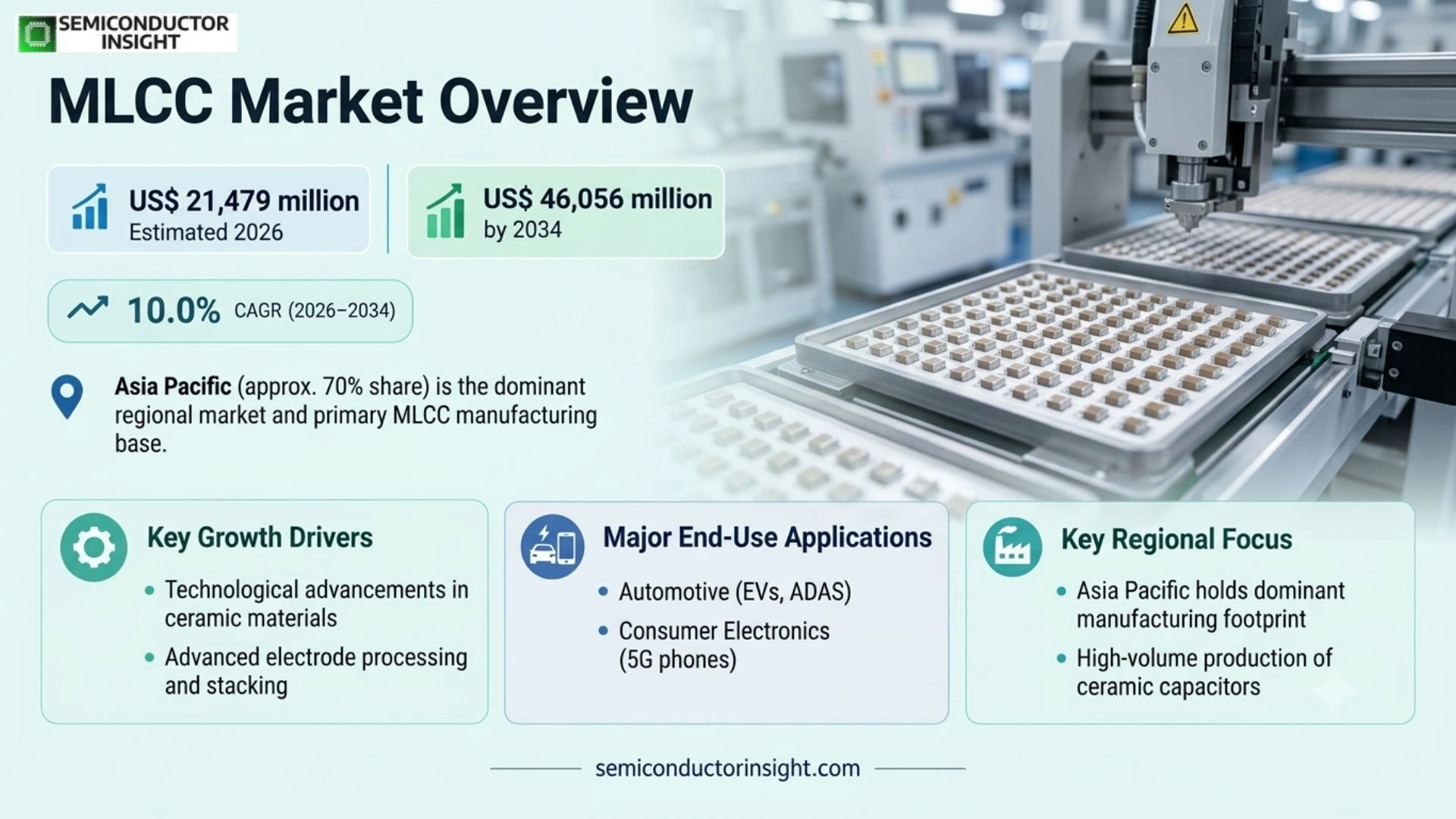
MLCC market was rebased to US$ 19,526 million in 2025 and is projected to reach US$ 46,056 million by 2034, corresponding to an anchor-implied CAGR of 10.0% during 2026–2034. The estimated 2026 market size is US$ 21,479 million. Asia Pacific is the largest regional market, representing about 70% on the source page, and also contains the dominant manufacturing footprint for ceramic materials, electrode processing, stacking and high-volume capacitor production.
A multilayer ceramic capacitor is a compact surface-mount component built by alternating thin ceramic dielectric layers with internal metal electrodes, stacking the layers, co-firing the body and applying terminal electrodes. Barium-titanate-based formulations dominate high-capacitance Class II products such as X7R and X5R, while C0G/NP0 compositions emphasize stability and low loss. The report scope also includes Y5V and other specialty dielectric systems serving consumer, automotive, industrial, defense and other electronic applications.
MLCC demand is driven by component count and electrical architecture rather than by electronics shipment volumes alone. A smartphone needs many small decoupling and filtering capacitors, but an electric vehicle, advanced driver-assistance platform or AI server can require substantially more capacitance, higher voltage tolerance and stricter reliability. Suppliers therefore compete simultaneously on miniaturization, capacitance density, voltage rating, temperature performance and mechanical robustness. Product mix can raise market value even when unit growth moderates.
The market is changing quickly because AI computing and electrification are forcing power distribution networks to operate at higher currents and, in some architectures, higher bus voltages. Murata commercialized a 47 µF 0402-inch MLCC in 2025 for high-density applications, while TDK introduced compact 100 V X7R products aimed at 48 V AI-server power systems and industrial equipment. These launches show how material control and layer thinning convert end-system power challenges into higher-value capacitor opportunities.
Segment Analysis: By Type
By type, the source page segments the market into X7R, X5R, C0G (NP0), Y5V and Others. X7R is the largest category, exceeding 28% of source-page market revenue, because it offers a practical balance between capacitance density, temperature range and cost. X5R is strong in compact consumer devices, C0G serves precision and high-frequency circuits, and Y5V competes where very high volumetric capacitance is more important than stability.
| Type | Electrical / material characteristics | Market position and purchasing logic |
|---|---|---|
| X7R | X7R is a Class II dielectric specification designed to maintain capacitance within a defined tolerance across a broad temperature range. Barium-titanate-based formulations enable high capacitance in small packages, while nickel internal electrodes support cost-effective mass production. Designers accept some voltage and temperature dependence in exchange for capacitance density substantially above precision Class I ceramic technologies. | Largest type, with more than 28% share on the source page. X7R spans consumer, industrial and automotive decoupling, filtering and power applications and therefore benefits from the widest combination of volume and value growth. Automotive-qualified X7R parts and 100 V products for 48 V server systems increase average value, while mainstream commodity sizes remain exposed to cyclical inventory and pricing pressure. |
| X5R | X5R also uses high-permittivity Class II ceramic materials but is specified over a narrower upper temperature limit than X7R. That trade-off allows very high capacitance density in miniature packages, making the dielectric popular in smartphones, wearables, portable electronics and other board-space-constrained products where operating temperatures are controlled and compactness outweighs the need for a wider automotive temperature range. | X5R is a major high-volume segment tied closely to consumer-electronics product cycles. Its commercial strength is the ability to replace larger capacitor formats with tiny surface-mount parts, but the segment can experience sharper inventory corrections when smartphone and device shipments slow. Suppliers differentiate by capacitance in 0201/0402-class packages, low profile and stable mass-production yield rather than by a broad temperature specification. |
| C0G (NP0) | C0G/NP0 is a Class I dielectric family valued for extremely stable capacitance, low losses, minimal voltage coefficient and predictable temperature behavior. Capacitance density is much lower than X7R or X5R, so these parts are used where electrical precision matters more than microfarads per unit volume, including RF, timing, resonant, filtering and precision analog circuits. | The segment is smaller in absolute value but technically defensible because high-frequency and precision applications cannot simply substitute a high-permittivity Class II part. Growth follows communications, industrial measurement, automotive sensing and RF electronics. Suppliers compete on tolerance, Q factor, voltage capability and package consistency, with specialty performance reducing the direct price competition seen in commodity decoupling capacitors. |
| Y5V | Y5V formulations provide very high dielectric constant and therefore strong capacitance density at low cost, but they allow much larger capacitance changes with temperature and applied voltage than X7R or X5R. This makes the technology suitable for non-critical bypass and bulk-capacitance roles where circuit designers can tolerate electrical variation and prioritize low component cost. | Y5V is structurally pressured in many designs as engineers move to X5R or X7R for better stability, particularly when board area is no longer the only consideration. It remains relevant in price-sensitive applications and legacy designs, but supplier investment is more concentrated on higher-value automotive, server and compact high-capacitance products. Its relative market position therefore grows more slowly than the headline MLCC market. |
| Others | The remaining category includes specialty temperature characteristics, high-voltage formulations, safety-certified parts, soft-termination constructions and other ceramic systems designed for specific mechanical, electrical or environmental requirements. These products may use similar manufacturing equipment but require different ceramic recipes, electrode designs, terminations and qualification flows, increasing process complexity compared with a single high-volume commodity line. | Specialty MLCCs can deliver attractive value growth because automotive, industrial, aerospace and high-power electronics increasingly need high voltage, high temperature, flex-crack resistance or unusually stable electrical behavior. Unit volumes are smaller than mainstream X7R/X5R, but qualification barriers and application-specific engineering reduce price substitutability. Suppliers with strong materials science and automotive customer approvals can capture disproportionate margin from this mixed category. |
Dielectric material and performance architecture
The source page further groups dielectric materials into Ceramic (Barium Titanate based), Paraelectric Materials and Specialty Compositions. In commercial high-capacitance MLCCs, barium titanate is the central dielectric material because its high permittivity supports very thin active layers. Murata describes a green-sheet process in which ceramic powder and binder are formed into sheets, nickel internal electrodes are printed, layers are stacked and the body is co-fired. The manufacturing challenge is controlling composition and thickness across hundreds or thousands of layers.
Segment Analysis: By Application
By application, the source page defines Consumer Electronics, Automotive, Industrial Machinery, Defense and Others. Consumer electronics remains the largest volume application, while automotive is a high-value growth engine because electric powertrains, ADAS, infotainment and domain controllers increase both MLCC count and reliability requirements. AI servers and data-center equipment sit partly inside the “Others” and computing demand pool but are becoming strategically important through 48 V power distribution and dense processor decoupling.
| Application | Demand characteristics |
|---|---|
| Consumer Electronics | Smartphones, tablets, notebooks, wearables, TVs and connected devices use large numbers of miniature MLCCs for decoupling, filtering and power management. Purchasing is highly volume- and price-sensitive, and customers push suppliers toward smaller case sizes with higher capacitance so board area can be reassigned to batteries, cameras and processors. The segment anchors factory utilization but is also the most exposed to short electronics inventory cycles. |
| Automotive | Automotive electronics require high reliability across temperature, vibration and long operating lives, increasing demand for AEC-Q200-qualified parts, soft termination and stable X7R-class dielectrics. Electric vehicles add inverters, onboard chargers, battery-management systems and more electronic control, while ADAS adds sensors and compute. The result is both higher capacitor content per vehicle and a richer mix of high-voltage or mechanically robust components. |
| Industrial Machinery | Factory automation, robotics, motor drives, renewable-power equipment and industrial power supplies use MLCCs for filtering, control and high-frequency switching. Customers value stable supply, long product lifecycles and environmental robustness more than the smallest package. Demand is less seasonal than consumer electronics and benefits from the shift toward higher-frequency power conversion, where low equivalent series resistance and compact ceramic capacitors support efficient switching architectures. |
| Defense | Defense and aerospace electronics use specialty MLCCs where temperature stability, high voltage, reliability screening or long-life supply are required. Volumes are small compared with smartphones or vehicles, but qualification requirements and low substitution rates support higher value per unit. Suppliers must maintain documented materials and manufacturing control, making this segment less vulnerable to short-term commodity price competition and more dependent on technical approvals. |
| Others | Other applications include telecommunications infrastructure, servers, networking, medical electronics and specialized power systems. AI data centers are becoming particularly important because accelerators and high-current processors require dense local decoupling, while 48 V power architectures increase demand for compact 100 V-rated parts. This mix shifts MLCC value toward high-capacitance and high-voltage products even when general-purpose capacitor unit growth remains moderate. |
Regional Analysis
Asia Pacific is the largest regional MLCC market and manufacturing base, representing about 70% on the source page. Japan and South Korea host major technology leaders, China and Southeast Asia provide large production and electronics-assembly capacity, and the region consumes huge quantities of capacitors in devices and vehicles. North America and Europe together account for more than 24% on the source page, with demand weighted toward automotive, industrial, data-center and high-reliability applications rather than mass capacitor manufacturing.
Why is MLCC demand and production concentrated in Asia Pacific?
MLCC production requires repeated ceramic-powder preparation, tape casting, electrode printing, stacking, pressing, cutting, firing, termination, plating, sorting and electrical testing. The process rewards scale, materials know-how and close coordination with electronics customers, which helps explain why supply is concentrated around mature Asian component ecosystems. Demand is also nearby: the region manufactures smartphones, computers, vehicles and industrial electronics. North America and Europe remain essential design and consumption markets, but they import a substantial share of finished MLCCs.
| Region | Position | Growth outlook | Demand profile | What decides supplier selection |
|---|---|---|---|---|
| Asia Pacific | Largest, ~70% | Highest absolute growth | Production + electronics consumption | Scale, ceramic-material control, yield, miniaturization capability and proximity to major electronics customers are decisive. Japanese and Korean leaders compete with Taiwanese and Chinese producers across different quality tiers, while ASEAN production provides geographic diversification. Customers increasingly qualify multiple Asian sites to reduce supply risk without giving up the process knowledge concentrated in the region. |
| North America | High-value consumption | Strong | AI servers, automotive, industrial, defense | Design-in support, high-voltage performance, availability and long-term supply matter more than local manufacturing volume. AI data centers and power electronics are raising demand for compact high-capacitance and 100 V products, while defense and industrial customers value specialty C0G, high-voltage and reliability-qualified components. Distributor inventory also influences which suppliers can win broad mid-volume design activity. |
| Europe | Automotive / industrial center | Moderate-strong | xEV, automation, renewable power, aerospace | Automotive qualification, supply continuity and application engineering are central. European OEMs and Tier 1 suppliers require long qualification cycles and stable production processes, so incumbent relationships create barriers to rapid share shifts. Industrial energy systems add demand for high-voltage and temperature-stable parts, while most physical MLCC production remains located in Asia. |
| South America | Smaller | Selective | Automotive, appliances, industrial electronics | Landed cost, distributor availability and qualification with multinational OEM platforms decide supplier selection. The region imports most advanced MLCCs, so currency, inventory and logistics can matter as much as nominal factory price. Local automotive and appliance production creates recurring demand, but high-end products typically follow design decisions made in North America, Europe or Asia. |
| Middle East & Africa | Emerging | Project led | Telecom, data centers, energy, defense | Supply reliability, high-temperature performance and global distributor coverage matter because local capacitor production is minimal. Growth comes from infrastructure and electronics deployment rather than manufacturing. Data centers, power conversion, defense and communications can use higher-value MLCCs, but the market remains dependent on imported components and technical support from global suppliers. |
Detailed Regional Market Analysis
Key MLCC Manufacturers and Competitive Landscape
The MLCC market is concentrated around a small group of Asian technology and scale leaders. The source page estimates that the top five manufacturers account for about 75% of market share. Competitive advantage is built on ceramic powder formulation, thin dielectric layers, internal electrode printing, stacking precision, firing control and yield. Those capabilities are cumulative: a supplier that can mass-produce thinner layers at high yield can offer more capacitance in a smaller package while protecting cost and reliability.
Murata, Samsung Electro-Mechanics, Taiyo Yuden and TDK compete strongly in high-end miniaturized, automotive and computing products, while Yageo, Kyocera AVX and other Taiwanese, Japanese and Chinese suppliers provide broad portfolios across value tiers. Production scale matters because high-volume consumer MLCCs are price-sensitive, but technology differentiation matters more as voltage, temperature, capacitance or mechanical requirements rise. This creates a two-speed market in which commodity capacity cycles coexist with structural growth in high-value products.
Capacity expansion decisions show that leading suppliers are not abandoning volume manufacturing despite cyclicality. Murata completed new MLCC production buildings in Japan and the Philippines, while Taiyo Yuden completed Building No. 5 at its Tamamura plant for MLCC technology and development. These investments deepen process know-how and improve resilience. Suppliers increasingly distribute capacity across Japan, ASEAN, China and other locations so customers can qualify geographically diversified sources without changing component families.
Customer qualification creates powerful competitive stickiness in automotive, industrial and high-reliability segments. An OEM cannot replace an MLCC solely because another part has the same capacitance and voltage; dielectric behavior, DC-bias performance, flex-crack risk, termination, temperature characteristics and production consistency must be validated. As a result, suppliers with early design-in access and long process histories can retain positions for years, while new entrants typically gain share first in less demanding commodity applications.
| Competitive tier | Representative companies | Strategic position |
|---|---|---|
| Global technology / scale leaders | Murata Manufacturing; Samsung Electro-Mechanics; Taiyo Yuden; TDK Corporation | These suppliers combine very high production scale with proprietary ceramic-material and thin-layer process expertise. They lead miniaturization, high-capacitance and automotive-qualified product development and can support global OEM design teams. Their challenge is capital intensity: maintaining leadership requires continuous investment in powder processing, stacking, firing, plating and factory automation while preserving yield as layers become thinner. |
| Broad global challengers | Kyocera (AVX); Yageo Corporation; Vishay Intertechnology; Walsin Technology | These companies compete through broad catalogs, distribution reach, automotive and industrial qualifications and selective vertical integration. They can capture customers seeking second sources to the largest Japanese and Korean suppliers. Their advantage is portfolio breadth across capacitor technologies and regions, while the technological challenge is matching leading-edge capacitance density and miniaturization at comparable mass-production yield. |
| Regional / focused Asian suppliers | Nippon Chemi-Con; Samwha Capacitor Group; Fenghua Advanced Technology; Holy Stone Enterprise; Darfon Electronics; Three-Circle Group; NIC Components | These suppliers serve regional electronics manufacturing and price-sensitive segments while developing higher-value products selectively. They benefit from proximity to Asian customers and can be important second sources during allocation cycles. Competitive progression depends on moving from commodity case sizes into automotive, high-capacitance and specialty products without sacrificing yield or customer confidence in long-term process consistency. |
Companies profiled in the report
- Murata Manufacturing
- Samsung Electro-Mechanics (SEMCO)
- Kyocera (AVX)
- Yageo Corporation
- Taiyo Yuden Co., Ltd.
- TDK Corporation
- Nippon Chemi-Con Corporation
- Vishay Intertechnology, Inc.
- Walsin Technology Corporation
- Samwha Capacitor Group
- Fenghua Advanced Technology
- Holy Stone Enterprise Co., Ltd.
- Darfon Electronics Corporation
- Three-Circle Group
- NIC Components Corp.
MLCC Production Capacity Analysis
MLCC production capacity is concentrated in Asia because the process combines high-volume ceramic manufacturing with materials and equipment expertise accumulated over decades. The source page estimates Asia Pacific at about 70% of market value, and supplier investment patterns support that manufacturing center of gravity. Capacity is not interchangeable, however: a line optimized for commodity X5R may not be able to produce high-voltage automotive X7R or ultra-thin high-capacitance parts at the same yield without material and process upgrades.
The manufacturing flow begins with barium-titanate or specialty ceramic powder preparation, slurry formulation and tape casting into thin green sheets. Nickel internal electrodes are printed, layers are stacked and pressed, the body is cut and co-fired, and external electrodes are applied and plated before electrical sorting. Each step amplifies upstream variation. As active layers become thinner and layer counts rise, particle size distribution, electrode alignment, contamination and firing atmosphere become increasingly important to yield and long-term reliability.
Recent supplier projects show continued capacity commitment. Murata’s new Izumo building represents about ¥47 billion of total investment and roughly 69,829 square meters, while its Philippine building adds about 77,981 square meters of production space with an approximately ¥11.2 billion building investment. Taiyo Yuden’s Tamamura Building No. 5 adds roughly 9,000 square meters focused on MLCC technology and development. These are not directly comparable capacity figures, but together they demonstrate ongoing capital intensity.
The principal bottlenecks are high-purity dielectric powders, thin-layer process know-how, electrode printing, co-firing yield and energy-intensive kiln capacity. Lead time can tighten rapidly when consumer demand and automotive demand rise simultaneously because expanding high-quality sintering and finishing capability takes longer than adding simple assembly labor. Suppliers mitigate concentration risk by operating multiple Asian sites, but customer requalification means capacity cannot always be switched instantly from one plant to another during disruptions.
| Production stage | Key constraint | Market implication |
|---|---|---|
| Ceramic material preparation | Barium-titanate chemistry, particle size distribution, dopants and binder control determine dielectric performance and the ability to cast thinner, defect-free sheets. High-capacitance Class II products require extremely consistent materials, while precision Class I formulations require different electrical behavior. | Materials know-how creates a durable barrier to entry. Suppliers that control ceramic formulation can push capacitance density higher while maintaining reliability, allowing them to win premium products rather than competing only on standard case-size price. |
| Printing, stacking & pressing | Internal nickel electrodes must align across hundreds or thousands of layers without shorts, voids or contamination. Thinner dielectric layers and smaller packages leave less tolerance for printing or registration errors, so equipment precision and statistical process control determine usable yield. | Miniaturization raises capital and engineering requirements. The commercial payoff is large because more capacitance in the same footprint supports smartphone, AI-server and automotive board-density requirements and commands a value premium over commodity parts. |
| Co-firing & atmosphere control | Ceramic and nickel electrodes are fired together under carefully controlled temperature and atmosphere. Defects at this stage destroy much of the value already added in powder preparation, printing and stacking, making kiln uniformity and recipe control critical. | Firing yield is a hard capacity constraint. Poor yield consumes ceramic, electrodes and furnace time without generating saleable output, so process leaders can expand effective capacity by improving yield rather than only adding furnaces. |
| Termination, plating & electrical sort | External electrodes, barrier plating and final electrical sorting must meet solderability, resistance and reliability specifications. Automotive and high-voltage products may require soft termination or stricter screening, adding process steps and inspection intensity. | Finishing capability differentiates high-value segments. Suppliers that can qualify robust terminations and tight electrical distributions can serve automotive and industrial designs with longer lifecycles and less price volatility than consumer commodity applications. |
MLCC Market Dynamics: Drivers, Restraints and Opportunities
MLCC growth is being pulled upward by higher capacitor content per system and richer product mix, but it remains exposed to commodity electronics inventory cycles and difficult manufacturing economics. AI servers, electric vehicles and high-frequency power conversion require more capacitance, higher voltage and tighter reliability in limited board area. Suppliers must therefore invest in thinner dielectric layers, advanced materials and geographically diversified production while managing the risk that standard consumer MLCC pricing can weaken during periods of excess inventory.
MARKET DRIVERS
Drivers Impact Analysis*
| Factor | (~) % Impact on CAGR Forecast* | Commercial transmission mechanism |
|---|---|---|
| AI servers and 48 V power architectures | +2.4% | Dense accelerators require large local decoupling capacitance, while 48 V distribution increases demand for compact 100 V-rated products. Recent Murata, TDK and Samsung announcements show supplier investment and contracts moving directly toward this requirement, raising value per component. |
| Vehicle electrification and ADAS | +2.0% | Electric powertrains, battery management, ADAS and domain controllers raise MLCC count and shift mix toward automotive-qualified X7R, soft-termination and higher-voltage parts with longer qualification cycles and stronger pricing than commodity grades. |
| Miniaturization of consumer electronics | +1.6% | Smartphones and compact devices continue pushing higher capacitance into 0201 and 0402-class packages, favoring suppliers with thin-layer ceramic processing and strong yield while protecting the relevance of consumer electronics as the largest volume application. |
| Industrial power electronics & 5G infrastructure | +1.1% | Higher switching frequencies, automation and communications equipment use ceramic capacitors for filtering and decoupling across long-lived industrial platforms, supporting stable demand outside consumer cycles and increasing the need for high-voltage or temperature-stable products. |
AI computing converts board-density limits into MLCC value growth
AI accelerators and server power systems draw high current and require capacitors close to processors and voltage-regulation stages. Murata’s 47 µF 0402-inch product and TDK’s compact 100 V X7R launches illustrate the technical response: pack more capacitance or voltage capability into less board area. Samsung’s KRW 1.0722 trillion AI-server MLCC contract for 2027 shows that hyperscale demand is becoming a committed commercial market rather than only a design trend.
Electric vehicles increase both capacitor count and qualification intensity
The International Energy Agency reports more than 20 million electric-car sales in 2025, about one-quarter of global new-car sales. EVs contain inverters, onboard chargers, battery-management systems, infotainment and ADAS electronics that all use MLCCs. Automotive customers also require long operating life, wide temperature performance and mechanical robustness, so electrification raises not only unit demand but the share of higher-value X7R, high-voltage and soft-termination products.
Consumer miniaturization keeps thin-layer processing strategically important
Consumer electronics remains the largest application by volume, and board space continues to shrink as devices allocate more area to batteries, cameras and processors. MLCC makers respond by casting thinner ceramic layers, printing finer electrodes and increasing layer counts. The commercial implication is that material and process leadership protects share: a supplier that reaches a target capacitance in a smaller package can win a design even if overall smartphone unit growth is modest.
Industrial and communications systems provide a steadier demand base
Robotics, factory automation, renewable-power conversion, telecom infrastructure and industrial controls require decoupling and filtering across long product lifecycles. Ericsson reported more than three billion 5G subscriptions by the end of 2025, while power electronics continue expanding across factories and energy systems. These applications use broader voltage and temperature ranges than many consumer devices, supporting specialty MLCC demand and reducing reliance on one short-cycle electronics segment.
MARKET RESTRAINTS
Restraints Impact Analysis*
| Factor | (~) % Impact on CAGR Forecast* | Commercial transmission mechanism |
|---|---|---|
| Consumer-electronics inventory cycles | -1.5% | High-volume X5R and X7R demand can correct quickly when smartphone and device inventories build, reducing factory utilization and pushing commodity prices lower. This can temporarily obscure structural growth in automotive and server products. |
| Yield challenges at extreme miniaturization | -1.1% | Thinner dielectric layers and higher layer counts reduce process tolerance. Small changes in powder, printing or firing can create scrap, slowing effective capacity growth and increasing the capital required to qualify advanced products. |
| Raw-material and energy intensity | -0.8% | High-purity ceramic powders, nickel electrodes, plating metals and energy-intensive firing contribute fixed process cost and expose producers to input volatility that is difficult to recover in commodity product pricing. |
| Geographic concentration of production | -0.7% | Most advanced MLCC capacity is concentrated in Asia. Disruptions can affect global OEM supply, while moving qualified automotive production between plants requires time, process matching and customer approval. |
Commodity MLCC pricing remains cyclical
The same production scale that makes MLCCs inexpensive also creates vulnerability when electronics customers over-order and later reduce inventory. Standard case sizes can shift from shortage to excess supply faster than producers can adjust fixed kiln and stacking capacity, putting pressure on price and utilization. Suppliers increasingly counter this by emphasizing automotive, industrial and AI products whose demand is more qualification-driven and whose performance requirements reduce direct substitution.
Miniaturization makes yield improvement progressively harder
Higher capacitance in a smaller case requires thinner dielectric layers, more internal electrodes and tighter alignment. Each improvement reduces manufacturing tolerance and raises the risk of shorts, cracks or electrical variation. A line can therefore have substantial nominal capacity but limited effective output for the most advanced parts until yields mature. This slows supply expansion in leading-edge categories and forces suppliers to spend heavily on materials, equipment and process control.
Firing and materials create a difficult cost base
MLCC production uses carefully controlled ceramic powders, nickel electrodes, plating materials and high-temperature co-firing. Energy costs and raw-material quality therefore influence margins even when selling prices are stable. Producers cannot easily eliminate these steps because electrical performance depends on the final microstructure. Cost pressure is strongest in commodity products where customers can switch among suppliers, while specialty grades provide more room to recover higher manufacturing expense.
Concentrated Asian supply creates qualification and logistics risk
The leading MLCC producers and much of their capacity are located in Japan, South Korea, China, Taiwan and Southeast Asia. Geographic concentration improves ecosystem efficiency but exposes global OEMs to earthquakes, power constraints, logistics interruptions and geopolitical risk. Customers increasingly qualify multiple plants or suppliers, yet automotive and high-reliability requalification takes time, so physical diversification does not immediately make every unit of capacity fungible during a disruption.
MARKET OPPORTUNITIES
High-capacitance MLCCs for AI servers
Server accelerators need dense decoupling near processors and voltage regulators, creating strong demand for 22 µF, 47 µF and other high-capacitance values in very small packages. Suppliers that can maintain low impedance and high yield at these capacitance densities can capture premium designs. Long-term supply agreements also improve visibility compared with commodity spot demand, turning AI infrastructure into a strategic capacity-allocation market rather than simply another electronics application.
100 V and higher-voltage products for 48 V architectures
Data centers, industrial systems and vehicles increasingly use higher distribution voltages to reduce current and copper losses. TDK’s 100 V X7R launches show how this architecture expands the addressable market for compact high-voltage MLCCs. The opportunity is not limited to one capacitance value: suppliers can build full families across case sizes and temperature characteristics, enabling customers to standardize on one technology platform throughout the power-conversion chain.
Automotive soft-termination and mechanically robust designs
Board flex, vibration and thermal cycling can crack rigid ceramic capacitors, creating a reliability challenge in vehicles and industrial equipment. Soft termination and related construction techniques absorb mechanical stress and reduce crack propagation. Suppliers that combine this feature with high voltage, X7R temperature performance and AEC-Q200 qualification can capture safety-critical and long-lifecycle designs where customers are willing to pay for reduced field-failure risk and predictable multi-year supply.
Geographic diversification without abandoning Asian process clusters
Murata’s investments across Japan, the Philippines and India illustrate an opportunity to diversify production and logistics while retaining access to the Asian materials and equipment ecosystem. Customers increasingly value second-site qualification after recent supply disruptions. Suppliers that replicate process control across multiple factories can win resilience-driven business, particularly in automotive and industrial programs, without bearing the much higher cost and longer learning curve of recreating the entire MLCC ecosystem in a new region.
MLCC Supply Chain Analysis
Stage 1 – Ceramic and electrode materials determine achievable performance
High-capacitance MLCCs depend on barium-titanate-based ceramic systems with carefully controlled particle size, dopants and binder chemistry, while internal electrodes commonly use nickel. Material suppliers and captive powder operations capture value because dielectric chemistry determines permittivity, temperature behavior and the ability to cast thin defect-free layers. As dimensions shrink, consistency becomes more important than bulk material cost, increasing the strategic value of proprietary powders and formulation expertise.
Stage 2 – Layer formation and stacking are the core manufacturing know-how
Ceramic slurry is cast into green sheets, nickel electrodes are printed, layers are aligned and stacked, and the laminated block is pressed and cut. The market leaders differentiate by making thinner layers and stacking more of them at high speed without creating shorts or alignment defects. Equipment automation matters, but recipes, process windows and in-line inspection are equally important. This stage largely determines capacitance density and effective yield before the expensive firing step.
Stage 3 – Co-firing and finishing convert process precision into saleable yield
The stacked body is co-fired under controlled atmosphere so ceramic and nickel electrodes densify together without oxidation or distortion. Terminations are then applied, plated and electrically sorted. Energy consumption and furnace utilization make this stage capital intensive, while poor firing yield destroys value already invested upstream. Automotive and specialty parts add stricter sorting or termination requirements, allowing suppliers with mature process control to earn better value than commodity producers with unstable yields.
Stage 4 – Design-in, qualification and distribution determine commercial capture
OEMs and EMS providers select MLCCs by capacitance, voltage, dielectric, case size, temperature range, DC-bias behavior, reliability and availability. Consumer designs can change quickly, but automotive and industrial qualifications create long relationships. Distributors hold thousands of combinations to serve fragmented customers, while direct supply agreements dominate the largest accounts. Once a part is designed into a long-lifecycle platform, supply consistency and second-site qualification can be as important as unit price.
Recent Developments in the MLCC Market
TDK announced mass production of a 10 µF, 100 V X7R MLCC with soft termination, targeting applications including AI servers, humanoid robots and xEVs. The combination of high capacitance, high voltage and mechanical robustness in one product illustrates where premium MLCC development is moving. Suppliers are engineering capacitors around system-level power and reliability requirements rather than competing only on standard capacitance-per-case-size roadmaps.
Murata completed a new MLCC production building at Izumo Murata Manufacturing with approximately 69,829 square meters of floor area and total investment of about ¥47 billion. The project reinforces Japan’s role as an advanced MLCC manufacturing and technology base. Adding large-scale capacity while product mix shifts toward AI and automotive applications indicates that leading suppliers expect structural demand to outlast normal consumer-electronics inventory cycles.
Samsung Electro-Mechanics announced an AI-server MLCC supply contract valued at KRW 1.0722 trillion, approximately US$780 million, with supply scheduled for 2027. The company said it had secured more than ten long-term agreements. The development is significant because it converts AI-server capacitor demand into visible multi-year commercial commitments and supports capacity allocation toward higher-end server products rather than only smartphone or general-purpose MLCC output.
Murata completed a new Philippine MLCC production building with approximately 77,981 square meters of floor area and about ¥11.2 billion of building investment. Murata explicitly described a strategy of distributing production bases across Japan, ASEAN and China. This investment improves geographic resilience and demonstrates that supply-chain diversification is occurring through multiple Asian sites rather than a wholesale relocation away from the region’s established materials and equipment ecosystem.
Taiyo Yuden announced commercialization of a 22 µF MLCC in a 1005M-size package suitable for embedding and identified AI-server decoupling as a target application. Mass production began in August 2025. The product illustrates the capacitance-density race: suppliers are using thinner layers and advanced materials to reduce board area while delivering the high local capacitance required around power-hungry processors and networking devices.
Report Scope & Segmentation
| Attribute | Report coverage |
|---|---|
| Market | Multilayer Ceramic Capacitor (MLCC) Market. The report covers surface-mount multilayer ceramic capacitors differentiated by dielectric type, end application, end user, dielectric material and sales channel, and it analyzes production capacity, regional demand, competition, dynamics and the supply chain within that defined scope. |
| Base / estimate / forecast | Base year 2025: US$ 19,526 million. Estimated year 2026: US$ 21,479 million. Forecast end 2034: US$ 46,056 million. Anchor-implied CAGR for 2026–2034: 10.0%. The rebased series is derived from the source page’s published 2024 and 2032 size anchors rather than from the printed CAGR label. |
| By Type | X7R; X5R; C0G (NP0); Y5V; Others. These segments are preserved from the source page without adding, merging or renaming dielectric categories, and the article uses X7R as the largest type because the source page states that it exceeds 28% share. |
| By Application | Consumer Electronics; Automotive; Industrial Machinery; Defense; Others. Consumer electronics remains the largest volume application, while automotive is treated as an important higher-value growth application because electrification and ADAS increase both capacitor content and reliability requirements. |
| By End User | Original Equipment Manufacturers (OEMs); Electronic Manufacturing Services (EMS); Component Distributors. This axis describes the principal commercial channels through which MLCCs are designed in, purchased, stocked and assembled into finished electronic platforms. |
| By Dielectric Material | Ceramic (Barium Titanate based); Paraelectric Materials; Specialty Compositions. The material axis is preserved from the source page and is used to explain why high-permittivity ceramic processing and specialty formulations create different capacitance-density and stability trade-offs. |
| By Sales Channel | Direct Sales; Distributor Sales; Online Retail. Large automotive, consumer and computing accounts are commonly served through direct relationships, while distributors remain important for broad industrial, engineering and replacement demand across many case sizes and electrical values. |
| Regions | Asia-Pacific; North America; Europe; South America; Middle East & Africa. Asia Pacific is the largest region in 2025, with about 70% share stated on the source page, and it remains the dominant manufacturing center for advanced MLCC production. |
| Companies profiled | Murata Manufacturing; Samsung Electro-Mechanics (SEMCO); Kyocera (AVX); Yageo Corporation; Taiyo Yuden Co., Ltd.; TDK Corporation; Nippon Chemi-Con Corporation; Vishay Intertechnology, Inc.; Walsin Technology Corporation; Samwha Capacitor Group; Fenghua Advanced Technology; Holy Stone Enterprise Co., Ltd.; Darfon Electronics Corporation; Three-Circle Group; NIC Components Corp. |
Frequently Asked Questions
What is the 2025 size of the global MLCC market?
The rebased global MLCC market size is US$ 19,526 million in 2025. The value is calculated from the source page’s published 2024 and 2032 market-size anchors so the base year, forecast endpoint and CAGR form one internally consistent compound-growth series. Demand spans consumer electronics, automotive, industrial machinery, defense and other applications, with X7R, X5R, C0G/NP0, Y5V and specialty dielectric products included in the source scope.
What is the 2034 MLCC market forecast and CAGR?
The market is projected to reach US$ 46,056 million by 2034, corresponding to an anchor-implied CAGR of 10.0% during 2026–2034. The estimated 2026 market value is US$ 21,479 million. Growth is supported by AI-server power systems, electric vehicles, higher electronics content and continued component miniaturization, while commodity inventory cycles, manufacturing yield and the energy intensity of ceramic co-firing restrain the pace of expansion.
Which region leads the MLCC market?
Asia Pacific is the largest MLCC region in 2025, and the source page attributes about 70% of market value to the region. Japan and South Korea host major technology leaders, while China, Taiwan and Southeast Asia provide large production and electronics-assembly ecosystems. This concentration reflects the scale and process know-how required for ceramic powder preparation, thin-layer printing, stacking, co-firing and high-volume electrical sorting.
Which MLCC dielectric type is largest?
X7R is the largest dielectric type, accounting for more than 28% of the market on the source page. It combines high capacitance density with a wider usable temperature range than X5R and much higher capacitance density than precision C0G/NP0. That balance makes X7R suitable across consumer, automotive and industrial applications, while automotive-qualified and high-voltage X7R products also raise average value relative to basic commodity decoupling capacitors.
Why is automotive an important MLCC growth market?
Vehicles increasingly contain inverters, onboard chargers, battery-management systems, ADAS computers, infotainment and many electronic control units. Electric vehicles therefore raise both the number of capacitors and the need for high-voltage, temperature-stable and mechanically robust products. Automotive qualification also lengthens supplier relationships because part substitutions require validation. The result is a high-value growth segment that is less exposed to short consumer-electronics replacement cycles than smartphones and other devices.
How are AI servers changing MLCC demand?
AI servers use high-current processors and dense power-delivery networks that require substantial local decoupling capacitance. Moving power distribution toward 48 V architectures also increases demand for compact 100 V-rated parts around conversion stages. Murata, TDK and Taiyo Yuden launched high-capacitance or high-voltage products for server applications in 2025–2026, while Samsung announced a large 2027 supply contract, demonstrating direct commercial traction in this emerging demand pool.
What are the main MLCC manufacturing steps?
MLCC manufacturing begins with ceramic powder and slurry preparation, followed by green-sheet tape casting, internal nickel-electrode printing, stacking, pressing and cutting. The multilayer body is then co-fired under controlled atmosphere, terminal electrodes are applied and plated, and finished parts are electrically sorted. Each step affects yield and reliability, which is why materials expertise, layer alignment and firing control form significant barriers to entry for advanced high-capacitance products.
What are the main restraints on MLCC market growth?
The principal restraints are cyclical consumer-electronics inventories, lower commodity pricing during periods of excess capacity, difficult yield control as dielectric layers become thinner, energy- and material-intensive firing, and geographic concentration of manufacturing in Asia. These constraints do not eliminate structural demand, but they can create sharp short-term changes in utilization and profitability. Suppliers reduce exposure by shifting mix toward automotive, industrial, high-voltage and AI-server products with higher qualification barriers.
Where are the best opportunities for MLCC suppliers?
The strongest opportunities are high-capacitance miniaturized parts for AI processors, 100 V and higher-voltage products for 48 V power architectures, automotive soft-termination and high-reliability products, and geographically diversified Asian manufacturing that can support second-site qualification. These opportunities reward materials science, process control and application engineering rather than simple commodity capacity. Suppliers that can maintain leading yield while meeting customer reliability requirements can capture more value per component and longer design lifecycles.
Which companies are profiled in the MLCC report?
The explicit source-page company list includes Murata Manufacturing, Samsung Electro-Mechanics, Kyocera (AVX), Yageo, Taiyo Yuden, TDK, Nippon Chemi-Con, Vishay Intertechnology, Walsin Technology, Samwha Capacitor Group, Fenghua Advanced Technology, Holy Stone Enterprise, Darfon Electronics, Three-Circle Group and NIC Components. The list spans Japanese, Korean, Taiwanese, Chinese and U.S.-linked suppliers and reflects the strong concentration of technology and physical production in Asia Pacific.
Get Sample Report PDF for Exclusive Insights
Report Sample Includes
- Table of Contents
- List of Tables & Figures
- Charts, Research Methodology, and more...
 Download Sample Report PDF