Optical Disk Market Insights
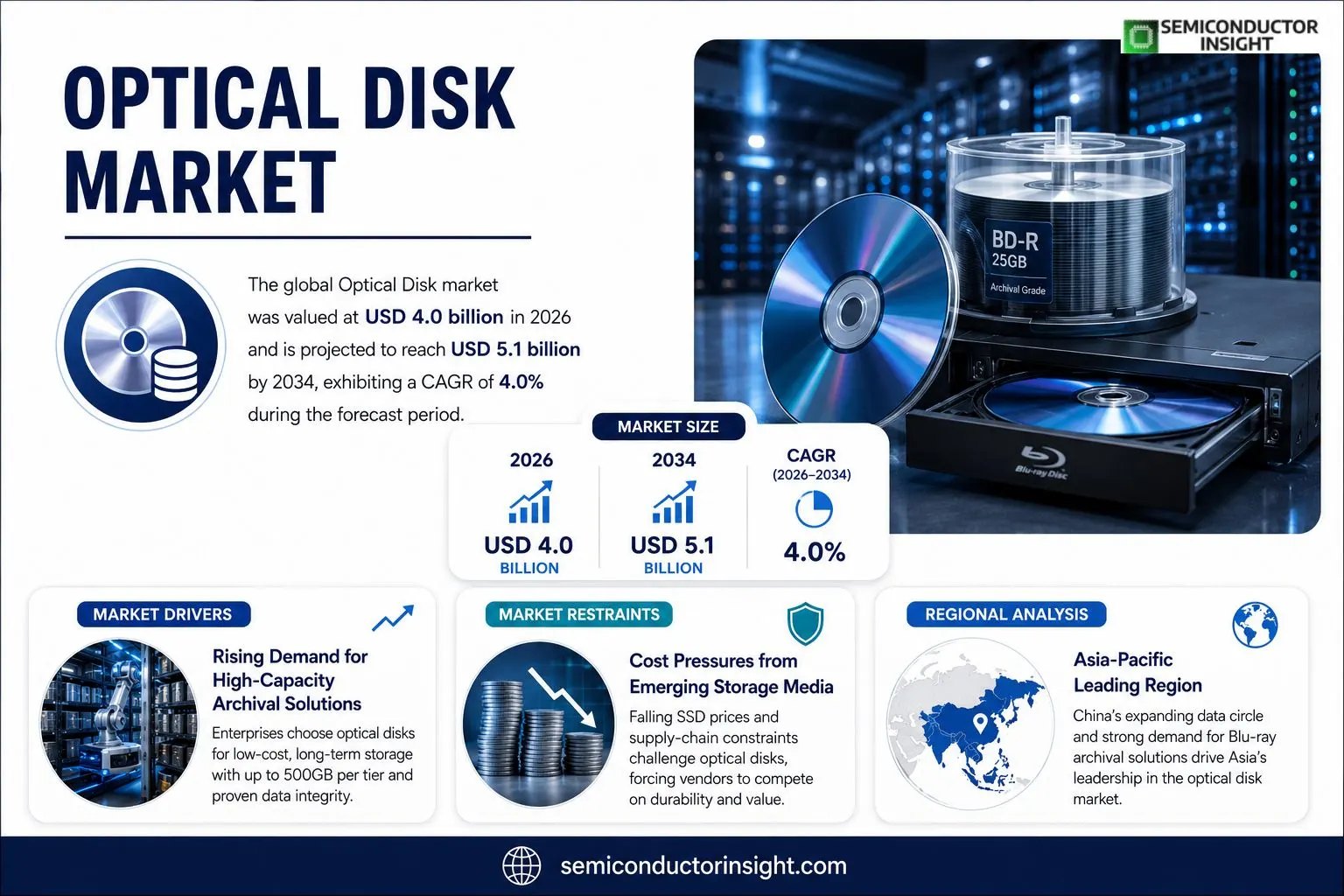
Optical Disk market size was valued at USD 3.9 billion in 2026. The market will rise from USD 4 billion in 2026 to USD 5.1 billion by 2034, exhibiting a CAGR of 4 % during the forecast period.
An optical disk is a flat‑sized storage medium that records data through microscopic pits created by a laser beam; reading is performed by reflecting light off these pits back into a photodetector. Formats such as CD, DVD and Archival Disc differ mainly in layer count, wavelength and capacity, yet all share the advantage of long‑term stability without magnetic degradation.The upward trend reflects several forces: because China’s data circle is set to become the world’s largest by 2026, organizations are turning to Blu‑ray‑based archival solutions that combine low cost with high durability for cold‑data storage; meanwhile “hot” data continues to rely on magnetic media, prompting an emerging hybrid model where optical layers preserve infrequently accessed files while magnetic layers handle active workloads; furthermore, enterprises seeking compliance‑grade retention find the inherent resistance of optical media to electromagnetic interference attractive.
MARKET DRIVERS
Rising Demand for High‑Capacity Archival Solutions
Enterprises that must retain large volumes of immutable records are turning to Optical Disk Market because disk cartridges can store up to 500 GB per tier while guaranteeing data integrity for decades. This longevity lowers the total cost of ownership compared with periodic tape migrations, prompting IT directors to allocate fresh budgets to optical‑based libraries.
Legacy Infrastructure in Enterprise Environments
Numerous manufacturing plants still operate on control‑system software that validates only CD‑ROM or DVD‑ROM media. Upgrading these legacy nodes would entail sizable redesigns, so firms prefer to extend the life of existing optical drives, sustaining demand for media and compatible hardware.
➤ “Companies that rely on immutable storage view optical media as a strategic safeguard against ransomware‑induced data loss.”
Beyond compliance, the relatively low power draw of optical readers versus hard‑disk arrays translates into measurable energy savings in data‑center aisles, a factor that resonates with sustainability‑focused procurement policies.
MARKET CHALLENGES
Cost Pressures from Emerging Storage Media
Solid‑state drives have fallen below $0.10 per gigabyte in bulk purchases, eroding the price advantage that optical disks once held. Buyers evaluating new storage projects now benchmark against flash‑based solutions, forcing optical vendors to justify their pricing through durability claims rather than raw cost.
Other Challenges
Supply‑Chain Constraints
The limited number of manufacturers capable of producing high‑density optical substrates has resulted in lead times that stretch beyond 12 weeks for premium DVD‑R‑XL stock. This bottleneck hampers rapid scale‑up for seasonal campaigns such as software distribution spikes.
MARKET RESTRAINTS
Regulatory and Environmental Concerns
Disposal regulations for polycarbonate discs and metal layers have tightened across the EU and North America, imposing additional compliance costs on manufacturers. Companies that cannot demonstrate recycling pathways face penalties, which discourages new entrants and narrows the supplier base.
MARKET OPPORTUNITIES
Emerging Applications in Automotive Infotainment
Vehicle manufacturers are experimenting with dual‑layer Blu‑ray discs to host high‑definition maps and OTA update packages that require tamper‑evident storage. The ability of optical media to survive temperature swings from –40 °C to 85 °C makes it an attractive complement to electronic flash modules, opening a niche revenue stream for specialized disk producers.
Optical Disk Market Trends
Cold‑Data Storage Shifts Toward Blu‑ray
Within the broader Optical Disk Market, the IDC forecast that China’s data circle will become the world’s largest by 2026 has reshaped the strategic calculus for long‑term storage. Cold‑data workloads, defined by minimal access frequency and stringent stability requirements, are increasingly matched to Blu‑ray‑based optical media because of its lower cost per gigabyte and proven archival integrity. Vendors are reallocating capacity budgets toward these media, recognizing that the economics of storing petabytes of infrequently accessed files improve when optical layers replace traditional magnetic shelves. This reallocation signals a measurable shift in how enterprises design their tiered‑storage architectures, with the optical tier now positioned as the default repository for dormant datasets.
Other Trends
Hybrid Optical‑Magnetic Solutions
Hybrid optical‑magnetic platforms blend the rapid response of magnetic disks with the durability of optical layers. In practice, “hot” data resides on SSD or HDD caches while the same file’s immutable snapshot is written to a Blu‑ray disc, creating a dual‑copy that can be re‑hydrated without disrupting primary operations. Recent product launches demonstrate that the latency penalty associated with optical retrieval has been reduced through parallel read heads and higher rotational speeds, making the technology viable for backup windows that previously demanded magnetic tape. For service providers, this hybrid approach translates into lower total cost of ownership while preserving compliance with data‑retention mandates that stipulate immutable storage.
Enterprise Adoption of Archival Disc Formats
The enterprise segment is also exploring archival disc (AD) formats that push capacity beyond traditional DVD and CD limits. By encoding multiple layers and leveraging advanced error‑correction codes, AD drives can store several terabytes on a single disc, appealing to industries such as media production and aerospace where regulatory audits demand on‑site, tamper‑proof copies. Adoption curves suggest that organizations with strict audit trails are already piloting AD solutions to replace legacy tape libraries, anticipating smoother audit workflows and reduced physical footprint. Consequently, supply chains are adjusting, with manufacturers scaling up production of high‑capacity discs and integrating them into modular rack units designed for data‑center environments.
COMPETITIVE LANDSCAPEKey Industry Players
Optical Disk Market Competitive Landscape Overview
Sony continues to dominate the high‑capacity Blu‑ray segment, leveraging its vertically integrated production lines and extensive IP portfolio. The company’s ability to secure OEM contracts for both consumer electronics and enterprise archival solutions creates a barrier that smaller manufacturers find difficult to breach. Concurrently, Fujifilm and Panasonic have reinforced their positions through strategic investments in next‑generation recording layers, allowing them to capture premium pricing in data‑center‑grade optical storage. The concentration of revenue among these three firms underscores a market structure where scale, brand trust, and advanced R&D drive competitive advantage.Beyond the headline players, a cluster of niche specialists is reshaping specific subsectors. RITEK and CMC Magnetics focus on low‑cost DVD production for emerging markets, while Hitachi Maxell and Taiyo Yuden excel in specialty archival discs for governmental archives. Companies such as Falcon Technologies International and Verbatim target the professional media niche, offering customized substrates for long‑term preservation. Meanwhile, newer entrants like Tsinghua Unigroup and Lenovo are exploring hybrid optical‑magnetic solutions, indicating a diversification trend that could influence supply‑chain dynamics over the next few years.
List of Key Optical Disk Companies Profiled
- Sony
- Fujifilm
- RITEK
- CMC Magnetics
- Hitachi Maxell
- Showa Denko
- Panasonic
- Taiyo Yuden
- Falcon Technologies International (FTI)
- Philips
- Lenovo
- Tsinghua Unigroup
- Verbatim
- Toshiba
- Mitsubishi Chemical
Segment Analysis:
| Segment Category | Sub-Segments | Key Insights |
| By Type |
|
Archival Disc (AD)
|
| By Application |
|
Enterprise Use
|
| By End User |
|
IT & Data Centers
|
| By Storage Temperature |
|
Cold Data Storage
|
| By Market Driver |
|
Cost Efficiency
|
Regional Analysis: Optical Disk Market
North America
Large‑scale enterprises in North America still allocate a portion of their storage budget to optical media for cold storage tiers, valuing its durability and low power draw. The approach complements flash‑based solutions by providing a cost‑effective repository for data that does not require rapid retrieval, allowing IT planners to optimize overall storage architecture.
Although streaming services dominate home entertainment, a niche segment of collectors and hobbyists sustains demand for optical discs. This group appreciates physical media for its tangible ownership and archival safety, prompting specialty retailers to maintain a curated catalog of limited‑edition releases.
The regional supply chain benefits from proximity to major polymer manufacturers and disc‑pressing facilities, reducing lead times and transportation costs. Recent diversification efforts have added secondary production sites, insulating the market from localized disruptions.
Data‑protection regulations in the United States and Canada indirectly boost optical disk usage, as compliance frameworks often mandate offline, immutable storage for records beyond the five‑year horizon, a niche where optical media excels.
Europe
European manufacturers emphasize sustainability, integrating recycled materials into optical disc production. This aligns with the EU’s circular‑economy directives, prompting vendors to differentiate on eco‑friendly credentials. Financial institutions across the region adopt optical storage to meet GDPR‑related archiving requirements, leveraging its static nature to mitigate cyber‑risk exposure. Meanwhile, Germany’s engineering firms incorporate optical disks into embedded systems, valuing their resistance to electromagnetic interference. The combined effect is a stable, though modest, demand curve that underpins local supply chains and supports a network of specialized distributors.
Asia‑Pacific
In the Asia‑Pacific, Optical Disk Market experiences a gradual transition as manufacturers upgrade to higher‑density formats to accommodate expanding data volumes. Countries such as Japan and South Korea maintain a legacy of optical media in educational and governmental archives, where long‑term preservation is critical. Growth in the entertainment sector fuels continued production of Blu‑ray discs for premium releases, especially in markets with strong home‑theater adoption. Regional trade agreements facilitate component sourcing, while emerging economies explore optical solutions for cost‑effective backup in sectors lacking extensive cloud infrastructure.
South America
South American enterprises often weigh total cost of ownership when selecting storage technologies. Optical disks present an attractive proposition for organizations seeking low‑maintenance, long‑life archival options without significant upfront capital outlay. Brazil’s audiovisual industry, in particular, leverages optical media for distribution of regional cinema, capitalizing on its compatibility with existing playback equipment. Local partners have begun offering value‑added services such as data‑migration and secure shredding, enhancing the overall appeal of optical solutions in a market still grappling with uneven broadband penetration.
Middle East & Africa
In the Middle East and Africa, Optical Disk Market is shaped by a blend of governmental data‑retention mandates and the need for resilient offline storage in environments prone to network instability. Oil‑and‑gas firms in the Gulf region retain critical legacy schematics on optical media, citing its resistance to harsh climatic conditions. Meanwhile, African NGOs adopt disks for archiving field reports, benefiting from their durability in remote locations lacking reliable electricity. Partnerships with international manufacturers are expanding, introducing newer disc technologies that promise higher capacity while respecting the region’s price‑sensitivity.
Report Scope
This market research report provides a comprehensive analysis of the Optical Disk Market , covering the forecast period 2026–2034. It offers detailed insights into market dynamics, technological advancements, competitive landscape, and key trends shaping the industry.
Key focus areas of the report include:
- Market Overview: The report begins with an overview outlining its current market scenario, key growth indicators, and industry transformation drivers. It discusses macroeconomic factors, demand–supply balance, regulatory landscape, and the strategic role of semiconductors in powering advancements across industries such as automotive, telecommunications, consumer electronics, and industrial automation.
- Market Size & Forecast: Historical data and future projections for revenue, unit shipments, and market value across major regions and segments.
- Segmentation Analysis: Detailed breakdown by product type, technology, application, and end-user industry to identify high-growth segments and investment opportunities.
- Regional Insights: Insights into market performance across North America, Europe, Asia-Pacific, Latin America, and the Middle East & Africa, including country-level analysis where relevant.
- Competitive Landscape: Profiles of leading market participants, including their product offerings, R&D focus, manufacturing capacity, pricing strategies, and recent developments such as mergers, acquisitions, and partnerships.
- Technology Trends & Innovation: Assessment of emerging technologies, integration of AI/IoT, semiconductor design trends, fabrication techniques, and evolving industry standards.
- Market Drivers & Restraints: Evaluation of factors driving market growth along with challenges, supply chain constraints, regulatory issues, and market-entry barriers.
- Stakeholder Insights: Insights for component suppliers, OEMs, system integrators, investors, and policymakers regarding the evolving ecosystem and strategic opportunities.
Primary and secondary research methods are employed, including interviews with industry experts, data from verified sources, and real-time market intelligence to ensure the accuracy and reliability of the insights presented.
FREQUENTLY ASKED QUESTIONS:
What is the current market size of Optical Disk Market?
-> Optical Disk Market was valued at USD million in 2026 and is expected to reach USD million by 2034, at a CAGR of % during the forecast period.
Which key companies operate in Optical Disk Market?
-> Key players include Sony, Fujifilm, Amethystum Storage Tech, RITEK, CMC Magnetics, Hitachi Maxell, Showa Denko, Panasonic, Taiyo Yuden Co, Falcon Technologies International (FTI), Philips, Lenovo, and Tsinghua Unigroup.
What are the key growth drivers?
-> Key growth drivers include increasing demand for low‑cost, stable cold‑data storage, Blu‑ray’s advantages for archival applications, and the emergence of optical‑magnetic hybrid storage solutions.
Which region dominates the market?
-> Asia leads the market, driven primarily by China’s expanding data circle, which is projected to become the world’s largest by 2026.
What are the emerging trends?
-> Emerging trends include optical‑magnetic hybrid storage technologies, growth of Blu‑ray for long‑term archival discs, and increased focus on archival disc (AD) solutions for enterprise cold‑storage.

Get Sample Report PDF for Exclusive Insights
Report Sample Includes
- Table of Contents
- List of Tables & Figures
- Charts, Research Methodology, and more...
 Download Sample Report PDF