SEMICONDUCTOR INSIGHT
MARKET RESEARCH REPORT

Optical Circulator Market

2026 to 2034
MARKET INTELLIGENCE
ACROSS KEY REGIONS
2026 EDITION
OPTOELECTRONICS Semiconductor Market Research

Optical Circulator Market

Emerging Trends, Technological Advancements, and Business Strategies (2026-2034)

◷
UPDATED 03 November 2026
▤
REPORT LENGTH Detailed Report
▣
REPORT CODE bf06dd665d33
▯
FORMATS PDF

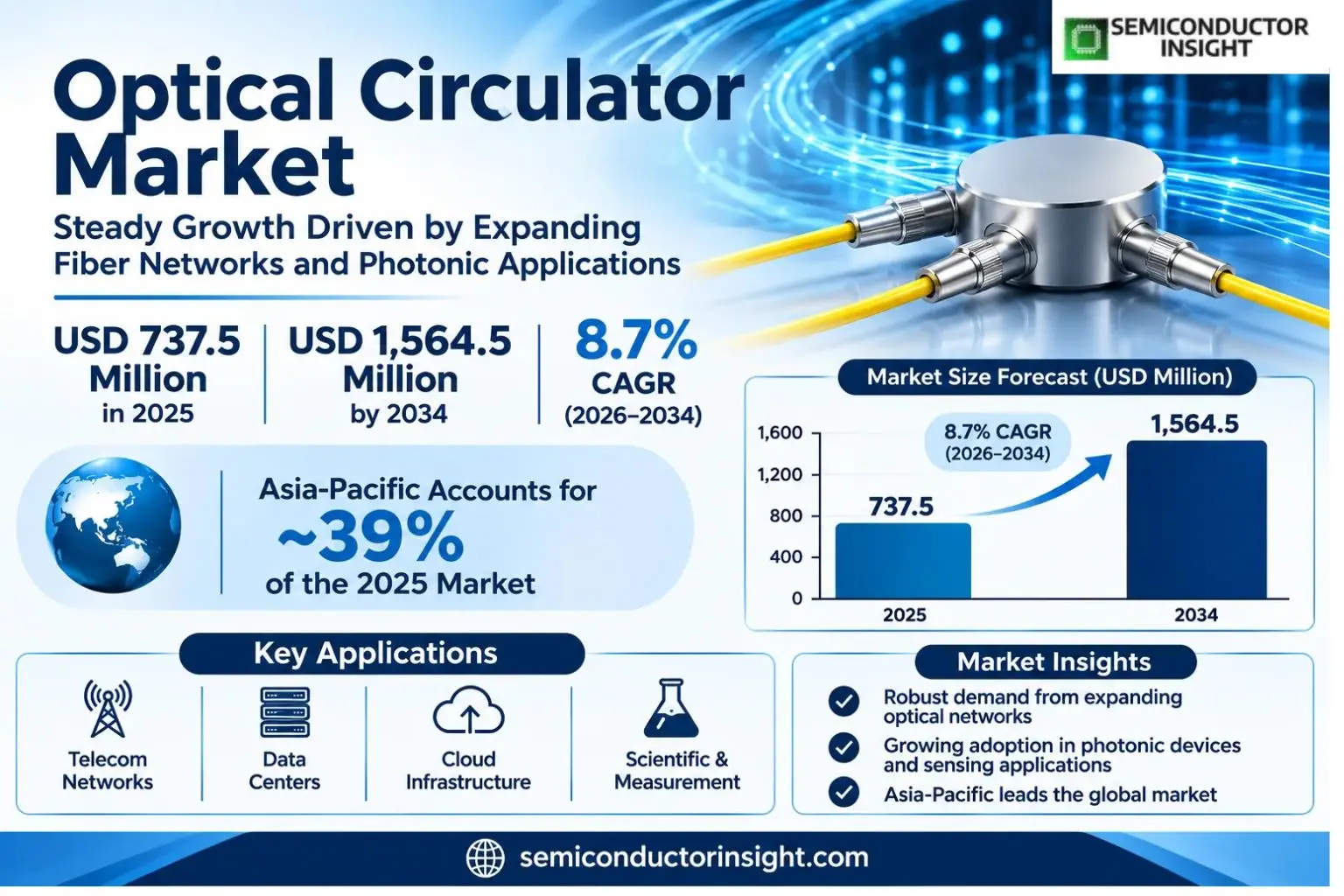
Optical circulator market stood at USD 737.5 million in 2025 and is forecast to attain USD 1,564.5 million by 2034, a CAGR of 8.7% over 2026–2034. Asia-Pacific accounted for the largest 2025 regional position at an estimated ~39%, supported by component assembly in China, optical transmission projects across Asian telecom networks and a large base of photonic device manufacturing.

Get the sample PDF with study scope, segmentation and methodology details.

Key Statistics

2025 Market Size
USD 737.5 million
2034 Projected Size
USD 1,564.5 million
CAGR (2026–2034)
8.7%
Largest Market in 2025
Asia-Pacific (~39%)

Key Takeaways

  • Global expansion: the optical circulator market reached USD 737.5 million in 2025 and is projected at USD 1,564.5 million in 2034, representing 8.7% annual growth across the forecast horizon; increased use of directional optical components in amplifiers, wavelength routing and fiber sensing underpins purchases by equipment designers and specialized component assemblers.
  • Single-mode circulators: standard single-mode designs account for an estimated ~73% of sales value, serving 1310 nm and 1550 nm fiber platforms with three-port or four-port signal routing; polarization-maintaining models capture the remaining estimated ~27% through interferometry, coherent research, laser applications and other demanding optical systems.
  • Optical amplifiers: amplifier-related installations hold an estimated ~39% of applications, while add-drop multiplexing contributes an estimated ~28%, optical sensing an estimated ~23% and specialized systems the remaining ~10%; high isolation and low insertion loss are decisive qualification criteria for each application.
  • Regional demand: Asia-Pacific leads with an estimated ~39% of revenue as China, Japan and South Korea combine component manufacturing and optical network equipment production; North America holds an estimated ~27%, Europe about ~23%, South America about ~6% and the Middle East and Africa about ~5%.
  • Design constraints: component suppliers must balance optical isolation, insertion loss, polarization sensitivity, environmental endurance and price; competition from other optical architectures, integration into photonic circuits and qualification costs place limits on the addressable market even while installed fiber capacity increases.

Optical Circulator Market Overview

Optical circulator market stood at USD 737.5 million in 2025 and is forecast to attain USD 1,564.5 million by 2034, a CAGR of 8.7% over 2026–2034. Asia-Pacific accounted for the largest 2025 regional position at an estimated ~39%, supported by component assembly in China, optical transmission projects across Asian telecom networks and a large base of photonic device manufacturing.

Base year: 2025 · Estimated year: 2026 · Forecast period: 2026–2034 · Historical data: 2020–2024 · Values in USD million

An optical circulator is a passive, nonreciprocal component that directs incoming light through a predetermined sequence of fiber ports. In a common three-port configuration, optical energy arriving at port 1 exits through port 2 and a return signal from port 2 travels onward to port 3 instead of returning to the originating laser. This one-way routing function protects transmitters from reflected light, enables signal extraction and separates measurement returns in systems where ordinary couplers would waste valuable optical power.

Commercial optical circulators commonly incorporate magneto-optic materials, birefringent elements, collimators and precision-aligned fiber pigtails inside hermetic or ruggedized housings. Their specifications depend on the operating wavelength, including familiar 1310 nm and 1550 nm communication bands, as well as isolation in decibels, insertion loss in decibels, optical return loss, polarization-dependent loss and permitted optical power. Many designs have three ports, although four-port variants support additional routing arrangements for compact instrumentation and amplification chains.

The market includes discrete single-mode and polarization-maintaining circulators, packaged three-port and four-port devices, high-power or specialty-wavelength assemblies and qualifying custom configurations delivered to optical equipment makers. Revenue excludes complete network switches, routers, coherent transponders, standalone fiber cable, lasers and unrelated installation services. An integrated optical assembly is counted only to the extent that the circulator itself is sold as an identifiable component, rather than assuming the full system price belongs to this product category.

Equipment engineers generally trade off power handling against size, fiber compatibility and back-reflection performance when selecting a circulator. A laboratory sensing installation may prioritize stable polarization and tight calibration across temperature, while a telecom amplifier designer values low loss, predictable routing and documented repeatability. Qualification can take weeks because a change of ferrite material, optical coating or fiber type can alter isolation, mechanical reliability or the performance of an entire gain stage; purchasing therefore favors approved parts with traceable production tests.

Expansion in cloud networks and fiber access raises the number of optical links, but not every link contains a discrete circulator. Demand is concentrated in architectures that require controlled reverse-path extraction, bidirectional transmission on shared fiber or optical signal conditioning. The most durable suppliers diversify across fiber lasers, distributed sensing, spectroscopy and test instruments, reducing dependence on one network deployment cycle. Product catalogs with 850 nm, 1064 nm, 1310 nm, 1550 nm and 2000 nm options demonstrate how wavelength coverage broadens the addressable customer base.

Segment Analysis: By Type

The product mix consists of Single-Mode Type and Polarization-Maintaining Type. Standard single-mode circulators generate an estimated ~73% of 2025 value because they fit the dominant transmission-fiber installed base and can be sourced in repeatable telecom packages at 1310 nm and 1550 nm. Polarization-maintaining designs hold an estimated ~27%, with particularly strong relevance in systems whose sensor output, laser stability or interferometric accuracy depends on a preserved polarization axis.

Type Function Market position
Single-Mode Type Single-mode circulators work with ordinary telecom-compatible fiber and use magneto-optic rotation with polarization-management optics to send light from port 1 toward port 2 and from port 2 toward port 3. Typical deployments use 1310 nm or 1550 nm parts, three-port routing, compact packages and low-loss pigtail connections. Their purpose is to separate launched and returned optical power or isolate amplifier sections without a powered switching mechanism. Largest type at an estimated ~73% share. These devices benefit from mature telecom component supply chains and a wide customer base in optical amplifiers, wavelength routing and fiber sensing. Standardization across 2 common transmission bands lowers qualification effort for repeat orders, while competing suppliers differentiate on isolation, lead time, connector termination and insertion loss. Demand rises with the installation of optical gain stages and bidirectional fiber paths rather than with fiber kilometers alone.
Polarization-Maintaining Type Polarization-maintaining circulators are built around fiber and optical elements that preserve a defined polarization state through directional routing. The approach is important in interferometers, coherent instruments, precision fiber gyroscopes, laser systems and some sensing assemblies where polarization drift changes the reading. Suppliers offer variants at 780 nm, 980 nm, 1064 nm and 1550 nm as well as longer-wavelength products, often with explicit fast-axis conventions and tighter alignment requirements. Specialty segment at an estimated ~27% share. Engineering-intensive products can earn higher per-unit values than standard versions because fiber axis alignment and temperature stability require careful production controls. Buyers normally qualify a specific port scheme and operating wavelength before approval. Although volumes are smaller than those for telecom single-mode parts, opportunities extend to new photonic measurement platforms, medical instrumentation and industrial lasers that cannot tolerate unmanaged polarization changes.

Segment Analysis: By Application

Applications divide into Optical Amplifiers, Add-Drop Multiplexer, Optic Sensor and Other uses. Optical amplifiers hold an estimated ~39% of 2025 value, reflecting controlled signal direction in gain stages and high-power handling requirements. Add-drop multiplexers account for an estimated ~28%, optical sensing about ~23% and specialized laboratory or laser systems about ~10%. The corresponding buying criteria range from dense network compatibility to polarization preservation and protection against return light.

Application Demand characteristics
Optical Amplifiers Largest application, an estimated ~39% share. An amplifier designer needs directional separation so light amplified in an active fiber or waveguide does not feed unwanted reflections back into sensitive input circuitry. Circulators can also steer signals through selected gain paths and assist bidirectional arrangements. Purchasers focus on 1550 nm operation, stable low insertion loss, isolation and thermal behavior because a small optical penalty can cascade across repeated spans or compromise signal-to-noise margin.
Add-Drop Multiplexer An estimated ~28% share. Metropolitan and regional optical networks use wavelength add-drop equipment to insert, remove or redirect channels without converting every optical signal to electronics. Passive routing elements can form part of those assemblies when designers need predetermined light direction or protection from back reflections. The segment is sensitive to package size, connector cleanliness, channel power, wavelength tolerance and compatibility with integrated switching architectures that may substitute for discrete circulators.
Optic Sensor An estimated ~23% share. Fiber Bragg grating interrogators, reflectometry instruments, distributed measurement systems and specialized laser sensors frequently transmit light and receive a return over the same fiber. A circulator routes the return signal toward a detector rather than the source. Buyers value polarization performance, low measurement drift and wavelength coverage including 1064 nm or 1550 nm, while outdoor and industrial installations add vibration, humidity and temperature qualification requirements.
Other An estimated ~10% share. Remaining usage covers photonics research, laboratory instruments, optical coherence arrangements, specialty laser sources and custom optical modules. Some installations require high-power three-port devices near 2 microns; others use miniature components within scientific systems. This category is smaller but diverse, and customers often order special fibers, connectors, magnetic shielding or nonstandard wavelength windows, allowing capable niche manufacturers to compete through engineering responsiveness rather than pure unit price.

The application mix determines sales channels and documentation requirements. Telecom components are typically designed into optical subassemblies through supplier qualification and repeat purchase orders, whereas laboratory users may purchase a few custom units through specialist distributors. Fiber-sensing integrators must match the component with their interrogator laser, return-signal detector and environmental envelope. Across all 4 application groups, a genuine circulator adds nonreciprocal directional routing; it is not interchangeable with a basic optical isolator or a two-way passive splitter.
Optical Circulator Market Emerging Trends, Technological Advancements, and Business Strategies (2026-2034)

Regional Analysis

Asia-Pacific commands an estimated ~39% of 2025 optical circulator revenue, with North America at an estimated ~27%, Europe at an estimated ~23%, South America at an estimated ~6% and the Middle East and Africa near ~5%. Regional demand reflects the location of passive-component factories, optical system development teams and the telecom or industrial investments that require separated return paths. Asia-Pacific is expected to advance near ~10.0% CAGR, compared with roughly ~8.0% in North America and ~7.0% in Europe.

How do optical circulator purchasing patterns differ across the five regions?

China and other Asian manufacturing centers supply many standard telecom circulators, while Japan and South Korea add specialized laser, optical measurement and network equipment demand. North America buys for large research programs, cloud infrastructure and industrial sensing platforms, with engineering support playing a larger role in procurement. Europe has experienced manufacturers and demanding telecom qualification procedures. South America and the Middle East and Africa are smaller end markets where carriers and industrial system integrators commonly import finished optical assemblies rather than producing every passive component locally.

Region Position Growth outlook Demand profile What decides supplier selection
Asia-Pacific Largest (~39%) Fastest (~10.0% CAGR) China-made passive components; Japanese sensing systems Supplier qualification and lead-time control
North America Second (~27%) Steady (~8.0% CAGR) Optical system design; AI data center growth Loss and reliability specifications
Europe Third (~23%) Moderate (~7.0% CAGR) Industrial sensing and metro fiber upgrades Documentation and certification
South America Smaller (~6%) Growth (~9.0% CAGR) Carrier backhaul and industrial measurement Import cost and integration
Middle East & Africa Smaller (~5%) Developing (~9.3% CAGR) Regional fiber buildout and energy systems Harsh-environment procurement

Asia-Pacific LARGEST · ~39% SHARE

Why is Asia-Pacific the largest optical circulator market?

Asia-Pacific holds an estimated ~39% of global value and a projected ~10.0% CAGR because optical-component assembly and equipment purchasing coexist across China, Japan and South Korea. Chinese factories supply standard 3-port and 4-port fiber circulators for telecom applications, Japanese precision optics users support specialty parts, and Korean network equipment makers require components qualified for high-speed optical networks. India and Southeast Asia add procurement for network extensions and sensing equipment.

Market positionLargest market (~39%)
Growth outlookGrowth (~10.0% CAGR)
Demand profileTelecom components and sensing
Market access gatePrice and supply continuity
Country Position in region What drives demand
China Largest China combines domestic optical-component production, fiber transport equipment manufacturing and high-volume component exports. Industrial parks around Shenzhen offer 1310 nm and 1550 nm circulators, while system integrators serving national carriers buy assembled optical modules. Producers compete on low insertion loss, 3-port package availability and stable 5-week or shorter lead-time commitments. Special orders for 2-micron devices and polarization-maintaining fiber are produced in smaller runs because alignment and testing are less standardized.
Japan Established Japanese buyers emphasize 2 distinct product niches: long-life optical communication hardware and precision measurement systems. Fiber sensing and laboratory photonics use 1064 nm or 1550 nm circulators to separate returning light from the source, with strict acceptance limits for polarization drift. Instrument designers typically test multiple temperature points and verify isolation after repeated connector changes. The result is a smaller domestic volume than China but greater willingness to specify high-reliability parts for demanding systems.
South Korea Advanced South Korea operates sophisticated photonics, semiconductor and telecom equipment industries that purchase compact routing devices for 5G transport and industrial optical sensing. Network customers generally require stable performance across C-band operation, while research centers may select polarization-maintaining variants for coherent experiments. Distribution is shared between international component brands and specialist Asian manufacturers. Engineering teams prioritize repeatability between production lots and traceable optical power measurements before a circulator is approved for a commercial product.

Market instances

  • DK Photonics lists a broad catalog of three-port and four-port devices. The manufacturer lists 1310 nm and 1550 nm polarization-insensitive devices, C+L-band assemblies, 4-port variants and specialty options extending from 532 nm to roughly 2000 nm. That breadth shows how component producers address both communications and industrial photonics through configurable fiber, wavelength and packaging specifications. The commercial significance is an extensive Asian sourcing base, while the market effect is shorter engineering selection cycles for customers who can reuse the same supplier across several systems.
  • High-power optical circulators now cover multiple industrial laser bands. The DK Photonics high-power catalog includes 1550 nm models rated at up to 30 W and 1064 nm configurations up to 100 W alongside lower-power specialty units around 1940 nm and 2050 nm. Those specifications serve industrial and research customers rather than ordinary carrier links. The significance is that power-handling requirements create a separate premium component tier, and the likely commercial effect is diversification beyond commodity single-mode routing products.
  • Optical communications continue to drive fiber infrastructure investment. Demand for fiber systems is expanding in the 2025–2026 equipment cycle, supported by high-capacity transceiver and network investments. Passive optical devices are sourced when amplifier chains and bidirectional signal paths require optical isolation and directional extraction, although most newly installed links do not directly consume a circulator. This distinction matters when forecasting component shipments because changes in the mix of 3-port and integrated photonic arrangements can outweigh growth in total fiber kilometers.
In the full report: Country-level revenue, supplier presence, qualification requirements and sales channels for China, Japan, South Korea and other Asian markets, together with Type and Application coverage.

North America SECOND · ~27% SHARE

What supports circulator demand across North America?

North America represents an estimated ~27% of 2025 value and develops near ~8.0% CAGR, underpinned by U.S. photonics research, data-center transport systems and industrial fiber sensing. Many buyers develop the equipment locally but import passive optics from an international supplier base. Canada adds specialized research and instrumentation, while Mexico serves electronics assembly and cross-border integration. Purchase decisions frequently require documentation on insertion loss, return loss, reliability and performance over industrial temperatures.

Market positionSecond market (~27%)
Growth outlookGrowth (~8.0% CAGR)
Demand profileResearch and network systems
Market access gateSpecification-driven purchasing
Country Position in region What drives demand
United States Largest U.S. demand spans coherent network equipment research, university photonics laboratories, defense-related sensing platforms and optical instrumentation. Agiltron offers 1310/1550 nm circulators for amplifier and fiber sensor applications, illustrating the value of domestic application engineering even when supply chains cross borders. Buyers may test 3-port routing under multiple return-power conditions and inspect reliability at elevated temperatures. Long design cycles reward makers that provide customizable pigtails, clear datasheets and reproducible production measurements.
Canada Specialty Canadian research institutions and fiber sensing companies use circulators within interferometric instruments, distributed condition-monitoring systems and laboratory optical assemblies. The purchasing base is smaller than in the U.S. but includes technically demanding users of polarization-maintaining fiber and high-isolation 1550 nm parts. System integrators must compare device loss with the optical power budget and confirm that the return path stays separated over the full operating temperature range. Many orders pass through distributors that support North American component testing.
Mexico Developing Mexican demand arises from optical network expansion, telecom electronics integration and manufacturing operations serving U.S. customers. Assemblers often purchase approved 3-port or 4-port circulators as part of larger amplifier, sensor or communications bill-of-materials packages. Import lead times and connector compatibility matter more than local production of magneto-optic elements. Customers with exposure to U.S. telecom standards may require test reports covering 1310 nm and 1550 nm performance before changing suppliers or accepting substitutions.

Market instances

  • Corning and Meta agreed on an optical connectivity supply arrangement. On 27 January 2026, Corning disclosed a multiyear agreement valued at up to USD 6 billion to support Meta data-center construction and optical cable and connectivity procurement in the United States. This agreement concerns fiber, cable and connectivity rather than direct circulator sales. It nevertheless signals an expanding optical ecosystem in which some specialized amplifier and network-equipment applications require nonreciprocal signal routing, so it offers adjacent demand context rather than a measurable component order.
  • Agiltron highlights 1310/1550 nm nonreciprocal three-port operation. The U.S. supplier describes a compact low-insertion-loss circulator that moves light sequentially among ports while suppressing reverse backscatter, and cites fiber amplifier and sensor applications. A published lead-time indication of approximately 5 weeks illustrates that even catalog products may require planned procurement rather than immediate substitution. The significance for instrument makers is the need to validate both optical performance and delivery resilience when locking a qualified component into a design.
  • Higher-isolation circulators address demanding return paths. Agiltron markets a three-stage 1310/1550 nm circulator identified with up to 60 dB isolation in its product title, with 3-port and 4-port order configurations referenced in the associated technical document. Such specifications matter in optical tests where a weak reflection must be separated from a strong launch beam. The development illustrates performance differentiation in specialized components, not evidence of broader telecom fiber deployment translating directly into matched circulator shipments.
In the full report: National demand analysis for the United States, Canada and Mexico, incorporating procurement practice, technical qualification, optical measurement programs and cross-border component supply.

Europe THIRD · ~23% SHARE

How does European optical engineering influence circulator purchases?

Europe captures an estimated ~23% of 2025 revenue with growth near ~7.0% CAGR, reflecting established optical engineering, scientific instrumentation and telecom systems development. France and Germany have sophisticated fiber measurement customers and component integrators, while the United Kingdom contributes research and specialist photonics applications. European firms often prioritize long-term part availability, environmental qualification and documented optical characteristics. Slower network investment can limit commodity purchases, but specialized sensing applications support higher-value configurations.

Market positionThird market (~23%)
Growth outlookGrowth (~7.0% CAGR)
Demand profilePrecision optics and sensors
Market access gateLong-life component qualification
Country Position in region What drives demand
Germany Industrial Germany buys passive optical routing devices for industrial metrology, telecom infrastructure and photonic research equipment. Automotive and machine-tool builders use fiber sensing where electrical interference, vibration or temperature complicates conventional measurement. Components with 1064 nm or 1550 nm wavelengths can support different instrument classes, so integrators frequently maintain approved part lists by wavelength and port configuration. European manufacturing costs put pressure on catalog prices, while traceable optical tests protect specialized supplier positions.
France Research French photonics research and industrial instrumentation users purchase polarization-sensitive components for fiber lasers, spectroscopy and sensor platforms. IDIL Fibres Optiques is among suppliers named in the sector, and buyers assess whether 3-port routing, low polarization-dependent loss and compatible fiber terminations meet a specific optical layout. Orders are often engineered rather than purchased solely by commodity part number. The market opportunity depends on technical support, repeatable alignment and the ability to replace a qualified device without revalidating an entire measurement system.
United Kingdom Established The United Kingdom combines optical research groups, telecom network equipment users and specialist sensing applications in energy infrastructure. Demand is dispersed across laboratories, instrumentation developers and operators maintaining older optical systems. Purchasers may request C-band equipment compatibility, connectorized assemblies and evidence that isolation remains stable under vibration or temperature cycling. Distributors with test expertise help smaller customers choose between standard single-mode parts and polarization-maintaining models, particularly when the application needs reliable recovery of a low-level reflection.

Market instances

  • European optical component suppliers retain a specialty design role. European photonics companies serve research and industrial programs where customers need unusual wavelength windows, fiber types or connector specifications that differ from mass-market telecom assemblies. A project using 4-port directional routing can require a separate optical layout from a 3-port system, creating an engineering opportunity for smaller suppliers. The market effect is greater emphasis on consultation and prototypes; such orders often provide useful margins but do not generate the same shipment volumes as standard transceiver-related parts.
  • Metro fiber system upgrades continue to change component needs. Network operators are increasing coherent capacity and adopting new optical transport arrangements as traffic rises, but integrated wavelength-routing equipment can reduce the need for individual discrete components in certain designs. Designers still specify circulators where reflection control or bidirectional amplification calls for a 3-port nonreciprocal path. This distinction affects European demand because replacement orders depend on actual equipment architecture, not simply on the announced number of fiber routes or data-center connections.
  • Optical measurement standards strengthen testing expectations. European laboratory and industrial users commonly require documented insertion loss, isolation, wavelength drift and environmental stability before accepting a circulator in a repeatable instrument. Devices built around 1550 nm telecom fiber differ from high-power 1064 nm laser variants in damage thresholds and polarization handling. Multi-parameter qualification protects measurement accuracy but raises procurement costs. For suppliers, the opportunity is to provide reliable calibration records and long-lived designs instead of competing exclusively on catalog price.
In the full report: Country-level optical device demand in Germany, France and the United Kingdom, with research, sensing, telecommunications and technical compliance comparisons.

South & Central America SMALLER · ~6% SHARE

Where does Latin American optical circulator demand originate?

South and Central America contribute an estimated ~6% of global value and approach ~9.0% CAGR from a smaller base. Fiber network expansion and industrial measurement generate end-use demand, but many operators buy a complete optical amplifier or sensing assembly from international suppliers rather than sourcing each circulator individually. Brazil is the largest procurement market, Argentina adds scientific and telecom demand, and Chile purchases specialized sensing products for energy and mining. Currency volatility and customs costs shape distributor inventories.

Market positionEmerging market (~6%)
Growth outlookGrowth (~9.0% CAGR)
Demand profileTelecom and industrial sensing
Market access gateImport-sensitive distribution
Country Position in region What drives demand
Brazil Largest Brazilian network operators and optical system integrators purchase components for long-distance telecom transport, metro networks and industrial sensor applications. The customer base contains large carriers and smaller companies assembling measurement equipment for utilities and manufacturing plants. Standard 1310 nm and 1550 nm circulators are typically imported as qualified components, and supplier selection depends on delivered cost, available documentation and replacement lead time. Purchasing often follows specific network expansion projects rather than a smooth quarterly equipment production pattern.
Argentina Developing Argentina has demand in academic photonics, telecom maintenance and specialized instrumentation, but import financing and currency conditions complicate optical-component procurement. Laboratories may specify narrow wavelength windows, low insertion loss and polarization-maintaining 3-port parts for experiments that require clean separation of the returned signal. Commercial orders tend to be small batches sourced through global distributors. Buyers focus on whether a chosen product remains available for ongoing maintenance, because changing the optical assembly after validation can be costly.
Chile Specialty Chile uses fiber-optic sensing in mining, energy, infrastructure monitoring and academic instrumentation, creating a selective market for optical circulators within complete sensor systems. Long cable runs are attractive for electrical immunity, although the circulator itself usually sits at the interrogator rather than along the monitored fiber. Customers purchasing a 1550 nm sensor platform may require the same part throughout several years of operation. Import logistics and ruggedization matter for remote mine installations where equipment downtime is expensive.

Market instances

  • Fiber monitoring in mining creates a niche component channel. A distributed fiber sensor installation may transmit interrogating light into a long optical cable and guide the backscattered return to a detector through a three-port circulator. In mineral processing and remote infrastructure, this architecture offers electrical isolation and the possibility of covering many locations from one interrogation unit. The commercial implication is small but valuable shipments of qualified optical parts embedded in higher-priced instruments, rather than direct demand proportional to kilometers of fiber installed.
  • Carrier infrastructure upgrades are project-led across Latin America. Regional network operators continue to extend and modernize optical transport capacity for business broadband, cloud access and mobile backhaul. Circulators are relevant where selected amplifier or bidirectional routing designs demand their directional behavior; many access and switching architectures do not require them. This distinction helps manufacturers avoid assuming that a large 2026 fiber rollout creates an equivalent surge in demand for every passive component. Distribution capacity and maintenance inventories influence which supplier receives a project order.
  • Imported assemblies influence lead times and cost structures. System integrators commonly source 3-port 1550 nm components from Asian or North American manufacturers, adding freight, customs and distributor margins before delivery to an end customer. A delayed replacement circulator can halt testing of an entire amplifier or sensor module despite its relatively small physical size. Buyers therefore favor common connector and pigtail configurations for maintenance stock and request documented optical loss figures to qualify alternative sources when procurement disruptions occur.
In the full report: Brazil, Argentina and Chile market conditions, covering optical networks, sensor instrumentation, import economics and after-sales service.

Middle East & Africa SMALLER · ~5% SHARE

How are Gulf and African markets using directional photonic components?

The Middle East and Africa account for an estimated ~5% of 2025 value with projected growth close to ~9.3% CAGR. Telecom investment, industrial optical sensing and specialized energy-infrastructure monitoring form the principal channels. Saudi Arabia and the United Arab Emirates import communications and measurement equipment, while South Africa supports industrial monitoring and research applications. Direct manufacturing of precision circulators is limited relative to Asia, so successful suppliers depend on equipment partners, local distributors and qualified replacement inventory.

Market positionSmaller market (~5%)
Growth outlookGrowth (~9.3% CAGR)
Demand profileTelecom and energy projects
Market access gateHarsh-environment reliability
Country Position in region What drives demand
Saudi Arabia Largest Saudi Arabia purchases optical networking platforms and fiber sensing systems for telecom connectivity, energy facilities and large industrial projects. Circulators appear inside selected optical amplifiers, reflectometry units and sensor interrogators rather than as visible infrastructure materials. Equipment contractors often specify compact 3-port 1550 nm components that have already passed system testing. Temperature qualification and the ability to obtain a replacement quickly matter for desert deployments. Domestic end-user procurement is substantial, but precision passive-device fabrication generally remains overseas.
United Arab Emirates Regional hub The United Arab Emirates acts as a logistics and engineering hub for optical communications equipment distributed throughout Gulf markets. Enterprise networks, telecom operators and energy services companies purchase complete systems that sometimes incorporate nonreciprocal optical routing. Local distributors help identify which 1310 nm or 1550 nm circulator matches a failed module and whether connector termination is compatible. High ambient heat and coastal humidity increase attention to packaging stability, while project work creates variable order quantities rather than constant factory demand.
South Africa African hub South Africa combines telecom infrastructure, mining, power utilities and universities that use fiber sensing and optical measurement equipment. Industrial integrators may specify circulators for interrogators that measure strain or vibration while keeping the light source isolated from reflected signals. Sourcing relies on international manufacturers and specialist distributors able to deliver low-loss components, frequently with multiweek lead times. Cost constraints favor standard single-mode parts, whereas research or precision instrumentation may justify polarization-maintaining designs and extensive calibration records.

Market instances

  • Energy infrastructure expands the use of fiber interrogation systems. Fiber sensing can cover long pipelines, power cables and other assets where electrically passive measurements are valuable. The interrogator requires optical separation between the transmitted probe and its returned signal, a role frequently performed by a circulator. This architecture is relevant to oil, gas and utility customers across Gulf markets, although not every monitoring system uses an identical optical layout. The market effect is demand for a small number of high-reliability components within customized industrial measurement platforms.
  • Optical capacity projects create indirect component demand. New telecom backbone and metro capacity in Gulf countries requires higher-performance fiber equipment, optical test instruments and maintenance support. Circulators can serve amplifier and return-path functions in selected designs, yet their share in the overall infrastructure budget is a fraction of the network equipment total. Project developers therefore qualify the device for specific optical conditions instead of ordering it as a general-purpose cable accessory. This generates uneven but technically demanding purchase volumes.
  • Regional service networks favor standard component configurations. Customers maintaining network and industrial optics often hold spare parts for 1310 nm and 1550 nm systems, since a substitute with different fiber or connector geometry can force a complete recalibration. Three-port devices with known insertion-loss and isolation specifications are easier to procure through global channels than unusual high-power or 2-micron variants. Distributors that document traceability and offer dependable replacement logistics can compete on service rather than price alone in dispersed Middle Eastern and African markets.
In the full report: Country analysis of Saudi Arabia, the United Arab Emirates and South Africa, with energy-sector sensing, telecom procurement and replacement logistics.

Key Optical Circulator Manufacturers and Competitive Landscape

Competition combines catalog-based optical-component specialists with vertically integrated suppliers that serve fiber transmission and industrial photonics. Agiltron and DK Photonics publish extensive component ranges, including standard 1310/1550 nm three-port devices, polarization-maintaining configurations and specialty high-power parts. Coherent, SENKO, IDIL Fibres Optiques, Corning, Kohoku Kogyo, LightComm and other named market participants compete or participate in related optical supply chains, although not every company has the same visible current circulator portfolio.

Purchasing decisions normally begin with a specific optical link budget. A component with strong isolation but elevated insertion loss can weaken a sensor return or add cost to a cascaded amplifier, while a low-loss device with inadequate power handling may deteriorate prematurely. For 1310 nm and 1550 nm products, buyers compare port layout, polarization-dependent loss, fiber pigtail lengths, connector options, test reports and lead times. Repeat qualification creates customer stickiness even when another supplier advertises a lower list price.

Optical-component specialists frequently compete through product breadth rather than marketing a single universal circulator. DK Photonics lists devices across visible, near-infrared and approximately 2-micron wavelengths, and its PM range serves laser and measurement applications needing an aligned polarization axis. Agiltron offers 3-port and 4-port 1310/1550 nm configurations as well as high-isolation and high-power families. These capabilities let suppliers cross-sell isolators, WDM filters, couplers and other passive elements to system integrators using similar fiber interfaces.

High-volume telecom buyers tend to favor stable procurement arrangements, but specialty optical instruments reward flexibility. A research customer may need an unusual connector, fast-axis block orientation or operating band that a standard stock-keeping unit cannot deliver. Manufacturing competence in optical alignment, magneto-optic design, fiber bonding and thermal cycling distinguishes premium suppliers from trading intermediaries. The supplier landscape is internationally distributed, with Asian factories providing substantial component capacity and North American and European engineering teams supporting custom system integration.

Consolidation in the broader photonics industry can change how suppliers appear on company lists. Integrated network-equipment providers, fiber manufacturers and component distributors may be named alongside actual circulator makers, but revenue attributable to complete optical systems is outside this product boundary. The company review consequently emphasizes technically documented circulator offerings and does not assign unsupported market shares to individual brands. Customer concentration matters because a small group of equipment designers can account for large repeat orders of a qualified 3-port component.

Tier structure

Tier Companies Basis of competition
Specialist manufacturers Agiltron, DK Photonics, IDIL Fibres Optiques, Kohoku Kogyo These vendors and component engineering groups address directional fiber routing and specialized optical subsystems with customer-specific configuration support. Standard and polarization-maintaining designs require different fiber handling and test procedures. Their advantage lies in combining technical catalogs, engineering advice and qualification records, rather than in supplying every part of an optical transport network. Revenue opportunities are tied to design wins with amplifier, sensor and laser equipment builders.
Optical component networks Coherent, SENKO, LightComm, F-TONE GROUP Companies active in a broad range of fiber-optic components and optical assemblies can supply complementary items to customers selecting circulators. Their commercial strength may include existing procurement relationships, access to connectorized subassemblies and established distributor channels. Buyers should verify the current circulator product family and legal supplier entity for each quoted device rather than treating every historic company list as proof of current standalone circulator production.
Supporting infrastructure Corning, optical test distributors, telecom system integrators Fiber and connectivity groups create the environments in which specialized directional components are sometimes used, but their full fiber, cable or equipment sales must not be equated with circulator revenue. Distributors are important for 1-off laboratory purchases and aftermarket spares, whereas telecom equipment manufacturers use qualification programs for repeat component procurement. Their role is primarily channel access, system specification or adjacent demand rather than direct production of all circulator types.

Key companies profiled

  • Coherent
  • SENKO
  • IDIL Fibres Optiques
  • Corning
  • Kohoku Kogyo
  • DK Photonics Technology
  • Agiltron
  • LightComm
  • F-TONE GROUP
  • Shenzhen Xuhui Luminous Communication Technology

Optical Circulator Production Capacity Analysis

Production relies on precision optics rather than large-scale silicon fabrication. Manufacturing steps include magneto-optic element selection, micro-optic polishing, birefringent crystal orientation, collimator bonding, fiber pigtail attachment and optical testing. Standard 3-port 1310 nm and 1550 nm products benefit from a mature Asian manufacturing ecosystem, while polarization-maintaining and high-power variants usually require more setup time and individual qualification. Output capability is therefore constrained by trained alignment technicians and testing throughput as much as by physical clean-room area.

Assembly yield is governed by the alignment between fiber collimators and the internal optical path. Small angular errors introduce insertion loss and leakage into a port that should be isolated, and magneto-optic rotation must remain effective over the specified wavelength and temperature window. Production lines use optical power meters, swept-wavelength sources and environmental chambers to verify each unit. A component that looks mechanically correct may still fail the customer test because its worst-case isolation at a second temperature is below specification.

Manufacturers serving telecom customers seek repeatable batch production with consistent 3-port pinouts, standardized pigtail lengths and familiar connector formats. Specialty 2-micron high-power circulators introduce additional thermal and optical-material considerations, and polarization-maintaining models require orientation of the fiber principal axes. These factors favor smaller engineering lots at a premium price. The same facility may build isolators and circulators on shared equipment, so published company-wide passive optical output should not be treated as a circulator-only capacity figure.

Supply continuity also depends on nonreciprocal optical materials, packaging adhesives, ferrules and fiber from several upstream sources. A shortage of a specialized garnet crystal or a delayed coating run can postpone delivery despite adequate factory assembly space. Customers expecting 5-week component lead times often keep safety stock for amplifier or sensor platforms already in production. Capacity expansion is commercially attractive where manufacturers can validate a design once and fill repeat orders without changing optical materials or introducing a new qualification cycle.

Optical Circulator Market Dynamics: Drivers, Restraints and Opportunities

Directional optical routing grows with amplifier deployment, sensor interrogation and the increasing complexity of fiber networks. The demand outlook also depends on how much of each system continues to use discrete devices rather than alternative integrated optical approaches. In the 2026–2034 period, data center interconnect spending and precision photonics create opportunities, while high assembly costs, optical integration and pricing pressure restrain growth. The component contribution framework below distinguishes these opposing influences across three forecast windows.

MARKET DRIVERS

Drivers Impact Analysis*

Market Drivers Impact Rank CAGR Contribution (%) 2026–2028 2029–2031 2032–2034
Demand for optical amplification and capacity expansion High +4.10% High High High
Bidirectional wavelength routing in metro equipment Medium-High +2.50% High High Medium
Growth in distributed fiber sensing and monitoring Medium +1.75% Medium High High
Development of specialized high-power laser systems Medium +1.35% Medium Medium High
Qualification of compact precision photonic instruments Low-Medium +0.90% Medium Medium Medium
Others (replacement units and laboratory prototyping) Low +0.75% Low Medium Medium

Signal amplification requires reliable directional isolation

Optical amplifier chains must control back reflections that can destabilize lasers or disturb receiver paths. A circulator separates forward and reverse optical signals while conserving more signal power than a simple splitter in selected architectures. Designs operating around 1550 nm are especially familiar to telecom engineers, and new high-capacity links can raise component requirements for sophisticated gain arrangements. Demand is selective: growth follows the number of qualified amplifier circuits using this routing principle rather than all fiber cable installations.

Metro networks create new optical routing problems

Metropolitan optical systems must connect multiple sites and wavelengths while managing reflection and bidirectional transmission. Add-drop multiplexing, coherent transport and protected optical paths can create roles for passive nonreciprocal routing, particularly in subassemblies where separate transmit and receive functions share an optical route. Equipment makers select the component by isolation, package footprint and wavelength tolerance because an inappropriate choice degrades the whole channel. These engineering needs support a meaningful application share even as some new integrated switches omit discrete circulators.

Optical sensors need separation of weak reflected signals

Fiber Bragg grating and other optical interrogation instruments launch a defined optical pulse or wavelength and then measure returning reflections from the same path. A three-port circulator can carry the return toward a receiver without routing it into the laser. This configuration is useful in distributed strain, temperature and structural monitoring, and in selected laboratory measurements. Market growth depends on industrial projects, network testing and the design of interrogators that specify a discrete device rather than a different separation scheme.

High-power lasers expand component differentiation

Industrial and scientific laser designs expose optical routing components to more demanding power and heat conditions than ordinary telecom measurements. DK Photonics lists high-power families at 1064 nm and 1550 nm, and devices around 2000 nm target other specialized optical sources. These products require thermal management and stable isolation to withstand reflected energy. Their higher engineering content makes them commercially attractive, but order volumes remain project-dependent and cannot be inferred from total global laser output.

MARKET RESTRAINTS

Restraints Impact Analysis*

Market Restraints Impact Rank CAGR Contribution (%) 2026–2028 2029–2031 2032–2034
Substitution through integrated photonic architectures Medium -0.95% Medium High High
Optical alignment and qualification expense Low-Medium -0.75% High Medium Medium
Commodity price competition in standard designs Low-Medium -0.55% Medium Medium High
Others (component lead times and technical mismatch) Low -0.40% Medium Low Low
*CAGR contribution shows the percentage points each factor adds to or removes from the forecast CAGR for 2026–2034; driver contributions less restraint contributions equal the market CAGR. Period columns rate the strength of each factor in that window.

Integrated functions can replace discrete optical routing

Some photonic circuit designs accomplish signal direction, splitting or reflection management using integrated structures or a different combination of active and passive elements. Where a system designer removes a standalone three-port component, more transmission bandwidth does not automatically generate additional circulator revenue. System-level optical budgets also change as co-packaged optics and compact network modules become more common. Suppliers must defend their position through proven performance, lower loss and packaging efficiency rather than assuming every new optical channel needs a separate circulator.

Precision testing raises unit costs and approval times

Circulators depend on small optical alignments, specialized magneto-optic elements and fiber interfaces that are sensitive to assembly variation. Measuring insertion loss at a nominal wavelength is insufficient when an end customer also requires isolation, return loss, polarization effects and temperature stability. Failure of any parameter can reject an otherwise functional production lot. Manufacturers therefore bear inspection and environmental-test costs, while customers may spend weeks requalifying a substitute if a critical optical part becomes unavailable.

Low-end pricing challenges product profitability

Standard single-mode devices in popular 1310 nm and 1550 nm bands have enough competing suppliers to make price a prominent factor in many catalog purchases. Some buyers accept basic optical performance for educational or low-power instruments, reducing the premium available to a manufacturer offering additional engineering. Lower-priced imports also influence distributor negotiations, even for specialist customers. Sustained margin depends on service, reliable optical test data, ruggedized packaging and stable supply for the exact part already approved in the customer system.

Fiber and connector variation complicates substitutions

Two nominally comparable three-port devices can use different single-mode fiber grades, connector polish types, bare pigtail lengths or pinout conventions. A mismatched assembly may increase reflections or require a new calibration that delays delivery of the complete instrument. Nonstandard wavelength demands are particularly challenging because a component designed around 1550 nm does not automatically work at 1064 nm or 2000 nm. Procurement teams therefore prefer validated replacements and maintain stocks rather than treating circulators as interchangeable generic optical connectors.

MARKET OPPORTUNITIES

Return-path sensing in energy and industrial infrastructure

Optical monitoring systems are attractive for electrically noisy sites because the sensing fiber does not need active electronics along the measured cable. Depending on the interrogation method, a circulator can guide reflected signals back to a protected receiver while preserving source stability. Expanding inspection programs for pipelines, power systems and industrial facilities create opportunities for devices with low drift and documented environmental endurance. Specialty buyers may pay more for 1550 nm or polarization-maintaining configurations with proven behavior during temperature cycles.

Premium differentiation through compact multiport packages

Designers seeking smaller optical equipment want miniaturized components that preserve isolation and low loss in a limited package volume. A supplier able to customize three-port or four-port architecture, pigtail geometry and connector formats can shorten a system builder’s integration work. Differentiation also includes stronger back-reflection suppression and compatibility with high-power sources. These engineering services can support higher unit value even when commodity circulator prices soften, particularly for medical, measurement or laser installations made in modest quantities.

Higher optical power and broader wavelength coverage

High-power devices at 1064 nm, 1550 nm and around 2000 nm serve fiber lasers, scientific photonics and specialty measurement systems beyond mainstream telecommunications. The component must tolerate heat and return light while maintaining reliable routing, creating a barrier to inexperienced suppliers. Catalog breadth enables customers to use one engineering partner for several instruments. Opportunities remain strongest where a power rating or polarization specification is essential, not merely where a device advertises an unusual wavelength that customers do not actually need.

Documented reliability and after-sales qualification

Equipment manufacturers value stable parts that can be purchased unchanged through several product generations. Suppliers can strengthen their position by providing traceable environmental test reports, connector inspection results and consistent performance at relevant wavelength bands. This reduces customer redesign risk and may justify qualification of a second source for critical programs. The opportunity is particularly clear in scientific instruments and industrial monitoring, where downtime and field replacement cost can exceed the purchase price of a small passive optical component.

Optical Circulator Supply Chain Analysis

The supply chain begins with magneto-optic and birefringent materials, precision lenses, optical fiber, ferrules, coatings and packaging hardware. Specialist manufacturers convert those inputs into aligned nonreciprocal optical paths, test three-port and four-port behavior and then supply instrument companies or fiber-system integrators. Asian component production supports volume supply, while North American and European engineering groups contribute design requirements and custom integration. The highest commercial value resides in assured optical performance, stable qualification and technical service rather than raw material weight.

Optical materialsMagneto-optic garnets, polarization optics, micro-lenses and thin-film coatings, single-mode and polarization-maintaining fiber, precision ferrules and connector hardware
ManufacturingCrystal orientation, collimator assembly, pigtail alignment, adhesive curing, package sealing and individual optical loss, isolation and temperature tests
Sales channelsDirect engineering sales to OEMs, optical-component distributors, contract photonics assembly houses, network equipment suppliers and laboratory catalogs
ApplicationsOptical amplifiers, add-drop multiplexer subsystems, fiber sensing interrogators, precision photonic instruments and specialty laser systems

Optical materials. Garnet-based magneto-optic elements and precision polarization components form the functional center of the circulator. Their optical properties, coating quality and mechanical alignment determine whether the packaged assembly reaches the specified isolation and loss levels at 1310 nm, 1550 nm or another target wavelength. Fiber pigtails and connector hardware are easier to source in standard telecom grades, but maintaining polarization through specialty fiber adds complexity. Upstream substitutions can force requalification because even a small materials change may affect temperature drift or optical reflection.

Assembly and testing. Manufacturers build a nonreciprocal route by aligning fiber collimators with optical elements, bonding the assembly, sealing the package and measuring performance in the required port directions. Tests typically include insertion loss, isolation, return loss and wavelength dependence, with extra power or temperature checks for demanding devices. A three-port sample may pass nominal loss yet fail because the reverse path is insufficiently attenuated. Production efficiency therefore depends on controlling alignment yield and testing time rather than simply increasing the number of mechanical assembly stations.

Distribution and procurement. A large equipment maker usually purchases against an approved drawing or sample with controlled fiber length, connector details and optical performance, while a university laboratory may order an individual catalog unit. Distributors help identify replacement devices, but they cannot guarantee interchangeability without access to port maps and qualification data. Customers often buy safety stock for systems that will operate for many years. Suppliers with technical support and predictable delivery windows can earn repeat business even when competing brands offer comparable nominal optical specifications.

End-use integration. In an amplifier or interrogator, the circulator interacts with a laser, detector, coupler and fiber path, so its optical loss affects the complete budget. A system integrator tests the final instrument at relevant operating power, wavelength and temperature conditions before accepting component changes. Telecom designers pay particular attention to channel performance over multiple spans; industrial users add humidity, vibration and field replacement considerations. The component is a small share of total equipment cost, but inadequate routing or reliability can disable a valuable customer system.

Recent Developments in the Optical Circulator Market

  • 8 July 2026 Industry development
    DiCon Fiberoptics introduced a compact waveguide optical amplifier at ECOC, reporting more than 25 dB gain and describing applications in AI data centers, optical communications and specialty photonics. The announcement concerns an amplifier, not a circulator product launch. Its relevance is the ongoing redesign of amplification hardware and its optical interfaces, which can alter how suppliers specify three-port signal routing, isolation and reflection management in adjacent systems. The event is therefore demand context rather than direct circulator revenue. Source
  • 27 January 2026 Infrastructure agreement
    Corning and Meta announced a multiyear optical connectivity agreement worth up to USD 6 billion and planned manufacturing capacity expansion in North Carolina to supply data-center fiber, cable and connectivity systems. The transaction does not identify orders for discrete optical circulators. It does, however, show the scale of investment in optical infrastructure surrounding selected amplifier and monitoring applications. Component suppliers should assess actual equipment bills of materials rather than translating this infrastructure contract directly into circulator shipments. Source
  • 6 November 2025 Enterprise optical networks
    Corning and Nokia announced a collaboration on fiber-to-the-edge and optical local-area-network solutions for enterprises. The announcement concerns broad optical connectivity rather than a new three-port circulator. It is relevant because enterprise fiber architectures increase the installed population of optical equipment that may require testing, amplification or reflection control. Suppliers of passive routing components can benefit when a compatible instrument or subassembly is selected, but integrated architectures may not use a discrete circulator at every endpoint. Source
  • 29 September 2025 Component integration
    Corning and GlobalFoundries described a collaboration on detachable fiber connector solutions for the GF Fotonix platform and demonstrations at the 2025 ECOC exhibition. Such photonic packaging initiatives illustrate demand for tighter optical interfaces and serviceability, rather than a direct circulator launch. The implication for circulator suppliers is that connector choices, package dimensions and insertion-loss allowances become increasingly important when an optical component must fit beside emerging integrated photonic structures. Source
  • 2026 product portfolio High-power photonics
    DK Photonics listed optical circulators extending across standard telecom and specialty laser wavelengths, including 1550 nm high-power single-mode and polarization-maintaining products and 1064 nm configurations rated for high optical power. The catalog demonstrates engineering choices around magneto-optic materials, fiber polarization and thermal limits, but it does not establish a dated product launch or disclosed sales figure. The market consequence is a wider product range for industrial and research equipment designers seeking to separate returned laser energy. Source
  • 2026 product portfolio Polarization management
    DK Photonics continued to display a polarization-maintaining circulator range spanning visible and infrared bands, with fast-axis-blocked and compact designs intended for different optical systems. A PM component is distinct from a standard single-mode device because the allowed polarization orientation must remain controlled through the routing path. The catalog is useful technical evidence for specialized component availability, although the offering itself does not establish a specific factory expansion or sales increase. Source
  • 2026 product documentation Three-stage isolation
    Agiltron described a three-stage 1310/1550 nm circulator associated with up to 60 dB isolation and provided product ordering options for three-port and four-port assemblies. Its documentation highlights the design challenge of suppressing backscatter and return light while preserving low loss. The listing indicates a performance-oriented niche for scientific measurement and optical amplification equipment, but it does not establish the amount of company revenue attributable to these devices or a precise commercialization date. Source
  • July 2025 Coherent transmission demand
    Cignal AI published industry commentary forecasting that shipments of 800G coherent pluggable optical devices would exceed USD 1 billion in revenue during 2026. This is adjacent equipment demand, not a measurement of the circulator category. It nevertheless highlights changes in metro and long-haul optical networks that may influence amplifier architecture and the qualification of passive routing functions. Circulator vendors should distinguish opportunities created by a specific system design from the broader market value of transceiver and networking equipment. Source

REPORT SCOPE & SEGMENTATION

Attribute Details
Study Period 2020–2034
Base Year 2025
Estimated Year 2026
Forecast Period 2026–2034
Historical Period 2020–2024
Market Size 2025 USD 737.5 million
Market Size 2026 USD 801.8 million
Market Size 2034 USD 1,564.5 million
Growth Rate CAGR of 8.7% from 2026–2034
Unit Value (USD Million)
Segmentation By Type, By Application, and By Region
By Type Single-Mode Type · Polarization-Maintaining Type
By Application Optical Amplifiers · Add-Drop Multiplexer · Optic Sensor · Other
By Region Every region covered by Type, Application and Country
Asia-PacificChina, Japan, South Korea, India and Rest of Asia-Pacific
North AmericaUnited States, Canada and Mexico
EuropeGermany, France, United Kingdom and Rest of Europe
South & Central AmericaBrazil, Argentina, Chile and other countries
Middle East & AfricaSaudi Arabia, United Arab Emirates, South Africa and other countries
Key Companies Profiled Coherent, SENKO, IDIL Fibres Optiques, Corning, Kohoku Kogyo, DK Photonics Technology, Agiltron, LightComm, F-TONE GROUP, Shenzhen Xuhui Luminous Communication Technology
Customization Scope Optional scope customization with purchase, including additional national analysis, fiber compatibility, specialty wavelength configurations and procurement-chain review.

Frequently Asked Questions

What is the size of the optical circulator market?

Worldwide optical circulator revenue is assessed at USD 737.5 million in 2025 and is forecast to reach USD 1,564.5 million by 2034, representing a CAGR of 8.7% over 2026–2034. Demand is concentrated in nonreciprocal fiber routing functions used in amplification, wavelength management, optical sensing and specialized instruments. Purchases depend on component-level design selection, not simply on the length of cable installed in a network.

How does an optical circulator work?

A circulator transfers optical power sequentially between a defined set of ports, typically from port 1 to port 2 and from port 2 to port 3. Magneto-optic behavior and polarization elements make the route nonreciprocal, which means a reflected signal can be separated from the launch beam. This is useful in amplification and measurement systems that would lose optical power or disturb a laser if light returned along the same path.

What is the difference between a circulator and an isolator?

An optical isolator principally suppresses reverse-traveling light to protect a source, while a circulator provides another useful output path for that returned light. A three-port circulator can direct a strong outgoing optical pulse into a sensing fiber and then route the weak reflected response to a dedicated receiver. Engineers compare both devices on isolation and loss, but the extra port makes the circulator suitable for bidirectional measurement arrangements.

Which optical circulator type has the largest share?

Single-mode circulators hold an estimated ~73% share because standard telecom-compatible fiber systems commonly use 1310 nm and 1550 nm devices. The remaining estimated ~27% belongs to polarization-maintaining designs, which serve interferometry, precision sensing, coherent instruments and selected laser applications. The latter require careful fiber-axis control and tend to have smaller production runs and more demanding optical qualification than standard catalog components.

Which application leads optical circulator purchases?

Optical amplifier applications account for an estimated ~39% of 2025 value because gain systems may require controlled signal direction and protection from back reflections. Add-drop multiplexing contributes an estimated ~28%, optical sensing an estimated ~23% and other specialist systems about ~10%. Actual usage depends on the optical architecture: some equipment integrates routing functions differently and does not incorporate a discrete three-port product.

Which region accounts for most circulator revenue?

Asia-Pacific is the largest region, holding an estimated ~39% of the market because it combines extensive component manufacturing with optical network and instrument production. North America follows at about ~27% due to research, data-center transport and photonics system design, while Europe contributes about ~23% from industrial sensing and specialist optics. South America and the Middle East and Africa collectively represent the remaining estimated ~11%.

How are optical circulators specified for network equipment?

Engineers check operating wavelength, number of ports, insertion loss, reverse isolation, polarization-dependent loss, power tolerance and package geometry. A 1550 nm product with excellent nominal performance may still be unsuitable for a 1310 nm instrument or a high-power 1064 nm laser. Connector polish, fiber pigtail configuration and operating temperature range also matter because they determine whether the chosen part can be inserted into an existing qualified assembly.

Why are polarization-maintaining devices important?

An optical instrument that measures phase, strain or polarization-sensitive interference can produce unreliable readings when a routing component changes the polarization state unpredictably. Polarization-maintaining circulators use special fibers and controlled orientation to preserve the required axis as light moves through the device. They therefore serve precision optical measurement and some laser systems where a standard single-mode component is insufficient, although higher complexity and narrower customer demand limit volume.

What restrains growth in the optical circulator industry?

The main constraints are substitution by integrated photonic routing, the cost of aligning magneto-optic optical elements, lengthy system qualification and commodity pricing for common telecom devices. Supply disruptions can also delay specialized materials or packaging parts, especially for nonstandard wavelengths and high-power products. Companies with proven optical test records and customizable packages can defend margins, but network capacity growth alone does not guarantee a matching rise in standalone circulator demand.

What is included in the study coverage?

The coverage uses 2025 as the base year and 2026 as the estimate year, with a 2026–2034 forecast and historical reference period of 2020–2024. It segments optical circulators by Single-Mode and Polarization-Maintaining Type and by Optical Amplifiers, Add-Drop Multiplexer, Optic Sensor and Other applications. The regional framework spans Asia-Pacific, North America, Europe, South and Central America, and the Middle East and Africa.

Research Sources & Evidence Base

View research sources used for this overview
  1. Agiltron. SM Fiber Optical Circulator 1310nm & 1550nm, three-port routing, optical isolation, insertion loss and component applications.
  2. Agiltron. Three-stage SM optical circulator, high-isolation fiber routing architecture and product specifications.
  3. Agiltron. 2-micron high-power fiber circulator, specialty long-wavelength optical components and permitted applications.
  4. Agiltron. Three-port multimode optical circulator, multimode configuration and nonreciprocal port behavior.
  5. DK Photonics. Optical circulator portfolio, available wavelengths and three-port or four-port designs.
  6. DK Photonics. Polarization-maintaining circulators, fast-axis handling and specialty wavelengths.
  7. DK Photonics. High-power circulator range, rated optical power and laser applications.
  8. DK Photonics. High-power fiber components, related optical-component classes and supply-chain context.
  9. Castor Optics. Wideband multimode optical circulator, specialty multimode directional fiber routing.
  10. GoPhotonics. Agiltron polarization-maintaining circulator listing, technical configurations and distributor channel context.
  11. GoPhotonics. Agiltron high-power circulator listing, specialized power handling and procurement.
  12. GoPhotonics. Agiltron circulator component catalog, catalog availability and wavelength choices.
  13. ECOC Exhibition. DiCon waveguide optical amplifier, 8 July 2026 adjacent optical gain-stage design development.
  14. Cignal AI. 800G coherent pluggable market context, July 2025 optical transmission equipment demand backdrop.
  15. Corning. Corning and Meta optical connectivity agreement, 27 January 2026 optical network infrastructure expansion.
  16. Corning. Optical communications corporate news, 2025 optical LAN collaboration and photonics connector integration.
  17. Opterro. Optical fiber sensing systems, industrial fiber measurement end-use context.
  18. Nasdaq / Coherent. 100G ZR optical application announcement, bidirectional optical network equipment and demand context.
Optical Circulator Market Emerging Trends, Technological Advancements, and Business Strategies (2026-2034)

Get Sample Report PDF for Exclusive Insights

Report Sample Includes

  • Table of Contents
  • List of Tables & Figures
  • Charts, Research Methodology, and more...

PDF Icon Download Sample Report PDF

Download Sample Report

Table of Content

Table of Contents
1 Research Methodology and Statistical Scope
1.1 Market Definition and Statistical Scope of Optical Circulator
1.2 Key Market Segments
1.2.1 Optical Circulator Segment by Type
1.2.2 Optical Circulator Segment by Application
1.3 Methodology & Sources of Information
1.3.1 Research Methodology
1.3.2 Research Process
1.3.3 Market Breakdown and Data Triangulation
1.3.4 Base Year
1.3.5 Report Assumptions & Caveats
2 Optical Circulator Market Overview
2.1 Global Market Overview
2.1.1 Global Optical Circulator Market Size (M USD) Estimates and Forecasts (2026-2034)
2.1.2 Global Optical Circulator Sales Estimates and Forecasts (2026-2034)
2.2 Market Segment Executive Summary
2.3 Global Market Size by Region
3 Optical Circulator Market Competitive Landscape
3.1 Global Optical Circulator Sales by Manufacturers (2019-2024)
3.2 Global Optical Circulator Revenue Market Share by Manufacturers (2019-2024)
3.3 Optical Circulator Market Share by Company Type (Tier 1, Tier 2, and Tier 3)
3.4 Global Optical Circulator Average Price by Manufacturers (2019-2024)
3.5 Manufacturers Optical Circulator Sales Sites, Area Served, Product Type
3.6 Optical Circulator Market Competitive Situation and Trends
3.6.1 Optical Circulator Market Concentration Rate
3.6.2 Global 5 and 10 Largest Optical Circulator Players Market Share by Revenue
3.6.3 Mergers & Acquisitions, Expansion
4 Optical Circulator Industry Chain Analysis
4.1 Optical Circulator Industry Chain Analysis
4.2 Market Overview of Key Raw Materials
4.3 Midstream Market Analysis
4.4 Downstream Customer Analysis
5 The Development and Dynamics of Optical Circulator Market
5.1 Key Development Trends
5.2 Driving Factors
5.3 Market Challenges
5.4 Market Restraints
5.5 Industry News
5.5.1 New Product Developments
5.5.2 Mergers & Acquisitions
5.5.3 Expansions
5.5.4 Collaboration/Supply Contracts
5.6 Industry Policies
6 Optical Circulator Market Segmentation by Type
6.1 Evaluation Matrix of Segment Market Development Potential (Type)
6.2 Global Optical Circulator Sales Market Share by Type (2019-2024)
6.3 Global Optical Circulator Market Size Market Share by Type (2019-2024)
6.4 Global Optical Circulator Price by Type (2019-2024)
7 Optical Circulator Market Segmentation by Application
7.1 Evaluation Matrix of Segment Market Development Potential (Application)
7.2 Global Optical Circulator Market Sales by Application (2019-2024)
7.3 Global Optical Circulator Market Size (M USD) by Application (2019-2024)
7.4 Global Optical Circulator Sales Growth Rate by Application (2019-2024)
8 Optical Circulator Market Segmentation by Region
8.1 Global Optical Circulator Sales by Region
8.1.1 Global Optical Circulator Sales by Region
8.1.2 Global Optical Circulator Sales Market Share by Region
8.2 North America
8.2.1 North America Optical Circulator Sales by Country
8.2.2 U.S.
8.2.3 Canada
8.2.4 Mexico
8.3 Europe
8.3.1 Europe Optical Circulator Sales by Country
8.3.2 Germany
8.3.3 France
8.3.4 U.K.
8.3.5 Italy
8.3.6 Russia
8.4 Asia Pacific
8.4.1 Asia Pacific Optical Circulator Sales by Region
8.4.2 China
8.4.3 Japan
8.4.4 South Korea
8.4.5 India
8.4.6 Southeast Asia
8.5 South America
8.5.1 South America Optical Circulator Sales by Country
8.5.2 Brazil
8.5.3 Argentina
8.5.4 Columbia
8.6 Middle East and Africa
8.6.1 Middle East and Africa Optical Circulator Sales by Region
8.6.2 Saudi Arabia
8.6.3 UAE
8.6.4 Egypt
8.6.5 Nigeria
8.6.6 South Africa
9 Key Companies Profile
9.1 Coherent
9.1.1 Coherent Optical Circulator Basic Information
9.1.2 Coherent Optical Circulator Product Overview
9.1.3 Coherent Optical Circulator Product Market Performance
9.1.4 Coherent Business Overview
9.1.5 Coherent Optical Circulator SWOT Analysis
9.1.6 Coherent Recent Developments
9.2 SENKO
9.2.1 SENKO Optical Circulator Basic Information
9.2.2 SENKO Optical Circulator Product Overview
9.2.3 SENKO Optical Circulator Product Market Performance
9.2.4 SENKO Business Overview
9.2.5 SENKO Optical Circulator SWOT Analysis
9.2.6 SENKO Recent Developments
9.3 IDIL Fibres Optiques
9.3.1 IDIL Fibres Optiques Optical Circulator Basic Information
9.3.2 IDIL Fibres Optiques Optical Circulator Product Overview
9.3.3 IDIL Fibres Optiques Optical Circulator Product Market Performance
9.3.4 IDIL Fibres Optiques Optical Circulator SWOT Analysis
9.3.5 IDIL Fibres Optiques Business Overview
9.3.6 IDIL Fibres Optiques Recent Developments
9.4 Corning
9.4.1 Corning Optical Circulator Basic Information
9.4.2 Corning Optical Circulator Product Overview
9.4.3 Corning Optical Circulator Product Market Performance
9.4.4 Corning Business Overview
9.4.5 Corning Recent Developments
9.5 Kohoku Kogyo
9.5.1 Kohoku Kogyo Optical Circulator Basic Information
9.5.2 Kohoku Kogyo Optical Circulator Product Overview
9.5.3 Kohoku Kogyo Optical Circulator Product Market Performance
9.5.4 Kohoku Kogyo Business Overview
9.5.5 Kohoku Kogyo Recent Developments
9.6 DK Photonics Technology
9.6.1 DK Photonics Technology Optical Circulator Basic Information
9.6.2 DK Photonics Technology Optical Circulator Product Overview
9.6.3 DK Photonics Technology Optical Circulator Product Market Performance
9.6.4 DK Photonics Technology Business Overview
9.6.5 DK Photonics Technology Recent Developments
9.7 Agiltron
9.7.1 Agiltron Optical Circulator Basic Information
9.7.2 Agiltron Optical Circulator Product Overview
9.7.3 Agiltron Optical Circulator Product Market Performance
9.7.4 Agiltron Business Overview
9.7.5 Agiltron Recent Developments
9.8 LightComm
9.8.1 LightComm Optical Circulator Basic Information
9.8.2 LightComm Optical Circulator Product Overview
9.8.3 LightComm Optical Circulator Product Market Performance
9.8.4 LightComm Business Overview
9.8.5 LightComm Recent Developments
9.9 F-TONE GROUP
9.9.1 F-TONE GROUP Optical Circulator Basic Information
9.9.2 F-TONE GROUP Optical Circulator Product Overview
9.9.3 F-TONE GROUP Optical Circulator Product Market Performance
9.9.4 F-TONE GROUP Business Overview
9.9.5 F-TONE GROUP Recent Developments
9.10 Shenzhen Xuhui Luminous Communication Technology
9.10.1 Shenzhen Xuhui Luminous Communication Technology Optical Circulator Basic Information
9.10.2 Shenzhen Xuhui Luminous Communication Technology Optical Circulator Product Overview
9.10.3 Shenzhen Xuhui Luminous Communication Technology Optical Circulator Product Market Performance
9.10.4 Shenzhen Xuhui Luminous Communication Technology Business Overview
9.10.5 Shenzhen Xuhui Luminous Communication Technology Recent Developments
10 Optical Circulator Market Forecast by Region
10.1 Global Optical Circulator Market Size Forecast
10.2 Global Optical Circulator Market Forecast by Region
10.2.1 North America Market Size Forecast by Country
10.2.2 Europe Optical Circulator Market Size Forecast by Country
10.2.3 Asia Pacific Optical Circulator Market Size Forecast by Region
10.2.4 South America Optical Circulator Market Size Forecast by Country
10.2.5 Middle East and Africa Forecasted Consumption of Optical Circulator by Country
11 Forecast Market by Type and by Application (2025-2030)
11.1 Global Optical Circulator Market Forecast by Type (2025-2030)
11.1.1 Global Forecasted Sales of Optical Circulator by Type (2025-2030)
11.1.2 Global Optical Circulator Market Size Forecast by Type (2025-2030)
11.1.3 Global Forecasted Price of Optical Circulator by Type (2025-2030)
11.2 Global Optical Circulator Market Forecast by Application (2025-2030)
11.2.1 Global Optical Circulator Sales (K Units) Forecast by Application
11.2.2 Global Optical Circulator Market Size (M USD) Forecast by Application (2025-2030)
12 Conclusion and Key FindingsList of Tables
Table 1. Introduction of the Type
Table 2. Introduction of the Application
Table 3. Market Size (M USD) Segment Executive Summary
Table 4. Optical Circulator Market Size Comparison by Region (M USD)
Table 5. Global Optical Circulator Sales (K Units) by Manufacturers (2019-2024)
Table 6. Global Optical Circulator Sales Market Share by Manufacturers (2019-2024)
Table 7. Global Optical Circulator Revenue (M USD) by Manufacturers (2019-2024)
Table 8. Global Optical Circulator Revenue Share by Manufacturers (2019-2024)
Table 9. Company Type (Tier 1, Tier 2, and Tier 3) & (based on the Revenue in Optical Circulator as of 2022)
Table 10. Global Market Optical Circulator Average Price (USD/Unit) of Key Manufacturers (2019-2024)
Table 11. Manufacturers Optical Circulator Sales Sites and Area Served
Table 12. Manufacturers Optical Circulator Product Type
Table 13. Global Optical Circulator Manufacturers Market Concentration Ratio (CR5 and HHI)
Table 14. Mergers & Acquisitions, Expansion Plans
Table 15. Industry Chain Map of Optical Circulator
Table 16. Market Overview of Key Raw Materials
Table 17. Midstream Market Analysis
Table 18. Downstream Customer Analysis
Table 19. Key Development Trends
Table 20. Driving Factors
Table 21. Optical Circulator Market Challenges
Table 22. Global Optical Circulator Sales by Type (K Units)
Table 23. Global Optical Circulator Market Size by Type (M USD)
Table 24. Global Optical Circulator Sales (K Units) by Type (2019-2024)
Table 25. Global Optical Circulator Sales Market Share by Type (2019-2024)
Table 26. Global Optical Circulator Market Size (M USD) by Type (2019-2024)
Table 27. Global Optical Circulator Market Size Share by Type (2019-2024)
Table 28. Global Optical Circulator Price (USD/Unit) by Type (2019-2024)
Table 29. Global Optical Circulator Sales (K Units) by Application
Table 30. Global Optical Circulator Market Size by Application
Table 31. Global Optical Circulator Sales by Application (2019-2024) & (K Units)
Table 32. Global Optical Circulator Sales Market Share by Application (2019-2024)
Table 33. Global Optical Circulator Sales by Application (2019-2024) & (M USD)
Table 34. Global Optical Circulator Market Share by Application (2019-2024)
Table 35. Global Optical Circulator Sales Growth Rate by Application (2019-2024)
Table 36. Global Optical Circulator Sales by Region (2019-2024) & (K Units)
Table 37. Global Optical Circulator Sales Market Share by Region (2019-2024)
Table 38. North America Optical Circulator Sales by Country (2019-2024) & (K Units)
Table 39. Europe Optical Circulator Sales by Country (2019-2024) & (K Units)
Table 40. Asia Pacific Optical Circulator Sales by Region (2019-2024) & (K Units)
Table 41. South America Optical Circulator Sales by Country (2019-2024) & (K Units)
Table 42. Middle East and Africa Optical Circulator Sales by Region (2019-2024) & (K Units)
Table 43. Coherent Optical Circulator Basic Information
Table 44. Coherent Optical Circulator Product Overview
Table 45. Coherent Optical Circulator Sales (K Units), Revenue (M USD), Price (USD/Unit) and Gross Margin (2019-2024)
Table 46. Coherent Business Overview
Table 47. Coherent Optical Circulator SWOT Analysis
Table 48. Coherent Recent Developments
Table 49. SENKO Optical Circulator Basic Information
Table 50. SENKO Optical Circulator Product Overview
Table 51. SENKO Optical Circulator Sales (K Units), Revenue (M USD), Price (USD/Unit) and Gross Margin (2019-2024)
Table 52. SENKO Business Overview
Table 53. SENKO Optical Circulator SWOT Analysis
Table 54. SENKO Recent Developments
Table 55. IDIL Fibres Optiques Optical Circulator Basic Information
Table 56. IDIL Fibres Optiques Optical Circulator Product Overview
Table 57. IDIL Fibres Optiques Optical Circulator Sales (K Units), Revenue (M USD), Price (USD/Unit) and Gross Margin (2019-2024)
Table 58. IDIL Fibres Optiques Optical Circulator SWOT Analysis
Table 59. IDIL Fibres Optiques Business Overview
Table 60. IDIL Fibres Optiques Recent Developments
Table 61. Corning Optical Circulator Basic Information
Table 62. Corning Optical Circulator Product Overview
Table 63. Corning Optical Circulator Sales (K Units), Revenue (M USD), Price (USD/Unit) and Gross Margin (2019-2024)
Table 64. Corning Business Overview
Table 65. Corning Recent Developments
Table 66. Kohoku Kogyo Optical Circulator Basic Information
Table 67. Kohoku Kogyo Optical Circulator Product Overview
Table 68. Kohoku Kogyo Optical Circulator Sales (K Units), Revenue (M USD), Price (USD/Unit) and Gross Margin (2019-2024)
Table 69. Kohoku Kogyo Business Overview
Table 70. Kohoku Kogyo Recent Developments
Table 71. DK Photonics Technology Optical Circulator Basic Information
Table 72. DK Photonics Technology Optical Circulator Product Overview
Table 73. DK Photonics Technology Optical Circulator Sales (K Units), Revenue (M USD), Price (USD/Unit) and Gross Margin (2019-2024)
Table 74. DK Photonics Technology Business Overview
Table 75. DK Photonics Technology Recent Developments
Table 76. Agiltron Optical Circulator Basic Information
Table 77. Agiltron Optical Circulator Product Overview
Table 78. Agiltron Optical Circulator Sales (K Units), Revenue (M USD), Price (USD/Unit) and Gross Margin (2019-2024)
Table 79. Agiltron Business Overview
Table 80. Agiltron Recent Developments
Table 81. LightComm Optical Circulator Basic Information
Table 82. LightComm Optical Circulator Product Overview
Table 83. LightComm Optical Circulator Sales (K Units), Revenue (M USD), Price (USD/Unit) and Gross Margin (2019-2024)
Table 84. LightComm Business Overview
Table 85. LightComm Recent Developments
Table 86. F-TONE GROUP Optical Circulator Basic Information
Table 87. F-TONE GROUP Optical Circulator Product Overview
Table 88. F-TONE GROUP Optical Circulator Sales (K Units), Revenue (M USD), Price (USD/Unit) and Gross Margin (2019-2024)
Table 89. F-TONE GROUP Business Overview
Table 90. F-TONE GROUP Recent Developments
Table 91. Shenzhen Xuhui Luminous Communication Technology Optical Circulator Basic Information
Table 92. Shenzhen Xuhui Luminous Communication Technology Optical Circulator Product Overview
Table 93. Shenzhen Xuhui Luminous Communication Technology Optical Circulator Sales (K Units), Revenue (M USD), Price (USD/Unit) and Gross Margin (2019-2024)
Table 94. Shenzhen Xuhui Luminous Communication Technology Business Overview
Table 95. Shenzhen Xuhui Luminous Communication Technology Recent Developments
Table 96. Global Optical Circulator Sales Forecast by Region (2025-2030) & (K Units)
Table 97. Global Optical Circulator Market Size Forecast by Region (2025-2030) & (M USD)
Table 98. North America Optical Circulator Sales Forecast by Country (2025-2030) & (K Units)
Table 99. North America Optical Circulator Market Size Forecast by Country (2025-2030) & (M USD)
Table 100. Europe Optical Circulator Sales Forecast by Country (2025-2030) & (K Units)
Table 101. Europe Optical Circulator Market Size Forecast by Country (2025-2030) & (M USD)
Table 102. Asia Pacific Optical Circulator Sales Forecast by Region (2025-2030) & (K Units)
Table 103. Asia Pacific Optical Circulator Market Size Forecast by Region (2025-2030) & (M USD)
Table 104. South America Optical Circulator Sales Forecast by Country (2025-2030) & (K Units)
Table 105. South America Optical Circulator Market Size Forecast by Country (2025-2030) & (M USD)
Table 106. Middle East and Africa Optical Circulator Consumption Forecast by Country (2025-2030) & (Units)
Table 107. Middle East and Africa Optical Circulator Market Size Forecast by Country (2025-2030) & (M USD)
Table 108. Global Optical Circulator Sales Forecast by Type (2025-2030) & (K Units)
Table 109. Global Optical Circulator Market Size Forecast by Type (2025-2030) & (M USD)
Table 110. Global Optical Circulator Price Forecast by Type (2025-2030) & (USD/Unit)
Table 111. Global Optical Circulator Sales (K Units) Forecast by Application (2025-2030)
Table 112. Global Optical Circulator Market Size Forecast by Application (2025-2030) & (M USD)
List of Figures
Figure 1. Product Picture of Optical Circulator
Figure 2. Data Triangulation
Figure 3. Key Caveats
Figure 4. Global Optical Circulator Market Size (M USD), 2026-2034
Figure 5. Global Optical Circulator Market Size (M USD) (2026-2034)
Figure 6. Global Optical Circulator Sales (K Units) & (2026-2034)
Figure 7. Evaluation Matrix of Segment Market Development Potential (Type)
Figure 8. Evaluation Matrix of Segment Market Development Potential (Application)
Figure 9. Evaluation Matrix of Regional Market Development Potential
Figure 10. Optical Circulator Market Size by Country (M USD)
Figure 11. Optical Circulator Sales Share by Manufacturers in 2023
Figure 12. Global Optical Circulator Revenue Share by Manufacturers in 2023
Figure 13. Optical Circulator Market Share by Company Type (Tier 1, Tier 2 and Tier 3): 2023
Figure 14. Global Market Optical Circulator Average Price (USD/Unit) of Key Manufacturers in 2023
Figure 15. The Global 5 and 10 Largest Players: Market Share by Optical Circulator Revenue in 2023
Figure 16. Evaluation Matrix of Segment Market Development Potential (Type)
Figure 17. Global Optical Circulator Market Share by Type
Figure 18. Sales Market Share of Optical Circulator by Type (2019-2024)
Figure 19. Sales Market Share of Optical Circulator by Type in 2023
Figure 20. Market Size Share of Optical Circulator by Type (2019-2024)
Figure 21. Market Size Market Share of Optical Circulator by Type in 2023
Figure 22. Evaluation Matrix of Segment Market Development Potential (Application)
Figure 23. Global Optical Circulator Market Share by Application
Figure 24. Global Optical Circulator Sales Market Share by Application (2019-2024)
Figure 25. Global Optical Circulator Sales Market Share by Application in 2023
Figure 26. Global Optical Circulator Market Share by Application (2019-2024)
Figure 27. Global Optical Circulator Market Share by Application in 2023
Figure 28. Global Optical Circulator Sales Growth Rate by Application (2019-2024)
Figure 29. Global Optical Circulator Sales Market Share by Region (2019-2024)
Figure 30. North America Optical Circulator Sales and Growth Rate (2019-2024) & (K Units)
Figure 31. North America Optical Circulator Sales Market Share by Country in 2023
Figure 32. U.S. Optical Circulator Sales and Growth Rate (2019-2024) & (K Units)
Figure 33. Canada Optical Circulator Sales (K Units) and Growth Rate (2019-2024)
Figure 34. Mexico Optical Circulator Sales (Units) and Growth Rate (2019-2024)
Figure 35. Europe Optical Circulator Sales and Growth Rate (2019-2024) & (K Units)
Figure 36. Europe Optical Circulator Sales Market Share by Country in 2023
Figure 37. Germany Optical Circulator Sales and Growth Rate (2019-2024) & (K Units)
Figure 38. France Optical Circulator Sales and Growth Rate (2019-2024) & (K Units)
Figure 39. U.K. Optical Circulator Sales and Growth Rate (2019-2024) & (K Units)
Figure 40. Italy Optical Circulator Sales and Growth Rate (2019-2024) & (K Units)
Figure 41. Russia Optical Circulator Sales and Growth Rate (2019-2024) & (K Units)
Figure 42. Asia Pacific Optical Circulator Sales and Growth Rate (K Units)
Figure 43. Asia Pacific Optical Circulator Sales Market Share by Region in 2023
Figure 44. China Optical Circulator Sales and Growth Rate (2019-2024) & (K Units)
Figure 45. Japan Optical Circulator Sales and Growth Rate (2019-2024) & (K Units)
Figure 46. South Korea Optical Circulator Sales and Growth Rate (2019-2024) & (K Units)
Figure 47. India Optical Circulator Sales and Growth Rate (2019-2024) & (K Units)
Figure 48. Southeast Asia Optical Circulator Sales and Growth Rate (2019-2024) & (K Units)
Figure 49. South America Optical Circulator Sales and Growth Rate (K Units)
Figure 50. South America Optical Circulator Sales Market Share by Country in 2023
Figure 51. Brazil Optical Circulator Sales and Growth Rate (2019-2024) & (K Units)
Figure 52. Argentina Optical Circulator Sales and Growth Rate (2019-2024) & (K Units)
Figure 53. Columbia Optical Circulator Sales and Growth Rate (2019-2024) & (K Units)
Figure 54. Middle East and Africa Optical Circulator Sales and Growth Rate (K Units)
Figure 55. Middle East and Africa Optical Circulator Sales Market Share by Region in 2023
Figure 56. Saudi Arabia Optical Circulator Sales and Growth Rate (2019-2024) & (K Units)
Figure 57. UAE Optical Circulator Sales and Growth Rate (2019-2024) & (K Units)
Figure 58. Egypt Optical Circulator Sales and Growth Rate (2019-2024) & (K Units)
Figure 59. Nigeria Optical Circulator Sales and Growth Rate (2019-2024) & (K Units)
Figure 60. South Africa Optical Circulator Sales and Growth Rate (2019-2024) & (K Units)
Figure 61. Global Optical Circulator Sales Forecast by Volume (2026-2034) & (K Units)
Figure 62. Global Optical Circulator Market Size Forecast by Value (2026-2034) & (M USD)
Figure 63. Global Optical Circulator Sales Market Share Forecast by Type (2025-2030)
Figure 64. Global Optical Circulator Market Share Forecast by Type (2025-2030)
Figure 65. Global Optical Circulator Sales Forecast by Application (2025-2030)
Figure 66. Global Optical Circulator Market Share Forecast by Application (2025-2030)