NB-IoT (Narrowband IoT) Modem IC Market Insights
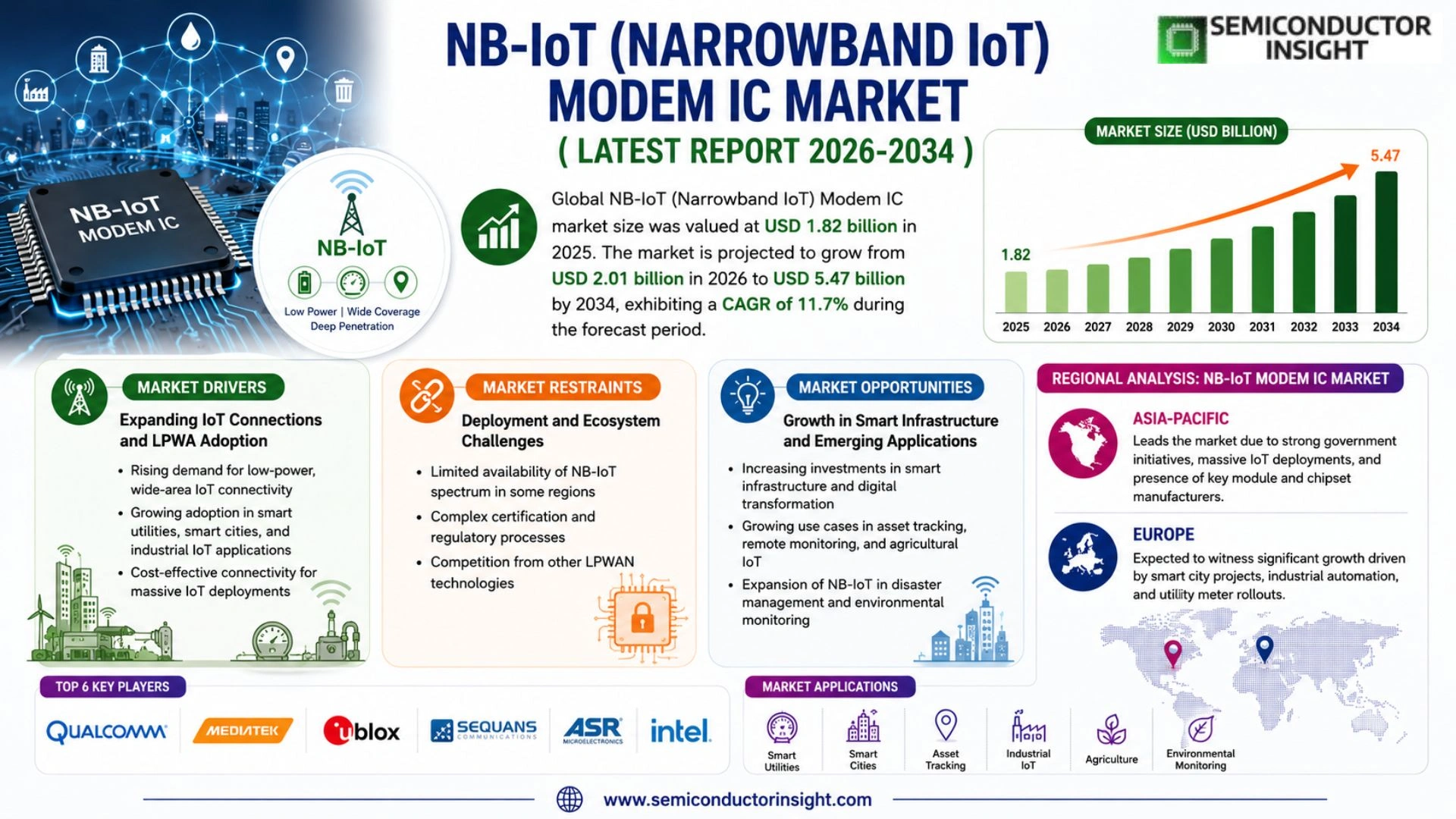
NB-IoT (Narrowband IoT) Modem IC market size was valued at USD 1.82 billion in 2025. The market is projected to grow from USD 2.01 billion in 2026 to USD 5.47 billion by 2034, exhibiting a CAGR of 11.7% during the forecast period.
NB-IoT Modem ICs are purpose-built semiconductor chips designed to enable low-power, wide-area wireless communication for Internet of Things devices operating over licensed cellular spectrum. These integrated circuits support the 3GPP-standardized NB-IoT (Release 13 and beyond) protocol, facilitating reliable data transmission across applications including smart metering, asset tracking, smart cities, industrial monitoring, and connected healthcare. The product category encompasses standalone modem ICs, integrated System-on-Chip (SoC) solutions, and multi-mode chipsets that combine NB-IoT with LTE-M or GPRS connectivity.
The market is witnessing robust expansion driven by accelerating global rollout of NB-IoT network infrastructure, tightening government mandates around smart utility metering, and the surging adoption of low-power IoT deployments across industrial and consumer verticals. Furthermore, the declining cost of NB-IoT chipsets , with average selling prices falling below USD 2 per unit for high-volume applications , is broadening addressability across cost-sensitive markets. Strategic initiatives by leading semiconductor players continue to reinforce growth momentum; for instance, Qualcomm, MediaTek, and Nordic Semiconductor have each expanded their NB-IoT modem IC portfolios with enhanced power efficiency and integrated GNSS capabilities. Quectel Wireless Solutions, Sequans Communications, and u-blox AG are among the prominent players operating in this market with competitive and diversified product offerings.
MARKET DRIVERS
Accelerating Global IoT Device Deployments Fueling Demand for NB-IoT Modem ICs
NB-IoT (Narrowband IoT) Modem IC Market is experiencing robust growth driven by the rapid expansion of connected device ecosystems across industries such as smart metering, asset tracking, agriculture, and smart cities. Telecom operators worldwide have been aggressively rolling out NB-IoT network coverage, particularly across Asia-Pacific, Europe, and parts of North America, creating a strong infrastructure foundation that directly stimulates demand for NB-IoT modem integrated circuits. As enterprises seek low-power, wide-area connectivity solutions for massive machine-type communications (mMTC), NB-IoT modem ICs have emerged as a preferred choice due to their superior coverage, extended battery life, and low module cost.
Government Smart City and Digital Infrastructure Initiatives Supporting NB-IoT Modem IC Adoption
Public sector investments in smart city infrastructure have become a significant catalyst for the NB-IoT Modem IC Market. Governments across China, South Korea, Germany, and the UAE have mandated or incentivized the deployment of smart utility meters, intelligent street lighting, and connected public safety systems , all of which rely heavily on NB-IoT modem IC technology. China, in particular, has mandated NB-IoT adoption in water and gas metering applications at a national scale, generating consistent and large-volume procurement of NB-IoT modem ICs from domestic and international semiconductor suppliers. These policy-driven deployments provide market participants with a relatively stable and predictable demand outlook.
➤ The integration of NB-IoT modem ICs into smart metering infrastructure across China alone has driven multi-million unit annual shipments, underscoring how policy mandates can serve as powerful market accelerants for the broader NB-IoT (Narrowband IoT) Modem IC Market.
The evolution of 3GPP Release 14, 15, and 16 standards has further enhanced the technical capabilities of NB-IoT, introducing features such as improved positioning, higher data throughput, and multicast support. These enhancements have expanded the applicable use cases for NB-IoT modem ICs beyond simple telemetry into more complex industrial monitoring and healthcare wearable applications. As chipset manufacturers integrate these advanced features into next-generation modem ICs while maintaining cost efficiency, the addressable market for NB-IoT modem IC solutions continues to broaden, further supporting sustained market growth.
MARKET CHALLENGES
Competitive Pressure from Alternative LPWAN Technologies Challenging NB-IoT Modem IC Market Growth
One of the most significant challenges confronting NB-IoT (Narrowband IoT) Modem IC Market is the presence of competing Low-Power Wide-Area Network (LPWAN) technologies, notably LoRaWAN and Sigfox, which offer unlicensed spectrum operation and lower initial deployment costs in certain use cases. While NB-IoT modem ICs benefit from licensed spectrum reliability and deep indoor penetration, enterprise buyers in cost-sensitive verticals sometimes opt for alternative connectivity solutions, creating competitive displacement risks. Additionally, the emergence of LTE-M (Cat-M1) as a complementary or substitute technology within the cellular IoT space introduces another layer of competitive complexity, as some applications may prefer LTE-M’s higher bandwidth and voice capability over the more constrained NB-IoT profile.
Other Challenges
Fragmented Ecosystem and Interoperability Issues
Despite standardization efforts, the NB-IoT modem IC market continues to face challenges related to ecosystem fragmentation. Variations in network operator implementations, regional spectrum allocations, and differing operator support for specific 3GPP release features create interoperability hurdles for device manufacturers. This fragmentation complicates the design process for modem IC vendors, who must support multiple band configurations and certification requirements across global markets, increasing both development costs and time-to-market for new NB-IoT modem IC products.
Supply Chain Constraints and Semiconductor Sourcing Volatility
The broader semiconductor industry’s susceptibility to supply chain disruptions , as demonstrated during recent global chip shortages , poses a persistent operational challenge for the NB-IoT Modem IC Market. Manufacturers of NB-IoT modem ICs rely on advanced fabrication nodes and specialized foundry capacity, both of which can be subject to allocation constraints during periods of elevated demand. These supply-side vulnerabilities can delay product launches, inflate component costs, and disrupt customer procurement planning, thereby creating headwinds for otherwise strong underlying demand in the NB-IoT modem IC segment.
MARKET RESTRAINTS
Ultra-Low Average Selling Prices Compressing Margins Across the NB-IoT Modem IC Value Chain
A fundamental restraint on NB-IoT (Narrowband IoT) Modem IC Market is the intense price pressure that characterizes the segment. As the market has matured, average selling prices for NB-IoT modem ICs have declined considerably, driven by aggressive competition among major semiconductor vendors including Qualcomm, MediaTek, Nordic Semiconductor, and several Chinese chipmakers. While lower prices benefit downstream device manufacturers and end users, they significantly compress gross margins for modem IC suppliers, limiting their capacity to reinvest in research and development for next-generation products. This price erosion is particularly acute in high-volume commodity applications such as utility metering, where procurement decisions are heavily cost-driven.
Dependency on Carrier Network Rollout Timelines Creating Demand Uncertainty for NB-IoT Modem IC Vendors
The commercial success of NB-IoT modem IC products is inherently tied to the pace and geographic scope of NB-IoT network deployments by mobile network operators (MNOs). In regions where NB-IoT coverage remains incomplete or where operators have prioritized competing technologies such as LTE-M or private 5G, device manufacturers face hesitancy in committing to large-scale NB-IoT modem IC procurement. This dependency on carrier network investment cycles introduces demand uncertainty that can be difficult for modem IC vendors to plan around, particularly for smaller fabless companies with limited financial buffers to absorb demand fluctuations. The uneven global rollout of NB-IoT infrastructure thus acts as a structural restraint on more uniform market expansion.
Furthermore, the transition toward 5G and network sunsetting considerations introduce long-term planning risk for stakeholders in the NB-IoT Modem IC Market. While 3GPP has affirmed NB-IoT’s inclusion within the 5G standards framework, enterprise customers and system integrators in certain markets have expressed caution about long-term technology commitments, preferring to observe how the NB-IoT and 5G RedCap technology trajectories evolve before scaling deployments. This wait-and-see posture among a subset of potential buyers moderates near-term demand growth for NB-IoT modem ICs in those markets.
MARKET OPPORTUNITIES
Expansion of Smart Agriculture and Environmental Monitoring Applications Unlocking New NB-IoT Modem IC Demand
NB-IoT (Narrowband IoT) Modem IC Market stands to benefit substantially from the growing adoption of precision agriculture and environmental monitoring solutions. Soil moisture sensors, weather stations, livestock trackers, and irrigation management systems deployed across vast rural geographies require connectivity solutions that offer long battery life, deep coverage, and low cost per node , attributes where NB-IoT modem ICs excel. As governments and agribusinesses in emerging economies invest in agricultural modernization, the demand for NB-IoT-enabled devices in rural and remote deployments is expected to create significant new volume opportunities for modem IC manufacturers, particularly those offering integrated, single-chip solutions optimized for ultra-low power consumption.
Integration of NB-IoT Modem ICs into Healthcare Wearables and Remote Patient Monitoring Devices
Healthcare represents a compelling and underserved growth opportunity for the NB-IoT Modem IC Market. Remote patient monitoring, elderly care wearables, medication adherence trackers, and chronic disease management devices are increasingly being designed to leverage cellular IoT connectivity for reliable data transmission to cloud-based health platforms. The NB-IoT modem IC’s combination of low power draw, small form factor potential, and wide network coverage makes it technically well-suited for these applications. As healthcare systems globally accelerate digital transformation initiatives and as regulatory frameworks for connected medical devices become clearer, the healthcare vertical is positioned to become a meaningful revenue contributor for NB-IoT modem IC suppliers over the coming years.
Emergence of 5G-Integrated NB-IoT Modem IC Architectures Opening Next-Generation Design Opportunities
The formal incorporation of NB-IoT within 5G non-standalone and standalone network architectures under 3GPP standards presents a significant long-term opportunity for NB-IoT modem IC vendors to develop next-generation, multi-mode chipsets. Semiconductor companies capable of engineering modem ICs that support both legacy NB-IoT operation and forward-compatible 5G IoT modes will be well-positioned to capture design wins across a wide range of industrial and consumer IoT applications. This architectural convergence also encourages platform-level investment by leading chipset vendors, which is expected to drive innovation in areas such as integrated security, on-chip artificial intelligence inference capabilities, and further reductions in power consumption , all of which will enhance the competitive positioning of NB-IoT (Narrowband IoT) Modem IC Market relative to alternative connectivity solutions.
Trends
Accelerating Global NB-IoT Network Rollout Driving Modem IC Adoption
NB-IoT (Narrowband IoT) Modem IC Market is experiencing a significant surge in demand, largely propelled by the accelerating global deployment of NB-IoT network infrastructure over licensed cellular spectrum. Telecom operators across Asia-Pacific, Europe, and North America have been rapidly expanding NB-IoT coverage, enabling semiconductor manufacturers to align their modem IC portfolios with growing end-user connectivity requirements. This infrastructure expansion is directly translating into stronger procurement cycles for purpose-built NB-IoT modem ICs across applications such as smart metering, asset tracking, industrial monitoring, and connected healthcare. As network availability broadens, enterprises and utility providers are increasingly committing to large-scale IoT deployments, sustaining strong upstream demand for NB-IoT chipsets.
Other Trends
Declining Chipset Costs Expanding Addressable Markets
A prominent trend shaping NB-IoT (Narrowband IoT) Modem IC Market is the consistent decline in average selling prices for NB-IoT modem ICs. Average selling prices have fallen below USD 2 per unit for high-volume applications, significantly broadening the addressable market across cost-sensitive verticals including smart agriculture, low-cost asset trackers, and consumer-grade connected devices. This pricing evolution is enabling smaller enterprises and emerging economies to justify IoT investments at scale, further widening the total deployment base for NB-IoT modem ICs globally.
Portfolio Expansion by Leading Semiconductor Players
Major semiconductor companies are actively expanding and diversifying their NB-IoT modem IC offerings. Qualcomm, MediaTek, and Nordic Semiconductor have each extended their product portfolios to include modem ICs with enhanced power efficiency and integrated GNSS capabilities. Additionally, companies such as Quectel Wireless Solutions, Sequans Communications, and u-blox AG continue to compete with differentiated, multi-mode chipsets that combine NB-IoT with LTE-M or GPRS connectivity, catering to applications that require flexible and interoperable communication standards.
Government Mandates Supporting Smart Utility Metering Deployments
Regulatory frameworks across multiple regions are mandating the adoption of smart utility metering, creating a reliable and recurring demand channel for NB-IoT (Narrowband IoT) Modem IC Market. Government-driven smart meter rollout programs in countries across Europe and Asia are compelling utilities to integrate NB-IoT-enabled metering solutions, given their low power consumption, deep indoor penetration, and compatibility with existing cellular infrastructure. These mandates are expected to sustain consistent procurement volumes for NB-IoT modem ICs over the coming years.
Shift Toward Integrated SoC Solutions and Multi-Mode Chipsets
The NB-IoT Modem IC Market is witnessing a clear industry shift from standalone modem ICs toward integrated System-on-Chip solutions and multi-mode chipsets. Device manufacturers are increasingly favoring SoC designs that consolidate processing, memory, and modem functionality into a single unit, reducing bill-of-materials costs and simplifying product development cycles. Multi-mode chipsets supporting both NB-IoT and complementary standards such as LTE-M are gaining traction among OEMs seeking design flexibility across diverse IoT application verticals, reinforcing this as one of the defining product-level trends in the market.
COMPETITIVE LANDSCAPE
Key Industry Players
NB-IoT Modem IC Market: A Highly Specialized Semiconductor Arena Shaped by Cellular IoT Innovation and Strategic R&D Investment
Global NB-IoT (Narrowband IoT) Modem IC Market is characterized by the dominant presence of a select group of established semiconductor giants and specialized wireless chipset developers. Qualcomm Technologies leads the competitive field with its MDM9205 and subsequent NB-IoT/LTE-M modem platforms, leveraging its deep cellular IP portfolio and global carrier relationships to maintain a commanding position. MediaTek has similarly reinforced its standing through its MT2625 NB-IoT SoC , a highly integrated, ultra-low-power chipset widely adopted across smart metering and asset tracking applications in Asia-Pacific markets. Nordic Semiconductor, renowned for its low-power wireless expertise, has expanded aggressively into the NB-IoT space with multi-mode modem solutions incorporating enhanced power optimization and integrated GNSS, addressing the growing demand from industrial IoT and logistics verticals. The market structure reflects moderate consolidation, with the top five players collectively accounting for a significant share of global shipments, while competition intensifies across pricing, power efficiency, integration level, and certification breadth.
Beyond the tier-one players, several specialized and regionally prominent companies contribute meaningfully to the NB-IoT Modem IC competitive ecosystem. Sequans Communications has carved a distinct niche with its Monarch and Monarch 2 chipset families, purpose-built for LPWA applications and broadly certified across global NB-IoT and LTE-M networks. u-blox AG offers a portfolio of NB-IoT modules and modem ICs targeting precision-grade IoT deployments including connected metering and smart city infrastructure. Quectel Wireless Solutions, though primarily a module maker, integrates proprietary and third-party NB-IoT modem ICs into its widely distributed product lines. Sierra Wireless, Telit Communications, and Fibocom Wireless also maintain competitive offerings in the NB-IoT connectivity segment. On the domestic Chinese front, HiSilicon (Huawei’s semiconductor arm) and Unisoc (formerly Spreadtrum) have emerged as formidable competitors, supplying cost-optimized NB-IoT SoCs primarily to the vast Chinese smart utility and infrastructure market. Sony Semiconductor Israel (formerly Altair Semiconductor) and Riot Micro round out the competitive landscape with differentiated modem architectures targeting power-constrained IoT applications across North America and Europe.
List of Key NB-IoT Modem IC Companies Profiled
- Qualcomm Technologies, Inc.
- MediaTek Inc.
- Nordic Semiconductor ASA
- Sequans Communications S.A.
- u-blox AG
- Quectel Wireless Solutions Co., Ltd.
- HiSilicon Technologies Co., Ltd. (Huawei)
- Unisoc Technologies Co., Ltd.
- Sierra Wireless, Inc.
- Telit Communications PLC
- Fibocom Wireless Inc.
- Sony Semiconductor Israel Ltd. (formerly Altair Semiconductor)
- Riot Micro Inc.
- Sanechips Technology Co., Ltd. (ZTE subsidiary)
- Eigencomm Co., Ltd.
Segment Analysis:
| Segment Category | Sub-Segments | Key Insights |
| By Type |
|
Integrated System-on-Chip (SoC) Solutions dominate the NB-IoT Modem IC market by type, owing to their ability to consolidate modem functionality, processing cores, memory, and power management into a single compact package.
|
| By Application |
|
Smart Metering stands out as the leading application segment within the NB-IoT Modem IC market, propelled by stringent government mandates and utility modernization programs being implemented across major economies worldwide.
|
| By End User |
|
Utilities & Energy Providers represent the most prominent end user segment, consistently driving large-scale procurement of NB-IoT modem ICs as part of comprehensive grid modernization and demand management initiatives.
|
| By Power Efficiency Class |
|
Ultra-Low Power (ULP) Modem ICs lead this segmentation as the preferred choice across the vast majority of NB-IoT deployment scenarios where battery-operated, maintenance-free operation over extended periods is a non-negotiable design requirement.
|
| By Deployment Mode |
|
In-Band Deployment emerges as the dominant mode adopted by network operators and device manufacturers, reflecting the widespread preference for overlaying NB-IoT services on existing LTE network infrastructure without requiring dedicated spectrum allocation.
|
Regional Analysis: NB-IoT (Narrowband IoT) Modem IC Market
Asia-Pacific
China’s central government has institutionalized NB-IoT adoption through successive five-year plans and smart city mandates, compelling utility operators, municipal authorities, and transport agencies to integrate NB-IoT modem ICs into their infrastructure. This top-down demand signal has catalyzed a thriving domestic semiconductor design ecosystem, enabling local fabless chip companies to scale production rapidly and reduce dependence on foreign modem IC suppliers.
South Korea’s leading mobile network operators and Japan’s established carrier infrastructure have been instrumental in enabling large-scale NB-IoT Modem IC Market growth across the two nations. Mature spectrum allocation frameworks, high carrier investment in LPWAN networks, and a robust industrial IoT base in sectors such as automotive telematics, factory automation, and precision agriculture continue to sustain strong regional modem IC demand.
India is transitioning from early-stage NB-IoT trials to commercial-scale deployments, with telecom operators expanding LTE network coverage into semi-urban and rural geographies. The country’s ambitious smart metering and digital infrastructure programs are creating sustained procurement pipelines for low-cost NB-IoT modem ICs. Favorable government policies around domestically manufactured electronics further enhance India’s medium-term contribution to regional NB-IoT Modem IC Market growth.
Nations including Vietnam, Thailand, Malaysia, and Indonesia are witnessing accelerated industrial IoT adoption as multinational manufacturers expand regional production footprints. The proliferation of NB-IoT-enabled asset tracking, environmental monitoring, and supply chain management solutions is generating a growing addressable market for modem IC suppliers seeking to diversify beyond China and capitalize on Southeast Asia’s expanding connectivity infrastructure.
North America
North America represents one of the most strategically important markets in the global NB-IoT Modem IC Market, characterized by sophisticated enterprise demand, advanced carrier infrastructure, and a highly innovative semiconductor design community. The United States leads regional adoption, with major carriers having deployed NB-IoT-compatible network layers that enable a broad spectrum of enterprise IoT applications spanning smart utilities, commercial real estate monitoring, precision agriculture, and connected healthcare devices. The regulatory environment in North America favors open spectrum competition and innovation, encouraging both established semiconductor firms and emerging fabless chipset designers to invest in next-generation NB-IoT modem IC architectures. Canada complements the regional landscape through its expanding smart city initiatives and growing agricultural IoT sector. While North America does not match Asia-Pacific in volume-driven demand, it consistently commands premium value segments of the NB-IoT Modem IC Market, particularly in applications requiring enhanced security, ultra-low power operation, and seamless integration with enterprise cloud platforms.
Europe
Europe occupies a significant and strategically distinctive position within the global NB-IoT Modem IC Market, shaped by stringent regulatory standards, a strong emphasis on energy efficiency, and ambitious digital transformation agendas across member states. The European Union’s initiatives around smart metering, building energy management, and connected infrastructure have generated consistent and policy-backed demand for NB-IoT modem ICs across utility and industrial verticals. Germany, France, the Netherlands, and the United Kingdom are among the most active adopters, with telecom operators having invested substantially in nationwide NB-IoT network coverage. European semiconductor firms and research institutions contribute meaningfully to modem IC innovation, particularly in areas of chipset miniaturization and ultra-low power design. The region’s rigorous data privacy frameworks, including GDPR compliance requirements, are also shaping modem IC design priorities, with security and data integrity features becoming key differentiators for suppliers targeting the European NB-IoT Modem IC Market through 2034.
South America
South America is an emerging participant in the global NB-IoT Modem IC Market, with adoption currently concentrated in Brazil, which serves as the region’s primary IoT innovation hub. Brazilian utilities and municipal governments have initiated smart metering and smart city pilot programs that are gradually expanding into full commercial deployments, creating early but promising demand for NB-IoT modem ICs. Argentina and Colombia are also demonstrating growing interest in LPWAN technologies to address connectivity challenges in geographically dispersed industrial and agricultural operations. The region’s NB-IoT Modem IC Market development is tempered by economic volatility, fragmented spectrum policies, and uneven telecom infrastructure investment across national borders. Nevertheless, the long-term outlook for South America remains constructive, as digital transformation agendas gain traction and international semiconductor suppliers seek to establish distribution and partnership networks ahead of anticipated market acceleration in the latter half of the 2026–2034 forecast period.
Middle East & Africa
The Middle East and Africa collectively represent the frontier growth segment of the global NB-IoT Modem IC Market, with adoption dynamics varying considerably across sub-regions. Gulf Cooperation Council nations, led by the United Arab Emirates and Saudi Arabia, are investing heavily in smart city ecosystems as part of broader national economic diversification strategies, generating early commercial demand for NB-IoT modem ICs in infrastructure monitoring, logistics, and connected utilities. Israel’s advanced technology sector contributes meaningful chipset innovation to the regional landscape. Sub-Saharan Africa, while at an earlier stage of NB-IoT deployment, presents a compelling long-term opportunity given its vast unconnected population, expanding mobile infrastructure, and acute need for low-cost, low-power IoT connectivity in agriculture, healthcare, and natural resource management. As mobile network operators across Africa continue to modernize their networks and introduce LTE-based IoT services, the Middle East and Africa region is expected to emerge as an increasingly relevant contributor to global NB-IoT Modem IC Market growth through 2034.
Report Scope
This market research report provides a comprehensive analysis of the NB-IoT (Narrowband IoT) Modem IC Market , covering the forecast period 2026–2034. It offers detailed insights into market dynamics, technological advancements, competitive landscape, and key trends shaping the industry.
Key focus areas of the report include:
- Market Overview: The report begins with an overview outlining its current market scenario, key growth indicators, and industry transformation drivers. It discusses macroeconomic factors, demand–supply balance, regulatory landscape, and the strategic role of semiconductors in powering advancements across industries such as automotive, telecommunications, consumer electronics, and industrial automation.
- Market Size & Forecast: Historical data and future projections for revenue, unit shipments, and market value across major regions and segments.
- Segmentation Analysis: Detailed breakdown by product type, technology, application, and end-user industry to identify high-growth segments and investment opportunities.
- Regional Insights: Insights into market performance across North America, Europe, Asia-Pacific, Latin America, and the Middle East & Africa, including country-level analysis where relevant.
- Competitive Landscape: Profiles of leading market participants, including their product offerings, R&D focus, manufacturing capacity, pricing strategies, and recent developments such as mergers, acquisitions, and partnerships.
- Technology Trends & Innovation: Assessment of emerging technologies, integration of AI/IoT, semiconductor design trends, fabrication techniques, and evolving industry standards.
- Market Drivers & Restraints: Evaluation of factors driving market growth along with challenges, supply chain constraints, regulatory issues, and market-entry barriers.
- Stakeholder Insights: Insights for component suppliers, OEMs, system integrators, investors, and policymakers regarding the evolving ecosystem and strategic opportunities.
Primary and secondary research methods are employed, including interviews with industry experts, data from verified sources, and real-time market intelligence to ensure the accuracy and reliability of the insights presented.
FREQUENTLY ASKED QUESTIONS:
What is the current market size of NB-IoT (Narrowband IoT) Modem IC Market?
-> Global NB-IoT (Narrowband IoT) Modem IC Market was valued at USD 1.82 billion in 2025 and is expected to reach USD 5.47 billion by 2034, growing at a CAGR of 11.7% during the forecast period from 2026 to 2034.
Which key companies operate NB-IoT (Narrowband IoT) Modem IC Market?
-> Key players include Qualcomm, MediaTek, Nordic Semiconductor, Quectel Wireless Solutions, Sequans Communications, and u-blox AG, among others.
What are the key growth drivers?
-> Key growth drivers include accelerating global rollout of NB-IoT network infrastructure, tightening government mandates around smart utility metering, surging adoption of low-power IoT deployments across industrial and consumer verticals, and declining chipset costs falling below USD 2 per unit for high-volume applications.
Which region dominates the market?
-> Asia-Pacific is the fastest-growing region driven by large-scale smart metering deployments and IoT infrastructure investments, while North America and Europe remain significant markets supported by advanced cellular network rollouts and regulatory mandates.
What are the emerging trends?
-> Emerging trends include integrated System-on-Chip (SoC) solutions, multi-mode chipsets combining NB-IoT with LTE-M or GPRS connectivity, enhanced power efficiency features, integrated GNSS capabilities, and expanding applications in smart cities, connected healthcare, and industrial monitoring.

Get Sample Report PDF for Exclusive Insights
Report Sample Includes
- Table of Contents
- List of Tables & Figures
- Charts, Research Methodology, and more...
 Download Sample Report PDF