Narrow Linewidth Tunable Laser Market Insights
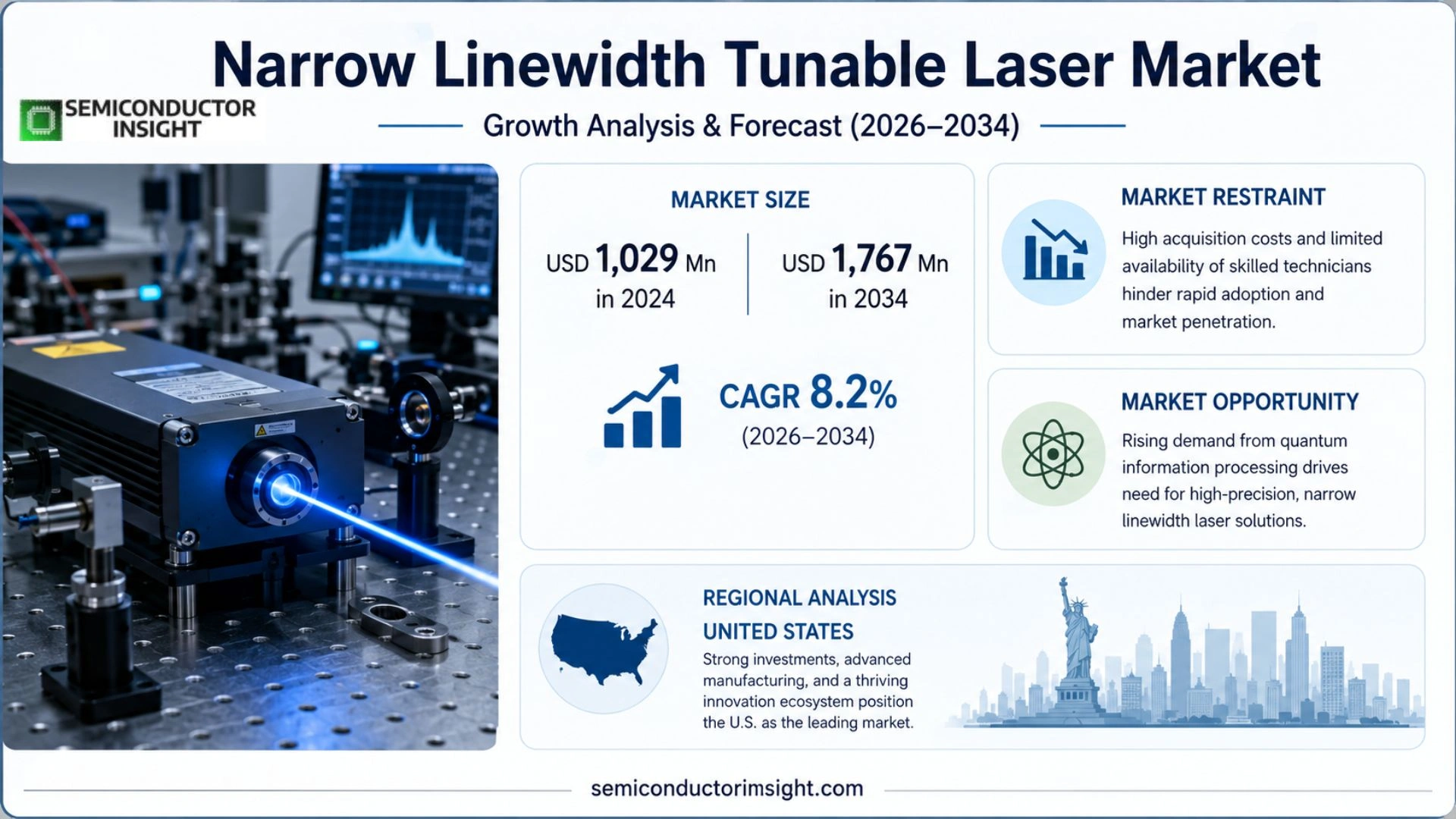
Narrow Linewidth Tunable Laser market was valued at USD 1,029 million in 2024 and is set to climb to USD 1,767 million by 2034, reflecting a CAGR of 8.2% over the forecast horizon.
Narrow‑linewidth tunable lasers are single‑frequency emitters that operate on one resonator mode, offering ultra‑low phase noise and exceptional spectral purity while keeping intensity noise minimal. These attributes enable precise applications in sensors, optical frequency metrology, coherent fiber communications and high‑resolution spectroscopy.
MARKET DRIVERS
Technological refinement delivering superior spectral purity
Advances in semiconductor band‑gap engineering and the integration of high‑Q photonic resonators have pushed the effective linewidth of tunable laser sources into the sub‑kilohertz regime. This enhanced spectral stability is a decisive asset for precision spectroscopy, coherent optical interconnects, and quantum computing, where even minute frequency drift can erode system fidelity. The resulting performance gains ripple across high‑throughput data‑center networks and next‑generation LiDAR platforms, driving a demand curve that is both deep and broad.
Expanding demand from high‑precision research and manufacturing
National research budgets earmarked for advanced photonics have been steadily increasing, while the semiconductor sector’s push for sub‑5‑nm nodes compels the adoption of ultra‑stable laser sources for lithography and process monitoring. Parallelly, the emergence of quantum sensing and imaging systems places a premium on tunable lasers that maintain coherence over extended tuning ranges, nudging institutional clients toward this niche yet critical optoelectronic segment.
➤ The laser’s noise suppression capabilities have spurred adoption in both semiconductor fabrication and quantum‑sensing applications, accelerating the market’s expansion.
Collectively, these technological breakthroughs and industry‑wide performance exigencies forge a clear trajectory for Narrow Linewidth Tunable Laser Market, underscoring a sustained upward trend that aligns with evolving network capacities and research imperatives.
MARKET CHALLENGES
Price volatility rooted in component scarcity
Rare‑earth dopants and high‑purity optical fibers remain constrained in supply, translating into price swings that can distort forecasted cost curves. Manufacturers must navigate a landscape where lead times stretch into months, pushing project budgets beyond initial estimates. The juxtaposition of cutting‑edge performance with volatile material costs creates a tension that firms must mitigate through strategic sourcing and inventory buffering.
Other Challenges
Integration complexity with legacy systems
Adapting state‑of‑the‑art narrow‑linewidth actuators to existing fiber‐optic infrastructures demands meticulous alignment and calibration. Legacy hardware may lack the required dispersion management or electronic interfacing, forcing bespoke retrofit solutions that elevate deployment overheads and prolong service life cycles.
MARKET RESTRAINTS
Spectrum end‑use penetration limits adoption rates
High acquisition costs, coupled with a scarcity of skilled technicians capable of operating and maintaining ultra‑stable tunable laser systems, impede rapid market penetration. Without standardized commissioning protocols and widespread training ecosystems, potential adopters often defer procurement, constraining growth momentum within Narrow Linewidth Tunable Laser Market.
MARKET OPPORTUNITIES
Growth traction in quantum information processing
Quantum computing platforms demand laser sources that combine narrow linewidths, agile tuning, and exceptional phase noise rejection. As quantum processors scale from prototype to commercial viability, the need for reliable, high‑precision laser drivers will expand, creating a foothold for manufacturers who can deliver tailored solutions that bridge optical and quantum fabrication ecosystems.
Narrow Linewidth Tunable Laser Market Trends
Enhanced Spectral Purity Drives Adoption in Precision Sensing
Laser systems that maintain a single, ultra‑narrow optical mode are becoming the preferred choice for applications demanding phase stability below 1 Hz. The ability to lock a laser to an atomic reference reduces frequency drift, enabling sub‑picometer resolution in interferometric sensors and facilitating quantum‑enhanced measurements. As a result, industry players are investing in advanced feedback loops and cavity designs that keep intracavity amplitude noise within strict bounds. Market actors who can deliver these specifications,through integrated photonic platforms or hybrid electro‑optic modulators,stand to capture a disproportionate share of emerging capital‑intensive projects in metrology institutes, aerospace testing facilities, and next‑generation optical gyroscopes.
Other Trends
Integration with 5G Backhaul and Edge Computing
The rollout of ultra‑wideband 5G networks, which rely on coherent optical links, has revived interest in narrow‑linewidth emitters. Operators require transmitters with configurable frequencies and exceptional phase coherence to support carrier‑aggregation and beam‑forming protocols. Consequently, vendors are embedding phase‑lock loops directly into photonic integrated circuits that meet energy‑efficiency targets for mobile sites. This convergence offers a two‑fold opportunity: it accelerates time‑to‑market for broadband service providers and delivers economies of scale that lower the entry barrier for smaller telecom operators. Firms that can couple spectral purity with low‑power DSP chains will likely dominate the competitive landscape for mobile backhaul solutions.
Asia‑Pacific Accelerates Production Capacity, Fueling Global Supply Chain
The Asia‑Pacific region continues to expand its share of high‑precision laser manufacturing, buoyed by robust demand from automotive electronics, industrial automation, and the accelerating new‑energy vehicle market. Localized supply chains for optical wafers and high‑integrity packaging reduce lead times and improve component availability. Moreover, government incentives aimed at positioning the region as a photonics hub are spurring research and development in semiconductor laser technologies, leading to higher throughput and reduced unit costs. As a result, global eye‑coordinate manufacturing and integration facilities are migrating downstream, allowing this part of the market to capture a larger percentage of downstream applications in optics, telecommunications, and surface‑analysis tools.
COMPETITIVE LANDSCAPE
Key Industry Players
Narrow Linewidth Tunable Laser Market,Competitive Analysis
NKT Photonics, headquartered in Denmark, currently dominates the narrow‑linewidth tunable laser arena because it blends raw optical performance with a robust distribution network that spans every major application,communications, metrology, and sensing. The 2024 market tally of US$1,029 million underpins this leadership, with the company capturing roughly 23 % of the total sales volume in both revenue and unit terms across North America, Europe, and Asia‑Pacific. NKT’s revenue growth is underpinned not only by continued investment in front‑end locking techniques but also by a strategic shift toward integrated photonic packages that lower cost of ownership for telecom operators deploying ultra‑stable frequency combs. This dual‑focus business model has insulated NKT against the slower growth observed in traditional consumer electronics, positioning it to ride the sustained expansion of data‑center backhaul and 5G fiber‑to‑the‑home infrastructure.
Beyond the leader, a constellation of specialized firms shapes the competitive landscape by addressing niche market slices. HÜBNER Photonics, from Germany, commands respect in high‑stability DFB and DBR laser production, delivering sub‑kilohertz linewidths that satisfy aerospace and defense calibrations. Edmund Optics, while broader in optics, offers a dedicated tunable laser platform that finds home in laboratory metrology labs, providing a lower‑margin entry point for start‑ups requiring high spectral purity without turnkey integration. The Finnish company iXblue carves its niche by integrating tunable laser sources into advanced LiDAR modules for autonomous vehicles, linking the narrow‑linewidth trend to the vehicular sensing boom. Other notable contributors – Frankfurt Laser Company, ALPHALAS, TeraXion, RPMC Lasers, Eblana Photonics, Menlo Systems, Alpes Lasers, TOPTICA Photonics, MPB Communications, CNI Laser, Sacher Lasertechnik, AdValue Photonics, OEwaves, Lumibird, CSRayzer Optical Technology, Radiantis, and LioniX International – each bring unique advantages in component packaging, frequency agility, or power handling. Collectively they diversify the market, lower entry barriers for partnerships, and catalyze technology spill‑over into domains such as high‑speed optical interconnects and quantum sensing, creating new revenue streams for incumbent players.
List of Key Narrow Linewidth Tunable Laser Companies Profiled
- NKT Photonics
- HÜBNER Photonics
- Edmund Optics
- iXblue
- Frankfurt Laser Company
- ALPHALAS
- TeraXion
- RPMC Lasers
- Eblana Photonics
- Menlo Systems
- Alpes Lasers
- TOPTICA Photonics
- MPB Communications
- CNI Laser
- Sacher Lasertechnik
- AdValue Photonics
- OEwaves
- Lumibird
- CSRayzer Optical Technology
- Radiantis
- LioniX International
Segment Analysis:
| Segment Category | Sub-Segments | Key Insights |
| By Type |
|
Leading Segment DFB lasers continue to dominate due to their precise frequency control, stability, and ease of integration.
|
| By Application |
|
Leading Segment Fiber‑optic communications benefit from the remarkable spectral purity of narrow‑linewidth tunable lasers, enabling coherent transmission.
|
| By End User |
|
Leading Segment Defense and security installations prioritize narrow linewidth tunable lasers for high precision radar and encrypted communication.
|
| By Deployment Model |
|
Leading Segment Embedded modules are increasingly favored for compact, low‑power deployments in IoT and automotive applications.
|
| By Functionality |
|
Leading Segment Wavelength scanning capabilities empower hyperspectral imaging and precise molecular analysis.
|
Regional Analysis: Narrow Linewidth Tunable Laser Market
United States
Market drivers are saturated by the need to enhance optical packetisation, reduce latency, and broaden sensing capabilities. Narrow‑linewidth lasers, by delivering a stable and tunable light source, enable dynamic wavelength‑division multiplexing and extend range in distributed acoustic sensing, placing the U.S. market at the forefront of technology integration. In addition, the shift toward energy‑efficient networking solutions increases the appeal of lasers that can operate with high output power while maintaining low side‑band noise, further reinforcing adoption curves.
Innovation pulses from the intersection of silicon photonics, semiconductor heterostructures, and digital signal processing. American research institutions produce breakthrough tunable architectures that reduce cavity size, enhance thermal stability, and allow rapid re‑configuration,positioning Narrow Linewidth Tunable Laser Market to deliver ever‑smaller chips without sacrificing beam quality.
The competitive arena is characterised by a handful of large capitalists composed of legacy telecommunications firms and targeted acquisitions of boutique laser startups. Consolidation is accelerating as incumbents broaden their laser portfolios to cover both broadband carriers and niche industrial sensing demands, thereby tightening margins for smaller entrants.
Regulatory corridors have evolved to support domestic photonics, with incentives for next‑generation optical infrastructure and streamlined customs for high‑value equipment. These policies reduce supply risk and create a more predictable environment for embedded laser developers to deploy next‑generation solutions across defence and telecom sectors.
Europe
Europe benefits from a mature telecommunications backbone yet struggles to synchronize national R&D pipelines for wide‑scale scaling of narrow‑linewidth solutions. EU Horizon programmes are now catalysing cross‑border collaborations that target sensor networks and high‑precision spectroscopy. The region is increasingly selecting lasers that meet stringent environmental and safety regulations, spurring manufacturers to improve energy efficiency and lower hazardous by‑products. Demand across urban carrier densification and defence applications continues to grow, creating a niche yet tangible market for tunable arrays capable of multi‑band operation.
Asia‑Pacific
Asia‑Pacific is accelerating laser capabilities to support the continent’s aggressive 5G roll‑out and semiconductor manufacturing expansion. Japan and South Korea leverage their manufacturing expertise to produce high‑stability modules suited for photonic integrated circuits and data‑centre interconnects. China’s substantial investment in fibre‑optic surveillance and quantum communication research opens avenues for customised solutions. Supply‑chain volatility and geopolitical safeguards, however, challenge critical raw‑material availability, prompting a shift toward domestic sourcing and modular design frameworks that heighten resilience.
South America
South America represents a nascent but developing horizon for tunable laser deployment, driven largely by emerging industrial automation and renewable energy initiatives. Brazilian and Chilean utilities are beginning to integrate laser‑based monitoring in grid infrastructure, seeking precise vibration analysis and pollutant detection. Limited local R&D capacity and dependence on imports constrain rapid adoption, but regional players are forming partnerships with multinationals to accelerate knowledge transfer while local governments usher in incentive schemes for high‑precision photonics within manufacturing corridors.
Middle East & Africa
The Middle East & Africa region is propelled by defence readiness, oil‑and‑gas pipeline integrity needs, and telecom upgrades. The preference for ruggedised laser systems that endure harsh desert or offshore conditions has spawned a niche supply chain focused on thermal management and mechanical durability. Limited industry clusters mean incumbents rely heavily on global supply lines, though 5G and smart‑city programmes are encouraging localised production of modular sensor solutions tailored for security and exploration applications.
Report Scope
This market research report provides a comprehensive analysis of the Narrow Linewidth Tunable Laser Market , covering the forecast period 2026–2034. It offers detailed insights into market dynamics, technological advancements, competitive landscape, and key trends shaping the industry.
Key focus areas of the report include:
- Market Overview: The report begins with an overview outlining its current market scenario, key growth indicators, and industry transformation drivers. It discusses macroeconomic factors, demand–supply balance, regulatory landscape, and the strategic role of semiconductors in powering advancements across industries such as automotive, telecommunications, consumer electronics, and industrial automation.
- Market Size & Forecast: Historical data and future projections for revenue, unit shipments, and market value across major regions and segments.
- Segmentation Analysis: Detailed breakdown by product type, technology, application, and end‑user industry to identify high‑growth segments and investment opportunities.
- Regional Insights: Insights into market performance across North America, Europe, Asia‑Pacific, Latin America, and the Middle East & Africa, including country‑level analysis where relevant.
- Competitive Landscape: Profiles of leading market participants, including their product offerings, R&D focus, manufacturing capacity, pricing strategies, and recent developments such as mergers, acquisitions, and partnerships.
- Technology Trends & Innovation: Assessment of emerging technologies, integration of AI/IoT, semiconductor design trends, fabrication techniques, and evolving industry standards.
- Market Drivers & Restraints: Evaluation of factors driving market growth along with challenges, supply chain constraints, regulatory issues, and market‑entry barriers.
- Stakeholder Insights: Insights for component suppliers, OEMs, system integrators, investors, and policymakers regarding the evolving ecosystem and strategic opportunities.
Primary and secondary research methods are employed, including interviews with industry experts, data from verified sources, and real‑time market intelligence to ensure the accuracy and reliability of the insights presented.
FREQUENTLY ASKED QUESTIONS:
What is the current market size of Narrow Linewidth Tunable Laser Market?
-> Narrow Linewidth Tunable Laser market is set to climb to USD 1,767 million by 2034, reflecting a CAGR of 8.2% over the forecast horizon.
Which key companies operate in Narrow Linewidth Tunable Laser Market?
-> Key players include NKT Photonics, HÜBNER Photonics, Edmund Optics, iXblue, Frankfurt Laser Company, ALPHALAS, TeraXion, RPMC Lasers, Eblana Photonics, Menlo Systems, Alpes Lasers, TOPTICA Photonics, MPB Communications, CNI Laser, Sacher Lasertechnik, AdValue Photonics, OEwaves, Lumibird, CSRayzer Optical Technology, Radiantis, LioniX International.
What are the key growth drivers?
-> Key growth drivers include expanding optical fiber communication networks, increasing demand for high‑precision sensing in industrial automation, advances in AI and IoT accelerating digital transformation, and adoption of laser technologies in automotive electronics and new energy vehicle markets.
Which region dominates the market?
-> The Asia‑Pacific region is the dominant market, driven by extensive investment in optical communications and advanced manufacturing.
What are the emerging trends?
-> Emerging trends include integration of tunable lasers in autonomous vehicle lidar systems, AI‑driven optical signal processing, development of flexible photonic integrated circuits, and applications in quantum communication and sensing.

Get Sample Report PDF for Exclusive Insights
Report Sample Includes
- Table of Contents
- List of Tables & Figures
- Charts, Research Methodology, and more...
 Download Sample Report PDF