MRI RF Receiver Coil (Digital) Preamp IC Market Insights
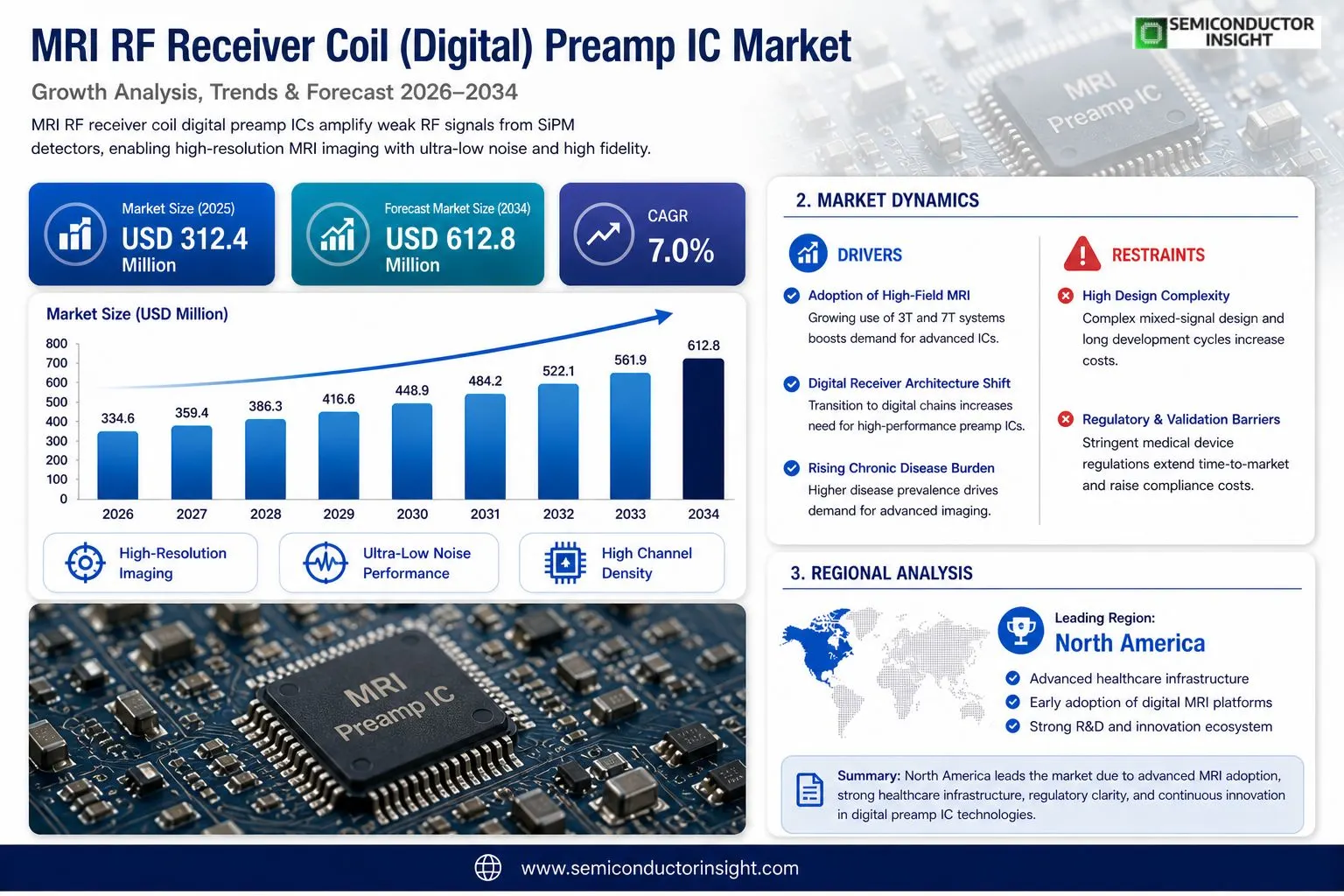
Global MRI RF Receiver Coil (Digital) Preamp IC market size was valued at USD 312.4 million in 2025. The market is projected to grow from USD 334.6 million in 2026 to USD 612.8 million by 2034, exhibiting a CAGR of 7.0% during the forecast period.
MRI RF receiver coil digital preamplifier integrated circuits are highly specialized semiconductor components designed to amplify weak radio frequency signals captured by receiver coils in magnetic resonance imaging systems. These ICs are engineered to deliver ultra-low noise figures, high gain, and exceptional signal fidelity, operating within the specific Larmor frequency ranges dictated by MRI field strengths , typically between 64 MHz for 1.5T systems and 297 MHz for 7T systems. Digital preamp ICs represent an advancement over conventional analog counterparts by enabling direct analog-to-digital conversion closer to the coil element, significantly reducing signal degradation and cable-induced noise in modern MRI architectures.
The market is gaining strong momentum driven by the rapid global expansion of advanced MRI installations, the growing clinical preference for high-field and ultra-high-field MRI systems, and the accelerating transition toward digital receiver architectures across leading OEM platforms. Furthermore, the rising prevalence of neurological, cardiovascular, and musculoskeletal conditions worldwide is intensifying demand for high-resolution diagnostic imaging, directly supporting adoption of next-generation coil technologies. Key industry participants such as Siemens Healthineers, GE HealthCare, Philips Healthcare, and specialized semiconductor suppliers continue to advance digital preamp IC performance, reinforcing the market’s sustained growth trajectory through the forecast period.
MARKET DRIVERS
Rising Demand for High-Field MRI Systems Accelerating Adoption of Digital Receiver Coil Architectures
MRI RF Receiver Coil (Digital) Preamp IC Market is experiencing sustained growth driven by Global expansion of advanced diagnostic imaging infrastructure. Healthcare systems worldwide are increasingly investing in high-field and ultra-high-field MRI platforms operating at 3T and above, where digital receiver coil technology offers superior signal fidelity, reduced electromagnetic interference, and improved channel isolation compared to legacy analog architectures. These performance advantages are compelling hospital networks and imaging centers to upgrade their coil ecosystems, directly stimulating demand for purpose-built digital preamp ICs engineered for MRI RF front-end applications.
Technological Transition from Analog to Digital Signal Processing Chains as a Core Market Engine
A fundamental architectural shift is underway across the MRI industry as original equipment manufacturers migrate from conventional analog preamplifier designs toward fully integrated digital RF receiver coil preamp ICs. This transition is motivated by the need to minimize signal degradation along extended cable runs, enable per-element digitization close to the coil array, and support increasingly dense multi-channel configurations,some exceeding 128 or even 256 receive channels. Semiconductor suppliers capable of delivering ultra-low-noise figure performance, high linearity, and low power dissipation in compact form factors are positioned as critical enablers of next-generation MRI coil design.
➤ The integration of digital preamplification directly at the coil element level represents one of the most consequential hardware innovations in MRI receiver chain design in recent years, enabling scalable multi-channel arrays without proportional increases in system complexity or noise floor penalties.
Beyond system-level performance, the increasing prevalence of parallel imaging techniques such as GRAPPA and SENSE, as well as compressed sensing reconstruction algorithms, depends heavily on maintaining high signal-to-noise ratio (SNR) across all receive channels simultaneously. This requirement places stringent demands on the noise performance and dynamic range of MRI RF receiver coil digital preamp ICs, reinforcing their critical role and sustaining procurement volumes across academic medical centers, private radiology groups, and OEM supply chains globally.
MARKET CHALLENGES
Stringent Regulatory and Biocompatibility Compliance Requirements Creating Barriers for Preamp IC Developers
Semiconductor components intended for integration within MRI RF receiver coil digital preamp assemblies must comply with a complex matrix of medical device regulations, electromagnetic compatibility standards, and quality management requirements including ISO 13485 and IEC 60601 series norms. For fabless and emerging IC design companies, navigating these compliance pathways demands substantial investment in testing, documentation, and third-party validation,costs that can significantly extend development timelines and constrain margins. The highly specialized nature of MRI RF front-end applications also limits the addressable customer base, making it difficult for new entrants to achieve the volume necessary to amortize qualification expenditures efficiently.
Other Challenges
Thermal Management Within Coil Enclosures
Embedding active digital electronics within MRI receive coil housings introduces non-trivial thermal management challenges. Digital preamp ICs dissipate power in proximity to sensitive receive antenna elements and in close contact with patients, requiring careful thermal design to prevent image artifacts caused by local heating, maintain patient safety thresholds, and protect component reliability over repeated scan cycles in high-utilization clinical environments.
Supply Chain Concentration and Specialty Process Dependencies
MRI RF receiver coil preamp IC Market segment relies on advanced semiconductor process nodes optimized for low-noise RF performance, such as SiGe BiCMOS platforms, which are available from a limited number of foundries globally. This concentration creates supply chain vulnerability, particularly during periods of broader semiconductor capacity constraints. Long lead times for specialty wafer starts and limited second-source options can disrupt coil OEM production schedules and introduce pricing volatility that challenges procurement planning for both large system manufacturers and smaller coil specialists.
MARKET RESTRAINTS
High Development Cost and Extended Qualification Cycles Limiting Speed of Market Penetration
The development of MRI RF receiver coil digital preamp ICs requires deep interdisciplinary expertise spanning RF analog circuit design, low-noise amplifier theory, high-speed digital interfaces, and MRI-specific application knowledge. This combination of competencies is scarce in the semiconductor industry, and the associated non-recurring engineering (NRE) costs for tape-out, characterization, and clinical validation are substantial. As a result, MRI RF Receiver Coil (Digital) Preamp IC Market is served by a relatively concentrated set of specialized suppliers, and the pace at which new products reach qualified design wins is materially slower than in higher-volume consumer or communications IC markets.
Capital Expenditure Pressures Among Healthcare Providers Moderating MRI Fleet Refresh Rates
While clinical demand for advanced MRI capabilities remains robust, hospital capital budgets in many markets face structural pressure from rising operational costs, staffing constraints, and competing investment priorities. Replacement cycles for MRI systems and associated coil inventories can extend well beyond typical technology refresh horizons when budget conditions tighten. This dynamic moderates the pace of transition to digital coil architectures in cost-sensitive markets and may delay procurement of coil assemblies incorporating the latest generation of digital preamp IC technology, creating a lag between technical availability and widespread clinical deployment that acts as a restraint on market expansion velocity.
MARKET OPPORTUNITIES
Emergence of Ultra-High-Field and Portable MRI Platforms Opening New Design Windows for Digital Preamp IC Innovation
The commercial development of ultra-high-field MRI systems operating at 7T and the simultaneous emergence of low-field portable MRI platforms represent two distinct but equally significant growth vectors for MRI RF Receiver Coil (Digital) Preamp IC Market. Ultra-high-field systems demand coil electronics with exceptional noise performance and bandwidth to fully exploit the SNR advantages available at higher field strengths, while portable MRI platforms require highly integrated, power-efficient digital preamp IC solutions capable of operating reliably in unshielded, resource-constrained environments. Both segments are in active investment phases, creating meaningful design-win opportunities for IC suppliers able to address their divergent performance envelopes.
Growing Adoption of AI-Driven Image Reconstruction Elevating the Strategic Importance of High-Quality RF Front-End Components
The rapid integration of artificial intelligence and deep learning reconstruction algorithms into clinical MRI workflows is reinforcing the strategic value of high-performance digital RF receiver coil preamp ICs. AI-based acceleration techniques rely on high-fidelity, low-noise raw data from the receive chain to deliver diagnostically acceptable image quality at reduced acquisition times or with undersampled k-space data. As MRI system manufacturers and software vendors invest in AI-native scanner architectures, the quality of the MRI RF receiver coil digital preamp front end becomes increasingly consequential to overall system performance, positioning leading IC suppliers as essential technology partners in the broader MRI ecosystem rather than commodity component vendors. This dynamic is expected to support premium pricing, deepen customer relationships, and sustain long-term demand across MRI RF Receiver Coil (Digital) Preamp IC Market.
MRI RF Receiver Coil (Digital) Preamp IC Market Trends
Accelerating Shift Toward Digital Receiver Architectures in MRI Systems
One of the most defining trends reshaping MRI RF Receiver Coil (Digital) Preamp IC Market is the broad industry transition from conventional analog preamplifier designs to fully integrated digital receiver architectures. Leading MRI original equipment manufacturers, including Siemens Healthineers, GE HealthCare, and Philips Healthcare, are progressively migrating their premium and mid-range MRI platforms toward digital signal processing pathways that position analog-to-digital conversion closer to the individual coil element. This architectural shift enables significantly lower signal degradation and minimizes cable-induced noise, translating directly into superior diagnostic image quality. As hospitals and imaging centers upgrade aging MRI infrastructure, the demand for high-performance digital preamp ICs operating across Larmor frequency ranges , from 64 MHz in 1.5T systems to 297 MHz in 7T configurations , continues to intensify across global markets.
Other Trends
Rising Clinical Adoption of High-Field and Ultra-High-Field MRI Systems
Growing clinical preference for high-field (3T) and ultra-high-field (7T) MRI systems is creating sustained upstream demand within MRI RF Receiver Coil (Digital) Preamp IC Market. These advanced imaging platforms require preamplifier ICs engineered for higher operating frequencies, ultra-low noise figures, and exceptional gain stability to preserve signal fidelity at elevated field strengths. The increasing global burden of neurological, cardiovascular, and musculoskeletal conditions is further accelerating investments in high-resolution diagnostic imaging capabilities, reinforcing procurement of next-generation coil electronics across academic medical centers and specialized diagnostic facilities worldwide.
Semiconductor Innovation Driving Ultra-Low Noise Performance
Specialized semiconductor suppliers are intensifying research and development efforts aimed at delivering digital preamp ICs with progressively lower noise figures and higher integration density. Advances in compound semiconductor materials and refined CMOS fabrication processes are enabling components that meet the increasingly stringent signal fidelity requirements of modern digital MRI coil designs. This ongoing innovation cycle is reinforcing the competitive differentiation strategies of key market participants and supporting broader adoption across diverse MRI coil form factors.
Global Expansion of Advanced MRI Infrastructure Supporting Market Momentum
The rapid global expansion of advanced MRI installations, particularly across emerging markets in Asia-Pacific and Latin America, represents a significant structural growth driver for MRI RF Receiver Coil (Digital) Preamp IC Market. Government-backed healthcare infrastructure programs and rising private hospital investments are accelerating deployments of modern MRI systems equipped with digital receiver coil technologies. This expanding installed base of advanced imaging platforms is expected to generate sustained long-term demand for high-performance digital preamp ICs throughout the forecast period.
COMPETITIVE LANDSCAPE
Key Industry Players
MRI RF Receiver Coil (Digital) Preamp IC Market , Competitive Dynamics and Leading Participants
Global MRI RF Receiver Coil (Digital) Preamp IC market is characterized by a moderately consolidated competitive structure, where a combination of large-scale medical imaging OEMs and highly specialized semiconductor companies dictate the pace of innovation and commercialization. Siemens Healthineers, GE HealthCare, and Philips Healthcare collectively represent the most influential participants in this space, each operating proprietary digital receiver coil platforms that integrate advanced preamp IC architectures developed either in-house or through exclusive semiconductor partnerships. These industry leaders are actively driving the transition from conventional analog signal chains to fully digital front-end architectures, where the analog-to-digital conversion is positioned in close proximity to the coil element , a design philosophy that minimizes cable-induced noise and signal degradation, and is now considered the benchmark for high-field and ultra-high-field MRI system design. Their sustained investment in 1.5T, 3T, and emerging 7T MRI platforms continues to anchor demand for high-performance digital preamp ICs with ultra-low noise figures and wide dynamic range operating across Larmor frequency bands from approximately 64 MHz to 297 MHz.
Beyond the dominant OEM tier, a growing ecosystem of specialized semiconductor suppliers and RF component manufacturers is establishing a meaningful competitive presence in MRI RF Receiver Coil (Digital) Preamp IC Market. Companies such as Texas Instruments, Analog Devices, and NXP Semiconductors supply advanced low-noise amplifier ICs and mixed-signal components that form the foundational building blocks of digital preamp IC designs. Meanwhile, firms including Integrated Device Technology (IDT, now part of Renesas Electronics), Microchip Technology, and Broadcom contribute enabling semiconductor technologies relevant to high-frequency, low-noise MRI signal chain applications. Emerging and mid-tier players such as InVivo Therapeutics-affiliated coil developers, Quality Electrodynamics (QED), and Rapid Biomedical are also gaining traction by offering coil assemblies with integrated digital preamp solutions tailored to specific clinical and research MRI configurations, further diversifying the competitive landscape and intensifying innovation-driven rivalry across the forecast period.
List of Key MRI RF Receiver Coil (Digital) Preamp IC Companies Profiled
- Siemens Healthineers
- GE HealthCare
- Philips Healthcare
- Texas Instruments
- Analog Devices, Inc.
- NXP Semiconductors
- Renesas Electronics (Integrated Device Technology)
- Microchip Technology
- Broadcom Inc.
- Quality Electrodynamics (QED)
- Rapid Biomedical GmbH
- Noras MRI Products
- Takashima & Co., Ltd.
- NOVA Medical, Inc.
- Hitachi Healthcare
Segment Analysis:
| Segment Category | Sub-Segments | Key Insights |
| By Type |
|
High-Field Digital Preamp ICs (3T) represent the leading segment within the MRI RF Receiver Coil digital preamp IC market, driven by the widespread clinical adoption of 3T MRI systems across major hospital networks and diagnostic imaging centers globally.
|
| By Application |
|
Neurological Imaging stands as the dominant application segment for MRI RF Receiver Coil digital preamp ICs, underpinned by the escalating global prevalence of neurological disorders and the critical role of high-resolution MRI in their diagnosis and monitoring.
|
| By End User |
|
Hospitals and Tertiary Care Centers constitute the leading end-user segment, as these facilities house the highest concentration of advanced MRI systems and drive substantial procurement of high-performance digital preamp IC-enabled coil assemblies.
|
| By Architecture |
|
Fully Digital Receiver Architecture is the leading and most rapidly advancing segment, reflecting the industry-wide transition toward digital signal processing closer to the coil element to achieve superior image quality and system scalability.
|
| By Coil Configuration |
|
Phased-Array Coils represent the dominant coil configuration driving the highest demand for digital preamp ICs, owing to their multi-element design that requires an individual high-performance preamplifier for each channel element to achieve the enhanced signal-to-noise ratio and parallel imaging capabilities demanded by modern clinical MRI workflows.
|
Regional Analysis: MRI RF Receiver Coil (Digital) Preamp IC Market
North America
North America hosts a concentration of leading semiconductor design firms and MRI system integrators that are at the forefront of digital preamp IC development. Continuous investment in low-noise amplifier architecture, multi-channel coil arrays, and high-speed digital signal processing reflects the region’s commitment to advancing MRI image resolution and diagnostic accuracy for clinical and research applications.
The United States and Canada benefit from well-established hospital and outpatient imaging networks that routinely upgrade MRI system components. The widespread adoption of high-field and ultra-high-field MRI platforms has created sustained demand for digital preamp ICs that deliver superior noise performance, enabling clinicians to achieve sharper anatomical imaging with greater diagnostic confidence across multiple specialties.
A clearly defined regulatory pathway overseen by the FDA provides a stable environment for medical IC developers operating in MRI RF Receiver Coil (Digital) Preamp IC Market. Harmonized safety and electromagnetic compatibility standards across North America reduce time-to-market for novel digital receiver components, encouraging OEM partnerships and accelerating the commercial launch of next-generation preamp IC solutions.
Venture capital activity and cross-industry collaborations between semiconductor companies, MRI OEMs, and academic research institutions are particularly vibrant in North America. These alliances drive co-development of application-specific integrated circuits tailored for digital MRI receiver chains, reinforcing the region’s capacity to commercialize breakthrough preamp IC technologies ahead of global competitors.
Europe
Europe represents a highly significant and technologically sophisticated market for MRI RF Receiver Coil (Digital) Preamp IC Market. Countries such as Germany, the Netherlands, the United Kingdom, and France are home to globally recognized MRI system manufacturers and research institutions that have been instrumental in shaping digital receiver coil architectures. The region’s emphasis on precision medicine and population health screening has accelerated procurement of advanced MRI platforms equipped with digital preamp ICs. Strong public and private funding for medical imaging research, combined with the European Union’s support for health technology innovation, sustains a favorable environment for market participants. Regulatory compliance under the EU Medical Device Regulation framework ensures consistent quality standards, while cross-border academic collaborations foster applied research that frequently translates into commercially viable preamp IC designs. Europe’s aging demographic profile further amplifies demand for non-invasive diagnostic imaging, solidifying the region’s position as a key growth contributor in Global MRI RF Receiver Coil (Digital) Preamp IC Market through the forecast horizon.
Asia-Pacific
Asia-Pacific is emerging as the fastest-growing regional market for MRI RF Receiver Coil (Digital) Preamp IC solutions, propelled by rapid healthcare infrastructure expansion across China, Japan, South Korea, and India. Government-led initiatives to improve access to advanced diagnostic imaging in both urban and rural settings are driving procurement of modern MRI systems that incorporate digital receiver coil technologies. Japan and South Korea contribute through their established semiconductor manufacturing ecosystems and significant OEM activity in medical imaging equipment. China’s domestic push to develop indigenous MRI platforms and reduce dependence on imported components is creating new opportunities for local and international preamp IC suppliers. India’s growing private hospital sector and increasing health insurance penetration are expanding the addressable market for high-performance MRI systems. Collectively, Asia-Pacific’s combination of volume-driven demand, government investment, and rising clinical sophistication positions it as a pivotal region in MRI RF Receiver Coil (Digital) Preamp IC Market over the coming years.
South America
South America occupies a developing but progressively important position in MRI RF Receiver Coil (Digital) Preamp IC Market. Brazil leads regional demand, supported by its substantial private healthcare sector and ongoing public investment in diagnostic infrastructure through national health programs. Argentina and Colombia are also expanding their medical imaging capacities, creating incremental opportunities for digital preamp IC adoption. While economic volatility and import dependency on advanced semiconductor components present constraints, growing awareness of early disease detection and the clinical advantages of high-resolution MRI is gradually driving procurement upgrades. International MRI OEMs are establishing stronger distribution and service networks across the continent, facilitating market entry for digital receiver coil technologies. As regional healthcare systems mature and procurement budgets stabilize, South America is expected to exhibit steady, if measured, growth in MRI RF Receiver Coil (Digital) Preamp IC Market through the forecast period.
Middle East & Africa
The Middle East and Africa represent an emerging frontier for MRI RF Receiver Coil (Digital) Preamp IC Market, characterized by divergent development trajectories across sub-regions. Gulf Cooperation Council nations, particularly Saudi Arabia and the United Arab Emirates, are investing substantially in world-class healthcare facilities and diagnostic centers that specify advanced MRI systems with digital receiver architectures. Vision-aligned national health transformation programs in these countries are accelerating procurement timelines. In contrast, Sub-Saharan Africa and parts of North Africa face infrastructure gaps and funding limitations that constrain near-term adoption of sophisticated digital preamp IC technologies. However, international development partnerships and telemedicine-driven imaging initiatives are gradually extending MRI access across underserved markets. South Africa serves as a regional anchor for private diagnostic services. Over the long term, improving economic conditions and a growing burden of chronic disease are expected to underpin rising demand for advanced MRI capabilities, positioning the Middle East and Africa as an evolving opportunity within Global MRI RF Receiver Coil (Digital) Preamp IC Market.
Report Scope
This market research report provides a comprehensive analysis of the MRI RF Receiver Coil (Digital) Preamp IC Market , covering the forecast period 2026–2034. It offers detailed insights into market dynamics, technological advancements, competitive landscape, and key trends shaping the industry.
Key focus areas of the report include:
- Market Overview: The report begins with an overview outlining its current market scenario, key growth indicators, and industry transformation drivers. It discusses macroeconomic factors, demand–supply balance, regulatory landscape, and the strategic role of semiconductors in powering advancements across industries such as automotive, telecommunications, consumer electronics, and industrial automation.
- Market Size & Forecast: Historical data and future projections for revenue, unit shipments, and market value across major regions and segments.
- Segmentation Analysis: Detailed breakdown by product type, technology, application, and end-user industry to identify high-growth segments and investment opportunities.
- Regional Insights: Insights into market performance across North America, Europe, Asia-Pacific, Latin America, and the Middle East & Africa, including country-level analysis where relevant.
- Competitive Landscape: Profiles of leading market participants, including their product offerings, R&D focus, manufacturing capacity, pricing strategies, and recent developments such as mergers, acquisitions, and partnerships.
- Technology Trends & Innovation: Assessment of emerging technologies, integration of AI/IoT, semiconductor design trends, fabrication techniques, and evolving industry standards.
- Market Drivers & Restraints: Evaluation of factors driving market growth along with challenges, supply chain constraints, regulatory issues, and market-entry barriers.
- Stakeholder Insights: Insights for component suppliers, OEMs, system integrators, investors, and policymakers regarding the evolving ecosystem and strategic opportunities.
Primary and secondary research methods are employed, including interviews with industry experts, data from verified sources, and real-time market intelligence to ensure the accuracy and reliability of the insights presented.
FREQUENTLY ASKED QUESTIONS:
What is the current market size of MRI RF Receiver Coil (Digital) Preamp IC Market?
-> Global MRI RF Receiver Coil (Digital) Preamp IC Market was valued at USD 312.4 million in 2025 and is projected to grow from USD 334.6 million in 2026 to USD 612.8 million by 2034, exhibiting a CAGR of 7.0% during the forecast period.
Which key companies operate in MRI RF Receiver Coil (Digital) Preamp IC Market?
-> Key players include Siemens Healthineers, GE HealthCare, Philips Healthcare, and specialized semiconductor suppliers, among others.
What are the key growth drivers?
-> Key growth drivers include the rapid global expansion of advanced MRI installations, growing clinical preference for high-field and ultra-high-field MRI systems, accelerating transition toward digital receiver architectures, and rising prevalence of neurological, cardiovascular, and musculoskeletal conditions worldwide intensifying demand for high-resolution diagnostic imaging.
Which region dominates the market?
-> Asia-Pacific is the fastest-growing region, while North America remains a dominant market driven by advanced MRI infrastructure and high adoption of next-generation coil technologies.
What are the emerging trends?
-> Emerging trends include the direct analog-to-digital conversion closer to the coil element, development of ultra-low noise figure digital preamp ICs, advancement in high-field and ultra-high-field MRI system architectures, and the transition from conventional analog to fully digital receiver coil platforms to reduce signal degradation and cable-induced noise.

Get Sample Report PDF for Exclusive Insights
Report Sample Includes
- Table of Contents
- List of Tables & Figures
- Charts, Research Methodology, and more...
 Download Sample Report PDF