Motor Control (PMSM, BLDC, Stepper) Driver IC Market Insights
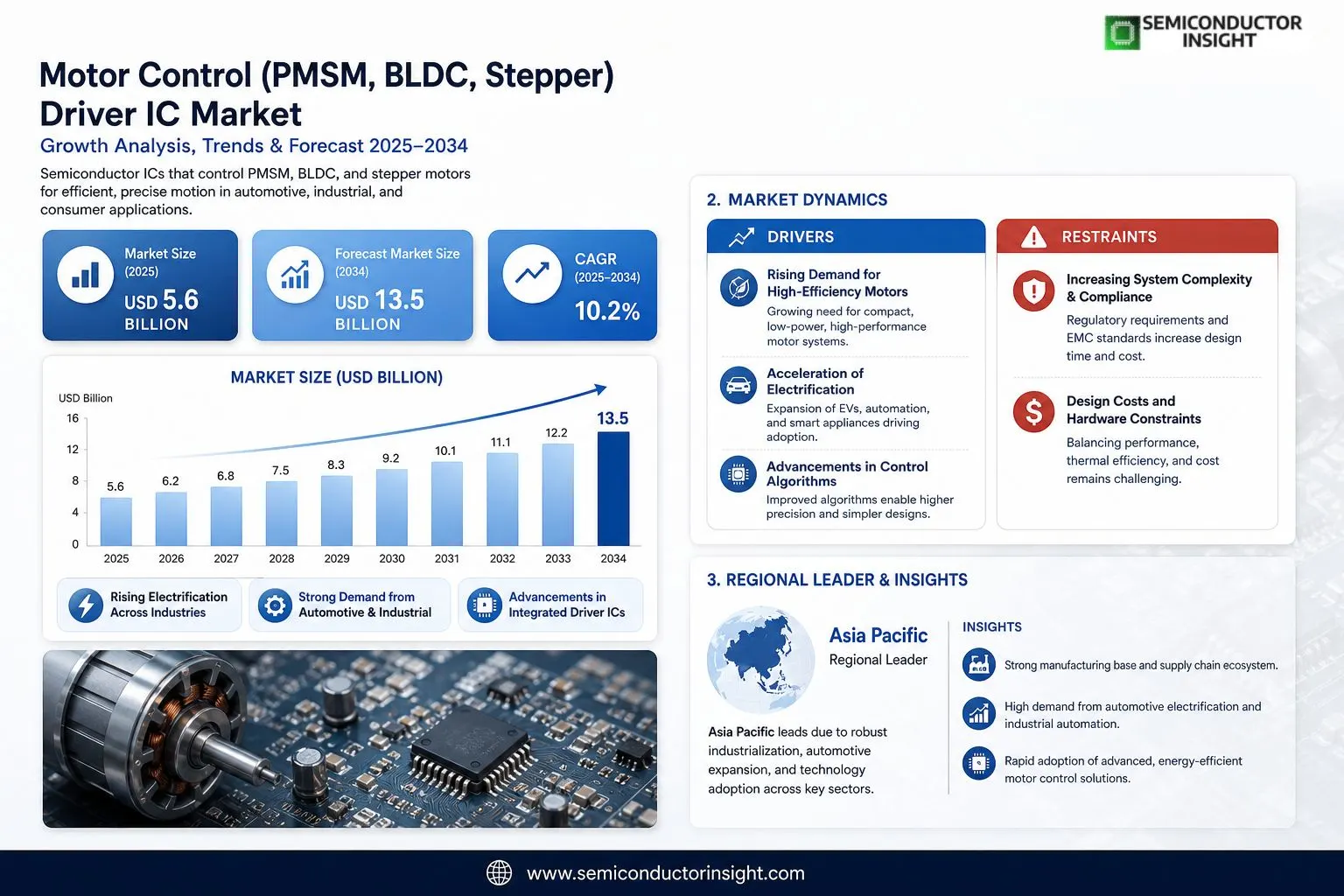
Global Motor Control (PMSM, BLDC, Stepper) Driver IC market size was valued at USD 5.6 billion in 2025. The market is projected to grow from USD 6.2 billion in 2026 to USD 13.5 billion by 2034, exhibiting a CAGR of 10.2% during the forecast period.
Motor control driver ICs for PMSM, BLDC, and stepper motors are specialized semiconductor devices designed to efficiently manage the operation of various electric motors. These integrated circuits handle critical functions such as commutation, current sensing, speed regulation, and protection, enabling precise and reliable motor performance across diverse applications.
The market is experiencing robust growth due to several factors, including the accelerating adoption of electric vehicles, rising demand for industrial automation and robotics, and the expansion of consumer electronics requiring compact and energy-efficient motion control solutions. Furthermore, the push toward higher energy efficiency standards and the integration of smart features in motor systems are contributing to market expansion. Advances in semiconductor technology have allowed for more integrated, compact driver ICs with enhanced thermal management and diagnostic capabilities. Key players continue to innovate with solutions tailored for high-voltage and low-power applications. For instance, leading semiconductor manufacturers have introduced new families of gate drivers and intelligent power modules optimized for BLDC and PMSM motors in automotive and industrial settings. Infineon Technologies, STMicroelectronics, Texas Instruments, and ON Semiconductor are among the prominent companies operating in the market with extensive portfolios covering a wide range of voltage ratings, current capacities, and control algorithms suitable for PMSM, BLDC, and stepper motor applications.
MARKET DRIVERS
Rising Demand for High‑Efficiency Electric Motor Systems
Motor Control (PMSM, BLDC, Stepper) Driver IC Market continues to expand as industries increasingly shift toward higher energy efficiency, improved torque control, and precision motion systems. Growing adoption of electric motors in consumer electronics, automotive subsystems, and industrial automation is driving consistent demand for advanced driver ICs that offer compact design, reduced power consumption, and enhanced thermal management. Manufacturers are prioritizing driver solutions that improve motor performance while lowering system-level costs.
Acceleration of Electrification Across Industries
The ongoing electrification of automotive platforms, industrial machinery, and smart appliances is increasing the deployment of PMSM, BLDC, and stepper motor architectures. This shift supports broader adoption of high-integration motor driver ICs with onboard diagnostics, safety functions, and digital control interfaces. As electric mobility and automation mature, demand continues to grow for reliable controller solutions that meet strict efficiency and performance benchmarks.
➤ Technological advancements in motor control algorithms are reducing design complexity and enabling higher precision across diverse applications.
Overall, the market is supported by continuous innovation in semiconductor design, miniaturization of power stages, and advancements in mixed-signal architectures. These trends reinforce long-term market expansion as industries aim for optimized motor performance and reduced system power losses.
MARKET CHALLENGES
Complexity of Integrating Advanced Motor Types
The integration of PMSM, BLDC, and stepper motors into modern systems requires sophisticated control algorithms, precise current monitoring, and robust system tuning. Engineers face challenges in meeting performance expectations while maintaining compact footprints and ensuring compatibility with multiple motor architectures. As control requirements grow more demanding, development cycles become longer and require highly specialized technical expertise.
Other Challenges
Design Costs and Hardware Constraints
Balancing performance, thermal efficiency, and cost remains a top challenge for manufacturers, especially as applications require higher efficiency and greater integration without compromising reliability.
MARKET RESTRAINTS
Increasing System Complexity and Compliance Requirements
Growing regulatory requirements around energy efficiency, noise reduction, and electromagnetic compatibility place pressure on manufacturers to incorporate advanced features within motor control driver ICs. This often results in longer design cycles and higher development costs. Additionally, ensuring long-term component reliability under diverse operating conditions remains a limiting factor for widespread adoption in certain use cases.
MARKET OPPORTUNITIES
Growth in Automation and Smart Systems
The rapid expansion of automation, robotics, smart appliances, and electric mobility presents substantial opportunities for Motor Control (PMSM, BLDC, Stepper) Driver IC Market. Increasing adoption of intelligent motor systems with integrated sensing, digital communication, and self-diagnostic capabilities opens new avenues for innovation. As industries transition toward more connected and automated systems, demand is rising for driver ICs optimized for precision control, low energy consumption, and scalable performance across varied motor types.
Motor Control (PMSM, BLDC, Stepper) Driver IC Market Trends
Increasing Integration and Intelligence in Motor Driver ICs
Motor Control (PMSM, BLDC, Stepper) Driver IC Market is experiencing steady transformation as manufacturers shift toward highly integrated solutions capable of supporting advanced motor control requirements. These ICs increasingly combine functions such as current sensing, thermal monitoring, fault diagnostics, and embedded control algorithms within a single package. This consolidation reflects a broader industry movement toward reducing system complexity while improving reliability and performance across automotive, industrial, and consumer applications. As electric mobility expands and robotics becomes more prevalent in manufacturing, engineers prioritize motor driver ICs that offer precise control, superior efficiency, and robust protection features.Another prominent trend is the expansion of smart motor systems, driven by the rising adoption of automation technologies. Compact driver ICs optimized for PMSM, BLDC, and stepper motors enable smoother operation and reduced energy consumption, which aligns with global efficiency initiatives. Semiconductor advancements have allowed manufacturers to deliver ICs designed to operate effectively under demanding thermal and electrical conditions, supporting both high-voltage automotive platforms and low‑power consumer electronics.
Other Trends
Advancements in Semiconductor Materials and Packaging
Ongoing improvements in semiconductor processes and packaging technologies are enhancing the capabilities of motor driver ICs. Manufacturers are incorporating refined thermal management structures and more efficient power transistors to support applications that require sustained high-power operation. These developments contribute to longer device lifespans and improved operational stability. Furthermore, optimized packaging enables greater miniaturization, which is essential for compact motor-driven systems used in consumer devices, drones, and precision equipment.
Growing Use of Motor Drivers in Electric and Autonomous Platforms
The accelerating adoption of electric vehicles and autonomous systems is influencing the design priorities of motor driver IC suppliers. Automotive manufacturers seek solutions capable of supporting multiple motor types within powertrain, safety, and comfort systems. PMSM and BLDC drivers are particularly in demand due to their efficiency and controllability. Companies such as Infineon Technologies, Texas Instruments, ON Semiconductor, and STMicroelectronics continue to expand portfolios that address stringent automotive requirements, incorporating features such as advanced gate driving, integrated protection mechanisms, and support for sophisticated control algorithms.
Enhancement of Industrial Automation and Robotics
Industrial automation is further intensifying demand for reliable motor driver ICs that support high‑precision motion control. BLDC, PMSM, and stepper motor drivers with improved sensing accuracy and enhanced real‑time feedback capabilities help optimize robotic performance and energy usage. Manufacturers are prioritizing configurable driver IC architectures to meet diverse industrial use cases, including conveyors, CNC machinery, and collaborative robots. As factories increasingly adopt intelligent automation technologies, the role of advanced motor driver ICs will continue to expand, reinforcing their importance across global industrial ecosystems.
COMPETITIVE LANDSCAPE
Key Industry Players
Motor Control (PMSM, BLDC, Stepper) Driver IC Market Competitive Overview
Motor Control (PMSM, BLDC, Stepper) Driver IC Market is led by major semiconductor manufacturers with strong portfolios spanning automotive, industrial, and consumer electronics applications. Companies such as Infineon Technologies, STMicroelectronics, Texas Instruments, and ON Semiconductor maintain dominant market positions due to their extensive offerings in high‑efficiency motor driver ICs, integrated power modules, and advanced control solutions optimized for BLDC and PMSM architectures. Their continuous investment in high-voltage platforms, compact driver IC integration, and enhanced diagnostic capabilities reinforces their leadership across key high-growth sectors including electric vehicles, robotics, and industrial automation.
Alongside these top-tier players, several niche and specialized companies contribute significantly by addressing application‑specific requirements such as ultra‑low‑power stepper motor control, high‑precision motion systems, and cost‑optimized consumer device integration. Firms including Allegro MicroSystems, Monolithic Power Systems, ROHM Semiconductor, Toshiba Electronic Devices & Storage, and Renesas Electronics focus on differentiated solutions featuring advanced commutation techniques, improved current sensing, and embedded intelligence. These players support a competitive environment marked by rapid innovation, broadening product portfolios, and increased focus on energy-efficient motor control architectures.
List of Key Motor Control Driver IC Companies Profiled
- Infineon Technologies
- STMicroelectronics
- Texas Instruments
- ON Semiconductor (onsemi)
- Renesas Electronics
- Allegro MicroSystems
- Monolithic Power Systems (MPS)
- ROHM Semiconductor
- NXP Semiconductors
- Toshiba Electronic Devices & Storage
- Microchip Technology
- ABLIC Inc.
- Melexis
- Trinamic Motion Control (now part of Maxim Integrated / Analog Devices)
- Panasonic Industry
Segment Analysis:
| Segment Category | Sub-Segments | Key Insights |
| By Type |
|
BLDC Motor Driver ICs dominate due to:
|
| By Application |
|
Automotive Systems lead due to:
|
| By End User |
|
Automotive Manufacturers represent the leading end user:
|
| By Motor Voltage Class]] |
|
Low-Voltage Driver ICs lead due to:
|
| By Integration Level]] |
|
Fully Integrated Smart Driver ICs dominate because:
|
Regional Analysis: Motor Control (PMSM, BLDC, Stepper) Driver IC Market
Asia-Pacific
China’s Motor Control Driver IC market is propelled by the world’s largest electric vehicle ecosystem alongside one of the most expansive industrial automation rollouts globally. Domestic semiconductor champions and global IC suppliers alike are scaling PMSM and BLDC driver IC production to serve China’s booming EV, drone, and smart appliance sectors, making it the single largest national market within the Asia-Pacific region.
Japan and South Korea distinguish themselves through advanced motor control driver IC innovation targeting robotics, semiconductor fabrication equipment, and high-end consumer electronics. Leading semiconductor firms from both nations invest heavily in next-generation PMSM driver IC architectures that prioritize ultra-low noise, high efficiency, and miniaturization, sustaining their technology leadership in Global Motor Control Driver IC Market competitive landscape.
Southeast Asian markets including Vietnam, India, Thailand, and Indonesia are emerging as high-growth frontiers for stepper and BLDC motor driver IC adoption. Rapid urbanization, growth in electric mobility, and expanding light manufacturing activity are creating new demand centers. India’s electric two-wheeler market, in particular, is accelerating BLDC driver IC integration at a pace that is drawing significant attention from global and regional IC suppliers.
Taiwan plays a critical foundational role in the Asia-Pacific Motor Control Driver IC ecosystem as a leading fabless design and wafer fabrication hub. Taiwanese IC design houses and foundries supply a substantial share of PMSM, BLDC, and stepper driver IC silicon to regional and global OEMs, ensuring supply chain resilience and enabling rapid product customization that continues to reinforce Asia-Pacific’s market leadership position.
North America
North America represents one of the most technologically sophisticated markets for Motor Control (PMSM, BLDC, Stepper) Driver IC solutions, underpinned by robust demand from the electric vehicle industry, aerospace and defense applications, and the region’s rapidly expanding industrial robotics sector. The United States serves as the primary growth engine, where significant federal investments in domestic semiconductor manufacturing and clean energy transition are catalyzing procurement of advanced PMSM and BLDC driver ICs. The region’s strong base of electric vehicle manufacturers and charging infrastructure developers is generating consistent demand for high-performance motor driver ICs capable of managing complex torque and speed control requirements. Additionally, North America’s industrial automation sector, encompassing warehouse robotics, collaborative robots, and precision CNC machinery, is a significant and growing consumer of stepper and BLDC driver IC technologies. Canada is also witnessing gradual adoption through clean energy and smart building initiatives, while the broader region benefits from a mature design ecosystem supported by globally leading semiconductor firms headquartered domestically.
Europe
Europe’s Motor Control (PMSM, BLDC, Stepper) Driver IC Market is characterized by stringent energy efficiency regulations, a well-established industrial automation heritage, and accelerating electromobility adoption across key economies including Germany, France, Italy, and the Nordic countries. The European Union’s ambitious carbon neutrality targets are compelling manufacturers across automotive, HVAC, and industrial machinery sectors to migrate toward highly efficient PMSM and BLDC motor systems, directly driving demand for sophisticated driver ICs. Germany, as Europe’s industrial powerhouse, leads adoption through its automotive OEM base and advanced machinery manufacturing sector, which increasingly integrates precision motor control driver ICs into next-generation production equipment. The region’s focus on functional safety standards such as ISO 26262 and IEC 61508 is also shaping the design requirements for motor control driver ICs deployed in safety-critical automotive and industrial applications. Southern and Eastern European markets are progressively emerging as secondary growth contributors as industrial modernization efforts intensify.
South America
South America presents a gradually developing market for Motor Control (PMSM, BLDC, Stepper) Driver IC technologies, with Brazil standing out as the region’s primary demand center owing to its diversified industrial base spanning agribusiness machinery, automotive assembly, and consumer electronics manufacturing. The ongoing modernization of Brazilian industrial facilities and the slow but steady penetration of energy-efficient motor systems into HVAC and water treatment infrastructure are creating incremental opportunities for BLDC and stepper driver IC suppliers. Argentina and Colombia represent secondary markets where expanding manufacturing activity and rising awareness of energy efficiency imperatives are beginning to translate into greater adoption of advanced motor control driver ICs. The region’s market trajectory, however, remains sensitive to macroeconomic volatility and currency fluctuations that can constrain capital expenditure on automation and drive IC procurement cycles. Nevertheless, South America’s long-term outlook is supported by growing foreign direct investment in manufacturing and infrastructure modernization across major economies.
Middle East & Africa
The Middle East and Africa region occupies an early but strategically relevant position in Global Motor Control (PMSM, BLDC, Stepper) Driver IC Market, with demand currently concentrated in sectors such as oil and gas processing, desalination plant automation, and commercial building systems across Gulf Cooperation Council economies. The UAE and Saudi Arabia are leading motor control driver IC adoption within the region, supported by large-scale industrial infrastructure projects and smart city development initiatives that incorporate advanced HVAC and pump control systems reliant on BLDC and PMSM driver IC solutions. Africa’s market remains nascent but holds long-term potential tied to industrialization, renewable energy deployment , particularly solar-powered pumping systems utilizing BLDC driver ICs , and the gradual formalization of manufacturing sectors in economies such as South Africa, Egypt, and Nigeria. Regional market growth is expected to gain momentum as infrastructure investment intensifies and energy efficiency regulations progressively tighten across member states through the 2026–2034 forecast horizon.
Report Scope
This market research report provides a comprehensive analysis of the Motor Control (PMSM, BLDC, Stepper) Driver IC Market , covering the forecast period 2026–2034. It offers detailed insights into market dynamics, technological advancements, competitive landscape, and key trends shaping the industry.
Key focus areas of the report include:
- Market Overview: The report begins with an overview outlining its current market scenario, key growth indicators, and industry transformation drivers. It discusses macroeconomic factors, demand–supply balance, regulatory landscape, and the strategic role of semiconductors in powering advancements across industries such as automotive, telecommunications, consumer electronics, and industrial automation.
- Market Size & Forecast: Historical data and future projections for revenue, unit shipments, and market value across major regions and segments.
- Segmentation Analysis: Detailed breakdown by product type, technology, application, and end-user industry to identify high-growth segments and investment opportunities.
- Regional Insights: Insights into market performance across North America, Europe, Asia-Pacific, Latin America, and the Middle East & Africa, including country-level analysis where relevant.
- Competitive Landscape: Profiles of leading market participants, including their product offerings, R&D focus, manufacturing capacity, pricing strategies, and recent developments such as mergers, acquisitions, and partnerships.
- Technology Trends & Innovation: Assessment of emerging technologies, integration of AI/IoT, semiconductor design trends, fabrication techniques, and evolving industry standards.
- Market Drivers & Restraints: Evaluation of factors driving market growth along with challenges, supply chain constraints, regulatory issues, and market-entry barriers.
- Stakeholder Insights: Insights for component suppliers, OEMs, system integrators, investors, and policymakers regarding the evolving ecosystem and strategic opportunities.
Primary and secondary research methods are employed, including interviews with industry experts, data from verified sources, and real-time market intelligence to ensure the accuracy and reliability of the insights presented.
FREQUENTLY ASKED QUESTIONS:
What is the current market size of Motor Control (PMSM, BLDC, Stepper) Driver IC Market?
-> Global Motor Control (PMSM, BLDC, Stepper) Driver IC Market was valued at USD 5.6 billion in 2025 and is projected to grow from USD 6.2 billion in 2026 to USD 13.5 billion by 2034, exhibiting a CAGR of 10.2% during the forecast period.
Which key companies operate in Motor Control (PMSM, BLDC, Stepper) Driver IC Market?
-> Key players include Infineon Technologies, STMicroelectronics, Texas Instruments, and ON Semiconductor, among others, offering extensive portfolios covering a wide range of voltage ratings, current capacities, and control algorithms suitable for PMSM, BLDC, and stepper motor applications.
What are the key growth drivers?
-> Key growth drivers include accelerating adoption of electric vehicles, rising demand for industrial automation and robotics, and the expansion of consumer electronics requiring compact and energy-efficient motion control solutions, along with the push toward higher energy efficiency standards and integration of smart features in motor systems.
Which region dominates the market?
-> Asia-Pacific is among the fastest-growing regions driven by manufacturing expansion and EV adoption, while North America and Europe remain significant markets due to strong automotive and industrial automation sectors.
What are the emerging trends?
-> Emerging trends include advances in semiconductor technology enabling more integrated and compact driver ICs, enhanced thermal management and diagnostic capabilities, introduction of new families of gate drivers and intelligent power modules optimized for BLDC and PMSM motors, and growing integration of AI and IoT in motor control systems for automotive and industrial applications.

Get Sample Report PDF for Exclusive Insights
Report Sample Includes
- Table of Contents
- List of Tables & Figures
- Charts, Research Methodology, and more...
 Download Sample Report PDF