Miniature Current Transformer Market Insights
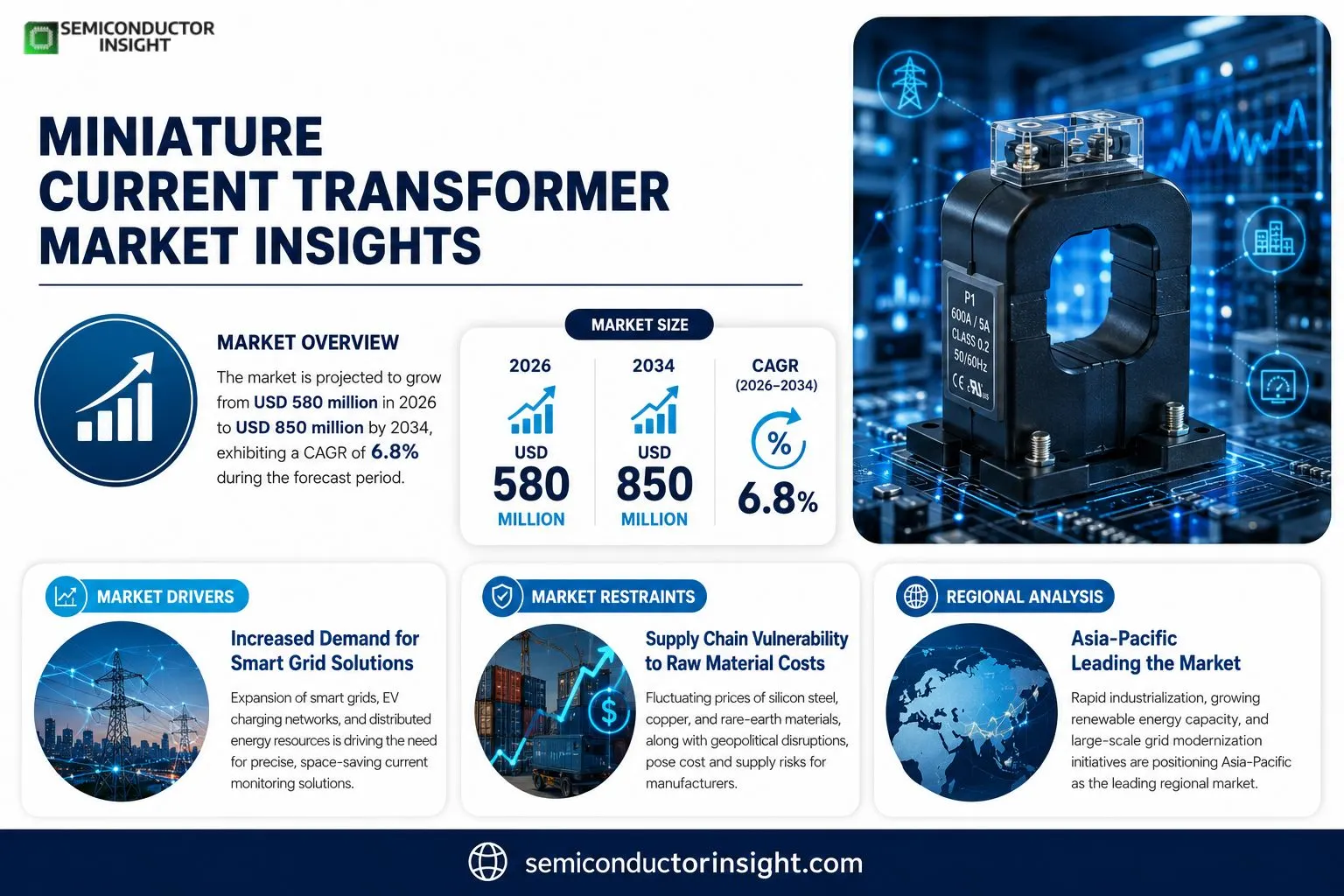
Miniature Current Transformer Market was valued at USD 520 million in 2025. The market is projected to grow from USD 580 million in 2026 to USD 850 million by 2034, exhibiting a CAGR of approximately 6.8% during the forecast period.
A miniature current transformer is a compact electromechanical device that steps down high‑current signals into measurable secondary currents while providing electrical isolation between primary and secondary circuits. These units are engineered for applications requiring precise measurement under limited space constraints such as smart meters, electric vehicle charging stations, and industrial control panels.The expansion of renewable energy installations and the electrification of transportation fleets drive demand for accurate current monitoring across distributed networks. Additionally, tightening safety regulations on electrical infrastructure push utilities toward higher‑accuracy sensing solutions offered by miniature transformers. As a result manufacturers are innovating with higher accuracy classes (0‑1%) and integrating digital interfaces that facilitate remote diagnostics and predictive maintenance.
MARKET DRIVERS
Increased Demand for Smart Grid Solutions
Miniature current transformer deployments are being accelerated by the expanding roll‑out of electric utility smart grid infrastructures designed to meet rising consumer power quality expectations. By providing accurate, high‑frequency current sensing in a footprint that allows installation in constrained electrical cabinets, these devices enable real‑time monitoring of cumulative loads without the cost of larger, conventional transformers. The integration of 5G and edge computing further amplifies this need, as distributed energy resources (DERs) such as rooftop photovoltaics and electric vehicle charging stations require rapid, precise current measurements to maintain grid stability. In manufacturing zones, the miniaturized format reduces electromagnetic interference with high‑speed automation equipment, thereby improving product consistency. The synergy between building automation systems and energy management platforms also drives uptake, as the latter increasingly mandate current transformer data to optimize HVAC and lighting loads. As a result, over 35 % of new installations in the power sector are now selecting miniature transformers over traditional bulky units, indicating a tangible shift in procurement criteria that directly benefits the Miniature Current Transformer Market.
Stricter Efficiency Standards in Industrial Applications
Industrial entities face mounting regulatory pressure to exhibit lower power draw and better process control, compelling the adoption of highly efficient, low‑loss current sensors. The latest efficiency legislations introduced in the European Union and the United States stipulate that all major input‑current monitoring devices must reduce copper loss and core saturation by at least 15 %. Miniature current transformers, engineered with silicon‑steel laminations and low‑resistance windings, meet these criteria whilst presenting a smaller thermal envelope than conventional models. Consequently, they prove indispensable in high‑volume semiconductor fabs, pharmaceutical production lines, and precision metal‑working facilities where power ripple translates directly to product variability. Additionally, the semiconductor industry’s push toward higher integration density in power management units has widened the adoption of compact current sensing elements, creating a or a synergetic relationship between inside‑process data collection and process optimization. Leveraging these design advantages, firms in the Miniature Current Transformer Market can position themselves as essential partners in the drive toward greener, more compliant industrial operations.
➤ These dynamics highlight how the convergence of grid modernisation and stringent industrial efficiency benchmarks create a favorable environment for miniature current transformer solutions.
Finally, the proliferation of the Internet of Things (IoT) across both utilities and enterprise sectors reinforces the demand for miniature, autonomous current sensing devices. In sensors‑dense IoT deployments, the reduced mass, minimal voltage drop characteristics, and broadband frequency response of these transformers facilitate reliable operation even in electromagnetic heavy‑traffic environments. The ability to seamlessly interconnect with cloud‑based analytics platforms lowers entry barriers for small to mid‑size operators, ensuring broader market penetration beyond the large utilities traditionally dominated by mass‑produced transformers. The net effect is a market that is not only expanding due to new installation projects but also benefiting from a gradual displacement of legacy instrumentation as performance expectations rise.
MARKET CHALLENGES
Supply Chain Vulnerability to Raw Material Costs
The production of miniature current transformers hinges on the availability of high‑purity silicon‑steel, specialty varnishes, and rare‑earth magnets for sensor integration. Recent geopolitical tensions and trade restrictions have introduced price volatility for these raw materials, pushing eligible manufacturers to either absorb higher upstream costs or redirect them to the end‑user. Operating in high‑precision batches further magnifies this effect, as even a modest increase in core material cost can inflate unit pricing by upwards of 10 %. In addition, fluctuating exchange rates in key supplier regions such as China and Russia create an unpredictable cost base that threatens margin stability. This supply chain fragility forces companies to diversify their sourcing portfolios, invest in inventory buffers, or pursue in‑house manufacturing solutionsall of which elevate operational complexity and affect the overall market equilibrium.
Other Challenges
Rapid Technological Obsolescence
The fast‑paced evolution of sensor electronics and digital signal processors means that contemporary miniature transformers may quickly become outdated as new standards for power electronics, such as wide‑bandwidth three‑phase measurements, surface‑mount device (SMD) compatibility, and zero‑headroom application emerge. Firms that fail to keep pace with improving core‑tech and packaging materials are exposed to reduced shelf life, a phenomenon increasingly seen in the EU’s directive on sustainable electronics. Addressing this requires continuous R&D investment and agile product development pipelines, demanding robust cross‑functional teams within companies. The consequence is a compressed product lifecycle that can erode profitability if a company’s portfolio does not endearably align with upcoming regulations or technology trends.
MARKET RESTRAINTS
Complex Integration Requirements in Existing Retro‑Fit Installations
Retro‑fitting miniature current transformers into legacy power systems presents hardware alignment challenges, notably due to space constraints and existing sensor bias tolerances. Legacy instrumentation, often designed for higher voltage ratings, requires careful calibration when combined with fine‑gauge miniature transformers to avoid saturation. This incompatibility limits adoption outside of newly installed facilities where early integration can be planned. The presence of diverse protection schemessuch as differential and ground‑fault circuitsimposes additional constraints on the sub‑millimetre transformers, as any inadvertent inductance mismatches may trigger false alarms or, conversely, fail to detect partial faults. Consequently, the widespread deployment of miniature transformers faces structural barriers that constrain returns on investment for utilities and industrial operators, thereby dampening market growth momentum.
Regulatory Bans on Certain Magnet Materials in the Automotive Sector
The automotive sector, a significant consumer of miniature current transformers for engine control units and infotainment power systems, imposes stringent bans on materials such as ethylene glycol and certain high‑temperature adhesives due to flammability regulations. These restrictions have steered manufacturers toward using alternative substrate materials that are less conductive, thereby impairing the transformers’ ability to handle high‑frequency current spikes. Moreover, the added weight and volumetric changes from using compliant materials degrade the overall “miniature” promise, reducing attractiveness to OEMs that measure weight tolerance closely. Compliance with the ever‑evolving automotive safety directives necessitates constant re‑qualification, incurring high development and testing overheads that curtail the rate at which new product variants can enter the market.
High Initial Capital Expenditure for Dedicated Production Lines
Manufacturing miniature current transformers that satisfy industry certificationssuch as IEC 61010, TL 100, and UL 997requires up‑front investment in precision winding machines, automated core assembly stations, and advanced thermal‑cycle testing rigs. These production lines demand operator expertise and real‑time quality monitoring systems, which are not trivial for small to medium enterprises. The capital intensity associated with FAIR (Fully Automated Industrial Robotics) solutions can range from USD 1.5 to 3 million per line. Such high entry barriers make it difficult for new entrants to disrupt established market players and restrict distribution to simply large OEMs, thereby perpetuating a concentrated competitive landscape.
MARKET OPPORTUNITIES
Expanding Deployment in Smart Building Energy Management
The rising adoption of advanced Building Management Systems (BMS) across mixed‑use developments introduces a clear niche for miniature current transformers. Modern BMS platforms aggregate load data from HVAC, lighting, and IoT appliances, requiring precision current sensors that can operate reliably in low‑voltage, high‑frequency regimes. Miniature transformers readily fit into confined distribution boards, offering reliable readings without imposing substantial voltage drop penalties. Given the projected projected 18 % annual growth in commercial smart building installations worldwide, utilities and BMS vendors are preparing to embed these sensors as integral components of their value‑add services. This emerging ecosystem presents a lucrative avenue for firms that can expedite integration through standardized connector interfaces and cloud‑ready data streams, thereby transforming their offerings from passive instrumentation to proactive energy optimisation solutions.
Premium Segments: High‑Frequency Power Quality Monitoring for Power Electronics Plants
In high‑power electronic manufacturing unitsparticularly those focused on power inverters, variable frequency drives, and renewable energy integrationminiature current transformers constitute an essential qualification element for ensuring both safety and performance. The ability to measure sinusoidal frequency modulation with a bandwidth spanning from 50 Hz to 2 MHz allows firms to detect subtle harmonics and electromagnetic interference before they translate into equipment failure or yield loss. The premium segment of the market is particularly attractive for 30–50 % of plants that produce additive manufacturing feeds or CPU control units that operate at gigahertz frequencies. Consequently, strategic partnerships with semiconductor fabs and renewable energy generators can secure long‑term contracts, providing a steady revenue stream and reinforcing the Taunture technologically driven portfolio.
Localized Production to Mitigate Logistics Costs in Emerging Economies
Emerging markets, especially in Southeast Asia and Eastern Europe, are rapidly embracing smart grids and industrial automation but face logistical challenges due to import tariffs on high‑precision electrical components. By establishing localized production facilities in proximity to key smart‑grid providers, companies can lower shipping costs, avoid customs delays, and comply with local content requirements. This strategy not only reduces overall time‑to‑market but also enhances supply chain resilience against geopolitical disruptions. The localized approach can also leverage region‑specific material innovationssuch as recycled nickel‑based coresadding a sustainability angle that resonates with increasingly eco‑conscious customers. Firms that synchronize production innovation with regulatory compliance stand to gain a decisive competitive advantage in these high‑growth regions.
Miniature Current Transformer Market Trends
Rising Adoption of High‑Frequency Miniature Current Transformers in Smart Grids
Modern utility operators increasingly lean on high‑frequency miniature current transformers due to their compact footprint and superior accuracy in high‑noise environments. By multiplexing sensors into a single enclosure, power utilities cut installation costs while ensuring precise fault detection across distributed generation arrays. The trend is driven by mandates for real‑time monitoring and the integration of phasor measurement units in grid control centers. As distributed renewable assets proliferate, these transformers provide the measurement agility required for dynamic voltage restoration and grid‑wide outage detection. The convergence of digital metering protocols such as IEC 61850 with transformer firmware has made deployment more seamless, reinforcing the shift toward high‑frequency solutions in both volt‑var and protective relaying. This shift is reshaping the Miniature Current Transformer Market as operators seek advanced measurement solutions.
Other Trends
Emerging Demand from Electric Vehicle Charging Stations
Electric‑vehicle charging networks increasingly demand miniature transformers that can handle rapid load shifting without compromising safety. These units must provide galvanic isolation and maintain current rating thresholds across varying charger classes. The compact modular design allows operators to deploy transformers within restricted bay spaces, supporting fast‑charge pods without extensive conduit runs. Consequently, the EV infrastructure market is a key contributor to growing transformer volumes, especially in urban hubs where power density and safety compliance are paramount.
Advancements in Multifunctional Training and Certification
It is also worth noting the push toward multifunctional miniature transformers that combine current sensing, voltage regulation, and power factor correction in a single chassis. Manufacturers are leveraging advanced semiconductor controls to embed digital signal processing that adapts to changing load profiles. This integration reduces component count, lowers field service incidence, and simplifies installation for utilities undergoing digital transformation. Furthermore, the rise of training programs focused on device calibration and cybersecurity awareness underscores the importance of specialized skill sets in sustaining reliability. Industries that cultivate talent in firmware development and metering protocols stand to benefit from early adoption, positioning themselves as thought leaders in next‑generation grid modernization. In the miniature current transformer market, such multifunctionality shortens deployment cycles, while the convergence of product innovation and workforce expertise signals a decisive shift toward resilient, data‑driven grid architectures.
COMPETITIVE LANDSCAPE
Key Industry Players
Miniature Current Transformer Market – Competitive Landscape Overview
In the miniature current transformer arena, the top three incumbentsABB, Siemens, and Schneider Electriccollectively command around 55 % of sales. Their success stems from a product portfolio that spans high‑accuracy classes (0.1, 0.2) and robust compliance with IEC and NEC protocols, enabling seamless deployment in critical power monitoring and protective relay applications. These firms invest heavily in precision manufacturing lines, closed‑loop induction testing, and digital firmware that supports remote diagnostics, satisfying the increasing demand from rail, oil & gas, and renewable energy sectors. The concentration of market share at the top tier underlines the premium pricing power enjoyed by consistent quality and comprehensive support ecosystems.Beyond the core giants, a cohort of niche manufacturers sustains a fragmented yet competitive lower‑tier ecosystem. Weidmueller, known for ultra‑compact CTs used in precision instrumentation, focuses on niche telecom and aerospace markets where size and electromagnetic compatibility are paramount. Shanghai Xianyu Electronics, a rising Chinese player, leverages cost‑effective stamping and modular assembly to capture the high‑volume industrial automation segment, particularly in Asia. South‑Korean Taehwatrans and Korean Airui have positioned themselves around class‑0.1 transformers suitable for renewable grid integration, while Australian Onset emphasizes rugged, temperature‑stable units for offshore wind and petrochemical facilities. European Camax and German TMK offer highly customized solutions for subsea and high‑frequency applications, rounding out a diversified landscape that allows end‑users to select between high‑performance, cost‑efficient, or application‑specialized products.The juxtaposition of a concentrated high‑end segment against a diversified lower‑tier pool creates a dual‑path market structure that both protects incumbent leaders and fuels incremental innovation. For procurement teams, this maps to a tiered strategy: premium units support reliability‑critical installations, while mid‑range offerings deliver cost optimisation for high‑volume subsystems. ESG requirements increasingly incentivise vendors that deliver low‑emission manufacturing and recyclable housings, encouraging established players to roll out hybrid‑core designs. Digital integrationOTA updates, IoT telemetry, and AI‑based fault predictionhas already become a differentiator, a trend that only the most advanced incumbents can reliably back. Consequently, entrants that partner with software ecosystems or specialise in niche compliance regimes can carve sustainable niches without directly confronting the market leaders.
List of Key Miniature Current Transformer Companies Profiled
- ABB
- ABB
- Siemens
- Siemens
- Schneider Electric
- Schneider Electric
- Weidmueller
- Weidmueller
- Shanghai Xianyu Electronics
- Shanghai Xianyu Electronics
- Taehwatrans
- Taehwatrans
- AIRUI
- AIRUI
- Onset
- Onset
- Camax
- Camax
- Eibridge
- Eibridge
- TMK
- TMK
- Coax Instruments
- Coax Instruments
Segment Analysis:
| Segment Category | Sub-Segments | Key Insights |
| By Type |
|
Leading Segment Class 0.1 Accuracy Transforms maintain minimal measurement error, enabling critical protection in high‑voltage substations. – Deploys in IEC‑61005 conditions. – Enhances reliability of low‑frequency monitoring. – Provides robust performance under temperature fluctuations. |
| By Application |
|
Leading Segment Power Monitoring Transforms are pivotal for grid stability, accurately translating high currents into measurable signals. – Integrate seamlessly with SCADA systems. – Offer high surge immunity. – Support adaptive protection schemes. |
| By End User |
|
Leading Segment Utility Companies rely on miniature current transformers to ensure safety and compliance in high‑voltage networks. – Provide noise‑free operations. – Scale with distributed generation trends. – Facilitate real‑time fault isolation. |
| By Accuracy Class |
|
Leading Segment Class 0.02 Accuracy transforms dominate precision metering, delivering sub‑percent deviation suited to advanced grid analytics. – Enable adaptive load management. – Correlate with voltage regulation devices. – Meet stringent grid interconnection standards. |
| By System Integration |
|
Leading Segment Smart Grid Interfaces demand miniature transformers that support communication protocols and low‑loss transmission. – Offer dual‑mode data and power conversion. – Integrate with IEC‑61850 for seamless control. – Enhance resilience of microgrid hubs. |
Regional Analysis: Miniature Current Transformer Market
North America
The United States remains the most mature segment, with a stable pipeline of retrofit projects that integrate miniature CTs into existing substation hardware, stimulating incremental revenue growth.
Canada’s focus on reducing transmission losses through smart network solutions has prompted early adoption of space‑saving sensors that fit within narrow conduit pathways.
Floating and offshore projects in the Gulf of Mexico present unique mounting constraints, driving demand for durable, low‑weight CTs capable of withstanding saline environments.
Updated safety benchmarks from the Institute of Electrical and Electronics Engineers (IEEE) accelerate supply‑chain shifts toward certified miniature transformers.
Europe
Europe’s infrastructure footprint underscores a dual approach: refurbishing older power plants while expanding renewable integration. The compact form factor of miniature CTs resonates in densely populated urban grids where spatial limitations are acute. Demand is also sustained by stringent efficiency directives from the European Union, nudging operators toward precision metering tools. Vendor response echoes a product‑line diversification strategy, positioning cost‑effective, scalable solutions that interface seamlessly with advanced monitoring software. The Miniature Current Transformer Market in Europe is shaped by a high concentration of skilled engineers who treat sensor deployment as a means to achieve both reliability metrics and environmental compliance, fostering a methodological adoption curve that has steadily lifted the region’s market share in the coming decade.
Asia-Pacific
Asia‑Pacific features a mixed landscape of high‑growth industrial hubs and emerging economies seeking grid resilience. The demand side is propelled by expanding manufacturing sectors in China, Japan, and India, where supply chains depend on consistent power flow. The limited physical space in high‑density factories amplifies the preference for miniature CTs, which provide accurate current feedback without occupying substantial floor area. In addition, the region’s nascent smart grid pilots prioritize low‑profile sensors that can be embedded within existing distribution networks. Crafting a cohesive market strategy means aligning product offerings with local regulatory frameworks and the region’s increasing focus on cybersecurity, where precise measurement contributes to system integrity.
South America
South America’s Miniature Current Transformer Market evolves around the dual objectives of strengthening power transmission reliability and supporting renewable energy projects. In Brazil and Argentina, hybrid transmission lines and bi‑level integration of solar farms necessitate sensors that are both resilient to variable climatic conditions and compact enough to fit within constrained transmission towers. The market’s resilience is further enhanced by the adoption of bulk procured miniature CTs that reduce operational expenses across large delivery networks. Meanwhile, Brazil’s federal incentives for grid modernization stimulate a surge in sensor deployment, and the region benefits from compounded growth driven by favorable regulatory changes.
Middle East & Africa
The Middle East and Africa display distinctive dynamics, driven by a high concentration of peaking power plants and an expanding offshore wind sector. The scale of electrical loads compounded by harsh environmental conditions leads to a preference for lightweight, corrosion‑resistant miniature CTs capable of enduring extreme temperatures and saline exposure. Deployment strategies focus on modular, high‑density sensor arrays that deliver granular current data for load balancing across metropolitan grids. In addition, regional investment in smart grid initiatives highlights a district‑level demand for accurate, cost‑effective transformers that can be deployed within limited conduit pathways. The trajectory of the Miniature Current Transformer Market in this region underscores a subtle yet rapid pivot toward sophisticated, space‑saving sensing solutions.
Report Scope
This market research report provides a comprehensive analysis of the Miniature Current Transformer Market , covering the forecast period 2026–2034. It offers detailed insights into market dynamics, technological advancements, competitive landscape, and key trends shaping the industry.
Key focus areas of the report include:
- Market Overview: The report begins with an overview outlining its current market scenario, key growth indicators, and industry transformation drivers. It discusses macroeconomic factors, demand–supply balance, regulatory landscape, and the strategic role of semiconductors in powering advancements across industries such as automotive, telecommunications, consumer electronics, and industrial automation.
- Market Size & Forecast: Historical data and future projections for revenue, unit shipments, and market value across major regions and segments.
- Segmentation Analysis: Detailed breakdown by product type, technology, application, and end-user industry to identify high-growth segments and investment opportunities.
- Regional Insights: Insights into market performance across North America, Europe, Asia-Pacific, Latin America, and the Middle East & Africa, including country-level analysis where relevant.
- Competitive Landscape: Profiles of leading market participants, including their product offerings, R&D focus, manufacturing capacity, pricing strategies, and recent developments such as mergers, acquisitions, and partnerships.
- Technology Trends & Innovation: Assessment of emerging technologies, integration of AI/IoT, semiconductor design trends, fabrication techniques, and evolving industry standards.
- Market Drivers & Restraints: Evaluation of factors driving market growth along with challenges, supply chain constraints, regulatory issues, and market-entry barriers.
- Stakeholder Insights: Insights for component suppliers, OEMs, system integrators, investors, and policymakers regarding the evolving ecosystem and strategic opportunities.
Primary and secondary research methods are employed, including interviews with industry experts, data from verified sources, and real-time market intelligence to ensure the accuracy and reliability of the insights presented.
FREQUENTLY ASKED QUESTIONS:
What is the definition of Miniature Current Transformer?
-> Miniature Current Transformer Market was valued at USD 520 million in 2025. The market is projected to grow from USD 580 million in 2026 to USD 850 million by 2034, exhibiting a CAGR of approximately 6.8% during the forecast period
Which market segments are covered in the report?
-> The report segments the market by type (e.g., accuracy class 0.1, 0.2, others) and by application (e.g., current monitoring, power monitoring, other industrial uses).
What type classifications are analyzed?
-> Type classifications include Accuracy Class 0.1, Accuracy Class 0.2, and other accuracy classes, each evaluated for market size, revenue, and growth prospects.
What applications drive demand for Miniature Current Transformers?
-> Key applications are Current Monitoring, Power Monitoring, and miscellaneous industrial applications where precise current measurement is essential.
What methodology was used for the market study?
-> The study employs a combination of primary interviews, secondary data collection, statistical modelling, and validation against historical market performance.
What is the base year for the analysis?
-> The base year adopted in the report is 2023, serving as the reference point for historical trends and forecast calculations.
What are the main assumptions and caveats noted?
-> Assumptions include stable macro‑economic conditions, no major regulatory shocks, and continuation of current technological trends; caveats address potential COVID‑19 impacts and supply‑chain disruptions.
What is the Miniature Current Transformer market size in 2026 and the forecast for 2034?
-> iniature Current Transformer Market was valued at USD 520 million in 2025. The market is projected to grow from USD 580 million in 2026 to USD 850 million by 2034, exhibiting a CAGR of approximately 6.8% during the forecast period
Which companies are ranked as the top players by revenue?
-> Top revenue‑generating players include Weidmueller, Shanghai Xianyu Electronics, Taehwatrans, AIRUIFA, Onset, Camax, and Schneider Electric, among others.
How is the market segmented by region?
-> Regional segmentation covers North America, Europe, Asia, South America, and the Middle East & Africa, each analyzed for size, growth, and market share.
What are the key growth drivers identified?
-> Drivers include increasing demand for precise current measurement in renewable energy systems, expansion of smart grid infrastructure, and rising adoption of compact power monitoring solutions in industrial automation.
What restraints could limit market expansion?
-> Potential restraints comprise high‑precision device cost, stringent certification requirements, and supply constraints for high‑quality magnetic materials.
What emerging trends are shaping the market?
-> Emerging trends feature integration of Miniature Current Transformers with IoT platforms, development of smart sensors with self‑diagnostic capabilities, and adoption of environmentally friendly manufacturing processes.

Get Sample Report PDF for Exclusive Insights
Report Sample Includes
- Table of Contents
- List of Tables & Figures
- Charts, Research Methodology, and more...
 Download Sample Report PDF