Military Chips Market Insights
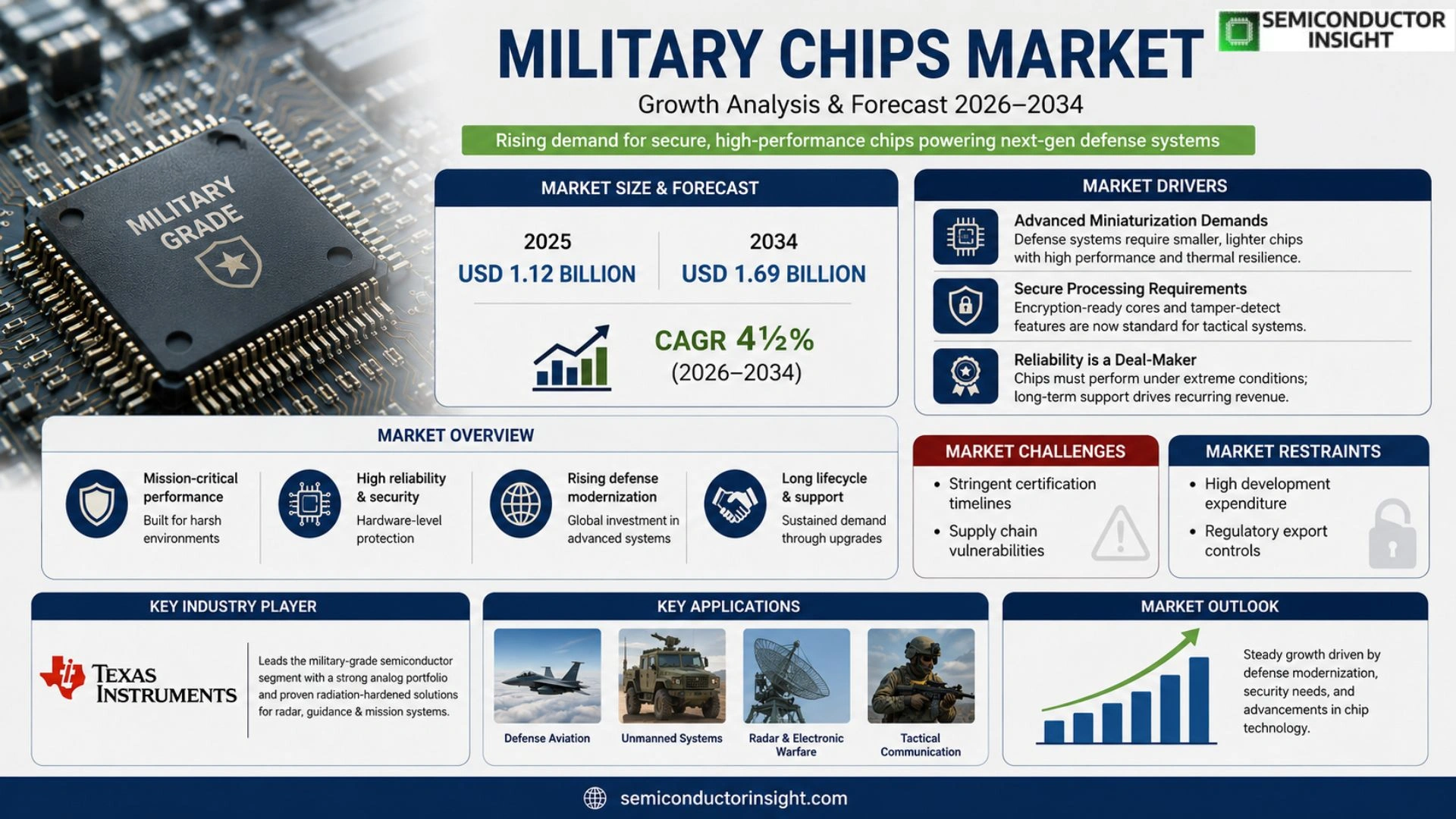
Global Military Chips market size was valued at USD 1.12 billion in 2025 and will increase to USD 1.69 billion by 2034, exhibiting a CAGR of approximately 4½ percent during the forecast period.
A chip, also known as a microcircuit or integrated circuit, is a silicon wafer that houses densely packed electronic components used across computers, communication gear and countless other devices.
Military chips refer specifically to semiconductor components deployed within defence systems such as radars, navigation units, fire‑control modules and electronic‑countermeasure equipment; they form the technological backbone of modern armed forces.
The sector’s modest expansion reflects broader semiconductor trends where analog and sensor categories posted double‑digit growth in 2022 while overall industry revenue rose modestly amid inflationary pressures; meanwhile heightened government spending on advanced weaponry sustains demand for specialised military‑grade silicon.
MARKET DRIVERS
Advanced Miniaturization Demands
The push for smaller, lighter platforms in defense aviation and unmanned systems has forced designers to adopt processors with higher transistor density. Military Chips Market suppliers that can deliver sub‑millimeter footprints while maintaining thermal resilience are seeing a surge in procurement contracts from major armed forces.
Secure Processing Requirements
Encryption‑ready cores and tamper‑detect mechanisms are now baseline specifications for tactical radios and battlefield computers. OEMs that embed hardware‑level security differentiate themselves, prompting defense budgets to allocate a larger share of funds toward certified silicon solutions.
➤ “Reliability under extreme G‑forces is no longer optional; it is a decisive factor in contract awards.”
Because mission‑critical equipment cannot tolerate downtime, lifecycle support agreements are expanding. Vendors that couple long‑term warranty with on‑site firmware updates are capturing recurring revenue streams, reinforcing the overall growth trajectory of Military Chips market.
MARKET CHALLENGES
Stringent Certification Timelines
Defense acquisition cycles impose rigorous testing milestones, and any deviation can delay deliveries by months. Suppliers that lack a proven track record with qualification bodies often face repeated redesigns, inflating program costs.
Other Challenges
Supply Chain Vulnerabilities
Global shortages of specialty substrates and rare‑earth materials have exposed the fragility of the supply chain, forcing manufacturers to hold larger safety stocks and eroding profit margins.
MARKET RESTRAINTS
High Development Expenditure
Designing radiation‑hardened chips that meet DoD standards requires multi‑year R&D programs costing upwards of $150 million. Smaller firms struggle to secure the capital needed, limiting the competitive pool and slowing diversification.
Regulatory Export Controls
Stringent export licensing on advanced semiconductors curtails market entry for many global players. Companies that cannot navigate the complex licensing framework risk losing access to lucrative foreign defense contracts.
MARKET OPPORTUNITIES
Integration of AI at the Edge
Field‑deployed AI inference engines require on‑chip accelerators capable of processing sensor data in real time. Vendors that embed low‑latency neural processing units into rugged silicon are positioned to capture a growing share of next‑generation combat platforms.
Expansion into Space‑Based Defense
The emergence of low‑Earth‑orbit constellations for ISR (Intelligence, Surveillance, Reconnaissance) creates demand for chips that can operate under extreme radiation and temperature swings. Companies that qualify their products for space‑grade standards stand to unlock a new revenue tier within Military Chips market.
Military Chips Market Trends
Rise of Radiation‑Hardened Computing Chips
Military Chips market is witnessing a decisive shift toward radiation‑hardened computing components. Defense platforms operating at high altitude or in space environments demand silicon that can tolerate ionizing radiation without functional degradation. Vendors are therefore investing in process‑node refinements that embed hardened gate oxides and fault‑tolerant architectures. This technical emphasis translates into longer product lifecycles for radars, satellite communications, and unmanned aerial systems, where downtime translates directly into mission risk. Companies that can guarantee a predictable mean‑time‑to‑failure under extreme conditions are gaining preference in procurement cycles, nudging the overall market composition toward specialist suppliers rather than generic semiconductor producers.
Other Trends
Supply‑Chain Localization
Geopolitical friction has forced many governments to reassess the geographic dispersion of their defense‑grade silicon sources. Military Chips market now reflects a growing proportion of domestically sourced wafers, especially in North America and selected European nations. This re‑balancing is driven less by protectionist rhetoric and more by the need for assured access to qualified foundries that meet stringent security clearances. As a result, manufacturers are establishing joint ventures or licensing agreements within sovereign borders, a move that reduces lead‑time variability and mitigates the risk of export‑control disruptions.
Integration of AI Capabilities in Defense Sensors
Another salient development in Military Chips market is the embedding of artificial‑intelligence inference engines directly into sensor silicon. Modern threat environments require real‑time pattern recognition, whether for missile launch detection or electronic‑countermeasure identification. By co‑locating AI accelerators with analog front‑ends, system integrators can off‑load computationally intensive tasks from host processors, thereby shrinking overall system weight and power budgets. This architectural shift is prompting chip designers to adopt heterogeneous integration techniques, merging memory, logic, and AI cores onto a single package. The commercial implication is clear: suppliers that deliver a turnkey AI‑enabled sensor chip gain a competitive edge, while traditional analog‑only vendors must evolve or risk obsolescence.
COMPETITIVE LANDSCAPE
Key Industry Players
Military Chips Market: Competitive Overview
Texas Instruments continues to anchor the military‑grade semiconductor segment, leveraging its deep analog portfolio and longstanding defense contracts. Its ability to deliver radiation‑hardened parts for radar and guidance subsystems translates into a disproportionate share of the $1.07 billion 2024 market, despite a modest overall growth rate. The firm’s vertical integration, from wafer fab to test‑and‑assembly, mitigates supply‑chain volatility and gives customers confidence in lifecycle support, a critical factor for weapons‑system manufacturers that require long‑term part availability.
Beyond the dominant analog specialist, a cluster of diversified fabs is carving out niches that complement the overall ecosystem. Infineon and Analog Devices focus on power management and high‑frequency components essential for next‑generation electronic‑counter‑measure suites. STMicroelectronics supplies mixed‑signal and sensor chips for navigation and autonomous platform projects, while NXP’s secure‑element expertise feeds cryptographic modules in mission‑critical communications. Samsung and Intel, traditionally consumer‑centric, are redirecting mature‑process nodes toward defense‑grade logic and memory, expanding capacity for AI‑enabled threat detection. Smaller regional players such as Micron Technology, ON Semiconductor, SSMEC, Unigroup Guoxin, Linxens (Tsinghua Unigroup), and Changsha Jingjia Microelectronics add depth in memory, discrete, and specialty interconnects, allowing system integrators to source a broader spectrum of parts without over‑reliance on the top tier.
List of Key Military Chips Companies Profiled
- Texas Instruments
- Infineon Technologies
- Analog Devices
- STMicroelectronics
- Renesas Electronics
- Micron Technology
- Intel Corporation
- Microchip Technology
- ON Semiconductor
- Samsung Electronics
- NXP Semiconductors
- SSMEC
- Unigroup Guoxin
- Linxens (Tsinghua Unigroup)
- Changsha Jingjia Microelectronics
Segment Analysis:
| Segment Category | Sub-Segments | Key Insights |
| By Type |
|
Analog Chips are the dominant type because they provide critical signal conditioning for radar and electronic warfare systems.
|
| By Application |
|
Radar applications drive the most sophisticated chip requirements.
|
| By End User |
|
Aircraft represent the leading end‑user segment.
|
| By Functionality |
|
Signal Processing chips are pivotal for mission‑critical data handling.
|
| By Integration Level |
|
System‑in‑Package is emerging as the preferred integration approach.
|
Regional Analysis: Military Chips Market
Recent procurement cycles favor modular chipsets that can be upgraded without redesigning entire weapons. This policy direction encourages suppliers to deliver scalable IP blocks, fostering a market where flexibility rivals raw performance.
The resurgence of on‑shore fabs, backed by tax incentives, reduces reliance on foreign sources. A stronger domestic supply chain improves confidentiality for classified programs and shortens lead times for critical components.
NATO standardization groups are harmonizing chip interfaces, which simplifies cross‑border logistics. Participants benefit from pooled testing facilities and shared threat models, accelerating field acceptance.
Multi‑sourcing strategies and strategic stockpiles of critical wafers mitigate disruption risks. Companies now embed redundancy at the design stage, ensuring mission‑critical systems retain capability even amid component shortages.
Europe
European nations balance sovereign security concerns with collaborative defense projects such as the Eurofighter and naval frigate programs. The region’s approach emphasizes certification processes that demand high reliability under diverse climatic conditions, prompting chip manufacturers to invest in robust packaging. Additionally, the European Union’s investment in the “European Chips Act” nurtures a continental supply chain, allowing local firms to capture a modest share of Military Chips market while strengthening export controls.
Asia‑Pacific
In the Asia‑Pacific, rapid modernization of armed forces drives demand for ruggedized micro‑electronics. Countries like Japan and South Korea leverage their existing consumer semiconductor expertise to produce radiation‑tolerant variants for missile guidance. Meanwhile, emerging defense spenders such as India and Australia focus on technology transfer agreements, ensuring that domestic assembly lines gain hands‑on experience with sophisticated chip designs.
South America
South American defense establishments, though operating under tighter fiscal constraints, prioritize cost‑effective solutions that extend the lifespan of legacy platforms. Partnerships with North American OEMs often involve localized testing facilities, helping regional forces adopt proven Military Chips Market products without extensive redesigns. The emphasis remains on incremental upgrades that boost performance while preserving existing logistics chains.
Middle East & Africa
The Middle East and Africa display a divergent pattern: affluent Gulf states invest heavily in bespoke missile and UAV technologies, seeking to embed cutting‑edge chips that deliver real‑time data fusion. Conversely, many African nations focus on basic communications and surveillance hardware, where rugged chips serve as the backbone for border security. International collaboration programs and joint training exercises frequently act as conduits for technology diffusion across this varied landscape.
Report Scope
This market research report provides a comprehensive analysis of the Military Chips Market , covering the forecast period 2026–2034. It offers detailed insights into market dynamics, technological advancements, competitive landscape, and key trends shaping the industry.
Key focus areas of the report include:
- Market Overview: The report begins with an overview outlining its current market scenario, key growth indicators, and industry transformation drivers. It discusses macroeconomic factors, demand–supply balance, regulatory landscape, and the strategic role of semiconductors in powering advancements across industries such as automotive, telecommunications, consumer electronics, and industrial automation.
- Market Size & Forecast: Historical data and future projections for revenue, unit shipments, and market value across major regions and segments.
- Segmentation Analysis: Detailed breakdown by product type, technology, application, and end-user industry to identify high-growth segments and investment opportunities.
- Regional Insights: Insights into market performance across North America, Europe, Asia-Pacific, Latin America, and the Middle East & Africa, including country-level analysis where relevant.
- Competitive Landscape: Profiles of leading market participants, including their product offerings, R&D focus, manufacturing capacity, pricing strategies, and recent developments such as mergers, acquisitions, and partnerships.
- Technology Trends & Innovation: Assessment of emerging technologies, integration of AI/IoT, semiconductor design trends, fabrication techniques, and evolving industry standards.
- Market Drivers & Restraints: Evaluation of factors driving market growth along with challenges, supply chain constraints, regulatory issues, and market-entry barriers.
- Stakeholder Insights: Insights for component suppliers, OEMs, system integrators, investors, and policymakers regarding the evolving ecosystem and strategic opportunities.
Primary and secondary research methods are employed, including interviews with industry experts, data from verified sources, and real-time market intelligence to ensure the accuracy and reliability of the insights presented.
FREQUENTLY ASKED QUESTIONS:
What is the current market size of Military Chips Market?
-> Military Chips market will increase to USD 1.69 billion by 2034, exhibiting a CAGR of approximately 4½ percent during the forecast period.
Which key companies operate in Military Chips Market?
-> Key players include Texas Instruments, Infineon, Analog Devices, STMicroelectronics, Renesas, Micron Technology, Intel, Microchip, onsemi, Samsung, NXP Semiconductors, SSMEC, Unigroup Guoxin, Linxens (Tsinghua Unigroup), Changsha Jingjia Microelectronics.
What are the key growth drivers?
-> Key growth drivers include increased defense spending, modernization of military platforms, demand for advanced radar and communication systems, miniaturization of electronic components, and heightened focus on secure and resilient semiconductor technologies.
Which region dominates the market?
-> North America dominates Military Chips market, driven by substantial defense budgets and significant R&D investments, while the Asia‑Pacific region shows strong growth potential.
What are the emerging trends?
-> Emerging trends include integration of AI/ML in defense chips, increased adoption of analog and sensor chips for smart weaponry, development of secure hardware for cyber‑defense, and the shift toward heterogeneous integration and system‑in‑package solutions.
Get Sample Report PDF for Exclusive Insights
Report Sample Includes
- Table of Contents
- List of Tables & Figures
- Charts, Research Methodology, and more...
 Download Sample Report PDF