Metric Circular Connectors Market Insights
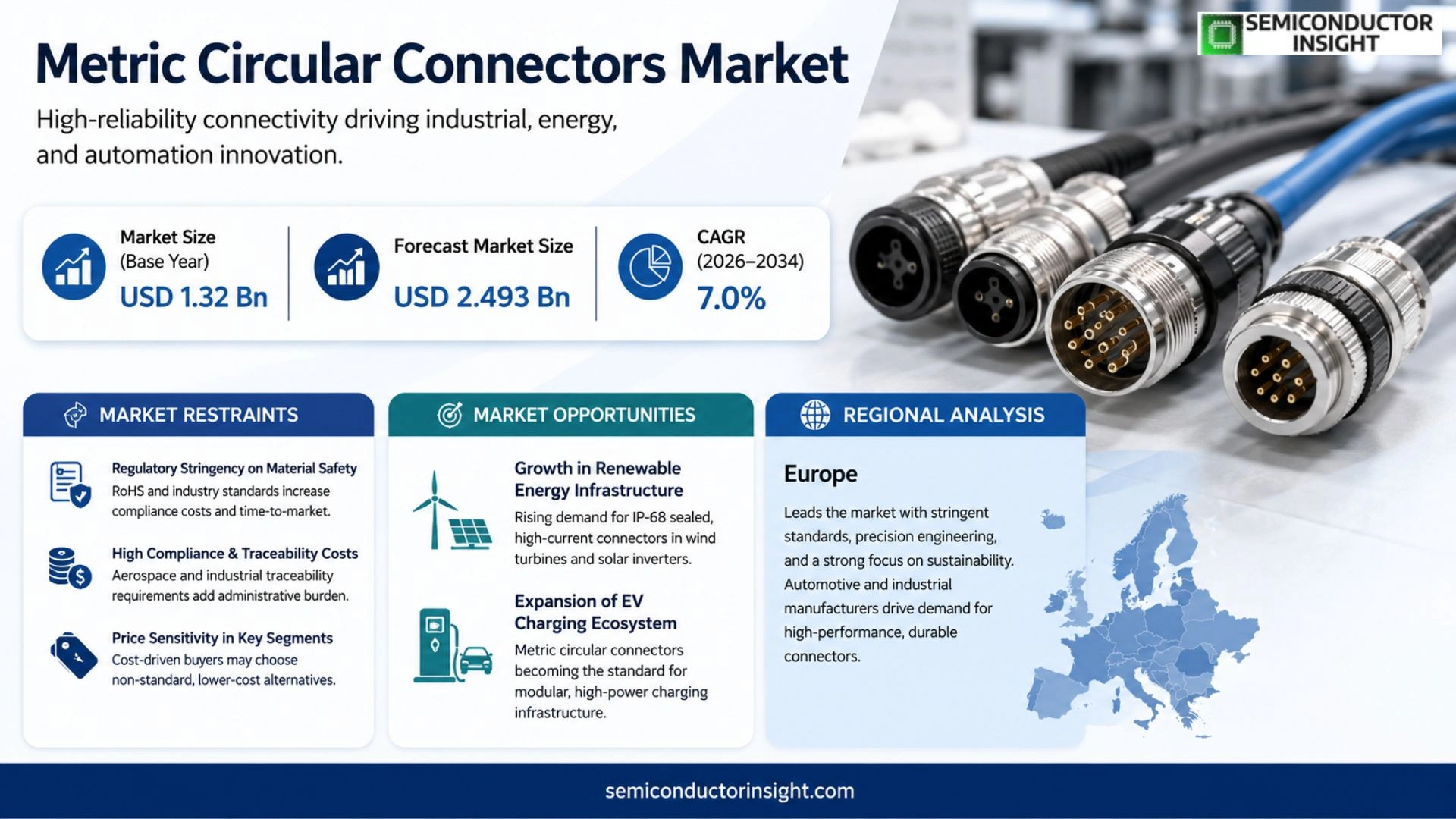
Global Metric Circular Connectors market was valued at USD 1.566 billion in 2024 and is expected to reach USD 2.493 billion by 2034, reflecting a compound annual growth rate of 7.0% during the forecast horizon.
Metric circular connectors are precision‑engineered cylindrical interfaces that provide reliable electrical or data transmission between equipment modules. They are categorized by type,hybrid, signal, data and power,and serve automotive electrification, 5G infrastructure, data‑center hardware, aerospace, rail transit and industrial automation.
The upward trajectory stems from expanding demand for electric vehicles, accelerated rollout of 5G networks and growing investment in data‑center capacity. Leading suppliers such as Phoenix Contact, TE Connectivity and Amphenol are expanding their portfolios to meet higher current ratings and tighter space constraints.
MARKET DRIVERS
Increasing Demand for Compact Electrical Interfaces
The rise of automation across manufacturing floors has compelled OEMs to replace bulky harnesses with tighter, space‑saving solutions. Metric Circular Connectors satisfy this need by delivering a high pin count within a reduced footprint, allowing equipment designers to free valuable panel space and lower overall weight. This engineering advantage translates directly into cost savings on material and assembly labor, a factor that resonates strongly with procurement teams.
Shift Toward High‑Performance Automation
Modern robotics and collaborative machines rely on rapid, reliable signal transmission under harsh conditions. Metric Circular Connectors market benefits from the push for connectors that can endure vibration, temperature extremes, and contamination while maintaining low insertion loss. Vendors that offer improved shielding and locking mechanisms are gaining preference among system integrators seeking to minimize downtime.
➤ Design engineers cite reduced wiring complexity as a decisive factor when selecting metric‑type circular connectors for new generation production lines.
Beyond performance, the drive for standardization across global supply chains encourages the adoption of metric dimensions, which align with ISO guidelines and simplify cross‑regional sourcing. Companies that position their product lines around this metric consistency are better placed to capture contracts that demand uniformity across multiple factories.
MARKET CHALLENGES
Installation Complexity in Retrofitting Projects
Legacy equipment often features non‑metric or proprietary connector families, making the swap to metric circular units a labor‑intensive effort. Technicians must re‑engineer cable bundles, verify torque specifications, and sometimes redesign mounting hardware, which inflates project timelines and budgets.
Other Challenges
Supply‑Chain Volatility
Fluctuations in raw‑material prices for copper and high‑grade polymers create price uncertainty for manufacturers. When component lead times extend, system integrators may postpone upgrades, dampening short‑term sales momentum for Metric Circular Connectors market.
MARKET RESTRAINTS
Regulatory Stringency on Material Safety
European RoHS and emerging Asian directives impose tight limits on lead, cadmium, and certain flame‑retardant chemicals. Manufacturers that rely on legacy compounds must re‑qualify their product lines, a process that can stall market entry and increase compliance costs.
Additionally, specific industries such as aerospace demand traceability and documented testing for every connector batch. The administrative burden associated with maintaining these records can deter smaller suppliers from entering Metric Circular Connectors market, limiting competitive pressure.
Cost‑sensitive segments, particularly in consumer‑grade automation, may reject premium‑priced metric solutions in favor of cheaper, non‑standard alternatives, curbing overall market breadth.
MARKET OPPORTUNITIES
Growth in Renewable Energy Infrastructure
Wind turbine nacelles and solar‑field inverters increasingly adopt metric circular connectors to manage high‑current cabling within confined housings. The need for connectors that combine robust sealing with quick mating cycles opens a niche for vendors that can certify IP‑68 performance while maintaining low contact resistance.
Beyond stationary power, electric‑vehicle charging stations are standardizing on metric circular interfaces for modular power distribution modules. Early entrants that align their product roadmaps with these emerging standards stand to secure long‑term supply contracts.
Finally, the rise of Industry 4.0 platforms encourages the integration of smart sensors directly into connector bodies. Embedding diagnostics and condition‑monitoring capabilities into metric circular housings could differentiate offerings and create a new revenue stream for manufacturers willing to invest in miniaturized electronics.
Metric Circular Connectors Market Trends
Electrification of Vehicles Fuels Connector Demand
The shift toward electric drivetrains has forced vehicle manufacturers to redesign wiring architectures. Metric Circular Connectors, with their standardized pitch and high pin density, enable compact power distribution and signal routing inside limited chassis volumes. As battery capacities rise, engineers prioritize connectors that can sustain higher currents without compromising seal integrity. This technical pressure translates into greater procurement volumes from automotive OEMs, prompting suppliers to broaden their product portfolios with higher‑temperature ratings and reinforced locking mechanisms. The ripple effect is evident in tier‑1 suppliers, who are now negotiating larger, long‑term contracts to lock in supply certainty.
Other Trends
5G Infrastructure and Data Center Expansion
Rollout of 5G antenna arrays and the parallel construction of hyperscale data centers generate a surge in high‑speed signal pathways. Metric Circular Connectors are favored for their repeatable impedance characteristics, which reduce signal distortion in densely packed rack environments. Service providers are imposing stricter test regimes, pushing manufacturers to certify products against tighter insertion loss thresholds. Consequently, we observe a migration toward connectors that combine data‑grade performance with ruggedized shells, allowing field technicians to service installations without interrupting service.
Aerospace and Defense Adoption of High‑Performance Connectors
Aircraft avionics and defense platforms demand connectors that can survive extreme thermal cycles, vibration, and electromagnetic interference. Metric Circular Connectors satisfy these requirements through alloy housings and gold‑plated contacts that maintain conductivity under harsh conditions. Recent procurement notices from major airframe programs emphasize modularity, enabling rapid reconfiguration of sensor suites. Suppliers that can deliver certified traceability and maintain low failure rates are gaining preferred‑vendor status, which reshapes the competitive hierarchy and drives modest price premiums for validated high‑reliability parts.
COMPETITIVE LANDSCAPE
Key Industry Players
Metric Circular Connectors: Competitive Overview 2024‑2031
Phoenix Contact dominates the upper tier of the market, leveraging its extensive portfolio of hybrid and power connectors to secure large‑scale contracts in automotive electrification and data‑center infrastructure. Its vertical integration, from design to manufacturing, enables rapid response to evolving standards in 5G and autonomous‑vehicle platforms, granting the company a decisive pricing advantage and a sizable share of global revenue. TE Connectivity follows closely, exploiting a broad geographic footprint and a diversified end‑user base that spans aerospace, defense, and industrial automation, which cushions the firm against sector‑specific volatility. The concentration of revenue among these two firms pressures marginal suppliers to pursue strategic alliances or niche specialization to sustain margins, while their ability to lock in long‑term OEM agreements shapes pricing dynamics throughout the supply chain.
Beyond the two giants, a cadre of specialist firms adds depth to the competitive field. Amphenol and HARTING maintain strong positions in signal‑ and data‑connector segments, often winning niche tenders for aerospace and medical equipment where stringent reliability criteria prevail. Smaller but innovative players such as NorComp, Altech, Bulgin, CONEC, ERNI Electronics, Lumberg Automation, Omron, and Weidmuller differentiate through custom engineering services and rapid prototyping, allowing them to capture emerging opportunities in rail‑transit electrification and renewable‑energy infrastructure. These midsize manufacturers frequently leverage regional production hubs in Eastern Europe and Southeast Asia to offset cost differentials, enhancing competitiveness in price‑sensitive industrial segments. Their emphasis on modular design accelerates time‑to‑market for customized solutions, a factor increasingly vital as end‑users demand swift iteration of electronic architectures.
List of Key Metric Circular Connectors Companies Profiled
- Phoenix Contact
- TE Connectivity
- Amphenol
- HARTING
- NorComp
- Altech
- Bulgin
- CONEC
- ERNI Electronics
- 3M
- Lumberg Automation
- Omron
- Weidmuller
- Hirose Electric
- Würth Elektronik
Segment Analysis:
| Segment Category | Sub-Segments | Key Insights |
| By Type |
|
Hybrid Connectors are emerging as the preferred choice because they combine power and signal pathways within a single circular envelope, enabling streamlined system architecture.
|
| By Application |
|
Industrial applications dominate the demand landscape due to the sector’s need for rugged, reliable interconnects that can withstand harsh environments and maintain performance over long service lives.
|
| By End User |
|
OEMs drive the market by seeking versatile connectors that can be standardized across product families while allowing customization for specific performance targets.
|
| By Connectivity Feature |
|
High‑Speed Data connectivity is gaining prominence as systems demand greater bandwidth for real‑time analytics and machine‑to‑machine communication.
|
| By Market Trend |
|
Electrification is reshaping connector requirements across automotive, rail, and renewable‑energy installations, prompting a shift toward higher current capacity and robust thermal management.
|
Regional Analysis: Metric Circular Connectors Market
Europe
The push for higher power density in European electric vehicles and the rollout of Industry 4.0 factories are prompting OEMs to seek connectors that can handle tighter space constraints without compromising signal integrity. Suppliers that can deliver compact, high‑frequency solutions are seeing their designs adopted across multiple sectors, creating cross‑industry momentum.
EU directives on hazardous substances and waste management require manufacturers to eliminate lead‑based alloys and to provide end‑of‑life recycling pathways. Companies that embed compliance into product development avoid costly redesigns later, positioning themselves as preferred partners for downstream assemblers.
Proximity to high‑precision machining hubs in Central Europe reduces lead times for custom connector batches. However, recent raw‑material price volatility compels buyers to lock in longer contracts, balancing cost certainty against the flexibility of on‑demand production.
Renewable‑energy installations, particularly offshore wind farms in the North Sea, are beginning to specify metric circular connectors for harsh‑marine environments. Their corrosion‑resistant features and ease of maintenance align with the operational demands of these projects.
North America
North America’s Metric Circular Connectors Market is shaped by a blend of legacy aerospace programs and a rapid acceleration in data‑center construction. U.S. defense contracts continue to demand connectors that meet stringent MIL‑SPEC criteria, while cloud‑service providers prioritize high‑throughput interconnects for server racks. The divergent requirements have led to a bifurcated supplier landscape: niche firms focusing on aerospace certification and larger players scaling up volume production for IT infrastructure. As the continent pushes toward higher bandwidth standards, manufacturers that can harmonize aerospace reliability with data‑center efficiency are gaining strategic footholds.
Asia‑Pacific
In Asia‑Pacific, Metric Circular Connectors market is being amplified by the region’s manufacturing scale and aggressive cost‑optimization culture. Chinese and Indian OEMs favor connectors that can be produced in high volumes while maintaining acceptable tolerance levels, prompting a wave of tier‑1 suppliers to introduce automated stamping lines. Simultaneously, Japan’s precision‑engineering sector continues to demand premium‑grade connectors for robotics and advanced medical devices. This duality creates a market where price‑sensitive mass production coexists with high‑value niche segments, compelling suppliers to diversify their portfolios to capture both ends of the spectrum.
South America
South America’s Metric Circular Connectors Market remains modest but is slowly gaining traction as local automotive assemblers upgrade their production lines to meet global emission standards. Brazil’s push for domestically produced electric‑vehicle platforms has sparked interest in connectors that can withstand higher temperature cycles without degradation. Regional distributors are therefore partnering with European and Asian manufacturers to import designs that satisfy these durability expectations, while also encouraging technology transfer to build indigenous capabilities over the medium term.
Middle East & Africa
The Middle East & Africa region presents a distinct set of challenges for Metric Circular Connectors market, chiefly extreme climate conditions and fragmented infrastructure development. Oil‑and‑gas projects in the Gulf require connectors that can tolerate sand ingress and temperature fluctuations, leading operators to select components with enhanced sealing features. In Africa, emerging telecom networks are beginning to standardize on metric circular connectors for base‑station equipment, driven by the need for ruggedness and ease of field replacement. Suppliers that can tailor corrosion‑resistant finishes and provide reliable after‑sales support are gradually establishing a foothold across these diverse applications.
Report Scope
This market research report provides a comprehensive analysis of the Metric Circular Connectors Market , covering the forecast period 2026–2034. It offers detailed insights into market dynamics, technological advancements, competitive landscape, and key trends shaping the industry.
Key focus areas of the report include:
- Market Overview: The report begins with an overview outlining its current market scenario, key growth indicators, and industry transformation drivers. It discusses macroeconomic factors, demand–supply balance, regulatory landscape, and the strategic role of semiconductors in powering advancements across industries such as automotive, telecommunications, consumer electronics, and industrial automation.
- Market Size & Forecast: Historical data and future projections for revenue, unit shipments, and market value across major regions and segments.
- Segmentation Analysis: Detailed breakdown by product type, technology, application, and end-user industry to identify high-growth segments and investment opportunities.
- Regional Insights: Insights into market performance across North America, Europe, Asia-Pacific, Latin America, and the Middle East & Africa, including country-level analysis where relevant.
- Competitive Landscape: Profiles of leading market participants, including their product offerings, R&D focus, manufacturing capacity, pricing strategies, and recent developments such as mergers, acquisitions, and partnerships.
- Technology Trends & Innovation: Assessment of emerging technologies, integration of AI/IoT, semiconductor design trends, fabrication techniques, and evolving industry standards.
- Market Drivers & Restraints: Evaluation of factors driving market growth along with challenges, supply chain constraints, regulatory issues, and market-entry barriers.
- Stakeholder Insights: Insights for component suppliers, OEMs, system integrators, investors, and policymakers regarding the evolving ecosystem and strategic opportunities.
Primary and secondary research methods are employed, including interviews with industry experts, data from verified sources, and real-time market intelligence to ensure the accuracy and reliability of the insights presented.
FREQUENTLY ASKED QUESTIONS:
What is the current market size of Metric Circular Connectors Market?
-> Metric Circular Connectors market is expected to reach USD 2.493 billion by 2034, reflecting a compound annual growth rate of 7.0%
Which key companies operate in Metric Circular Connectors Market?
-> Key players include Phoenix Contact, TE Connectivity, Amphenol, HARTING, NorComp, Altech, Bulgin, CONEC, ERNI Electronics, 3M, Lumberg Automation, Omron, Weidmuller, among others.
What are the key growth drivers?
-> Key growth drivers include automobile electrification and intelligence, expansion of global 5G communications, construction of computers and data centers, and rising demand in aerospace, rail transit, and industrial applications.
Which region dominates the market?
-> Asia is the fastest‑growing region, driven by strong manufacturing bases and increasing adoption of advanced connector technologies.
What are the emerging trends?
-> Emerging trends include high‑speed data connectors for 5G, integration of smart IoT capabilities, and growing demand for robust connectors in electric vehicle and renewable energy sectors.

Get Sample Report PDF for Exclusive Insights
Report Sample Includes
- Table of Contents
- List of Tables & Figures
- Charts, Research Methodology, and more...
 Download Sample Report PDF