Metal Oxide Resist (MOR) Market Insights
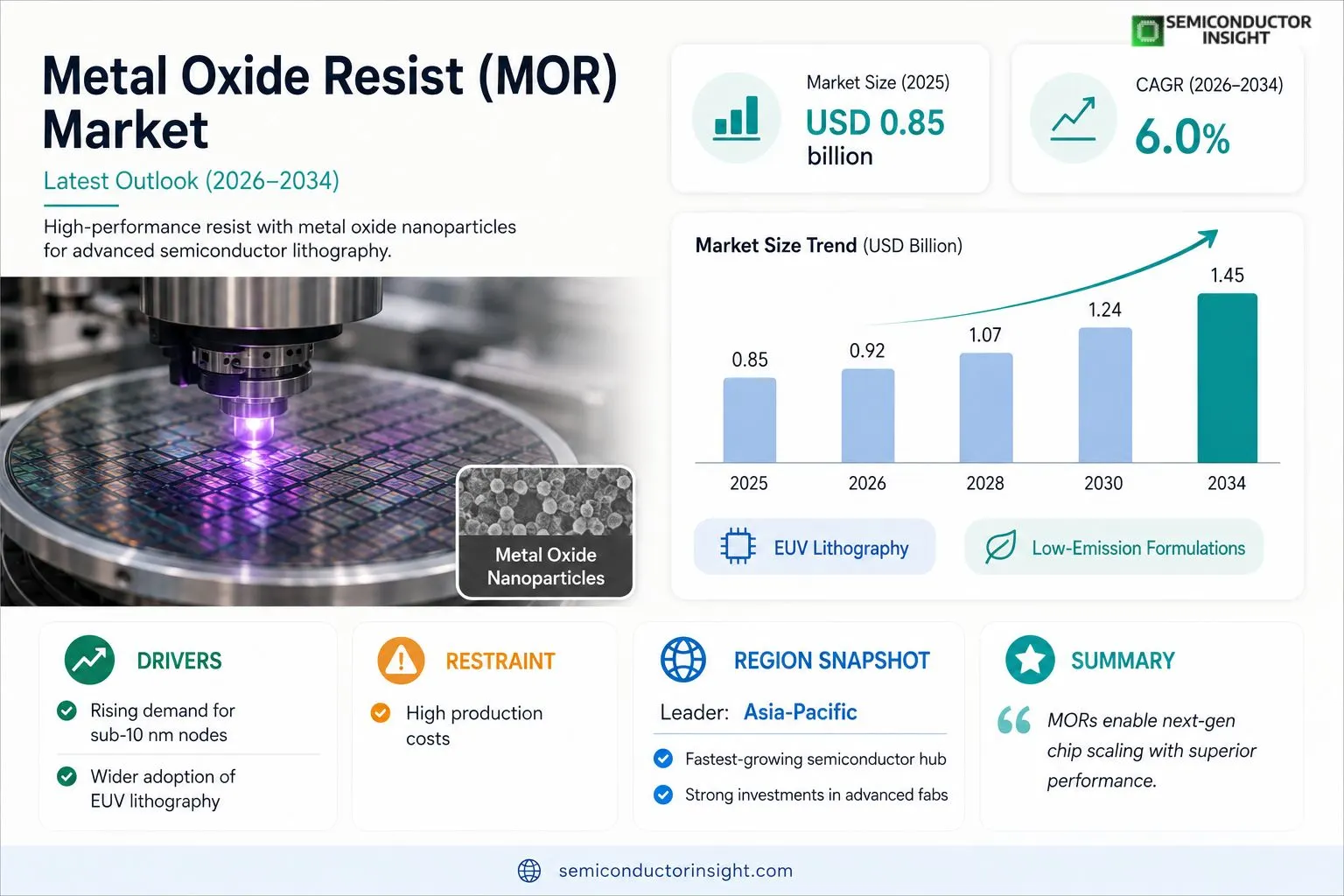
Global Metal Oxide Resist (MOR) market size was valued at USD 0.85 billion in 2025. The market is projected to grow from USD 0.92 billion in 2026 to USD 1.45 billion by 2034, exhibiting a CAGR of 6.0% during the forecast period.
Metal Oxide Resists are specialized photoresist materials composed of metal oxide nanoparticles dispersed within an organic matrix, enabling high‑resolution patterning for advanced semiconductor manufacturing processes such as extreme ultraviolet (EUV) lithography. These resists provide superior etch resistance and improved line‑edge roughness compared with conventional organic resists.The market is experiencing rapid expansion due to several factors, including increasing demand for sub‑10 nm node devices, rising adoption of EUV lithography across leading foundries, and continuous R&D investments aimed at enhancing performance characteristics. Furthermore, collaborations between major chemical suppliers and equipment manufacturers accelerate technology transfer, while sustainability pressures drive development of low‑emission formulations.
MARKET DRIVERS
Increasing Demand for High‑Resolution Lithography
Metal Oxide Resist (MOR) Market is being propelled by the semiconductor industry’s shift toward sub‑10 nm patterning. Advanced nodes require materials with superior line‑edge roughness control, and MORs deliver the necessary sensitivity and etch resistance, enabling manufacturers to achieve higher yields.
Growth in Emerging Technologies
Applications such as 5G infrastructure, artificial‑intelligence accelerators, and automotive sensors are expanding the addressable market for MORs. These sectors prioritize miniaturization and performance, creating a robust pipeline of orders for high‑performance resist solutions.
➤ Analysts project a compound annual growth rate of roughly 12 % for MOR segment through 2032, driven primarily by the factors above.
In addition, strategic collaborations between resist manufacturers and equipment suppliers are accelerating technology transfer, further reinforcing the upward trajectory of Metal Oxide Resist (MOR) Market.
MARKET CHALLENGES
Compatibility with Existing Process Flows
Integrating MORs into legacy fabs can be complex because the material’s chemistries sometimes require modified bake cycles and exposure parameters, increasing operational risk and capital expenditure.
Other Challenges
Supply Chain Constraints
Limited availability of high‑purity metal‑oxide precursors can cause lead‑times to extend, especially during periods of rapid demand growth, restraining the speed of market adoption.
MARKET RESTRAINTS
High Production Costs
The synthesis of metal‑oxide resist polymers involves multiple high‑energy steps, resulting in a cost structure that is higher than conventional chemically amplified resists. This price premium can deter cost‑sensitive manufacturers.
Regulatory and Environmental Concerns
Strict environmental regulations on metal‑containing waste streams require additional treatment processes, adding both complexity and expense to the overall manufacturing workflow.
MARKET OPPORTUNITIES
Development of Low‑Temperature Processing
Emerging low‑temperature cure chemistries are enabling MORs to be applied on temperature‑sensitive substrates, opening new avenues in flexible electronics and photonics where traditional resists are unsuitable.
Customization for Niche Applications
Tailoring metal‑oxide compositions for specific dielectric constants or optical properties presents a differentiated value proposition, allowing vendors to capture premium segments such as quantum‑dot displays and next‑generation memory devices.
Metal Oxide Resist (MOR) Market Trends
Rising Adoption of EUV Lithography
The semiconductor industry is increasingly reliant on extreme ultraviolet (EUV) lithography to achieve sub‑10 nm patterning precision. Metal oxide‑based photoresists deliver the high etch resistance and line‑edge smoothness required for these nodes, making them a preferred choice for leading foundries. As device architectures become more complex, the demand for EUV‑compatible resists has surged, driving rapid volume growth. This shift is reinforced by continuous investment in EUV tool upgrades, which in turn expands the addressable market for advanced resist materials. Consequently, the adoption curve for Metal Oxide Resist (MOR) technology is steepening, reflecting its strategic relevance in next‑generation chip production.
Other Trends
Sustainability and Low‑Emission Formulations
Environmental considerations are reshaping material development pathways. Suppliers are engineering metal oxide resist formulations that emit fewer volatile organic compounds during spin‑coating and post‑exposure bake steps. These low‑emission variants align with stricter regulatory frameworks and corporate sustainability targets, while maintaining the high resolution and defect control required for EUV processes. Collaborative research programs focus on greener solvents and recyclable waste streams, positioning the sector to meet both performance and ecological criteria without compromising throughput.
Strategic Partnerships Accelerate Technology Transfer
Joint ventures between major chemical companies and lithography equipment manufacturers are accelerating the commercialization of next‑generation resist chemistries. By co‑developing process windows and sharing metrology data, partners reduce time‑to‑market for novel formulations. These alliances also enable coordinated scaling of pilot lines, ensuring that new resist technologies can be validated at volume production levels swiftly. The synergy enhances knowledge exchange, mitigates risk, and drives continuous improvement across the supply chain, reinforcing the overall health and resilience of the Metal Oxide Resist market.
COMPETITIVE LANDSCAPEKey Industry Players
Metal Oxide Resist (MOR) Market Competitive Landscape
MOR market is currently anchored by a handful of large chemical manufacturers that dominate supply to leading semiconductor foundries. JSR Corporation, leveraging its deep expertise in advanced photoresist chemistry, commands the largest share of high‑resolution EUV‑compatible metal‑oxide formulations. Its product roadmap aligns closely with the aggressive node scaling plans of industry leaders such as TSMC and Intel, giving JSR a decisive advantage in both volume and innovation. Parallel to JSR, TOKYO OHKA KOGYO Co., Ltd. (TOK) operates a robust global distribution network and supplies a broad portfolio of inorganic resist materials that address sub‑10 nm lithography. The market structure therefore reflects a duopolistic concentration at the top, complemented by strategic collaborations between these incumbents and equipment manufacturers to accelerate technology transfer and reduce time‑to‑market for next‑generation nodes.Beyond the two dominant firms, a diverse cohort of niche specialists contributes critical differentiation to MOR ecosystem. Fujifilm Holdings Corporation offers proprietary sol‑gel based metal‑oxide resists that prioritize low‑emission processing, appealing to foundries under sustainability mandates. Merck KGaA supplies high‑purity metal‑oxide nanoparticles that enhance etch resistance, while Dow Chemical Company focuses on formulation chemistry that improves line‑edge roughness. Additional players such as Shin‑Etsu Chemical Co., Ltd., Sumitomo Chemical Co., Ltd., Hitachi Kokusai (formerly Hitachi Chemical), Linde plc, Samsung Advanced Institute of Technology, Intel’s in‑house materials group, Applied Materials (through its materials division), and Nanomaterials Technology Ltd. each address specific performance niches or regional market segments, reinforcing a competitive landscape that balances scale, specialization, and collaborative innovation.
List of Key Metal Oxide Resist Companies Profiled
- JSR Corporation
- TOKYO OHKA KOGYO Co., Ltd.
- Fujifilm Holdings Corporation
- Merck KGaA
- Dow Chemical Company
- Shin‑Etsu Chemical Co., Ltd.
- Sumitomo Chemical Co., Ltd.
- Hitachi Kokusai
- Linde plc
- Samsung Advanced Institute of Technology
- Intel Materials Group
- Applied Materials (Materials Division)
- Nanomaterials Technology Ltd.
Segment Analysis:
| Segment Category | Sub-Segments | Key Insights |
| By Type |
|
Sol‑gel based MOR
|
| By Application |
|
EUV lithography
|
| By End User |
|
Semiconductor manufacturers
|
| By Performance Attribute |
|
Low Line‑Edge Roughness
|
| By Collaboration Model |
|
Supplier‑Foundry Partnerships
|
Regional Analysis: North America
United States
The demand for MOR is strongly correlated with advancements in advanced packaging techniques like 2.5D and 3D integration. These technologies require highly precise and reliable MOR materials to ensure efficient interconnects and signal integrity.
The US semiconductor industry is witnessing a shift towards more complex chip designs and manufacturing processes. This evolution necessitates MOR with improved resolution, uniformity, and etch resistance. Investment in new fabrication facilities is expected to further boost MOR demand.
Government programs aimed at bolstering domestic semiconductor production are directly benefiting MOR market. These initiatives provide incentives for companies to invest in R&D and manufacturing capabilities, thereby driving demand for advanced resist solutions.
Ongoing research and development efforts are focused on creating MOR with enhanced performance characteristics. This includes improving resolution, reducing line edge roughness (LER), and enhancing etch resistance to meet the demands of advanced lithography techniques.
Europe
The European Metal Oxide Resist (MOR) market is characterized by a mature semiconductor industry, particularly in countries like Germany, France, and the Netherlands. The region is focused on high-performance computing, automotive electronics, and industrial applications where advanced chip packaging is becoming increasingly prevalent. Sustainability concerns are also influencing MOR development, with a growing emphasis on environmentally friendly formulations. European suppliers are actively investing in research to develop next-generation MOR that meets stringent environmental regulations. The demand for MOR is steadily growing, driven by the expansion of existing industries and the emergence of new applications.
Asia-Pacific
Asia-Pacific, spearheaded by China, Japan, and South Korea, represents the largest and fastest-growing market for Metal Oxide Resist (MOR). The region’s semiconductor industry is experiencing exponential expansion, fueled by massive investments in integrated circuits, memory chips, and system-on-chips (SoCs). China’s government support for domestic semiconductor manufacturing is a major driver of market growth. The demand for high-resolution MOR is particularly strong in Asia-Pacific due to the rapid adoption of advanced process technologies. Competition is intense in this region, with numerous local and international players vying for market share.
South America
Metal Oxide Resist (MOR) Market in South America is relatively nascent but holds significant potential. Brazil and Chile are the key markets in the region, driven by the growth of electronics manufacturing and increasing adoption of consumer electronics. While the semiconductor industry is smaller compared to other regions, the demand for MOR is gradually increasing as local manufacturers upgrade their production capabilities. The market is characterized by a limited number of suppliers, and import dependence is high.
Middle East & Africa
Metal Oxide Resist (MOR) Market in the Middle East & Africa is emerging, driven by investments in infrastructure development and the expansion of the electronics sector in countries like Saudi Arabia and South Africa. The demand for MOR is primarily driven by the automotive industry, telecommunications infrastructure, and consumer electronics. The market is still in its early stages of development, with opportunities for growth as the region’s semiconductor industry matures.
Report Scope
This market research report provides a comprehensive analysis of the Metal Oxide Resist (MOR) Market , covering the forecast period 2026–2034. It offers detailed insights into market dynamics, technological advancements, competitive landscape, and key trends shaping the industry.
Key focus areas of the report include:
- Market Overview: The report begins with an overview outlining its current market scenario, key growth indicators, and industry transformation drivers. It discusses macroeconomic factors, demand–supply balance, regulatory landscape, and the strategic role of semiconductors in powering advancements across industries such as automotive, telecommunications, consumer electronics, and industrial automation.
- Market Size & Forecast: Historical data and future projections for revenue, unit shipments, and market value across major regions and segments.
- Segmentation Analysis: Detailed breakdown by product type, technology, application, and end-user industry to identify high-growth segments and investment opportunities.
- Regional Insights: Insights into market performance across North America, Europe, Asia-Pacific, Latin America, and the Middle East & Africa, including country-level analysis where relevant.
- Competitive Landscape: Profiles of leading market participants, including their product offerings, R&D focus, manufacturing capacity, pricing strategies, and recent developments such as mergers, acquisitions, and partnerships.
- Technology Trends & Innovation: Assessment of emerging technologies, integration of AI/IoT, semiconductor design trends, fabrication techniques, and evolving industry standards.
- Market Drivers & Restraints: Evaluation of factors driving market growth along with challenges, supply chain constraints, regulatory issues, and market-entry barriers.
- Stakeholder Insights: Insights for component suppliers, OEMs, system integrators, investors, and policymakers regarding the evolving ecosystem and strategic opportunities.
Primary and secondary research methods are employed, including interviews with industry experts, data from verified sources, and real-time market intelligence to ensure the accuracy and reliability of the insights presented.
FREQUENTLY ASKED QUESTIONS:
What is the current market size of Metal Oxide Resist (MOR) Market?
-> Metal Oxide Resist (MOR) Market was valued at USD 850 million in 2025 and is expected to reach USD 1,450 million by 2034. It is projected to grow at a CAGR of 6.0% during the forecast period.
Which key companies operate in Metal Oxide Resist (MOR) Market?
-> Key players include BASF SE, JSR Corporation, TOK (Tokyo Ohka Kogyo), Sumitomo Chemical, and Merck KGaA, among others.
What are the key growth drivers?
-> Key growth drivers include rising adoption of EUV lithography, increasing demand for sub‑10 nm node devices, and sustainability‑focused R&D initiatives.
Which region dominates the market?
-> Asia‑Pacific is the fastest‑growing region, while North America holds significant market share.
What are the emerging trends?
-> Emerging trends include low‑emission MOR formulations, integration of AI/ML for process control, and advanced multi‑patterning techniques.

Get Sample Report PDF for Exclusive Insights
Report Sample Includes
- Table of Contents
- List of Tables & Figures
- Charts, Research Methodology, and more...
 Download Sample Report PDF