MEMS Ultrasonic Transducer (PMUT, CMUT) Market Insights
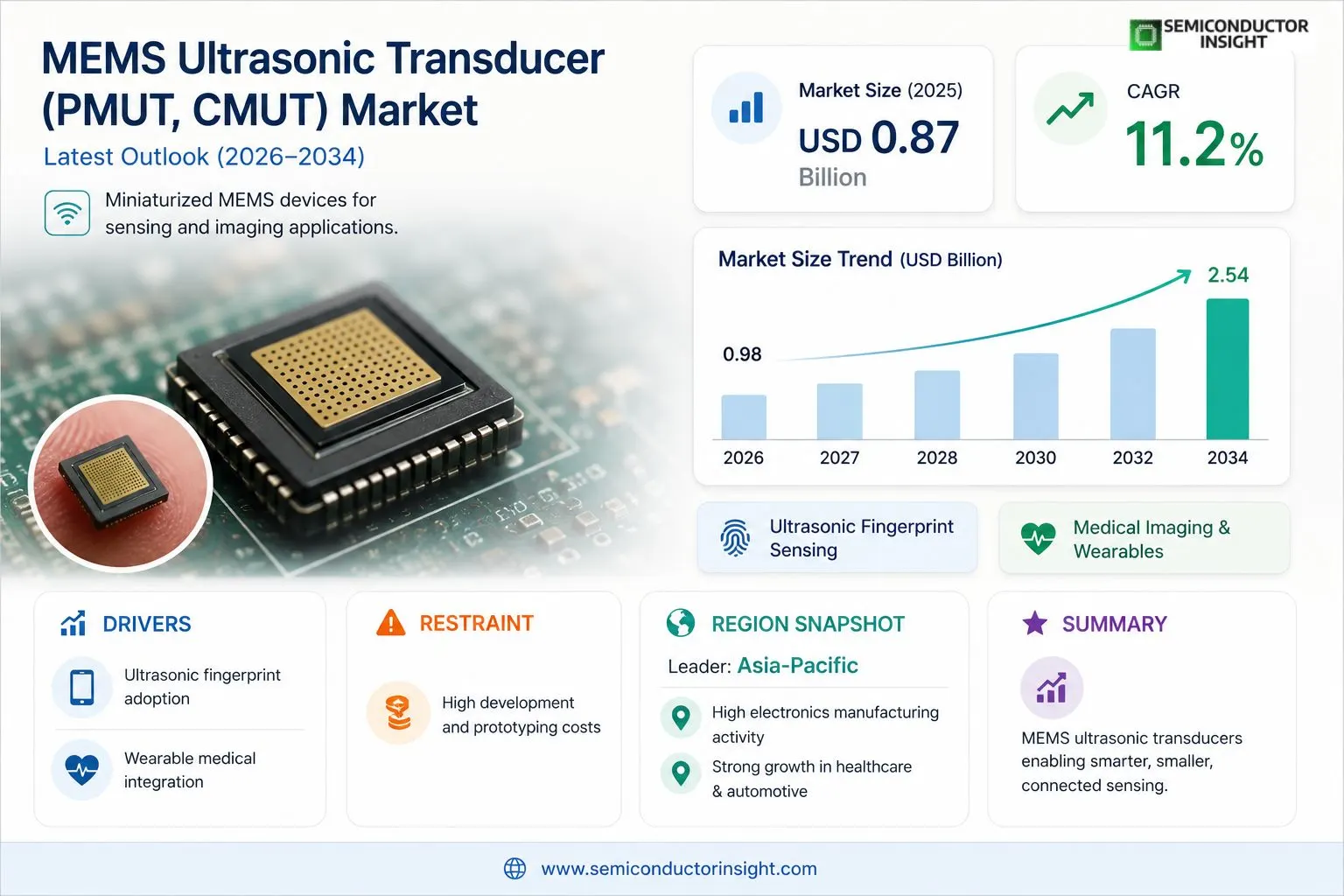
Global MEMS Ultrasonic Transducer (PMUT, CMUT) market size was valued at USD 0.87 billion in 2025. The market is projected to grow from USD 0.98 billion in 2026 to USD 2.54 billion by 2034, exhibiting a CAGR of 11.2% during the forecast period.
MEMS ultrasonic transducers are miniaturized acoustic sensing and emitting devices fabricated using microelectromechanical systems (MEMS) technology. They are broadly categorized into two primary types: Piezoelectric Micromachined Ultrasonic Transducers (PMUTs), which rely on piezoelectric thin films to generate and detect ultrasonic waves, and Capacitive Micromachined Ultrasonic Transducers (CMUTs), which operate on electrostatic principles. These devices are integral to a wide range of applications including medical imaging, fingerprint sensing, gesture recognition, proximity detection, industrial non-destructive testing (NDT), and automotive ranging systems.
The market is witnessing robust expansion driven by rising adoption of ultrasonic fingerprint sensors in consumer electronics, growing integration of MEMS transducers in wearable medical devices, and increasing demand for advanced driver-assistance systems (ADAS) in the automotive sector. Furthermore, the transition from conventional piezoelectric transducers to MEMS-based alternatives , owing to their compact form factor, lower power consumption, and compatibility with standard CMOS fabrication processes , is accelerating industry-wide adoption. Key players operating in the MEMS Ultrasonic Transducer market include Butterfly Network, Inc., Kionix, Inc. (ROHM Co., Ltd.), Vesper Technologies, Chirp Microsystems (TDK Corporation), and STMicroelectronics, among others, each contributing to rapid technological advancements and expanding product portfolios across the PMUT and CMUT segments.
MARKET DRIVERS
Rising Adoption of MEMS Ultrasonic Transducers in Consumer Electronics and Mobile Devices
MEMS Ultrasonic Transducer (PMUT, CMUT) Market is experiencing robust growth driven by accelerating integration of piezoelectric micromachined ultrasonic transducers (PMUTs) and capacitive micromachined ultrasonic transducers (CMUTs) into consumer electronics. Smartphones, wearables, and smart home devices increasingly rely on ultrasonic sensing for fingerprint recognition, proximity detection, and gesture control. The miniaturized form factor and low power consumption of MEMS-based ultrasonic solutions make them highly suitable for battery-operated devices, directly fueling demand across the consumer segment.
Expanding Role in Medical Imaging and Point-of-Care Diagnostics
The healthcare sector represents a significant growth catalyst for the PMUT and CMUT market. CMUT-based transducer arrays are enabling next-generation portable ultrasound systems with superior image resolution and broader bandwidth compared to conventional piezoelectric transducers. The growing global emphasis on point-of-care diagnostics and handheld ultrasound devices has substantially increased investments in CMUT technology development. Medical OEMs are actively partnering with MEMS foundries to co-develop application-specific transducer arrays suited for cardiovascular, ophthalmic, and intravascular imaging applications.
➤ The integration of PMUT arrays into under-display fingerprint sensors for flagship smartphones has emerged as one of the most commercially significant applications within the MEMS Ultrasonic Transducer market, with multiple leading semiconductor suppliers scaling production of ultrasonic fingerprint-on-display solutions.
Automotive applications are also emerging as a key driver, with MEMS ultrasonic transducers being evaluated for in-cabin gesture recognition, driver monitoring, and advanced parking assistance systems. The transition toward electric and autonomous vehicles has intensified the demand for compact, reliable sensing technologies, and PMUT-based solutions offer advantages in terms of integration density and silicon-compatible fabrication, supporting broader automotive OEM adoption over the forecast horizon.
MARKET CHALLENGES
Manufacturing Complexity and Yield Challenges in CMUT Fabrication
Despite strong demand signals, MEMS Ultrasonic Transducer (PMUT, CMUT) Market faces notable manufacturing challenges. CMUT fabrication requires highly controlled surface micromachining or wafer-bonding processes to achieve uniform membrane characteristics across large arrays. Even minor process variations can lead to inconsistent electromechanical performance, impacting transducer sensitivity and frequency response. Achieving high fabrication yield at commercial scale remains a persistent challenge for foundries attempting to transition CMUT designs from research prototypes to volume production.
Integration Complexity with ASIC Read-Out Circuits
Both PMUT and CMUT devices require tight integration with application-specific integrated circuits (ASICs) for signal conditioning and read-out. Achieving low-noise, high-density electrical interconnects between the transducer array and the ASIC , particularly in 2D array configurations for 3D imaging , introduces significant packaging and co-design challenges. These integration complexities increase development timelines and costs, particularly for smaller companies without access to advanced heterogeneous integration capabilities.
Other Challenges
Limited Standardization Across Application Segments
The absence of unified performance standards for MEMS ultrasonic transducers across medical, industrial, and consumer applications creates fragmentation in the supply chain. Each end-use segment demands application-specific transducer geometries, frequency ranges, and reliability certifications, making it difficult for manufacturers to develop scalable, multi-market product platforms and increasing time-to-market for new entrants.
Competition from Established Piezoelectric Ceramic Technologies
Conventional lead zirconate titanate (PZT)-based bulk piezoelectric transducers continue to hold strong positions in several medical and industrial ultrasound applications due to their proven reliability and established supply chains. Displacing incumbent technologies requires MEMS ultrasonic transducer suppliers to demonstrate clear performance advantages, long-term reliability, and competitive total cost of ownership, which remains an ongoing commercial challenge in markets with conservative procurement cycles.
MARKET RESTRAINTS
High Development and Prototyping Costs Limiting Broader Market Participation
The capital-intensive nature of MEMS fabrication infrastructure poses a significant restraint on MEMS Ultrasonic Transducer (PMUT, CMUT) Market. Developing and validating a new PMUT or CMUT design requires access to specialized MEMS foundry services, multi-project wafer runs, and extensive acoustic and electrical characterization equipment. These upfront costs create high barriers to entry for startups and academic spin-offs, concentrating commercial development among well-capitalized semiconductor companies and limiting the pace of innovation at the broader ecosystem level.
Regulatory and Biocompatibility Requirements in Medical Applications
For medical imaging and implantable applications, MEMS ultrasonic transducers must comply with stringent regulatory frameworks including FDA 510(k) clearance or CE marking under the EU Medical Device Regulation (MDR). Demonstrating biocompatibility, electrical safety, and long-term acoustic performance stability in biological environments adds substantial time and cost to the product development lifecycle. These regulatory requirements disproportionately affect smaller developers and can delay commercialization of novel CMUT-based diagnostic devices by several years, restraining near-term market revenue growth.
Material and Process Limitations Affecting High-Temperature and Harsh-Environment Performance
Many PMUT designs rely on thin-film piezoelectric materials such as aluminum nitride (AlN) or PZT deposited via MEMS-compatible processes. While these materials deliver adequate performance for consumer and medical applications, their piezoelectric coefficients and thermal stability may be insufficient for high-temperature industrial environments such as process monitoring or downhole sensing. This material limitation constrains the addressable market for MEMS ultrasonic transducers in certain industrial segments where bulk piezoelectric or capacitive alternatives continue to demonstrate superior robustness.
MARKET OPPORTUNITIES
Growth Potential in Miniaturized Industrial Non-Destructive Testing (NDT) Applications
The industrial non-destructive testing segment presents a compelling long-term opportunity for MEMS Ultrasonic Transducer (PMUT, CMUT) Market. The need for compact, array-based ultrasonic probes capable of high-resolution subsurface inspection of welds, composites, and structural components is driving interest in CMUT array solutions. MEMS-based NDT probes can enable phased-array imaging in form factors previously unachievable with conventional transducer technologies, opening opportunities in aerospace, energy infrastructure, and precision manufacturing inspection.
Emergence of PMUT-Based Ultrasonic Communication and Power Transfer
Beyond sensing, PMUT technology is being explored for ultrasonic data communication and wireless power transfer to miniaturized implantable medical devices. The ability to transmit both power and data through tissue using focused ultrasonic beams generated by PMUT arrays could transform the design of neural interfaces, cardiac monitors, and drug delivery implants. Early-stage research programs backed by NIH and DARPA funding are advancing this application domain, positioning it as a high-value emerging opportunity within the broader MEMS ultrasonic transducer ecosystem over the next decade.
Expansion into Augmented Reality and Human-Machine Interaction Platforms
The rapid growth of augmented reality (AR) headsets and advanced human-machine interfaces is creating new design wins for MEMS ultrasonic transducers. PMUT arrays are being evaluated for mid-air haptic feedback generation, volumetric hand tracking, and silent ultrasonic voice capture , capabilities that align closely with next-generation AR and mixed reality platform requirements. As major technology platform developers accelerate hardware roadmaps for spatial computing, demand for highly integrated, low-power PMUT modules suitable for wearable AR applications is expected to increase substantially, representing a differentiated growth vector within the MEMS ultrasonic transducer landscape.
MEMS Ultrasonic Transducer (PMUT, CMUT) Market Trends
Rising Adoption of Ultrasonic Sensors Driving MEMS Ultrasonic Transducer Market
One of the most prominent trends shaping MEMS Ultrasonic Transducer (PMUT, CMUT) Market is the accelerating integration of ultrasonic fingerprint sensing technology in consumer electronics. Smartphone manufacturers are increasingly replacing optical and capacitive fingerprint sensors with under-display ultrasonic solutions enabled by Piezoelectric Micromachined Ultrasonic Transducers (PMUTs), owing to their superior accuracy, enhanced security, and ability to function through thick glass and metal surfaces. This shift is prompting MEMS transducer manufacturers to scale production capabilities and invest heavily in advanced piezoelectric thin-film deposition techniques to meet surging demand from the consumer electronics segment.
Other Trends
Integration of CMUT Technology in Wearable Medical Devices
Capacitive Micromachined Ultrasonic Transducers (CMUTs) are gaining significant traction in the wearable medical device segment. Their compact form factor, low power consumption, and compatibility with standard CMOS fabrication processes make them highly suitable for continuous health monitoring applications such as wearable ultrasound patches, cardiac monitoring devices, and non-invasive blood pressure sensors. The growing emphasis on remote patient monitoring and point-of-care diagnostics is reinforcing demand for miniaturized, high-performance MEMS ultrasonic transducers across Global healthcare industry.
Expanding Role in Automotive ADAS Applications
The automotive sector represents a rapidly growing end-use domain for MEMS Ultrasonic Transducer (PMUT, CMUT) Market. Increasing deployment of Advanced Driver-Assistance Systems (ADAS) , including parking assist, blind-spot detection, and pedestrian proximity sensing , is driving demand for miniaturized, high-reliability ultrasonic ranging solutions. MEMS-based transducers are progressively replacing conventional bulky piezoelectric sensors in automotive platforms due to their reduced size, improved signal precision, and ability to be manufactured at scale using semiconductor-compatible processes.
Transition from Conventional Piezoelectric Transducers to MEMS-Based Alternatives
A notable structural trend within the industry is the broader transition from traditional bulk piezoelectric transducers to MEMS ultrasonic alternatives across industrial non-destructive testing (NDT), gesture recognition, and proximity detection applications. This migration is primarily driven by the operational advantages offered by PMUT and CMUT devices, including lower power requirements, batch fabrication compatibility, and ease of integration with existing CMOS electronics , collectively reducing system-level costs while improving overall device performance.
Competitive Innovation Among Key Market Players Accelerating PMUT and CMUT Advancement
Leading companies in MEMS Ultrasonic Transducer (PMUT, CMUT) Market , including Butterfly Network, Inc., Chirp Microsystems (TDK Corporation), Vesper Technologies, STMicroelectronics, and Kionix, Inc. (ROHM Co., Ltd.) , are actively expanding their product portfolios and investing in next-generation transducer architectures. Competitive dynamics are centered on improving frequency bandwidth, sensitivity, and array integration density for both PMUT and CMUT platforms, supporting diversified application deployment across medical imaging, industrial sensing, consumer electronics, and automotive sectors.
COMPETITIVE LANDSCAPE
Key Industry Players
MEMS Ultrasonic Transducer (PMUT, CMUT) Market: Competitive Dynamics and Strategic Positioning of Leading Innovators
Global MEMS Ultrasonic Transducer (PMUT, CMUT) market is characterized by a moderately consolidated competitive landscape, with a blend of established semiconductor giants, specialized MEMS developers, and innovative start-ups driving technological progress. TDK Corporation , through its acquisition of Chirp Microsystems , stands as a dominant force, leveraging its extensive resources and MEMS expertise to deliver low-power ultrasonic sensing solutions targeting proximity detection, gesture recognition, and consumer electronics applications. STMicroelectronics also commands a significant market presence, offering PMUT-based solutions that integrate seamlessly with CMOS fabrication processes, serving automotive, industrial, and IoT end-markets. Butterfly Network, Inc. has emerged as a key disruptor in the medical imaging segment, having developed a fully integrated CMUT-on-CMOS chip that enables handheld, portable ultrasound imaging at scale. The competitive intensity is further amplified by Vesper Technologies, which specializes in piezoelectric MEMS microphones and ultrasonic transducers optimized for always-on sensing in wearable and smart home devices.
Beyond the leading players, the MEMS Ultrasonic Transducer market hosts several notable niche participants contributing to the rapid evolution of PMUT and CMUT technologies. Kionix, Inc. , now operating under ROHM Co., Ltd. , has expanded its MEMS sensor portfolio to address ultrasonic sensing needs across consumer and industrial domains. Qualcomm’s ultrasonic fingerprint sensing division continues to advance under-display fingerprint solutions based on PMUT arrays, holding strong design wins with major smartphone OEMs. Knowles Corporation brings deep expertise in acoustic MEMS to the ultrasonic transducer space, while companies such as SiTime Corporation, Murata Manufacturing Co., Ltd., and Tronics Microsystems contribute precision fabrication and high-frequency transducer capabilities. InVensense (TDK), Sonitor Technologies, and Acuity Research round out the competitive field, each pursuing differentiated strategies across medical, automotive, and smart sensing verticals. Ongoing R&D investments, strategic acquisitions, and partnerships with foundries are expected to continue reshaping competitive dynamics as the market progresses toward USD 2.54 billion by 2034.
List of Key MEMS Ultrasonic Transducer Companies Profiled
- Butterfly Network, Inc.
- STMicroelectronics
- TDK Corporation (Chirp Microsystems)
- Vesper Technologies
- Kionix, Inc. (ROHM Co., Ltd.)
- Qualcomm Technologies, Inc.
- Knowles Corporation
- Murata Manufacturing Co., Ltd.
- InVensense, Inc. (TDK Corporation)
- Tronics Microsystems
- Sonitor Technologies
- SiTime Corporation
- Acuity Research
- Preciseley Microtechnology Corporation
- UltraSense Systems, Inc.
Segment Analysis:
| Segment Category | Sub-Segments | Key Insights |
| By Type |
|
PMUTs currently lead the MEMS ultrasonic transducer market, owing to their widespread integration in consumer electronics and wearable devices.
|
| By Application |
|
Fingerprint Sensing has emerged as the dominant application segment, propelled by the rapid proliferation of under-display biometric authentication across premium and mid-range smartphone ecosystems.
|
| By End User |
|
Consumer Electronics Manufacturers represent the leading end-user segment, accounting for the broadest adoption of MEMS ultrasonic transducers driven by insatiable demand for advanced biometric and sensing features in smartphones, wearables, and smart home devices.
|
| By Fabrication Technology |
|
CMOS-Integrated MEMS fabrication technology dominates the market, underpinned by its ability to monolithically combine transducer elements with signal processing circuitry on a single chip.
|
| By Frequency Range |
|
Mid Frequency (1 MHz – 10 MHz) devices lead the market, striking an optimal balance between penetration depth and image resolution that serves the broadest range of commercial and medical applications.
|
Regional Analysis: MEMS Ultrasonic Transducer (PMUT, CMUT) Market
North America
North America leads in the adoption of PMUT and CMUT technologies within the medical imaging space. The demand for miniaturized, high-resolution ultrasound probes for point-of-care diagnostics has spurred collaboration between MEMS foundries and medical device manufacturers. Wearable cardiac monitoring and intraoral imaging are among the fastest-growing application segments in the region, reflecting a broader shift toward patient-centric, portable ultrasound platforms.
The widespread integration of MEMS ultrasonic transducers in smartphones, laptops, and smart home devices is a defining trend in North America. PMUT-based under-display fingerprint sensors and proximity detectors are gaining significant design-win traction among major OEMs. The consumer electronics supply chain in the region is actively collaborating with MEMS developers to scale production and optimize transducer performance for next-generation devices.
North America’s robust defense sector is a critical end-user of CMUT-based sonar and non-destructive evaluation systems. Federal investment in autonomous underwater vehicles and structural health monitoring platforms has created a sustained pipeline of demand. Industrial automation applications, including robotic proximity sensing and precision flow measurement, are also contributing meaningfully to regional MEMS Ultrasonic Transducer market expansion in the United States and Canada.
A dense network of university research programs, national laboratories, and venture-backed startups underpins North America’s innovation leadership in MEMS Ultrasonic Transducer (PMUT, CMUT) Market. Institutions such as MIT, Stanford, and Georgia Tech have produced foundational CMUT and PMUT research that continues to translate into commercial applications. Government grants through agencies like NIH and DARPA further accelerate technology readiness levels across medical and defense segments.
Europe
Europe represents a strategically significant region in MEMS Ultrasonic Transducer (PMUT, CMUT) Market, underpinned by its strong industrial heritage, precision engineering capabilities, and progressive regulatory frameworks that favor medical device innovation. Germany, the Netherlands, and France are at the forefront of MEMS fabrication and system-level integration, with established semiconductor clusters supporting both PMUT and CMUT development. The European medical technology sector demonstrates particularly strong demand for high-frequency ultrasonic transducers used in diagnostic imaging, therapeutic ultrasound, and lab-on-chip applications. The region also benefits from Horizon Europe funding initiatives that support collaborative research between academia and industry. Automotive applications , including in-cabin gesture recognition and advanced driver assistance systems , are a distinctly European growth driver for MEMS ultrasonic sensors. Regulatory harmonization across EU member states facilitates smoother market access for PMUT and CMUT-based medical devices, strengthening Europe’s competitive position in Global landscape through the forecast period.
Asia-Pacific
Asia-Pacific is the fastest-growing region in Global MEMS Ultrasonic Transducer (PMUT, CMUT) Market, propelled by its expansive consumer electronics manufacturing base, rising healthcare infrastructure investment, and growing domestic demand for advanced sensing technologies. China, Japan, South Korea, and Taiwan collectively constitute a powerful production and innovation hub for MEMS devices. Chinese semiconductor foundries are significantly scaling their PMUT fabrication capabilities, supported by national technology self-sufficiency programs. Japan and South Korea bring world-class precision manufacturing expertise to CMUT development, particularly for medical and industrial applications. The region’s rapidly expanding middle class is driving consumer electronics demand, while government-backed smart city and industrial IoT initiatives are catalyzing adoption of MEMS ultrasonic transducers in infrastructure monitoring and automation. With growing patent filings and R&D investment, Asia-Pacific is increasingly transitioning from a manufacturing center to an innovation leader in the MEMS Ultrasonic Transducer market.
South America
South America occupies a nascent but gradually evolving position in MEMS Ultrasonic Transducer (PMUT, CMUT) Market. Brazil leads the region in terms of technology adoption, supported by a growing medical device industry and expanding telecommunications infrastructure. Demand for PMUT-based ultrasonic sensors is emerging in healthcare diagnostics, particularly in urban centers where access to portable, cost-effective imaging solutions is gaining traction. Industrial applications such as flow measurement in oil and gas , a sector of significant regional importance , are beginning to draw attention toward MEMS-based ultrasonic sensing alternatives. While local MEMS fabrication capabilities remain limited, the region is increasingly integrated into global supply chains through partnerships with North American and Asian technology providers. Government initiatives aimed at modernizing healthcare and industrial infrastructure are expected to gradually elevate South America’s participation in the broader MEMS Ultrasonic Transducer market over the forecast horizon.
Middle East & Africa
The Middle East & Africa region presents a long-term growth opportunity in MEMS Ultrasonic Transducer (PMUT, CMUT) Market, primarily driven by increasing healthcare modernization efforts, expanding oil and gas infrastructure, and growing investment in smart city development. Gulf Cooperation Council (GCC) nations, particularly the UAE and Saudi Arabia, are actively investing in advanced medical technology and industrial automation, creating demand pathways for PMUT and CMUT-based sensing solutions. The healthcare sector across the broader African continent is witnessing a gradual shift toward affordable, portable diagnostic tools, where MEMS ultrasonic transducers offer compelling advantages. Non-destructive testing applications in energy and petrochemical industries represent a meaningful near-term demand driver in the Middle East. While the region currently relies heavily on technology imports, strategic partnerships and technology transfer agreements are beginning to lay the groundwork for deeper regional participation in the MEMS Ultrasonic Transducer market through 2034.
Report Scope
This market research report provides a comprehensive analysis of the MEMS Ultrasonic Transducer (PMUT, CMUT) Market , covering the forecast period 2026–2034. It offers detailed insights into market dynamics, technological advancements, competitive landscape, and key trends shaping the industry.
Key focus areas of the report include:
- Market Overview: The report begins with an overview outlining its current market scenario, key growth indicators, and industry transformation drivers. It discusses macroeconomic factors, demand–supply balance, regulatory landscape, and the strategic role of semiconductors in powering advancements across industries such as automotive, telecommunications, consumer electronics, and industrial automation.
- Market Size & Forecast: Historical data and future projections for revenue, unit shipments, and market value across major regions and segments.
- Segmentation Analysis: Detailed breakdown by product type, technology, application, and end-user industry to identify high-growth segments and investment opportunities.
- Regional Insights: Insights into market performance across North America, Europe, Asia-Pacific, Latin America, and the Middle East & Africa, including country-level analysis where relevant.
- Competitive Landscape: Profiles of leading market participants, including their product offerings, R&D focus, manufacturing capacity, pricing strategies, and recent developments such as mergers, acquisitions, and partnerships.
- Technology Trends & Innovation: Assessment of emerging technologies, integration of AI/IoT, semiconductor design trends, fabrication techniques, and evolving industry standards.
- Market Drivers & Restraints: Evaluation of factors driving market growth along with challenges, supply chain constraints, regulatory issues, and market-entry barriers.
- Stakeholder Insights: Insights for component suppliers, OEMs, system integrators, investors, and policymakers regarding the evolving ecosystem and strategic opportunities.
Primary and secondary research methods are employed, including interviews with industry experts, data from verified sources, and real-time market intelligence to ensure the accuracy and reliability of the insights presented.
FREQUENTLY ASKED QUESTIONS:
What is the current market size of MEMS Ultrasonic Transducer (PMUT, CMUT) Market?
-> Global MEMS Ultrasonic Transducer (PMUT, CMUT) Market was valued at USD 0.87 billion in 2025 and is expected to reach USD 2.54 billion by 2034, growing at a CAGR of 11.2% during the forecast period from 2026 to 2034.
Which key companies operate in MEMS Ultrasonic Transducer (PMUT, CMUT) Market?
-> Key players include Butterfly Network, Inc., Kionix, Inc. (ROHM Co., Ltd.), Vesper Technologies, Chirp Microsystems (TDK Corporation), and STMicroelectronics, among others.
What are the key growth drivers?
-> Key growth drivers include rising adoption of ultrasonic fingerprint sensors in consumer electronics, growing integration of MEMS transducers in wearable medical devices, increasing demand for advanced driver-assistance systems (ADAS) in the automotive sector, and the transition from conventional piezoelectric transducers to MEMS-based alternatives owing to their compact form factor, lower power consumption, and compatibility with standard CMOS fabrication processes.
Which region dominates the market?
-> Asia-Pacific is the fastest-growing region driven by high consumer electronics manufacturing activity, while North America remains a significant market owing to strong adoption of MEMS-based medical imaging and automotive ADAS technologies.
What are the emerging trends?
-> Emerging trends include miniaturization of ultrasonic transducers using MEMS technology, integration of PMUTs and CMUTs in wearable health monitoring devices, expanding use of MEMS ultrasonic sensors in gesture recognition and proximity detection, and growing adoption of CMUT-based arrays for advanced medical imaging applications.

Get Sample Report PDF for Exclusive Insights
Report Sample Includes
- Table of Contents
- List of Tables & Figures
- Charts, Research Methodology, and more...