MEMS Microphone (Analog, Digital, PDM) Market Insights
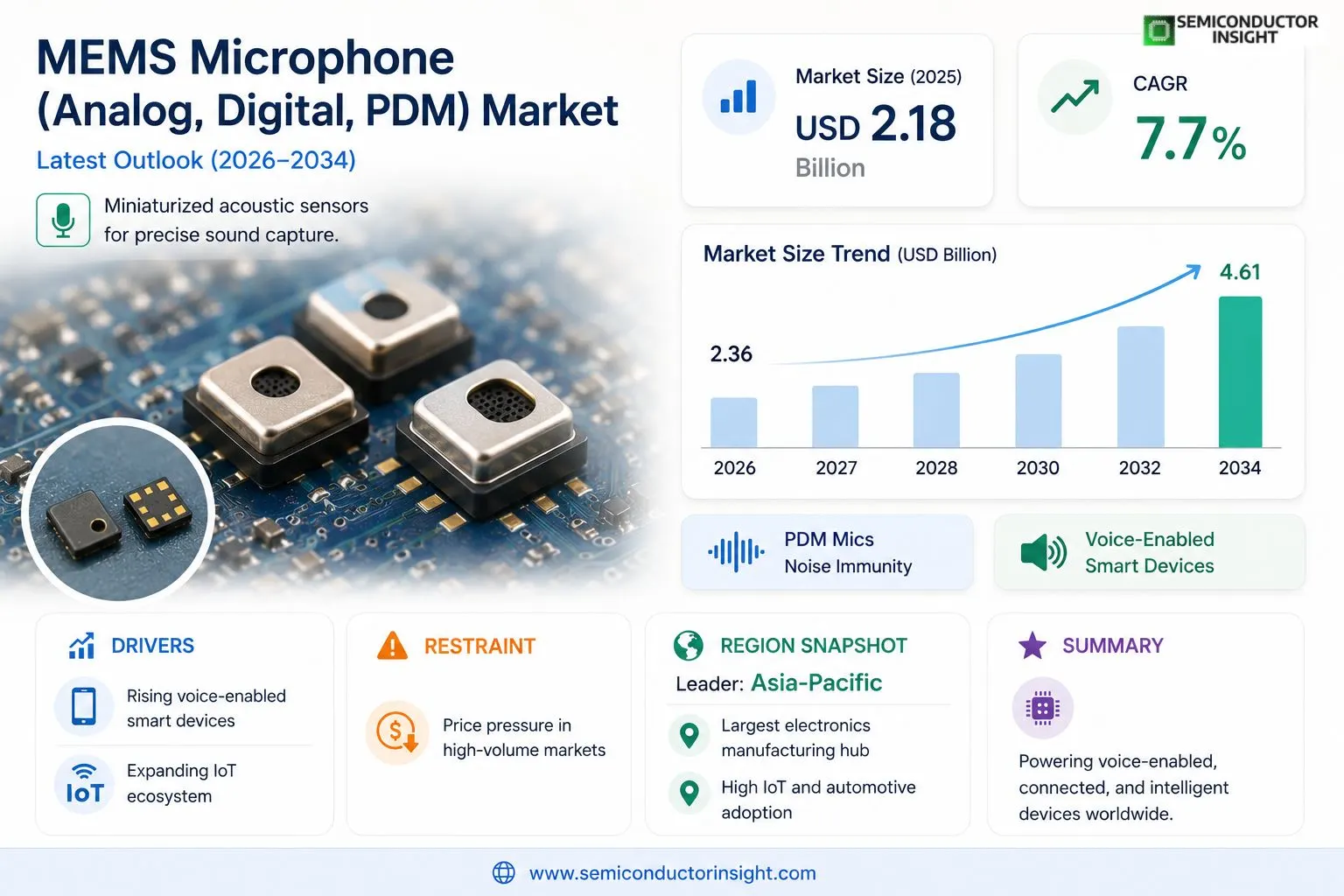
Global MEMS Microphone (Analog, Digital, PDM) market size was valued at USD 2.18 billion in 2025. The market is projected to grow from USD 2.36 billion in 2026 to USD 4.61 billion by 2034, exhibiting a CAGR of 7.7% during the forecast period.
MEMS (Micro-Electro-Mechanical Systems) microphones are miniaturized acoustic sensors fabricated using semiconductor manufacturing techniques, converting sound waves into electrical signals with exceptional precision. These microphones are broadly classified into analog, digital, and PDM (Pulse Density Modulation) types, each serving distinct application requirements across consumer electronics, automotive, industrial, and medical sectors. Analog MEMS microphones deliver continuous voltage output, while digital and PDM variants offer improved noise immunity and seamless integration with modern digital signal processors.
The market is witnessing strong momentum driven by the proliferating adoption of voice-enabled smart devices, the rapid expansion of the Internet of Things (IoT) ecosystem, and growing integration of MEMS microphones in automotive cabin monitoring and active noise cancellation systems. Furthermore, the surge in demand for true wireless stereo (TWS) earbuds, smart speakers, and AI-powered voice assistants has significantly accelerated consumption of PDM and digital MEMS microphones globally. Key industry participants including Knowles Corporation, STMicroelectronics, and TDK Corporation (InvenSense) continue to lead the market with broad and innovative product portfolios.
MARKET DRIVERS
Surging Demand for Consumer Electronics and Smart Devices
MEMS Microphone (Analog, Digital, PDM) Market has witnessed sustained growth driven by the rapid proliferation of consumer electronics, including smartphones, tablets, laptops, and wearable devices. MEMS microphones have become the preferred acoustic sensing solution for original equipment manufacturers due to their compact form factor, superior signal-to-noise ratio, and consistent performance across varying environmental conditions. As global smartphone penetration continues to expand, particularly across emerging economies in Asia-Pacific and Latin America, the demand for high-quality audio input components has grown proportionately, reinforcing the market’s upward trajectory.
Expansion of Voice-Enabled Interfaces and AI-Powered Assistants
The accelerating adoption of voice-enabled interfaces across consumer and enterprise applications represents one of the most significant drivers for MEMS Microphone (Analog, Digital, PDM) Market. Virtual assistants integrated into smart speakers, automotive infotainment systems, and IoT-connected devices require reliable far-field audio capture, a capability where digital PDM MEMS microphones demonstrate distinct technical advantages. The integration of artificial intelligence and natural language processing into everyday devices has elevated microphone performance requirements, compelling manufacturers to invest in advanced MEMS acoustic architectures capable of capturing speech with high fidelity in acoustically challenging environments.
➤ The proliferation of IoT-connected devices globally is creating a compelling volume opportunity for both analog and digital PDM MEMS microphone manufacturers, as multi-microphone array configurations become standard in smart home, automotive, and industrial monitoring applications.
Automotive applications have emerged as a high-value end-use segment within MEMS Microphone (Analog, Digital, PDM) Market. Modern vehicles increasingly incorporate hands-free communication systems, active noise cancellation, and in-cabin voice command functionality, all of which depend on robust MEMS microphone arrays. The transition toward electric vehicles and advanced driver-assistance systems has further intensified the demand for high-performance digital MEMS microphones capable of operating reliably under automotive-grade environmental specifications, including wide temperature ranges and resistance to mechanical vibration.
MARKET CHALLENGES
Technical Complexity of Multi-Microphone Array Integration
Despite the broad adoption of MEMS microphone technology, system integrators and device manufacturers face considerable technical challenges when designing multi-microphone array configurations. Achieving precise phase matching, consistent sensitivity across all units, and low inter-channel variation requires tight manufacturing tolerances and sophisticated calibration processes. In applications such as beamforming and noise cancellation, even minor performance inconsistencies between individual MEMS microphones in an array can significantly degrade acoustic output quality, creating design and quality assurance burdens for manufacturers operating in MEMS Microphone (Analog, Digital, PDM) Market.
Other Challenges
Supply Chain Vulnerabilities and Semiconductor Capacity Constraints
MEMS Microphone (Analog, Digital, PDM) Market remains susceptible to disruptions stemming from global semiconductor supply chain constraints. MEMS fabrication requires specialized wafer processing capabilities that are concentrated among a limited number of foundries, creating bottlenecks during periods of elevated demand. Geopolitical tensions affecting semiconductor trade flows and raw material availability have introduced additional uncertainty into supply planning, making it difficult for microphone manufacturers to maintain stable lead times and competitive pricing for both analog and digital PDM product lines.
Acoustic Performance Trade-offs Across Form Factor Miniaturization
As end-use device designs continue to prioritize thinner profiles and reduced component footprints, MEMS microphone manufacturers face the engineering challenge of preserving acoustic performance within increasingly constrained package dimensions. Miniaturization can compromise front cavity volume and membrane surface area, which are directly related to sensitivity and low-frequency response. Balancing the commercial imperative for smaller package sizes against the technical requirements of high signal-to-noise ratio and wide dynamic range performance remains an ongoing challenge across MEMS Microphone (Analog, Digital, PDM) Market.
MARKET RESTRAINTS
Intense Price Compression in High-Volume Consumer Electronics Segments
One of the primary restraints affecting MEMS Microphone (Analog, Digital, PDM) Market is the persistent pricing pressure exerted by large-volume consumer electronics buyers. Smartphone and wearable device manufacturers, which collectively represent a substantial portion of total MEMS microphone demand, consistently leverage their purchasing scale to negotiate aggressive unit pricing. This dynamic compresses margins for microphone suppliers, particularly those serving the entry-level and mid-tier device segments where analog MEMS microphones remain prevalent. Sustained price erosion limits the capacity of smaller and mid-size market participants to fund the research and development investments necessary to advance acoustic performance and expand into higher-margin application areas.
Barriers Posed by Established Incumbent Suppliers and Patent Ecosystems
MEMS Microphone (Analog, Digital, PDM) Market is characterized by a concentrated competitive landscape dominated by a small number of established suppliers that hold extensive intellectual property portfolios covering core MEMS fabrication processes, package designs, and signal conditioning architectures. New entrants and regional manufacturers seeking to develop competitive analog or digital PDM MEMS microphone products face significant barriers related to freedom-to-operate analysis, licensing costs, and the time required to accumulate the application engineering expertise necessary to qualify products with tier-one customers. This incumbent advantage reinforces market concentration and limits the pace of competitive diversification.
MARKET OPPORTUNITIES
Growing Adoption of MEMS Microphones in Industrial and Healthcare IoT Applications
Beyond consumer electronics, MEMS Microphone (Analog, Digital, PDM) Market is positioned to capture significant growth from the expanding deployment of IoT-connected devices in industrial monitoring, predictive maintenance, and healthcare applications. In industrial environments, digital PDM MEMS microphones are increasingly being evaluated for acoustic emission sensing and machine health monitoring, where their immunity to electromagnetic interference and compatibility with digital processing pipelines offer practical advantages over traditional condenser microphone technologies. Similarly, medical wearables and hearing health devices represent a growing application area where the combination of miniaturization, low power consumption, and high acoustic performance makes MEMS microphone technology particularly well-suited.
Advancement of Ultra-Low-Power MEMS Microphone Architectures for Always-On Applications
The development of ultra-low-power MEMS microphone designs tailored for always-on keyword detection and voice activity monitoring represents a compelling growth avenue within MEMS Microphone (Analog, Digital, PDM) Market. As battery-powered wearable and hearable devices proliferate, the power consumption characteristics of the audio front-end subsystem have become a critical differentiator. Manufacturers that successfully commercialize analog and digital PDM MEMS microphones capable of operating at sub-100-microamp current draw without sacrificing sensitivity or noise floor performance stand to gain meaningful share in the rapidly expanding hearables and true wireless stereo earbud segments, which are projected to sustain strong unit volume growth in the coming years.
MEMS Microphone (Analog, Digital, PDM) Market Trends
Rising Adoption of Voice-Enabled Smart Devices Driving MEMS Microphone Demand
MEMS Microphone (Analog, Digital, PDM) Market is experiencing robust growth momentum, primarily fueled by the accelerating adoption of voice-enabled smart devices across consumer and enterprise segments. As AI-powered voice assistants become increasingly embedded in smartphones, smart speakers, and wearables, manufacturers are prioritizing high-performance PDM and digital MEMS microphones that offer superior noise immunity and seamless integration with modern digital signal processors. The proliferation of true wireless stereo (TWS) earbuds has further amplified demand, with leading audio device brands incorporating multiple MEMS microphone arrays to enable active noise cancellation and beamforming capabilities. This trend is reshaping product design priorities and pushing innovation cycles across the MEMS microphone supply chain.
Other Trends
Expansion of IoT Ecosystem Accelerating PDM Microphone Integration
The rapid expansion of the Internet of Things (IoT) ecosystem is emerging as a significant trend within MEMS Microphone (Analog, Digital, PDM) Market. IoT-connected devices such as smart home hubs, industrial sensors, and healthcare monitoring equipment increasingly rely on compact, low-power MEMS microphones to enable always-on voice detection and acoustic sensing. PDM microphones, in particular, are gaining traction in IoT applications due to their digital output compatibility and minimal electromagnetic interference, making them well-suited for densely connected environments. Key industry participants including Knowles Corporation, STMicroelectronics, and TDK Corporation (InvenSense) are actively expanding their PDM and digital product portfolios to address this growing segment.
Automotive Sector Emerging as a High-Growth Application Area
Automotive integration represents one of the most compelling emerging trends in MEMS Microphone (Analog, Digital, PDM) Market. Modern vehicles are increasingly equipped with in-cabin voice control systems, hands-free communication platforms, and advanced driver assistance features that rely on high-sensitivity MEMS microphones. The growing deployment of active noise cancellation systems within automotive interiors is driving demand for analog and digital MEMS variants capable of operating reliably across wide temperature ranges and challenging acoustic environments. As automakers accelerate the integration of connected and autonomous vehicle technologies, the automotive segment is expected to sustain strong demand for MEMS microphone solutions.
Technological Advancements Supporting Next-Generation MEMS Microphone Development
Continuous advancements in semiconductor fabrication techniques are enabling the development of smaller, more power-efficient MEMS microphones with enhanced acoustic performance. Manufacturers are investing in multi-microphone array architectures and improved signal-to-noise ratio capabilities to meet the stringent requirements of medical devices, industrial monitoring systems, and next-generation consumer electronics. Analog MEMS microphones continue to serve cost-sensitive applications, while the broader industry shift toward digital and PDM variants reflects the growing preference for noise-resilient, digitally compatible solutions. These technological developments are collectively strengthening the long-term growth outlook for Global MEMS Microphone (Analog, Digital, PDM) Market.
COMPETITIVE LANDSCAPE
Key Industry Players
MEMS Microphone (Analog, Digital, PDM) Market – Global Competitive Landscape and Key Industry Participants
Global MEMS Microphone (Analog, Digital, PDM) market is characterized by a moderately consolidated competitive structure, with a handful of dominant technology-driven companies commanding significant market share. Knowles Corporation stands as the undisputed market leader, leveraging decades of acoustic engineering expertise and a broad portfolio spanning analog, digital, and PDM MEMS microphones tailored for consumer electronics, medical hearing instruments, and IoT applications. TDK Corporation, operating through its InvenSense division, and STMicroelectronics also maintain strong positions, continuously advancing their product architectures to meet the evolving demands of AI-powered voice assistants, true wireless stereo (TWS) earbuds, and automotive cabin monitoring systems. These leading players invest heavily in R&D to enhance signal-to-noise ratio (SNR), reduce power consumption, and improve acoustic performance across their MEMS microphone product lines, enabling seamless integration with modern digital signal processors and SoC platforms.
Beyond the tier-one leaders, the MEMS microphone competitive landscape also features several agile and specialized players carving out meaningful positions in niche segments. Infineon Technologies (formerly Cirrus Logic’s MEMS division acquisition) and Robert Bosch GmbH bring deep semiconductor fabrication capabilities that support high-volume automotive and industrial-grade MEMS microphone deployments. Asian manufacturers such as AAC Technologies, Goertek Inc., and BSE Co., Ltd. have emerged as formidable competitors, particularly in consumer electronics supply chains serving major OEMs in China, South Korea, and Japan. Meanwhile, companies like Vesper Technologies focus on piezoelectric MEMS microphone innovation, targeting ruggedized always-on applications. The competitive intensity in this market continues to escalate as players race to capture growing demand from smart home devices, wearables, and next-generation automotive infotainment platforms, driving ongoing consolidation, licensing agreements, and strategic partnerships across Global value chain.
List of Key MEMS Microphone Companies Profiled
- Knowles Corporation
- STMicroelectronics
- TDK Corporation (InvenSense)
- Infineon Technologies AG
- Robert Bosch GmbH
- AAC Technologies Holdings Inc.
- Goertek Inc.
- BSE Co., Ltd.
- Vesper Technologies Inc.
- Cirrus Logic, Inc.
- Hosiden Corporation
- New Japan Radio Co., Ltd. (NJR)
- Sanico Electronics Co., Ltd.
- MEMSensing Microsystems Co., Ltd.
Segment Analysis:
| Segment Category | Sub-Segments | Key Insights |
| By Type |
|
PDM MEMS Microphones represent the leading and fastest-evolving type segment within Global MEMS microphone market, driven by their seamless compatibility with modern digital signal processors and microcontrollers.
|
| By Application |
|
Smartphones & Tablets continue to dominate the application landscape for MEMS microphones, given the ubiquitous deployment of multiple microphone arrays in modern mobile devices to enable beamforming, voice recognition, and active noise cancellation.
|
| By End User |
|
Consumer Electronics Manufacturers constitute the dominant end-user segment, underpinned by their relentless drive to integrate advanced acoustic capabilities into an ever-broadening portfolio of connected devices.
|
| By Package Type |
|
Surface Mount Device (SMD) Package is the overwhelmingly dominant packaging format in the MEMS microphone market, reflecting the industry-wide transition to automated, high-throughput surface mount assembly processes across consumer and industrial electronics manufacturing.
|
| By Technology Integration |
|
MEMS Microphones with Integrated ASIC lead the technology integration segment, as the co-packaging of the acoustic sensing element with an Application-Specific Integrated Circuit delivers a highly optimized, compact, and production-ready solution that simplifies system design for OEM customers.
|
Regional Analysis: MEMS Microphone (Analog, Digital, PDM) Market
Asia-Pacific
Asia-Pacific’s role as the world’s primary consumer electronics manufacturing base directly fuels demand for MEMS Microphone (Analog, Digital, PDM) components. The dense clustering of smartphone, tablet, and wearable device manufacturers across China, South Korea, and Taiwan ensures a continuous, high-volume requirement for advanced MEMS microphone solutions, particularly digital and PDM variants optimized for noise cancellation and voice clarity in compact form factors.
The swift adoption of IoT ecosystems and AI-powered smart home devices across urban centers in China, India, and Southeast Asia is creating robust new demand channels for digital PDM and analog MEMS microphones. Voice-activated assistants, smart speakers, and connected security systems are increasingly standard in new residential and commercial developments, positioning the region as a high-growth frontier for advanced microphone integration.
Governments and private-sector leaders across Asia-Pacific are channeling substantial resources into MEMS semiconductor fabrication, miniaturization research, and process innovation. This investment landscape accelerates the development of next-generation MEMS microphone architectures, ensuring that the region not only supplies global demand but also pioneers new microphone form factors and acoustic performance standards suited to emerging application segments.
Beyond consumer electronics, the Asia-Pacific MEMS Microphone (Analog, Digital, PDM) Market is experiencing growing traction in automotive voice control systems and industrial automation. The region’s booming electric vehicle segment and factory automation initiatives are increasingly incorporating high-performance MEMS microphones for in-cabin voice recognition, advanced driver assistance systems, and industrial human-machine interfaces, broadening the total addressable market significantly.
North America
North America represents one of the most technologically advanced and innovation-driven regions in Global MEMS Microphone (Analog, Digital, PDM) Market. The United States, in particular, is home to several pioneering MEMS microphone design firms, fabless semiconductor companies, and leading technology platform providers whose ecosystems create sustained demand for high-performance analog, digital, and PDM microphone solutions. The region’s strong presence in cloud computing, artificial intelligence, and voice interface platforms has made it a critical market for premium MEMS microphone integration across smart speakers, professional audio equipment, automotive infotainment, and enterprise communication devices. Growing investments in next-generation hearing aids, augmented reality headsets, and wearable health monitors further diversify regional demand. North American enterprises and research institutions also play a central role in setting global performance and reliability standards for MEMS microphone technologies, ensuring continued influence on market direction through the 2026–2034 period.
Europe
Europe maintains a significant and strategically important position in MEMS Microphone (Analog, Digital, PDM) Market, distinguished by its emphasis on quality engineering, industrial precision, and regulatory compliance. Germany, the United Kingdom, France, and the Nordic countries are key contributors, driven by strong automotive, industrial automation, and professional audio sectors that demand high-reliability MEMS microphone components. The European automotive industry’s leadership in advanced driver assistance systems and in-vehicle voice control creates a consistent pull for ruggedized, high-fidelity digital and PDM MEMS microphones. Additionally, European smart home and building automation initiatives are accelerating microphone integration in ambient sensing and voice-activated control systems. Europe’s stringent electromagnetic compatibility and environmental standards also encourage suppliers to advance MEMS microphone designs toward superior noise performance and durability, strengthening the region’s long-term role as a quality-focused market within Global landscape.
South America
South America represents an emerging growth opportunity within Global MEMS Microphone (Analog, Digital, PDM) Market, with Brazil and Mexico serving as the primary demand centers. While the region currently accounts for a comparatively modest share of global MEMS microphone consumption, the ongoing expansion of smartphone penetration, rising disposable incomes, and increasing adoption of affordable smart consumer devices are steadily building a foundation for market development. Local assembly operations and electronics distribution networks are gradually maturing, enabling greater accessibility of digital and PDM MEMS microphone-integrated products across urban and semi-urban markets. Growth in the Brazilian and Mexican telecommunications sectors, along with nascent smart home adoption trends, signals promising medium-to-long-term demand expansion. As regional economic conditions stabilize and digital infrastructure investment continues, South America is positioned to become an increasingly relevant contributor to overall MEMS microphone market dynamics through the forecast period.
Middle East & Africa
The Middle East & Africa region occupies an early-stage but progressively developing position in MEMS Microphone (Analog, Digital, PDM) Market. Gulf Cooperation Council nations, particularly the UAE and Saudi Arabia, are spearheading demand growth through ambitious smart city projects, rapid adoption of consumer electronics, and a thriving telecommunications sector investing in next-generation connectivity infrastructure. Voice-enabled services and AI-driven applications embedded within smart urban environments are creating new integration requirements for advanced MEMS microphone technologies. Across sub-Saharan Africa, increasing mobile device penetration and the expansion of digital services platforms are gradually stimulating awareness and demand for MEMS microphone-equipped devices. While infrastructure and manufacturing ecosystem limitations present near-term challenges, ongoing foreign direct investment in regional technology sectors and growing youth-driven digital consumption trends are expected to support steady market growth for MEMS Microphone (Analog, Digital, PDM) Market throughout the 2026–2034 outlook period.
Report Scope
This market research report provides a comprehensive analysis of the MEMS Microphone (Analog, Digital, PDM) Market , covering the forecast period 2026–2034. It offers detailed insights into market dynamics, technological advancements, competitive landscape, and key trends shaping the industry.
Key focus areas of the report include:
- Market Overview: The report begins with an overview outlining its current market scenario, key growth indicators, and industry transformation drivers. It discusses macroeconomic factors, demand–supply balance, regulatory landscape, and the strategic role of semiconductors in powering advancements across industries such as automotive, telecommunications, consumer electronics, and industrial automation.
- Market Size & Forecast: Historical data and future projections for revenue, unit shipments, and market value across major regions and segments.
- Segmentation Analysis: Detailed breakdown by product type, technology, application, and end-user industry to identify high-growth segments and investment opportunities.
- Regional Insights: Insights into market performance across North America, Europe, Asia-Pacific, Latin America, and the Middle East & Africa, including country-level analysis where relevant.
- Competitive Landscape: Profiles of leading market participants, including their product offerings, R&D focus, manufacturing capacity, pricing strategies, and recent developments such as mergers, acquisitions, and partnerships.
- Technology Trends & Innovation: Assessment of emerging technologies, integration of AI/IoT, semiconductor design trends, fabrication techniques, and evolving industry standards.
- Market Drivers & Restraints: Evaluation of factors driving market growth along with challenges, supply chain constraints, regulatory issues, and market-entry barriers.
- Stakeholder Insights: Insights for component suppliers, OEMs, system integrators, investors, and policymakers regarding the evolving ecosystem and strategic opportunities.
Primary and secondary research methods are employed, including interviews with industry experts, data from verified sources, and real-time market intelligence to ensure the accuracy and reliability of the insights presented.
FREQUENTLY ASKED QUESTIONS:
What is the current market size of MEMS Microphone (Analog, Digital, PDM) Market?
-> Global MEMS Microphone (Analog, Digital, PDM) Market was valued at USD 2.18 billion in 2025 and is expected to reach USD 4.61 billion by 2034, growing at a CAGR of 7.7% during the forecast period from 2026 to 2034.
Which key companies operate in MEMS Microphone (Analog, Digital, PDM) Market?
-> Key players include Knowles Corporation, STMicroelectronics, and TDK Corporation (InvenSense), among others, who continue to lead the market with broad and innovative product portfolios.
What are the key growth drivers?
-> Key growth drivers include proliferating adoption of voice-enabled smart devices, rapid expansion of the Internet of Things (IoT) ecosystem, growing integration of MEMS microphones in automotive cabin monitoring and active noise cancellation systems, and surging demand for true wireless stereo (TWS) earbuds, smart speakers, and AI-powered voice assistants.
Which region dominates the market?
-> Asia-Pacific is the fastest-growing region, driven by large-scale consumer electronics manufacturing and strong adoption of IoT-enabled devices, while North America remains a significant market owing to advanced automotive and AI technology integration.
What are the emerging trends?
-> Emerging trends include AI-powered voice assistant integration, PDM and digital MEMS microphone adoption in TWS earbuds and smart speakers, automotive cabin monitoring systems, active noise cancellation technologies, and expanding IoT ecosystem deployments across consumer, industrial, and medical applications.

Get Sample Report PDF for Exclusive Insights
Report Sample Includes
- Table of Contents
- List of Tables & Figures
- Charts, Research Methodology, and more...
 Download Sample Report PDF