Magnetoresistive RAM (MRAM, STT-MRAM) Market Insights
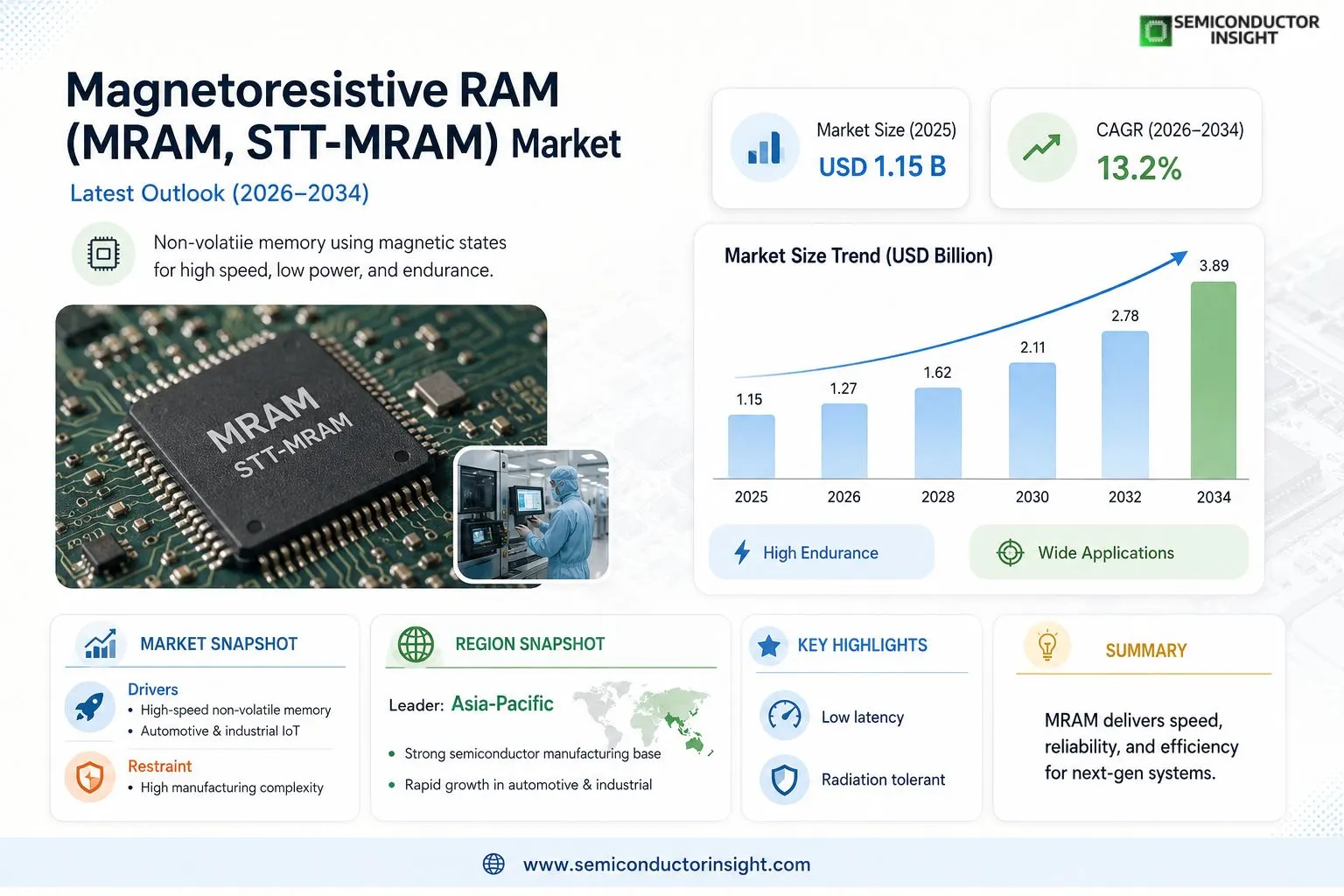
Global Magnetoresistive RAM (MRAM, STT-MRAM) market size was valued at USD 1.15 billion in 2025. The market is projected to grow from USD 1.27 billion in 2026 to USD 3.89 billion by 2034, exhibiting a CAGR of 13.2% during the forecast period.
Magnetoresistive RAM (MRAM) is a non-volatile memory technology that stores data using magnetic states rather than electrical charges, offering a compelling combination of high speed, low power consumption, and virtually unlimited endurance. Spin-Transfer Torque MRAM (STT-MRAM), the most advanced variant, utilizes spin-polarized current to switch magnetic tunnel junctions, enabling greater scalability and higher storage density compared to conventional MRAM. These technologies find broad application across embedded systems, automotive electronics, aerospace, industrial automation, and enterprise storage solutions.
The market is gaining strong momentum driven by the escalating demand for faster, more energy-efficient non-volatile memory in next-generation computing architectures. STT-MRAM is increasingly being adopted as a replacement for SRAM-based last-level caches and embedded Flash in microcontrollers and system-on-chip designs, owing to its superior write endurance and low latency. Furthermore, automotive and industrial IoT applications are accelerating adoption, as MRAM offers reliable operation across extreme temperature ranges. Notable industry activity underscores this growth , in 2023, Everspin Technologies continued expanding its STT-MRAM product lines targeting data center and automotive markets, while Samsung and TSMC have actively integrated embedded MRAM into advanced process nodes. Everspin Technologies, Inc., Avalanche Technology, and Renesas Electronics Corporation are among the key players shaping the competitive landscape with diverse and expanding product portfolios.
MARKET DRIVERS
Rising Demand for Non-Volatile, High-Speed Memory in Embedded and Industrial Applications
Magnetoresistive RAM (MRAM, STT-MRAM) Market is experiencing sustained growth momentum driven by the increasing need for memory solutions that combine the speed of SRAM with the non-volatility of Flash. In industrial automation, automotive electronics, and IoT edge devices, the ability to retain data without power while supporting rapid read/write cycles has made MRAM an increasingly preferred alternative to conventional memory architectures. Leading semiconductor manufacturers have scaled up investment in MRAM-compatible process nodes, reflecting the technology’s readiness for high-volume deployment across mission-critical embedded applications.
Proliferation of Automotive Electronics and Safety-Critical Systems Accelerating STT-MRAM Adoption
The automotive sector represents one of the most significant demand catalysts for Magnetoresistive RAM (MRAM, STT-MRAM) Market. Modern vehicles increasingly integrate advanced driver-assistance systems (ADAS), electronic control units (ECUs), and in-vehicle infotainment platforms, all of which require memory capable of operating reliably across extreme temperature ranges and under high electromagnetic interference conditions. STT-MRAM’s inherent radiation hardness and endurance characteristics make it particularly well suited for automotive-grade applications. Major automotive semiconductor suppliers have begun qualifying STT-MRAM for use in safety-critical microcontrollers, further reinforcing the technology’s commercial traction.
➤ STT-MRAM offers write endurance exceeding 1012 cycles and data retention beyond 10 years at elevated temperatures, positioning it as a technically superior memory option for automotive and industrial environments where reliability is non-negotiable.
Beyond automotive, the broader industrial Internet of Things ecosystem is generating substantial pull for MRAM solutions. Edge computing nodes, programmable logic controllers, and real-time data acquisition systems all benefit from the zero-standby-power and instant-on capabilities inherent to MRAM technology. As industrial digitization accelerates globally, the Magnetoresistive RAM market is well positioned to capture a growing share of the embedded non-volatile memory segment, displacing legacy NOR Flash and EEPROM solutions in latency-sensitive and energy-constrained deployments.
MARKET CHALLENGES
High Manufacturing Complexity and Cost Parity Barriers Constraining Broad Market Penetration
Despite its compelling technical attributes, Magnetoresistive RAM (MRAM, STT-MRAM) Market faces persistent challenges related to production cost and manufacturing complexity. MRAM fabrication requires the precise deposition of magnetic tunnel junction (MTJ) stacks within standard CMOS process flows, a process that demands tight process control and specialized equipment not universally available at contract foundries. These integration complexities translate into elevated per-bit costs relative to mature Flash and DRAM technologies, limiting MRAM’s addressable market primarily to applications where performance and reliability justify the cost premium rather than high-volume consumer memory segments.
Scalability Limitations and Competing Emerging Memory Technologies Adding Competitive Pressure
As process nodes shrink below 28nm, MRAM cell scalability becomes increasingly challenging due to the physics governing MTJ switching behavior and thermal stability. Maintaining adequate retention while reducing write current at advanced nodes remains an active area of research, and the path to sub-10nm MRAM has not yet been fully validated at production scale. Concurrently, competing emerging memory technologies including Phase-Change Memory (PCM), Resistive RAM (ReRAM), and Ferroelectric RAM (FeRAM) are advancing on parallel development tracks, each vying for design wins in overlapping target markets. This competitive landscape requires MRAM vendors to continuously differentiate on endurance, speed, and process integration advantages.
Other Challenges
Ecosystem and Supply Chain Immaturity
The MRAM supply chain remains concentrated among a limited number of vertically integrated suppliers and foundry partners with qualified MTJ process capabilities. This concentration creates sourcing risk for system designers seeking to qualify MRAM for long-lifecycle industrial or automotive programs, where multi-source availability is often a prerequisite. Broader ecosystem development, including EDA tool support, reference designs, and application-specific qualification data, continues to lag behind the mature NOR Flash ecosystem, creating friction in customer design-in cycles.
Customer Qualification and Technology Familiarity Gaps
Many embedded system designers remain unfamiliar with MRAM programming models and the nuances of integrating MTJ-based memory into existing firmware and hardware architectures. The absence of a large installed base of MRAM-based designs, relative to incumbent technologies, means that Magnetoresistive RAM (MRAM, STT-MRAM) Market must invest significantly in technical enablement, application engineering support, and developer education to accelerate adoption across a fragmented global customer base.
MARKET RESTRAINTS
Limited Foundry Availability and Restricted Process Node Access Tempering Market Expansion
A primary structural restraint on Magnetoresistive RAM (MRAM, STT-MRAM) Market is the limited number of semiconductor foundries that have successfully integrated MTJ deposition into high-volume CMOS manufacturing lines. While leading-edge foundries have demonstrated MRAM-compatible processes at 28nm and 22nm nodes, broader availability across a wider range of foundry partners and process nodes remains constrained. This restricts fabless semiconductor companies from freely selecting their preferred manufacturing partner when designing MRAM-embedded microcontrollers or standalone memory devices, thereby limiting the overall pace of new product introductions and market supply expansion.
Dominance of Established NOR Flash and SRAM Incumbents Creating Inertia in the Design-In Process
The embedded non-volatile memory market is characterized by deeply entrenched incumbent technologies. NOR Flash memory benefits from decades of manufacturing optimization, broad multi-source availability, and an extensive ecosystem of software tools and reference designs. SRAM similarly enjoys well-understood integration pathways in microcontroller and ASIC designs. Displacing these incumbents in established product lines requires system designers to undertake costly and time-consuming re-qualification programs, creating significant switching inertia. For the Magnetoresistive RAM market, this inertia is particularly pronounced in conservative end markets such as medical devices and aerospace, where component qualification cycles can span multiple years and regulatory approvals impose additional barriers to memory technology transitions.
Furthermore, pricing dynamics in the broader memory market periodically suppress the relative cost-competitiveness of MRAM. During periods of NOR Flash oversupply, spot pricing for incumbent technologies can decline sharply, widening the cost gap with MRAM and weakening the business case for adopters whose primary motivation is economic rather than performance-driven. These cyclical pricing pressures, combined with structural qualification barriers, represent ongoing restraints that Magnetoresistive RAM (MRAM, STT-MRAM) Market must navigate to achieve sustained penetration across its target application segments.
MARKET OPPORTUNITIES
Integration of MRAM as Last-Level Cache in AI and Data Center Processor Architectures
The accelerating deployment of AI inference workloads at both the edge and in hyperscale data centers is creating a compelling opportunity for STT-MRAM to serve as high-density, low-latency last-level cache or storage-class memory. As processor architectures increasingly demand memory tiers that bridge the latency gap between DRAM and persistent storage, the unique combination of MRAM’s non-volatility, near-SRAM access speeds, and byte-addressability positions it favorably for integration within next-generation AI accelerator and CPU designs. Several leading chip architects are actively evaluating embedded MRAM for on-die cache applications, and successful commercialization in this segment could significantly expand the total addressable market for Magnetoresistive RAM technology.
Expansion into Space, Defense, and Radiation-Hardened Electronics Markets
The inherent radiation tolerance of MRAM, a consequence of its magnetic storage mechanism being immune to ionizing particle-induced bit upsets that afflict charge-based memories, presents a substantial opportunity in space and defense electronics. Satellites, launch vehicle avionics, and military embedded computing platforms require memory capable of reliable operation in high-radiation environments where conventional Flash and SRAM are susceptible to single-event upsets. Magnetoresistive RAM (MRAM, STT-MRAM) Market stands to benefit significantly as space commercialization expands global satellite constellations and defense modernization programs drive demand for radiation-hardened components. Several MRAM suppliers have initiated radiation qualification programs targeting MIL-SPEC and space-grade application requirements, signaling active pursuit of this high-value opportunity.
Growing Adoption in Wearable Devices and Ultra-Low-Power IoT Endpoints
The proliferation of wearable health monitors, smart sensors, and battery-powered IoT endpoints is generating strong demand for memory solutions that minimize active and standby power consumption without sacrificing data integrity. MRAM’s zero static power retention, combined with its ability to support rapid write operations at low supply voltages, aligns directly with the power budgets of next-generation wearable and IoT devices. As semiconductor vendors continue to optimize MRAM for sub-1V operation and integrate it within ultra-low-power microcontroller platforms, the Magnetoresistive RAM market is well positioned to capture incremental design wins in a rapidly growing installed base of connected edge devices projected to number in the tens of billions globally over the coming decade.
Trends
Rising Adoption of STT-MRAM as a Replacement for Conventional Embedded Memory
One of the most defining trends shaping Magnetoresistive RAM (MRAM, STT-MRAM) Market is the accelerating shift toward Spin-Transfer Torque MRAM as a viable replacement for SRAM-based last-level caches and embedded Flash memory in microcontrollers and system-on-chip designs. Unlike traditional non-volatile memory technologies that rely on electrical charges, STT-MRAM leverages spin-polarized current to switch magnetic tunnel junctions, delivering superior write endurance, low latency, and greater scalability. As semiconductor manufacturers pursue more energy-efficient and high-performance memory architectures, STT-MRAM is increasingly being integrated into advanced process nodes. Industry leaders such as Samsung and TSMC have actively embedded MRAM into their advanced fabrication processes, signaling a broader industry-wide move to adopt this technology at scale within next-generation computing platforms.
Other Trends
Automotive and Industrial IoT Applications Driving Robust Demand
Magnetoresistive RAM (MRAM, STT-MRAM) Market is witnessing strong traction from automotive and industrial IoT sectors, where memory reliability under extreme operating conditions is non-negotiable. MRAM’s ability to function dependably across wide temperature ranges makes it particularly well-suited for automotive electronics, including advanced driver-assistance systems and in-vehicle infotainment units. Industrial automation applications similarly benefit from MRAM’s virtually unlimited endurance and non-volatile characteristics, reducing risks associated with data loss during power interruptions. Everspin Technologies has continued expanding its STT-MRAM product lines specifically targeting data center and automotive markets, reflecting the growing strategic importance of these verticals in shaping the competitive landscape of the broader MRAM industry.
Expanding Product Portfolios Among Key Market Players
Competitive activity in Magnetoresistive RAM (MRAM, STT-MRAM) Market is intensifying as leading companies broaden their product portfolios to address diverse end-use requirements. Everspin Technologies, Inc., Avalanche Technology, and Renesas Electronics Corporation are among the prominent players driving innovation and expanding their presence across embedded systems, aerospace, and enterprise storage segments. This diversification of offerings is enabling broader market penetration and supporting the transition of MRAM from a niche technology to a mainstream memory solution across multiple industries.
Non-Volatile Memory Demand in Next-Generation Computing Architectures
The broader push toward next-generation computing architectures is creating sustained demand within Magnetoresistive RAM (MRAM, STT-MRAM) Market. As data-intensive workloads proliferate across cloud infrastructure, edge computing, and AI-driven applications, the need for faster, more energy-efficient non-volatile memory solutions has become increasingly critical. MRAM’s combination of high speed, low power consumption, and exceptional endurance positions it as a compelling candidate to address these evolving requirements, reinforcing its long-term growth trajectory across enterprise and embedded computing environments.
COMPETITIVE LANDSCAPEKey Industry Players
Magnetoresistive RAM (MRAM, STT-MRAM) Market: Competitive Dynamics and Leading Innovators Shaping the Non-Volatile Memory Industry
Global Magnetoresistive RAM (MRAM, STT-MRAM) market is characterized by a moderately consolidated competitive landscape, with a mix of specialized memory companies, semiconductor giants, and vertically integrated chipmakers driving innovation and commercialization. Everspin Technologies, Inc. stands out as the foremost pure-play MRAM manufacturer, commanding a significant share of the standalone STT-MRAM segment with product lines specifically targeting data center storage, industrial automation, and automotive electronics. The company has continued to scale its STT-MRAM offerings, reinforcing its position as a preferred supplier for applications requiring high write endurance and low-latency non-volatile memory. Alongside Everspin, global semiconductor leaders such as Samsung Electronics and TSMC have made strategic moves to integrate embedded MRAM into advanced process nodes, underscoring the technology’s growing relevance as a replacement for embedded Flash and SRAM-based last-level caches in next-generation system-on-chip and microcontroller designs.
Beyond the dominant players, a robust ecosystem of niche innovators and established semiconductor firms is actively shaping the MRAM competitive environment. Avalanche Technology has gained recognition for its persistent SRAM solutions based on STT-MRAM, targeting enterprise and embedded applications. Renesas Electronics Corporation has incorporated embedded MRAM into its microcontroller platforms, leveraging the technology’s superior endurance and low-power attributes for automotive and industrial IoT use cases. Spin Memory (formerly Spin Transfer Technologies) has focused on advancing STT-MRAM cell architecture for greater scalability, while GlobalFoundries offers embedded MRAM process technology as part of its foundry services. Other contributors include Tower Semiconductor, which provides MRAM-compatible fabrication platforms, and Crocus Technology, known for its magnetic logic unit (MLU) technology. Headway Technologies, a subsidiary of TDK Corporation, brings expertise in magnetic tunnel junction development, while companies such as Toshiba Memory (Kioxia) and Intel have explored MRAM integration within broader non-volatile memory roadmaps. Honeywell International has historically served aerospace and defense segments with radiation-hardened MRAM solutions, addressing mission-critical reliability requirements that conventional memory technologies cannot meet.
List of Key Magnetoresistive RAM (MRAM, STT-MRAM) Companies Profiled
- Everspin Technologies, Inc.
- Avalanche Technology
- Renesas Electronics Corporation
- Samsung Electronics Co., Ltd.
- TSMC (Taiwan Semiconductor Manufacturing Company)
- GlobalFoundries Inc.
- Spin Memory, Inc.
- Crocus Technology
- Tower Semiconductor Ltd.
- Headway Technologies, Inc. (TDK Corporation)
- Honeywell International Inc.
- Kioxia Holdings Corporation (formerly Toshiba Memory)
- Intel Corporation
- NXP Semiconductors N.V.
- STMicroelectronics N.V.
Segment Analysis:
| Segment Category | Sub-Segments | Key Insights |
| By Type |
|
Spin-Transfer Torque MRAM (STT-MRAM) is the dominant and most commercially advanced segment within the MRAM technology landscape, owing to its compelling combination of performance attributes:
|
| By Application |
|
Embedded Memory for MCUs and SoCs represents the most rapidly expanding application segment, driven by the increasing complexity of intelligent edge devices and the growing need for non-volatile memory that can match the speed and endurance requirements of modern processors:
|
| By End User |
|
Automotive OEMs and Tier-1 Suppliers represent a leading and strategically critical end-user category for MRAM technology, as the automotive industry continues its rapid transition toward electrification, connectivity, and autonomy:
|
| By Integration Type |
|
Embedded MRAM (eMRAM) is the most strategically important integration category, reflecting the broader semiconductor industry’s shift toward integrating non-volatile memory directly into logic process nodes:
|
| By Density & Capacity |
|
Low-Density MRAM currently leads in terms of commercial availability and deployment breadth, underpinned by its well-established production maturity and wide-ranging suitability for embedded control applications:
|
Regional Analysis: Magnetoresistive RAM (MRAM, STT-MRAM) Market
North America
North America’s defense and aerospace sectors are among the most prominent end-users driving MRAM and STT-MRAM adoption. Military-grade requirements for radiation-hardened, high-endurance, and non-volatile memory solutions align precisely with the inherent strengths of MRAM technology, supporting consistent procurement growth across avionics, satellite systems, and tactical computing platforms throughout the forecast period.
The region benefits from an unparalleled concentration of semiconductor research institutions, national laboratories, and private-sector innovation hubs. This ecosystem accelerates STT-MRAM process node scaling, tunnel barrier optimization, and integration with CMOS platforms, enabling North American firms to maintain a technological lead over global competitors in next-generation non-volatile memory development.
Growing deployment of industrial IoT infrastructure and the rapid electrification of automotive platforms are creating new vectors of demand for embedded MRAM solutions in North America. Automotive-grade STT-MRAM is gaining traction in advanced driver-assistance systems and powertrain control units, where data retention under extreme thermal conditions is a fundamental design requirement.
Legislative initiatives aimed at strengthening domestic semiconductor supply chains are channeling capital toward advanced memory technologies, including MRAM and STT-MRAM. Federal funding programs and public-private partnerships are lowering barriers to commercialization, attracting both established memory manufacturers and emerging fabless startups to accelerate product roadmaps targeting high-reliability memory segments.
Europe
Europe represents a strategically significant region within Global Magnetoresistive RAM (MRAM, STT-MRAM) market, characterized by a strong industrial base, rigorous quality standards, and increasing investment in sovereign semiconductor capabilities. Countries such as Germany, France, and the Netherlands are at the forefront of integrating advanced non-volatile memory solutions into industrial automation, smart manufacturing, and automotive electronics platforms. The European automotive industry, one of the largest and most technically demanding in the world, is a key driver of STT-MRAM adoption, particularly for safety-critical embedded memory applications in next-generation vehicle architectures. European semiconductor research consortia and publicly funded innovation programs are actively supporting the development and pilot production of MRAM-based memory solutions. The region’s stringent data security and functional safety regulations further incentivize the transition toward more reliable, radiation-tolerant memory technologies. As European policymakers continue to emphasize technological self-reliance, Magnetoresistive RAM (MRAM, STT-MRAM) Market in the region is expected to benefit from sustained institutional support and growing cross-border collaboration among leading research and manufacturing entities through the forecast period.
Asia-Pacific
Asia-Pacific is emerging as the fastest-growing regional market for Magnetoresistive RAM (MRAM, STT-MRAM), propelled by the region’s dominant role in global semiconductor manufacturing, rapid expansion of consumer electronics production, and aggressive government investment in advanced memory technology development. Japan has historically been a pioneer in MRAM research and continues to drive meaningful commercialization activity through close collaboration between academic institutions and leading electronics manufacturers. South Korea and Taiwan, home to some of the world’s most advanced semiconductor fabrication facilities, are increasingly exploring STT-MRAM integration into next-generation memory product lines. China’s domestic push for semiconductor independence is stimulating significant local investment in non-volatile memory alternatives, including MRAM, as part of broader national technology strategy initiatives. The proliferation of edge computing, 5G infrastructure, and industrial automation across the region is generating robust demand for high-endurance embedded memory solutions, positioning Asia-Pacific as a critical growth engine for Global Magnetoresistive RAM (MRAM, STT-MRAM) market over the coming years.
South America
South America currently occupies a nascent but gradually developing position in Global Magnetoresistive RAM (MRAM, STT-MRAM) market. The region’s adoption trajectory is primarily shaped by its expanding industrial automation sector, growing telecommunications infrastructure investments, and increasing integration of advanced electronics in energy and resources management applications. Brazil leads regional demand, supported by a relatively diversified industrial economy and an expanding base of technology-focused enterprises. While local manufacturing of MRAM components remains limited, South American system integrators and end-users are progressively sourcing advanced non-volatile memory solutions for deployment in industrial control, smart grid, and communications hardware. Awareness of STT-MRAM’s performance and reliability advantages is gradually diffusing across the regional engineering community. As global supply chains mature and cost structures improve, South America is anticipated to experience a steady increase in MRAM adoption, particularly within sectors that prioritize long-term data integrity and operational resilience in demanding physical environments.
Middle East & Africa
The Middle East and Africa region represents an emerging frontier for Magnetoresistive RAM (MRAM, STT-MRAM) Market, with adoption currently concentrated in select high-value verticals such as oil and gas, defense, and telecommunications infrastructure. The Gulf Cooperation Council countries, particularly the United Arab Emirates and Saudi Arabia, are investing substantially in digital infrastructure modernization and smart city development, creating incremental demand for advanced semiconductor components including non-volatile memory technologies. Africa’s broader technology adoption is largely driven by mobile telecommunications expansion and gradual industrialization, where robust and low-power memory solutions can offer meaningful operational advantages. The region’s challenging environmental conditions, including extreme temperatures and humidity variations, make the inherent durability and data retention characteristics of MRAM and STT-MRAM particularly well-suited for local deployment requirements. While the overall market scale remains comparatively modest, the Middle East and Africa region is expected to demonstrate progressive growth as infrastructure investment deepens and awareness of advanced memory technology benefits continues to expand.
Report Scope
This market research report provides a comprehensive analysis of the Magnetoresistive RAM (MRAM, STT-MRAM) Market , covering the forecast period 2026–2034. It offers detailed insights into market dynamics, technological advancements, competitive landscape, and key trends shaping the industry.
Key focus areas of the report include:
- Market Overview: The report begins with an overview outlining its current market scenario, key growth indicators, and industry transformation drivers. It discusses macroeconomic factors, demand–supply balance, regulatory landscape, and the strategic role of semiconductors in powering advancements across industries such as automotive, telecommunications, consumer electronics, and industrial automation.
- Market Size & Forecast: Historical data and future projections for revenue, unit shipments, and market value across major regions and segments.
- Segmentation Analysis: Detailed breakdown by product type, technology, application, and end-user industry to identify high-growth segments and investment opportunities.
- Regional Insights: Insights into market performance across North America, Europe, Asia-Pacific, Latin America, and the Middle East & Africa, including country-level analysis where relevant.
- Competitive Landscape: Profiles of leading market participants, including their product offerings, R&D focus, manufacturing capacity, pricing strategies, and recent developments such as mergers, acquisitions, and partnerships.
- Technology Trends & Innovation: Assessment of emerging technologies, integration of AI/IoT, semiconductor design trends, fabrication techniques, and evolving industry standards.
- Market Drivers & Restraints: Evaluation of factors driving market growth along with challenges, supply chain constraints, regulatory issues, and market-entry barriers.
- Stakeholder Insights: Insights for component suppliers, OEMs, system integrators, investors, and policymakers regarding the evolving ecosystem and strategic opportunities.
Primary and secondary research methods are employed, including interviews with industry experts, data from verified sources, and real-time market intelligence to ensure the accuracy and reliability of the insights presented.
FREQUENTLY ASKED QUESTIONS:
What is the current market size of Magnetoresistive RAM (MRAM, STT-MRAM) Market?
-> Global Magnetoresistive RAM (MRAM, STT-MRAM) market size was valued at USD 1.15 billion in 2025 and is projected to grow from USD 1.27 billion in 2026 to USD 3.89 billion by 2034, exhibiting a CAGR of 13.2% during the forecast period.
Which key companies operate in Magnetoresistive RAM (MRAM, STT-MRAM) Market?
-> Key players include Everspin Technologies, Inc., Avalanche Technology, and Renesas Electronics Corporation, among others. Additionally, Samsung and TSMC have actively integrated embedded MRAM into advanced process nodes, further shaping the competitive landscape.
What are the key growth drivers?
-> Key growth drivers include the escalating demand for faster, more energy-efficient non-volatile memory in next-generation computing architectures, growing adoption of STT-MRAM as a replacement for SRAM-based last-level caches and embedded Flash in microcontrollers and system-on-chip designs, and expanding use in automotive electronics, industrial IoT, aerospace, and enterprise storage solutions owing to MRAM’s reliable operation across extreme temperature ranges.
Which region dominates the market?
-> Asia-Pacific is the fastest-growing region driven by semiconductor manufacturing activity and adoption in automotive and industrial applications, while North America remains a significant market supported by data center demand and key industry players such as Everspin Technologies.
What are the emerging trends?
-> Emerging trends include integration of embedded MRAM into advanced process nodes by leading foundries such as Samsung and TSMC, growing adoption of Spin-Transfer Torque MRAM (STT-MRAM) for high-density and scalable memory solutions, and increasing deployment in automotive electronics and industrial IoT applications requiring non-volatile memory with high endurance and low latency.

Get Sample Report PDF for Exclusive Insights
Report Sample Includes
- Table of Contents
- List of Tables & Figures
- Charts, Research Methodology, and more...