Magnetic Encoder (Rotation, Linear) IC Market Insights
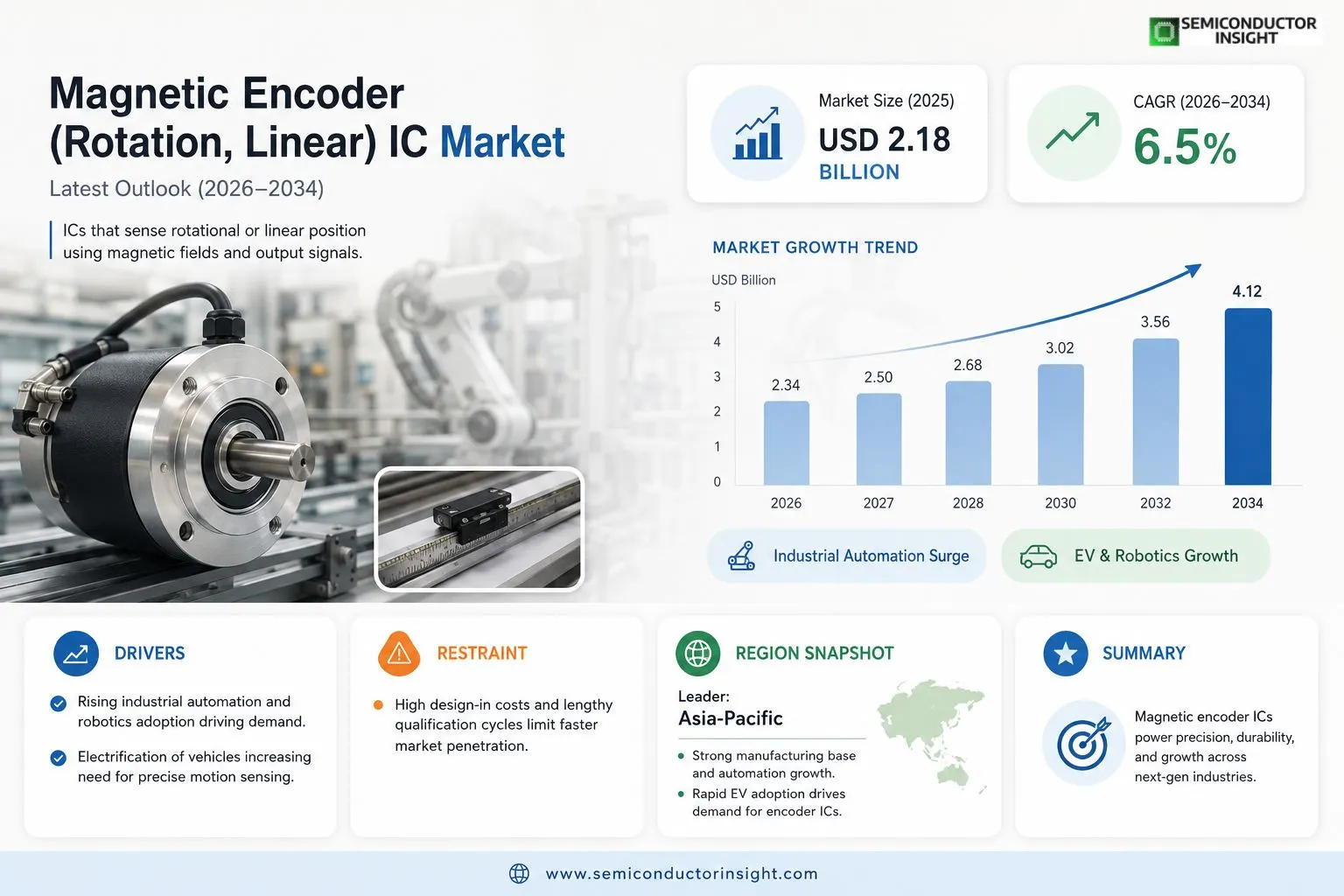
Global Magnetic Encoder (Rotation, Linear) IC market size was valued at USD 2.18 billion in 2025. The market is projected to grow from USD 2.34 billion in 2026 to USD 4.12 billion by 2034, exhibiting a CAGR of 6.5% during the forecast period.
Magnetic encoder ICs are precision sensing devices designed to detect and convert rotational or linear positional movement into digital or analog signals. These integrated circuits operate by sensing changes in a magnetic field generated by a magnetized target , typically a ring magnet or linear magnetic strip , and outputting accurate position, speed, or direction data. The product category encompasses rotary magnetic encoders, which measure angular displacement, and linear magnetic encoders, which capture straight-line positional data, both widely used across industrial automation, robotics, automotive systems, and consumer electronics applications.
The market is witnessing strong momentum driven by the accelerating adoption of factory automation, the proliferation of electric vehicles (EVs), and the expanding deployment of industrial robotics globally. Furthermore, the growing demand for high-resolution, contactless position sensing solutions , which offer superior durability and resistance to harsh environmental conditions compared to optical alternatives , is reinforcing the transition toward magnetic encoder IC technologies. Key players operating in this market include ams-OSRAM AG, Texas Instruments Incorporated, Allegro MicroSystems, Inc., Melexis NV, and Renesas Electronics Corporation, each maintaining broad product portfolios tailored to diverse application requirements.
MARKET DRIVERS
Rising Adoption of Industrial Automation and Robotics Fueling Demand for Magnetic Encoder ICs
Global Magnetic Encoder (Rotation, Linear) IC Market is experiencing significant growth momentum driven by the rapid expansion of industrial automation across manufacturing, automotive, and process industries. As factories increasingly deploy collaborative robots, CNC machinery, and automated guided vehicles (AGVs), the need for precise motion feedback solutions has intensified. Magnetic encoder ICs , both rotary and linear variants , provide reliable, contactless position and speed sensing that is critical for closed-loop motor control systems. Their inherent resistance to dust, vibration, and moisture makes them particularly well-suited for harsh industrial environments where optical alternatives often fall short.
Electrification of Automotive Platforms Accelerating Integration of Rotary and Linear Magnetic Encoder ICs
Global transition toward electric vehicles (EVs) and hybrid electric vehicles (HEVs) represents one of the most impactful drivers for the Magnetic Encoder IC Market. Electric powertrains rely heavily on precise rotor position sensing to optimize commutation in brushless DC and permanent magnet synchronous motors (PMSMs). Rotary magnetic encoder ICs are increasingly embedded within traction motor assemblies, power steering systems, throttle controls, and brake-by-wire modules. As automotive OEMs accelerate platform electrification, the per-vehicle content of magnetic encoder ICs is rising steadily, creating a structural demand uplift that is expected to persist through the coming decade.
➤ Industry estimates indicate that the average number of magnetic encoder IC units per electric vehicle is considerably higher than in conventional internal combustion engine platforms, reflecting the greater prevalence of electronically controlled actuators and motor-driven subsystems in EV architectures.
Beyond automotive electrification, the proliferation of servo drives in precision manufacturing equipment is reinforcing demand for high-resolution rotation and linear magnetic encoder ICs. Modern multi-axis CNC machining centers, semiconductor lithography equipment, and medical robotic surgery platforms require sub-micron positioning accuracy that advanced magnetic encoder IC solutions are increasingly capable of delivering. Continuous improvements in integrated Hall-effect sensor arrays, signal processing algorithms, and on-chip interpolation have allowed magnetic encoder ICs to close the performance gap with optical encoders while retaining their superior robustness advantages.
MARKET CHALLENGES
Susceptibility to Magnetic Field Interference Posing Design and Qualification Challenges
Despite their many advantages, magnetic encoder ICs face inherent technical challenges related to electromagnetic interference (EMI) and stray magnetic field sensitivity. In environments where powerful motors, transformers, or high-current bus bars operate in close proximity, stray magnetic fields can introduce positional errors that compromise system accuracy. Managing magnetic shielding, sensor placement, and PCB layout requires significant application engineering expertise and adds complexity to system-level design and qualification. For end-users in industries such as aerospace, medical devices, and precision instrumentation, these challenges can extend development timelines and increase validation costs, creating a barrier that moderates the pace of adoption in some high-reliability segments of the Magnetic Encoder IC Market.
Other Challenges
Competition from Optical Encoder Technologies
Optical encoders continue to maintain a strong installed base in applications where very high resolution and low magnetic noise immunity are paramount. Entrenched supply chains and familiarity among design engineers mean that transitioning from optical to magnetic encoder IC solutions requires deliberate justification, particularly in semiconductor equipment and precision metrology markets. Magnetic encoder IC suppliers must consistently demonstrate total cost of ownership advantages and performance parity to displace well-established optical solutions in these segments.
Supply Chain Constraints for Specialized Magnetic Sensor ICs
Magnetic Encoder (Rotation, Linear) IC Market is served by a relatively concentrated group of specialized semiconductor suppliers. Disruptions to wafer fabrication capacity, particularly for specialized CMOS and BiCMOS processes used in Hall-effect and magnetoresistive sensor ICs, can create supply tightness. Customers in automotive and industrial segments requiring long-term supply commitments and AEC-Q100 qualified components face heightened procurement risk during periods of foundry capacity constraints, underscoring the importance of multi-sourcing strategies and safety stock management.
MARKET RESTRAINTS
High Initial Design-In Costs and Long Qualification Cycles Restraining Faster Market Penetration
One of the primary restraints on growth in Magnetic Encoder (Rotation, Linear) IC Market is the considerable investment required during the design-in phase. Developing a magnetic encoder IC-based solution demands careful selection and characterization of the permanent magnet, precise mechanical tolerancing of the air gap, and rigorous system-level validation across temperature, vibration, and EMI conditions. For automotive applications in particular, the AEC-Q100 qualification process and functional safety compliance requirements under ISO 26262 can extend design-to-production timelines significantly. Smaller equipment manufacturers and system integrators with limited engineering resources may find these barriers prohibitive, limiting the addressable market to larger, better-resourced customers in the near term.
Resolution Limitations Relative to Optical Encoders Constraining Adoption in Ultra-Precision Applications
While the resolution of magnetic encoder ICs has improved substantially due to advances in on-chip interpolation and magnetoresistive sensing technologies, a performance gap relative to the highest-resolution optical encoder systems persists in certain ultra-precision application segments. Semiconductor wafer handling, laser beam steering, and high-accuracy coordinate measuring machines (CMMs) may require positional resolutions that current-generation magnetic encoder IC solutions cannot fully address without supplementary error correction mechanisms. This technical limitation acts as a structural restraint within the Magnetic Encoder IC Market, preserving the competitiveness of optical solutions in a defined but high-value portion of the overall motion control addressable market.
MARKET OPPORTUNITIES
Integration of Magnetic Encoder ICs in Humanoid Robotics and Collaborative Robot Joints Opening Significant Growth Avenues
The accelerating development and commercialization of humanoid robots and next-generation collaborative robots (cobots) represents a compelling emerging opportunity for Magnetic Encoder (Rotation, Linear) IC Market. Each robot joint requires one or more high-resolution position sensors for accurate torque and velocity control, and the compact form factor, low power consumption, and mechanical robustness of magnetic encoder ICs make them ideally suited for integration within actuator modules. As robot manufacturers scale production volumes, the demand for cost-effective, miniaturized magnetic encoder IC solutions embedded directly in joint actuator assemblies is projected to grow substantially, with leading robotics platforms potentially driving multi-million unit annual demand for encoder ICs across rotary and linear sensing functions.
Expansion of Renewable Energy Infrastructure Driving Demand for Linear and Rotary Magnetic Encoder ICs in Wind and Solar Applications
Global buildout of renewable energy infrastructure is creating substantial new addressable markets for rotation and linear magnetic encoder ICs. Wind turbine pitch control systems rely on linear and rotary position sensors to optimize blade angle in response to wind speed variations, directly impacting energy generation efficiency and mechanical fatigue management. Solar tracker systems require accurate angular position feedback to maintain optimal panel orientation relative to the sun’s position throughout the day. As installed capacity of both wind and solar power expands globally in alignment with national decarbonization targets, the aggregate demand for reliable, maintenance-free magnetic encoder IC solutions in renewable energy balance-of-plant applications is expected to represent a meaningful and growing segment of the overall market.
Miniaturization Trends and System-on-Chip Integration Creating New Design Opportunities Across Consumer and Medical Electronics Segments
Advances in semiconductor process technology are enabling magnetic encoder IC suppliers to deliver increasingly integrated, miniaturized solutions that combine Hall-effect or magnetoresistive sensing elements, signal conditioning, analog-to-digital conversion, and digital output interfaces within a single compact package. This trend toward higher integration is unlocking new application opportunities in segments such as minimally invasive surgical robotics, prosthetic limb actuation, wearable health monitoring devices, and consumer electronics haptic feedback systems , areas where the Magnetic Encoder IC Market has historically had limited penetration. As medical device and consumer electronics OEMs seek smaller, lower-power sensing solutions for next-generation products, the versatility and integration potential of magnetic encoder ICs position them as a preferred technology choice for a broadening range of end-use applications.
Magnetic Encoder (Rotation, Linear) IC Market Trends
Rising Adoption of Factory Automation Driving Magnetic Encoder IC Demand
Magnetic Encoder (Rotation, Linear) IC Market is experiencing robust growth momentum, largely propelled by the accelerating global shift toward factory automation. As manufacturing facilities increasingly deploy automated machinery, robotic arms, and precision conveyor systems, the demand for reliable position and motion sensing technologies has surged significantly. Magnetic encoder ICs , both rotary and linear variants , are integral to these systems, providing accurate angular displacement and straight-line positional data essential for coordinated machine control. Their contactless operating principle ensures long service life and consistent performance even in environments exposed to dust, vibration, and temperature fluctuations, making them a preferred sensing solution over traditional optical encoder alternatives in demanding industrial settings.
Other Trends
Proliferation of Electric Vehicles Expanding Application Scope
The rapid global proliferation of electric vehicles (EVs) is emerging as a key trend reshaping Magnetic Encoder (Rotation, Linear) IC Market. Electric drivetrains depend heavily on precise rotor position feedback for efficient motor control, regenerative braking management, and battery optimization. Rotary magnetic encoder ICs serve a critical function in EV traction motors and auxiliary systems, delivering the high-resolution, real-time positional data required for smooth and energy-efficient vehicle operation. As automotive OEMs scale their EV production capacities worldwide, the demand for robust, automotive-grade magnetic encoder IC solutions from suppliers such as Allegro MicroSystems and Melexis NV continues to strengthen considerably.
Growing Deployment of Industrial Robotics Fueling Market Expansion
The expanding deployment of industrial robotics across sectors including electronics manufacturing, automotive assembly, logistics, and healthcare is creating substantial demand for high-performance magnetic encoder ICs. Robotic joints and end-effectors require precise, continuous positional feedback to execute complex, repeatable movements with high accuracy. Linear and rotary magnetic encoder ICs from leading players such as ams-OSRAM AG, Texas Instruments Incorporated, and Renesas Electronics Corporation are increasingly integrated into collaborative robots and autonomous mobile robots, reflecting the technology’s ability to deliver reliable sensing performance across diverse robotic architectures and operational environments.
Shift Toward Contactless, High-Resolution Sensing Technologies
A defining trend within Magnetic Encoder (Rotation, Linear) IC Market is the growing industry preference for contactless, high-resolution position sensing solutions. Unlike contact-based or optical sensing alternatives, magnetic encoder ICs offer inherently superior durability, immunity to contamination, and long operational lifespans without mechanical wear. These attributes are particularly valued in harsh industrial and automotive environments. Advancements in integrated circuit design have further enhanced the resolution and signal accuracy of both rotary and linear magnetic encoder ICs, enabling their adoption in increasingly demanding precision applications such as semiconductor manufacturing equipment, medical robotics, and aerospace motion control systems, reinforcing a sustained transition toward magnetic encoder IC technologies globally.
COMPETITIVE LANDSCAPE
Key Industry Players
Magnetic Encoder (Rotation, Linear) IC Market , Competitive Dynamics and Leading Innovators
Global Magnetic Encoder (Rotation, Linear) IC market is characterized by a moderately consolidated competitive landscape, where a handful of established semiconductor and sensing technology companies command significant market share through deep application expertise, extensive intellectual property portfolios, and broad product lineups spanning both rotary and linear encoder IC variants. ams-OSRAM AG stands out as one of the foremost players, leveraging its specialized magnetic sensing heritage and high-resolution angle measurement solutions to serve demanding automotive, industrial automation, and robotics end markets. Allegro MicroSystems, Inc. and Melexis NV similarly maintain strong competitive positioning, offering differentiated Hall-effect and magnetoresistive encoder ICs optimized for contactless position sensing across electric vehicle (EV) powertrains, servo motor control, and precision motion systems. Texas Instruments Incorporated and Renesas Electronics Corporation further reinforce the competitive field with diversified analog and mixed-signal IC platforms, enabling customers to integrate position sensing with broader system-on-chip solutions. The competitive intensity across this market continues to escalate as demand accelerates for high-resolution, contactless sensing technologies capable of withstanding harsh industrial and automotive environments where optical encoder alternatives face inherent limitations.
Beyond the leading incumbents, a number of specialized and regionally significant players contribute meaningfully to the Magnetic Encoder IC competitive ecosystem. Companies such as Infineon Technologies AG, NXP Semiconductors, and MagnaChip Semiconductor have expanded their magnetic sensing portfolios to address the growing adoption of factory automation and collaborative robotics applications. iC-Haus GmbH and RLS d.o.o. cater to precision motion control niches, offering encoder ICs and integrated magnetic scale solutions for high-accuracy linear and rotary feedback systems. Meanwhile, Bourns, Inc. and Sensata Technologies serve application-specific segments spanning industrial controls, consumer electronics, and commercial vehicle systems. As the market advances toward an estimated USD 4.12 billion valuation by 2034, competitive differentiation is increasingly driven by resolution performance, power efficiency, functional safety compliance, and the ability to support multi-protocol digital output interfaces including SPI, SSI, and BiSS-C standards.
List of Key Magnetic Encoder (Rotation, Linear) IC Companies Profiled
- ams-OSRAM AG
- Texas Instruments Incorporated
- Allegro MicroSystems, Inc.
- Melexis NV
- Renesas Electronics Corporation
- Infineon Technologies AG
- NXP Semiconductors N.V.
- MagnaChip Semiconductor, Ltd.
- iC-Haus GmbH
- RLS d.o.o.
- Bourns, Inc.
- Sensata Technologies Holding plc
- ROHM Co., Ltd.
- Microchip Technology Inc.
- Heidenhain GmbH
Segment Analysis:
| Segment Category | Sub-Segments | Key Insights |
| By Type |
|
Rotary Magnetic Encoder ICs represent the dominant type segment within the magnetic encoder IC market, driven by their widespread deployment across motor control, robotics joint actuation, and servo drive systems.
Linear Magnetic Encoder ICs, while a smaller segment, are gaining meaningful traction in precision linear motion stages, CNC machining centers, and semiconductor fabrication equipment where highly accurate straight-line positional feedback is required. |
| By Application |
|
Industrial Automation & Robotics emerges as the leading application segment, underpinned by Global acceleration of smart factory adoption and the proliferating deployment of industrial robotic arms and automated guided vehicles (AGVs).
The Automotive & Electric Vehicles application is emerging as a high-growth segment, with magnetic encoder ICs playing pivotal roles in electric motor commutation, steering angle detection, pedal position sensing, and battery management systems across hybrid and fully electric vehicle platforms. |
| By End User |
|
Industrial Machinery Manufacturers constitute the leading end-user segment, as the intensifying global push toward industrial digitalization and smart manufacturing directly amplifies the consumption of high-performance magnetic encoder ICs in motion control and positioning equipment.
Automotive OEMs and Tier-1 Suppliers represent a rapidly growing end-user cohort, driven by electrification mandates and the integration of magnetic encoder ICs across multiple vehicle subsystems requiring precise electromechanical control. |
| By Interface Protocol |
|
Digital Output (SPI, I²C, SSI) interface magnetic encoder ICs are increasingly emerging as the preferred choice among system designers, reflecting the broader industry shift toward fully digitized motion control architectures.
Analog output variants continue to find relevance in cost-sensitive and legacy system applications, while ABZ incremental quadrature output ICs maintain a strong installed base across established industrial motor drive platforms. |
| By Resolution |
|
High Resolution (Above 14-bit) magnetic encoder ICs represent the fastest-evolving resolution tier, propelled by the increasing sophistication of precision motion applications that demand exceptional positional accuracy and minimal quantization error.
Medium-resolution variants retain broad relevance across general-purpose industrial drives and consumer electronics applications where a favorable balance between positional accuracy and component cost is the primary design consideration. |
Regional Analysis: Magnetic Encoder (Rotation, Linear) IC Market
Asia-Pacific
Asia-Pacific’s manufacturing sector is undergoing a profound transformation driven by smart factory deployments and collaborative robot integration. This shift has elevated demand for high-resolution magnetic encoder ICs used in servo drives, articulated robotic arms, and conveyor positioning systems. China’s “Made in China 2025” initiative and Japan’s Society 5.0 roadmap continue to accelerate encoder IC adoption across precision manufacturing environments, creating a sustained and expanding addressable market across the region.
The explosive growth of the electric vehicle industry across Asia-Pacific, particularly in China and South Korea, is a pivotal demand driver for Magnetic Encoder (Rotation, Linear) IC Market. Rotational magnetic encoder ICs are integral to motor control units, battery management positioning systems, and electronic power steering assemblies. As regional EV production scales to meet domestic and export demand, encoder IC specifications are evolving toward higher thermal resilience, compact form factors, and enhanced electromagnetic immunity to suit next-generation drivetrain architectures.
Asia-Pacific hosts an exceptionally deep semiconductor supply chain that provides competitive advantages to magnetic encoder IC developers and buyers alike. The region’s proximity to wafer fabrication, packaging, and testing facilities reduces lead times and production costs significantly. Taiwan’s TSMC and South Korea’s Samsung Foundry enable fabless encoder IC design companies to access advanced process nodes, resulting in more power-efficient and compact encoder solutions tailored for high-volume industrial and consumer applications across global markets.
Beyond the established markets of China, Japan, and South Korea, emerging economies within Asia-Pacific , including India, Vietnam, and Thailand , are gaining momentum as important growth contributors to Magnetic Encoder (Rotation, Linear) IC Market. Expanding electronics manufacturing zones, increasing foreign direct investment in industrial automation, and growing adoption of CNC machinery in these nations are steadily broadening the regional demand base, offering manufacturers new geographic opportunities within a rapidly industrializing landscape through the 2026–2034 forecast period.
North America
North America represents one of the most technologically advanced and innovation-intensive regions in Global Magnetic Encoder (Rotation, Linear) IC Market. The United States anchors regional demand through its highly developed aerospace, defense, semiconductor, and industrial automation sectors, all of which rely on precision magnetic encoder ICs for motion control, feedback systems, and position sensing applications. American IC design firms are at the forefront of developing next-generation encoder architectures that deliver superior signal processing, multi-turn capability, and integration with digital communication protocols such as SPI and I²C. Canada contributes through its advanced robotics and medical device manufacturing sectors, while the broader North American market benefits from proximity to leading technology universities and national research institutions fostering encoder IC innovation. The region’s ongoing reindustrialization efforts and federal investments in domestic semiconductor manufacturing are expected to reinforce a robust and diversified demand environment for Magnetic Encoder (Rotation, Linear) IC Market throughout the forecast horizon.
Europe
Europe occupies a strategically significant position in Magnetic Encoder (Rotation, Linear) IC Market, underpinned by its world-class precision engineering tradition and advanced industrial automation ecosystem. Germany, as the continent’s industrial powerhouse, drives substantial demand through its machine tool, automotive, and industrial robotics sectors, where rotational and linear magnetic encoder ICs are fundamental components in closed-loop motion control systems. Switzerland and Austria contribute through high-precision instrumentation and medical technology applications requiring exceptional encoder accuracy and reliability. The European Union’s ambitious green energy transition and electrification agenda are creating new demand vectors for magnetic encoder ICs in wind turbine pitch control, EV charging infrastructure, and energy-efficient motor systems. Regulatory emphasis on operational safety, electromagnetic compatibility, and product longevity further encourages adoption of robust encoder IC solutions, positioning Europe as a mature but steadily evolving market within Global Magnetic Encoder (Rotation, Linear) IC landscape.
South America
South America represents an emerging but increasingly relevant region within Global Magnetic Encoder (Rotation, Linear) IC Market. Brazil, as the continent’s largest economy, serves as the primary demand hub, with growing investments in industrial automation, agricultural machinery modernization, and oil and gas exploration equipment driving localized requirements for magnetic encoder ICs. The region’s expanding manufacturing sector, particularly in automotive assembly and food processing automation, is gradually integrating motion control solutions that incorporate both rotational and linear encoder technologies. While infrastructural challenges and economic variability have historically constrained rapid market adoption, sustained foreign investment in Brazilian and Argentine manufacturing facilities, combined with improving supply chain connectivity, is gradually broadening the market’s growth trajectory. South America is expected to witness consistent, if measured, development in magnetic encoder IC demand through the 2026–2034 forecast period as industrial modernization continues to gain momentum.
Middle East & Africa
The Middle East and Africa region presents a nascent yet opportunity-rich landscape for Magnetic Encoder (Rotation, Linear) IC Market. In the Middle East, ambitious economic diversification programs such as Saudi Arabia’s Vision 2030 and the UAE’s advanced manufacturing initiatives are generating new demand for industrial automation equipment, robotics, and smart infrastructure systems , all of which incorporate magnetic encoder ICs at the component level. The energy sector, including oil refinery automation and renewable energy installations such as solar tracking and wind turbine systems, represents a key application segment driving encoder IC adoption. Africa, while at an earlier stage of industrial development, is witnessing growing investments in manufacturing and mining automation that introduce magnetic encoder requirements into previously underserved markets. As the region’s industrial base matures and technology adoption accelerates, Magnetic Encoder (Rotation, Linear) IC Market in the Middle East and Africa is positioned for gradual but meaningful expansion through the forecast period.
Report Scope
This market research report provides a comprehensive analysis of the Magnetic Encoder (Rotation, Linear) IC Market , covering the forecast period 2026–2034. It offers detailed insights into market dynamics, technological advancements, competitive landscape, and key trends shaping the industry.
Key focus areas of the report include:
- Market Overview: The report begins with an overview outlining its current market scenario, key growth indicators, and industry transformation drivers. It discusses macroeconomic factors, demand–supply balance, regulatory landscape, and the strategic role of semiconductors in powering advancements across industries such as automotive, telecommunications, consumer electronics, and industrial automation.
- Market Size & Forecast: Historical data and future projections for revenue, unit shipments, and market value across major regions and segments.
- Segmentation Analysis: Detailed breakdown by product type, technology, application, and end-user industry to identify high-growth segments and investment opportunities.
- Regional Insights: Insights into market performance across North America, Europe, Asia-Pacific, Latin America, and the Middle East & Africa, including country-level analysis where relevant.
- Competitive Landscape: Profiles of leading market participants, including their product offerings, R&D focus, manufacturing capacity, pricing strategies, and recent developments such as mergers, acquisitions, and partnerships.
- Technology Trends & Innovation: Assessment of emerging technologies, integration of AI/IoT, semiconductor design trends, fabrication techniques, and evolving industry standards.
- Market Drivers & Restraints: Evaluation of factors driving market growth along with challenges, supply chain constraints, regulatory issues, and market-entry barriers.
- Stakeholder Insights: Insights for component suppliers, OEMs, system integrators, investors, and policymakers regarding the evolving ecosystem and strategic opportunities.
Primary and secondary research methods are employed, including interviews with industry experts, data from verified sources, and real-time market intelligence to ensure the accuracy and reliability of the insights presented.
FREQUENTLY ASKED QUESTIONS:
What is the current market size of Magnetic Encoder (Rotation, Linear) IC Market?
-> Global Magnetic Encoder (Rotation, Linear) IC Market was valued at USD 2.18 billion in 2025 and is expected to reach USD 4.12 billion by 2034, growing at a CAGR of 6.5% during the forecast period from 2026 to 2034.
Which key companies operate in Magnetic Encoder (Rotation, Linear) IC Market?
-> Key players include ams-OSRAM AG, Texas Instruments Incorporated, Allegro MicroSystems, Inc., Melexis NV, and Renesas Electronics Corporation, among others, each maintaining broad product portfolios tailored to diverse application requirements.
What are the key growth drivers?
-> Key growth drivers include accelerating adoption of factory automation, proliferation of electric vehicles (EVs), and expanding deployment of industrial robotics globally. Additionally, growing demand for high-resolution, contactless position sensing solutions offering superior durability and resistance to harsh environmental conditions is reinforcing market growth.
Which region dominates the market?
-> Asia-Pacific is the fastest-growing region driven by rapid industrialization and EV adoption, while North America and Europe remain significant markets supported by advanced manufacturing and automotive sectors.
What are the emerging trends?
-> Emerging trends include contactless magnetic position sensing, integration of rotary and linear magnetic encoder ICs in robotics and EVs, and the shift away from optical encoders toward magnetic alternatives due to their superior durability and performance in harsh environmental conditions.

Get Sample Report PDF for Exclusive Insights
Report Sample Includes
- Table of Contents
- List of Tables & Figures
- Charts, Research Methodology, and more...