Low Noise Amplifier (LNA) for 5G Market Insights
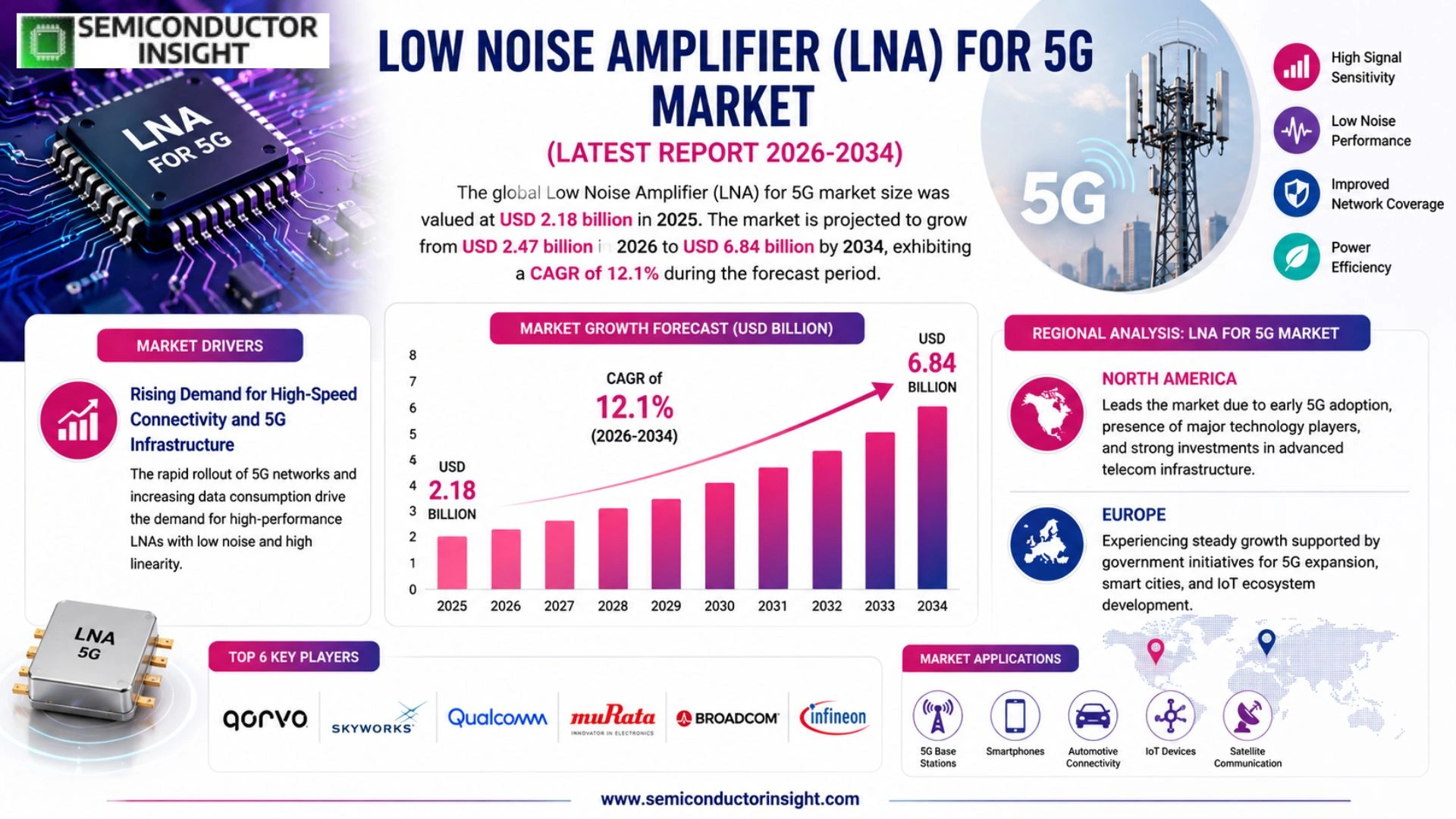
Global Low Noise Amplifier (LNA) for 5G Market size was valued at USD 2.18 billion in 2025. The market is projected to grow from USD 2.47 billion in 2026 to USD 6.84 billion by 2034, exhibiting a CAGR of 12.1% during the forecast period.
Low Noise Amplifiers (LNAs) are critical semiconductor components designed to amplify weak signals received by antenna systems while introducing minimal additional noise to the signal chain. In the context of 5G networks, LNAs are indispensable elements within the radio frequency (RF) front-end architecture, enabling reliable signal reception across sub-6 GHz and millimeter-wave (mmWave) frequency bands. These components are widely deployed across base stations, small cells, user equipment, and massive MIMO antenna arrays, forming the backbone of high-performance 5G communication infrastructure.
The market is witnessing strong momentum driven by the accelerating global rollout of 5G networks, rising demand for high-frequency RF components, and the proliferation of connected devices under the Internet of Things (IoT) ecosystem. Furthermore, the shift toward advanced semiconductor process nodes and the increasing adoption of GaN (Gallium Nitride) and GaAs (Gallium Arsenide) technologies are enhancing LNA performance, pushing broader commercial adoption. Strategic partnerships and product launches by leading industry participants , including Skyworks Solutions, Qorvo, Inc., Broadcom Inc., and NXP Semiconductors , are further reinforcing the competitive landscape and accelerating technological advancement across Low Noise Amplifier (LNA) for 5G Market.
MARKET DRIVERS
Rapid Global 5G Network Deployment Accelerating Demand for Low Noise Amplifiers
The accelerating rollout of 5G infrastructure across North America, Europe, and Asia-Pacific regions is one of the most significant drivers propelling Low Noise Amplifier (LNA) for 5G Market forward. As mobile network operators invest heavily in expanding sub-6 GHz and mmWave spectrum bands, the requirement for high-performance signal amplification components has grown substantially. Low Noise Amplifiers are critical to maintaining signal integrity in 5G base stations, small cells, and user equipment, ensuring that weak incoming signals are amplified with minimal added noise , a non-negotiable requirement in dense urban 5G deployments.
Surge in 5G-Enabled Consumer Electronics and IoT Devices
The proliferation of 5G-enabled smartphones, tablets, fixed wireless access terminals, and industrial IoT devices is generating substantial downstream demand for LNA components. Semiconductor manufacturers are integrating highly sensitive, low-power LNA modules into chipsets designed for 5G handsets and connected devices. As global 5G smartphone shipments continue to rise year-on-year, the volume requirements for LNA devices embedded within RF front-end modules (FEMs) are scaling accordingly. This trend is particularly pronounced in markets such as China, South Korea, and the United States, where 5G device penetration has reached advanced stages.
➤ The transition from 4G LTE to 5G NR (New Radio) standards necessitates a fundamental redesign of RF front-end architectures, with Low Noise Amplifiers for 5G required to operate across wider bandwidths and at higher frequencies , driving both volume growth and increased average selling prices across the LNA supply chain.
Beyond consumer devices, the expansion of 5G into mission-critical applications including autonomous vehicles, smart manufacturing, and private enterprise networks is further broadening the addressable market for Low Noise Amplifier (LNA) for 5G Market. These verticals demand superior noise figure performance and linearity, pushing RF component suppliers to develop next-generation GaN and GaAs-based LNA solutions capable of meeting stringent specifications across challenging operating environments.
MARKET CHALLENGES
Design Complexity at mmWave Frequencies Presents Significant Engineering Hurdles
One of the foremost challenges confronting Low Noise Amplifier (LNA) for 5G Market is the pronounced increase in design complexity as operating frequencies extend into the millimeter-wave (mmWave) spectrum, particularly in the 24 GHz to 100 GHz range. At these frequencies, achieving low noise figures while maintaining adequate gain, linearity, and power efficiency becomes considerably more difficult. Parasitic effects, substrate losses, and impedance matching challenges intensify at mmWave bands, requiring advanced process technologies such as advanced CMOS nodes, SiGe BiCMOS, or III-V compound semiconductors. The engineering expertise and simulation tooling required for mmWave LNA design remain concentrated among a limited number of specialist design houses, creating bottlenecks in the broader supply chain.
Other Challenges
Supply Chain Constraints and Semiconductor Material Availability
Low Noise Amplifier (LNA) for 5G Market is exposed to ongoing vulnerabilities in the global semiconductor supply chain. Specialty compound semiconductor materials, including gallium arsenide (GaAs) and gallium nitride (GaN), which are preferred substrates for high-performance 5G LNA devices, are subject to constrained foundry capacity and geopolitical supply risks. Lead times for advanced RF wafers have extended in periods of high demand, impacting the ability of LNA manufacturers to scale production in line with operator deployment schedules.
Power Consumption and Thermal Management in Dense 5G Networks
As 5G base station architectures, particularly massive MIMO systems, incorporate large numbers of antenna elements , each requiring dedicated LNA components , aggregate power consumption and thermal dissipation become critical engineering and operational concerns. Network operators and equipment vendors are under increasing pressure to improve the energy efficiency of RF front-end components, including LNAs, without compromising noise performance. Balancing these competing requirements remains an active area of challenge for Low Noise Amplifier (LNA) for 5G Market ecosystem.
MARKET RESTRAINTS
High Development Costs and Capital-Intensive Fabrication Processes Limiting Market Entry
The development and volume production of advanced Low Noise Amplifiers for 5G applications entails significant capital expenditure, particularly for designs utilizing compound semiconductor processes. Wafer fabrication costs for GaAs and GaN technologies are considerably higher than those associated with standard CMOS processes, raising the cost-per-unit threshold for 5G LNA products and limiting the competitive landscape to well-capitalized fabless design firms and integrated device manufacturers. Smaller entrants face meaningful financial barriers in qualifying advanced process nodes and achieving the economies of scale necessary to compete on price with established suppliers.
Intense Price Pressure in Volume Consumer 5G Segments Compressing Margins
While Low Noise Amplifier (LNA) for 5G Market benefits from strong volume demand driven by consumer device shipments, this same dynamic introduces intense price competition among RF component suppliers. Smartphone OEMs and their tier-one supply chain partners exert significant downward pricing pressure on RF front-end component vendors, including LNA suppliers, as they seek to manage bill-of-materials costs amid competitive handset pricing. This margin compression is a structural restraint for LNA vendors operating in the consumer segment, potentially constraining investment in next-generation research and development activities critical to long-term competitiveness.
MARKET OPPORTUNITIES
Expansion of Private 5G Networks Creating High-Value LNA Demand in Industrial Verticals
The growing adoption of private 5G networks across manufacturing, logistics, mining, energy, and defense sectors represents a compelling and high-value opportunity for Low Noise Amplifier (LNA) for 5G Market. Unlike consumer applications, industrial private 5G deployments prioritize performance, reliability, and longevity over cost minimization, enabling LNA suppliers to achieve stronger average selling prices and more favorable margin structures. The increasing integration of 5G connectivity into industrial automation systems, autonomous guided vehicles, and real-time machine control platforms is driving demand for ruggedized, high-performance RF front-end components suited to challenging operating environments.
Advanced Semiconductor Integration and Multi-Chip Module Architectures Opening New Design Paradigms
Advances in heterogeneous integration, including system-in-package (SiP) and multi-chip module (MCM) technologies, are creating significant opportunities for LNA suppliers to deliver higher levels of integration and performance within compact form factors demanded by 5G equipment designers. The ability to co-package LNA dies alongside filters, switches, and power amplifiers in a single module reduces system complexity for equipment manufacturers while creating differentiated, higher-value product offerings for RF component suppliers. Companies that successfully develop integrated RF front-end solutions incorporating high-performance 5G LNA functionality are well-positioned to capture a growing share of the expanding Low Noise Amplifier (LNA) for 5G market.
Emerging 5G Advanced and 6G Research Activity Laying Groundwork for Next-Generation LNA Innovation
Ongoing standardization work on 5G Advanced (Release 18 and beyond) and early-stage 6G research programs are establishing the technical requirements for the next generation of low noise amplification technologies. Sub-terahertz frequency research, beamforming innovations, and reconfigurable antenna architectures associated with these emerging standards will necessitate fundamentally new LNA design approaches, creating substantial long-term opportunities for semiconductor firms and research institutions investing today in advanced RF device technologies. Forward-looking participants Low Noise Amplifier (LNA) for 5G Market that align their development roadmaps with these emerging requirements stand to secure early-mover advantages in what is expected to be a significantly expanded future market.
Trends
Accelerating 5G Network Rollout Driving Demand for Low Noise Amplifier (LNA) for 5G Market
The global deployment of 5G infrastructure continues to serve as the primary growth catalyst for Low Noise Amplifier (LNA) for 5G Market. As telecom operators expand network coverage across urban and suburban regions, the demand for high-performance RF front-end components , particularly LNAs , has intensified significantly. These amplifiers play an indispensable role in ensuring reliable signal reception across both sub-6 GHz and millimeter-wave (mmWave) frequency bands, making them critical to the functional integrity of next-generation communication networks. The widespread installation of base stations, small cells, and massive MIMO antenna arrays has further amplified the need for LNAs that can deliver low noise figures while maintaining high linearity across challenging frequency ranges.
Other Trends
Adoption of Advanced Semiconductor Materials
A prominent trend shaping Low Noise Amplifier (LNA) for 5G Market is the increasing transition toward advanced semiconductor process technologies, notably Gallium Nitride (GaN) and Gallium Arsenide (GaAs). These materials offer superior electron mobility, higher breakdown voltages, and improved thermal performance compared to traditional silicon-based alternatives. As 5G systems demand components capable of operating at higher frequencies with minimal signal degradation, GaN and GaAs-based LNAs are emerging as preferred solutions for both infrastructure and device-level applications. This shift is enabling manufacturers to deliver amplifiers with enhanced efficiency and broader bandwidth capabilities, accelerating commercial deployment across the ecosystem.
Proliferation of IoT and Connected Devices
The rapid expansion of the Internet of Things (IoT) ecosystem is generating substantial incremental demand for Low Noise Amplifier (LNA) for 5G components. As billions of connected devices , spanning industrial sensors, smart home systems, and wearables , increasingly rely on 5G connectivity for low-latency, high-throughput communication, the requirement for compact, power-efficient LNAs integrated within user equipment is growing considerably. This trend is prompting semiconductor designers to develop miniaturized LNA solutions optimized for dense device environments without compromising signal quality.
Strategic Industry Activity Reinforcing Competitive Landscape
Low Noise Amplifier (LNA) for 5G Market is also being shaped by active strategic initiatives among leading industry participants. Companies including Skyworks Solutions, Qorvo, Inc., Broadcom Inc., and NXP Semiconductors are investing in targeted product launches and collaborative partnerships to strengthen their technological positioning. These efforts are accelerating innovation cycles, expanding application-specific LNA portfolios, and deepening integration within 5G RF front-end architectures , collectively reinforcing the long-term growth trajectory of the market.
COMPETITIVE LANDSCAPE
Key Industry Players
Low Noise Amplifier (LNA) for 5G Market: Competitive Dynamics and Leading Innovators
Global Low Noise Amplifier (LNA) for 5G Market is characterized by intense competition among a concentrated group of established semiconductor and RF component manufacturers. Skyworks Solutions, Qorvo, Inc., and Broadcom Inc. collectively command significant market share, leveraging their advanced GaN and GaAs process technologies to deliver high-performance LNA solutions optimized for both sub-6 GHz and millimeter-wave (mmWave) 5G frequency bands. These industry leaders benefit from deep integration across the RF front-end supply chain, long-standing relationships with major OEMs, and sustained investment in next-generation semiconductor process nodes. The accelerating global 5G network rollout , spanning base stations, massive MIMO arrays, and small cell deployments , continues to drive demand for high-frequency LNA components, prompting leading players to expand their product portfolios through strategic partnerships and targeted product launches.
Beyond the top-tier players, several specialized and diversified semiconductor companies are carving out significant positions within the Low Noise Amplifier for 5G market. NXP Semiconductors, Infineon Technologies, and Analog Devices bring strong RF design heritage and broad geographic reach, catering to diverse application segments including user equipment, IoT devices, and network infrastructure. Companies such as Murata Manufacturing, STMicroelectronics, and MACOM Technology Solutions are focusing on niche high-frequency and mmWave LNA segments, driving innovation in miniaturization and power efficiency. Collectively, these players are reinforcing the competitive landscape through continuous R&D investment, technology licensing, and strategic collaborations aimed at addressing the evolving performance requirements of 5G communication infrastructure.
List of Key Low Noise Amplifier (LNA) for 5G Companies Profiled
- Skyworks Solutions, Inc.
- Qorvo, Inc.
- Broadcom Inc.
- NXP Semiconductors N.V.
- Infineon Technologies AG
- Analog Devices, Inc.
- Murata Manufacturing Co., Ltd.
- STMicroelectronics N.V.
- MACOM Technology Solutions Holdings, Inc.
- Mini-Circuits
- Microchip Technology Inc.
- Texas Instruments Incorporated
- Renesas Electronics Corporation
- Mitsubishi Electric Corporation
- Sumitomo Electric Device Innovations, Inc.
Segment Analysis:
| Segment Category | Sub-Segments | Key Insights |
| By Type |
|
GaN-Based LNA holds the leading position in the Low Noise Amplifier for 5G market, primarily driven by its superior high-power handling capabilities and exceptional efficiency at millimeter-wave frequency bands.
|
| By Application |
|
5G Base Stations represent the dominant application segment within the Low Noise Amplifier for 5G market, underpinned by the global acceleration of 5G network infrastructure rollout.
|
| By End User |
|
Telecom Infrastructure Providers constitute the leading end-user segment in the Low Noise Amplifier for 5G market, reflecting the pivotal role these entities play in building and expanding 5G network ecosystems globally.
|
| By Frequency Band |
|
Sub-6 GHz currently leads the frequency band segment for Low Noise Amplifiers in the 5G market, owing to the widespread and mature deployment of sub-6 GHz 5G networks across numerous regions globally.
|
| By Integration Level |
|
Integrated LNA (RF Front-End Modules) represents the fastest-growing and increasingly dominant integration level segment, as the 5G ecosystem drives a compelling shift toward higher levels of RF component integration to achieve compact, power-efficient, and cost-optimized designs.
|
Regional Analysis: Low Noise Amplifier (LNA) for 5G Market
Asia-Pacific
China’s commanding position Low Noise Amplifier (LNA) for 5G Market is underpinned by its unparalleled scale of base station deployment. Domestic telecom giants are deploying massive MIMO and millimeter-wave infrastructure at a pace unmatched globally, creating sustained demand for high-performance LNA components. Government policy support and domestic semiconductor initiatives are accelerating local design and production capabilities, reducing dependency on foreign suppliers and fostering a competitive indigenous LNA ecosystem.
South Korea and Japan are pivotal innovation centers for Low Noise Amplifier (LNA) for 5G Market. South Korea’s advanced semiconductor firms are pioneering gallium arsenide and gallium nitride-based LNA designs optimized for sub-6 GHz and mmWave bands. Japan’s deep expertise in precision electronics and its growing private 5G network segment for smart manufacturing create a specialized, high-value demand environment that rewards premium LNA performance and reliability.
India represents one of the most compelling emerging opportunities Low Noise Amplifier (LNA) for 5G Market. Following successful spectrum auctions and the launch of commercial 5G services by major operators, demand for LNA-integrated base stations and user equipment is escalating rapidly. Government initiatives promoting domestic electronics manufacturing and telecom infrastructure investment are attracting global component suppliers and creating conditions for long-term, sustainable market expansion through the forecast period.
Taiwan’s world-class semiconductor foundries serve as the manufacturing backbone for Low Noise Amplifier (LNA) for 5G components consumed globally. Southeast Asian nations, including Vietnam and Malaysia, are increasingly integrated into the regional supply chain, offering complementary assembly and testing capabilities. As geopolitical pressures prompt supply chain diversification, this sub-region is attracting investment from global LNA designers seeking resilient, cost-efficient production alternatives to mainland China.
North America
North America represents a mature yet highly dynamic market for Low Noise Amplifier (LNA) for 5G technology. The United States is at the forefront of commercial 5G deployment, with nationwide carrier rollouts spanning both sub-6 GHz and millimeter-wave frequency bands. This dual-band deployment complexity creates strong demand for LNA solutions capable of delivering exceptional noise figure performance across a wide spectrum. The presence of leading semiconductor design firms and a robust defense electronics sector further amplifies domestic consumption, as military and aerospace applications increasingly adopt 5G-compatible LNA architectures. Canada is pursuing targeted 5G expansion in urban centers, contributing additional procurement activity. The region’s emphasis on Open RAN architectures is reshaping procurement dynamics, encouraging LNA suppliers to develop modular, interoperable solutions. Strong venture capital investment in wireless technology startups and a mature intellectual property environment continue to foster innovation, ensuring North America remains a critical market for premium Low Noise Amplifier (LNA) for 5G solutions through 2034.
Europe
Europe’s Low Noise Amplifier (LNA) for 5G market is characterized by a methodical and regulation-driven approach to network deployment. Major economies including Germany, the United Kingdom, France, and the Nordic nations are progressing steadily with 5G infrastructure buildout, with particular emphasis on industrial and enterprise private network applications. The European Union’s focus on technological sovereignty and supply chain resilience is prompting regional stakeholders to invest in domestic semiconductor capabilities, creating new opportunities for LNA component manufacturers. Germany’s strong automotive and manufacturing sectors are driving demand for ultra-reliable 5G connectivity solutions where LNA performance is critical. The United Kingdom’s post-Brexit technology ambitions are fostering domestic R&D investment in radio frequency components. Europe’s stringent regulatory standards for electromagnetic compatibility and energy efficiency are also shaping LNA design requirements, encouraging development of solutions that balance high performance with reduced power consumption for sustainable network operations.
South America
South America is an emerging and progressively important market within the global Low Noise Amplifier (LNA) for 5G landscape. Brazil leads regional momentum, with its telecommunications regulatory authority having allocated 5G spectrum and established a framework for nationwide commercial deployment by major operators. Urban centers including São Paulo, Rio de Janeiro, and Brasília are prioritized for early-phase 5G network buildout, generating initial demand for LNA-equipped base station equipment. Chile and Colombia are also advancing 5G readiness through spectrum planning and pilot programs. The region’s market growth is tempered by macroeconomic considerations and infrastructure investment constraints, but the long-term trajectory remains positive as digital transformation agendas gain political and commercial traction. International telecom equipment vendors supplying LNA-integrated infrastructure to South American operators play a key role in shaping regional technology adoption patterns through 2034.
Middle East & Africa
The Middle East & Africa region presents a bifurcated opportunity landscape for Low Noise Amplifier (LNA) for 5G Market. Gulf Cooperation Council nations, most notably Saudi Arabia and the United Arab Emirates, have established themselves as early adopters of 5G technology, deploying advanced network infrastructure as part of broader national digital transformation and smart city initiatives. These economies demonstrate strong appetite for high-performance LNA solutions integrated into both consumer and enterprise 5G infrastructure. In contrast, broader Africa faces structural challenges including limited spectrum availability, infrastructure financing gaps, and connectivity disparities that slow widespread 5G adoption. However, South Africa is actively progressing with 5G rollout, and several North African markets are at advanced planning stages. As satellite-terrestrial hybrid network models gain traction across the continent, demand for specialized LNA components suited to diverse frequency environments is anticipated to grow steadily over the 2026–2034 forecast horizon.
Report Scope
This market research report provides a comprehensive analysis of the Low Noise Amplifier (LNA) for 5G Market , covering the forecast period 2026–2034. It offers detailed insights into market dynamics, technological advancements, competitive landscape, and key trends shaping the industry.
Key focus areas of the report include:
- Market Overview: The report begins with an overview outlining its current market scenario, key growth indicators, and industry transformation drivers. It discusses macroeconomic factors, demand–supply balance, regulatory landscape, and the strategic role of semiconductors in powering advancements across industries such as automotive, telecommunications, consumer electronics, and industrial automation.
- Market Size & Forecast: Historical data and future projections for revenue, unit shipments, and market value across major regions and segments.
- Segmentation Analysis: Detailed breakdown by product type, technology, application, and end-user industry to identify high-growth segments and investment opportunities.
- Regional Insights: Insights into market performance across North America, Europe, Asia-Pacific, Latin America, and the Middle East & Africa, including country-level analysis where relevant.
- Competitive Landscape: Profiles of leading market participants, including their product offerings, R&D focus, manufacturing capacity, pricing strategies, and recent developments such as mergers, acquisitions, and partnerships.
- Technology Trends & Innovation: Assessment of emerging technologies, integration of AI/IoT, semiconductor design trends, fabrication techniques, and evolving industry standards.
- Market Drivers & Restraints: Evaluation of factors driving market growth along with challenges, supply chain constraints, regulatory issues, and market-entry barriers.
- Stakeholder Insights: Insights for component suppliers, OEMs, system integrators, investors, and policymakers regarding the evolving ecosystem and strategic opportunities.
Primary and secondary research methods are employed, including interviews with industry experts, data from verified sources, and real-time market intelligence to ensure the accuracy and reliability of the insights presented.
FREQUENTLY ASKED QUESTIONS:
What is the current market size of Low Noise Amplifier (LNA) for 5G Market?
-> Low Noise Amplifier (LNA) for 5G Market was valued at USD 2.18 billion in 2025 and is expected to reach USD 6.84 billion by 2034, growing at a CAGR of 12.1% during the forecast period from 2026 to 2034.
Which key companies operate Low Noise Amplifier (LNA) for 5G Market?
-> Key players include Skyworks Solutions, Qorvo, Inc., Broadcom Inc., and NXP Semiconductors, among others. These companies are actively involved in strategic partnerships and product launches to reinforce the competitive landscape and accelerate technological advancement.
What are the key growth drivers?
-> Key growth drivers include the accelerating global rollout of 5G networks, rising demand for high-frequency RF components, proliferation of connected devices under the Internet of Things (IoT) ecosystem, and the increasing adoption of GaN (Gallium Nitride) and GaAs (Gallium Arsenide) technologies enhancing LNA performance.
Which region dominates the market?
-> Asia-Pacific is among the fastest-growing regions, driven by rapid 5G infrastructure deployment, while North America remains a significant market supported by advanced telecommunications investments and leading semiconductor manufacturers.
What are the emerging trends?
-> Emerging trends include the shift toward advanced semiconductor process nodes, adoption of GaN and GaAs material technologies, deployment of massive MIMO antenna arrays, and the expansion of LNA applications across sub-6 GHz and millimeter-wave (mmWave) frequency bands for next-generation 5G communication infrastructure.

Get Sample Report PDF for Exclusive Insights
Report Sample Includes
- Table of Contents
- List of Tables & Figures
- Charts, Research Methodology, and more...
 Download Sample Report PDF