Lithium Battery Protection Boards Market Insights
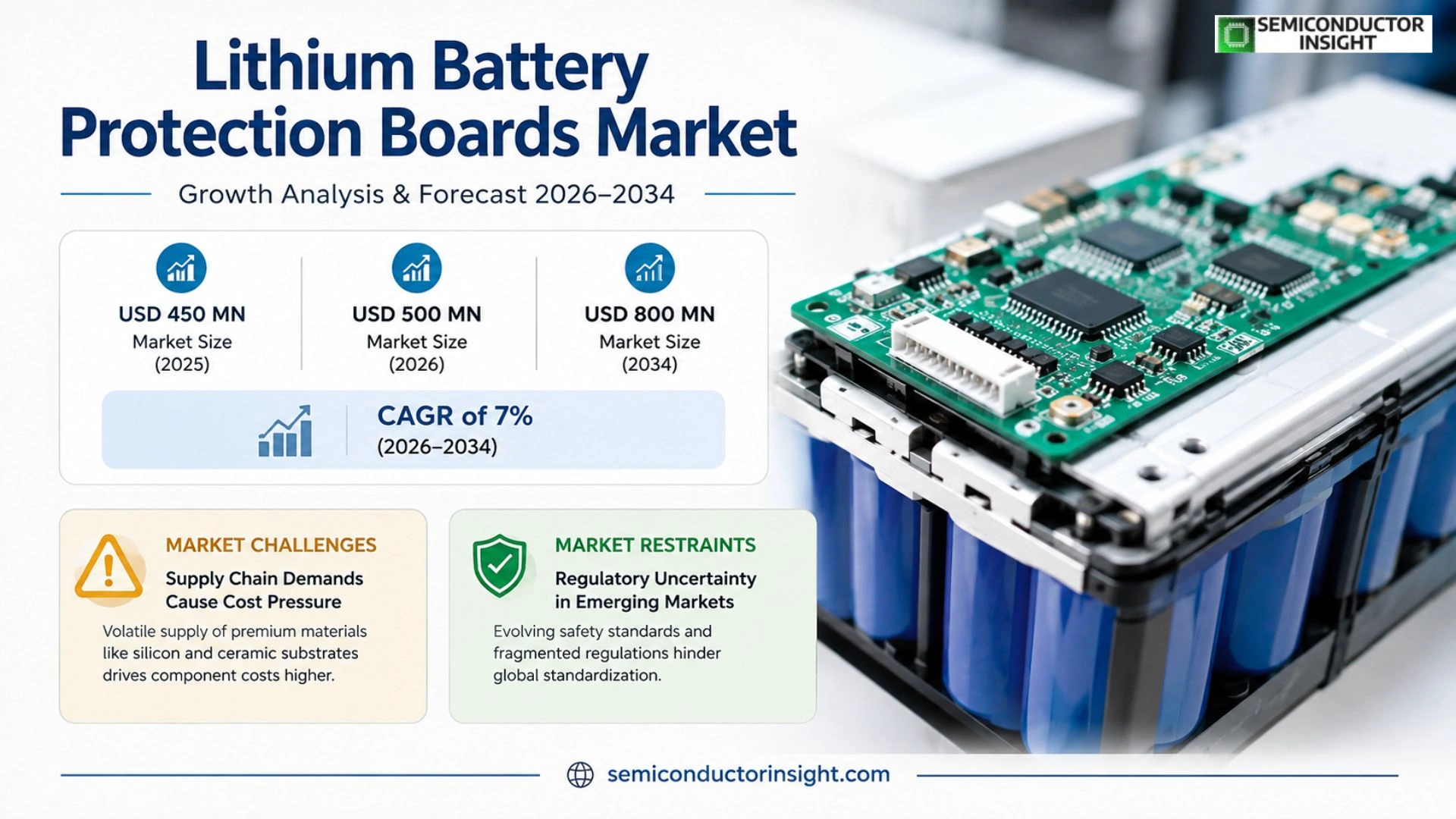
Lithium Battery Protection Boards Market size was valued at USD 450 million in 2025. It is projected to grow from USD 500 million in 2026 to USD 800 million by 2034, exhibiting a CAGR of approximately 7% during the forecast period.
Lithium Battery Protection Boards are circuit modules that safeguard lithium‑ion cells against over‑charge, over‑discharge, short‑circuiting and thermal runaway. These boards integrate cell monitoring sensors with power‑management ICs, enabling real‑time voltage balancing and fault detection essential for electric vehicle powertrains and high‑capacity energy storage systems.
MARKET DRIVERS
Energy Storage Evolution Fuels Demand
Lithium Battery Protection Boards Market continues to gain traction as battery storage systems scale across renewable energy, electric mobility, and data centers. Contemporary grid operators increasingly rely on integrated protection circuits to safeguard lithium chemistries against over‑charge, deep‑discharge, and short‑circuit events, thereby ensuring longevity and performance. Service providers and OEMs now treat protection boards as critical as cells themselves, driving an up‑market shift toward higher‑capacity, multi‑cell modules that demand advanced over‑current and thermal safeguards. Technology drivers such as silicon carbide (SiC) and gallium nitride (GaN) wafers have injected new levels of efficiency and compactness into board designs, permitting tighter integration and lower weight,attributes that decision‑makers in the EV share‑selling space find particularly appealing. By positioning protection boards as integral to safety certification, manufacturers are achieving higher margins, creating a virtuous driver loop where safety compliance fuels adoption and, in turn, drives further investment in protection technology. The pursuit of zero‑emission footprints pushes utilities toward longer‑duration storage arrays, amplifying the need for boards that can handle high current density while maintaining thermal reliability. Research‑heavy development of active cooling telemetry embedded within these boards is increasingly perceived as a market differentiator, pushing the entire Lithium Battery Protection Boards Market toward sophisticated, diagnostics‑enabled solutions.
Competitive Intensity Spurs Platform Innovation
Automotive manufacturers are collaborating with electronics firms to deliver plug‑in C‑BMS and BEC interfaces that give them granular control over energy flows. These partnerships give rise to highly modular protection boards that can be jointly customized for specific power demands, simplifying supply chain delivery for OEMs that are under pressure to differentiate by safety performance. The global shift toward electrified public transport is accelerating this trend, as cities require fleets that can guarantee consistent operation across diverse climates. A notable example is North American carriers adding silicon‑based protection systems to their hydrogen–battery hybrids to prevent can Tesla’s ultra‑fast charging stations from overheating. In 2025, projection figures indicate that battery‑management‑centric OEMs will devote up to 12% of R&D budgets solely to protection board enhancements, thereby reinforcing demand and lowering industry average unit cost through economies of scale. This virtuous cycle supports the thesis that competitive intensity is a core driver within Lithium Battery Protection Boards Market.
➤ Safety is the premium quality edge that will set the leading protection boards apart from commoditized alternatives
The regulatory environment shapefully limits the competitive horizon, as strict safety standards in the EU and Asia require proof-of-concept and exhaustive testing before boards can be deployed. Safety certification grants immediate credibility and often becomes a prerequisite for key procurement cycles, effectively narrowing competition to a handful of capable developers. Consequently, well‑capitalized firms that can navigate regulatory pathways experience quicker market penetration and a higher share‑of‑wallet across battery‑intensive segments, strengthening their dominance within Lithium Battery Protection Boards Market. This symbiosis between regulatory rigor and competitive fortification explains the sustained upward momentum in board adoption and the momentum that powers continued technological investment within the sector.
MARKET CHALLENGES
Supply Chain Demands Cause Cost Pressure
While Lithium Battery Protection Boards Market embraces digitalization, the underpinning material supply remains volatile. The reliance on premium silicon, ceramic substrates, and thin‑film coatings introduces a supply‑chain elasticity that can push component costs unpredictably high. Manufacturers face tight price windows, as thinner, higher‑density boards rely on premium-active materials whose price swings can skew production budgets. Cost pressure translates into thinner profit margins for small‑to‑mid‑size firms, forcing them to either absorb losses or risk exiting the market entirely. Additionally, quality variation across global suppliers can trigger rework cycles, thereby elongating production cycles and inflating inventory carry costs. In the aggregate, these challenges dampen a proven demand surge and create pressure on price elasticity.
Other Challenges
Complex Integration Obstacles
Integration complexity, driven by the heterogeneity of lithium chemistries,from LFP to NMC,requires board designers to balance thermal resistance with compactness. Solving this triangulation often demands bespoke layout and custom firmware, which can extend development times by 30–40% compared to standardized modules. Consequently, manufacturers seeking rapid time‑to‑market and capital efficiency risk being overburdened by each unique chemistry, a situation that underscores the need for ultra‑versatile protection platforms. In environments where regulatory approval is also required, the latency induced by integration hurdles can push bill‑of‑materials timing well beyond the critical windows of flagship vehicle launches or utility‑scale storage rollouts, creating a mismatch that cost firms can ill afford.
MARKET RESTRAINTS
Regulatory Uncertainty in Emerging Markets
In many emerging economies, safety standards for battery protection are still evolving, creating a fragmented regulatory landscape that hampers standardization. The absence of harmonized certification pathways results in compliance uncertainty for OEMs that rely on cross‑border supply chains, as boards that meet European directives may still be considered non‑compliant in Asian or African jurisdictions. Firms looking to expand in these markets must invest heavily in localized testing facilities or forge partnerships with regional certification authorities, resources that are scarce for medium‑sized players. This regulatory uncertainty reduces market confidence, discourages investment and short‑terminates potential product cycles. The impact on Lithium Battery Protection Boards Market is tangible: growth is restricted to regions with mature standard frameworks while emerging markets remain cautious or stepping back entirely.
MARKET OPPORTUNITIES
Edge Electronics Create New Revenue Streams
The rapid drift toward connected and autonomous vehicle platforms is opening a lucrative frontier for protection board designers. By embedding communication protocols (CAN‑FD, LIN, FlexRay) and diagnostic telemetry directly onto the board, firms can offer real‑time health monitoring, predictive maintenance, and dynamic load management, transforming the board from a passive safety component to a value‑added digital service. This shift unlocks recurring revenue through subscription‑based diagnostic platforms and software updates. Furthermore, the convergence of IoT and industrial automation invites the use of protection boards in robotics and high‑speed machinery, where real‑time fault detection can avert costly downtime. On the renewable energy front, grid‑scale storage operators seek partitioned protection solutions that can isolate individual modules while maintaining synchronicity across arrays, a niche that is ripe for value‑creation with modular design. As Lithium Battery Protection Boards Market continues to mature, these opportunities tie directly into broader digital transformation agendas, delivering a path to sustained profitability for firms that master the convergence of safety, connectivity, and services.
Lithium Battery Protection Boards Market Trends
Integration of Multi‑Layered Protection Schemes in High‑Density Energy Systems
Recent enterprise-level adoption of multi‑layered protection strategies in battery modules has reshaped demand curves for lithium battery protection boards. In modern energy storage ecosystems,whether it is electric‑vehicle manufacturing, grid‑scale storage or portable electronics,industry players are increasingly layering cell-to-cell, module-to-pack, and pack-to-HVDC supervision. Such composite oversight mitigates thermal runaway, voltage imbalance, and fault propagation, allowing producers to increase pack energy density without compromising safety margins. Consequently, the lithium battery protection board segment has evolved from a purely cost‑drive segment to a design‑centric capability. Companies that routinely embed digital front‑end diagnostics within protection boards now command premium margins, and the board’s role has become a competitive differentiator in supplier negotiations. The trend’s significance lies in its ability to unlock higher energy densities for producers while satisfying stricter regulatory safety standards.
Other Trends
Shift Toward Thermally Assisted Protection Mechanisms
Thermal-assist features,where protection boards incorporate heat-sensitive switches and thermal‑fuse-like elements,are gaining traction. These mechanisms enable rapid isolation in response to abnormal temperature rises, which is critical in high-current, high-power applications such as commercial EVs. The adoption of thermally‑managed boards reduces the need for external cooling infrastructure, thereby cutting system weight and cost. Moreover, manufacturers that integrate thermally aware firmware can synchronize protective actions across multiple modules, improving overall pack resilience. This shift serves a dual purpose: it strengthens safety compliance and delivers a leaner, lighter design that appeals to cost-conscious OEMs.
Rise of Compact, Flexible Protection Boards for Modular Battery Packs
Parallel to safety enhancements, a clear push toward compact, flexible protection boards is reshaping production lines across the industry. Advances in flexible printed circuits, ultrathin epoxy encapsulation, and miniaturized sensor arrays allow boards to conform to irregular module geometries, enabling tighter integration and higher assembly yield. This compactness is particularly valuable in small-form-factor applications such as electric scooters and portable power banks, where space constraints dictate component placement. Vendors that deliver modular board modules capable of scaling with pack size gain a strategic advantage, as they can service a spectrum of end‑uses without redesigning the core board architecture. Consequently, the lithium battery protection board market is becoming a niche where innovation speed and integration flexibility define competitive positioning.
COMPETITIVE LANDSCAPE
Key Industry Players
Global Lithium Battery Protection Boards Market – Industry Overview
The market is anchored by a handful of Tier‑1 manufacturers that enjoy extensive vertical integration and global distribution capabilities. Samsung SDI dominates the high‑capacity segment for automotive and stationary storage applications, leveraging its in‑house electrolyte and anode production to drive cost efficiencies. The company’s extensive partnership network with OEMs such as Hyundai and Volkswagen consolidates its positioning in the EV supply chain, while aggressive investment in solid‑state research positions it to capture future protection‑board designs that promise higher energy density. Other leading entities in this grouping include LG Chem and Panasonic, both of which operate multi‑country manufacturing hubs that allow rapid scaling of custom protection boards to meet evolving battery chemistries and safety regulations.
Niche and mid‑tier players focus on specialized chemistries or geographic footprints that enable them to serve emerging markets. Enersys has carved a niche in industrial and grid‑storage applications, offering compact, high‑voltage protection solutions backed by robust R&D in low‑temperature performance. Cambridge Energy Storage, operating out of New‑Zealand, targets the dual‑cycling lithium‑sulfur and lithium‑neon spaces with its high‑voltage, flexible busboard technology. A123 Systems and China Semiconductor & Battery Technology each provide modular, high‑reliability boards that cater to OEMs in electric vocational and lightweight vehicle segments. Strategic alliances with semiconductor suppliers and the move toward integrated BMS/PCB platforms underscore a shift toward tighter design integration and component miniaturisation, setting the stage for increased consolidation around Tier‑1 leaders.
List of Key Lithium Battery Protection Boards Companies Profiled
- Samsung SDI
- LG Chem
- Panasonic
- Enersys
- Cambridge Energy Storage
- A123 Systems
- China Semiconductor & Battery Technology
- Bright Current Industries
- Sekisui Chemical
- NexGen Energy Solutions
- Jiangnan Battery Co.
- Aluminium Battery Systems
Segment Analysis:
| Segment Category | Sub-Segments | Key Insights |
| By Type |
|
Leading Segment offers uniform thickness and superior mechanical strength, essential for battery modules in electric vehicles. Its rigid construction helps maintain optimal packing and protects against minor impacts, while the soft board delivers flexibility, accommodating shape changes during thermal expansion. Market participants choose the type that aligns with product design priorities, balancing structural resilience and adaptability. |
| By Application |
|
Leading Application is favored for power‑train and stationary storage due to inherent safety and long cycle life. High‑performance vehicles prioritize ternary chemistries where energy density drives design. Lithium titanate boards provide high‑rate discharge, essential for fast‑charging and time‑critical operations. Players evaluate regulation compliance and vehicle class when adopting a specific protection board. |
| By End User |
|
Leading End User demands harsh‑environment tolerance and compliance with stringent safety certifications, propelling hard‑board adoption. Energy storage customers favor modular boards that allow scalability for grid‑level systems, whereas industrial users prioritize mechanical robustness for heavy‑equipment operation. Each segment shapes design around lifespan, weight limits, and cost constraints. |
| By Installation Type |
|
Leading Installation involves direct plug‑in boards for simplified assembly and reduced void space, suitable for compact consumer electronics. Embedded boards are soldered within PCBs, offering precise control of electrical pathways for high‑end inverter applications. Modular boards enable plug‑and‑play configurations, enhancing maintainability and allowing rapid retrofitting across multiple platforms. |
| By Operating Temperature Range |
|
Leading Temperature Range boards incorporate materials resilient to sub‑freezing conditions for cold‑climate electric vehicles, baseline boards balance cost and reliability for standard deployment, and high‑temperature boards engineered with enhanced thermal stability support fast‑charge stations and heavy‑duty industrial machinery, thereby extending service intervals. |
Regional Analysis: Lithium Battery Protection Boards Market
Asia-Pacific
China’s domestic leadership in battery composition gifts its protection board vendors with proximity to raw material suppliers and access to the largest EV fleet. The national “Battery Supply‑Chain Initiative” has spurred investment in additive manufacturing to tailor cell‑level protections, while policy‑driven rollouts of fast‑charging networks create a demand pulse for high‑duty elimination boards.
Japan’s battery producers are renowned for precision and longevity. The country’s focus on thermal management and modular protection architectures positions it to supply system‑tier protection solutions that integrate seamlessly with safety‑circuitry mandated across forthcoming autonomous transport corridors.
South Korea’s emphasis on high‑energy‑density cells dovetails with its push for compact, high‑current pages. The synergy between its advanced solid‑state research programmes and industrial-scale panel production materialises in next‑generation protection boards that tolerate higher charge‑discharge rates while maintaining overhead clarity.
India’s emerging battery commodify trend is guided by local governments’ automotive electrification incentives. Rapid scaling of assembly lines, paired with domestic component manufacturing, nurtures a market that values customised protection modules to accommodate diverse battery chemistries adopted by regional OEMs.
North America
North America showcases a mature substrate for battery protection engineering, driven by a robust aerospace and high‑performance electric vehicle ecosystem. In this market, protection boards are integrally engineered to meet stringent safety standards in both aviation and automotive sectors, requiring tight harmonisation with thermal, electrical, and mechanical interfaces. The surge in cloud‑managed charging stations and the rapid adoption of plug‑in hybrids create a fragmented but highly active demand pool. Companies prioritising interoperability with electric grid systems leverage protection boards that offer real‑time diagnostics, enabling predictive maintenance and reduced downtime for fleet operators. Regulatory bodies in the United States and Canada have been tightening safety thresholds in recent years, which in turn elevates the importance of shielding, fault‑tolerance, and firmware‑controlled transient suppression. Meanwhile, a notable shift toward decarbonised grid solutions introduces ancillary appliances that require protection boards integrated with micro‑grid management units, broadening the traditional defence‑in‑depth approach. The region’s manufacturing philosophy is increasingly focused on high‑reliability components fabricated through additive production, allowing rapid adaptation to evolving safety protocols. Major OEMs maintain strategic partnerships with component suppliers that keep them ahead in a competitive landscape, making the North American market a benchmark for safety‑centric design. Concomitantly, pervasive venture capital interest in downstream electrification services foreshadows a shift towards platform‑based protection solutions, promising wider applicability of board technologies beyond core automotive domains. Beyond the typical automotive footprint, the United States and Canada are also exploring battery‑assisted electric medical devices and data center cooling solutions, both of which necessitate highly reliable, low‑heat‑generation protection boards. Through this expanding scope, the region is gradually redefining what constitutes a battery pack’s safety envelope, thereby driving higher technical specifications and cost‑effective manufacturing at scale. The confluence of rigorous safety regulation, diversified adoption across sectors, and an ongoing infusion of advanced manufacturing techniques ensures that North America remains an influential actor shaping the future of lithium battery protection board deployment.
Europe
Within the European context, protection boards are increasingly governed by pan‑EU harmonisation under the GDPR and CE safety directives, provisions that act as stringent filters for product certification. The region’s shift toward decarbonised mobility, alongside a strong policy framework that favours high‑efficiency battery chemistry research, results in a burgeoning emphasis on protection boards that deliver nuanced fault‑detection capabilities and lower environmental footprints. Companies increasingly pursue modular, thin‑profile designs capable of compliance with the EU’s extensive safety mandates, including electric touch‑sensing and temperature variance monitoring. The European market is also characterised by a distributed production network, where German precision engineering meets French material science, combined with the Netherlands’ world‑class logistics infrastructure. This collaboration manifests itself in protection board designs that integrate seamlessly with electrified rail systems and renewable energy conversion units, facilitating an approach whereby board-level power management remains optimal across dynamic loads. Additionally, a growing dialogue between governmental agencies and industry consortia seeks to standardise test regimes for battery packs destined for autonomous vehicles. This initiative is catalysing the creation of protection schemes that incorporate over‑current monitoring and health‑in‑the‑field algorithms, thereby moving beyond passive isolation toward proactive data analysis. As the European Union lays down stricter environmental tax policies, the battery protection segment is pressured to offer sustainable solutions that lower overall carbon footprints, aligning with the ambitious 2030 climate targets. In sum, although the European factory landscape is less concentrated than Asia‑Pacific, it offsets through a robust compliance framework and an emphasis on designing protection boards that can sustain the region’s transportation and energy ambitions, ultimately reinforcing its status as a cornerstone market for advanced battery safety solutions.
South America
South America presents a nascent yet dynamically evolving environment for lithium battery protection board demand, attributed primarily to the growing interest in electric commercial fleets and solar‑grid storage projects. The region’s geographic diversity enables a mix of private investment and state‑led development funds, accelerating the deployment of electrified public transport and establishing micro‑grids in remote locations. Consequently, protection boards that can adapt to intermittent power deliveries and expand over time become a strategic asset for utilities and city planners. As several country governments tighten regulatory oversight for vehicle safety, a wave of industry‑government partnership proposals has surfaced. These initiatives aim to augment local protection board knowledge bases, fostering a knowledge transfer pipeline between global manufacturers and emerging supply chains. The trend is orchestrated by a defined step‑up approach: first, a robust safety certification framework, second, the integration of protection boards in medium‑scale lithium battery installations, and third, mainstream adoption in consumer EVs. Moreover, South American automotive players are increasingly exploring hybridised propulsion systems, where the battery protection boards must fulfil dual roles,both for high‑capacity traction batteries and power‑management packs that feed auxiliary electronics. This hybrid operating model invites innovation in layered protection solutions, merging over‑voltage supervisors with active cooling elements to avoid thermal runaway. The region’s strategic position in lithium mining gives it exposure to budgeting strategies that emphasize product longevity and component reuse. As a result, protection boards with modular components and consumable swap‑in interfaces are gaining traction among OEMs looking to reduce overall replacement costs. Through localised production hubs and investment in human capital, the South American market is striking a balance between local sustainability and foreign expertise, underscoring its emerging role in the global battery protection ecosystem.
Middle East & Africa
In the Middle East and Africa, the lithium battery protection board market is characterized by a legacy of heavy industrial growth juxtaposed with a nascent push toward electrification. The region’s robust investments in smart city initiatives and renewable energy parks create a demand nucleus where protection boards that withstand high ambient temperatures and variable power inputs are essential. Near‑shore wind farms and concentrated solar arrays, for instance, rely heavily on battery ebuffers, bringing protection board requirements to the forefront of deployment decisions. Among Middle Eastern economies, strict venture capital investment in electric vehicles is being coupled with a strategic shift toward domestically sourced components. Localised manufacturing aimed at integrating protection boards with low‑cost cell chemistries and concentrated thermal management systems is producing sustainable energy backbones for both transport and storage. In parallel, African nations are embracing community‑level storage solutions; here protection boards are not simply safety components but also serve as key enablers of reliable backup and disaster‑resilient power, which becomes particularly valuable in disaster‑prone regions. The confluence of political stability in Gulf states and a rising number of electric freight initiatives pushes the market to adopt incremental safety standards more aligned with IEC specifications. Similarly, the Australian coast and South African sea‑side ports are engaging in collaborative research to adapt battery protection boards for maritime power systems, bringing novel operational exigencies that demand high‑conformal, low‑noise performance. These evolving use cases underpin a strategic emphasis on high‑lifetime expectancy and maintenance‑free designs, aligning with the region’s broader mobility and energy resilience narratives. As a result, protection boards that deliver advanced thermal monitoring and adaptive fault‑control are poised to capture value in this emerging and diverse market.
Report Scope
This market research report provides a comprehensive analysis of the Lithium Battery Protection Boards Market , covering the forecast period 2026–2034. It offers detailed insights into market dynamics, technological advancements, competitive landscape, and key trends shaping the industry.
Key focus areas of the report include:
- Market Overview: The report begins with an overview outlining its current market scenario, key growth indicators, and industry transformation drivers. It discusses macroeconomic factors, demand–supply balance, regulatory landscape, and the strategic role of semiconductors in powering advancements across industries such as automotive, telecommunications, consumer electronics, and industrial automation.
- Market Size & Forecast: Historical data and future projections for revenue, unit shipments, and market value across major regions and segments.
- Segmentation Analysis: Detailed breakdown by product type, technology, application, and end-user industry to identify high-growth segments and investment opportunities.
- Regional Insights: Insights into market performance across North America, Europe, Asia-Pacific, Latin America, and the Middle East & Africa, including country-level analysis where relevant.
- Competitive Landscape: Profiles of leading market participants, including their product offerings, R&D focus, manufacturing capacity, pricing strategies, and recent developments such as mergers, acquisitions, and partnerships.
- Technology Trends & Innovation: Assessment of emerging technologies, integration of AI/IoT, semiconductor design trends, fabrication techniques, and evolving industry standards.
- Market Drivers & Restraints: Evaluation of factors driving market growth along with challenges, supply chain constraints, regulatory issues, and market-entry barriers.
- Stakeholder Insights: Insights for component suppliers, OEMs, system integrators, investors, and policymakers regarding the evolving ecosystem and strategic opportunities.
Primary and secondary research methods are employed, including interviews with industry experts, data from verified sources, and real-time market intelligence to ensure the accuracy and reliability of the insights presented.
FREQUENTLY ASKED QUESTIONS:
What is the definition of Lithium Battery Protection Boards Market?
-> Lithium Battery Protection Boards Market is projected to grow from USD 500 million in 2026 to USD 800 million by 2034, exhibiting a CAGR of approximately 7%
Which market segments are identified by type?
-> The market is segmented into Hard Board and Soft Board technologies, each offering distinct form‑factor and integration advantages.
What are the primary application segments?
-> Applications include Ternary Lithium, Lithium Iron Phosphate, and Lithium Titanate batteries used in automotive, consumer electronics, renewable‑energy storage, and industrial equipment.
What does the Global Market Overview highlight?
-> It outlines the current market scenario, growth indicators, macro‑economic influences, regulatory frameworks, and the role of semiconductor advancements in expanding battery‑protection solutions.
What features and benefits does the report provide?
-> The report delivers quantitative market sizing, segmented forecasts, competitive analysis, technology trends, and strategic insights to support investment decisions.
Which research methodology is applied?
-> A combination of primary interviews, secondary data collection, and statistical modeling (top‑down and bottom‑up) is used to ensure robust and validated forecasts.
What is the base year for the analysis?
-> The base year is 2020, against which historical performance and future projections are benchmarked.
What assumptions and caveats are noted?
-> Assumptions include stable macro‑economic conditions, continued adoption of lithium technologies, and no major disruptive regulatory changes; caveats address potential supply‑chain constraints.
What is the projected market growth (CAGR) for 2020‑2031?
-> The report indicates a strong compound annual growth rate (CAGR) throughout the forecast horizon, reflecting increased demand for safe lithium‑ion solutions, although the exact percentage is detailed in the market‑size section of the full study.
Which companies are leading players in this market?
-> Top manufacturers include SmartElex, Litongwei Electronics Technology, Huasu Technology, Duolixin Electronic, Baiqiang, 1 Esource Technology, and Dali, among others.
What are the key growth drivers for the market?
-> Drivers include rising electric‑vehicle adoption, expanding renewable‑energy storage projects, stricter safety regulations, and technological advancements in board miniaturization and integration.
Which region shows the highest growth potential?
-> Asia demonstrates the fastest growth due to large‑scale battery production in China, Japan, South Korea, and emerging markets such as India and Southeast Asia.
What emerging trends are shaping the market?
-> Trends include the development of smart protection boards with AI‑enabled monitoring, integration of IoT for real‑time diagnostics, and the shift toward environmentally friendly manufacturing processes.

Get Sample Report PDF for Exclusive Insights
Report Sample Includes
- Table of Contents
- List of Tables & Figures
- Charts, Research Methodology, and more...
 Download Sample Report PDF