Liquid Cooling for AI Chip Market Insights
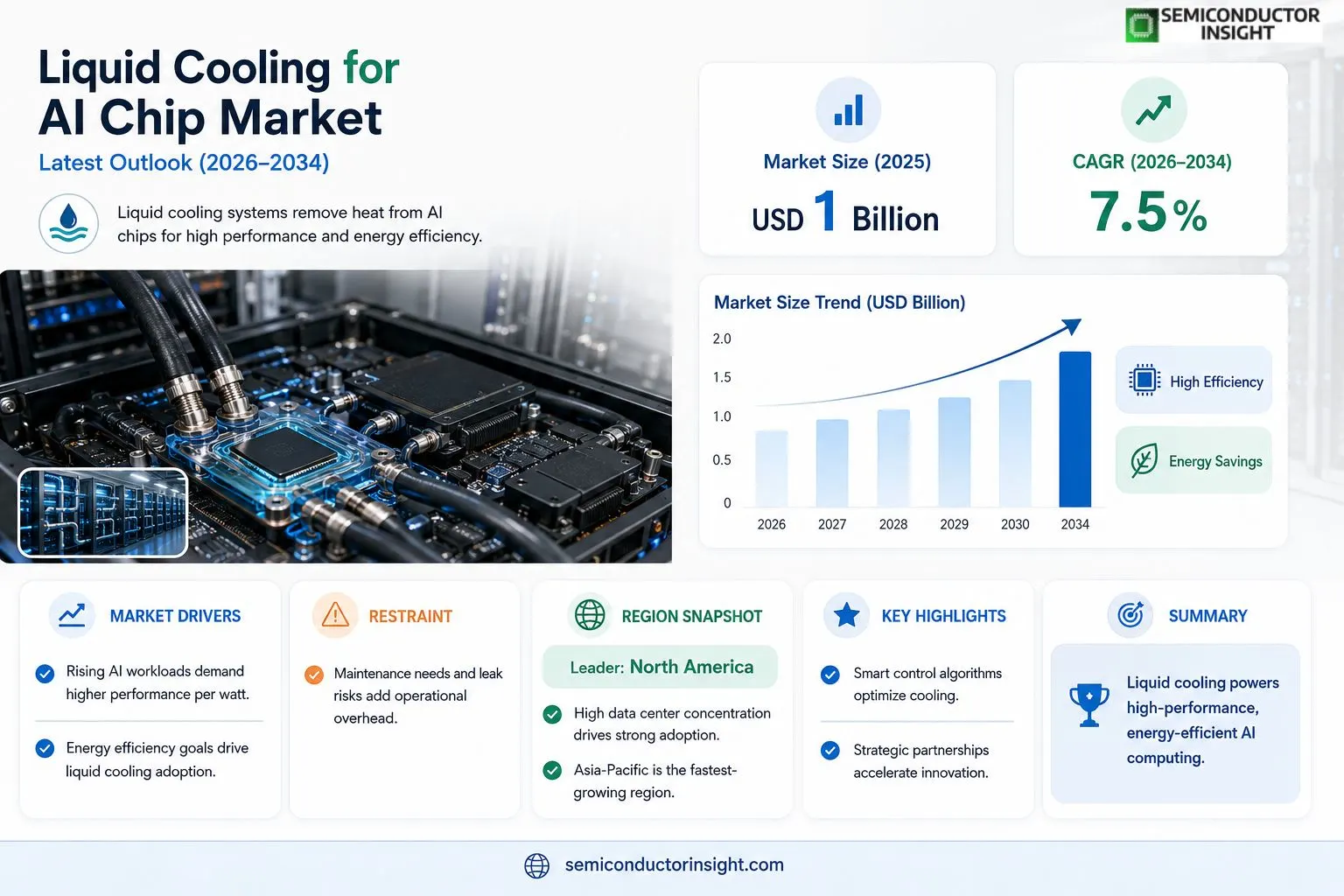
Global liquid cooling for AI chip market size was valued at USD 1 billion in 2025.The market is projected to grow from USD 1 billion in 2025 to USD 2 billion by 2034, exhibiting a CAGR of approximately 7½% during the forecast period.
Liquid cooling systems for AI chips employ high‑efficiency heat exchangers, dielectric fluids or two‑phase coolants that directly remove heat from densely packed processor dies.
This technology enables sustained performance under extreme computational loads while reducing energy consumption compared with traditional air‑based solutions.The market is accelerating because AI workloads demand ever‑higher power densities and continuous operation.
While manufacturers strive for greater throughput, thermal constraints pose a critical challenge; however, advances in pump design and smart control algorithms are expanding adoption.
Furthermore, leading players such as NVIDIA, AMD and CoolIT Systems are investing heavily in integrated cooling modules,NVIDIA announced a partnership with CoolIT Systems in early 2023 to co‑develop next‑generation GPU coolers.
This convergence of high‑performance computing and efficient thermal management fuels robust growth across data centers and edge deployments.
MARKET DRIVERS
Rising Demand for AI Compute Power
The surge in generative AI models and large‑scale neural networks is driving data‑center operators to seek higher performance per watt. Liquid Cooling for AI Chip Market solutions enable chips to operate at higher frequencies while maintaining thermal stability, directly supporting this compute expansion.
Energy Efficiency Imperatives
Energy‑intensive AI workloads are prompting firms to cut electricity costs and carbon footprints. Liquid‑cooling systems can lower overall power usage effectiveness (PUE) by up to 30 %, making them attractive for sustainability‑focused strategies.
➤ Adoption of liquid cooling reduces cooling‑related capital expenditures by allowing higher rack densities and fewer peripheral fans.
Furthermore, the growing ecosystem of compact high‑bandwidth interconnects aligns with liquid‑cooling architectures, reinforcing Liquid Cooling for AI Chip Market as a critical enabler of next‑generation AI infrastructure.
MARKET CHALLENGES
High Initial Capital Expenditure
Deploying liquid‑cooling loops requires specialized pumps, reservoirs, and heat exchangers, which represent a significant upfront cost compared with traditional air‑cooling solutions. This financial barrier can delay adoption, especially for smaller data‑center operators.
Other Challenges
Integration Complexity
Integrating liquid‑cooling modules with existing AI chip boards demands precise sealing and compatibility testing, increasing engineering effort and risk of leaks during early rollout phases.
MARKET RESTRAINTS
Maintenance and Reliability Concerns
Ongoing maintenance of coolant quality, pump reliability, and leak detection adds operational overhead. Enterprises that lack in‑house expertise may perceive these responsibilities as a restraint on scaling Liquid Cooling for AI Chip Market solutions across large fleets.
MARKET OPPORTUNITIES
Hybrid Cooling Architectures
Emerging hybrid designs that combine liquid cooling for high‑heat AI accelerators with conventional air cooling for peripheral components present a cost‑effective pathway. This approach widens the addressable market and offers a phased migration strategy for operators eager to capitalize on the performance gains of liquid cooling.
Liquid Cooling for AI Chip Market Trends
Accelerating Adoption in Data Centers
Global liquid cooling for AI chip market size was valued at USD 1 billion in 2025. The market is projected to reach USD 2 billion by 2034, reflecting strong demand for high‑efficiency thermal management as AI workloads increase power density and require continuous operation. Modern systems employ high‑efficiency heat exchangers, dielectric fluids or two‑phase coolants that directly extract heat from densely packed processor dies, enabling sustained performance under extreme computational loads. Compared with traditional air‑based solutions, liquid cooling reduces overall energy consumption, lowers total cost of ownership, and supports higher chip clock speeds without sacrificing reliability.
Other Trends
Integration of Smart Control Algorithms
Manufacturers are embedding sensors, telemetry and AI‑driven control loops into cooling modules. These smart algorithms continuously monitor temperature gradients and dynamically adjust pump speed, flow rate, and coolant pressure to maintain optimal thermal conditions. By fine‑tuning coolant delivery in real time, data‑center operators achieve up to 15 % further energy savings while protecting chips from thermal throttling during peak inference workloads.
Strategic Partnerships and Product Innovation
Key industry players such as NVIDIA, AMD and CoolIT Systems are investing heavily in integrated cooling solutions. NVIDIA announced a partnership with CoolIT Systems in early 2023 to co‑develop next‑generation GPU coolers that combine compact micro‑channel heat sinks with low‑viscosity dielectric fluids. AMD’s latest EPYC processors are being bundled with closed‑loop liquid cooling kits designed for edge AI deployments, where space constraints and power efficiency are paramount. These collaborations accelerate the rollout of turnkey liquid‑cooling platforms across hyperscale data centers, enterprise AI clusters, and emerging edge locations.Another notable development is the emergence of modular liquid‑cooling racks that allow operators to scale cooling capacity in line with AI workload growth. The modular design simplifies maintenance, reduces downtime, and provides flexibility to retrofit existing server infrastructure without extensive redesign. Together, these trends indicate a maturing ecosystem where liquid cooling is becoming a standard component of AI hardware architecture rather than a niche solution.
COMPETITIVE LANDSCAPEKey Industry Players
Competitive Overview of Liquid Cooling Solutions for AI Chips
The liquid‑cooling segment for AI chips is anchored by three dominant forces: GPU manufacturers that integrate thermal management into their product roadmaps, specialist cooling firms that supply high‑efficiency heat exchangers, and system integrators that bundle turnkey solutions for hyperscale data centers. NVIDIA leads the conversation through its strategic partnership with CoolIT Systems announced in early 2023, co‑developing a next‑generation GPU cooler that combines dielectric fluid immersion with active pump control. AMD follows a similar trajectory, embedding proprietary cooling modules into its MI series accelerators. CoolIT, as a pure‑play cooling provider, leverages its patents on two‑phase vapor chambers to capture a sizable share of the high‑performance AI workload market. Together, these players shape a market structure that privileges integrated design, high R‑R‑R (reliability, redundancy, and resilience), and scalable manufacturing, driving the forecasted growth from USD 1 billion in 2025 to USD 2 billion by 2034.Beyond the headline makers, a robust ecosystem of niche innovators fuels differentiation. Iceotope’s dielectric‑fluid immersion platforms target edge AI deployments where space constraints demand compact thermal solutions. Asetek supplies custom‑built water‑block assemblies that are popular with boutique AI server builders. Green Revolution Cooling focuses on sustainable, low‑power liquid loops for hyperscale facilities. Delta Electronics contributes advanced pump and fan assemblies, while Vertiv and Schneider Electric embed liquid‑cooling modules within their broader data‑center infrastructure portfolios. Regional specialists such as Beijing‑based Cool Solutions and Japan’s Thermocool add market depth, offering localized support and compliance with regional standards. Collectively, these firms expand the technology palette, encouraging broader adoption across both cloud and edge environments.
List of Key Liquid Cooling for AI Chip Companies Profiled
- NVIDIA
- AMD
- CoolIT Systems
- Iceotope
- Asetek
- Green Revolution Cooling
- Delta Electronics
- Vertiv
- Schneider Electric
- Cool Solutions
- Thermacool
- Intel (Thermal Division)
Segment Analysis:
| Segment Category | Sub-Segments | Key Insights |
| By Type |
|
Immersion Cooling is emerging as the dominant approach because it enables continuous heat extraction directly from the chip surface, preserving performance under sustained AI workloads.
|
| By Application |
|
Data Center Servers benefit most from liquid cooling because they host the highest density AI accelerators and demand uninterrupted performance.
|
| By End User |
|
Cloud Service Providers drive adoption as they operate massive AI fleets where thermal density is a primary constraint.
|
| By Deployment Environment |
|
On‑Premises Data Centers show the strongest preference for integrated liquid‑cooling modules due to greater control over infrastructure design.
|
| By Cooling Technology Integration |
|
Integrated GPU Modules are gaining traction as manufacturers embed coolant channels directly into the processor package.
|
Regional Analysis: North America
North America
The United States represents the largest market within North America for liquid cooling solutions for AI chips. Its robust AI research and development landscape, coupled with significant cloud computing investments, creates strong demand. Several key players are focused on innovation in immersion cooling and direct-to-chip liquid cooling technologies to address the power challenges of next-generation AI processors.
Canada’s growing AI sector, particularly in cities like Toronto and Montreal, is contributing to the increasing adoption of liquid cooling for AI chips. Government initiatives and investments in AI research are fostering a supportive environment for the growth of the thermal management market.
Mexico is witnessing a gradual increase in demand for liquid cooling solutions as its AI and data center industries expand. The country’s strategic location and growing manufacturing capabilities present opportunities for both domestic and international cooling solution providers.
Significant capital investment in artificial intelligence is a primary driver for the market. As AI adoption accelerates across various sectors, the need for high-performance and energy-efficient cooling solutions for AI chips will continue to rise.
North America
The North American market is characterized by a focus on high-performance liquid cooling technologies tailored for demanding AI workloads. The region’s technological leadership and significant investments in AI infrastructure are creating a strong demand for advanced thermal management solutions.
United States
The United States dominates the North American market, with a substantial number of AI chip manufacturers and data centers. The demand for liquid cooling in the US is driven by the increasing power density of AI processors and the need to maintain optimal system performance.
Canada
Canada’s AI ecosystem is rapidly expanding, creating new opportunities for liquid cooling solution providers. Government support for AI research and development is further fueling market growth.
Mexico
Mexico’s growing manufacturing sector and increasing adoption of AI technologies are contributing to the demand for liquid cooling solutions. The country presents a promising market for both domestic and international players.
Report Scope
This market research report provides a comprehensive analysis of the Liquid Cooling for AI Chip Market , covering the forecast period 2026–2034. It offers detailed insights into market dynamics, technological advancements, competitive landscape, and key trends shaping the industry.
Key focus areas of the report include:
- Market Overview: The report begins with an overview outlining its current market scenario, key growth indicators, and industry transformation drivers. It discusses macroeconomic factors, demand–supply balance, regulatory landscape, and the strategic role of semiconductors in powering advancements across industries such as automotive, telecommunications, consumer electronics, and industrial automation.
- Market Size & Forecast: Historical data and future projections for revenue, unit shipments, and market value across major regions and segments.
- Segmentation Analysis: Detailed breakdown by product type, technology, application, and end-user industry to identify high-growth segments and investment opportunities.
- Regional Insights: Insights into market performance across North America, Europe, Asia-Pacific, Latin America, and the Middle East & Africa, including country-level analysis where relevant.
- Competitive Landscape: Profiles of leading market participants, including their product offerings, R&D focus, manufacturing capacity, pricing strategies, and recent developments such as mergers, acquisitions, and partnerships.
- Technology Trends & Innovation: Assessment of emerging technologies, integration of AI/IoT, semiconductor design trends, fabrication techniques, and evolving industry standards.
- Market Drivers & Restraints: Evaluation of factors driving market growth along with challenges, supply chain constraints, regulatory issues, and market-entry barriers.
- Stakeholder Insights: Insights for component suppliers, OEMs, system integrators, investors, and policymakers regarding the evolving ecosystem and strategic opportunities.
Primary and secondary research methods are employed, including interviews with industry experts, data from verified sources, and real-time market intelligence to ensure the accuracy and reliability of the insights presented.
FREQUENTLY ASKED QUESTIONS:
What is the current market size of Liquid Cooling for AI Chip Market?
-> Liquid Cooling for AI Chip Market was valued at USD 1 billion in 2025 and is expected to reach USD 2 billion by 2034.
Which key companies operate in Liquid Cooling for AI Chip Market?
-> Key players include NVIDIA, AMD, and CoolIT Systems, among others.
What are the key growth drivers?
-> Key growth drivers include rising AI workloads demanding higher power densities, continuous operation requirements, and advances in pump design and smart control algorithms that improve cooling efficiency.
Which region dominates the market?
-> North America leads the market due to a high concentration of data centers, while Asia‑Pacific is the fastest‑growing region.
What are the emerging trends?
-> Emerging trends include integration of AI‑enabled smart cooling controls, adoption of two‑phase dielectric fluids, and modular cooling solutions for edge deployments.
Get Sample Report PDF for Exclusive Insights
Report Sample Includes
- Table of Contents
- List of Tables & Figures
- Charts, Research Methodology, and more...
 Download Sample Report PDF