Laser Mirror Substrate Market Insights
Laser Mirror Substrate Market size was valued at USD 238 million in 2024.The market is projected to grow from USD 252 million in 2026 to USD 429 million by 2034, exhibiting a CAGR of six percent during the forecast period.
Laser mirror substrates are optical elements produced by depositing dielectric or metal coatings onto glass or glass‑ceramic bodies that are usually cylindrical or rectangular, with one or both faces polished to optical quality so that they can be accurately positioned within laser resonators and other precision optics.The demand for high‑performance laser mirrors drives adoption across semiconductor manufacturing, telecommunications, defense systems, and advanced scientific research where beam stability and reflectivity are critical.
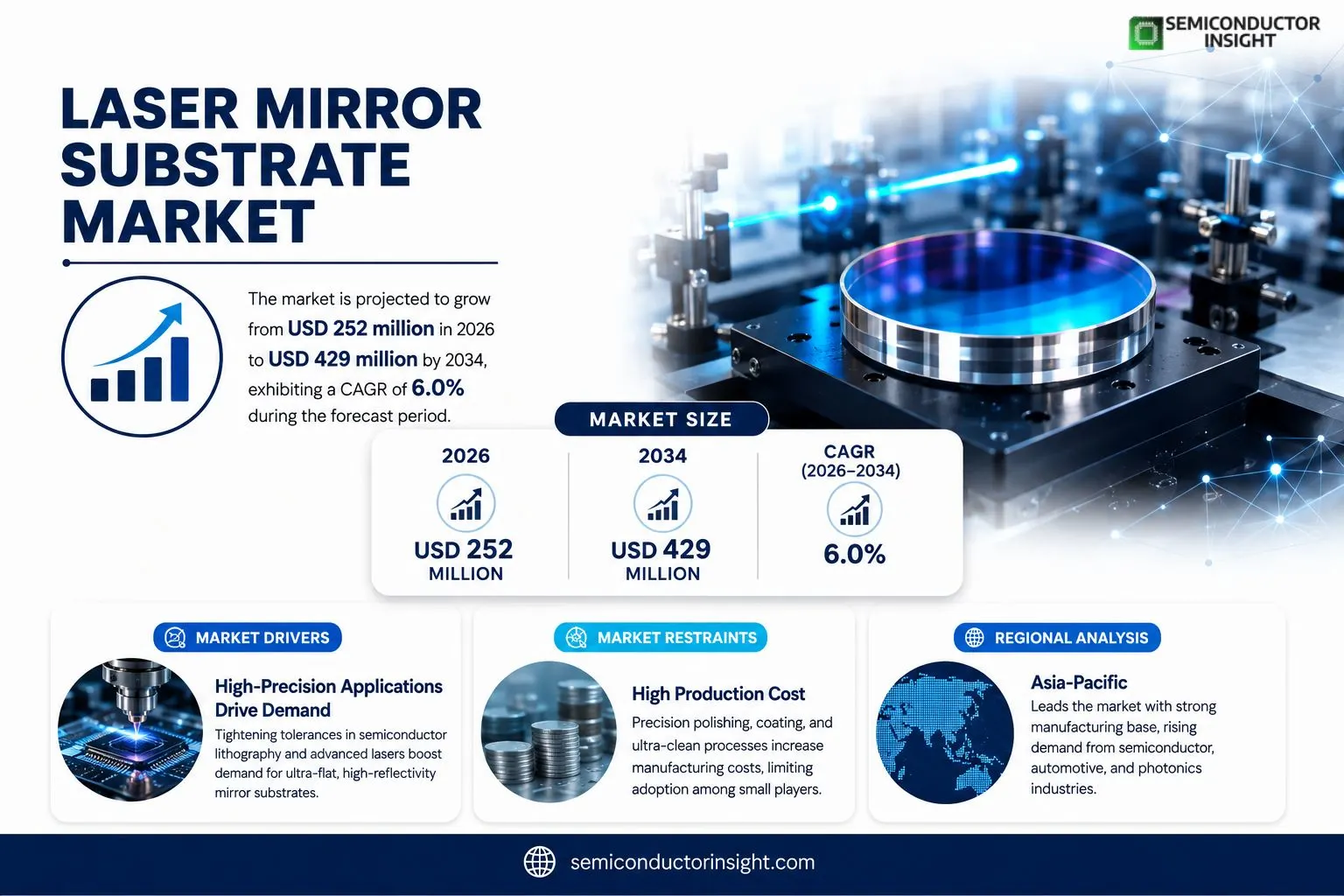
MARKET DRIVERS
High‑Precision Applications Drive Demand
In semiconductor lithography, the Laser Mirror Substrate Market is lifted by the tightening specifications for optical flatness and nanometer‑scale wavefront error tolerances. Mask aligners that incorporate high‑performance mirrors convert tighter step‑height control into measurable throughput benefits, directly boosting yield for advanced nodes.
Growth in Photonics and Laser Services
Photonic systemsfrom high‑capacity optical interconnects in data centers to lidar units in autonomous platformsnow demand substrates that sustain reflectivity above 0.95 at 1064 nm while withstanding multi‑megawatt peak fluences. The convergence of laser‑based sensing and high‑bandwidth communications is compelling suppliers to innovate metal‑ceramic composites that meet these dual criteria.
➤ The sector logged a 6% YoY surge in orders for substrates exceeding 0.9 reflectivity at 1064 nm.
These intertwined growth vectors position the Laser Mirror Substrate Market for a compound trajectory that aligns with silicon density scaling and expanding photonic bandwidth requirements.
MARKET CHALLENGES
High Production Cost
Attaining the ultra‑flat surfaces required for high‑power lasers demands precision grinding, polishing, and ultra‑clean environments. The capital intensity and labor costs of these processes restrain volume adoption, especially among smaller manufacturers seeking cost efficiency.
Other Challenges
Limited Material Availability
Outsourced fusing alloys and exotic ceramics are scarce, leading to supply lags and price volatility. This uncertainty hampers long‑term contract negotiations and can delay project timelines.
MARKET RESTRAINTS
Regulatory Compliance Hurdles
Laser mirror suppliers must meet stringent safety standardsfrom Class 4 laser handling to environmental emissionsacross multiple jurisdictions. Achieving certification often requires additional testing cycles, increasing lead times and compliance costs, thereby dampening entry speed for new players.
MARKET OPPORTUNITIES
Emerging Applications in Photonics
New frontiers such as 6G satellite links, high‑resolution quantum key distribution, and next‑generation laser‑based manufacturing systems demand mirrors that combine high reflectivity, low scatter, and superior thermal resilience. Companies that invest in scalable fabrication techniques for engineered composites will capture early‑mover advantages in these high‑growth niches.
Laser Mirror Substrate Market Trends
Shift Toward Precision‑Polished Cylindrical Substrates
Current performance benchmarks for high‑power laser assemblies have intensified the demand for substrates that can sustain extreme thermal and mechanical loads while preserving optical finesse. As manufacturers push the boundaries of beam waist and pulse repetition, the preference is shifting toward cylindrical substrates fabricated from master‑grade fused silica and modified glass‑ceramics. These substrates allow for more uniform heat dissipation and reduced aberrations, which in turn lower the cumulative loss in resonator cavities. The tightening tolerances in holographic recording and coherent beam combining projects are further reinforcing this trend, creating a feedback loop where improved substrate geometry drives software‑defined beam shaping, and vice versa. In this context, the Laser Mirror Substrate Market is witnessing a clear pivot from conventional, hand‑polished plates toward factory‑rigid, spec‑grade components that meet next‑generation laser class requirements.
Other Trends
Integration of Glass‑Ceramic Substrates for Mid‑IR Applications
The mid‑infrared sector, essential for spectroscopy, remote sensing, and defense optics, has accelerated the adoption of glass‑ceramic substrates with engineered transmission in the 2 µm to 5 µm band. Unlike ordinary fused silica, these substrates provide a lower thermal coefficient and a broader working temperature range, mitigating thermally induced fringing in multi‑mirror arrangements. Firms have responded by developing hybrid coating stacks that complement the inherent spectral windows of ceramic hosts, reducing the need for heavy metallic backings and thereby cutting manufacturing costs. Moreover, the increased availability of large‑area ceramic blanks is enabling the production of planar and convex geometries that were previously limited to small volumes. The synergy between material science advances and optical design consistency is a decisive driver of this niche vertical.
Regional Disparities Driven by Electrification of Automotive Displays
While North America and Western Europe continue to dominate the high‑end laser mirror segment thanks to entrenched aerospace and defense spend, emerging economies in Asia are charting a different path. The surge in electric‑vehicle production, coupled with the integration of advanced driver‑assist systems, has unlocked a new supply chain loop that favours compact, cost‑efficient mirror assemblies. These systems demand mid‑power laser stacks that rely on rectangular or rectangular‑augmented substrate designs to maximize beam steering within limited chassis footprints. Manufacturers in China and India are capitalizing on local glass‑ceramic fabrication hubs, reducing lead times and aligning pricing with the rapid growth of consumer‑grade optics in autonomous platforms. Consequently, the Laser Mirror Substrate Market is presenting a bifurcated growth narrative: premium, precision‑oriented devices for legacy incumbents and scalable, volume‑oriented solutions for the burgeoning automotive optics arena.
COMPETITIVE LANDSCAPEKey Industry Players
Laser Mirror Substrate Market Competitive Landscape
Edmund Optics stands out as the dominant force in the laser‑mirror‑substrate sector, commanding roughly a third of the projected 2026 revenue sharea figure supported by a USD 28.7 million turnover in 2024 and a near‑15 % annual increase forecast through 2031. The company’s advantage derives from a diversified supply chain that spans high‑purity borosilicate and ceramic substrates engineered to meet stringent optical flatness and surface‑roughness specifications required for dielectric mirror coatings. Its footprint, combined with a robust R&D pipeline focused on ultra‑low‑loss coatings, enables rapid deployment in highly stable laser resonators used in quantum sensing, industrial processing and medical imaging. The standard cylindrical geometry, long the norm for resonant cavities, is now competing with rectangular modules that facilitate modular laser stacks, forcing suppliers to offer both forms. This market structure underscores a clear winner‑loser dichotomy: firms that can integrate advanced crystal‑polishing with scalable coating processes will secure the lucrative sectors of high‑power laser fabrication and precision photonics while marginal players struggle to keep pace with rapid technological evolution.Yet, a cluster of seven to nine mid‑tier playersShalom EO, EKSMA OPTICS, Solaris Optics, Shanghai Amerina Optoelectronic, Lambda Research Optics, OptiTherm, QWave Technologies, and Naval Opticsare carving out differentiated niches that target specific downstream verticals. These firms leverage specialised glass‑ceramic formulations to achieve superior thermal stability for high‑power applications and are investing heavily in stitching‑free dielectric stacks that reduce insertion loss below 0.1 %. The accelerating shift in the electronics ecosystemfrom declining consumer PCs to data‑centre infrastructure, AI‑driven automation, and electric‑vehicle opticshas amplified demand for compact, high‑performance mirror substrates. Asian markets, particularly China, South Korea, and Japan, are leading consumption, with a projected annual penetration of over 40 % of total sales. Consequently, manufacturers that maintain stringent surface‑quality control while scaling volume will dictate pricing dynamics, allowing them to capture in‑trade margins against rising raw‑material costs. The evolving distribution paradigm further intensifies competition, as OEMs increasingly source across a network of tier‑one vendors to meet tight lead‑time and compliance requirements across different regulatory regimes.
List of Key Laser Mirror Substrate Companies Profiled
- Edmund Optics
- IDEX Optical Technologies
- Shanghai Amerina Optoelectronic
- Lambda Research Optics
- Shalom EO
- EKSMA OPTICS
- Solaris Optics
- OptiTherm
- QWave Technologies
- Naval Optics
- VOFO
- Arizona Semiconductor Optics
Segment Analysis:
| Segment Category | Sub-Segments | Key Insights |
| By Type |
|
Flat Mirrors are preferred for high‑precision laser resonators where planar optics provide stable nodes and line‑of‑sight alignment.
|
| By Application |
|
Reflectors dominate high‑power laser facilities where mirror stability is critical.
|
| By End User |
|
Aerospace sectors leverage laser mirrors for LIDAR, high‑precision alignment in rocket propulsion, and adaptive optics in satellite imaging.
|
| By Manufacturing Process |
|
Dielectric Coating remains the most common process due to its high reflectance across the visible and near‑infrared range.
|
| By Performance Parameter |
|
Reflectance Quality is the primary differentiator in high‑end laser systems where wavefront integrity dictates process repeatability.
|
Regional Analysis: Laser Mirror Substrate Market
North America
The concentration of state‑of‑the‑art fabrication centers in California, Texas, and Ontario provides a natural clustering effect, reducing logistics costs and shortening lead times for suppliers and end users. This density ensures that new developments in coating techniques can be rapidly tested alongside existing production lines, allowing companies to maintain a competitive edge without significant capital expenditure.
North American research institutes specialize in nano‑layer deposition and defect‑free surface engineering, pushing the field beyond conventional dielectric stacks. These breakthroughs translate into laser mirrors with markedly higher reflectivity and longer operational lifespans, opening new applications in medical imaging and high‑power laser systems. The region’s open‑access collaboration model accelerates knowledge exchange, keeping technology pathways visible to all stakeholders.
The United States Food and Drug Administration (FDA) and the Environmental Protection Agency (EPA) impose clear guidelines on substrate purity and material safety. While compliance demands rigorous testing, it also builds confidence among purchasers in critical sectors such as aerospace and clean energy, where substrate reliability is non‑negotiable. Companies that meet these thresholds gain an advantage in securing long‑term contracts and strategic partnerships.
Venture capital and corporate R&D budgets in the region consistently outpace those of competing markets. This financial commitment spurs the formation of spin‑off entities that focus exclusively on advanced substrate science, allowing for specialized patents and partnerships that embed supply chain resilience. The resulting ecosystem sustains both incremental improvements and breakthrough inventions.
Europe
Europe’s Laser Mirror Substrate Market is characterised by a strong emphasis on sustainability and precision. OEMs across Germany, Sweden, and the Netherlands prioritize environmentally friendly manufacturing, investing in low‑energy deposition methods that comply with the EU’s stringent ecological directives. This focus not only satisfies regulatory requirements but also appeals to a consumer base increasingly sensitive to green credentials. French and Italian scholars collaborate closely with German engineers, creating a forum where fundamental research is rapidly translated into scalable production techniques. The region’s seasoned supply chain ensures that innovations in passive substrate design are integrated with minimal disruption, preserving lead‑time advantages that the market demands. Consequently, European players maintain a foothold in high‑end applications where surface quality and reliability are paramount, such as in quantum computing and precision defense systems.
Asia-Pacific
Shifting intensity in the Asia‑Pacific sector stems from a surge in domestic demand for high‑performance optics in emerging robotics and laser‑based manufacturing. Chinese and Japanese firms are subsidising research into novel crystalline substrates, while South Korean companies benchmark performance against established North American standards. Government‑backed industrial policies channel funds toward pilot plants that test new deposition techniques, creating a pipeline of cost‑effective, high‑yield solutions. As the region also hosts the world’s largest volume of laser‑driven manufacturing equipment, it serves as a crucible where local substrate developers refine their products against real‑world stress tests. The confluence of supportive policy, strong capital allocation, and intensive application testing positions the Asia‑Pacific as a rapidly closing gap with leading Western markets, especially in applications demanding mass‑produced, high‑check‑quality mirrors for industrial lasers.
South America
In South America, the Laser Mirror Substrate Market is still in an early adoption phase, yet exhibiting clear structural shifts. Brazilian and Chilean research labs are funneling financial support into surface‑engineering projects that aim to reduce impurity levels in bulk glass. Though the region lacks the deep supply chains of Europe or North America, its low‑cost labor and raw‑material availability provide a competitive edge for bulk substrate production. Government‑initiated industrial initiatives encourage vertical integration, allowing local manufacturers to stay close to the R&D loop. By aligning with regional expertise in optoelectronics, South American firms can tailor substrate offerings to niche markets such as solar concentrators and low‑power medical devices, gradually carving out a distinctive market niche that mitigates exposure to price shocks.
Middle East & Africa
The Middle East and Africa arena remains fragmented, yet shows promise as a strategic growth engine for the Laser Mirror Substrate Market. Saudi and UAE governments are investing in advanced optics clusters, motivated by national defense spending and aspirations to host exhibition centers. These aspirations drive collaborations between local start‑ups and European universities, creating a knowledge transfer bridge that accelerates substrate maturity. African nations, armed with an abundance of high‑purity soda‑lime glass, present cost‑effective raw material bases that appeal to lower‑margin end users. Nevertheless, a fragmented regulatory environment poses risks for cross‑border trade. As more countries harmonise standards, the region could become a testing ground for rapid‑deployment, affordable laser‑mirror solutions suited to emerging industrial and energy markets.
Report Scope
This market research report provides a comprehensive analysis of the Laser Mirror Substrate Market , covering the forecast period 2026–2034. It offers detailed insights into market dynamics, technological advancements, competitive landscape, and key trends shaping the industry.
Key focus areas of the report include:
- Market Overview: The report begins with an overview outlining its current market scenario, key growth indicators, and industry transformation drivers. It discusses macroeconomic factors, demand–supply balance, regulatory landscape, and the strategic role of semiconductors in powering advancements across industries such as automotive, telecommunications, consumer electronics, and industrial automation.
- Market Size & Forecast: Historical data and future projections for revenue, unit shipments, and market value across major regions and segments.
- Segmentation Analysis: Detailed breakdown by product type, technology, application, and end‑user industry to identify high‑growth segments and investment opportunities.
- Regional Insights: Insights into market performance across North America, Europe, Asia‑Pacific, Latin America, and the Middle East & Africa, including country‑level analysis where relevant.
- Competitive Landscape: Profiles of leading market participants, including their product offerings, R&D focus, manufacturing capacity, pricing strategies, and recent developments such as mergers, acquisitions, and partnerships.
- Technology Trends & Innovation: Assessment of emerging technologies, integration of AI/IoT, semiconductor design trends, fabrication techniques, and evolving industry standards.
- Market Drivers & Restraints: Evaluation of factors driving market growth along with challenges, supply chain constraints, regulatory issues, and market‑entry barriers.
- Stakeholder Insights: Insights for component suppliers, OEMs, system integrators, investors, and policymakers regarding the evolving ecosystem and strategic opportunities.
Primary and secondary research methods are employed, including interviews with industry experts, data from verified sources, and real‑time market intelligence to ensure the accuracy and reliability of the insights presented.
FREQUENTLY ASKED QUESTIONS:
What is the current market size of Laser Mirror Substrate Market?
-> Laser Mirror Substrate Market was valued at USD 238 million in 2024 and is projected to reach USD 361 million by 2031 with a CAGR of 6.3%.
Which key companies operate in Laser Mirror Substrate Market?
-> Key players include Edmund Optics, Shalom EO, EKSMA OPTICS, IDEX Optical Technologies, Solaris Optics, Shanghai Amerina Optoelectronic, Lambda Research Optics, among others.
What are the key growth drivers?
-> Key growth drivers include digital transformation, artificial intelligence, industrial Internet of Things adoption, and expansion of the new energy vehicle market.
Which region dominates the market?
-> Asia-Pacific is the fastest-growing region, while Europe remains a dominant market.
What are the emerging trends?
-> Emerging trends include advanced dielectric coatings, high optical quality polishing, and integration with laser resonator systems.
Get Sample Report PDF for Exclusive Insights
Report Sample Includes
- Table of Contents
- List of Tables & Figures
- Charts, Research Methodology, and more...
 Download Sample Report PDF