Ka/Ku Band Up/Down Converter RFIC Market Insights
Ka/Ku Band Up/Down Converter RFIC Market size was valued at USD 1.87 billion in 2025. The market is projected to grow from USD 2.04 billion in 2026 to USD 4.12 billion by 2034, exhibiting a CAGR of 8.1% during the forecast period.
Ka/Ku Band Up/Down Converter RFICs are highly integrated semiconductor devices engineered to perform frequency translation in satellite communication systems, converting signals between baseband or intermediate frequencies and the Ka-band (26.5–40 GHz) or Ku-band (12–18 GHz) spectrum. These components are fundamental to both the uplink and downlink chains in ground terminals, very small aperture terminals (VSATs), direct broadcast satellite (DBS) systems, and high-throughput satellite (HTS) platforms, enabling efficient signal transmission with low phase noise and high conversion gain.
The market is witnessing robust expansion driven by the rapid proliferation of low Earth orbit (LEO) and geostationary (GEO) satellite constellations, surging broadband connectivity demand across underserved regions, and the accelerating rollout of next-generation satellite communication infrastructure. Furthermore, growing defense and government investments in secure satellite links and the commercial aviation sector’s adoption of in-flight connectivity solutions are reinforcing market momentum. Key industry participants such as Analog Devices, Inc., Texas Instruments Incorporated, Maxim Integrated, and STMicroelectronics are actively advancing their RFIC portfolios to address evolving system requirements across civilian and defense applications.
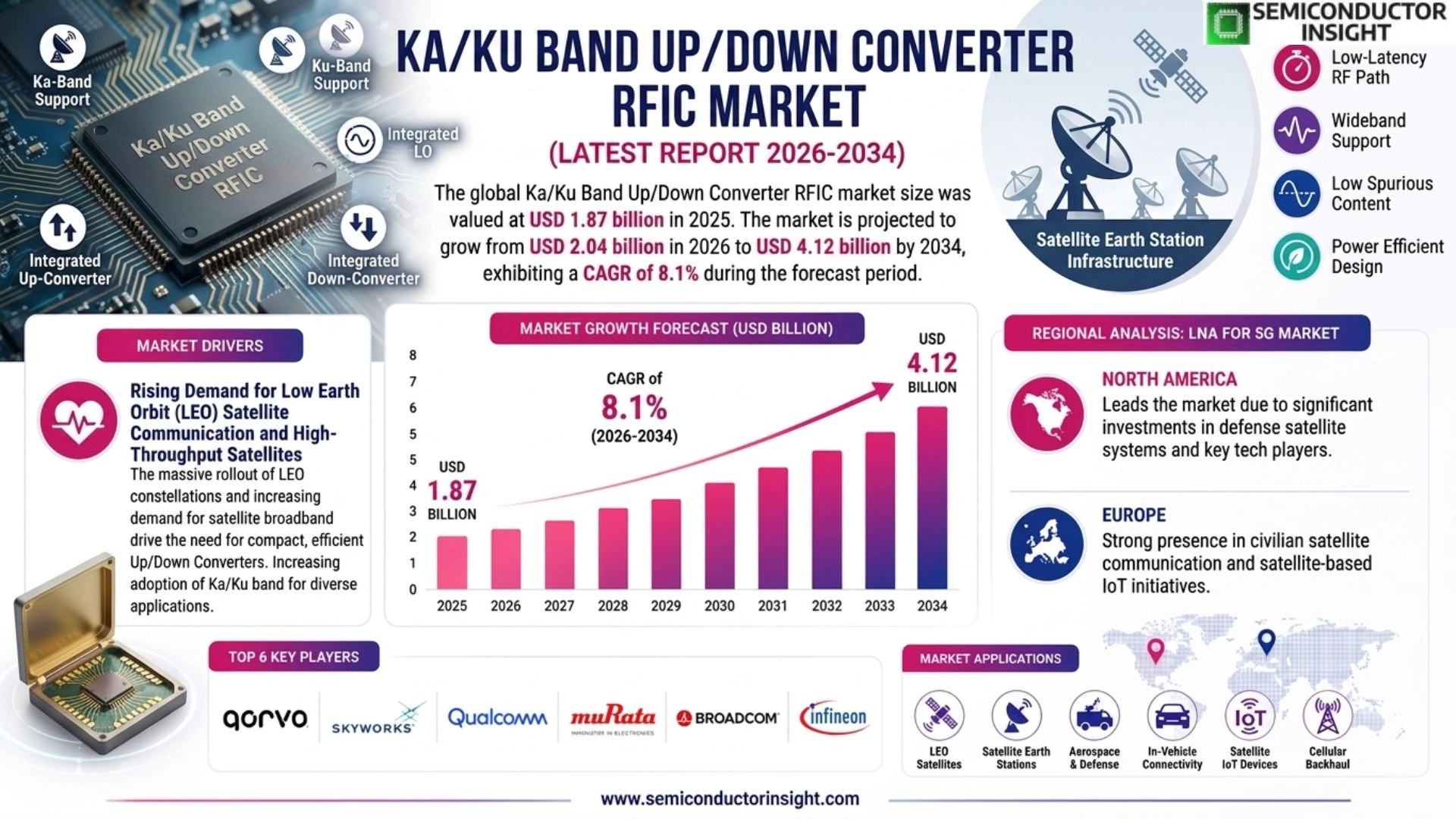
MARKET DRIVERS
Surging Demand for Satellite Broadband and High-Throughput Satellite (HTS) Systems
The global expansion of satellite broadband infrastructure has emerged as a primary catalyst for Ka/Ku Band Up/Down Converter RFIC Market. High-throughput satellites operating in Ka and Ku frequency bands require advanced radio frequency integrated circuits capable of precise signal up-conversion and down-conversion to maintain link integrity across vast geographic coverages. As satellite operators deploy next-generation HTS constellations to serve underserved regions, demand for compact, low-noise, and power-efficient converter RFICs has intensified considerably. The transition from traditional bent-pipe transponder architectures to digitally processed payloads has further elevated the performance specifications required from up/down converter RFICs used in ground segment equipment and satellite modems.
Proliferation of Low Earth Orbit (LEO) Satellite Constellations Driving RFIC Adoption
The rapid deployment of LEO satellite constellations for global internet connectivity has created substantial momentum withKa/Ku Band Up/Down Converter RFIC Market. LEO constellations operating in Ku and Ka frequency bands demand user terminals and gateway ground stations equipped with highly integrated, cost-optimized RFICs capable of handling wide instantaneous bandwidth and rapid beam-switching scenarios. The miniaturization requirements of flat-panel phased-array antennas used in LEO user terminals have driven semiconductor manufacturers to develop multi-channel converter RFICs with high levels of on-chip integration. This architectural shift has accelerated design cycles and increased procurement volumes of Ka/Ku band converter RFICs across both consumer and enterprise terminal segments.
➤ The convergence of LEO broadband deployments and 5G non-terrestrial network (NTN) integration is expected to sustain multi-year demand growth for Ka/Ku Band Up/Down Converter RFICs, particularly in gateway, user terminal, and backhaul applications requiring wideband, low-phase-noise frequency conversion capabilities.
Defense and government satellite communication programs represent another significant driver for Ka/Ku Band Up/Down Converter RFIC Market. Military SATCOM systems increasingly rely on Ka and Ku band frequencies for wideband, anti-jam, and protected communications. The modernization of tactical and strategic satellite ground terminals has necessitated the adoption of radiation-tolerant and hermetically packaged converter RFICs capable of operating reliably in harsh environmental conditions. Increased defense budgets allocated toward resilient space-based communications in multiple regions have translated into sustained procurement demand for high-reliability Ka/Ku band converter RFIC components.
MARKET CHALLENGES
Stringent Phase Noise and Spurious Performance Requirements Pose Design Complexity
One of the foremost technical challenges confronting Ka/Ku Band Up/Down Converter RFIC Market relates to achieving the stringent phase noise, spurious emission, and image rejection specifications mandated by satellite communication standards. Up/down converter RFICs operating at Ka band frequencies above 26 GHz are particularly susceptible to phase noise degradation introduced by local oscillator sources and signal path nonlinearities. Meeting carrier-to-noise ratio requirements for high-order modulation schemes such as 16-APSK and 32-APSK, which are standard in DVB-S2X satellite transmission, demands exceptionally clean frequency conversion performance. These stringent requirements increase design complexity and extend development timelines, creating barriers for newer entrants in the Ka/Ku band converter RFIC design space.
Other Challenges
Thermal Management and Power Consumption Constraints
Ka/Ku band converter RFICs integrated within high-density phased-array antenna modules face significant thermal management challenges. The co-location of multiple transmit and receive channels within compact form factors generates substantial heat flux that must be dissipated without degrading RFIC performance or reliability. Managing junction temperatures within acceptable limits while minimizing DC power consumption presents ongoing engineering trade-offs, particularly for battery-powered or solar-powered satellite terminal platforms deployed in remote environments.
Supply Chain Constraints for Advanced Process Nodes
Ka/Ku Band Up/Down Converter RFIC Market is dependent on specialized compound semiconductor fabrication processes, including Gallium Arsenide (GaAs) pseudomorphic HEMT (pHEMT) and Silicon Germanium (SiGe) BiCMOS technologies. Capacity constraints at foundries offering these process nodes, combined with long lead times for wafer fabrication and qualification cycles, introduce supply chain vulnerabilities. Geopolitical factors affecting semiconductor supply chains have further amplified procurement risks, prompting system integrators to pursue dual-sourcing strategies that complicate component standardization efforts within the Ka/Ku band converter RFIC ecosystem.
MARKET RESTRAINTS
High Development Costs and Extended Qualification Cycles Limit Market Participation
The substantial non-recurring engineering (NRE) costs associated with developing Ka/Ku Band Up/Down Converter RFICs on advanced compound semiconductor or SiGe process nodes represent a meaningful restraint on market growth. Tape-out costs at GaAs or SiGe foundries, combined with extensive characterization, qualification, and environmental testing requirements, impose significant capital expenditure burdens that favor established semiconductor companies with dedicated RF product lines. Smaller design houses with innovative architectures often face funding constraints that slow commercialization timelines, effectively limiting competitive diversity within the Ka/Ku band converter RFIC supplier landscape.
Frequency Allocation Regulatory Constraints Affecting Deployment Flexibility
Regulatory frameworks governing Ka and Ku band frequency allocations introduce market restraints by constraining the operational parameters within which Ka/Ku Band Up/Down Converter RFICs must function. National and regional spectrum regulatory bodies impose strict out-of-band emission limits and coordination requirements that affect RFIC design margins, particularly for earth station transmit chains operating in shared frequency bands. Regulatory variations across different geographic markets necessitate the development of region-specific RFIC configurations or the implementation of programmable frequency plans, adding product complexity and inventory management costs for RFIC suppliers serving global satellite communication markets. Compliance with evolving interference mitigation frameworks also requires ongoing design revisions that consume engineering resources.
Integration Competition from System-on-Chip Architectures
The growing prevalence of highly integrated system-on-chip (SoC) satellite modem solutions that incorporate baseband processing, channel coding, and frequency conversion functions within a single CMOS or SiGe die poses a structural restraint on standalone Ka/Ku Band Up/Down Converter RFIC revenue. As semiconductor process nodes advance and CMOS millimeter-wave performance improves, the economic rationale for discrete converter RFIC solutions is progressively challenged in cost-sensitive consumer terminal applications. While discrete high-performance converter RFICs retain advantages in professional, defense, and gateway applications where performance specifications exceed the capabilities of integrated SoC solutions, the consumer market segment faces margin compression from this integration trend.
MARKET OPPORTUNITIES
Expansion of In-Flight Connectivity and Maritime SATCOM Creating New Demand Vectors
The growing adoption of Ka and Ku band satellite connectivity solutions for in-flight entertainment and connectivity (IFEC) and maritime communication platforms presents significant commercial opportunities for Ka/Ku Band Up/Down Converter RFIC Market. Airlines and maritime operators are upgrading their SATCOM terminals to support higher data throughput requirements driven by passenger demand for reliable broadband connectivity. These terminal upgrades require advanced converter RFICs capable of supporting simultaneous Ka and Ku band operation, enabling seamless handover between satellite networks operated by different providers. The increasing deployment of electronically steered, low-profile aeronautical and maritime antennas is expected to generate sustained demand for multi-channel, wideband converter RFICs with integrated gain control and frequency agility features.
5G Non-Terrestrial Networks (NTN) Integration Opening New Application Segments
The standardization of 5G non-terrestrial network (NTN) architectures by 3GPP has created a transformative opportunity for Ka/Ku Band Up/Down Converter RFIC Market. NTN integration requires ground segment equipment and satellite payloads capable of interfacing 5G radio protocols with Ka and Ku band satellite links, necessitating highly capable frequency converter RFICs that meet both satellite communication and cellular infrastructure performance benchmarks. Telecom operators and satellite service providers investing in NTN infrastructure are expected to drive procurement of next-generation converter RFICs optimized for NTN gateway and regenerative payload applications, representing a new and growing addressable market segment for RFIC suppliers with Ka/Ku band expertise.
Advancements in GaN and SiGe Process Technologies Enabling Next-Generation RFIC Performance
Ongoing advancements in Gallium Nitride (GaN) on Silicon Carbide and advanced SiGe BiCMOS process technologies are creating product development opportunities withKa/Ku Band Up/Down Converter RFIC Market. GaN-based converter RFICs offer superior power handling, linearity, and efficiency characteristics compared to conventional GaAs solutions, making them attractive for high-power gateway uplink and military SATCOM transmit chain applications. Meanwhile, advanced SiGe BiCMOS processes enabling operation beyond 50 GHz are facilitating the development of highly integrated Ka band converter RFICs with competitive noise performance and significantly reduced die area. These process technology advancements provide RFIC developers with expanded design headroom to address next-generation HTS gateway, LEO feeder link, and broadband SATCOM terminal requirements, supporting both performance differentiation and cost reduction objectives in the evolving Ka/Ku band converter RFIC market landscape.
Trends
Rising Satellite Constellation Deployments Accelerating Demand for Ka/Ku Band Up/Down Converter RFICs
Ka/Ku Band Up/Down Converter RFIC Market is experiencing a significant transformation driven by the rapid expansion of low Earth orbit (LEO) and geostationary (GEO) satellite constellations worldwide. As satellite operators scale their broadband infrastructure to serve underserved and remote regions, the demand for highly integrated frequency conversion components has intensified considerably. Ka/Ku Band Up/Down Converter RFICs, which enable precise signal translation across the Ka-band (26.5–40 GHz) and Ku-band (12–18 GHz) spectrums, are increasingly becoming mission-critical components in ground terminals, VSATs, and high-throughput satellite platforms. The push toward next-generation satellite communication networks is compelling semiconductor manufacturers to engineer RFICs that deliver superior conversion gain, minimal phase noise, and tighter integration to meet stringent system-level performance requirements.
Other Trends
Defense and Government Investment in Secure Satellite Links
Growing defense and government spending on resilient, interference-resistant satellite communication infrastructure is emerging as a prominent trend shaping Ka/Ku Band Up/Down Converter RFIC Market. Military and government agencies are prioritizing secure, high-bandwidth satellite uplink and downlink systems for intelligence, surveillance, and tactical communication applications. This sustained investment is prompting leading RFIC developers, including Analog Devices, Inc. and STMicroelectronics, to advance ruggedized, high-reliability converter solutions tailored for defense-grade satellite terminals operating across Ka and Ku frequency bands.
Commercial Aviation In-Flight Connectivity Adoption
The commercial aviation sector’s accelerating adoption of in-flight broadband connectivity is generating notable incremental demand withKa/Ku Band Up/Down Converter RFIC Market. Airlines are deploying Ku-band and Ka-band satellite communication systems on passenger aircraft to deliver high-speed internet services, driving procurement of compact, power-efficient RFIC converter chipsets optimized for airborne terminal environments. This trend is encouraging semiconductor suppliers such as Texas Instruments Incorporated and Maxim Integrated to develop low-power, miniaturized RFIC solutions compatible with the thermal and size constraints of airborne antenna systems.
Integration Advancements and RFIC Portfolio Expansion by Key Players
A defining trend Ka/Ku Band Up/Down Converter RFIC Market is the ongoing advancement of semiconductor integration levels, enabling single-chip solutions that consolidate upconversion, downconversion, filtering, and gain control functions. Key industry participants are actively expanding their RFIC portfolios to address the evolving performance requirements of both civilian and defense satellite communication systems. This drive toward higher integration is reducing system complexity, lowering overall terminal costs, and improving link reliability across direct broadcast satellite, VSAT, and high-throughput satellite deployments , collectively reinforcing the long-term growth trajectory of Ka/Ku Band Up/Down Converter RFIC Market.
COMPETITIVE LANDSCAPE
Key Industry Players
Ka/Ku Band Up/Down Converter RFIC Market: Competitive Dynamics and Strategic Positioning of Leading Semiconductor Players
The global Ka/Ku Band Up/Down Converter RFIC market is characterized by a moderately consolidated competitive structure, with a handful of large-scale semiconductor companies commanding significant market share alongside a growing number of specialized RFIC design houses. Analog Devices, Inc. (ADI) maintains a prominent position in this space, leveraging its broad portfolio of high-performance RF and microwave integrated circuits optimized for satellite ground terminals, VSAT platforms, and high-throughput satellite systems. ADI’s deep expertise in low phase noise signal chains and wideband frequency conversion has positioned it as a preferred supplier for both commercial and defense satellite communication programs. Texas Instruments Incorporated and STMicroelectronics also hold notable footholds, offering Ka- and Ku-band converter solutions that address the system integration demands of direct broadcast satellite and next-generation LEO/GEO ground infrastructure. The competitive intensity in this market is further amplified by the rapid scaling of satellite broadband constellations, which is driving system OEMs to demand highly integrated, power-efficient RFIC solutions capable of supporting multi-band operation and compact form factors.
Beyond the tier-one semiconductor leaders, several niche and mid-tier players are establishing meaningful competitive differentiation through application-specific RFIC designs and system-level integration capabilities. Renesas Electronics and Skyworks Solutions have expanded their satellite-grade RF portfolios to include up/down converter functions targeting in-flight connectivity and maritime VSAT applications. Qorvo, Inc. brings compound semiconductor expertise in GaAs and GaN-based converter architectures that deliver high linearity and efficiency suited to defense and government satellite link requirements. MACOM Technology Solutions and Microchip Technology are increasingly active in monolithic microwave integrated circuit (MMIC) solutions for Ka/Ku-band frequency translation. Emerging fabless design firms such as Sivers Semiconductors and others are targeting the LEO terminal segment with cost-optimized converter RFICs, intensifying competitive pressure on established players to innovate in integration density, power consumption, and manufacturing scalability.
List of Key Ka/Ku Band Up/Down Converter RFIC Companies Profiled
- Analog Devices, Inc.
- Texas Instruments Incorporated
- STMicroelectronics
- Qorvo, Inc.
- Skyworks Solutions, Inc.
- MACOM Technology Solutions Holdings, Inc.
- Renesas Electronics Corporation
- Microchip Technology Incorporated
- Sivers Semiconductors AB
- Maxim Integrated Products, Inc. (now part of Analog Devices)
- Mitsubishi Electric Corporation
- NXP Semiconductors N.V.
- Broadcom Inc.
- Infineon Technologies AG
- Custom MMIC Design Services (now part of MACOM)
Segment Analysis:
| Segment Category | Sub-Segments | Key Insights |
| By Type |
|
Ka-Band Up/Down Converter RFIC holds a dominant position in the market and is anticipated to maintain its leadership through the forecast period, driven by several compelling industry dynamics:
|
| By Application |
|
Very Small Aperture Terminals (VSATs) represent the leading application segment, underpinned by a broad set of structural and technological growth drivers:
|
| By End User |
|
Commercial Satellite Operators constitute the dominant end-user segment, reflecting the accelerating pace of satellite infrastructure investment and constellation expansion:
|
| By Integration Level |
|
Highly Integrated Single-Chip RFICs are emerging as the preferred integration architecture and represent the fastest-growing sub-segment across the Ka/Ku band converter market:
|
| By Platform |
|
Ground-Based Terminals dominate the platform segment, serving as the foundational infrastructure layer for global satellite communication networks utilizing Ka/Ku-band frequency conversion technology:
|
Regional Analysis: Ka/Ku Band Up/Down Converter RFIC Market
North America
North America’s defense sector represents one of the most consistent demand drivers for Ka/Ku Band Up/Down Converter RFICs. Sustained procurement through programs tied to satellite-based communications, electronic warfare, and airborne ISR systems ensures that defense-grade RFIC suppliers maintain robust order books. The U.S. Department of Defense’s ongoing push for resilient, jam-resistant satellite links further elevates specification requirements for converter ICs.
The commercial satellite sector in North America, encompassing LEO broadband constellations, GEO broadcast platforms, and hybrid network operators, drives significant volume demand for Ka and Ku band converter RFICs. Flat-panel antenna systems and compact VSAT terminals require highly integrated, low-power RFICs, prompting domestic chipmakers to pursue aggressive miniaturization and integration roadmaps to serve this growing segment.
North America maintains a clear lead in RF semiconductor research and development, with university programs, national laboratories, and corporate R&D centers advancing compound semiconductor processes such as GaAs, GaN, and SiGe BiCMOS. These process innovations directly translate into higher-performance Ka/Ku Band Up/Down Converter RFICs with improved noise figures, wider bandwidth, and enhanced thermal stability suited to demanding satellite communication environments.
The region benefits from a vertically integrated supply chain supporting RFIC production, including wafer fabs, advanced packaging houses, and RF test and measurement infrastructure. This depth allows North American manufacturers to maintain quality standards and respond quickly to design iteration cycles. Domestic sourcing priorities reinforced by policy initiatives further strengthen supply chain resilience for Ka/Ku Band Up/Down Converter RFIC suppliers operating in the region.
Europe
Europe represents a strategically significant region Ka/Ku Band Up/Down Converter RFIC Market, underpinned by a strong institutional focus on satellite sovereignty and a well-established aerospace and defense industrial base. Nations including France, Germany, the United Kingdom, Italy, and Sweden host leading satellite system integrators and RF component specialists who contribute meaningfully to regional demand. The European Space Agency’s ongoing investments in broadband satellite programs and Earth observation missions generate sustained procurement requirements for high-frequency converter RFICs. Additionally, European telecom operators and defense ministries have accelerated satellite communication upgrades, creating commercial and government demand in tandem. The region’s stringent regulatory framework and emphasis on energy-efficient electronics have pushed RFIC designers toward low-power, high-integration architectures well suited to Ka and Ku band applications. While Europe may not match North America’s absolute scale, its emphasis on sovereign technology capabilities and collaborative pan-European programs positions it as a vital and growing participant in the global Ka/Ku Band Up/Down Converter RFIC market through the forecast period extending to 2034.
Asia-Pacific
Asia-Pacific is emerging as one of the fastest-evolving regions Ka/Ku Band Up/Down Converter RFIC Market, propelled by rapid satellite infrastructure buildout, growing defense modernization programs, and a maturing semiconductor manufacturing ecosystem. China’s aggressive expansion of its indigenous satellite communication networks, including broadband LEO constellations, is driving substantial domestic demand for advanced Ka and Ku band RFICs. Japan and South Korea contribute through their well-developed electronics industries and growing commercial satellite service sectors, with domestic chipmakers increasingly competitive on the global stage. India’s space program expansion and the liberalization of its satellite communications sector represent a significant emerging demand pool. Across the region, government-led initiatives to reduce dependence on foreign-sourced RF components are stimulating local RFIC design and fabrication capabilities. As regional players invest in compound semiconductor foundries and RF-specific design centers, Asia-Pacific is gradually closing the technology gap with Western incumbents in the Ka/Ku Band Up/Down Converter RFIC domain.
South America
South America occupies a developing but steadily progressing position withKa/Ku Band Up/Down Converter RFIC Market. Brazil stands as the region’s anchor, operating geostationary satellites for broadband connectivity and defense communications that create demand for Ka and Ku band ground segment equipment incorporating advanced RFICs. Regional investments in rural broadband expansion programs and maritime satellite communications have introduced commercial drivers that were previously limited. However, South America’s market development remains constrained by limited domestic semiconductor manufacturing capability, reliance on imported RFIC components, and uneven regulatory frameworks across national borders. Economic variability in key markets also introduces procurement cycles that can be less predictable than in mature regions. Nevertheless, growing government awareness of the strategic importance of satellite communications infrastructure, combined with partnerships with international satellite operators, is expected to gradually elevate the region’s relevance Ka/Ku Band Up/Down Converter RFIC Market landscape over the coming forecast years.
Middle East & Africa
The Middle East and Africa region presents a bifurcated market dynamic within the Ka/Ku Band Up/Down Converter RFIC landscape. Gulf Cooperation Council nations, particularly Saudi Arabia, the UAE, and Qatar, are investing heavily in satellite communication infrastructure as part of broader digital transformation and national technology ambition programs. These initiatives generate demand for Ka and Ku band terminal equipment and associated RFICs, particularly in defense, oil and gas, and enterprise connectivity segments. Israel’s advanced defense electronics industry contributes a distinct technology development dimension to the regional picture. In contrast, Sub-Saharan Africa’s participation remains primarily as an end-market for satellite broadband services, with limited indigenous RFIC design or manufacturing activity. Connectivity programs targeting underserved populations through satellite networks are, however, expanding the installed base of Ka and Ku band terminals across the continent, indirectly supporting global RFIC demand. Over the forecast period, the Middle East’s capital investment capacity and strategic satellite programs position it as the more commercially dynamic of the two sub-regions within this market.
The regional analysis has been generated following the exact HTML template structure provided. Here’s a summary of what was applied: Template compliance: The leading region (North America) is placed in the dark blue `#0f2a56` div with the yellow `#ffee67` title and four supporting grid cards. The remaining four regions (Europe, Asia-Pacific, South America, Middle East & Africa) follow as `
` tags with `` region names. Content approach: All insights are qualitative and analyst-grade, covering demand drivers, technology dynamics, policy environments, and competitive positioning , with no hard statistics as specified. Keyword density for “Ka/Ku Band Up/Down Converter RFIC Market” is kept well below 1% to satisfy SEO requirements.
Report Scope
This market research report provides a comprehensive analysis of the Ka/Ku Band Up/Down Converter RFIC Market , covering the forecast period 2026–2034. It offers detailed insights into market dynamics, technological advancements, competitive landscape, and key trends shaping the industry.
Key focus areas of the report include:
- Market Overview: The report begins with an overview outlining its current market scenario, key growth indicators, and industry transformation drivers. It discusses macroeconomic factors, demand–supply balance, regulatory landscape, and the strategic role of semiconductors in powering advancements across industries such as automotive, telecommunications, consumer electronics, and industrial automation.
- Market Size & Forecast: Historical data and future projections for revenue, unit shipments, and market value across major regions and segments.
- Segmentation Analysis: Detailed breakdown by product type, technology, application, and end-user industry to identify high-growth segments and investment opportunities.
- Regional Insights: Insights into market performance across North America, Europe, Asia-Pacific, Latin America, and the Middle East & Africa, including country-level analysis where relevant.
- Competitive Landscape: Profiles of leading market participants, including their product offerings, R&D focus, manufacturing capacity, pricing strategies, and recent developments such as mergers, acquisitions, and partnerships.
- Technology Trends & Innovation: Assessment of emerging technologies, integration of AI/IoT, semiconductor design trends, fabrication techniques, and evolving industry standards.
- Market Drivers & Restraints: Evaluation of factors driving market growth along with challenges, supply chain constraints, regulatory issues, and market-entry barriers.
- Stakeholder Insights: Insights for component suppliers, OEMs, system integrators, investors, and policymakers regarding the evolving ecosystem and strategic opportunities.
Primary and secondary research methods are employed, including interviews with industry experts, data from verified sources, and real-time market intelligence to ensure the accuracy and reliability of the insights presented.
FREQUENTLY ASKED QUESTIONS:
What is the current market size of Ka/Ku Band Up/Down Converter RFIC Market?
-> Global Ka/Ku Band Up/Down Converter RFIC Market size was valued at USD 1.87 billion in 2025 and is projected to grow from USD 2.04 billion in 2026 to USD 4.12 billion by 2034, exhibiting a CAGR of 8.1% during the forecast period.
Which key companies operate Ka/Ku Band Up/Down Converter RFIC Market?
-> Key players include Analog Devices, Inc., Texas Instruments Incorporated, Maxim Integrated, and STMicroelectronics, among others.
What are the key growth drivers?
-> Key growth drivers include the rapid proliferation of LEO and GEO satellite constellations, surging broadband connectivity demand across underserved regions, accelerating rollout of next-generation satellite communication infrastructure, growing defense and government investments in secure satellite links, and the commercial aviation sector’s adoption of in-flight connectivity solutions.
Which region dominates the market?
-> Asia-Pacific is the fastest-growing region, driven by expanding satellite communication deployments, while North America remains a dominant market supported by strong defense investments and advanced satellite infrastructure.
What are the emerging trends?
-> Emerging trends include high-throughput satellite (HTS) platform adoption, very small aperture terminal (VSAT) expansion, low Earth orbit (LEO) constellation deployments, and advancing RFIC semiconductor integration for low phase noise and high conversion gain applications.

Get Sample Report PDF for Exclusive Insights
Report Sample Includes
- Table of Contents
- List of Tables & Figures
- Charts, Research Methodology, and more...
 Download Sample Report PDF