Isolated RS-485 Transceivers Market Insights
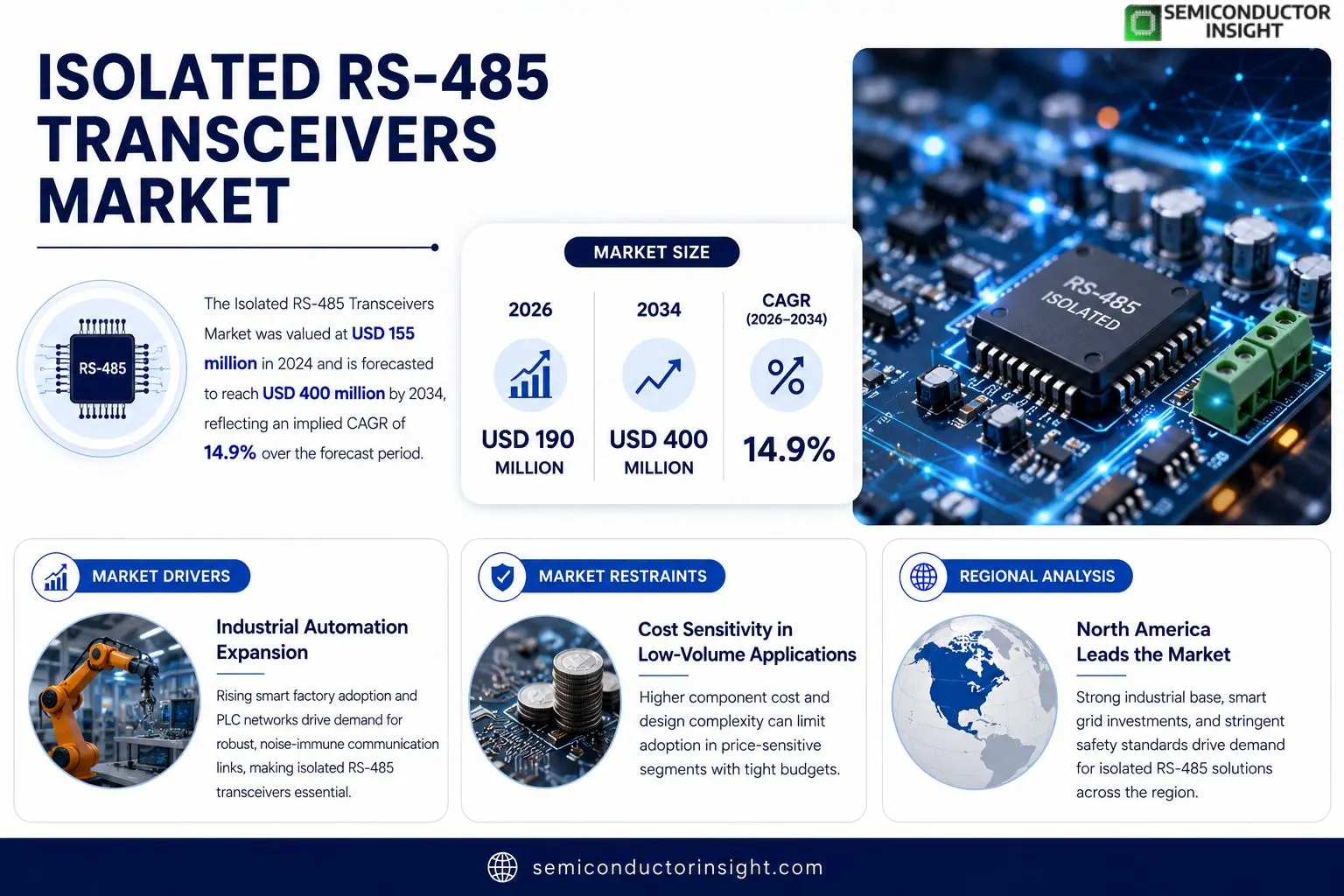
Isolated RS‑485 Transceivers Market was valued at USD 155 million in 2024 and is forecasted to reach USD 400 million by 2034, reflecting an implied CAGR of 14.9 % over the period.
Isolated RS‑485 Transceivers provide galvanic isolation between driver and receiver circuits; they are fail‑safe, delivering a high output when the receiver input is open or shorted.The expansion is linked to rising adoption of industrial automation, smart grid deployments, and automotive communication networks that demand robust noise immunity. Recent activity includes Analog Devices’ launch of a new isolated half‑duplex family in early 2024, while Texas Instruments announced an integrated solution targeting photovoltaic applications later that year. Other notable contributors such as Renesas and Shanghai Chipanalog Microelectronics continue to broaden their portfolios, reinforcing competitive pressure across the segment.
MARKET DRIVERS
Industrial Automation Expansion
The rise of smart factories has created a demand for reliable communication links that can survive harsh electrical environments. Isolated RS-485 transceivers provide the necessary protection against common‑mode noise, making them a preferred choice for PLC networks and motion‑control loops. As manufacturers adopt Ethernet‑compatible field buses, the need for galvanic isolation grows in parallel.
Electric Vehicle Infrastructure
Charging stations and battery‑management systems rely on long‑distance serial links to monitor cell health and power flow. The intrinsic safety offered by isolation helps meet stringent automotive standards, prompting vendors to integrate these devices into new charger designs. This trend is reinforced by government incentives that accelerate EV rollout.
➤ “Isolation is no longer an optional add‑on; it has become a baseline requirement for any rugged serial interface.”
Beyond heavy industry, the rise of IoT gateways in remote locationssuch as oil rigs and agricultural fieldsadds another layer of demand. Field devices often operate on separate power domains, and isolated transceivers prevent ground loops that could corrupt data streams, thereby safeguarding overall system uptime.
MARKET CHALLENGES
Cost Sensitivity in Low‑Volume Applications
Small‑scale equipment manufacturers frequently face tight budget constraints. While isolation delivers performance benefits, the additional component cost can deter adoption in price‑driven market segments, especially where alternative shielding techniques appear sufficient.
Other Challenges
Design Complexity
Integrating isolated transceivers often requires careful PCB layout to maintain isolation voltage ratings. Engineers must balance trace spacing, dielectric strength, and decoupling strategies, which can extend development cycles and increase validation effort.
MARKET RESTRAINTS
Stringent Certification Requirements
Products destined for aerospace, medical, or railway applications must clear multiple safety and electromagnetic compatibility certifications. The documentation and testing burden associated with isolation devices adds lead time, making some OEMs reluctant to qualify new parts unless a clear performance advantage is demonstrated.
MARKET OPPORTUNITIES
Growth of 5G‑Enabled Edge Nodes
The rollout of 5G gateways at the network edge creates a niche for robust serial interfaces that can bridge legacy sensors to high‑speed backhaul. Isolated RS-485 transceivers enable these nodes to operate reliably in electrically noisy environments while preserving data integrity across long cable runs.
Renewable Energy Integration
Wind turbines and solar inverters increasingly use distributed monitoring systems that rely on serial communication. The harsh outdoor conditionsincluding voltage spikes from lightningmake galvanic isolation a critical safeguard, positioning isolated transceivers as a strategic component in the clean‑energy supply chain.
Isolated RS-485 Transceivers Market Trends
Growing Adoption in Industrial Automation
The Isolated RS-485 Transceivers market recorded a valuation of roughly $155 million in 2024. Over the next seven years, the sector is forecast to climb to about $400 million, reflecting an annual growth pace of close to 15 percent. This trajectory is anchored in the expanding demand for reliable, fault‑tolerant communication links across factory floors, where harsh electrical environments make galvanic isolation a non‑negotiable requirement. Manufacturers are integrating these devices into programmable logic controllers and sensor networks to safeguard data integrity, a move that trims downtime and reduces warranty costs.
Other Trends
Safety‑Critical Applications
Transportation systems and medical equipment increasingly rely on isolated transceivers because a single short circuit can jeopardize human safety. In automotive chassis networks, the isolation barrier prevents high‑voltage spikes from propagating to low‑voltage control modules. Similarly, imaging devices in hospitals use the fail‑safe characteristicoutput remaining high when the receiver input is open or shortedto guarantee that alarms are never muted inadvertently. The regulatory pressure for compliance with safety standards is prompting OEMs to specify isolated RS‑485 solutions as a baseline component, thereby expanding the addressable market.
Emerging Opportunities in Renewable Energy
Photovoltaic farms and smart‑grid installations are creating a fresh demand vector. In solar inverters, long‑distance communication between string monitors and central controllers often traverses hostile outdoor wiring, making galvanic isolation vital to avoid corrosion‑induced failures. As grid operators migrate toward decentralized architectures, the need for robust half‑duplex and full‑duplex isolated links rises. Vendors that can deliver compact, low‑power transceiver families stand to capture a sizable slice of this niche, especially in regions where new solar capacity is being added at a rapid pace.
COMPETITIVE LANDSCAPE
Key Industry Players
Isolated RS‑485 Transceivers – Competitive Overview
The market is anchored by a handful of multinational semiconductor firms that control the bulk of volume shipments. Analog Devices (ADI) leverages its deep analog portfolio to offer transceivers with integrated protection features, positioning itself as a preferred supplier for automotive safety modules and industrial control systems. Texas Instruments follows a similar strategy, emphasizing scalable designs that simplify board‑level integration, which has earned it strong relationships with original equipment manufacturers in North America and Europe. Renesas contributes a differentiated product line that targets automotive networking, capitalising on its existing microcontroller customer base to bundle transceivers with system‑on‑chip solutions. Collectively, these three companies account for a sizable share of global revenue, creating a market structure where economies of scale and extensive application support reinforce their leadership.Beyond the tier‑one tier, a constellation of regional specialists intensifies competition through niche focus and cost‑effective engineering. Shanghai Chipanalog Microelectronics and Guangzhou Zhiyuan Electronics dominate the Chinese domestic supply chain, catering to smart‑grid deployments and low‑cost communication equipment. NOVOSENSE and NVE have built reputations around high‑reliability parts for aerospace and defense, where certification and long‑term availability outweigh price considerations. Emerging pure‑play players such as 2Pai Semiconductor, Silicon Internet of Things Technology, and UOTEK differentiate themselves by rapid ASIC‑friendly roll‑outs that target IoT gateways and edge‑computing nodes. Their strategies often involve aggressive pricing, localized manufacturing, and participation in standard‑setting bodies, which enables them to capture market share in fast‑growing Asian regions while challenging the incumbents on specific verticals.
List of Key Isolated RS‑485 Transceiver Companies Profiled
- Analog Devices, Inc.
- Texas Instruments
- Renesas Electronics
- Shanghai Chipanalog Microelectronics
- NOVOSENSE
- NVE Corporation
- 2Pai Semiconductor
- Silicon Internet of Things Technology
- Guangzhou Zhiyuan Electronics
- UOTEK
- Microchip Technology
- Infineon Technologies
Segment Analysis:
| Segment Category | Sub-Segments | Key Insights |
| By Type |
|
Half‑Duplex Preference dominates due to its inherent simplicity and robustness in noisy industrial environments.
|
| By Application |
|
Industrial Automation Lead drives demand for isolated transceivers because of stringent electromagnetic compatibility requirements.
|
| By End User |
|
OEM Focus shapes product road‑maps, prioritizing compact footprints and high isolation voltage.
|
| By Architecture |
|
Integrated Silicon Isolation gains traction because it offers smaller size and lower cost while maintaining high isolation ratings.
|
| By Compliance |
|
Safety‑Centric Compliance acts as a decisive factor for product selection across industries.
|
Regional Analysis: Isolated RS-485 Transceivers Market
North America
Manufacturers are embedding isolated transceivers into PLC I/O modules to protect against line transients, a practice that reduces downtime in high‑speed production lines and enhances overall equipment effectiveness.
Utilities are standardising on isolated RS‑485 links for substation monitoring, a choice that aligns with cyber‑security guidelines and improves fault isolation across expansive distribution networks.
Recent updates to UL and IEC standards emphasise isolation thresholds, compelling OEMs to source components that meet tighter creepage and clearance specifications.
Engineers are favouring integrated diagnostic LEDs and programmable fail‑safe modes, features that differentiate premium isolated transceivers in a crowded product set.
Europe
European manufacturers are leveraging the region’s strong emphasis on Industry 4.0 standards to embed isolated RS‑485 transceivers within modular machine tools. German automation firms, in particular, are aligning product roadmaps with the EU’s directive on electromagnetic compatibility, driving a preference for devices that guarantee high isolation voltage while occupying minimal PCB real‑estate. Meanwhile, the United Kingdom’s focus on offshore wind installations creates a niche for transceivers that can survive harsh marine exposure, prompting local suppliers to stress conformal coating and extended temperature ranges. The collective push toward harmonised safety certifications reduces fragmentation and allows pan‑European distributors to adopt a single, vetted component line across multiple verticals.
Asia‑Pacific
The Asia‑Pacific region is witnessing rapid diversification of end‑use applications, from dense factory floor networking in China to railway signalling upgrades in India. Rapid urbanisation fuels investment in building‑management systems, where isolated RS‑485 links provide the noise immunity essential for HVAC and fire‑safety integration. Japanese manufacturers, known for precision electronics, are differentiating by offering low‑bias current transceivers that conserve power in battery‑backed sensor nodes. Across Southeast Asia, cost‑sensitive OEMs are still balancing price against reliability, prompting a gradual shift toward mid‑tier devices that incorporate basic isolation without premium diagnostic features.
South America
In South America, the expanding mining sector is a primary catalyst for adoption of isolated RS‑485 transceivers. Chilean and Brazilian operators are retrofitting haul‑truck telemetry systems to survive severe vibration and electromagnetic bursts common in open‑pit environments. The region’s growing focus on renewable‑energy projects, especially hydroelectric plants, also demands robust isolation to protect sensitive control loops from water‑induced corrosion. Supply‑chain constraints have led many local integrators to favour a limited set of globally recognised brands that guarantee long‑term availability and compliance with IEC 60747 standards.
Middle East & Africa
Middle Eastern oil‑and‑gas complexes are integrating isolated RS‑485 transceivers into distributed control architectures to mitigate the high‑frequency interference typical of heavy‑duty motor drives. In the United Arab Emirates, smart‑city initiatives are deploying isolated links for water‑distribution monitoring, where isolation safeguards against stray currents in buried conduit. African nations, while still emerging in terms of industrial automation, are prioritising rugged transceivers for remote mining telemetry, valuing devices that combine high isolation voltage with extended temperature tolerance to survive harsh desert conditions.
Report Scope
This market research report provides a comprehensive analysis of the Isolated RS-485 Transceivers Market , covering the forecast period 2026–2034. It offers detailed insights into market dynamics, technological advancements, competitive landscape, and key trends shaping the industry.
Key focus areas of the report include:
- Market Overview: The report begins with an overview outlining its current market scenario, key growth indicators, and industry transformation drivers. It discusses macroeconomic factors, demand–supply balance, regulatory landscape, and the strategic role of semiconductors in powering advancements across industries such as automotive, telecommunications, consumer electronics, and industrial automation.
- Market Size & Forecast: Historical data and future projections for revenue, unit shipments, and market value across major regions and segments.
- Segmentation Analysis: Detailed breakdown by product type, technology, application, and end-user industry to identify high-growth segments and investment opportunities.
- Regional Insights: Insights into market performance across North America, Europe, Asia-Pacific, Latin America, and the Middle East & Africa, including country-level analysis where relevant.
- Competitive Landscape: Profiles of leading market participants, including their product offerings, R&D focus, manufacturing capacity, pricing strategies, and recent developments such as mergers, acquisitions, and partnerships.
- Technology Trends & Innovation: Assessment of emerging technologies, integration of AI/IoT, semiconductor design trends, fabrication techniques, and evolving industry standards.
- Market Drivers & Restraints: Evaluation of factors driving market growth along with challenges, supply chain constraints, regulatory issues, and market-entry barriers.
- Stakeholder Insights: Insights for component suppliers, OEMs, system integrators, investors, and policymakers regarding the evolving ecosystem and strategic opportunities.
Primary and secondary research methods are employed, including interviews with industry experts, data from verified sources, and real-time market intelligence to ensure the accuracy and reliability of the insights presented.
FREQUENTLY ASKED QUESTIONS:
What is the current market size of Isolated RS-485 Transceivers Market?
-> Isolated RS-485 Transceivers Market was valued at USD 155 million in 2024 and is projected to reach USD 400 million by 2034, growing at a CAGR of 14.9% during the forecast period.
Which key companies operate in Isolated RS-485 Transceivers Market?
-> Key players include ADI, Texas Instruments, Shanghai Chipanalog Microelectronics, NOVOSENSE, Renesas, NVE, 2Pai Semiconductor, Silicon Internet of Things Technology, Guangzhou Zhiyuan Electronics, UOTEK, among others.
What are the key growth drivers?
-> Key growth drivers include the fail‑safe architecture ensuring high output reliability, increasing demand in automotive, communication base stations, photovoltaic and smart grid applications, and the broader shift toward industrial automation and IoT‑enabled systems.
Which region dominates the market?
-> North America (United States) currently holds the largest share, while Asia (China) is emerging as a fast‑growing market, driven by strong industrial and automotive adoption.
What are the emerging trends?
-> Emerging trends include the integration of Isolated RS-485 transceivers in smart grid infrastructure, expanding use in automotive safety systems, and the development of more compact, low‑power isolated designs for IoT edge devices.
Get Sample Report PDF for Exclusive Insights
Report Sample Includes
- Table of Contents
- List of Tables & Figures
- Charts, Research Methodology, and more...
 Download Sample Report PDF