Iris Recognition Sensor (NIR) Market Insights
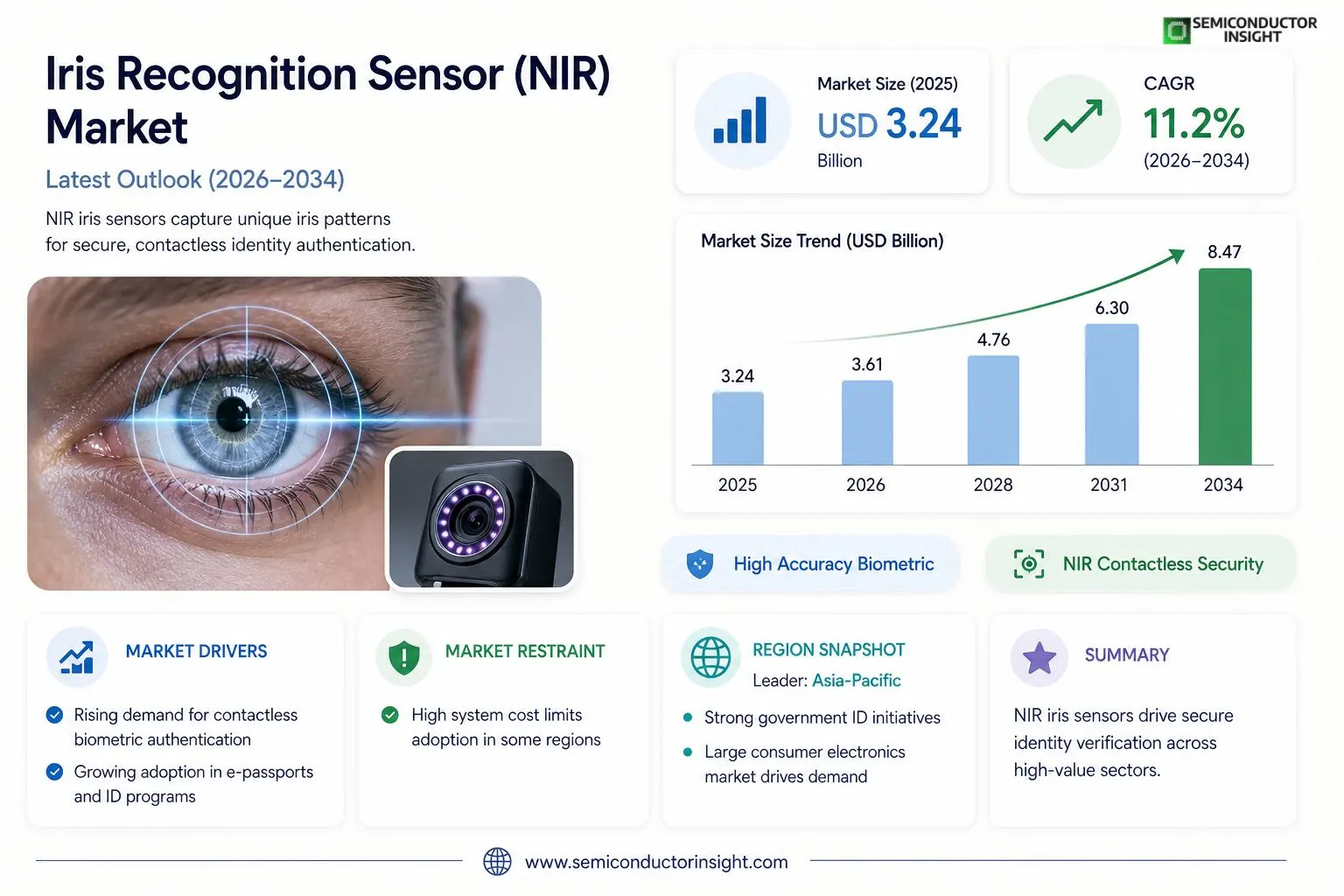
Global Iris Recognition Sensor (NIR) market size was valued at USD 3.24 billion in 2025. The market is projected to grow from USD 3.61 billion in 2026 to USD 8.47 billion by 2034, exhibiting a CAGR of 11.2% during the forecast period.
Iris recognition sensors utilizing Near-Infrared (NIR) technology are advanced biometric devices designed to capture and analyze the unique patterns of the human iris for identity verification and authentication. These sensors operate by emitting NIR light , typically in the 700–900 nm wavelength range , to illuminate the iris without causing discomfort, enabling high-precision image capture regardless of ambient lighting conditions. Core components of NIR-based iris recognition systems include NIR illuminators, optical lenses, image sensors, and embedded processing units, collectively enabling accurate, contactless, and highly secure biometric identification.
The market is witnessing robust expansion driven by escalating demand for advanced biometric security solutions across government, banking, healthcare, and border control sectors. The increasing deployment of iris recognition in national identity programs and e-passports, particularly across Asia-Pacific and the Middle East, is a significant growth catalyst. Furthermore, the integration of NIR iris sensors into smartphones and consumer electronics has broadened the addressable market considerably. Key industry participants such as Thales Group, Iris ID Systems, Jumio Corporation, Princeton Identity, and Iritech Inc. continue to drive innovation through product development and strategic partnerships, reinforcing the competitive landscape of Global Iris Recognition Sensor (NIR) market.
MARKET DRIVERS
Rising Demand for Contactless Biometric Authentication Fueling Iris Recognition Sensor (NIR) Market
Global Iris Recognition Sensor (NIR) Market is experiencing significant growth driven by an accelerating shift toward contactless and highly accurate biometric authentication systems. Near-infrared (NIR) iris recognition technology has emerged as one of the most reliable modalities in the biometric landscape, owing to its exceptional accuracy rates and resistance to environmental variations. Governments, financial institutions, and border control agencies are increasingly deploying NIR-based iris recognition sensors to enhance security infrastructure, reduce identity fraud, and streamline access management processes. The growing adoption of national ID programs and e-passport systems across emerging economies is directly amplifying market demand.
Integration of NIR Iris Sensors in Smartphones and Consumer Electronics Broadening Market Reach
The integration of iris recognition sensors using NIR illumination into consumer-grade smartphones and wearable devices has significantly expanded the addressable market. Leading mobile device manufacturers have embedded NIR iris scanners to provide users with a seamless and secure unlocking experience, further normalizing biometric authentication at the consumer level. This trend is reinforcing demand for compact, energy-efficient NIR iris sensor modules capable of operating under diverse lighting conditions. The convergence of artificial intelligence and NIR sensor technology is also enabling faster and more accurate iris pattern matching, strengthening the overall value proposition of this technology.
➤ The proliferation of digital identity verification requirements across banking, healthcare, and government sectors continues to serve as a primary catalyst for sustained growth in Iris Recognition Sensor (NIR) Market, with border management and law enforcement applications representing particularly high-value deployment verticals.
Additionally, the post-pandemic emphasis on hygiene-conscious, touchless security solutions has further reinforced the strategic importance of NIR-based iris recognition systems. Unlike fingerprint sensors, iris scanners eliminate physical contact entirely, making them especially attractive for high-traffic environments such as airports, hospitals, and corporate campuses. This behavioral and operational shift is expected to sustain long-term procurement cycles for iris recognition sensor hardware and software across both public and private sector end-users.
MARKET CHALLENGES
High System Cost and Complex Deployment Infrastructure Posing Barriers for Iris Recognition Sensor (NIR) Market
Despite strong growth prospects, Iris Recognition Sensor (NIR) Market faces notable challenges related to the relatively high cost of sensor hardware, enrollment systems, and backend integration infrastructure. Precision NIR illumination components, image processing modules, and anti-spoofing algorithms collectively contribute to elevated system costs, which can limit adoption among budget-constrained organizations and small-to-medium enterprises. Furthermore, achieving reliable iris capture in uncontrolled outdoor environments , where variable lighting, subject movement, and occlusion from eyewear or contact lenses are common , continues to present technical challenges for sensor manufacturers seeking to improve first-attempt recognition rates.
Other Challenges
Privacy Concerns and Regulatory Complexity
The collection and storage of iris biometric data raises significant privacy concerns among consumers and advocacy groups, particularly in jurisdictions governed by stringent data protection regulations such as the GDPR in Europe and various state-level biometric privacy laws in the United States. Compliance with these frameworks requires manufacturers and system integrators operating in the NIR iris recognition sensor space to implement robust data governance practices, consent management mechanisms, and secure storage protocols , adding operational complexity and cost to deployment programs.
Interoperability and Standardization Gaps
The absence of universally adopted interoperability standards across iris recognition platforms continues to hinder large-scale, multi-vendor deployments. Organizations deploying iris recognition sensor (NIR) solutions across distributed environments often encounter compatibility issues between different hardware generations and software ecosystems, necessitating costly custom integration work and limiting the scalability of enterprise-grade identity management programs.
MARKET RESTRAINTS
Limited Public Awareness and Low Biometric Infrastructure Maturity in Developing Regions Restraining Market Expansion
One of the principal restraints affecting Iris Recognition Sensor (NIR) Market is the uneven distribution of biometric infrastructure maturity across global regions. While developed economies in North America, Europe, and parts of Asia-Pacific have established relatively advanced digital identity ecosystems, large portions of Africa, Latin America, and Southeast Asia continue to lack the foundational IT infrastructure necessary to support widespread deployment of NIR iris recognition systems. Low awareness of the technology’s capabilities among end-users and procurement decision-makers in these regions further slows adoption curves, limiting the near-term revenue opportunity for market participants targeting global expansion strategies.
Competition from Alternative Biometric Modalities Limiting the Relative Market Penetration of NIR Iris Sensors
NIR-based iris recognition sensor Market also faces competitive pressure from alternative biometric technologies, including facial recognition, fingerprint scanning, and palm vein identification, which in many use cases offer lower implementation costs and greater user familiarity. Facial recognition systems, in particular, have benefited from rapid algorithm improvements and widespread integration into existing camera infrastructure, creating a cost-competitive alternative that organizations may favor over dedicated iris sensor deployments. This competitive dynamic constrains the pace at which iris recognition sensor (NIR) technology can capture market share, particularly in commercial sectors where cost efficiency is a primary procurement criterion.
MARKET OPPORTUNITIES
Expanding Government-Led Digital Identity and e-Governance Initiatives Creating High-Value Opportunities for Iris Recognition Sensor (NIR) Market Participants
Government-driven digital identity programs represent one of the most substantial growth opportunities for Iris Recognition Sensor (NIR) Market over the coming years. Numerous national governments are investing in large-scale biometric identity databases, voter registration systems, and social benefit distribution platforms that increasingly incorporate NIR iris recognition as a core verification modality, owing to its high uniqueness coefficient and low false acceptance rates. As international organizations continue to promote inclusive digital identity frameworks, demand for scalable and field-deployable NIR iris sensor solutions is expected to rise considerably, particularly across South Asia, Sub-Saharan Africa, and the Middle East.
Advancements in At-a-Distance and On-the-Move NIR Iris Capture Technology Unlocking New Application Verticals
Emerging developments in long-range and on-the-move iris recognition , enabled by advances in high-sensitivity NIR imaging arrays, adaptive illumination control, and deep learning-based image enhancement , are unlocking new application verticals that were previously inaccessible to traditional close-proximity iris scanners. Airports, stadiums, transit hubs, and high-security facilities stand to benefit from at-a-distance NIR iris recognition sensors that can authenticate individuals without requiring them to pause or position themselves in front of a fixed capture device. These innovations are anticipated to substantially broaden the commercial deployment base and increase average selling prices within Iris Recognition Sensor (NIR) Market, offering hardware manufacturers and system integrators meaningful revenue expansion opportunities through the forecast period.
Iris Recognition Sensor (NIR) Market Trends
Rising Adoption of NIR-Based Biometric Authentication Across Critical Sectors
Iris Recognition Sensor (NIR) Market is experiencing significant momentum as organizations across government, banking, healthcare, and border control sectors increasingly prioritize advanced biometric security solutions. NIR-based iris recognition technology, which operates within the 700–900 nm wavelength range, enables contactless, high-precision identity verification without causing user discomfort. This capability has positioned NIR iris sensors as a preferred authentication tool in environments where accuracy, hygiene, and non-intrusiveness are paramount. Government agencies worldwide are actively deploying these systems within national identity programs and e-passport infrastructure, particularly across Asia-Pacific and the Middle East, where digital identity initiatives are advancing rapidly.
Other Trends
Integration of NIR Iris Sensors into Consumer Electronics
A notable trend shaping Iris Recognition Sensor (NIR) Market is the growing integration of NIR iris sensors into smartphones and consumer electronics. Device manufacturers are embedding compact NIR illuminators, optical lenses, and image sensors directly into mobile form factors, enabling seamless biometric unlocking and secure mobile payments. This shift has substantially broadened the addressable market beyond enterprise and government applications, extending NIR iris recognition into everyday consumer use cases. As mobile device ecosystems continue to mature, demand for miniaturized, energy-efficient NIR sensor components is expected to intensify accordingly.
Innovation and Strategic Partnerships Among Key Industry Participants
Leading players in Iris Recognition Sensor (NIR) Market, including Thales Group, Iris ID Systems, Jumio Corporation, Princeton Identity, and Iritech Inc., are actively advancing the competitive landscape through continuous product development and strategic collaborations. These companies are focused on enhancing sensor accuracy, reducing false acceptance rates, and improving performance under varied environmental conditions. Cross-sector partnerships between technology developers and system integrators are enabling faster deployment of NIR iris recognition solutions across border control checkpoints, financial institutions, and healthcare facilities globally.
Expanding Role of NIR Iris Recognition in Border Control and National Identity Programs
The deployment of Iris Recognition Sensor (NIR) technology within border control and national identity programs represents one of the most consequential trends in the market today. Governments are incorporating NIR iris recognition into e-passport verification systems and automated border crossing infrastructure to strengthen national security and streamline passenger processing. The non-contact nature of NIR-based iris capture ensures hygienic, high-throughput identification , a critical requirement in high-traffic transit environments. As sovereign nations continue investing in digital identity modernization, Iris Recognition Sensor (NIR) Market is poised to benefit from sustained institutional demand across multiple regions.
COMPETITIVE LANDSCAPE
Key Industry Players
Iris Recognition Sensor (NIR) Market: Competitive Dynamics and Leading Innovators Shaping Global Biometric Security Landscape
Global Iris Recognition Sensor (NIR) market is characterized by a moderately consolidated competitive landscape, with a handful of technologically advanced players commanding significant market share alongside a growing number of specialized firms driving niche innovation. Thales Group stands as one of the foremost industry leaders, leveraging its extensive experience in identity management and border control solutions to deploy high-precision NIR-based iris recognition systems across government and law enforcement sectors worldwide. Princeton Identity, Iris ID Systems, and Iritech Inc. similarly hold prominent positions, investing heavily in research and development to enhance sensor accuracy, miniaturization, and integration capabilities. The competitive intensity of this market is further amplified by the accelerating adoption of iris biometrics in national identity programs, e-passport infrastructure, and smart border management systems , particularly across Asia-Pacific and the Middle East , compelling established players to forge strategic partnerships and pursue acquisitions to consolidate their technological portfolios.
Beyond the dominant players, a range of significant niche participants continues to shape the competitive dynamics of Iris Recognition Sensor (NIR) Market. Companies such as Jumio Corporation, Aware Inc., BioEnable Technologies, Dermalog Identification Systems, and IriShield (Unison Co.) have carved out strong footholds by targeting specific verticals including financial services authentication, healthcare patient identification, and consumer electronics integration. The proliferation of NIR iris sensors in smartphones and wearable devices has attracted technology firms such as Samsung Electronics and Qualcomm, further intensifying cross-industry competition. Emerging players from South Korea, Japan, and China are increasingly entering the market with cost-competitive solutions, challenging incumbents and accelerating the pace of product innovation. Strategic collaborations between sensor manufacturers and software-driven identity verification platforms are expected to remain a defining characteristic of the competitive landscape through the forecast period.
List of Key Iris Recognition Sensor (NIR) Companies Profiled
- Thales Group
- Iris ID Systems
- Jumio Corporation
- Princeton Identity
- Iritech Inc.
- Aware Inc.
- Dermalog Identification Systems GmbH
- BioEnable Technologies Pvt. Ltd.
- IriShield (Unison Co., Ltd.)
- Samsung Electronics Co., Ltd.
- Qualcomm Technologies, Inc.
- EyeLock LLC
- Crossmatch Technologies (HID Global)
- Veridt Inc.
- Daon Inc.
Segment Analysis:
| Segment Category | Sub-Segments | Key Insights |
| By Type |
|
Dual-Eye Iris Recognition Sensors represent the leading segment within the By Type category, owing to their superior accuracy and reduced false rejection rates compared to single-eye alternatives.
|
| By Application |
|
Border Control & Immigration Management stands as the dominant application segment, driven by global governmental initiatives to modernize border infrastructure with advanced biometric verification technologies.
|
| By End User |
|
Government & Defense constitutes the foremost end-user segment in Iris Recognition Sensor (NIR) Market, reflecting the public sector’s sustained commitment to deploying robust biometric frameworks for national security and civil identification.
|
| By Component |
|
NIR Illuminators emerge as the most critical component segment, serving as the foundational element that enables precise and comfortable iris image capture across diverse environmental conditions.
|
| By Deployment Mode |
|
Fixed/Stationary Deployment leads the deployment mode segment, predominantly driven by its widespread adoption in high-security institutional environments that require continuous, reliable, and high-throughput biometric verification capabilities.
|
Regional Analysis: Iris Recognition Sensor (NIR) Market
Asia-Pacific
Large-scale national identity and e-governance programs across Asia-Pacific have created an unprecedented institutional demand for iris recognition sensor (NIR) solutions. Government mandates in India, China, and Southeast Asian nations are embedding NIR-based iris authentication into public service delivery, welfare distribution, and law enforcement frameworks, fundamentally broadening the addressable market and setting compliance-driven adoption benchmarks for the region.
The widespread incorporation of near-infrared iris recognition sensors into flagship smartphones, tablets, and wearable devices by leading Asian manufacturers has normalized the technology among mass-market consumers. This integration has substantially reduced per-unit costs through economies of scale, accelerating adoption beyond institutional use cases into everyday personal device security and mobile payment authentication within Iris Recognition Sensor (NIR) Market.
Asia-Pacific hosts a dense concentration of semiconductor fabricators, optical component specialists, and NIR sensor module assemblers, giving the region a decisive supply chain advantage. This vertical integration allows manufacturers to innovate rapidly, respond to design changes with agility, and maintain cost competitiveness,factors that collectively reinforce the region’s dominant position within Global Iris Recognition Sensor (NIR) Market landscape through the forecast period.
The aggressive rollout of smart city infrastructure across China, India, and ASEAN nations is generating sustained demand for high-accuracy, contactless biometric access control solutions. Near-infrared iris recognition sensors are increasingly preferred for airport border control, metro access management, and secure facility entry, owing to their hygiene advantages and superior performance under varied environmental conditions across the Asia-Pacific region.
North America
North America represents one of the most technologically mature and innovation-driven markets for iris recognition sensor (NIR) technology globally. The United States, in particular, has a long-standing investment in biometric identification systems spanning federal agencies, defense establishments, airport security networks, and financial institutions. The region’s regulatory environment, including frameworks around identity verification and physical access control, continues to support the sustained deployment of NIR-based iris recognition solutions in high-security environments. The presence of leading biometric technology developers and substantial research and development activity in the United States ensures a steady pipeline of next-generation iris sensor innovations. Canada is similarly expanding adoption within immigration and border management infrastructure. The healthcare and banking sectors in North America are increasingly evaluating iris recognition sensor technology as a frictionless, hygienic alternative to legacy authentication methods, further broadening the market’s vertical reach across the region through 2034.
Europe
Europe occupies a significant position in Iris Recognition Sensor (NIR) Market, shaped by a unique interplay of stringent data privacy regulations, growing border security imperatives, and advancing national identity modernization programs. The General Data Protection Regulation (GDPR) has introduced a complex compliance landscape for biometric data processing, prompting technology vendors to develop privacy-by-design NIR iris sensor solutions tailored to European regulatory expectations. Countries such as Germany, the United Kingdom, France, and the Netherlands are actively integrating near-infrared iris recognition sensors into e-passport systems, automated border control gates, and critical infrastructure protection frameworks. The European Union’s broader push toward a unified digital identity ecosystem is expected to create meaningful institutional demand for iris recognition sensor technology. European defense and law enforcement agencies also represent consistent procurement channels within the regional market, supporting steady growth across the forecast period.
South America
South America presents an emerging yet increasingly relevant opportunity within Global Iris Recognition Sensor (NIR) Market. Brazil, as the region’s largest economy, is spearheading adoption through voter registration biometric systems, financial inclusion programs, and public security initiatives that incorporate near-infrared iris recognition as a reliable modality. Argentina and Colombia are also exploring iris sensor deployments within law enforcement and border management contexts. While infrastructure challenges and cost sensitivity remain factors influencing adoption pace, growing government investment in digital identity and the expansion of mobile connectivity are progressively lowering barriers to market entry. The region’s young and digitally engaged population, combined with rising awareness of biometric authentication benefits, positions South America as a market with substantial long-term growth potential for iris recognition sensor technology through the 2026–2034 forecast window.
Middle East & Africa
The Middle East and Africa region is witnessing growing momentum in the adoption of Iris Recognition Sensor (NIR) technology, driven by distinct yet complementary demand drivers across its constituent sub-regions. Gulf Cooperation Council nations,particularly the United Arab Emirates, Saudi Arabia, and Qatar,have invested heavily in biometric-enabled smart infrastructure, with iris recognition sensors deployed at airports, government service centers, and financial institutions as part of ambitious national digital transformation agendas. Africa, while at an earlier stage of adoption, is seeing increasing interest in iris-based biometric solutions for national ID programs and humanitarian aid distribution, where accurate identity verification is critical. The region’s expanding telecommunications infrastructure and growing smartphone penetration are gradually creating a foundation for broader near-infrared iris recognition sensor adoption. Technology partnerships with global biometric vendors and multilateral development funding are expected to further catalyze market growth across the Middle East and Africa through 2034.
Report Scope
This market research report provides a comprehensive analysis of the Iris Recognition Sensor (NIR) Market , covering the forecast period 2026–2034. It offers detailed insights into market dynamics, technological advancements, competitive landscape, and key trends shaping the industry.
Key focus areas of the report include:
- Market Overview: The report begins with an overview outlining its current market scenario, key growth indicators, and industry transformation drivers. It discusses macroeconomic factors, demand–supply balance, regulatory landscape, and the strategic role of biometric technologies in powering advancements across industries such as government, banking, healthcare, and border control.
- Market Size & Forecast: Historical data and future projections for revenue, unit shipments, and market value across major regions and segments.
- Segmentation Analysis: Detailed breakdown by product type, technology, application, and end-user industry to identify high-growth segments and investment opportunities.
- Regional Insights: Insights into market performance across North America, Europe, Asia-Pacific, Latin America, and the Middle East & Africa, including country-level analysis where relevant.
- Competitive Landscape: Profiles of leading market participants, including their product offerings, R&D focus, manufacturing capacity, pricing strategies, and recent developments such as mergers, acquisitions, and partnerships.
- Technology Trends & Innovation: Assessment of emerging technologies, integration of AI/IoT, NIR sensor design trends, fabrication techniques, and evolving industry standards.
- Market Drivers & Restraints: Evaluation of factors driving market growth along with challenges, supply chain constraints, regulatory issues, and market-entry barriers.
- Stakeholder Insights: Insights for component suppliers, OEMs, system integrators, investors, and policymakers regarding the evolving ecosystem and strategic opportunities.
Primary and secondary research methods are employed, including interviews with industry experts, data from verified sources, and real-time market intelligence to ensure the accuracy and reliability of the insights presented.
FREQUENTLY ASKED QUESTIONS:
What is the current market size of Iris Recognition Sensor (NIR) Market?
-> Iris Recognition Sensor (NIR) Market was valued at USD 3.24 billion in 2025 and is expected to reach USD 8.47 billion by 2034, growing at a CAGR of 11.2% during the forecast period.
Which key companies operate in Iris Recognition Sensor (NIR) Market?
-> Key players include Thales Group, Iris ID Systems, Jumio Corporation, Princeton Identity, and Iritech Inc., among others.
What are the key growth drivers?
-> Key growth drivers include escalating demand for advanced biometric security solutions, increasing deployment of iris recognition in national identity programs and e-passports, and integration of NIR iris sensors into smartphones and consumer electronics.
Which region dominates the market?
-> Asia-Pacific is the fastest-growing region, driven by large-scale national identity programs, while the Middle East also represents a significant growth market due to e-passport and border control deployments.
What are the emerging trends?
-> Emerging trends include integration of NIR iris sensors in consumer electronics, contactless biometric authentication, and adoption of iris recognition in e-passports and national identity programs.

Get Sample Report PDF for Exclusive Insights
Report Sample Includes
- Table of Contents
- List of Tables & Figures
- Charts, Research Methodology, and more...
 Download Sample Report PDF