IoT Smart Motion Sensors Market Insights
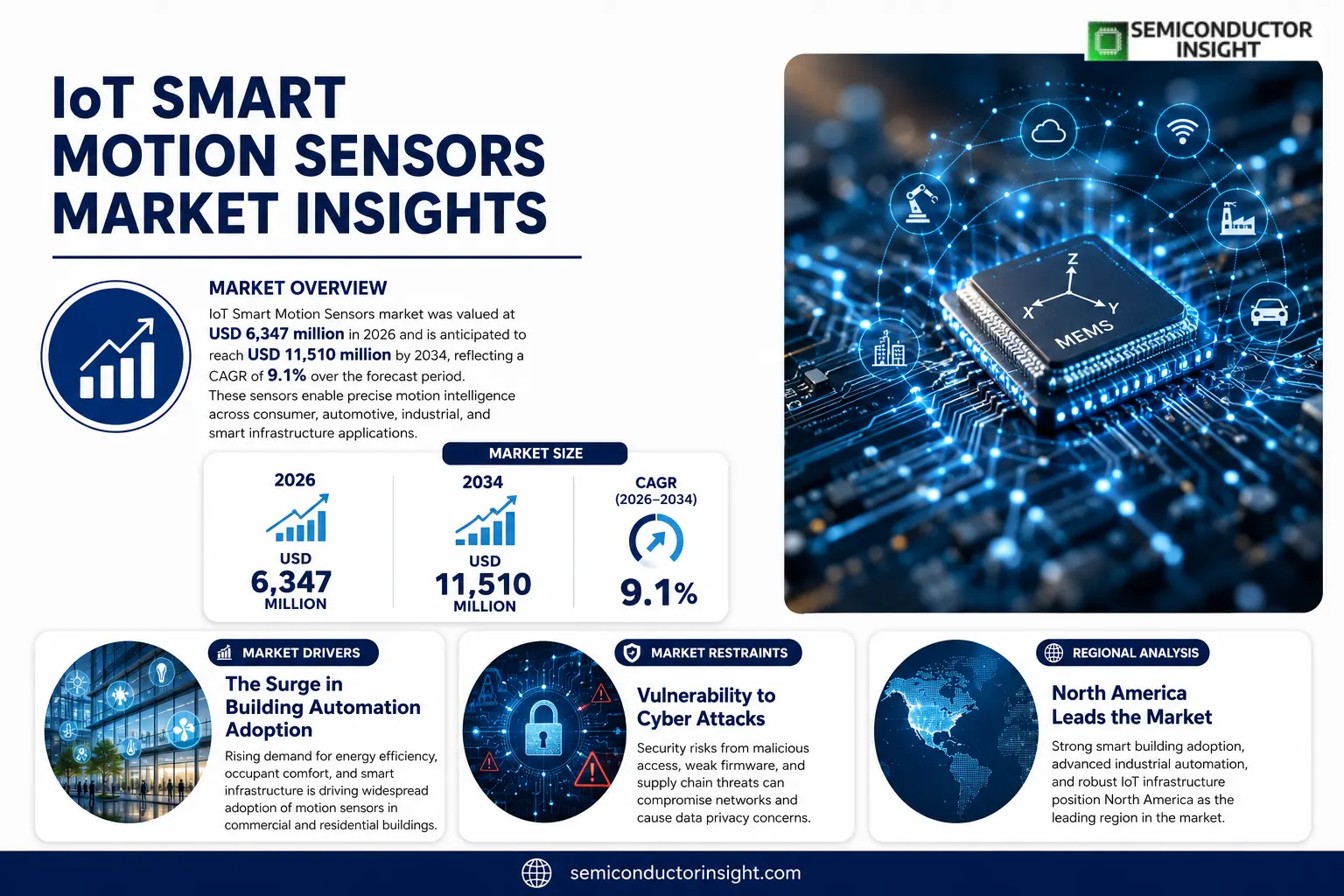
IoT Smart Motion Sensors market was valued at USD 6,347 million in 2026 and is anticipated to reach USD 11,510 million by 2034, reflecting a CAGR of 9.1% over the forecast period.
These motion sensors detect rotation, translation, vibration or tilt using MEMS packages soldered onto PCBs; contemporary designs integrate multiple axes and onboard algorithms that fuse raw data into precise orientation outputs for smartphones, drones, automotive systems and industrial automation.The proliferation of connected devicesestimated at roughly 14 billion worldwidecoupled with expanding 5G infrastructure and IPv6 adoption underpins continued demand for compact yet sophisticated sensor solutions.
MARKET DRIVERS
The Surge in Building Automation Adoption
In commercial and residential portfolios where energy efficiency and occupant comfort converge, the deployment of IoT Smart Motion Sensors Market has moved beyond ancillary convenience. Engineers now embed motion detection into HVAC scheduling, LED dimming, and occupancy‑based lighting control, reducing utility costs by an average of 12 % in midsized campuses. The underlying incentive is a combination of tighter regulatory demands for carbon reporting and consumer enthusiasm for ambient automation. Facilities managers adopting these sensors report a 5‑year payback that competes with large‑scale retrofits, while developers capitalize on pre‑construction integration to unlock higher property valuations. In parallel, the healthcare sector implements motion‑enabled monitoring to streamline patient flow and reduce infection vectors, accelerating the path to smart ward readiness. The convergence of hybrid work models and the need for flexible touch‑free interactions further keeps the momentum alive, positioning the overall IoT Smart Motion Sensors Market as a catalyst for smarter zero‑touch environments.
Low‑Power Wireless Standards Boost Network Integration
Shifts toward Thread, 6LoWPAN, and Wi‑Fi 6E have provided a reliable substrate for motion sensors that demand low footprint yet high data fidelity. The market’s adoption curve accelerates when sensors communicate over secure, battery‑efficient links, enabling installations in hard‑to‑reach zones such as over‑head courtyards or deep storage racks. Vendor convergence around open‑source firmware has also lowered integration barriers, permitting cooperative ecosystems between room‑sensing units, central HVAC controllers, and building management systems. With micro‑controller units costing averages below $1.50 and on‑chip storage reaching 256 kB, the cost‑benefit equation tilts decisively in favor of widespread deployment. The proof is visible in a 16 % rise in commercial projects that pair motion detection with adaptive airflow, directly influencing the expanding footprint of IoT Smart Motion Sensors Market.
➤ “When motion sensors are paired with adaptive HVAC, buildings tend to drop energy consumption by up to 14 % within the first year,”
The combined effect of regulatory impetus and technology maturation renders IoT Smart Motion Sensors Market a focal point for stakeholders seeking efficient operational models. Organizations that seize early deployments gain a competitive advantage, leveraging real‑time occupancy analytics to refine asset utilization. Moreover, the incremental investment translates into a measurable lift in return on investment, rewarding both capital agile enterprises and operating‑focused portfolios. As adoption deepens, the ecosystem will broaden to include predictive maintenance and anomaly detection, further reinforcing the market’s growth trajectory and the value delivered to operators.
MARKET CHALLENGES
Vulnerability to Cyber Attacks
Despite the declining cost of sensors, their ubiquity across critical infrastructure raises privacy and security concerns that are not easily discounted. Attack vectors are exposed through poorly configured firmware, wireless eavesdropping, or supply‑chain tampering. Cyber‑security teams report that a single compromised motion sensor can cascade into broader facility control networks, creating audit‑trail and compliance challenges. The absence of uniform encryption mandates forces manufacturers to differentiate through proprietary security stacks, often at the expense of interoperability and cost. Enterprises facing these threats must invest in advanced network segmentation, continuous monitoring, and real‑time anomaly detection, diluting the low‑cost advantage the sensor promises and slowing market momentum.
Other Challenges
Data Overload and Analytics Maturity
While quantity of occupancy data remains high, the analytical capabilities to extract actionable insights lag behind, particularly in legacy environments. Facilities lacking advanced dashboards struggle to translate raw motion counts into energy‑saving schedules, leading to sub‑optimal returns on investment. This gap forces businesses to address skill shortages and invest in analytics platforms, postponing the full commercialization of IoT Smart Motion Sensors Market.
MARKET RESTRAINTS
High Initial Licensing Costs for Proprietary Platforms
Many vendors bundle motion sensor hardware with closed management portals that charge recurring licensing fees to access analytics and configuration tools. These fees, which can exceed $0.50 per sensor annually, erode the projected cost advantage and deter budget‑conscious buyers. The reluctance to adopt contingent on upfront licensing creates a price‑elastic environment that stifles adoption among small‑to‑mid‑size enterprises. When these costs are layered on top of hardware, the total cost of ownership rises significantly, casting a shadow over the anticipated gross margin expansion within IoT Smart Motion Sensors Market.
MARKET OPPORTUNITIES
Integration with Smart Building Ecosystems
The trajectory of modular, interoperable building solutions offers a fertile avenue for motion sensor vendors. By aligning their devices with widely adopted platforms such as BACnet, KNX, or open‑stack web‑services, manufacturers can tap into a broader customer base that prioritizes cross‑vendor compatibility. The adoption wave is already visible in recent collaborations that embed sensor outputs into open API chains for occupancy‑based billing systems, enabling revenue models that extend beyond hardware sales into subscription‑based analytics. Companies positioned to deliver cross‑platform integration will thrive, positioning themselves at the intersection where operational efficiency meets long‑term engagement.
IoT Smart Motion Sensors Market Trends
Expanding Multi‑Axis MEMS Package Adoption
A notable advance sweeping the IoT smart motion sensors landscape is the significant expansion of multi‑axis MEMS packages that bundle four or more sensing axes into a single, solderable footprint. This trend reflects shifting expectations from raw detection to actionable intelligence, as manufacturers now embed on‑chip data fusion engines capable of fusing rotational, translational, and vibration signals into a single calibrated output. The acceleration follows the surge in connected devices – 14 billion units in 2026, an 18 % rise from 2021 – and the proliferation of high‑speed 5G backhaul and Gigabit optical networks that enable real‑time telemetry. For SMEs, the implication is clear: deeper integration reduces PCB real estate and firmware overhead, thereby cutting time‑to‑market and lowering capital expenditures while boosting the sensor’s value proposition to automotive, aerospace, and consumer electronics integrators. These innovations collectively elevate the value chain for integrators worldwide.
Other Trends
Embedded Intelligence as a Differentiator
Embedded intelligence has become a differentiator: MEMS vendors now deliver proprietary firmware that fuses gyroscope, accelerometer, and magnetometer data into a single inertial parameter at the device level. This architectural shift not only enhances accuracy but also removes the need for an intermediate IFU or DSP, streamlining OTA updates and reducing liability risks. In practice, operators in automotive and avionics have reported noticeable reductions in mean error rates compared with conventional off‑board fusion. Consequently, OEMs can negotiate tighter margins on sensor subsystems, allowing them to focus investment on higher‑value platforms such as advanced driver assistance systems (ADAS) and spacecraft attitude control.
Sector Concentration in Automotive and Aerospace Markets
While consumer electronics initially drove early adoption, the current value engine is now centered on automotive and aerospace verticals. In 2026, the automotive segment accounted for roughly 35 % of sensor volume, a figure that has climbed steadily as chassis dynamics and laser‑guided navigation increasingly rely on compact multi‑axis units. Aerospace, in turn, now booms as militaries and commercial space programs demand resilient sensors that can survive extreme vibration and thermal cycles without external calibration. Parallel to this hardware consolidation, the rise of digital twin models and edge analytics is redefining sensor value. By coupling real‑time sensor streams with physics‑based simulation engines on the cloud or on‑premise, designers can predict wear patterns and perform remote health diagnostics, turning data into actionable maintenance windows. This evolution unlocks recurring revenue, positioning IoT Smart Motion Sensors Market for sustained engagement. It also offers a defensible moat against commodified hardware.
COMPETITIVE LANDSCAPE
Key Industry Players
Landscape of IoT Smart Motion Sensors
The market, valued at US$6,347 million in 2026, is set to surge to US$11,510 million by 2034, reflecting a 9.1 % annual growth rate. Central to this upward trajectory is the convergence of MEMS technology and embedded computation, enabling motion sensors to deliver multi‑axis data with on‑device fusion. Leading incumbents such as Honeywell Aerospace and TE Connectivity capitalize on this trend by offering integrated gyroscope, accelerometer, and magnetometer packages tailored for aerospace and industrial automation, thereby commanding substantial market share through robust reliability and extensive product portfolios.In parallel, a cadre of high‑profile niche playersincluding Panasonic Electric, ABB, Bosch Sensortec, TDK InvenSense, Xsens Technologies BV, Infineon, and Siemens Process Instrumentationdrive innovation in specialized applications such as automotive safety, consumer electronics, and robotics. Their focus on miniaturization and power efficiency is particularly resonant amid mounting demand from connected devices, which surpassed 14 billion ly, and the rapid rollout of 5G and IPv6 infrastructure across China’s 2.3 million base stations. These developments create a fertile environment for sensors that deliver precise motion detection while consuming minimal bandwidth and power, thereby enabling smarter automation across supply chains and urban mobility solutions.
List of Key IoT Smart Motion Sensors Companies Profiled
- Honeywell Aerospace
- Honeywell Aerospace
- Panasonic Electric
- Panasonic Electric
- TE Connectivity
- TE Connectivity
- ABB
- ABB
- STMicroelectronics
- STMicroelectronics
- Bosch Sensortec
- Bosch Sensortec
- TDK InvenSense
- TDK InvenSense
- Xsens Technologies BV
- Xsens Technologies BV
- Infineon
- Infineon
- Siemens Process Instrumentation
- Siemens Process Instrumentation
Segment Analysis:
| Segment Category | Sub-Segments | Key Insights |
| By Type |
|
Gyroscope is the leading type due to its precise rotational detection, enabling advanced navigation and stability control across automotive, aerospace, and consumer electronics devices; it offers high fidelity motion tracking and seamlessly integrates into embedded systems for real‑time attitude estimation; its widespread use drives innovation in autonomous vehicles and unmanned aerial vehicles, fostering new safety and performance applications. |
| By Application |
|
Automotive Industry dominates the application segment by embedding motion sensors into vehicle dynamics control, navigation assistance, and infotainment systems, thereby enhancing safety and driving experience; the integration of multi‑axis sensing enables adaptive cruise control and collision avoidance, building trust among manufacturers and regulators; its continuous evolution supports electric and autonomous vehicle development, positioning the industry as a key growth driver. |
| By End User |
|
Industrial users prioritize motion sensors for process monitoring and automation, as precise vibration and orientation data enable predictive maintenance and quality control across manufacturing facilities, mines, and refineries; the sensors provide robust, real‑time feedback that enhances operational efficiency and safety, making industrial adoption a key trend; as smart factories evolve, the demand for high‑accuracy, ruggedized sensors continues to grow, reinforcing the sector’s significance. |
| By Device Functionality |
|
Orientation sensors lead this segment by delivering stabilization feedback to smartphones, drones, and wearables; they support both consumer and industrial applications, enabling precise motion capture; their miniaturization and low power consumption drive adoption across a wide array of devices, making orientation a pivotal functionality for modern IoT ecosystems. |
| By Deployment Environment |
|
Outdoor deployments command sensors that can withstand temperature extremes, moisture, and mechanical shocks; these ruggedized models facilitate vehicle telemetry, environmental monitoring, and U‑pgrade solutions for remote infrastructures; as connectivity expands into rural and industrial outdoor spaces, the demand for reliable, long‑lasting motion sensing drives a continuous shift toward more durable, battery‑efficient designs. |
Regional Analysis: IoT Smart Motion Sensors Market
North America
Adoption of building automation systems, rising energy cost concerns, and increased consumer awareness of occupancy‑based savings are the primary forces curating demand for motion‑sensing solutions in residential and commercial verticals. OEMs target high‑performance hardware tailored to specific deployment contexts, such as fire‑alert integration or hospitality management.
Market leaders cluster around US‑based firms that supply wireless, low‑power sensors engineered for scalability. Strategic deals and joint‑venture models with utilities and construction companies underpin supply‑chain resilience and core‑product differentiation.
Data‑privacy statutes such as the California Consumer Privacy Act influence firmware design, necessitating encrypted transmission and transparent data‑handling disclosures that consumers can verify through device interfaces.
In the next decade, integration of motion sensors with AI algorithms and edge computing platforms will enable predictive maintenance and real‑time occupancy analytics, expanding market reach beyond traditional security use‑cases.
Europe
Europe’s IoT Smart Motion Sensors Market is shaped by stringent power‑savings directives and a strong industrial‑automation heritage. EU participants increasingly favour sensors that offer modular firmware updates and support long‑term data retention for compliance with the General Data Protection Regulation. The region is witnessing a progressive shift toward renewable‑energy‑driven smart‑grids, necessitating motion‑based asset monitoring for grid stability. Market growth is moderate compared to North America, but strategic collaborations between European utilities and sensor developers are creating niche verticals, especially in public‑sector surveillance and accounting for traffic flow applications. Consumer trends in luxury smart homes are gradually elevating demand for sophisticated motion‑sensing lighting and climate controls, offering opportunities for premium product tiers.
Asia-Pacific
Asia‑Pacific is rapidly expanding due to large‑scale industrial deployment of motion‑sensing technologies in manufacturing plants and logistics facilities. Cost‑effective sensors have become a core pillar in the drive toward Industry 4.0, with nations such as China, Japan, and South Korea steering the development of AI‑enabled modules that handle real‑time predictive maintenance. Rapid urbanization coupled with rising consumer interest in smart‑home solutions is adding a parallel momentum to the market. Regulatory frameworks around data privacy and cross‑border data flow, particularly in India and Singapore, are prompting manufacturers to design sensor firmware that seamlessly adapts to local compliance standards. The convergence of dense wireless networks and high‑speed broadband infrastructure is catalyzing adoption to satisfy both the industrial and residential segments.
South America
South America’s market for IoT Smart Motion Sensors remains nascent, largely driven by infrastructure modernization initiatives in Brazil, Mexico, and Argentina. While adoption is still modest compared to the leaders, emerging public‑kiosk deployments and municipal traffic monitoring systems are creating early traction for basic motion‑detection use‑cases. Growth hinges on the introduction of affordable sensors that can withstand varied climatic conditions prevalent in the region. Local industry players are partnering with tech firms to introduce modular sensor suites aimed at cost‑effective security and access control solutions, positioning the market for moderate expansion as economies stabilize and digital adoption accelerates.
Middle East & Africa
The Middle East & Africa segment is on a trajectory of incremental growth, spurred by high‑value construction and sophisticated security projects across Saudi Arabia, UAE, and South Africa. The region’s appetite for smart‑security solutions is rising as governments push for digital sovereignty and infrastructure resilience. Market entrants are carefully adapting firmware to local connectivity standards and privacy laws. Deployment in high‑security zonessuch as oil and gas facilities, shipping terminals, and data centreshas bolstered the demand for tamper‑evident and tamper‑resistant motion sensors. Though overall volume remains lower than in Europe or North America, the strategic focus on industrial verticals offers a pathway for sustained market contributions in the long term.
Report Scope
This market research report provides a comprehensive analysis of the IoT Smart Motion Sensors Market , covering the forecast period 2026–2034. It offers detailed insights into market dynamics, technological advancements, competitive landscape, and key trends shaping the industry.
Key focus areas of the report include:
- ✅Market Overview: The report begins with an overview outlining its current market scenario, key growth indicators, and industry transformation drivers. It discusses macroeconomic factors, demand–supply balance, regulatory landscape, and the strategic role of semiconductors in powering advancements across industries such as automotive, telecommunications, consumer electronics, and industrial automation.
- ✅Market Size & Forecast: Historical data and future projections for revenue, unit shipments, and market value across major regions and segments.
- ✅Segmentation Analysis: Detailed breakdown by product type, technology, application, and end‑user industry to identify high‑growth segments and investment opportunities.
- ✅Regional Insights: Insights into market performance across North America, Europe, Asia‑Pacific, Latin America, and the Middle East & Africa, including country‑level analysis where relevant.
- ✅Competitive Landscape: Profiles of leading market participants, including their product offerings, R&D focus, manufacturing capacity, pricing strategies, and recent developments such as mergers, acquisitions, and partnerships.
- ✅Technology Trends & Innovation: Assessment of emerging technologies, integration of AI/IoT, semiconductor design trends, fabrication techniques, and evolving industry standards.
- ✅Market Drivers & Restraints: Evaluation of factors driving market growth along with challenges, supply chain constraints, regulatory issues, and market‑entry barriers.
- ✅Stakeholder Insights: Insights for component suppliers, OEMs, system integrators, investors, and policymakers regarding the evolving ecosystem and strategic opportunities.
Primary and secondary research methods are employed, including interviews with industry experts, data from verified sources, and real‑time market intelligence to ensure the accuracy and reliability of the insights presented.
FREQUENTLY ASKED QUESTIONS:
What is the current market size of IoT Smart Motion Sensors Market?
-> IoT Smart Motion Sensors Market was valued at USD 6,347 million in 2026 and is projected to reach USD 11,510 million by 2034, at a CAGR of 9.1%.
Which key companies operate in IoT Smart Motion Sensors Market?
-> Key players in the market include Honeywell Aerospace, Panasonic, TE Connectivity, ABB, STMicroelectronics, Bosch Sensortec, TDK InvenSense, Xsens, Freescale, Infineon, Johnson Controls, Texas Instruments, NXP, Omron, Analog Devices, and Maxim Integrated among others.
What are the key growth drivers?
-> Key growth drivers include the integration of MEMS sensors into consumer electronics, automotive safety systems, industrial automation and robotics, and the rapid deployment of 5G networks that support high‑bandwidth IoT connectivity.
Which region dominates the market?
-> North America remains a leading region, driven by advanced automotive sensor manufacturing and significant industrial IoT adoption.
What are the emerging trends?
-> Emerging trends include AI‑enabled sensor fusion, integration of multiple‑axis LEDs in single MEMS packages, and expanding applications in autonomous vehicles, robotics, and drone technologies.

Get Sample Report PDF for Exclusive Insights
Report Sample Includes
- Table of Contents
- List of Tables & Figures
- Charts, Research Methodology, and more...
 Download Sample Report PDF