IoT RFID Sensors Market Insights
IoT RFID Sensors Market was valued at USD 9390 million in 2024 and is projected to reach USD 14640 million by 2031, at a CAGR of 6.7%.
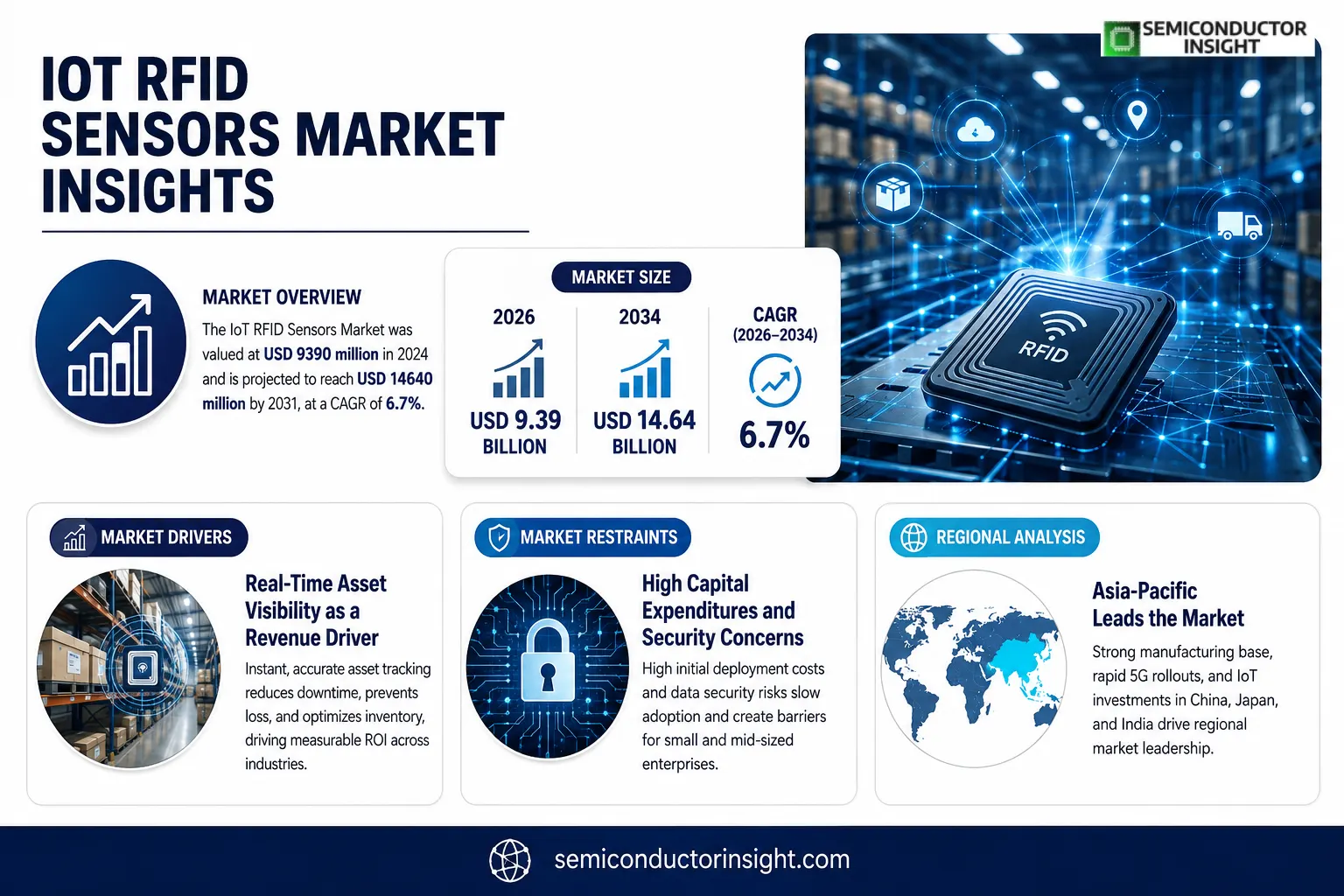
MARKET DRIVERS
Edge‑Enabled Sensing Drives Adoption
The convergence of low‑power microcontrollers and advanced antenna designs has lowered the entry barrier for deploying RFID tags in a broad spectrum of assets. Modern IoT RFID Sensors can now perform basic pre‑processing, compress data, and selectively transmit high‑value events over 4G/LTE or emerging NB‑IoT networks, thereby reducing latency to sub‑second ranges. As logistics providers demand instant confirmation of parcel integrity and rail operators track car‑sets in real time, the cost‑benefit calculus skews decidedly in favor of RFID‑based visibility solutions. Moreover, manufacturers are increasingly adopting discrete, recyclable tags that economise on material consumption while complying with tightening environmental regulations. The cumulative effect is a compounding upward trajectory for IoT RFID Sensors Market, especially in North America and East Asia where industrial automation budgets exceed five per cent of GDP. The shift is not merely technologicalit signals a broader industry willingness to pay a premium for data that can be read without line‑of‑sight, thereby eliminating the need for QR codes or manual scanning in fast‑moving supply chains.
Real‑Time Asset Visibility as a Revenue Driver
Asset owners are recalibrating their return‑on‑investment models around the time‑to‑value metric. When a RFID sensor indicates a temperature excursion or a torque imbalance within minutes of occurrence, the downstream cost savings from averting a recall or preventing a mechanical failure are quantifiable. In the automotive sector alone, predictive fault detection has translated into over USD 600 million in avoided warranty claims last fiscal year. Retail chains are leveraging similar insights to optimise inventory flow, reducing out‑of‑stock incidents by 15 % on average. The financial narrative is clear: IoT RFID Sensors Market is shifting from a mere tracking tool to a high‑margin asset‑management platform. Companies that embed analytics into the sensor stacknot just data collectionare witnessing a progressively higher margin per unit sold, driving strategic mergers and acquisitions within the space. Consequently, venture capital is funneling into start‑ups offering integrated edge gateways, signalling the market’s maturation toward an ecosystem rather than a single‑vendor product offering.
➤ The weight of data is shifting company power balances; those who can translate proximity signals into actionable intelligence hold a decisive competitive edge.
The convergence of lower component costs, rising network coverage, and increasingly sophisticated analytics is cementing a virtuous cycle in IoT RFID Sensors Market. The more businesses realize the breadth of operational risk that RFID can mitigateranging from counterfeiting in pharmaceuticals to real‑time condition monitoring in aviationthe greater the adoption pressure. This cycle is expected to accelerate, even as supply‑chain resilience remains a top priority for global manufacturers. Firms that invest early in modular, secure, and AI‑ready RFID frameworks stand to reap not only operational efficiencies but also new revenue streams from data‑as‑a‑service models.
MARKET CHALLENGES
High Capital Expenditures for Full‑Scale Deployment
Initial outlays for RFID sensor arraysincluding tag printing, reader installation, and integration with existing ERP systemscan eclipse a company’s annual operating budget in the early adoption phase. Enterprise IT departments, accustomed to iterative upgrades, are cautious when imposing upfront capital on a solution that promises incremental visibility gains. As a result, the market’s expansion is proceeding at a measured pace, with most adopters preferring phased rollouts that focus on high‑value nodes and gradually expand network coverage. The resulting adoption lag can erode the perceived ROI, creating a persistent barrier for smaller players that lack deep pockets or enterprise‑grade financing options.
Other Challenges
Fragmentation of IoT Standards
Competing protocols such as UHF‑ISO 18000‑6C, NXP’s NFC, and proprietary low‑frequency variants lead to integration headaches and increased development costs. The lack of harmonised firmware interfaces hampers plug‑and‑play deployments, making the market less attractive to cost‑conscious OEMs.
Data Security Concerns
With sensors broadcasting over wireless channels, the risk of eavesdropping or malicious tag manipulation persists. Regulatory requirements for data encryption and audit trails add further compliance burden for businesses across financial and healthcare sectors.
Integration with Legacy Systems
Many enterprises still rely on monolithic data centers and bespoke middleware. Bringing RFID data into these architectures often demands significant custom coding, leading to extended project timelines and unpredictable costs.
MARKET RESTRAINTS
Regulatory Compliance Burden Limits Rapid Scale‑Up
Across the globe, the regulatory environment governing RFID emissions, data residency, and privacy is tightening. In the European Union, the Radio Equipment Directive mandates stringent electromagnetic compatibility (EMC) testing for any device that broadcasts. In the United States, the Federal Communications Commission (FCC) requires rigorous spectrum‑occupation reports for UHF tags operating in 860–960 MHz. Beyond communications permits, industries such as aerospace, defense, and pharmaceuticals impose additional certification frameworksincluding RTCA DO‑160 and ISO 13485that RFID manufacturers must satisfy before deployment. Each layer of compliance introduces a time‑to‑market delay that is measurable in quarters rather than weeks. Consequently, smaller players who cannot absorb parallel certification pathways find their go‑to‑market timelines extended, eroding the competitive edge that speed and flexibility typically confer in IoT RFID Sensors Market.
MARKET OPPORTUNITIES
AI‑Driven Predictive Maintenance
The next frontier for RFID in the industrial Internet of Things hinges on pairing sensor data with machine‑learning analytics to deliver predictive maintenance insights at scale. By ingesting millisecond‑level displacement, temperature, and vibration metrics from distributed RFID tags across an enterprise, AI algorithms can model component wear curves and forecast failure windows with unprecedented precision. This capability unlocks a new revenue tier where manufacturers charge per predictive event rather than per physical tag, effectively monetising the time‑savings and reduced downtime that executives demand. Start‑ups that bundle edge gateways, advanced analytics, and service‑level agreements are already outselling legacy OEMs in niche markets such as wind‑turbine farms and pharmaceutical supply chains. For established players, strategic partnerships with cloud‑based AI platforms allow co‑creation of proprietary predictive models, enhancing their value proposition and positioning them for longer‑term market leadership within IoT RFID Sensors Market.
IoT RFID Sensors Market Trends
Rising Adoption Driven by Digital Thread Integration
The rapid leap in digital twin deployments across manufacturing ecosystems has positioned RFID sensors as the linchpin of real‑time asset visibility. By embedding antennas capable of ultra‑stable data capture, production lines now transmit status updates every few milliseconds, enabling predictive maintenance without interrupting throughput. Global data indicate that connected IoT devices surpassed fourteen billion entities in 2024, reflecting an 18 percent expansion since 2021. In China, the deployment of 2.3 million 5G base stations has accelerated bandwidth availability, allowing dense sensor networks to operate at gigabit speeds. This convergence of high‑frequency radio and edge computing has spurred a surge in RFID sensor adoption in automotive, aerospace, and logistics portfolios, underscoring the tangible link between operational efficiency and sensor density. Real‑time asset visibility has become a cornerstone for operational resilience.
Other Trends
Low‑Frequency Versus High‑Frequency Sensor Penetration
Low‑frequency RFID has traditionally dominated inventory in retail due to its lower cost and ideal penetration in metal‑laden environments. However, the migration toward high‑frequency and UHF variants is reshaping the sensor landscape, as these tags deliver three‑to‑five‑fold higher read ranges and reduced interference from conductive strata. In 2024, the UHF segment captured approximately 54 percent of total sensor deployments, reflecting a shift toward early‑stage product lifecycle integration and cross‑border logistics where barcoding is no longer sufficient.
Asset Management and Logistics Drive
Asset management and logistics represent the fastest expanding downstream applications, with firms deploying RFID tags to eliminate manual reconciliation and accelerate order fulfilment cycles. A 2024 industry survey noted that 68 percent of supply‑chain leaders now rely on real‑time tag data to trigger reorder points; this directly translates into inventory carry‑cost reductions exceeding 12 percent across mid‑tier manufacturers.
Warehouse Digital Twins Leverage RFID Data
Digital twins of warehouse layouts powered by RFID data enable scenario simulation before equipment deployment, reducing capital outlay risk. A 2024 benchmark showed that enterprises integrating twin models achieve a 15 percent lift in throughput while cutting downtime by 8 percent, illustrating the dependable ROI that sensor density can unlock.
Regional Concentration Amplifies Market Traction
While North America remains the largest revenue generator, Asia‑Pacific’s compound acceleration fueled by China’s gigabit optical network that covers more than 500 million households positions the region as the leading adopter of high‑frequency RFID solutions. In European markets, stringent environmental regulations are driving a gradual shift toward low‑frequency sensors in packaging, whereas Middle‑East operators are piloting AI‑enabled tag analytics to comply with emerging traceability mandates. The concentration of data‑center infrastructure, coupled with the spread of IPv6, ensures that data pipelines can seamlessly ingest the vast streams generated by billions of sensors, creating an ecosystem where market entrants face a higher baseline of technical competence. As regulatory thresholds tighten, firms must demonstrate compliance through traceable data streams, prompting investments in resilient sensor architectures.
COMPETITIVE LANDSCAPE
Key Industry Players
IoT RFID Sensors Market Dynamics
The IoT RFID sensors domain is dominated by a handful of firms that have built comprehensive ecosystems around radio‑frequency identification and edge analytics. Leading conglomerates such as Zebra Technologies and Rockwell Automation occupy strong positions owing to their integration of sensor hardware, processing units, and cloud‑based asset‑tracking platforms. Their product portfolios span low‑frequency, high‑frequency, and UHF modules, allowing them to serve broad verticals from logistics to industrial control. These incumbents drive industry consensus on interoperability standards and tend to set pricing tiers through volume discounts that cement long‑term relationships with OEMs and supply‑chain managers. Their strategic investments in artificial‑intelligence‑enabled data analytics further reinforce the demand for higher‑precision tags, elevating the overall CAPEX of procurement cycles and creating entry barriers that new entrants find difficult to surpass.A second echelon of niche playersSilicon‑based manufacturers such as Murata, ELA Innovation, and Balluff, together with specialized firms like Provix and AbeTechfocuses on deploying ultra‑compact, low‑power sensors for asset protection and intelligent warehouse systems. These companies commonly serve capital‑intensive sectors such as aerospace, defense, and retail, where regulatory compliance with NATO, FCC, and CE mandates requires certified sensor infrastructure. Their agility in customizing firmware, combined with strategic partnerships with mobile network operators for data back‑haul, positions them favorably against the soldered integration of the larger incumbents. Yet their revenues remain modest compared to the industry leaders, limiting their ability to scale rapidly in the face of accelerated networking requirements posed by 5G, edge computing, and the expanding footprint of gigabit‑grade urban deployments.
List of Key IoT RFID Sensors Companies Profiled
- Zebra Technologies
- Rockwell Automation
- Siemens
- Omron Automation
- Murata
- Balluff
- Provix
- Abetech
- Avery Dennison
- EAgile
- Electro‑Matic Products
- Imprint Enterprises
Segment Analysis:
| Segment Category | Sub-Segments | Key Insights |
| By Type |
|
UHF Sensors
|
| By Application |
|
Asset Management
|
| By End User |
|
Retail
|
| By Deployment Environment |
|
Smart City
|
| By Technology Innovation |
|
Edge Computing
|
Regional Analysis: IoT RFID Sensors Market
North America
North America’s penetration is reinforced by established RFID infrastructure, enabling widespread adoption across manufacturing and inventory sectors. The incumbent market already benefits from strong OEM supply chains, which accelerates the roll‑out of low‑cost sensor nodes.
Adoption trends in the region favour smart‑factory implementations, where RFID sensors integrate with IIoT platforms for predictive maintenance and safety management, delivering measurable cost reductions.
The investment landscape remains vibrant, with funding directed toward cloud‑based monitoring solutions that harmonise RFID data with enterprise resource planning systems, allowing cross‑vertical scalability.
Technology advancements focus on low‑energy, battery‑free RFID blocks that support extended environmental sensing, aligning with the sustainability goals of many corporations.
Europe
Europe remains a critical battleground for IoT RFID Sensors Market, with the EU’s “Circular Economy Action Plan” spurring a surge in sensor deployments across the automotive, pharmaceuticals, and logistics sectors. Continental manufacturers are shifting toward embedded RFID tags that capture both positional and quality‑control data, ensuring compliance with the EU’s stringent traceability directives. The region’s mature data‑protection framework encourages integration with cloud analytics while preserving consumer privacy. Germany and France lead the charge, supported by strong public‑private partnerships that fund pilot projects in smart warehouses. As the market matures, European players are gearing up to deliver modular sensor suites that enable sector‑specific customization, positioning them advantageously against global competitors.
Asia‑Pacific
In the Asia‑Pacific, IoT RFID Sensors Market is driven by rapid urbanisation and an expanding manufacturing base. With rapidly scaling e‑commerce ecosystems and a pronounced push toward Industry 4.0 in China, Japan, and South Korea, RFID sensor penetration is accelerating beyond traditional inventory tracking. Market entrants are leveraging low‑cost sensor modules integrated with advanced analytics to cater to the burgeoning demand for real‑time supply‑chain visibility in the region. Singapore’s Smart Nation initiative and India’s Digital India program are creating fertile ground for distributed sensor networks that bridge last‑mile logistics gaps. Moreover, the region’s emphasis on interoperability standards is bolstering cross‑border supply‑chain collaboration, setting the stage for a consolidated market presence that rivals the more established North American and European landscapes.
South America
South America’s IoT RFID Sensors Market is gaining momentum as commodity‑heavy economies such as Brazil and Argentina seek to modernise their distribution networks. The focus lies on integrating RFID sensors with advanced logistics software to cut down inventory holding costs and improve fraud detection in export‑centric industries. Investment flow is primarily driven by foreign direct investment from Japanese and South Korean firms, which bring both technology and capital to the region. Regional trade agreements, notably the MERCOSUR framework, facilitate the harmonisation of RFID standards, enabling large‑scale deployment across supply chains that cut across borders. While the maturity level is lower than in North American or European markets, South America’s strategic position as a bridge between raw material producers and global markets creates an attractive arena for growth in the next decade.
Middle East & Africa
The Middle East and Africa present a paradoxical mix of high potential and uneven infrastructure for IoT RFID Sensors Market. Key drivers include the Gulf Cooperation Council’s commitment to digital transformation and Saudi Arabia’s Vision 2030, which underscores the deployment of sensor‑enabled supply‑chain solutions to diversify economies. In Africa, the rise of mobile‑first logistics platforms offers a unique entry point for RFID sensor integration, particularly in Kenyan and Nigerian urban centres. However, regional disparities in connectivity and a shortage of skilled personnel pose significant obstacles, causing adoption to lag behind more developed markets. Nevertheless, targeted public‑private partnerships focusing on pilot programmes in oil‑and‑gas and textile industries are slowly unlocking new opportunities, setting the stage for a gradual market build‑out over the coming decade.
Report Scope
This market research report provides a comprehensive analysis of the IoT RFID Sensors Market , covering the forecast period 2026–2034. It offers detailed insights into market dynamics, technological advancements, competitive landscape, and key trends shaping the industry.
Key focus areas of the report include:
- Market Overview: The report begins with an overview outlining its current market scenario, key growth indicators, and industry transformation drivers. It discusses macroeconomic factors, demand–supply balance, regulatory landscape, and the strategic role of semiconductors in powering advancements across industries such as automotive, telecommunications, consumer electronics, and industrial automation.
- Market Size & Forecast: Historical data and future projections for revenue, unit shipments, and market value across major regions and segments.
- Segmentation Analysis: Detailed breakdown by product type, technology, application, and end-user industry to identify high-growth segments and investment opportunities.
- Regional Insights: Insights into market performance across North America, Europe, Asia-Pacific, Latin America, and the Middle East & Africa, including country-level analysis where relevant.
- Competitive Landscape: Profiles of leading market participants, including their product offerings, R&D focus, manufacturing capacity, pricing strategies, and recent developments such as mergers, acquisitions, and partnerships.
- Technology Trends & Innovation: Assessment of emerging technologies, integration of AI/IoT, semiconductor design trends, fabrication techniques, and evolving industry standards.
- Market Drivers & Restraints: Evaluation of factors driving market growth along with challenges, supply chain constraints, regulatory issues, and market-entry barriers.
- Stakeholder Insights: Insights for component suppliers, OEMs, system integrators, investors, and policymakers regarding the evolving ecosystem and strategic opportunities.
Primary and secondary research methods are employed, including interviews with industry experts, data from verified sources, and real-time market intelligence to ensure the accuracy and reliability of the insights presented.
FREQUENTLY ASKED QUESTIONS:
What is the current market size of IoT RFID Sensors Market?
-> IoT RFID Sensors Market was valued at USD 9390 million in 2024 and is projected to reach USD 14640 million by 2031, at a CAGR of 6.7%.
Which key companies operate in IoT RFID Sensors Market?
-> Key players include Zebra Technologies, Rockwell Automation, Siemens, Omron Automation, Provix, Anantics, Electro-Matic Products, EAgile, Murata, Avery Dennison, ELA Innovation, Balluff, Imprint Enterprises, Coridian Technologies, AbeTech, Invengo Technology, and Shenzhen Chainway Information Technology, among others.
What are the key growth drivers?
-> Key growth drivers include rapid proliferation of connected IoT devices, expansion of 5G and gigabit networks, and integration of RFID technology across supply chain, asset management and industrial automation.
Which region dominates the market?
-> Asia, especially China, dominates the market with the largest installed base of RFID sensors, backed by extensive 5G base stations, gigabit optical networks, and high IoT device penetration.
What are the emerging trends?
-> Emerging trends include AI-enabled RFID analytics, edge computing integration, and 5G-empowered IoT RFID networks.
Get Sample Report PDF for Exclusive Insights
Report Sample Includes
- Table of Contents
- List of Tables & Figures
- Charts, Research Methodology, and more...
 Download Sample Report PDF