Ion Selective Sensors Market Insights
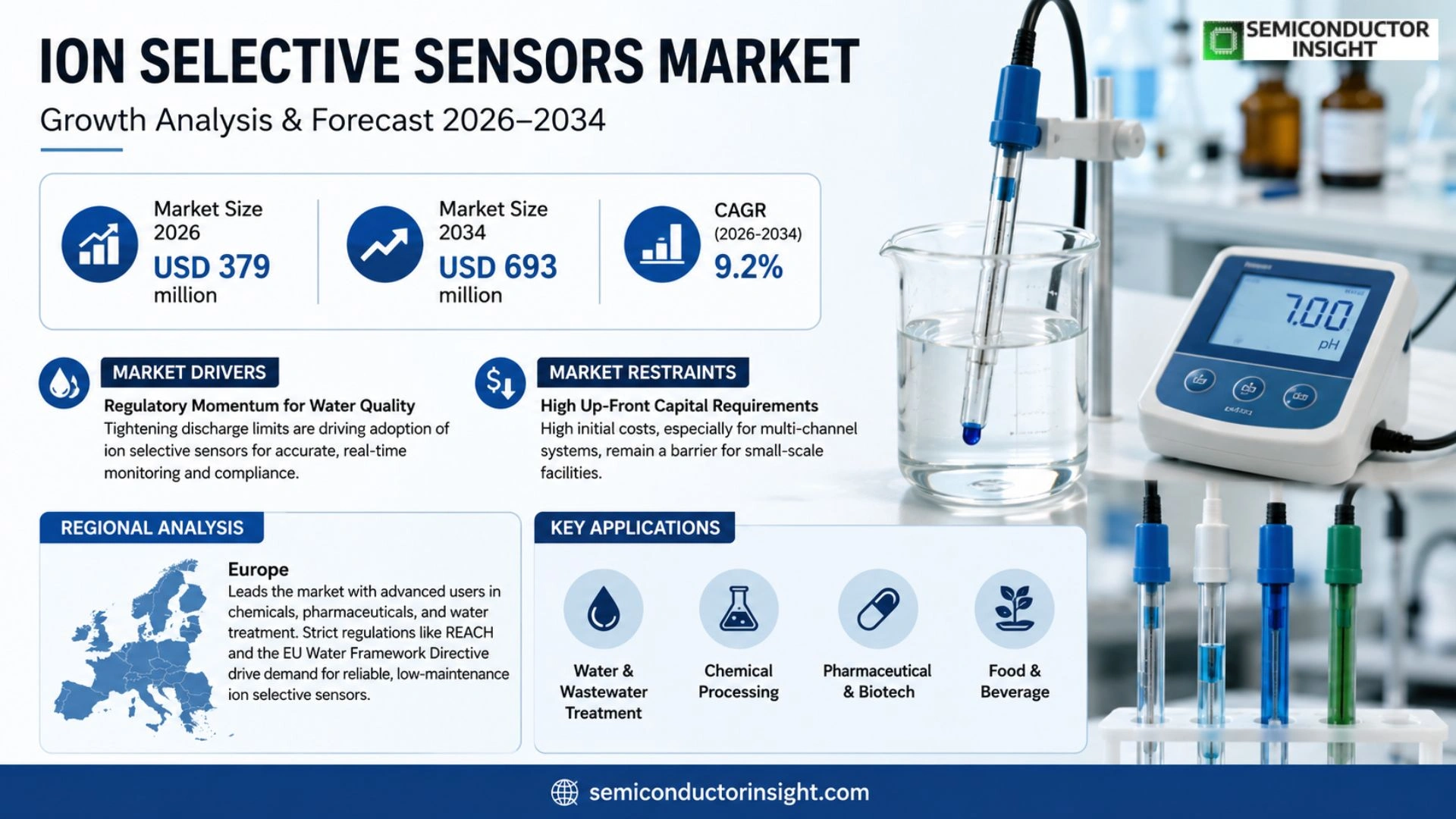
Global Ion Selective Sensors market was valued at USD 379 million in 2026 and will increase to USD 693 million by 2034, reflecting a CAGR of 9.2 % over the forecast period.
Ion selective sensors are electrode devices that selectively measure the activity of a specific ion or a group of ions in aqueous or non‑aqueous solutions. By converting ionic concentration into an electrical signal, they support accurate monitoring across industrial process control, agricultural nutrient management, environmental water‑quality testing and medical diagnostics.
Leading manufacturers such as Thermo Scientific, Metrohm, Cole‑Parmer, Siemens, Van London, NT Sensors and Mettler Toledo account for a substantial share of global revenue. The United States represents the largest regional market in North America, while China drives growth in Asia owing to expanding manufacturing sectors and stricter water‑quality regulations.
MARKET DRIVERS
Regulatory Momentum for Water Quality
The tightening of discharge limits across North America, Europe and parts of Asia has compelled utilities to replace legacy analyzers with more selective technologies. Ion selective sensors deliver the specificity required to meet compliance without the need for extensive sample pretreatment, reducing operational risk for plant managers.
Industrial Automation Requirements
Manufacturers are embedding real‑time ion monitoring into control loops to improve yield and lower waste. The shift toward digital twins and predictive maintenance makes the fast response time of ion selective probes a compelling component of the overall automation stack.
➤ Companies that integrate wireless communication modules with ion selective sensors are reporting a 15‑20% reduction in laboratory spend.
Finally, the rise of renewable energy storage,particularly flow batteries,has created a niche demand for accurate ion concentration data, prompting sensor makers to broaden their product portfolios to service this emerging segment.
MARKET CHALLENGES
Calibration Complexity in Harsh Environments
Field installations often expose probes to temperature swings, fouling agents and high salinity, all of which degrade calibration stability. Operators must allocate skilled personnel for regular checks, inflating total cost of ownership and slowing adoption in remote sites.
Other Challenges
Material Compatibility
Many ion selective membranes are vulnerable to aggressive solvents used in petrochemical processing, forcing users to replace sensors more frequently than anticipated.
MARKET RESTRAINTS
High Up‑Front Capital Requirements
Although the operating expense of ion selective sensors is modest, the initial purchase price,especially for multi‑channel platforms,remains a barrier for small‑scale facilities. Decision‑makers often defer investment until the economic case is unequivocally demonstrated.
Limited Standardization
The absence of globally accepted performance benchmarks hampers cross‑vendor comparisons, making it difficult for buyers to assess long‑term reliability. This ambiguity slows procurement cycles and curtails market momentum.
MARKET OPPORTUNITIES
Smart‑City Water Networks
Municipalities are piloting sensor‑dense grids that stream ion concentration data to cloud‑based analytics platforms. Providers that package Ion Selective Sensors Market solutions with turnkey integration services are positioned to capture a sizable share of these emerging contracts.
Personal Healthcare Diagnostics
Wearable devices capable of monitoring electrolytes in sweat are moving from prototype to commercial stage. The convergence of miniaturized ion selective technology with mobile health apps opens a new revenue stream that extends beyond traditional industrial applications.
Ion Selective Sensors Market Trends
Surge in Environmental and Agricultural Applications
Ion Selective Sensors Market is seeing a noticeable uptick as regulators tighten water‑quality standards across North America and Europe. Manufacturers are responding to increased demand for real‑time ion monitoring in irrigation systems, where precise nutrient control can translate into measurable yield improvements. Meanwhile, municipalities are upgrading legacy monitoring networks with sensor arrays that can differentiate between heavy metals and common ions, reducing false alarms and lowering maintenance costs. The combined effect of stricter legislation and cost‑effective instrumentation is stretching the market’s revenue from roughly $379 million in 2024 toward the high‑600 million range by the early 2030s.
Other Trends
Shift Toward Solid‑State Technologies
Traditional glass electrodes have long dominated the segment, yet recent advances in solid‑state membranes are eroding that dominance. Solid‑state designs offer faster response times, wider temperature tolerance, and a smaller footprint, attributes that appeal to portable field kits used in precision agriculture. Although glass‑based products still command a sizable share, analysts note that the proportion of solid‑state units sold is climbing steadily, hinting at a gradual reallocation of production capacity among leading suppliers.
Competitive Consolidation among Tier‑One Suppliers
Major players such as Thermo Scientific, Metrohm, and Siemens are pursuing strategic acquisitions to broaden their product portfolios and reinforce distribution channels. By integrating niche manufacturers that specialize in compound‑electrode designs, the top five firms are tightening their grip on market share, which in turn raises the barrier to entry for newcomers. This consolidation is prompting mid‑size companies to differentiate through application‑specific solutions, especially in the medical and environmental‑science niches, where customized calibration protocols can command premium pricing.
COMPETITIVE LANDSCAPE
Key Industry Players
Ion Selective Sensors – Competitive Landscape Overview
Ion Selective Sensors market is anchored by a small cohort of multinational firms that dominate revenue generation and R&D investment. Thermo Scientific, with its expansive portfolio of glass and solid‑state electrodes, commands the largest share, benefiting from deep integration with laboratory instrumentation and a global sales force that leverages the company’s broader analytical chemistry brand. This scale enables Thermo to negotiate favorable raw‑material contracts and to sustain a pipeline of incremental product refinements, which in turn raises entry barriers for smaller entrants. Siemens and Metrohm complement this hierarchy by focusing on industrial‑grade sensor solutions and high‑precision titration systems, respectively, each exploiting niche channels such as process control and water‑quality monitoring where performance reliability outweighs cost considerations. The concentration of market power in these few entities creates a competitive dynamic where differentiation hinges on sensor specificity, calibration stability, and digital connectivity rather than pure price competition.
Beyond the headline names, a cadre of specialized manufacturers contributes to market depth and drives incremental innovation. Companies such as NT Sensors, Hach, and Weiss Research excel in niche applications,ranging from agricultural soil analysis to clinical electrolyte monitoring,by offering customized electrode chemistries and low‑volume production runs. Regional players like Jiangsu SWR, Bante Instruments, and Shanghai INESA have captured domestic market share in China and Southeast Asia through aggressive pricing and close ties with local distributors, thereby challenging the global incumbents on cost fronts. Mettler Toledo leverages its precision weighing heritage to bundle sensors with integrated data‑logging platforms, while Van London’s focus on robust, field‑ready designs addresses the rugged requirements of environmental fieldwork. This layered ecosystem ensures that end‑users can select solutions that align with specific regulatory, performance, and budgetary constraints, fostering a market where strategic partnerships and product line extensions become pivotal competitive levers.
List of Key Ion Selective Sensors Companies Profiled
- Thermo Scientific
- Metrohm
- Cole-Parmer
- Siemens
- Van London
- NT Sensors
- Hach
- Weiss Research
- Mettler Toledo
- Jiangsu SWR
- Bante Instruments
- Shanghai INESA
Segment Analysis:
| Segment Category | Sub-Segments | Key Insights |
| By Type |
|
Glass continues to dominate the market due to its long‑standing reliability and well‑understood calibration characteristics.
|
| By Application |
|
Industrial applications drive the most extensive usage of ion selective sensors, especially in process control and water quality monitoring.
|
| By End User |
|
Research Laboratories remain the primary end‑user due to their need for precise ion activity measurements in experimental protocols.
|
| By Material Innovation |
|
Nanostructured Electrodes are emerging as a transformative material class, offering enhanced surface area and selectivity.
|
| By Market Driver |
|
Sustainability Focus is a compelling driver, pushing manufacturers to design sensors with lower power consumption and longer lifespan.
|
Regional Analysis: Ion Selective Sensors Market
Europe
Stringent EU directives on water quality and chemical safety have compelled manufacturers to embed ion selective sensors in compliance monitoring programs, creating a stable demand base that outlives short‑term economic cycles.
Process industries such as petrochemicals and food‑processing rely on real‑time ionic read‑outs to fine‑tune reaction conditions, driving a steady stream of replacement and upgrade orders for high‑accuracy sensor platforms.
Universities and nano‑technology labs across the continent focus on novel membrane materials, positioning Europe as a source of breakthrough sensor designs that later become commercial standards.
Proximity of component manufacturers,silicon fabs in France and polymer producers in the Netherlands,reduces lead times, allowing European users to maintain uninterrupted monitoring operations.
North America
North America benefits from a mature market for ion selective sensors, anchored by a large base of R&D laboratories in the United States and Canada. The region’s emphasis on rapid product development cycles encourages sensor manufacturers to offer plug‑and‑play solutions that integrate with existing SCADA systems. While regulatory drivers are less prescriptive than in Europe, voluntary standards set by industry associations push firms to adopt sensors for process optimization and environmental compliance. The competitive landscape is marked by a blend of legacy equipment providers and agile startups, generating a dynamic pricing environment that rewards those who can demonstrate quick ROI. Vendors that align closely with North American OEMs and offer on‑site calibration services tend to capture a larger share of the market.
Asia‑Pacific
Asia‑Pacific’s growth in Ion Selective Sensors arena stems from rapid industrialization in China, India, and South‑East Asian economies. Expanding chemical production, aggressive water‑purification projects, and government incentives for smart manufacturing create fertile ground for sensor uptake. Local manufacturers are scaling production capabilities, often leveraging cost‑effective material sourcing to offer competitively priced devices. However, the market is fragmented, with varying quality expectations across countries, prompting multinational vendors to establish joint ventures that blend local cost advantages with global reliability standards. The region’s appetite for portable, battery‑operated sensors reflects the need for field‑deployed solutions in remote mining and agricultural contexts.
South America
In South America, Ion Selective Sensors market is shaped by the mining sector and agricultural processing industries that require precise ionic monitoring to meet export quality criteria. Brazil and Chile lead in adoption, driven by tightening environmental legislation and a push toward automation in ore‑refining facilities. Supply‑chain bottlenecks for high‑precision components have slowed penetration, motivating regional distributors to stock safety‑certified inventory to reduce downtime for end users. Collaborative pilot programs between sensor firms and local universities are beginning to address the skill gap, gradually elevating the overall technical competence of the market.
Middle East & Africa
The Middle East & Africa region exhibits niche demand for ion selective sensors in desalination plants and oil‑field water‑treatment units. Energy‑intensive operations demand robust sensors that can withstand high temperatures and salinity, prompting vendors to tailor membrane chemistries for harsh conditions. While overall market size remains modest, strategic partnerships with government‑backed water‑management agencies are unlocking longer‑term contracts. In sub‑Saharan Africa, pilot projects focused on safe drinking water are introducing sensors into community‑scale treatment schemes, hinting at a future expansion driven by public‑health initiatives.
Report Scope
This market research report provides a comprehensive analysis of the Ion Selective Sensors Market , covering the forecast period 2026–2034. It offers detailed insights into market dynamics, technological advancements, competitive landscape, and key trends shaping the industry.
Key focus areas of the report include:
- Market Overview: The report begins with an overview outlining its current market scenario, key growth indicators, and industry transformation drivers. It discusses macroeconomic factors, demand–supply balance, regulatory landscape, and the strategic role of semiconductors in powering advancements across industries such as automotive, telecommunications, consumer electronics, and industrial automation.
- Market Size & Forecast: Historical data and future projections for revenue, unit shipments, and market value across major regions and segments.
- Segmentation Analysis: Detailed breakdown by product type, technology, application, and end-user industry to identify high-growth segments and investment opportunities.
- Regional Insights: Insights into market performance across North America, Europe, Asia-Pacific, Latin America, and the Middle East & Africa, including country-level analysis where relevant.
- Competitive Landscape: Profiles of leading market participants, including their product offerings, R&D focus, manufacturing capacity, pricing strategies, and recent developments such as mergers, acquisitions, and partnerships.
- Technology Trends & Innovation: Assessment of emerging technologies, integration of AI/IoT, semiconductor design trends, fabrication techniques, and evolving industry standards.
- Market Drivers & Restraints: Evaluation of factors driving market growth along with challenges, supply chain constraints, regulatory issues, and market-entry barriers.
- Stakeholder Insights: Insights for component suppliers, OEMs, system integrators, investors, and policymakers regarding the evolving ecosystem and strategic opportunities.
Primary and secondary research methods are employed, including interviews with industry experts, data from verified sources, and real-time market intelligence to ensure the accuracy and reliability of the insights presented.
FREQUENTLY ASKED QUESTIONS:
What is the current market size of Ion Selective Sensors Market?
-> Ion Selective Sensors Market is expected to reach USD 693 million by 2034, at a CAGR of 9.2% during the forecast period.
Which key companies operate in Ion Selective Sensors Market?
-> Key players include Thermo Scientific, Metrohm, Cole-Parmer, Siemens, Van London, NT Sensors, Hach, Weiss Research, Mettler Toledo, Jiangsu SWR, among others.
What are the key growth drivers?
-> Key growth drivers include rising demand for precise ion monitoring in industrial process control, environmental monitoring, agricultural testing, and medical diagnostics, coupled with advancements in solid‑state sensor technology and IoT integration.
Which region dominates the market?
-> North America (particularly the United States) holds a significant share, while Asia (especially China) is experiencing rapid growth, together driving the majority of market revenue.
What are the emerging trends?
-> Emerging trends include development of miniaturized solid‑state ion‑selective sensors, AI‑enabled data analytics for real‑time ion monitoring, and the integration of sensors into smart‑grid and IoT platforms.

Get Sample Report PDF for Exclusive Insights
Report Sample Includes
- Table of Contents
- List of Tables & Figures
- Charts, Research Methodology, and more...
 Download Sample Report PDF