IO-Link Master & Device Transceiver IC Market Insights
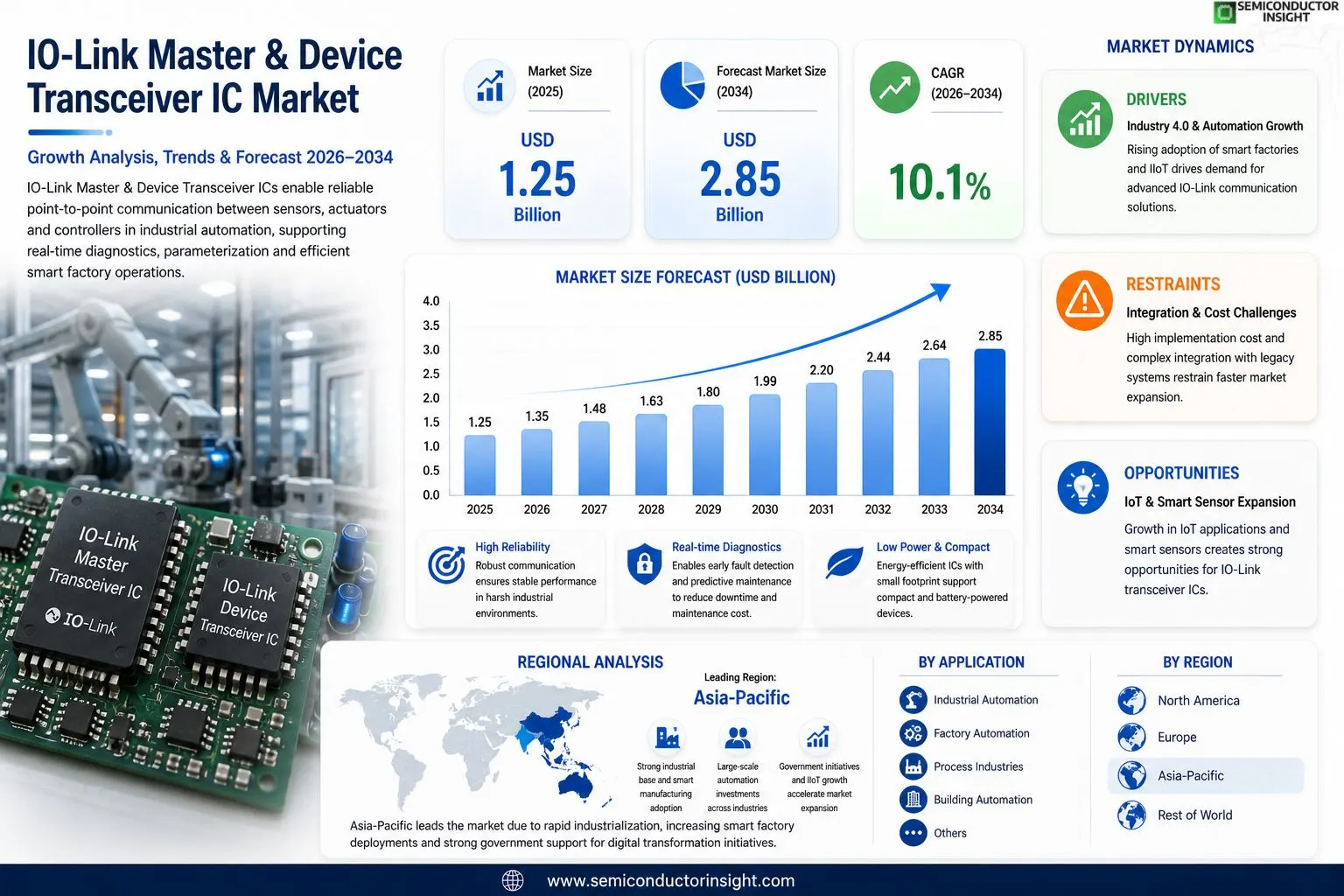
Global IO-Link Master & Device Transceiver IC market size was valued at USD 1.25 billion in 2025. The market is projected to grow from USD 1.35 billion in 2026 to USD 2.85 billion by 2034, exhibiting a CAGR of 9.8% during the forecast period.
IO-Link Master and Device Transceiver ICs serve as critical semiconductor components that enable reliable, point-to-point digital communication between sensors, actuators, and higher-level automation systems. These integrated circuits facilitate bidirectional data exchange, parameter setting, and diagnostic capabilities in industrial environments while supporting standardized protocols defined under IEC 61131-9. They typically incorporate features such as voltage regulation, signal conditioning, protection circuits, and protocol handling to ensure robust performance in harsh factory settings.
The market is experiencing steady expansion driven by the accelerating adoption of Industry 4.0 initiatives and the need for smarter, more connected industrial automation solutions. As manufacturers seek greater operational efficiency, predictive maintenance, and real-time visibility into production processes, demand for advanced transceiver ICs continues to rise. Furthermore, the proliferation of smart sensors and the requirement for simplified wiring architectures contribute significantly to market momentum. While legacy analog interfaces still dominate certain segments, the shift toward digital protocols is gaining traction because it reduces installation complexity and improves overall system reliability. Key players continue to invest in higher channel density designs and enhanced power management features to address evolving customer requirements in sectors such as automotive manufacturing, food and beverage processing, and logistics. Recent product introductions focus on improved electromagnetic compatibility and integration with modern fieldbus systems, further supporting broader deployment across global industrial facilities.
MARKET DRIVERS
Growing Deployment of Industrial Automation
IO-Link Master & Device Transceiver IC Market is being driven by the expanding integration of advanced automation across manufacturing, logistics, and processing industries. As factories accelerate their transition toward digitalized and interconnected production systems, demand for **reliable point-to-point communication** is rising. IO-Link technology enables simplified wiring, real-time diagnostics, and flexible device configuration, making it a preferred interface for modern smart sensors and actuators. These factors continue to push adoption as industries seek to enhance productivity and reduce downtime.
Rising Need for Predictive Maintenance Capabilities
The market is also supported by the growing emphasis on predictive maintenance strategies. IO-Link Master and Device Transceiver ICs allow continuous monitoring of field device health, enabling early detection of anomalies and reducing unscheduled equipment failures. Manufacturers increasingly rely on **sensor-level intelligence**, making IO-Link a foundational technology for modern condition-based monitoring solutions.
➤ Enhanced data transparency and simplified commissioning remain major contributors to sustained market adoption.
The combined push for Industry 4.0 readiness, efficiency optimization, and scalable automation architecture continues to strengthen long-term market momentum for IO-Link-enabled transceiver IC solutions.
MARKET CHALLENGES
Integration Complexity in Legacy Systems
Despite strong adoption trends, IO-Link Master & Device Transceiver IC Market faces challenges associated with integrating IO-Link into legacy industrial infrastructures. Many factories continue to operate older PLCs and sensor systems not originally designed for bidirectional digital communication. Ensuring compatibility without disrupting ongoing operations requires additional engineering effort and increases deployment time, limiting the speed of market expansion.
Other Challenges
Cost Sensitivity Among Small and Mid-Sized Manufacturers
For smaller manufacturers, the transition toward IO-Link-enabled devices can introduce upfront hardware and installation costs. These companies often prioritize essential upgrades, delaying investment in advanced automation interfaces and slowing adoption of IO-Link transceiver ICs.
MARKET RESTRAINTS
Limited Awareness in Developing Industrial Hubs
IO-Link Master & Device Transceiver IC Market is partially restrained by limited awareness in emerging manufacturing regions. Although IO-Link delivers clear operational advantages, many facilities in developing markets lack training and technical familiarity with sensor-level digital communication standards. This knowledge gap slows technology transition and restricts broader adoption. Additionally, the presence of established proprietary industrial protocols in certain sectors creates hesitancy toward adopting newer open communication standards, further moderating growth.
MARKET OPPORTUNITIES
Expansion of Smart Sensors and Edge Automation
Emerging opportunities in IO-Link Master & Device Transceiver IC Market are strongly aligned with the rapid expansion of smart sensors, compact automation devices, and edge-capable industrial hardware. As manufacturers shift toward decentralized control architectures and connected sensing environments, demand for IO-Link-enabled ICs is expected to accelerate. The technology’s ability to support efficient parameterization, high data availability, and consistent diagnostics positions it as a key enabler of next-generation industrial connectivity. Growing deployment of intelligent field devices in robotics, packaging, and process automation will further unlock long-term market prospects.
IO-Link Master & Device Transceiver IC Market Trends
Advancement of Intelligent Industrial Connectivity
IO-Link Master & Device Transceiver IC Market is undergoing significant transformation as industries accelerate digital integration across factory environments. The increasing reliance on smart automation systems, combined with the adoption of standardized communication frameworks, continues to elevate the importance of transceiver ICs capable of enabling robust point-to-point connectivity. These components support efficient data exchange, parameter configuration, and diagnostic transparency, allowing operators to gain deeper insights into machine behavior. With manufacturers prioritizing automation strategies that improve productivity, reduce downtime, and enhance equipment monitoring, demand for highly integrated IO-Link IC solutions remains consistently strong.
Growing preference for digital communication protocols is also shaping technological development. IO-Link’s flexibility, paired with its compatibility with diverse industrial sensors and actuators, is prompting wider deployment across multiple production lines. This trend is supported by the ongoing shift from legacy analog systems toward digital architectures that offer improved signal integrity, reduced wiring complexity, and more efficient troubleshooting processes. As factories modernize infrastructure to enhance real-time responsiveness and long-term operational resilience, adoption of IO-Link-enabled components continues to deepen across global markets.
Other Trends
Rising Integration of Smart Sensors
The increasing use of smart sensors with embedded processing capabilities is directly influencing demand for IO-Link Master and Device Transceiver ICs. These sensors rely on standardized communication frameworks to transmit diagnostic and performance data to supervisory systems. As industries deploy more advanced sensing units for tasks such as process control, equipment monitoring, and quality assurance, IO-Link ICs become essential to maintaining reliable digital connectivity. The growing emphasis on enhanced signal conditioning and protection features within these ICs reflects manufacturers’ efforts to address harsh operating conditions commonly found in industrial facilities.
Enhanced Electromagnetic Compatibility Requirements
Another notable trend involves stronger focus on electromagnetic compatibility as automated machinery becomes increasingly interconnected. Newer transceiver IC designs incorporate improved shielding and circuit protection mechanisms to ensure stable communication even in electrically noisy environments. This development aligns with the expansion of high-speed automation lines, where uninterrupted data exchange is critical for precise coordination among machines.
Digitalization Accelerating System-Level Integration
System-level integration is becoming a core priority as manufacturers seek to unify devices, communication networks, and analytical systems. IO-Link Master and Device Transceiver ICs support this transition by enabling seamless incorporation of field components into higher-level industrial controls. With modernization efforts intensifying across sectors such as automotive production, logistics automation, and food processing, the market continues to benefit from the rising need for streamlined digital architectures that enhance visibility and operational flexibility.
COMPETITIVE LANDSCAPE
Key Industry Players
IO-Link Master & Device Transceiver IC Market Competitor Assessment
IO-Link Master & Device Transceiver IC Market is shaped by a concentrated group of advanced semiconductor manufacturers that supply high‑reliability communication ICs for Industry 4.0 and factory automation infrastructure. Leading companies such as Analog Devices, Texas Instruments, and Infineon Technologies dominate the high‑performance segment due to their deep expertise in industrial communication, signal conditioning, and robust protection circuitry. These companies maintain strong competitive positions through continuous investments in integrated diagnostics, higher channel densities, and improved EMC performance tailored for harsh industrial environments. Their extensive portfolios and established relationships with automation OEMs enable them to supply optimized master and device transceiver solutions supporting IEC 61131‑9 standards.
Beyond the top-tier suppliers, several specialized automation semiconductor firms—including Maxim Integrated (now part of Analog Devices), Renesas Electronics, STMicroelectronics, and NXP Semiconductors—play important roles in providing differentiated offerings addressing power management, mixed-signal integration, and protocol interoperability. Niche industrial connectivity manufacturers such as Microchip Technology, Broadcom, and Semtech contribute through transceiver innovations designed for smart sensors and compact machine modules. Additionally, companies like CubeSolutions, Hans Turck, Balluff, and ifm electronic strengthen the market ecosystem through targeted IO-Link interface technologies embedded within automation components. This diversified base of suppliers enhances competition, drives pricing discipline, and accelerates innovation to meet the growing demand for digitalized industrial communication networks.
List of Key IO-Link Master & Device Transceiver IC Companies Profiled
- Analog Devices
- Texas Instruments
- Infineon Technologies
- STMicroelectronics
- Renesas Electronics
- Microchip Technology
- NXP Semiconductors
- Broadcom
- Semtech Corporation
- Maxim Integrated (Analog Devices)
- Balluff
- Hans Turck
- ifm electronic
- CubeSolutions
- Würth Elektronik
Segment Analysis:
| Segment Category | Sub-Segments | Key Insights |
| By Type |
|
Leading Segment
|
| By Application |
|
Leading Segment
|
| By End User |
|
Leading Segment
|
| By Technology Architecture |
|
Leading Segment
|
| By Communication Mode |
|
Leading Segment
|
Regional Analysis: IO-Link Master & Device Transceiver IC Market
North America
North America stands as the leading regional market, driven by strong industrial modernization trends, high adoption of advanced automation frameworks, and consistent investments in smart manufacturing. Across key industries such as automotive, electronics, pharmaceuticals, and logistics, demand for IO-Link Master & Device Transceiver IC solutions continues to rise due to the region’s push for intelligent connectivity and stronger real-time data exchange on the factory floor. The presence of major technology developers and automation-focused enterprises further accelerates system-level innovation, enabling seamless migration from legacy systems to IO-Link-enabled architectures.The region’s well-established industrial IoT ecosystem creates favorable conditions for enhancing sensor-level communication, predictive maintenance, and energy-efficient automation systems. Companies are increasingly integrating IO-Link Master & Device Transceiver IC components to streamline device interoperability and reduce engineering complexities, especially in multi-vendor environments. Furthermore, the rapid expansion of connected industrial devices supports scalable IO-Link deployment aligned with evolving Industry 4.0 standards.
North America also benefits from strong R&D activity, collaborative ventures between semiconductor manufacturers and automation OEMs, and growing interest in vertically integrated automation solutions. As factories continue to adopt decentralized, intelligent field-level components, the strategic role of IO-Link technology intensifies. The region’s regulatory emphasis on workplace safety, operational visibility, and equipment efficiency further strengthens investment in IO-Link enabling technologies. Overall, North America maintains a strong trajectory of innovation, making it a pivotal market in shaping Global IO-Link Master & Device Transceiver IC landscape.
North America’s early and widespread adoption of advanced automation technologies fuels strong demand for IO-Link Master & Device Transceiver IC components. Manufacturers increasingly rely on smart field devices to streamline production and improve system-level communication. The shift toward data-centric operations further enhances IO-Link integration across various industries, strengthening market expansion.
A mature semiconductor landscape and a thriving industrial IoT ecosystem support rapid technological growth. Continuous collaboration among chip manufacturers, automation OEMs, and solution providers encourages accelerated development of IO-Link-enabled devices. This environment fosters innovation, enabling scalable architectures and stronger device-to-system compatibility.
Regional alignment with Industry 4.0 standards drives structured investments into sensor-level intelligence and real-time monitoring technologies. Companies increasingly emphasize unified communication protocols, encouraging adoption of IO-Link Master & Device Transceiver IC interfaces to enhance interoperability and streamline digital transformation strategies.
The growing emphasis on predictive maintenance encourages industries to integrate IO-Link-enabled devices capable of generating real-time performance data. This supports more accurate equipment health monitoring and reduced downtime, reinforcing the value of IO-Link Master & Device Transceiver IC solutions in modern industrial environments.
Europe
Europe represents a mature and technologically progressive market, strongly influenced by structured industrial policies and long-standing automation leadership. Priority sectors such as automotive, machinery, packaging, and process manufacturing are actively integrating IO-Link Master & Device Transceiver IC architectures to strengthen device communication and optimize production flows. The region benefits from well-developed engineering expertise and strong collaboration between industry associations and automation companies. The push toward sustainable manufacturing also accelerates adoption of IO-Link-enabled solutions that enhance energy efficiency, diagnostics accuracy, and operational transparency. As European manufacturers enforce strict quality and reliability standards, they increasingly deploy IO-Link technology to support standardized communication and reduce system integration complexities.
Asia-Pacific
Asia-Pacific is one of the fastest-growing regions due to expanding manufacturing bases, large-scale industrial investments, and rapid digital transformation initiatives across emerging economies. Industries such as electronics, automotive, semiconductor assembly, and industrial machinery are accelerating adoption of IO-Link Master & Device Transceiver IC components to enhance process automation and improve data-driven operational control. Governments across key markets support extensive modernization programs that encourage integration of smart sensors and intelligent device interfaces. The increasing presence of global automation vendors in the region also facilitates broader access to IO-Link-enabled products, creating an environment favorable for long-term growth. Rising demand for cost-efficient automation drives significant interest in scalable sensor networking solutions supported by IO-Link technology.
South America
South America shows gradually increasing demand for IO-Link Master & Device Transceiver IC technology as industries adopt more automated and digitally connected systems. Manufacturing sectors such as food processing, mining, and automotive assembly are modernizing their production setups, leading to increased use of intelligent field devices. While adoption levels vary across countries, growing interest in process stability, equipment monitoring, and reduced downtime supports the uptake of IO-Link-enabled solutions. Partnerships with international automation vendors are helping local industries gain exposure to advanced communication interfaces that promote higher operational efficiency. Although the region remains in a developing stage, rising industrial modernization provides steady market growth opportunities.
Middle East & Africa
The Middle East & Africa region is witnessing progressive adoption of automation technologies, particularly in oil and gas, utilities, and large-scale industrial operations. As industries aim to improve asset reliability and operational intelligence, IO-Link Master & Device Transceiver IC integration becomes increasingly relevant. The region’s growing focus on industrial diversification and digital transformation initiatives encourages adoption of smart sensor networks and enhanced device-level communication systems. Infrastructure expansion and rising interest in predictive maintenance tools further contribute to supportive market conditions. Although adoption is still emerging, the region holds long-term potential as enterprises continue transitioning toward connected industrial ecosystems.
Report Scope
This market research report provides a comprehensive analysis of the IO-Link Master & Device Transceiver IC Market , covering the forecast period 2026–2034. It offers detailed insights into market dynamics, technological advancements, competitive landscape, and key trends shaping the industry.
Key focus areas of the report include:
- Market Overview: The report begins with an overview outlining its current market scenario, key growth indicators, and industry transformation drivers. It discusses macroeconomic factors, demand–supply balance, regulatory landscape, and the strategic role of semiconductors in powering advancements across industries such as automotive, telecommunications, consumer electronics, and industrial automation.
- Market Size & Forecast: Historical data and future projections for revenue, unit shipments, and market value across major regions and segments.
- Segmentation Analysis: Detailed breakdown by product type, technology, application, and end-user industry to identify high-growth segments and investment opportunities.
- Regional Insights: Insights into market performance across North America, Europe, Asia-Pacific, Latin America, and the Middle East & Africa, including country-level analysis where relevant.
- Competitive Landscape: Profiles of leading market participants, including their product offerings, R&D focus, manufacturing capacity, pricing strategies, and recent developments such as mergers, acquisitions, and partnerships.
- Technology Trends & Innovation: Assessment of emerging technologies, integration of AI/IoT, semiconductor design trends, fabrication techniques, and evolving industry standards.
- Market Drivers & Restraints: Evaluation of factors driving market growth along with challenges, supply chain constraints, regulatory issues, and market-entry barriers.
- Stakeholder Insights: Insights for component suppliers, OEMs, system integrators, investors, and policymakers regarding the evolving ecosystem and strategic opportunities.
Primary and secondary research methods are employed, including interviews with industry experts, data from verified sources, and real-time market intelligence to ensure the accuracy and reliability of the insights presented.
FREQUENTLY ASKED QUESTIONS:
What is the current market size of IO-Link Master & Device Transceiver IC Market?
-> IO-Link Master & Device Transceiver IC Market was valued at USD 1.25 billion in 2025 and is expected to reach USD 2.85 billion by 2034.
Which key companies operate in IO-Link Master & Device Transceiver IC Market?
-> Key players include leading semiconductor manufacturers and industrial automation solution providers that develop IO-Link master and device transceiver IC technologies.
What are the key growth drivers?
-> Key growth drivers include Industry 4.0 adoption, demand for advanced industrial automation, increasing use of smart sensors, simplified wiring architectures, and the need for real-time operational visibility.
Which region dominates the market?
-> Europe remains a dominant market due to strong industrial automation adoption, while Asia-Pacific is rapidly growing with expanding manufacturing activities.
What are the emerging trends?
-> Emerging trends include higher channel density IC designs, improved electromagnetic compatibility, enhanced power management features, and integration with modern fieldbus and IoT-enabled automation systems.

Get Sample Report PDF for Exclusive Insights
Report Sample Includes
- Table of Contents
- List of Tables & Figures
- Charts, Research Methodology, and more...
 Download Sample Report PDF