Integrated Passive Device (IPD) on Glass for RF Market Insights
Integrated Passive Device (IPD) on Glass for RF Market size was valued at USD 1.87 billion in 2025. The market is projected to grow from USD 2.09 billion in 2026 to USD 4.76 billion by 2034, exhibiting a CAGR of 9.6% during the forecast period.
Integrated Passive Devices (IPDs) on glass are advanced semiconductor components that consolidate multiple passive elements , including resistors, capacitors, inductors, and filters , onto a single glass substrate for radio frequency (RF) applications. The use of glass as a substrate offers superior electrical insulation, lower signal loss, and excellent dimensional stability compared to traditional silicon or organic substrates, making it particularly well-suited for high-frequency RF performance in wireless communication systems.
The market is witnessing robust expansion driven by the accelerating global rollout of 5G networks, growing adoption of millimeter-wave (mmWave) technologies, and the surging demand for compact, high-performance RF front-end modules in smartphones, IoT devices, and automotive connectivity systems. Furthermore, the increasing complexity of multi-band, multi-mode wireless devices is pushing manufacturers to integrate passive components more efficiently, where IPD on glass delivers a compelling advantage. Key industry participants such as Murata Manufacturing Co., Ltd., TDK Corporation, and STMicroelectronics continue to invest in advanced packaging and substrate innovations to strengthen their positions in this evolving market.
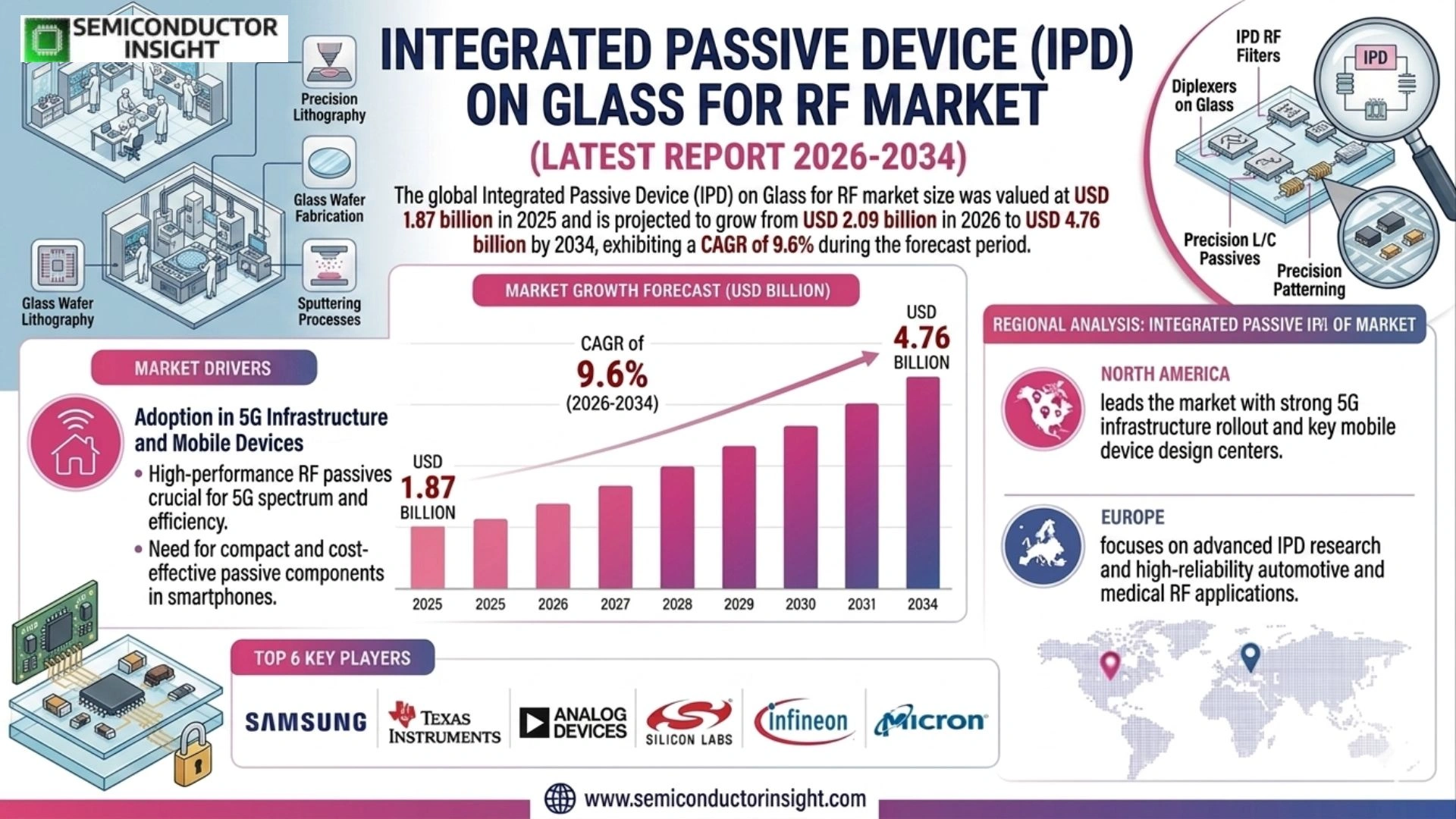
MARKET DRIVERS
Rising Demand for Miniaturized RF Components in Next-Generation Wireless Communication
Integrated Passive Device (IPD) on Glass for RF Market is experiencing significant growth momentum driven by the accelerating global rollout of 5G networks and the corresponding demand for compact, high-performance radio frequency components. As wireless communication infrastructure evolves, device manufacturers are under increasing pressure to reduce component footprints without compromising signal integrity or electrical performance. Glass substrates, owing to their superior dielectric properties, low signal loss, and dimensional stability, have emerged as a preferred platform for integrating passive RF components such as filters, baluns, couplers, and impedance matching networks into a single compact package.
Proliferation of IoT Devices and Wearable Electronics Fueling IPD on Glass Adoption
The rapid expansion of the Internet of Things (IoT) ecosystem and the surge in wearable electronics represent a strong structural driver for Integrated Passive Device (IPD) on Glass for RF Market. These application segments demand ultra-thin, lightweight, and highly reliable RF front-end solutions that can operate efficiently across multiple frequency bands. Glass-based IPDs offer a compelling combination of mechanical rigidity, thermal stability, and excellent RF performance at high frequencies, making them particularly well-suited for compact consumer and industrial wireless devices. The growing penetration of Bluetooth, Wi-Fi 6/6E, UWB, and sub-6 GHz 5G modules in end-user devices continues to amplify demand for advanced passive integration solutions.
➤ Glass substrates in RF integrated passive devices offer a coefficient of thermal expansion (CTE) that closely matches that of silicon, enabling tighter integration and enhanced long-term reliability in demanding operating environments , a key performance advantage over traditional organic or ceramic-based substrates.
Furthermore, the automotive sector’s shift toward connected and autonomous vehicle platforms is creating an additional demand vector for glass-based IPD solutions. Advanced driver-assistance systems (ADAS), vehicle-to-everything (V2X) communication, and in-vehicle infotainment systems all require robust, multi-band RF front-end components. The ability of IPD on glass technology to deliver consistent performance across a wide frequency range while withstanding automotive-grade environmental conditions positions it as a strong candidate for next-generation vehicular RF architectures, further reinforcing the growth trajectory of Integrated Passive Device (IPD) on Glass for RF Market.
MARKET CHALLENGES
High Manufacturing Complexity and Precision Requirements Limiting Broader Market Entry
One of the most significant challenges confronting Integrated Passive Device (IPD) on Glass for RF Market is the inherently complex and precision-intensive nature of the fabrication process. Manufacturing IPDs on glass substrates requires advanced thin-film deposition techniques, photolithography, and precise etching processes that demand substantial capital investment and highly specialized process knowledge. Glass, while offering superior electrical characteristics, is a more brittle and difficult-to-handle material compared to silicon or organic laminates, increasing the risk of substrate cracking or damage during wafer-level processing. These technical barriers contribute to higher per-unit costs and longer yield optimization cycles, particularly for newer entrants attempting to establish competitive production capabilities.
Other Challenges
Limited Standardization Across the Supply Chain
The absence of universally adopted design standards and process specifications for glass-based IPD fabrication creates fragmentation across the supply chain. Semiconductor packaging houses, RF module integrators, and OEM customers often operate with divergent design rules and qualification protocols, complicating the path to high-volume commercialization. This lack of standardization increases design-to-production lead times and can hinder interoperability between components sourced from different suppliers, adding friction to the broader adoption of IPD on glass solutions in the RF domain.
Thermal Management and Integration Compatibility Constraints
Despite the favorable thermal expansion characteristics of glass, managing heat dissipation in densely integrated RF passive devices on glass substrates remains a technical challenge. As operating frequencies increase and component densities rise, localized thermal buildup can affect component performance and long-term reliability. Additionally, achieving seamless integration of glass-based IPDs with active silicon dies or heterogeneous packaging platforms requires precise alignment and bonding technologies that are still maturing, presenting ongoing engineering hurdles for design teams targeting advanced RF front-end module architectures.
MARKET RESTRAINTS
Elevated Production Costs Relative to Conventional Substrate Technologies
A primary restraint acting on Integrated Passive Device (IPD) on Glass for RF Market is the comparatively elevated cost structure associated with glass substrate processing relative to more mature alternatives such as silicon, low-temperature co-fired ceramic (LTCC), or organic laminates. The specialized equipment required for glass wafer handling, the higher incidence of substrate breakage during processing, and the relatively limited number of qualified foundries capable of high-volume glass IPD production collectively constrain cost competitiveness. For price-sensitive consumer electronics applications, this cost differential can be a decisive factor that favors incumbent technologies, slowing the pace of glass-based IPD adoption even where technical performance advantages are evident.
Constrained Ecosystem of Qualified Suppliers and Foundry Capacity
The global supply base for glass-based RF IPD fabrication remains relatively concentrated, with a limited number of specialized foundries and material suppliers currently offering mature, high-volume production capabilities. This supply concentration introduces sourcing risk and limits the negotiating leverage of downstream customers seeking competitive pricing or flexible capacity allocation. The qualification process for new glass IPD suppliers is lengthy and resource-intensive, creating inertia within existing supply chains and slowing the organic expansion of the foundry ecosystem. Until broader capacity investment occurs across the value chain, supply-side constraints will continue to act as a meaningful restraint on the overall growth rate of Integrated Passive Device (IPD) on Glass for RF Market.
MARKET OPPORTUNITIES
Expansion of mmWave 5G Infrastructure Creating New Application Frontiers for Glass IPDs
The progressive deployment of millimeter-wave (mmWave) 5G networks presents a substantial growth opportunity for Integrated Passive Device (IPD) on Glass for RF Market. At mmWave frequencies , typically spanning 24 GHz to 100 GHz , the electrical performance advantages of glass substrates become particularly pronounced, as low dielectric loss and smooth surface topography enable precise impedance control and reduced insertion loss in passive RF components. Antenna-in-package (AiP) architectures and phased-array modules operating in the mmWave band are increasingly leveraging glass-based IPDs to achieve the required performance density, positioning the technology for accelerated adoption as mmWave infrastructure buildout intensifies across North America, East Asia, and parts of Europe.
Heterogeneous Integration Trends and Advanced Packaging Paradigms Opening New Design Spaces
The broader industry transition toward heterogeneous integration and system-in-package (SiP) architectures represents a compelling long-term opportunity for glass-based IPD technologies within the RF domain. As chipmakers and module integrators seek to co-package active and passive components with greater density and efficiency, glass substrates , with their ability to support fine-pitch redistribution layers, through-glass vias (TGVs), and embedded passive structures , offer a versatile platform for next-generation RF front-end integration. Collaborative development programs between glass manufacturers, semiconductor foundries, and RF module OEMs are accelerating the maturation of this ecosystem. Strategic investments in panel-level glass processing and wafer-level packaging innovations are expected to progressively reduce cost-per-unit metrics, broadening the addressable market for Integrated Passive Device (IPD) on Glass for RF Market solutions across both high-performance and mid-tier application segments.
Trends
5G Network Rollout Accelerating Demand for IPD on Glass Solutions
Integrated Passive Device (IPD) on Glass for RF Market is experiencing significant momentum, primarily fueled by the accelerating global deployment of 5G networks. As wireless infrastructure expands across urban and suburban regions, the need for compact, high-performance RF front-end modules has intensified. IPDs on glass substrates are emerging as a preferred solution due to their superior electrical insulation, lower signal loss, and excellent dimensional stability compared to conventional silicon or organic substrates. These properties make IPD on glass particularly well-suited for high-frequency RF performance requirements in next-generation wireless communication systems, positioning the technology at the forefront of the broader semiconductor packaging evolution.
Other Trends
Growing Adoption of Millimeter-Wave (mmWave) Technologies
The rising adoption of millimeter-wave technologies is reshaping Integrated Passive Device (IPD) on Glass for RF Market. mmWave frequencies demand passive components with exceptional precision and minimal signal degradation, criteria that glass substrates fulfill with greater consistency than traditional alternatives. As mmWave applications expand beyond telecom infrastructure into automotive radar, industrial sensing, and fixed wireless access, manufacturers are increasingly turning to IPD on glass to meet stringent performance benchmarks. This trend is reinforcing investment in advanced glass-based packaging innovations across the semiconductor supply chain.
Surging Demand from Smartphones and IoT Devices
Consumer electronics, particularly smartphones and Internet of Things (IoT) devices, represent a critical demand driver for Integrated Passive Device (IPD) on Glass for RF Market. The growing complexity of multi-band, multi-mode wireless devices requires highly efficient passive component integration within increasingly constrained form factors. IPD on glass enables manufacturers to consolidate resistors, capacitors, inductors, and filters onto a single substrate, delivering both miniaturization and enhanced RF performance. As global smartphone penetration continues and IoT connectivity expands across industries, demand for compact RF front-end modules utilizing glass-based IPD solutions is expected to rise steadily.
Automotive Connectivity Emerging as a High-Growth Application Segment
Automotive connectivity systems are emerging as a notable growth avenue withIntegrated Passive Device (IPD) on Glass for RF Market. Modern vehicles increasingly rely on advanced wireless communication technologies , including vehicle-to-everything (V2X) connectivity, telematics, and in-vehicle infotainment , all of which demand reliable and compact RF components. The thermal stability and mechanical robustness of glass substrates make IPD on glass an attractive option for automotive-grade applications. Leading industry participants such as Murata Manufacturing Co., Ltd., TDK Corporation, and STMicroelectronics continue to invest in substrate and packaging innovations to address these evolving automotive RF requirements and capitalize on this expanding application segment.
COMPETITIVE LANDSCAPE
Key Industry Players
Integrated Passive Device (IPD) on Glass for RF Market , Competitive Dynamics and Leading Innovators
Global Integrated Passive Device (IPD) on Glass for RF Market is characterized by the strong presence of established semiconductor and passive component manufacturers driving technological advancement and supply chain consolidation. Murata Manufacturing Co., Ltd. commands a significant share of the market, leveraging its extensive expertise in miniaturized passive components and RF front-end module integration. TDK Corporation and STMicroelectronics also hold prominent positions, continuously investing in advanced glass substrate packaging to address the demanding performance requirements of 5G mmWave deployments, multi-band smartphones, IoT platforms, and automotive wireless connectivity systems. These leading players are differentiating through proprietary glass substrate processes that deliver lower signal loss, superior electrical insulation, and enhanced dimensional stability , critical parameters as RF systems push into higher frequency bands.
Beyond the market leaders, a number of specialized and regionally significant players are shaping the competitive contours of the IPD on Glass for RF landscape. Companies such as Qualcomm Technologies, Inc. and Broadcom Inc. integrate IPD solutions within their broader RF front-end portfolios, intensifying competition in the smartphone and wireless infrastructure segments. Meanwhile, dedicated substrate and packaging specialists including Taiyo Yuden Co., Ltd., Skyworks Solutions, and Qorvo, Inc. are advancing glass-based passive integration to serve the surging demand for compact, high-performance RF modules. The market is projected to expand from USD 2.09 billion in 2026 to USD 4.76 billion by 2034 at a CAGR of 9.6%, creating strong incentives for both incumbents and emerging participants to scale their glass IPD capabilities and form strategic partnerships across the semiconductor value chain.
List of Key Integrated Passive Device (IPD) on Glass for RF Companies Profiled
- Murata Manufacturing Co., Ltd.
- TDK Corporation
- STMicroelectronics
- Qualcomm Technologies, Inc.
- Broadcom Inc.
- Skyworks Solutions, Inc.
- Qorvo, Inc.
- Taiyo Yuden Co., Ltd.
- Vishay Intertechnology, Inc.
- Würth Elektronik GmbH & Co. KG
- AVX Corporation (Kyocera Group)
- YAGEO Corporation
- Johanson Technology, Inc.
- Soshin Electric Co., Ltd.
- Knowles Corporation
Segment Analysis:
| Segment Category | Sub-Segments | Key Insights |
| By Type |
|
RF Filters represent the leading type segment within the Integrated Passive Device on Glass for RF market, driven by their indispensable role in managing signal integrity across an increasingly crowded wireless spectrum.
|
| By Application |
|
Wireless Communication (5G/LTE) dominates the application landscape for IPD on glass, underpinned by the accelerating global rollout of next-generation network infrastructure and the evolving complexity of RF front-end module design.
|
| By End User |
|
Consumer Electronics Manufacturers constitute the leading end-user segment in the IPD on glass for RF market, reflecting the enormous scale and rapid product refresh cycles characteristic of the global consumer device industry.
|
| By Substrate Technology |
|
Borosilicate Glass leads the substrate technology segment, valued for its well-established combination of electrical, thermal, and mechanical properties that are particularly well-aligned with demanding RF application requirements.
|
| By Packaging Technology |
|
Wafer-Level Packaging (WLP) emerges as the dominant packaging technology for IPD on glass for RF applications, driven by its inherent compatibility with the high-precision fabrication processes required to produce glass-substrate passive components at commercial scale.
|
Regional Analysis: Integrated Passive Device (IPD) on Glass for RF Market
Asia-Pacific
Asia-Pacific leads global 5G network expansion, creating substantial and sustained demand for advanced RF passive components. The rapid proliferation of 5G base stations and smart devices across China, South Korea, and Japan is compelling device makers to adopt compact, high-performance Integrated Passive Device solutions on glass substrates that deliver superior signal integrity and reduced form factors essential for next-generation wireless platforms.
The region hosts a deeply integrated semiconductor and advanced packaging ecosystem, enabling cost-competitive and high-throughput production of IPD on glass components. Taiwan’s foundry expertise, Japan’s precision materials heritage, and South Korea’s leading-edge chip design capabilities collectively create an unmatched manufacturing environment that supports the scaling of IPD on glass technology across consumer, telecom, and automotive RF applications.
Asia-Pacific’s role as the world’s primary consumer electronics production center directly fuels demand for miniaturized RF passive solutions. Smartphones, wearables, and connected home devices manufactured across the region increasingly require IPD on glass integration to meet stringent size, weight, and performance requirements, reinforcing Asia-Pacific’s strategic importance as both a production and consumption hub for this specialized market segment.
National governments across Asia-Pacific are channeling significant resources into semiconductor self-sufficiency and advanced materials research, with direct benefits for the IPD on glass for RF market. State-backed funding programs, technology parks, and academic-industry collaboration initiatives are accelerating the commercialization timeline for glass-substrate RF passives, ensuring the region retains a competitive advantage in technology maturity and production readiness through the forecast period.
North America
North America represents a strategically significant market for the Integrated Passive Device (IPD) on Glass for RF segment, underpinned by a robust landscape of semiconductor innovation, defense electronics demand, and early commercial 5G adoption. The United States, in particular, plays a pivotal role as a center of RF technology research and development, with leading fabless chip designers, defense contractors, and telecommunications equipment providers driving demand for high-performance passive integration on glass substrates. Federal investments in domestic semiconductor manufacturing and national security-related communication systems are creating new avenues for IPD on glass adoption in mission-critical RF applications. Additionally, North America’s thriving automotive sector, increasingly dependent on advanced radar and V2X communication modules, presents a growing addressable market for glass-based RF passives. The region’s strong intellectual property environment and access to top-tier academic research institutions further support continued innovation, positioning North America as a key contributor to technology standards and market evolution throughout the 2026–2034 forecast horizon.
Europe
Europe occupies a notable position in Global Integrated Passive Device (IPD) on Glass for RF Market, driven by its well-established automotive electronics industry, robust telecommunications infrastructure, and a growing emphasis on industrial IoT and smart manufacturing applications. Germany, France, the Netherlands, and Sweden are among the key contributors to the regional market, with leading automotive OEMs and tier-one suppliers actively integrating advanced RF passive technologies into connected and autonomous vehicle platforms. European research consortia and EU-funded semiconductor initiatives are helping local players accelerate the development of glass-substrate IPD solutions, bridging the gap with Asian and North American counterparts. The region’s stringent quality and reliability standards also reinforce demand for precision-engineered RF passive components. As Europe continues to invest in digital infrastructure and 5G private networks for industrial applications, the market for IPD on glass technology is expected to grow steadily, supported by a favorable regulatory environment and a commitment to technological sovereignty.
United States
Within the broader North American context, the United States warrants distinct consideration as a major and highly specialized market for Integrated Passive Device (IPD) on Glass for RF applications. The country’s unparalleled concentration of RF semiconductor companies, defense electronics primes, and hyperscale technology firms creates a diverse and dynamic demand environment. Government programs focused on domestic chip production and next-generation communications security are catalyzing investment in advanced packaging technologies, including IPD on glass, which offers compelling advantages in signal performance and integration density. The commercial wireless ecosystem in the United States, characterized by aggressive spectrum deployment and the expansion of private 5G networks, is further accelerating the need for compact, high-frequency RF passive solutions. Leading research universities and national laboratories continue to advance glass-substrate processing techniques, ensuring that the United States remains at the forefront of innovation within the global IPD on glass for RF market landscape.
Middle East & Africa
The Middle East and Africa region represents an emerging but progressively relevant frontier for Integrated Passive Device (IPD) on Glass for RF Market. While the region currently trails more established markets in terms of production capability and technology maturity, significant investments in telecommunications modernization and smart city infrastructure across Gulf Cooperation Council nations are beginning to shape demand for advanced RF components. Countries such as the United Arab Emirates and Saudi Arabia are aggressively pursuing digital transformation agendas that encompass 5G network deployment, connected transportation systems, and intelligent building technologies , all of which rely on capable RF passive solutions. Africa’s expanding mobile broadband adoption, driven by a growing youth population and increasing smartphone penetration, presents a longer-term growth opportunity for IPD on glass technology as network operators upgrade to higher-frequency architectures. As regional technology ecosystems mature and local manufacturing capabilities develop over the forecast period, the Middle East and Africa are expected to contribute meaningfully to the global demand picture for this specialized market.
Report Scope
This market research report provides a comprehensive analysis of the Integrated Passive Device (IPD) on Glass for RF Market , covering the forecast period 2026–2034. It offers detailed insights into market dynamics, technological advancements, competitive landscape, and key trends shaping the industry.
Key focus areas of the report include:
- Market Overview: The report begins with an overview outlining its current market scenario, key growth indicators, and industry transformation drivers. It discusses macroeconomic factors, demand–supply balance, regulatory landscape, and the strategic role of semiconductors in powering advancements across industries such as automotive, telecommunications, consumer electronics, and industrial automation.
- Market Size & Forecast: Historical data and future projections for revenue, unit shipments, and market value across major regions and segments.
- Segmentation Analysis: Detailed breakdown by product type, technology, application, and end-user industry to identify high-growth segments and investment opportunities.
- Regional Insights: Insights into market performance across North America, Europe, Asia-Pacific, Latin America, and the Middle East & Africa, including country-level analysis where relevant.
- Competitive Landscape: Profiles of leading market participants, including their product offerings, R&D focus, manufacturing capacity, pricing strategies, and recent developments such as mergers, acquisitions, and partnerships.
- Technology Trends & Innovation: Assessment of emerging technologies, integration of AI/IoT, semiconductor design trends, fabrication techniques, and evolving industry standards.
- Market Drivers & Restraints: Evaluation of factors driving market growth along with challenges, supply chain constraints, regulatory issues, and market-entry barriers.
- Stakeholder Insights: Insights for component suppliers, OEMs, system integrators, investors, and policymakers regarding the evolving ecosystem and strategic opportunities.
Primary and secondary research methods are employed, including interviews with industry experts, data from verified sources, and real-time market intelligence to ensure the accuracy and reliability of the insights presented.
FREQUENTLY ASKED QUESTIONS:
What is the current market size of Integrated Passive Device (IPD) on Glass for RF Market?
-> Integrated Passive Device (IPD) on Glass for RF Market was valued at USD 1.87 billion in 2025 and is expected to reach USD 4.76 billion by 2034, growing at a CAGR of 9.6% during the forecast period from 2026 to 2034.
Which key companies operate Integrated Passive Device (IPD) on Glass for RF Market?
-> Key players include Murata Manufacturing Co., Ltd., TDK Corporation, and STMicroelectronics, among others, who continue to invest in advanced packaging and substrate innovations to strengthen their positions in this evolving market.
What are the key growth drivers?
-> Key growth drivers include the accelerating global rollout of 5G networks, growing adoption of millimeter-wave (mmWave) technologies, and surging demand for compact, high-performance RF front-end modules in smartphones, IoT devices, and automotive connectivity systems. The increasing complexity of multi-band, multi-mode wireless devices is also pushing manufacturers to integrate passive components more efficiently.
Which region dominates the market?
-> Asia-Pacific is a key region Integrated Passive Device (IPD) on Glass for RF Market, driven by rapid 5G infrastructure deployment and strong semiconductor manufacturing capabilities, while North America and Europe also represent significant markets due to advanced wireless communication ecosystems.
What are the emerging trends?
-> Emerging trends include millimeter-wave (mmWave) technology adoption, advanced glass substrate innovations, miniaturization of RF front-end modules, and integration of IPDs in automotive connectivity and IoT devices, driven by the superior electrical insulation, lower signal loss, and excellent dimensional stability that glass substrates offer over traditional silicon or organic substrates.

Get Sample Report PDF for Exclusive Insights
Report Sample Includes
- Table of Contents
- List of Tables & Figures
- Charts, Research Methodology, and more...
 Download Sample Report PDF