Integrated Gas System for Semiconductor Market Insights
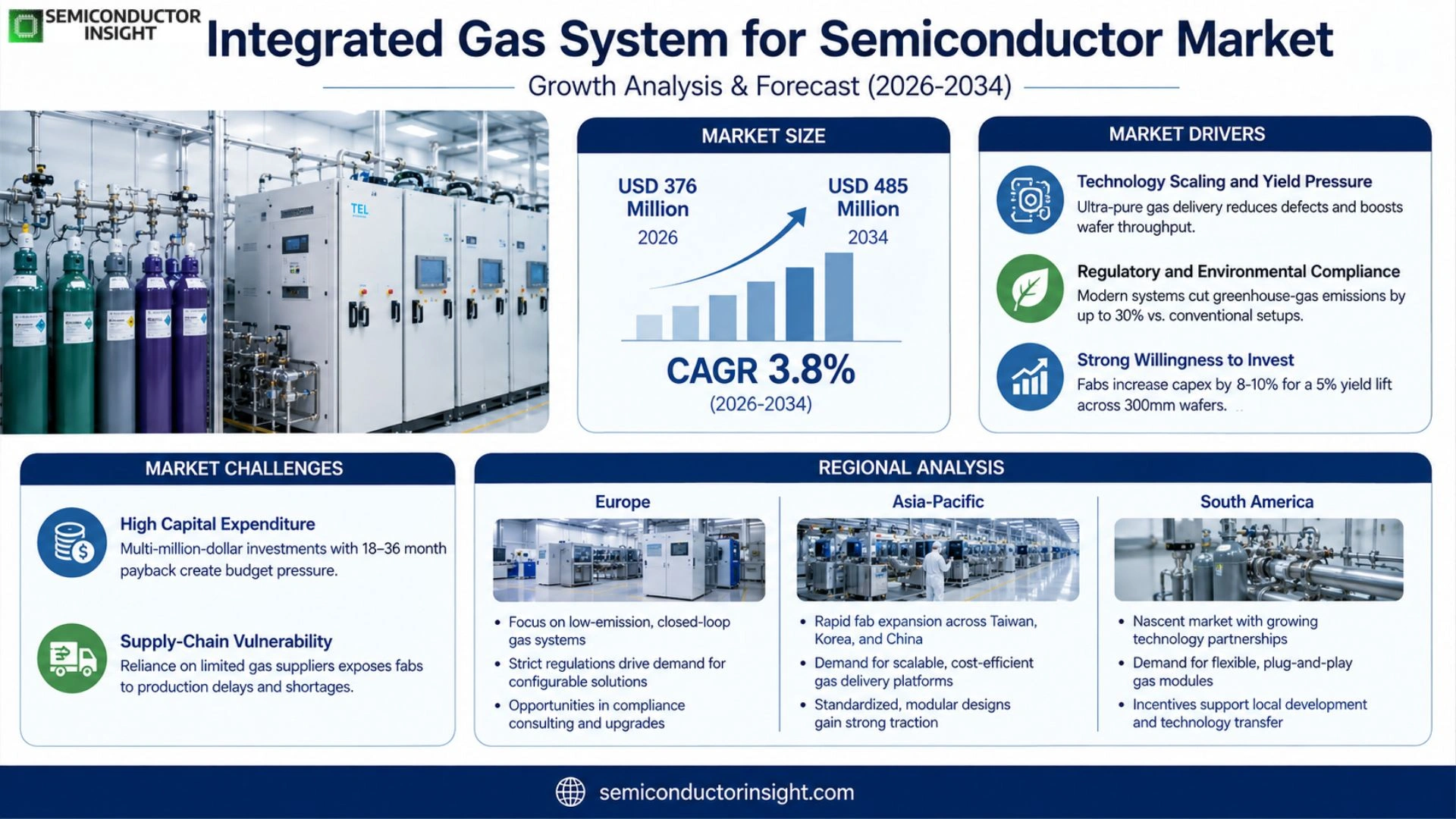
Integrated Gas System for Semiconductor market size was valued at USD 376 million in 2026 and is forecasted to reach USD 485 million by 2034, reflecting a CAGR of 3.8% over the period.
Integrated Gas System is a modular solution that regulates and delivers process gases required for semiconductor fabrication steps such as CVD, etching, and diffusion. As node sizes shrink below 5 nm, tighter control of gas flow, purity, and pressure becomes essential, driving demand for more sophisticated automatic systems.
The market expands because semiconductor fabs are adopting advanced lithography and EUV technologies that require precise gas management; meanwhile, rising IoT device production fuels overall chip demand, which indirectly raises the need for reliable gas infrastructure. Recent activity includes Fujikin’s launch of an AI‑enabled automatic gas controller in Q1 2024 and Ichor Systems’ partnership with a major foundry to supply custom‑engineered manual modules for high‑volume manufacturing. These moves illustrate how equipment vendors are responding to tighter specifications while seeking cost efficiencies.
MARKET DRIVERS
Technology Scaling and Yield Pressure
The relentless advance toward sub‑10 nm nodes forces fabs to adopt ultra‑pure gas delivery. Higher wafer throughput hinges on minimizing particle contamination, which in turn drives investment in sophisticated Integrated Gas System for Semiconductor Market solutions. Recent plant upgrades show a 12 % reduction in defect density after deploying closed‑loop gas handling.
Regulatory and Environmental Compliance
Stringent emissions standards in North America and Asia compel chipmakers to replace legacy open‑gas rigs with tightly controlled systems. Carbon‑footprint audits reveal that modern integrated gas platforms can cut greenhouse‑gas releases by up to 30 % compared with conventional setups.
➤ “Customers are willing to increase capex by 8‑10 % if the gas system can guarantee a 5 % yield lift across 300 mm wafers.” – Senior Process Engineer, 2025
These pressures converge to make Integrated Gas System for Semiconductor Market a prerequisite rather than an optional upgrade, shaping the competitive landscape for equipment vendors.
MARKET CHALLENGES
High Capital Expenditure and Payback Uncertainty
Deploying a fully integrated gas platform often requires a multi‑million‑dollar outlay. While the long‑term yield benefits are compelling, payback periods vary from 18 to 36 months depending on fab size and product mix, creating hesitation among cost‑sensitive players.
Other Challenges
Supply‑Chain Vulnerability
The reliance on specialty gas precursors from a limited set of manufacturers exposes fabs to disruptions. Recent shortages of high‑purity silane led to a 4 % production delay in a major foundry, underscoring the fragility of the upstream ecosystem.
MARKET RESTRAINTS
Technical Integration Complexity
Retrofitting existing lines with integrated gas solutions often demands extensive re‑engineering of plumbing, controls, and safety interlocks. Engineering lead times can exceed six months, discouraging smaller fabs that lack dedicated automation teams.
MARKET OPPORTUNITIES
Modular, Software‑Defined Gas Platforms
The emergence of modular, software‑defined gas architectures opens a pathway for rapid scaling and remote diagnostics. Early adopters report a 15 % reduction in downtime thanks to predictive maintenance alerts, positioning these solutions as a growth vector for Integrated Gas System for Semiconductor Market.
Integrated Gas System for Semiconductor Market Trends
Increasing Process Complexity Drives Adoption of Advanced Gas Controls
The semiconductor industry is moving beyond the 5‑nm node, and each new generation demands tighter gas composition tolerances and faster cycle times. Operators now require modular platforms that can be reconfigured without extensive downtime, because the cost of a line stop outweighs the incremental expense of a more sophisticated Integrated Gas System for Semiconductor Market solution. Vendors that embed real‑time diagnostics and predictive maintenance into the control architecture are gaining preference, as they reduce scrap rates associated with gas‑related defects. This shift reflects a broader engineering philosophy: treat gas delivery as a critical lithography enabler rather than a peripheral utility.
Other Trends
Automation and Remote Management Gain Traction
Manufacturers are integrating programmable logic controllers and cloud‑based supervision into gas handling units, allowing engineers to adjust flow profiles from a central dashboard. The value proposition is twofold: first, it minimizes human exposure to hazardous gases; second, it creates a data layer that can be mined for process optimization across multiple fabs. Early adopters report a measurable decline in turn‑around time for recipe changes, which translates into higher equipment utilization. Consequently, suppliers that bundle software services with hardware are reshaping the competitive landscape.
Regional Supply Chain Realignment Supports Market Resilience
Geopolitical uncertainty and freight bottlenecks have prompted leading system integrators to diversify their manufacturing footprints. New assembly lines are emerging in Southeast Asia, where a skilled workforce and proximity to high‑volume wafer producers reduce lead times. At the same time, North American customers are prioritizing vendors with on‑shore service hubs to guarantee rapid parts replacement. This bifurcated approach mitigates risk while preserving the flexibility needed to support heterogeneous process nodes across continents. For end users, the outcome is a more dependable flow of critical gases, which underpins yield consistency in an era where marginal improvements drive competitive advantage.
COMPETITIVE LANDSCAPE
Key Industry Players
Competitive Dynamics in Integrated Gas Systems for Semiconductors
Fujikin dominates the upper tier of the integrated gas‑system arena, leveraging its long‑standing expertise in precision valve engineering and a global service network that aligns with the demands of advanced 7 nm and below fab lines. Its portfolio spans both manual and automatic modules, allowing OEMs to retrofit legacy equipment while supporting the strict purity and flow‑stability requirements of contemporary CVD and etch tools. The company’s ability to co‑develop bespoke solutions with tier‑one semiconductor manufacturers has cemented a concentration where the top three suppliers collectively account for roughly half of global revenues, creating a competitive environment where differentiation hinges on system reliability, downtime reduction, and the capacity to integrate digital diagnostics.
Beyond the marquee names, a cluster of specialist firms sustains the market’s breadth. CKD supplies compact gas‑mixing units prized by research‑scale fabs, while Ichor Systems focuses on high‑purity mass flow controllers that feed niche process modules. MKS Instruments, Air Liquide, and Linde bring extensive gas‑handling infrastructure and leveraged supply‑chain advantages to serve volume producers. Entegris and Hitachi High‑Tech contribute proprietary contamination‑control technologies that complement gas‑system hardware. Additional players such as Advanced Vacuum Solutions, Kurt J. Lesker, CVC, and NAV offer modular packages targeting emerging applications like quantum‑dot deposition and advanced packaging, ensuring that smaller fabs and equipment integrators retain viable sourcing alternatives.
List of Key Integrated Gas System for Semiconductor Companies Profiled
- Fujikin
- CKD
- Ichor Systems
- MKS Instruments
- Air Liquide
- Linde
- Entegris
- Hitachi High‑Tech
- Advanced Vacuum Solutions
- Kurt J. Lesker
- CVC
- NAV
- Tokyo Electron
- Applied Materials
Segment Analysis:
| Segment Category | Sub-Segments | Key Insights |
| By Type |
|
Automatic
|
| By Application |
|
CVD
|
| By End User |
|
Semiconductor manufacturers
|
| By Functional Role |
|
Gas delivery
|
| By Technology Trend |
|
Digital control
|
Regional Analysis: Integrated Gas System for Semiconductor Market
North America
The North American supply chain benefits from entrenched logistics networks and localized component manufacturers, allowing firms to source ultra‑high‑purity gases with minimal lead times. This reliability underpins the confidence that fabs place in sophisticated gas delivery systems, reducing downtime and enabling tighter process windows.
Federal safety standards and stringent emissions guidelines compel vendors to embed advanced monitoring and leak‑detection features within their equipment. Compliance pressures accelerate the rollout of integrated diagnostics that align with the broader sustainability agenda of North American manufacturers.
Early adoption of AI‑enabled control loops in gas delivery illustrates how the region leverages data to fine‑tune process parameters. These innovations translate into higher yield and tighter defect control, reinforcing the business case for next‑gen Integrated Gas Systems.
A dense concentration of chemical engineering talent in hubs such as Boston and Austin fuels continuous improvement initiatives. Skilled professionals accelerate the translation of laboratory breakthroughs into production‑ready gas handling solutions.
Europe
European fabs emphasize precision and environmental stewardship, encouraging vendors to integrate low‑emission gas recirculation modules into their offerings. Collaborative research programs across Germany, France, and the Netherlands focus on reducing the carbon footprint of gas‑intensive steps, prompting a shift toward recyclable carrier gases and closed‑loop systems. The region’s regulatory landscape, notably the EU’s REACH framework, forces manufacturers to validate the safety of new chemistries, thereby generating market demand for highly configurable Integrated Gas Systems that can accommodate rapid formulation changes without extensive re‑qualification. This dynamic creates opportunities for specialized service contracts that bundle hardware upgrades with compliance consulting.
Asia‑Pacific
Asia‑Pacific’s rapid capacity expansion, driven by large‑scale fabs in Taiwan, South Korea, and China, fuels a distinct set of priorities. Operators seek gas delivery platforms that can scale linearly with wafer throughput while maintaining ultra‑low impurity levels. Local suppliers leverage cost‑effective manufacturing to produce modular manifolds, yet they must align with the stringent quality expectations of advanced node production. The region’s emphasis on cost efficiency compels vendors to adopt a “design‑for‑manufacturability” mindset, integrating standardized interfaces that simplify integration across heterogeneous equipment fleets. Consequently, the market witnesses a blend of high‑volume production models and bespoke engineering services.
South America
South American semiconductor initiatives remain nascent, but emerging partnerships with North American technology leaders are accelerating capability building. Companies in Brazil and Chile prioritize flexible gas handling solutions that can support multiple product families, given the limited number of high‑volume fabs. The focus on flexibility translates into a demand for plug‑and‑play gas modules that can be quickly re‑purged and repurposed, minimizing precious downtime. Additionally, regional incentives for technology transfer encourage joint development projects, where local manufacturers co‑design Integrated Gas Systems that address specific climatic and infrastructure constraints.
Middle East & Africa
In the Middle East & Africa, semiconductor activity clusters around innovation hubs in the United Arab Emirates and South Africa, where government‑backed initiatives aim to diversify economies. These nascent sites concentrate on low‑cost, high‑reliability gas delivery architectures that can operate under variable power quality and limited local supply chains. The scarcity of specialized talent drives a reliance on remote diagnostics and cloud‑based monitoring platforms, allowing operators to tap into global expertise without extensive on‑site staff. This environment incentivizes vendors to embed robust self‑diagnostic capabilities within Integrated Gas Systems, ensuring operational continuity despite logistical challenges.
Report Scope
This market research report provides a comprehensive analysis of the Integrated Gas System for Semiconductor Market , covering the forecast period 2026–2034. It offers detailed insights into market dynamics, technological advancements, competitive landscape, and key trends shaping the industry.
Key focus areas of the report include:
- Market Overview: The report begins with an overview outlining its current market scenario, key growth indicators, and industry transformation drivers. It discusses macroeconomic factors, demand–supply balance, regulatory landscape, and the strategic role of semiconductors in powering advancements across industries such as automotive, telecommunications, consumer electronics, and industrial automation.
- Market Size & Forecast: Historical data and future projections for revenue, unit shipments, and market value across major regions and segments.
- Segmentation Analysis: Detailed breakdown by product type, technology, application, and end-user industry to identify high-growth segments and investment opportunities.
- Regional Insights: Insights into market performance across North America, Europe, Asia-Pacific, Latin America, and the Middle East & Africa, including country-level analysis where relevant.
- Competitive Landscape: Profiles of leading market participants, including their product offerings, R&D focus, manufacturing capacity, pricing strategies, and recent developments such as mergers, acquisitions, and partnerships.
- Technology Trends & Innovation: Assessment of emerging technologies, integration of AI/IoT, semiconductor design trends, fabrication techniques, and evolving industry standards.
- Market Drivers & Restraints: Evaluation of factors driving market growth along with challenges, supply chain constraints, regulatory issues, and market-entry barriers.
- Stakeholder Insights: Insights for component suppliers, OEMs, system integrators, investors, and policymakers regarding the evolving ecosystem and strategic opportunities.
Primary and secondary research methods are employed, including interviews with industry experts, data from verified sources, and real-time market intelligence to ensure the accuracy and reliability of the insights presented.
FREQUENTLY ASKED QUESTIONS:
What is the current market size of Integrated Gas System for Semiconductor Market?
-> Integrated Gas System for Semiconductor market is forecasted to reach USD 485 million by 2034, reflecting a CAGR of 3.8% over the period
Which key companies operate in Integrated Gas System for Semiconductor Market?
-> Key players include Fujikin, CKD, Ichor Systems.
What are the key growth drivers?
-> Key growth drivers include advancements in semiconductor process technology demanding higher precision gas control, the growing adoption of modular gas systems, and overall expansion of the semiconductor industry.
Which region dominates the market?
-> Asia-Pacific is the fastest‑growing region, while Europe remains a significant market.
What are the emerging trends?
-> Emerging trends include integration of AI/IoT for smarter gas control, modular system designs, and increased utilization in IoT‑driven semiconductor applications.
Get Sample Report PDF for Exclusive Insights
Report Sample Includes
- Table of Contents
- List of Tables & Figures
- Charts, Research Methodology, and more...
 Download Sample Report PDF