Industrial IoT (IIoT) Edge Gateway Processor Market Insights
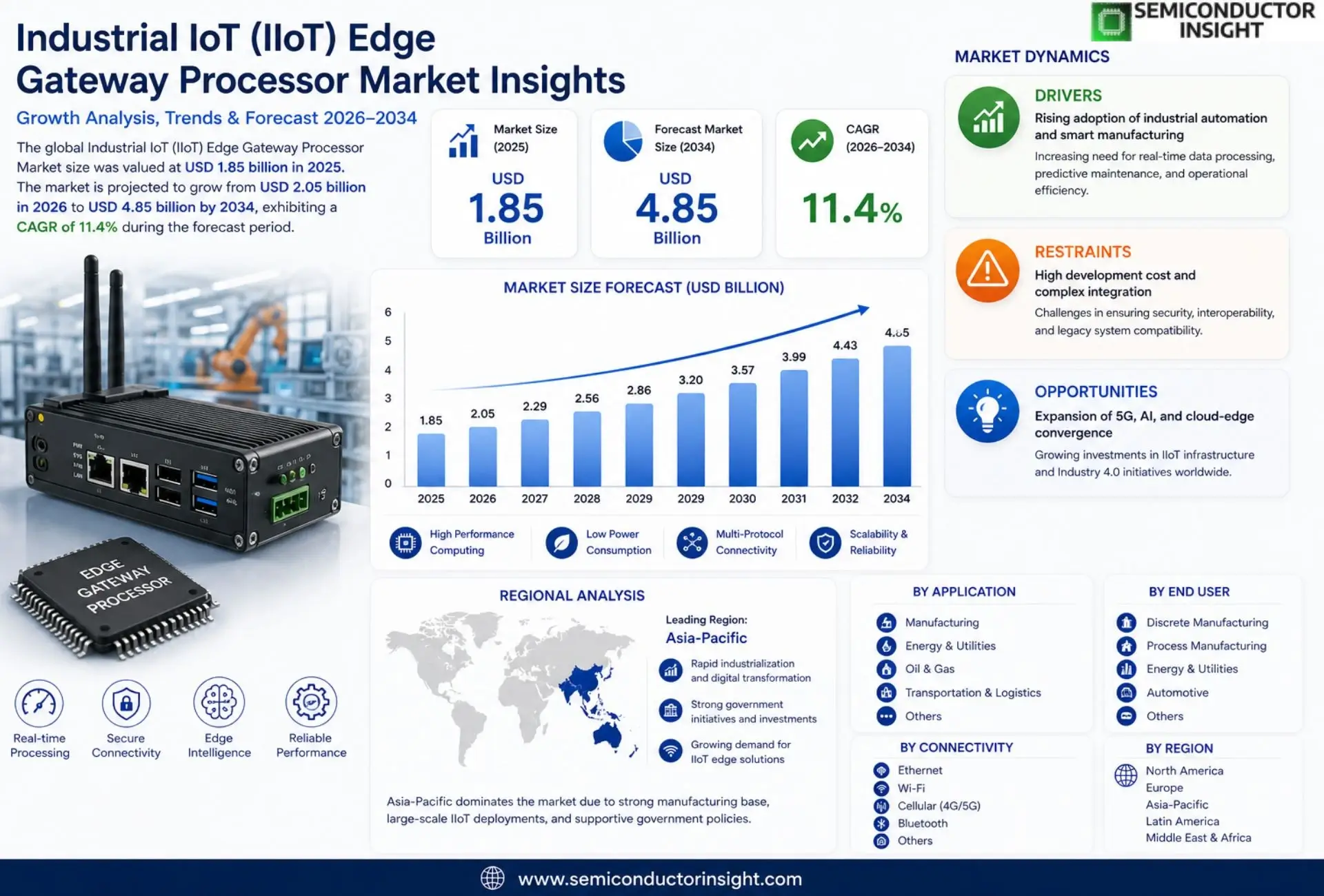
Industrial IoT (IIoT) Edge Gateway Processor Market size was valued at USD 1.85 billion in 2025. The market is projected to grow from USD 2.05 billion in 2026 to USD 4.85 billion by 2034, exhibiting a CAGR of 11.4% during the forecast period.
Industrial IoT (IIoT) edge gateway processors serve as the critical computing core within edge gateways, enabling seamless data aggregation, protocol translation, real-time processing, and secure connectivity between industrial sensors, machines, and cloud or on-premise systems. These specialized processors handle demanding tasks such as local analytics, edge AI inference, and deterministic control in harsh industrial environments while minimizing latency and bandwidth usage.
The market is experiencing robust growth due to several factors, including the accelerating adoption of Industry 4.0 initiatives, rising demand for real-time decision-making in manufacturing and energy sectors, and the proliferation of connected industrial devices. Furthermore, advancements in edge computing technologies are contributing to market expansion as organizations seek to process vast amounts of operational data closer to the source. However, challenges around cybersecurity and interoperability persist, even as integration of AI capabilities at the edge continues to drive innovation. Initiatives by key players in the market are also expected to fuel the market growth. For instance, leading semiconductor companies have introduced processors optimized for low-power, high-performance edge applications supporting multiple industrial protocols. Intel Corporation, NXP Semiconductors, Texas Instruments, and Qualcomm Technologies are some of the key players that operate in the market with a wide range of portfolios.
MARKET DRIVERS
Growing Need for Real-Time Industrial Data Processing
The increasing adoption of advanced automation systems across manufacturing, energy, logistics, and transportation is driving demand for edge processors capable of **real-time analytics**. As industries migrate toward decentralized architectures, companies require hardware that can securely process operational data at the network edge. This trend strengthens the position of Industrial IoT (IIoT) Edge Gateway Processor Market by supporting faster decision-making, reducing network latency, and enabling more resilient industrial workflows.
Expansion of Industrial AI and Predictive Maintenance
Industrial AI adoption is accelerating as enterprises leverage algorithms for equipment monitoring, energy optimization, and advanced diagnostics. Edge gateway processors equipped with AI-ready chipsets are becoming critical to execute machine learning tasks locally. The increasing industry-wide commitment to minimizing equipment downtime is fueling demand for processors that support **low-power, high-performance edge inference** within rugged environments.
➤ Edge processors are becoming foundational for next-generation industrial automation strategies.
As industries adopt cyber-physical systems and transition toward Industry 4.0, robust edge computing infrastructure remains central to ensuring security, operational continuity, and scalability. These requirements continue to reinforce long-term demand for high-efficiency gateway processors.
MARKET CHALLENGES
Integration Complexity with Legacy Industrial Systems
Many industrial environments operate legacy control systems that are decades old. Integrating modern edge gateway processors with these systems is technically challenging due to compatibility gaps, inconsistent communication protocols, and limited processing capabilities on older equipment. These complexities slow adoption and require significant engineering resources for seamless deployment.
Other Challenges
Cybersecurity Concerns
Industrial operations face heightened cybersecurity threats, and deploying additional edge devices expands the attack surface. Ensuring secure boot processes, encrypted data flows, and hardware-level protection remains a major concern for system integrators and end users.
MARKET RESTRAINTS
High Deployment Costs and Technical Skill Requirements
The initial investment associated with deploying industrial-grade edge gateway processors—including hardware procurement, installation, and integration—acts as a barrier for many small and midsize enterprises. Additionally, implementing edge architectures requires specialized expertise in embedded systems, networking, and industrial automation, creating a skills gap that slows broader adoption across resource-constrained industries.
MARKET OPPORTUNITIES
Growing Adoption of 5G-Enabled Industrial Connectivity
The rollout of private 5G networks across factories, ports, and energy facilities is creating significant opportunities for advanced gateway processors optimized for high-bandwidth, low-latency communication. As enterprises modernize their connectivity infrastructure, edge processors capable of supporting **high-speed, secure data orchestration** are expected to experience increasing demand. This shift enables new use cases in autonomous material handling, robotics, and distributed sensor networks, strengthening the long-term growth outlook for Industrial IoT (IIoT) Edge Gateway Processor Market.
Trends
Rising Deployment of Intelligent Edge Processing
Industrial IoT (IIoT) Edge Gateway Processor Market is undergoing rapid advancement as manufacturers, utilities, and large-scale industrial operators accelerate digital transformation efforts. Growth is strongly supported by the expanding adoption of Industry 4.0 architectures, where organizations increasingly require distributed computing capabilities to handle operational workloads closer to machines and sensors. Edge gateway processors enable this shift by providing the computational foundation needed for low-latency data processing, deterministic control, and efficient bandwidth management within industrial environments. Their role has become more critical as connected industrial assets continue to increase and operational data volumes surge worldwide.
Other Trends
Integration of AI and Real-Time Analytics
One of the most significant developments is the continued integration of AI-driven analytics directly into edge gateway processors. These processors are being engineered to support advanced inference workloads, allowing industrial facilities to detect anomalies, optimize workflows, and execute automated decisions without relying solely on cloud infrastructure. This trend is reinforced by advancements in semiconductor architectures designed for improved energy efficiency and robust performance in demanding settings. Leading manufacturers have enhanced processor designs to support diverse industrial communication protocols, enabling seamless interoperability between legacy machines and modern connected systems.
Strengthening Industrial Cybersecurity
Cybersecurity innovation is another key trend shaping Industrial IoT (IIoT) Edge Gateway Processor Market. With rising connectivity comes increased exposure to cyber risks, leading to heightened demand for processors featuring embedded security modules, encryption acceleration, and secure boot capabilities. Industrial operators are prioritizing solutions that ensure data integrity and system resilience across distributed facilities. As cyber threats targeting operational technology environments grow more sophisticated, advanced processor-level defense mechanisms have become essential for protecting mission-critical assets.
Expansion of Multi-Protocol and Interoperable Architectures
The need for interoperability across diverse industrial ecosystems continues to influence processor development. Modern edge gateway processors are increasingly built to support multiple industrial protocols simultaneously, enabling smooth communication between sensors, controllers, and enterprise systems. This trend is driven by the complexity of mixed-asset environments in manufacturing, energy, and process industries, where equipment lifecycles span decades. Enhanced protocol translation capabilities help reduce integration costs and simplify industrial modernization efforts.
Growing Importance of Scalable and Ruggedized Processing Platforms
Industrial organizations are prioritizing edge processors engineered for ruggedness, scalability, and long operational lifecycles. Facilities require hardware capable of operating under extreme temperatures, vibration, and electrical noise while maintaining consistent performance. This has led to a shift toward processors optimized for industrial endurance as well as modular architectures that allow performance scaling based on workload requirements. As digital transformation initiatives expand across both established and emerging industrial sectors, robust edge gateway processors are becoming a foundational element in supporting real-time operations, secure connectivity, and long-term system reliability.
COMPETITIVE LANDSCAPEKey Industry Players
Industrial IoT (IIoT) Edge Gateway Processor Market Competitive Assessment
Industrial IoT (IIoT) Edge Gateway Processor Market is characterized by the presence of several global semiconductor leaders that shape the competitive dynamics through continuous innovation in low‑power, high‑performance industrial processors. Companies such as Intel Corporation, NXP Semiconductors, Texas Instruments, and Qualcomm Technologies hold strong market positions due to their extensive portfolios supporting industrial‑grade connectivity, AI inference at the edge, deterministic control, and secure real-time data processing. These players leverage mature manufacturing capabilities, strategic partnerships with gateway OEMs, and broad protocol support to maintain dominance in Industry 4.0 deployments across manufacturing, energy, and logistics environments.
Beyond the major semiconductor providers, the market includes a diverse set of specialized and emerging players focusing on ruggedized compute modules, AI‑optimized edge silicon, and advanced industrial networking solutions. Firms such as Advantech, Renesas Electronics, STMicroelectronics, MediaTek, Arm, and Marvell Technology contribute significantly through tailored processor architectures for industrial automation and edge intelligence. Their solutions cater to niche requirements such as ultra‑low latency control, multi-protocol interoperability, and long lifecycle support essential for industrial operations. This fragmented yet innovation-driven landscape fosters competitive differentiation based on performance efficiency, security capabilities, and integration flexibility across heterogeneous industrial systems.
List of Key Industrial IoT (IIoT) Edge Gateway Processor Market Companies Profiled
- Intel Corporation
- NXP Semiconductors
- Texas Instruments
- Qualcomm Technologies
- Renesas Electronics
- STMicroelectronics
- Marvell Technology
- Arm Ltd.
- MediaTek Inc.
- Advantech Co., Ltd.
- Analog Devices, Inc.
- Broadcom Inc.
- Siemens Industrial Edge (Processor Ecosystem Contributor)
- Rockwell Automation (Edge Gateway Hardware Integrator)
- Microchip Technology Inc.
Segment Analysis:
| Segment Category | Sub-Segments | Key Insights |
| By Type |
|
Leading Segment ARM-based processors continue to gain significant traction.
|
| By Application |
|
Leading Segment Industrial automation control maintains a strong position.
|
| By End User |
|
Leading Segment Manufacturing remains the dominant adopter.
|
| By Processing Architecture |
|
Leading Segment Multi-core architectures are broadly preferred.
|
| By Connectivity Standard |
|
Leading Segment Ethernet-based connectivity continues to dominate.
|
Regional Analysis: Industrial IoT (IIoT) Edge Gateway Processor Market
North America
North America remains the leading region Industrial IoT (IIoT) Edge Gateway Processor Market, largely due to its robust digital transformation ecosystem, strong adoption of automation technologies, and the presence of established industrial enterprises seeking to modernize operations. The region benefits from mature industrial sectors—such as manufacturing, energy, and transportation—that increasingly rely on edge computing to streamline workflows, enhance operational visibility, and reduce latency in mission-critical applications. The market environment is further strengthened by widespread 5G rollout, expanding cloud–edge integration frameworks, and extensive investment in cybersecurity measures that support reliable IIoT deployments.
Technology vendors in the region prioritize innovation in edge processor capabilities, emphasizing power-efficient architectures, real-time analytics, and enhanced interoperability with industrial protocols. Demand is also rising as organizations shift toward hybrid edge-cloud models, enabling faster decision-making in remote or high-volume operational settings. Combined with strict regulatory expectations around data protection and operational continuity, North America continues to foster early adoption of advanced IIoT gateway processors designed to support next-generation industrial automation systems. These conditions make the region a consistent leader, shaping global best practices and accelerating market maturity across emerging industrial applications.
North America’s leadership in processor innovation stems from sustained R&D investment and strong collaboration between semiconductor companies and industrial automation firms. This synergy supports the development of optimized architectures tailored for edge workloads, including real-time processing, ruggedized environments, and secure data exchange. The presence of advanced test labs and pilot manufacturing sites accelerates adoption across multiple industrial sectors.
Industrial facilities in North America increasingly prioritize edge-based processing to reduce latency and enhance reliability in applications such as predictive maintenance and automated quality control. Many enterprises are transitioning from legacy systems to smart factory architectures, prompting higher demand for sophisticated IIoT edge gateway processors capable of managing complex data flows at operational sites.
The region’s regulatory landscape encourages the adoption of resilient and secure IIoT infrastructure. Policies promoting cybersecurity, data governance, and operational transparency shape the design requirements of edge gateway processors. These standards ensure that industrial systems maintain high levels of reliability and protection across interconnected environments.
Strong partnerships between cloud providers, industrial automation vendors, and semiconductor manufacturers position North America as a collaborative hub for developing integrated edge architectures. These alliances accelerate innovation cycles and enable enterprises to deploy scalable, interoperable IIoT solutions that seamlessly bridge on-premises systems with cloud platforms.
Europe
Europe demonstrates growing momentum Industrial IoT (IIoT) Edge Gateway Processor Market, supported by government-backed digitalization programs and a strong manufacturing base transitioning toward Industry 4.0 standards. The region emphasizes energy-efficient processing technologies and advanced automation frameworks to modernize aging industrial infrastructure. Europe’s industrial enterprises are increasingly adopting edge-based architectures to enhance real-time monitoring, ensure operational continuity, and align with strict sustainability and safety regulations. Demand is particularly pronounced in sectors such as automotive, utilities, and advanced manufacturing, where precision and reliability are essential. Collaborative R&D initiatives across the region foster innovation in ruggedized edge processors designed for diverse operating conditions, reinforcing Europe’s role as a high-quality technology adopter with a growing appetite for next‑generation industrial edge solutions.
Asia-Pacific
Asia-Pacific is emerging as one of the fastest-growing regions Industrial IoT (IIoT) Edge Gateway Processor Market, driven by rapid industrialization, expanding manufacturing capacity, and strong investment in smart factory initiatives. Countries across the region are prioritizing automation to optimize large-scale production ecosystems and improve operational efficiency. The widespread development of industrial corridors, coupled with advancements in 5G infrastructure, supports large deployments of edge-enabled IIoT systems. Local and multinational manufacturers are increasingly integrating edge gateway processors to handle high-volume data processing closer to the source, reducing latency and enhancing system responsiveness. The region also benefits from a competitive semiconductor industry that accelerates innovation and cost efficiency, making Asia-Pacific a critical contributor to the global market’s expansion.
South America
South America is steadily adopting Industrial IoT (IIoT) Edge Gateway Processor solutions as industries in the region focus on operational modernization and improved resource management. The manufacturing, mining, and energy sectors are key drivers of demand as they increasingly require real-time monitoring and localized processing to manage remote or large-scale operations. While digital transformation maturity varies across countries, increasing investment in industrial automation technologies is enabling broader acceptance of edge computing architectures. Local enterprises seek processors that deliver reliability, energy efficiency, and adaptability to challenging operating environments. Partnerships with global technology providers further support market development, making South America an evolving but promising participant in the global IIoT edge landscape.
Middle East & Africa
The Middle East & Africa region is gradually strengthening its presence Industrial IoT (IIoT) Edge Gateway Processor Market as governments and enterprises invest in digital industrial transformation. Energy, logistics, and infrastructure projects increasingly utilize edge-based processing to improve operational oversight and reduce downtime. Harsh environmental conditions in many industrial locations drive demand for durable, high-performance edge processors capable of continuous operation. Strategic initiatives to diversify regional economies are encouraging industrial innovation, prompting greater interest in modern IIoT architectures. Although adoption levels vary, ongoing investment in industrial modernization, combined with growing connectivity infrastructure, supports consistent long-term market development across the region.
Report Scope
This market research report provides a comprehensive analysis of the Industrial IoT (IIoT) Edge Gateway Processor Market , covering the forecast period 2026–2034. It offers detailed insights into market dynamics, technological advancements, competitive landscape, and key trends shaping the industry.
Key focus areas of the report include:
- Market Overview: The report begins with an overview outlining its current market scenario, key growth indicators, and industry transformation drivers. It discusses macroeconomic factors, demand–supply balance, regulatory landscape, and the strategic role of semiconductors in powering advancements across industries such as automotive, telecommunications, consumer electronics, and industrial automation.
- Market Size & Forecast: Historical data and future projections for revenue, unit shipments, and market value across major regions and segments.
- Segmentation Analysis: Detailed breakdown by product type, technology, application, and end-user industry to identify high-growth segments and investment opportunities.
- Regional Insights: Insights into market performance across North America, Europe, Asia-Pacific, Latin America, and the Middle East & Africa, including country-level analysis where relevant.
- Competitive Landscape: Profiles of leading market participants, including their product offerings, R&D focus, manufacturing capacity, pricing strategies, and recent developments such as mergers, acquisitions, and partnerships.
- Technology Trends & Innovation: Assessment of emerging technologies, integration of AI/IoT, semiconductor design trends, fabrication techniques, and evolving industry standards.
- Market Drivers & Restraints: Evaluation of factors driving market growth along with challenges, supply chain constraints, regulatory issues, and market-entry barriers.
- Stakeholder Insights: Insights for component suppliers, OEMs, system integrators, investors, and policymakers regarding the evolving ecosystem and strategic opportunities.
Primary and secondary research methods are employed, including interviews with industry experts, data from verified sources, and real-time market intelligence to ensure the accuracy and reliability of the insights presented.
FREQUENTLY ASKED QUESTIONS:
What is the current market size of Industrial IoT (IIoT) Edge Gateway Processor Market?
-> Industrial IoT (IIoT) Edge Gateway Processor Market was valued at USD 1.85 billion in 2025 and is expected to reach USD 4.85 billion by 2034.
Which key companies operate Industrial IoT (IIoT) Edge Gateway Processor Market?
-> Key players include Intel Corporation, NXP Semiconductors, Texas Instruments, and Qualcomm Technologies, among others.
What are the key growth drivers?
-> Key growth drivers include accelerating Industry 4.0 adoption, rising demand for real-time decision-making in industrial environments, proliferation of connected devices, and advancements in edge computing.
Which region dominates the market?
-> The reference content does not specify a dominant region for the market.
What are the emerging trends?
-> Emerging trends include integration of AI capabilities at the edge, advanced real-time data processing, enhanced cybersecurity solutions, and development of processors optimized for low-power high-performance industrial applications.

Get Sample Report PDF for Exclusive Insights
Report Sample Includes
- Table of Contents
- List of Tables & Figures
- Charts, Research Methodology, and more...
 Download Sample Report PDF