
IEC Style Contactors Market Insights
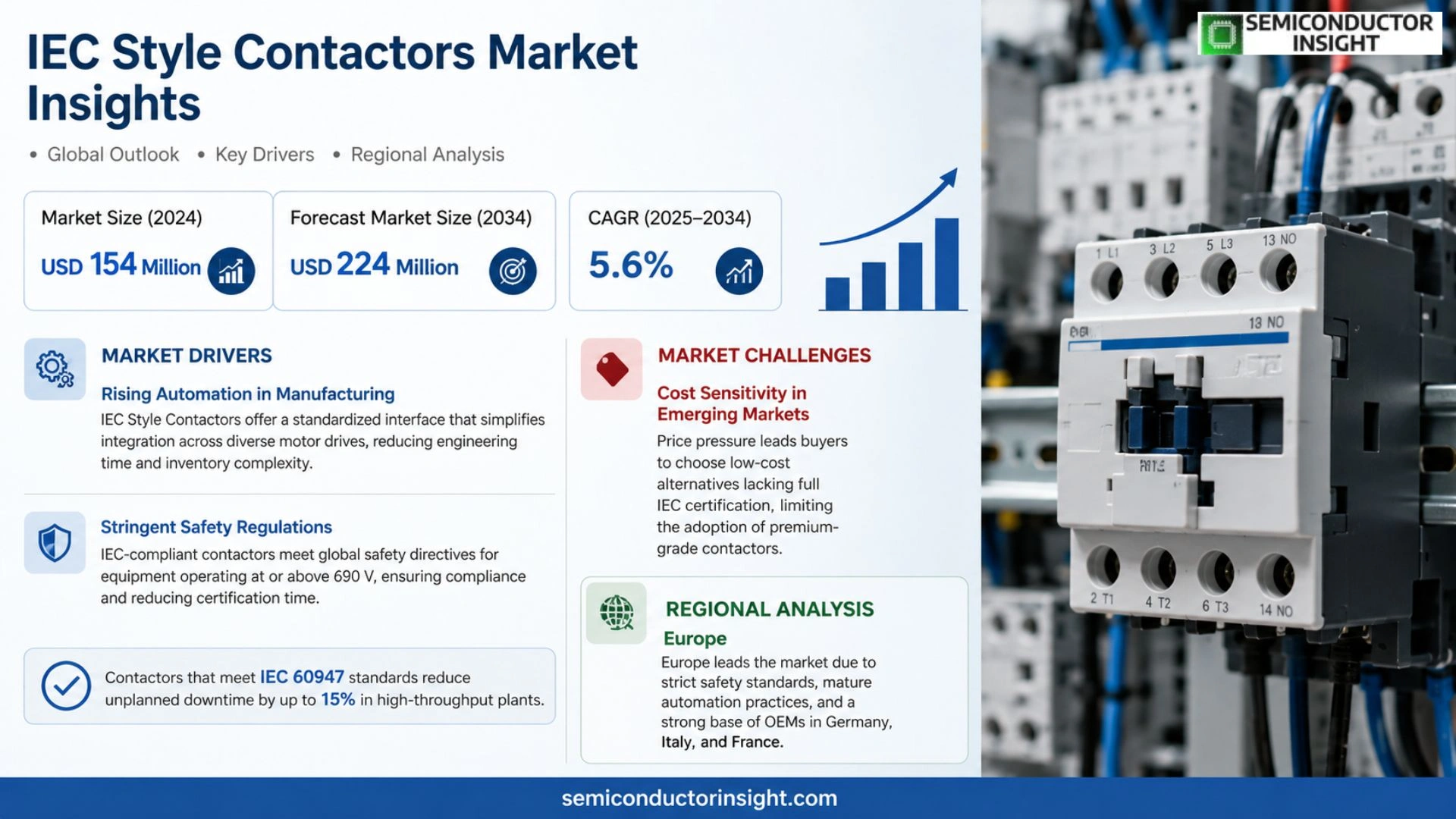
Global IEC Style Contactors market size was valued at USD 154 million in 2024 and will climb to USD 224 million by 2034, reflecting a CAGR of 5.6% over the forecast period.
IEC Style Contactors are electromechanical switching devices designed according to International Electrotechnical Commission (IEC) standards for reliable isolation and control of electrical circuits in low‑voltage applications. They typically feature standardized coil voltages, contact configurations (normally open, normally closed), and auxiliary contacts that enable integration into programmable logic controllers and safety systems across industrial and commercial installations.
The upward trajectory stems from expanding automation projects, stricter safety regulations, and heightened emphasis on energy efficiency within manufacturing sectors. Manufacturers such as ABB, Eaton, Schneider Electric, General Electric and Fuji Electric have introduced compact designs with enhanced arc‑quenching capabilities, responding to customer demand for space‑saving yet robust solutions. Recent product launches emphasize digital diagnostics that allow predictive maintenance, thereby reducing downtime for end users.
MARKET DRIVERS
Rising Automation in Manufacturing
The push toward fully automated production lines has elevated the demand for reliable switching equipment. IEC Style Contactors offer a standardized interface that simplifies integration across diverse motor drives, reducing engineering time and inventory complexity. Manufacturers value this uniformity because it enables rapid line re‑configuration when product mixes shift, a competitive edge in today’s just‑in‑time environment.
Stringent Safety Regulations
Global safety directives now require higher insulation ratings and fault‑tolerant designs for equipment that operates at or above 690 V. IEC‑compliant contactors meet these clauses out of the box, allowing plant owners to avoid costly retrofits. The ability to demonstrate compliance at the point of purchase shortens certification cycles and protects end‑users from potential liability.
➤ Contactors that meet IEC 60947 standards reduce unplanned downtime by up to 15 % in high‑throughput plants.
Beyond compliance, the modular construction of IEC Style Contactors supports predictive maintenance platforms. Sensors can be attached directly to the coil and auxiliary contacts, feeding real‑time health data into enterprise asset‑management systems. This intelligence translates into lower life‑cycle cost, a compelling argument for capital‑intensive sectors such as petrochemicals and automotive assembly.
MARKET CHALLENGES
Cost Sensitivity in Emerging Markets
While automation interest surges, price pressure remains intense in regions where labor costs still undercut capital investment. Buyers often prioritize low‑priced alternatives that lack full IEC certification, accepting higher failure risk to meet budget constraints. This trade‑off hampers wider diffusion of premium‑grade contactors despite their efficiency benefits.
Other Challenges
Supply Chain Disruptions
The recent semiconductor shortage has spilled over into auxiliary components such as driver ICs and protective relays that accompany IEC Style Contactors. Lead times have stretched from weeks to several months, forcing OEMs to hold larger safety stocks,a practice that erodes cash flow and inflates inventory carrying costs.
MARKET RESTRAINTS
High Initial Capital Expenditure
Deploying a fully IEC‑compliant switching network requires upfront spending on certified panels, wiring accessories, and engineering validation. For small‑to‑medium enterprises, the capital outlay can eclipse projected savings within the first three years, prompting a cautious rollout strategy.
Complex Certification Requirements
Achieving IEC 60947 compliance involves multiple testing stages, including dielectric strength, thermal endurance, and electromagnetic compatibility. The procedural rigor deters some manufacturers from pursuing certification for niche product lines, limiting market breadth.
Limited OEM Differentiation
Because the IEC standard dictates core dimensions and performance thresholds, many suppliers compete primarily on price. This commoditization restricts premium pricing opportunities and can stifle investment in next‑generation features such as integrated IoT gateways.
MARKET OPPORTUNITIES
Growth in Renewable Energy Infrastructure
New wind farms and solar farms rely on modular power conversion stations where IEC Style Contactors provide deterministic interruption capabilities. The need for equipment that can operate reliably under fluctuating grid conditions creates a niche for contactors with enhanced fault‑current limiting features.
Expansion of Data Center Power Systems
Data centers are upgrading to higher voltage distribution (e.g., 380 V DC) to improve energy efficiency. IEC‑standardized contactors can bridge the gap between legacy AC distribution and emerging DC architectures, offering a pathway for phased migration without extensive rewiring.
Adoption of Smart Grid Technologies
Smart grid deployments demand switchgear that can communicate status in real time. Embedding communication modules within IEC Style Contactors enables utilities to perform remote isolation, fault detection, and load balancing, opening revenue streams for manufacturers that bundle hardware with cloud‑based analytics services.
IEC Style Contactors Market Trends
Shift Toward Positive‑Polarity Contactors
IEC Style Contactors Market is witnessing a clear move away from reverse‑type devices toward positive‑polarity designs. Engineers cite the lower contact wear and improved arc‑quenching performance of positive units as decisive factors in new plant specifications. This technical advantage aligns with tighter reliability standards in both commercial and industrial installations, prompting OEMs to prioritize product lines that can meet extended service intervals. As a result, procurement cycles are increasingly favoring suppliers that have expanded their positive‑polarity portfolios, pressuring legacy manufacturers to accelerate redesign programs or risk marginalization in key projects.
Other Trends
Regional Realignment in North America and Asia
In North America, IEC Style Contactors Market is being reshaped by a surge in retrofit activity within aging manufacturing complexes. Facility managers are replacing legacy equipment to comply with updated energy‑efficiency mandates, creating a steady demand for modular contactors that can integrate with smart‑grid controls. Simultaneously, Asian producers are leveraging lower‑cost material sourcing and aggressive automation adoption to capture market share in high‑growth sectors such as automotive assembly and semiconductor fabrication. The divergent pace of regulatory enforcement and capital investment between the two regions forces global players to tailor distribution strategies,establishing localized service hubs in the United States while expanding joint‑venture networks across China, Japan, and South Korea.
Integration of IoT‑Enabled Monitoring
Another emerging dynamic in IEC Style Contactors Market is the embedding of IoT sensors directly into contactor housings. Real‑time diagnostics allow end‑users to anticipate failures, schedule maintenance during planned downtimes, and optimize load balancing across electrical networks. Suppliers that offer integrated analytics platforms are gaining a competitive edge, as plant operators increasingly view contactors not merely as switching devices but as data sources contributing to overall operational efficiency. This trend encourages manufacturers to invest in firmware development and secure communication protocols, shaping product roadmaps that blend traditional electromechanical reliability with modern digital services.
COMPETITIVE LANDSCAPE
Key Industry Players
Competitive Overview of the Global IEC Style Contactors Market
IEC Style Contactors Market is still dominated by a handful of large OEMs that together capture roughly three‑quarters of global revenue. ABB, with its extensive industrial automation portfolio, leverages scale and a worldwide service network to secure the bulk of contracts in both the industrial and commercial segments. Its ability to bundle contactors with broader control solutions creates a sticky customer base, especially in high‑volume regions such as Europe and North America. The top‑five cohort,comprising ABB, Eaton, Schneider Electric, General Electric and Allen‑Bradley,benefits from deep R&D pipelines and recurring maintenance contracts, which suppress entry of smaller rivals. The concentration of sales around a few anchor customers (e.g., major utilities and OEMs of electrical distribution equipment) reinforces this structure, making margin protection a central competitive lever.
Beyond the leading quartile, a diverse set of specialist manufacturers competes on niche performance attributes and regional responsiveness. Eaton differentiates through modular designs that align with its power‑management ecosystem, while Allen‑Bradley (Rockwell Automation) focuses on seamless integration with its PLC family. Schneider Electric exploits its strong presence in the building‑automation market to push contactors that meet stringent energy‑efficiency standards. Companies such as Fuji Electric and Asco capture market share in Asia by tailoring products to local certification regimes and offering aggressive pricing. Emerging Chinese firms are gaining traction by prioritising rapid product roll‑outs and leveraging domestic supply chains, a trend that could reshape regional dynamics if larger players do not adapt their pricing or service strategies.
List of Key IEC Style Contactors Companies Profiled
- ABB
- Eaton
- Allen‑Bradley (Rockwell Automation)
- Schneider Electric
- General Electric
- Westinghouse Electric
- Fuji Electric
- Asco
- Mitsubishi Electric
- Legrand
- Siemens
- Toshiba
- Hager Group
- Schrack
- Hitachi
Segment Analysis:
| Segment Category | Sub-Segments | Key Insights |
| By Type |
|
Positive
|
| By Application |
|
Industrial
|
| By End User |
|
Manufacturing
|
| By Voltage Rating |
|
Low Voltage
|
| By Industry |
|
Renewable Energy
|
Regional Analysis: IEC Style Contactors Market
The EU’s emphasis on functional safety obliges OEMs to source contactors that meet IEC‑60947‑4‑1, driving a steady influx of compliant units. Certification pathways are well‑established, which shortens time‑to‑market for new product introductions and reinforces supplier confidence.
Heavy‑duty sectors such as automotive manufacturing, renewable energy installations, and process chemicals have institutionalized IEC Style Contactors within their power distribution strategies, rewarding manufacturers that can guarantee longevity under demanding cycles.
A coordinated network of component suppliers, test laboratories, and logistics providers across Western and Central Europe mitigates disruptions, ensuring that engineering specifications are met without compromising lead times.
Emerging initiatives in smart factories and electrified transport demand more sophisticated contactor designs, prompting European firms to explore modular architectures that align with Industry 4.0 expectations.
North America
North America presents a divergent landscape where market momentum is propelled by a mixture of legacy infrastructure upgrades and aggressive adoption of renewable power assets. The United States, with its fragmented standards environment, emphasizes performance metrics over strict compliance, encouraging manufacturers to highlight efficiency gains in IEC Style Contactors. Canadian utilities, meanwhile, lean heavily on reliability certifications to meet harsh climatic conditions, fostering a niche for ruggedized offerings. Competitive pressures from domestic and Asian suppliers compel firms to differentiate through advanced diagnostics and modular serviceability, shaping procurement strategies that value total cost of ownership over initial price. The region’s focus on digital twins and predictive maintenance creates an ancillary demand for contactors that can integrate into broader condition‑monitoring platforms.
Asia‑Pacific
The Asia‑Pacific arena is characterized by rapid industrialization juxtaposed with a fragmented regulatory backdrop. Countries such as China and India prioritize cost‑effective solutions, yet an emerging middle class of engineering firms is beginning to appreciate the long‑term reliability of IEC‑standardized contactors. Manufacturing hubs in Southeast Asia are retrofitting older plants, driving a modest but steady need for replacement units that meet updated safety expectations. Meanwhile, Japan’s mature automation sector continues to demand high‑precision components, positioning the market as a balancing act between low‑cost volume producers and premium‑grade technology partners. Cross‑border supply chains, anchored by regional trade agreements, further influence sourcing decisions, encouraging a blend of local assembly and imported expertise.
South America
In South America, market expansion is tempered by economic volatility yet buoyed by infrastructure renewal programs across Brazil, Argentina, and Chile. Power utilities embark on grid modernization projects that favor IEC Style Contactors for their standardized performance envelope, reducing the risk of equipment mismatches. Industrial adopters, particularly in the mining and agribusiness sectors, view these components as a safeguard against unplanned downtime, a critical factor in regions where service support can be geographically dispersed. Local distributors are gradually building technical capabilities to provide on‑site testing, a service that adds value and mitigates the perceived complexity of IEC compliance.
Middle East & Africa
The Middle East & Africa region showcases a dual narrative: affluent Gulf markets are upgrading petrochemical complexes with cutting‑edge IEC‑compliant contactors, while sub‑Saharan nations focus on basic electrification efforts. Harsh environmental conditions, from extreme heat to dust, elevate the importance of robust thermal design, prompting vendors to emphasize sealed constructions. Energy diversification initiatives, especially renewable‑energy integration in the UAE and Saudi Arabia, are introducing new load profiles that demand contactors capable of handling frequent switching cycles. The growing presence of multinational system integrators brings global best practices to local projects, slowly reshaping procurement philosophies toward standardization and long‑term reliability.
Report Scope
This market research report provides a comprehensive analysis of the IEC Style Contactors Market , covering the forecast period 2026–2034. It offers detailed insights into market dynamics, technological advancements, competitive landscape, and key trends shaping the industry.
Key focus areas of the report include:
- Market Overview: The report begins with an overview outlining its current market scenario, key growth indicators, and industry transformation drivers. It discusses macroeconomic factors, demand–supply balance, regulatory landscape, and the strategic role of semiconductors in powering advancements across industries such as automotive, telecommunications, consumer electronics, and industrial automation.
- Market Size & Forecast: Historical data and future projections for revenue, unit shipments, and market value across major regions and segments.
- Segmentation Analysis: Detailed breakdown by product type, technology, application, and end-user industry to identify high-growth segments and investment opportunities.
- Regional Insights: Insights into market performance across North America, Europe, Asia-Pacific, Latin America, and the Middle East & Africa, including country-level analysis where relevant.
- Competitive Landscape: Profiles of leading market participants, including their product offerings, R&D focus, manufacturing capacity, pricing strategies, and recent developments such as mergers, acquisitions, and partnerships.
- Technology Trends & Innovation: Assessment of emerging technologies, integration of AI/IoT, semiconductor design trends, fabrication techniques, and evolving industry standards.
- Market Drivers & Restraints: Evaluation of factors driving market growth along with challenges, supply chain constraints, regulatory issues, and market-entry barriers.
- Stakeholder Insights: Insights for component suppliers, OEMs, system integrators, investors, and policymakers regarding the evolving ecosystem and strategic opportunities.
Primary and secondary research methods are employed, including interviews with industry experts, data from verified sources, and real-time market intelligence to ensure the accuracy and reliability of the insights presented.
FREQUENTLY ASKED QUESTIONS:
What is the current market size of IEC Style Contactors Market?
-> IEC Style Contactors Market was valued at USD 154 million in 2024 and is expected to reach USD 224 million by 2034, at a CAGR of 5.6%
Which key companies operate in IEC Style Contactors Market?
-> Key players include ABB, Eaton, Allen Bradley, Schneider, General Electric, Westinghouse, Fuji Electric, Asco, among others.
What are the key growth drivers?
-> Key growth drivers include rising industrial automation, increasing demand for reliable power distribution, and advancements in contactor technology.
Which region dominates the market?
-> The market is global with strong presence in North America, Europe, and Asia; no single region is identified as dominant in the provided data.
What are the emerging trends?
-> Emerging trends include smart contactor integration, IoT connectivity, and energy‑efficient designs.
Get Sample Report PDF for Exclusive Insights
Report Sample Includes
- Table of Contents
- List of Tables & Figures
- Charts, Research Methodology, and more...
 Download Sample Report PDF


