High Quality Circuit Boards Market Insights
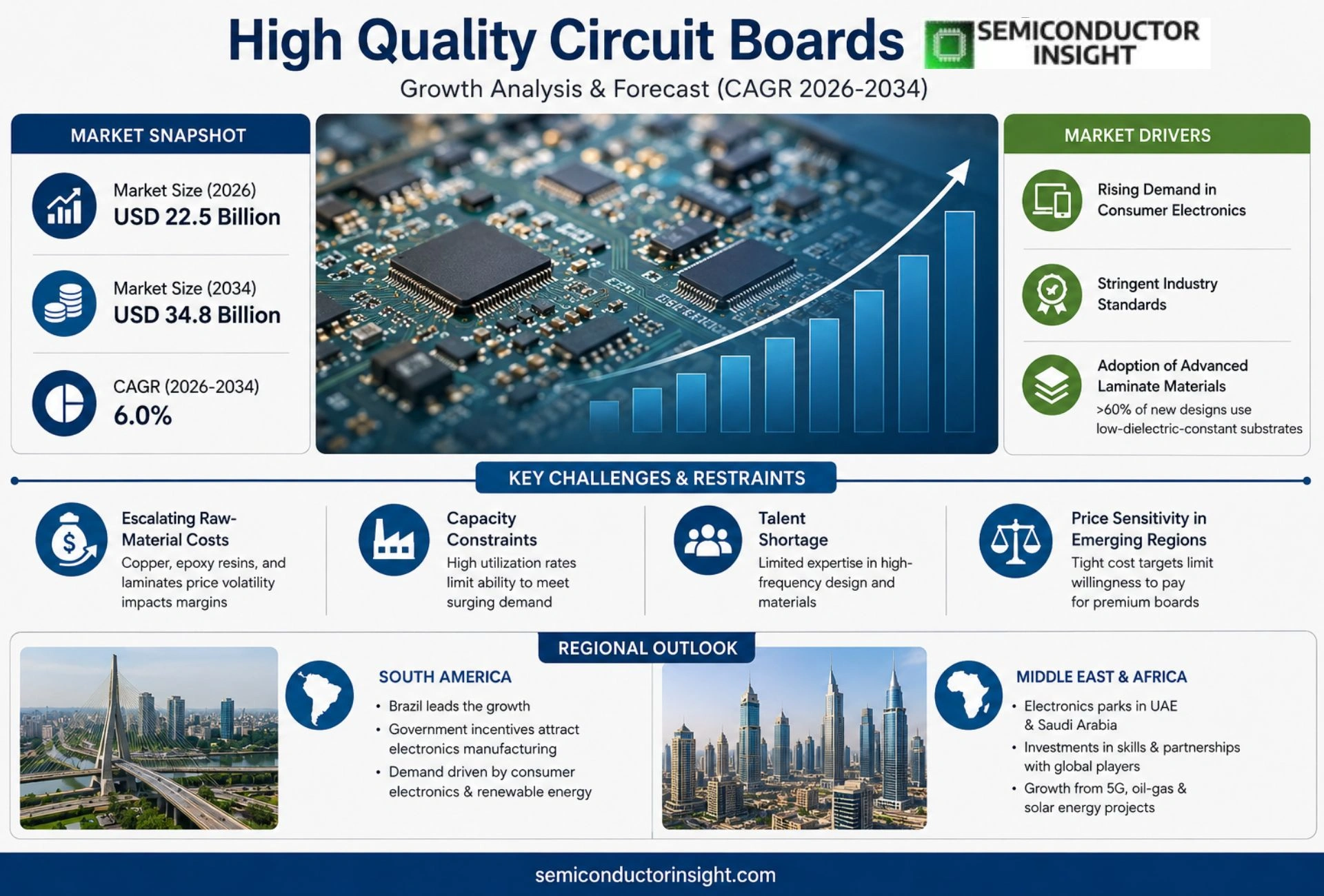
High Quality Circuit Boards market is expected to increase from USD 22.5 billion in 2026 to USD 34.8 billion by 2034, exhibiting a CAGR of 6.0% during the forecast period.
High Quality Circuit Boards are premium printed circuit boards engineered for superior electrical performance, dimensional stability and reliability required in sectors such as aerospace, automotive electronics and high‑frequency communications. They consist of multiple laminated copper layers bonded to a non‑conductive substrate, with precision‑etched traces and plated‑through vias that enable complex interconnections while meeting stringent thermal and mechanical specifications.
The market expands because AI‑enabled design tools, the rollout of 5G networks and the rise of electric vehicles demand higher signal integrity and tighter tolerances. Leading manufacturers,including Zhen Ding Tech, TTM Technologies, Unimicron and AT&S,are investing in advanced materials and automated production lines to satisfy these requirements while pursuing cost efficiencies.
MARKET DRIVERS
Rising Demand in Consumer Electronics
Smart‑phone upgrades, wearables, and automotive infotainment systems are forcing OEMs to source components that can sustain higher frequencies and tighter tolerances. Manufacturers that can guarantee minimal trace loss are winning contracts, and that preference is lifting High Quality Circuit Boards Market as designers prioritize signal integrity over cost savings.
Stringent Industry Standards
Regulatory bodies such as IEC and aerospace certification agencies have tightened requirements for thermal performance and material traceability. Companies that have invested in clean‑room facilities and documented process controls are able to command premium pricing, creating a clear incentive for capacity expansion across the sector.
➤ Adoption of advanced laminate materials is accelerating, with more than 60% of new designs specifying low‑dielectric‑constant substrates.
These dynamics converge to push suppliers toward higher‑value product lines, reinforcing the overall health of High Quality Circuit Boards Market while reshaping the competitive hierarchy.
MARKET CHALLENGES
Escalating Raw‑Material Costs
The price volatility of copper, epoxy resins, and specialty laminates is squeezing margins for producers that have not diversified their supply base. Even modest price spikes translate into larger bill‑of‑materials for end‑users, prompting some designers to reconsider component density as a cost‑containment measure.
Other Challenges
Capacity Constraints
Many high‑mix, low‑volume fabs are operating near full utilization. The lag between capital investment decisions and the commissioning of new production lines means that capacity shortages can persist for two to three years, limiting the ability to meet sudden spikes in demand.
Talent Shortage
Specialized engineering expertise in high‑frequency layout and material science is scarce. Firms that fail to attract or retain such talent risk longer time‑to‑market and higher rework rates, eroding the competitive edge that high‑quality boards normally provide.
MARKET RESTRAINTS
Price Sensitivity in Emerging Regions
While premium circuit boards are indispensable for high‑end products, many manufacturers in fast‑growing Asian markets remain constrained by tight cost targets. The willingness to pay a markup for superior performance is limited, forcing suppliers to balance price versus quality in a way that can temper overall volume growth.
Supply‑Chain Disruptions
Geopolitical tensions and logistics bottlenecks create intermittent shortages of critical inputs such as high‑purity copper foils. These hiccups impede just‑in‑time manufacturing models, compelling some buyers to maintain larger safety stocks, which in turn reduces the velocity of new orders for high‑specification boards.
MARKET OPPORTUNITIES
Expansion into 5G Infrastructure
Deployment of 5G base stations demands circuit boards that can handle millimeter‑wave frequencies with minimal loss. Providers that already operate high‑frequency production lines are positioned to capture a sizeable share of this emerging substrate demand, turning a technical capability into a revenue stream.
Green Manufacturing Initiatives
Environmental regulations are prompting OEMs to seek suppliers with certified low‑VOC processes and recyclable material options. Early adopters of greener production methods can differentiate themselves, command higher margins, and open doors to contracts with sustainability‑focused brands.
High Quality Circuit Boards Market Trends
AI and 5G Fueling Demand for High Quality Circuit Boards
The surge in artificial‑intelligence compute nodes and the rollout of fifth‑generation mobile networks have reshaped the demand profile for High Quality Circuit Boards Market. AI accelerators and 5G small‑cell infrastructure require board architectures that support ultra‑high signal integrity, tighter trace geometries, and laminated stacks with reduced dielectric loss. Consequently, manufacturers are accelerating the adoption of HDI and high‑frequency substrates, which deliver the necessary bandwidth while maintaining thermal reliability. The automotive sector, particularly electric‑vehicle power‑train modules, adds further pressure for multi‑layer, heavy‑copper constructions that can handle higher current loads without compromising size constraints. The transition to 400‑gigabit Ethernet in data‑center back‑planes further accentuates the need for tighter impedance control, prompting designers to adopt micro‑via technologies and advanced dielectric materials. End‑users are also prioritizing reliability metrics, as field failures drive costly warranty claims, making high‑yield production methods a competitive imperative.
Other Trends
Geographic Concentration and Capacity Shifts
The evolving structure of High Quality Circuit Boards Market reflects a production landscape that remains heavily weighted toward mainland China, which supplies the bulk of global capacity. Taiwanese and South Korean firms retain niche expertise in high‑density interconnects, while European players focus on low‑loss, high‑frequency boards for aerospace and telecom. Recent investment announcements from Vietnam and Malaysia signal a gradual geographic diversification as manufacturers seek to mitigate supply‑chain volatility and benefit from lower labor costs. In parallel, U.S. incumbents are expanding domestic fabs to satisfy defense‑related procurement rules, a move that could reshape the competitive balance over the next decade. Furthermore, the rise of electric‑bus depots in Southeast Asia is stimulating demand for robust bus‑charging controllers, which rely on boards with enhanced thermal cycling performance. These market forces are encouraging joint ventures between established Asian manufacturers and technology firms seeking to co‑develop next‑generation substrate chemistries.
Regulatory and Sustainability Pressures
Environmental compliance is exerting a steady pull on High Quality Circuit Boards Market. Stricter RoHS and REACH regulations in Europe and North America are compelling suppliers to shift toward lead‑free laminates and to improve waste‑recovery processes. At the same time, automotive OEMs are embedding sustainability clauses in their procurement contracts, demanding lower carbon footprints throughout the board‑manufacturing value chain. Companies that invest early in green chemistries and energy‑efficient production lines are beginning to capture premium pricing, while laggards face margin compression as customers re‑qualify component sources. In addition, the push for circular economy models is prompting OEMs to request traceability of raw material origins, driving suppliers to implement blockchain‑based tracking systems. Early adopters report smoother compliance audits and faster market entry for new product generations.
COMPETITIVE LANDSCAPE
Key Industry Players
High‑Quality Circuit Board market – competitive overview 2024‑2031
high‑quality circuit board arena continues to be shaped by a limited set of multinational manufacturers that control the majority of volume and advanced‑process capacity. Zhen Ding Technology, headquartered in Taiwan, leverages a vertically integrated plant network to serve automotive OEMs and 5G infrastructure providers, securing a commanding market share through scale and rapid design‑for‑manufacture cycles. TTM Technologies, with a strong footprint in North America and Europe, differentiates its offering by investing in high‑density interconnect (HDI) capabilities and maintaining a diversified customer base across aerospace and defense sectors. Unimicron, another Taiwanese giant, relies on a broad portfolio that spans multilayer rigid to rigid‑flex substrates, enabling it to capture demand from consumer electronics and medical device makers. Collectively, these firms account for more than half of global shipments, and their strategic emphasis on capacity expansion, precision engineering, and supply‑chain resilience determines the competitive tempo for the whole market.
Beyond the three dominant groups, a constellation of specialized manufacturers fills niche segments that require particular material expertise or process nuances. Mektec of Japan, renowned for high‑frequency and RF‑grade laminates, supplies telecom backbone projects that demand low loss and stringent thermal performance. DSBJ (Dai Henning) and Compeq Manufacturing, both based in Taiwan, focus on cost‑effective multilayer solutions for mass‑market consumer gadgets, yet have begun to introduce HDI lines to address premium handset requirements. Tripod Technology International and Shennan Circuits, operating out of China, excel in rapid prototyping and short‑run production, granting them agility in fast‑changing IoT applications. HannStar Board (GBM) and Kingboard Holdings leverage extensive copper‑core capabilities to support heavy‑current automotive modules. Ibiden of Japan, AT&S of Austria, Fujikura, and Meiko sustain leadership in rigid‑flex, high‑reliability, and specialty substrate markets, often partnering with original equipment manufacturers to co‑develop customized stack‑up architectures. Their collective presence diversifies the supply base and mitigates concentration risk for downstream designers.
List of Key High Quality Circuit Boards Companies Profiled
- Zhen Ding Technology Co., Ltd.
- TTM Technologies
- Unimicron Technology Corp.
- Mektec
- DSBJ (Dai Henning)
- Compeq Manufacturing
- Tripod Technology International Corp.
- Shennan Circuits
- HannStar Board (GBM)
- Kingboard Holdings Ltd.
- Ibiden Co., Ltd.
- Young Poong Electronics
- AT&S Austria Technologie & Systemtechnik
- Fujikura Ltd.
- Meiko Electronics Co., Ltd.
Segment Analysis:
| Segment Category | Sub-Segments | Key Insights |
| By Type |
|
Multi‑Layer Rigid PCB continues to dominate design conversations because it offers a reliable stack‑up for intricate routing and signal integrity. – Engineers value its proven manufacturing base and predictable yields. – Enables high component density without compromising mechanical stability. – Serves as the foundation for most high‑performance consumer and industrial products, fostering iterative innovation. |
| By Application |
|
Communication drives the demand for ultra‑high‑frequency and low‑loss board designs. – 5G infrastructure and networking equipment require tight impedance control. – The push for edge‑computing nodes elevates the need for compact, high‑bandwidth interconnects. – Reliability expectations push manufacturers toward stringent material and process standards. |
| By End User |
|
Electronics OEMs shape design specifications early in the product lifecycle. – They prioritize board reliability to protect brand reputation. – Close collaboration with PCB suppliers accelerates time‑to‑market. – OEMs increasingly demand co‑development services for customized stack‑ups and material selections. |
| By Material |
|
FR‑4 remains the workhorse substrate due to its balance of cost, performance, and manufacturability. – Its widespread availability supports rapid prototyping. – Continual improvements in laminate formulations extend its suitability for higher frequencies. – Serves as the baseline for most multi‑layer designs, ensuring supply‑chain stability. |
| By Technology |
|
Microvia is pivotal for achieving high‑density interconnects while maintaining a thin profile. – Enables stacking of numerous signal layers without excessive board thickness. – Critical for next‑generation mobile and wearable devices where space is at a premium. – Drives collaborative innovation between equipment manufacturers and PCB fabricators. |
Regional Analysis: High Quality Circuit Boards Market
Asia-Pacific
Manufacturers in the leading region are transitioning to high‑performance laminates that combine low dielectric loss with superior thermal conductivity. This shift enables tighter trace routing and higher operating frequencies, meeting the stringent requirements of next‑generation wireless devices and automotive radar modules.
Regional policies encourage the clustering of component suppliers, substrate producers, and assembly facilities. By shortening logistics windows, firms can respond faster to design changes and reduce inventory risk, a competitive edge in a market where lead‑time is critical.
AI‑enhanced optical inspection platforms are being deployed to catch micro‑defects early in the production line. This approach raises overall yield rates and satisfies the rigorous reliability standards demanded by aerospace and medical device customers.
Engineering services that co‑develop board layouts with OEMs are expanding, allowing designers to embed high‑frequency considerations at the schematic stage, thereby reducing costly redesign cycles later in the product lifecycle.
North America
The United States remains a major hub for innovation in High Quality Circuit Boards Market, largely because of its strong semiconductor design community and deep capital markets. R&D spend focuses on integrating heterogeneous components, such as photonic interconnects, into traditional boards. While manufacturing capacity is comparatively smaller than in Asia‑Pacific, North American firms differentiate through stringent quality certifications and rapid prototyping services that cater to defense and aerospace programs. Industry associations promote standards that facilitate smoother cross‑border collaboration, ensuring that design expertise can be leveraged alongside overseas production capabilities.
Europe
Europe’s market dynamics are shaped by a blend of precision engineering heritage and regulatory frameworks that emphasize environmental compliance. Countries like Germany and the United Kingdom invest heavily in low‑emission manufacturing processes, driving adoption of lead‑free laminates and recyclable substrates. The continent’s automotive sector, demanding high‑reliability boards for electric drivetrains, pushes suppliers toward tighter tolerances and extensive qualification testing. Collaborative clusters, especially in the Benelux region, encourage knowledge sharing among board fabricators, material scientists, and system integrators.
South America
In South America, Brazil leads the emergence of a modest yet growing High Quality Circuit Boards ecosystem. Local universities partner with multinational firms to develop design curricula that emphasize high‑frequency signal integrity. Although the region faces challenges related to infrastructure and skilled labor, targeted government incentives for electronics manufacturing free‑zones have begun to attract foreign investment. The primary growth vector is the rising demand for consumer electronics and renewable‑energy control systems, which require reliable board assemblies.
Middle East & Africa
The Middle East & Africa exhibits a nascent but increasingly strategic role in the market. UAE and Saudi Arabia are establishing electronics parks that host board manufacturers aiming to serve regional telecom operators upgrading to 5G. Investments in advanced training programs are gradually closing the talent gap, while partnerships with European design firms bring best‑practice methodologies to local production lines. Energy‑sector projects, particularly in oil‑gas monitoring and solar‑farm management, drive a modest but steady demand for high‑integrity circuit boards.
Report Scope
This market research report provides a comprehensive analysis of the High Quality Circuit Boards Market , covering the forecast period 2026–2034. It offers detailed insights into market dynamics, technological advancements, competitive landscape, and key trends shaping the industry.
Key focus areas of the report include:
- Market Overview: The report begins with an overview outlining its current market scenario, key growth indicators, and industry transformation drivers. It discusses macroeconomic factors, demand–supply balance, regulatory landscape, and the strategic role of semiconductors in powering advancements across industries such as automotive, telecommunications, consumer electronics, and industrial automation.
- Market Size & Forecast: Historical data and future projections for revenue, unit shipments, and market value across major regions and segments.
- Segmentation Analysis: Detailed breakdown by product type, technology, application, and end-user industry to identify high-growth segments and investment opportunities.
- Regional Insights: Insights into market performance across North America, Europe, Asia-Pacific, Latin America, and the Middle East & Africa, including country-level analysis where relevant.
- Competitive Landscape: Profiles of leading market participants, including their product offerings, R&D focus, manufacturing capacity, pricing strategies, and recent developments such as mergers, acquisitions, and partnerships.
- Technology Trends & Innovation: Assessment of emerging technologies, integration of AI/IoT, semiconductor design trends, fabrication techniques, and evolving industry standards.
- Market Drivers & Restraints: Evaluation of factors driving market growth along with challenges, supply chain constraints, regulatory issues, and market-entry barriers.
- Stakeholder Insights: Insights for component suppliers, OEMs, system integrators, investors, and policymakers regarding the evolving ecosystem and strategic opportunities.
Primary and secondary research methods are employed, including interviews with industry experts, data from verified sources, and real-time market intelligence to ensure the accuracy and reliability of the insights presented.
FREQUENTLY ASKED QUESTIONS:
What is the current market size of High Quality Circuit Boards Market?
-> High Quality Circuit Boards market is expected to increase from USD 22.5 billion in 2026 to USD 34.8 billion by 2034
Which key companies operate in High Quality Circuit Boards Market?
-> Key players include Zhen Ding Tech, TTM Technologies, Unimicron, Mektec, DSBJ, Compeq Manufacturing, Tripod, Shennan Circuits Company, HannStar Board (GBM), SEMCO, Kingboard, Ibiden, Wus, Young Poong, AT&S, Meiko, Daeduck Group, Nanya PCB, Fujikura, Kinwong, CMK, Sunshine Global Circuits.
What are the key growth drivers?
-> Key growth drivers include adoption of AI, 5G rollout, and new energy vehicle adoption, which spur demand for advanced printed circuit boards.
Which region dominates the market?
-> Asia dominates the market, with Chinese manufacturers holding the largest share, followed by Taiwan, Japan, and South Korea.
What are the emerging trends?
-> Emerging trends include high‑density interconnect (HDI) technologies, multi‑layer rigid PCBs, flexible‑rigid hybrids, heavy‑copper and high‑frequency PCB designs to meet requirements of 5G, AI, and electric vehicles.

Get Sample Report PDF for Exclusive Insights
Report Sample Includes
- Table of Contents
- List of Tables & Figures
- Charts, Research Methodology, and more...
 Download Sample Report PDF