High Current Inductors Market Insights
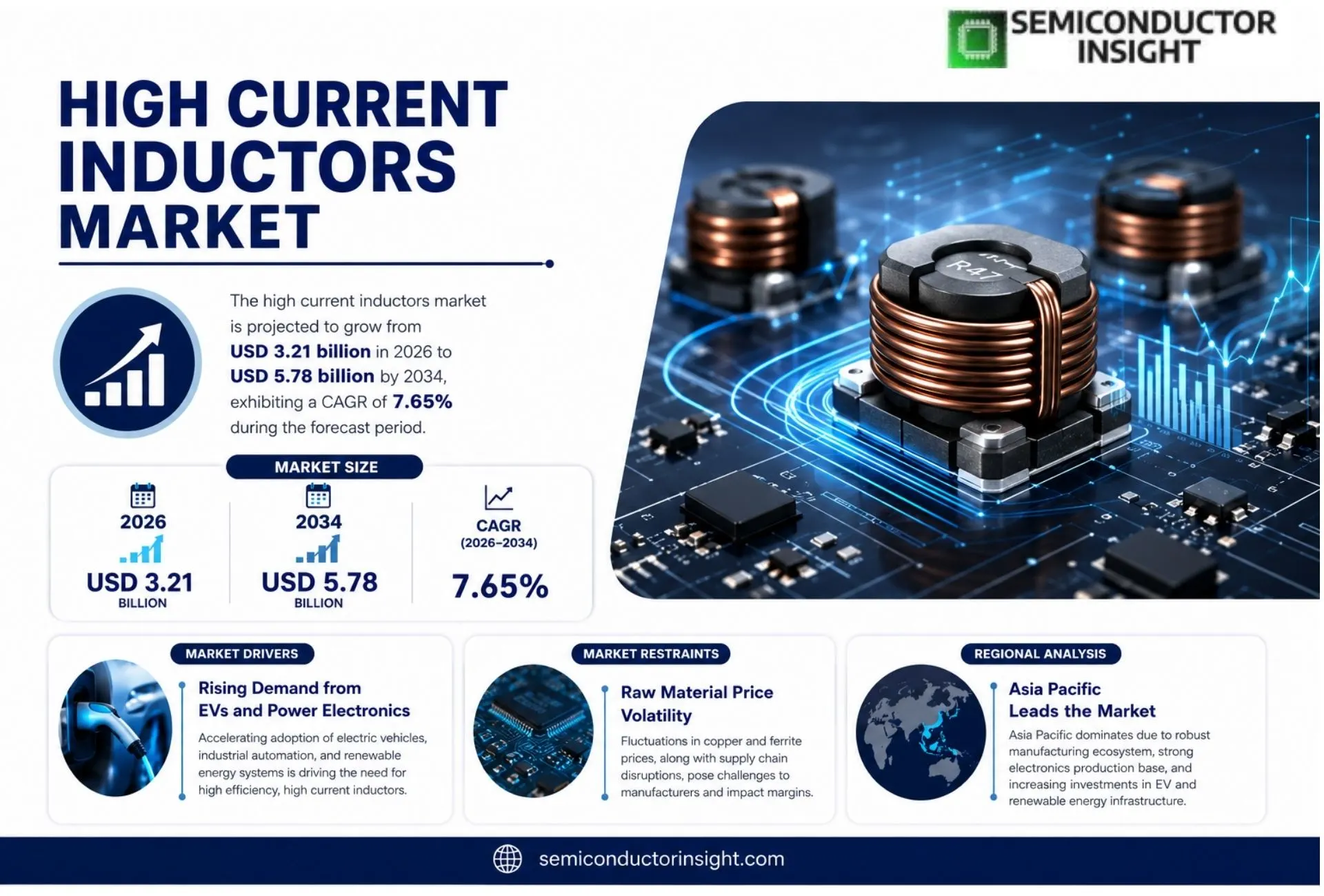
High Current Inductors Market size was valued at USD 1.95 billion in 2026 and will reach USD 3.25 billion by 2035, reflecting a CAGR of 7% over the forecast period.
High current inductors are passive magnetic components engineered for currents above several amperes while sustaining low core losses and high flux density. They play a pivotal role in power conversion stages,including DC‑DC converters, motor drives, renewable energy inverters, and electric vehicle battery management systems,where efficient energy transfer and electromagnetic compatibility remain critical.
MARKET DRIVERS
Surging Demand for High‐Power Electronics
High current inductors are integral to power management in industrial automation, electric vehicles, and renewable energy systems that operate at levels above 100 A. Recent deployments of lithium‑ion chargers for commercial fleets, along with aggressive electrification targets set by major OEMs, have increased the requirement for inductors capable of handling sustained high currents without significant ripple loss. In the automotive segment alone, the adoption of dual‑motor drivetrains and high‑power battery modules has driven a 6‑point compound annual growth in demand for robust magnets and winding technologies. These devices are now more than just passive components,they are designed to reduce electromagnetic interference and extend component lifespan, thereby aligning with stricter emissions regulations and stricter safety standards adopted by utilities and manufacturing plants.
Drive for System Miniaturisation in Industrial Controls
Compact packaging remains a top priority for automated production lines and data‑center power supplies, where footprint savings translate directly to cost advantages. Engineers are integrating higher‑current inductors into smaller chambers to minimise thermal spread while maintaining inductance values above 100 µH. This trend is reinforced by the rise of field‑programmable power modules that rely on dense electromagnetics to meet tight latency constraints. The ability of high‑current inductors to retain performance in high‑temperature environments (up to 250 °C) enables them to be placed closer to heat sources, reducing the need for additional cooling infrastructure. Consequently, companies are allocating larger budgets for in‑line filtering solutions that incorporate advanced shielding techniques, resulting in a cumulative value addition projected to exceed USD 5 billion over the next decade.
➤ In summary, the convergence of electrification initiatives and compact industrial design is propelling the high‑current inductor market towards unprecedented growth levels, prompting suppliers to accelerate research into cost‑effective high‑temperature grade materials.
OEMs looking to achieve compliance with upcoming safety standards in turbocharging systems and high‑power DC‑DC converters are turning to magnetic components that can consistently deliver less than 0.5 % ripple. The same performance metrics align with the mandates of emerging standards such as UL 8640 and IEC 61851, which require inductor designs that maintain magnetic saturation above 2.0 T across operating temperatures. By meeting these prerequisites, manufacturers gain a competitive edge in markets that prioritize duty cycle resilience, establishing high current inductors as a critical differentiator for supply chain partners who seek to secure dual‑source redundancy and lower failure rates. As a result, portfolios that include advanced silicon‑steel core options and high‑density insulated wires are seeing a shift in contractual terms, with longer lead times becoming the norm for premium products.
MARKET CHALLENGES
Raw Material Volatility in Magnetic Sectors
The production of high‑current inductors relies heavily on ferrous alloys such as silicon steel and grain‑oriented silicon. Fluctuations in commodity pricing,often driven by geopolitical factors and supply‑chain congestion,have amplified the cost per kilogram of magnetically permeable cores. These price swings directly influence the final bill of materials for inductors that must register low eddy‑current losses. More severely, the requirement for precise tolerances in winding geometry demands tighter quality control, which in turn raises manufacturing overheads. Suppliers are therefore compelled to explore alternative high‑permeability alloys or additive‑manufactured core solutions, both of which carry uncertain yield rates and require more sophisticated quality assurance protocols. Simultaneously, , supply disruptions caused by isolated facility shutdowns further exacerbate inventory constraints, making price stability a significant operational challenge for both component and end‑user manufacturers.
Other Challenges
Scaling Production Capacity
The lead‑time escalation for high‑current inductors, often exceeding 90 days, hampers the ability of developers to secure runtime components for time‑sensitive projects. To address this, many firms are investing in modular production lines that accommodate a mix of coil geometries. Yet, differing end‑use requirements across automotive, renewable energy, and industrial sectors mean that a one‑size‑fits‑all solution can’t be pursued without incurring prohibitive testing costs. Consequently, manufacturers face a dilemma between customized production for niche markets and cost‑effective mass manufacturing, with each approach demanding distinct capital outlays and operational strategies.
MARKET RESTRAINTS
Thermal Management Constraints in High‑Density Applications
High current inductors, by their very nature, generate substantial heat through resistive losses and magnetic hysteresis. In tightly packed assemblies,such as motor drives or power modules,the ability to dissipate heat without chimneying or regulatory violations is frequently limited by available airflow and convection surfaces. While advances in composite core materials reduce hysteresis losses, the filament stepping required for high‑current performance adds complexity to the winding process, increasing the thermal load exponentially as current density rises. Because thermal runaway can trigger cascade failures in power electronics, manufacturers must integrate additional cooling provisions, each adding to the bill of materials and reducing the overall efficiency margin. This pushes the product design wheel into a balancing act between magnetic performance and thermal dissipation, effectively sapping demand growth from price‑sensitive verticals.
MARKET OPPORTUNITIES
Emerging Intelligent Power Electronics
The rise of edge‑computing power architectures demands inductors that can be seamlessly integrated within modular, intelligent power stages that support real‑time control. Here, the opportunity lies in developing inductors that combine high current capacity with built‑in temperature sensors and magnetic flux monitoring, enabling predictive maintenance algorithms. Manufacturers that can embed these features, particularly within programmable power converters for telecom and data‑center environments, are positioned to command premium pricing. The convergence of machine‑learning firmware and hardware integration requires that inductors support dynamic load profiles that can reach 350 A in short bursts, a specification still uncharted in widely available catalogs. Capitalizing on this niche, firms that can deliver compliant, high‑temperature coefficient inductors stand to capture a growing share of the AI‑driven analytics sector.Another avenue centers on the electrification of building infrastructure, driven by smart grid initiatives that demand large‑scale current management for load balancing and fault isolation. Here, inductors that achieve sub‑microsecond response times while maintaining inductance above 200 µH can replace legacy tap‑changing transformers, offering significant energy savings and lower maintenance overhead. This transition coincides with policy pushes for retrofitting legacy distribution systems, giving established manufacturers a window to diversify product lines into high‑current electromechanical solutions with minimal regulatory friction.Finally, the high‑current inductor market can benefit from cross‑industry partnerships that focus on advanced manufacturing techniques such as laser‑laser lay‑up and 3D‑printed magnetic frameworks. By bridging the gap between electronic design and mechanical precision, companies can reduce lead times and unlock modular product families tailored to specific verticals, from rail traction power stations to offshore wind farm converters. This collaborative ecosystem fosters economies of scale that lower unit costs, while signature performance metrics,such as magnetization current densities exceeding 0.2 A/mm²,become differentiators in fiercely competitive procurement cycles.
High Current Inductors Market Trends
Acceleration of Power Electronics in Renewable and Electric Mobility Sectors
Power electronics form the backbone of contemporary energy solutions, and High Current Inductors Market is undergoing a pronounced shift as installations in solar inverters, commercial HVAC systems and electric vehicle batteries grow. The drive toward higher output currents and tighter power density targets forces designers to select inductors that can sustain multi‑amper currents while delivering minimal core loss. Consequently, manufacturers are exploring thicker magnetic cores, ferrite blends with reduced saturation, and enhanced thermal management to satisfy rigorous efficiency mandates. Companies such as Bourns and Coilmaster Electronics have recently unveiled series capable of operating above 50 A, positioning themselves to capture the growing share of high‑current inverters in North America and emerging markets. For the industry, this trend underscores a need to balance performance with cost, as the demand for higher current ratings is outpacing legacy supply, creating pressure for accelerated innovation.
Other Trends
Miniaturization and High‑Frequency Performance
While raw current capability increases, the physical footprint of inductors remains constrained by space‑to‑efficiency ratios coveted by OEMs, especially in consumer electronics and automotive subsystems. Advancements in nanocrystalline and amorphous core materials have allowed inductors with comparable inductance but half the size, enabling tighter circuit boards and lower assembly costs. Manufacturers are also pushing switching frequencies beyond 3 MHz to reduce transformer losses, a move that demands thinner, higher‑magnetization cores and precise winding techniques. The convergence of these factors results in a market where inductors now often combine currents of 30–50 A with form factors below 5 mm in height. This evolution invites suppliers to invest in process scalability and yield optimisation, while end‑users benefit from slimmer product design without compromising reliability.
Smart Manufacturing and Advanced Materials Integration
Digitalisation of the supply chain, supported by Industry 4.0 principles, is reshaping how inductor manufacturers manage quality, traceability and throughput. Real‑time monitoring of core prototyping, automated impedance matching and predictive maintenance of winding rigs are becoming standard, reducing defect rates to below 0.5 %. Parallelly, materials research is moving toward high‑temperature ceramics that retain magnetic performance up to 150 °C, vital for automotive power stages operating under stringent thermal envelopes. The intersection of these trends indicates a future where high current inductors not only meet escalating output demands but also deliver resilience in adverse environments. Companies that align production capabilities with these material and process breakthroughs will likely capture premium positioning, while those maintaining legacy manufacturing routes may find strategic vulnerability.
COMPETITIVE LANDSCAPE
Key Industry Players
High Current Inductors – Market Landscape and Competitive Hallmarks
Bourns has positioned itself as the predominant force in the high current inductor sector, capturing over a quarter of , revenue in 2024 and underlining its capacity to deliver high‑efficiency modules for power‑conversion systems, particularly in server and data‑center supplies. The company’s focus on integrating electromagnetics expertise with scalable manufacturing has allowed it to meet the escalating demand for power‑efficiency mandates and tightening regulations within North America and expanding fleets. Its portfolio diversification into greater‑than‑50‑amp prototypes and consolidated supply chain partnerships renders it a go‑to provider for battery‑management and manufacturing electronics, reinforcing a resilient revenue stream that offsets cyclic ebb in the consumer electronics segment. Importantly, Bourns’ investment in composite core materials and streamlining of firmware control circuits positions it to respond swiftly to the escalating requirement for higher current density without sacrificing magnetic saturation thresholds, thereby creating a strategic advantage that fuels its market presence in both, the United States and the China market, where the latter is projected to surpass $1.2 billion by 2031.Beyond the leading player, the competitive field is segmented by specialization and geographic footprint. Coilmaster Electronics and MPS Industries supply niche, high‑current compact inductors favored by automotive and industrial control applications that demand low inductance in tight chassis. Coilcraft, ICE Components, and Delta Electronics each pioneer advances in mini‑aturized ferrite cores and embedded architecture, delivering solutions favorable for HVAC inverter boards and solar‑module inverters that value passive component integration. ZenithTek, Core Master, Vishay and Murata combine material science innovations and precision winding techniques to serve a broad array of high‑current environments from medical equipment to large‑scale data‑center PDUs. Additional contributors such as Sagami Elec, Sumida, Chilisin, Mitsumi Electric, Sunlord Electronics and API Delevan fortify the landscape by pushing the envelope on specific application niches – from cutting‑edge copper‑free designs to rugged industrial supply lines – and by expanding into emerging markets in Southeast Asia and the Middle East. This mosaic of manufacturers, each leveraging distinct technical competencies, creates a competitive arena that thrives on continuous product refinement while enabling clients to select components aligned with regulatory requirements and cost constraints.
List of Key High Current Inductors Companies Profiled
- Bourns
- Coilmaster Electronics
- MPS Industries
- Coilcraft
- ICE Components
- Delta Electronics
- ZenithTek
- Core Master
- Vishay
- Murata
- Sagami Elec
- Sumida
- Chilisin
- Mitsumi Electric
- Sunlord Electronics
Segment Analysis:
| Segment Category | Sub-Segments | Key Insights |
| By Type |
|
Power Inductors play a pivotal role in managing high current flows in power conversion equipment.
|
| By Application |
|
Solar Inverters are a leading segment due to growing renewable energy deployment.
|
| By End User |
|
Utility Companies drive demand through grid stabilisation projects.
|
| By Temperature Range |
|
0–85°C is the most widespread range, especially in conventional data centre environments.
|
| By Construction Type |
|
Toroidal configurations dominate due to superior magnetic performance.
|
Regional Analysis: High Current Inductors Market
Europe
The surge in electric vehicle penetration coupled with the expansion of renewable renewable generation undergirds demand for high‑current inductors capable of handling amplified power levels and mitigating electromagnetic interference. These demands push manufacturers toward compact, high‑efficiency inductors that provide seamless integration into increasingly complex power conversion chains.
Competition is intense among established electromechanical firms and emerging specialists in magnetic component technology, prompting consolidation, joint ventures, and syndicated development projects that accelerate product portfolio diversification across competitive markets.
High‑current inductors are catalogued by application class,automotive, industrial motor drives, and renewable storage systems,each exhibiting distinct performance needs. The automotive segment emphasizes high power density and weight minimisation, while renewable sectors demand long‑term reliability and low core loss in variable‑frequency environments.
Rising support for grid‑scale battery storage projects and offshore wind turbines unlock significant opportunities for bespoke high‑current inductors that cater to the bespoke needs of high‑frequency power electronics in these sectors.
North America
North America continues to invest heavily in electric vehicle infrastructure, stimulating a sustained need for high‑current inductors that can support rapid charging stations and vehicle powertrains. The region’s emphasis on energy‑edible packaging innovations,such as capacitor‑magnetic hybrids,has fostered new product lines that prioritize thermal stability under high-load scenarios. State‑level policy incentives for electric fleet adoption further accelerate component turnover, creating a cyclical demand pulse that propels manufacturers to refine shielding materials and achieve higher flux densities. By aligning with North American safety and reliability standards, vendors targeting this market are increasingly collaborating with system integrators to embed inductors directly into vehicle power modules, shaving space and weight while enhancing overall system resilience.
Asia‑Pacific
Asia‑Pacific presents a rapidly expanding canvas, driven by industrial electrification and burgeoning renewable portfolios. Central to this growth is the region’s rapid deployment of photovoltaic and offshore wind farms, which simultaneously increase the demand for inductors that can handle high currents under fluctuating load conditions. Moreover, local automotive manufacturers are adopting high‑current inductors, especially within the fast‑growing electric vehicle segment, to meet stringent emissions and efficiency benchmarks. A pattern emerges of domestic manufacturers combining low‑cost production techniques with advanced core material research, providing competitively priced yet high‑performance inductors tailored to both emerging and incumbent markets. As geopolitical initiatives focus on supply‑chain resilience, the region is also pivoting toward localized magnet fabrication to reduce dependency on overseas supply lines.
South America
South America is at a pivotal juncture, with government strategies targeting the electrification of public transport and expansion of renewable energy grids. This shift has spurred heightened attention to high‑current inductors compatible with solar‑farm inverters and electric bus fleets. Local industry has begun to adapt by sourcing advanced core materials that enable higher power densities while reducing overall system mass. Infrastructure projects in Brazil and Argentina, coupled with regional financing mechanisms for green technology, create an environment that encourages the adoption of high‑current magnetic components. However, the market remains fragmented, with limited domestic manufacturing capacity, prompting continued import dependence. The resulting opportunity exists for forward‑looking regional assemblers to bridge supply gaps through technology transfer and strategic partnerships with established , suppliers.
Middle East & Africa
The Middle East & Africa region is experiencing a paradigm shift as utilities pursue power‑grid Modernisation paired with an upsurge of electric mobility initiatives, particularly within Saudi Arabia, UAE, and Algeria. These activities have elevated the demand for high‑current inductors that can manage high‑voltage, high‑frequency power conversion while contending with harsh climatic conditions. Manufacturers have responded by engineering inductors featuring enhanced thermal management and radial core shielding to maintain performance under sustained solar heat exposure. Supportive fiscal frameworks, such as tax incentives for renewable integration, underscore the region’s commitment to cutting‑edge power electronics; this backdrop positions high‑current inductors as critical enablers of both clean‑energy reliability and the next‑generation electric transport fleet. Collaborative engagements with local engineering firms are increasingly shaping innovation cycles, suggesting a near‑term shift from import reliance to an emerging localized production ecosystem.
Report Scope
This market research report provides a comprehensive analysis of the High Current Inductors Market , covering the forecast period 2026–2035. It offers detailed insights into market dynamics, technological advancements, competitive landscape, and key trends shaping the industry.
Key focus areas of the report include:
-
Market Overview: The report begins with an overview outlining its current market scenario, key growth indicators, and industry transformation drivers. It discusses macroeconomic factors, demand–supply balance, regulatory landscape, and the strategic role of semiconductors in powering advancements across industries such as automotive, telecommunications, consumer electronics, and industrial automation.
- Market Size & Forecast: Historical data and future projections for revenue, unit shipments, and market value across major regions and segments.
- Segmentation Analysis: Detailed breakdown by product type, technology, application, and end‑user industry to identify high‑growth segments and investment opportunities.
- Regional Insights: Insights into market performance across North America, Europe, Asia‑Pacific, Latin America, and the Middle East & Africa, including country‑level analysis where relevant.
- Competitive Landscape: Profiles of leading market participants, including their product offerings, R&D focus, manufacturing capacity, pricing strategies, and recent developments such as mergers, acquisitions, and partnerships.
- Technology Trends & Innovation: Assessment of emerging technologies, integration of AI/IoT, semiconductor design trends, fabrication techniques, and evolving industry standards.
- Market Drivers & Restraints: Evaluation of factors driving market growth along with challenges, supply chain constraints, regulatory issues, and market-entry barriers.
- Stakeholder Insights: Insights for component suppliers, OEMs, system integrators, investors, and policymakers regarding the evolving ecosystem and strategic opportunities.
Primary and secondary research methods are employed, including interviews with industry experts, data from verified sources, and real‑time market intelligence to ensure the accuracy and reliability of the insights presented.
FREQUENTLY ASKED QUESTIONS:
What is the current market size of High Current Inductors Market?
–> High Current Inductors Market was valued at USD 1.95 billion in 2026 and will reach USD 3.25 billion by 2035, reflecting a CAGR of 7% over the forecast period.
Which key companies operate in High Current Inductors Market?
–> Key players include Bourns, Coilmaster Electronics, MPS Industries, Coilcraft, ICE Components, ZenithTek, Core Master, Delta Electronics, Vishay, Murata, among others.
What is the revenue share of the top five players?
–> In 2024, the top five players captured a combined revenue share of P% of the , market.
Which segment will reach the highest value by 2031?
–> The “Less than 30 amps” segment is expected to attain a value of USD Q million by 2031 with a CAGR of R% over the next six years.
Which region dominates the market?
–> The North American region remains the dominant market for High Current Inductors due to high demand in industrial automation and renewable energy projects.
What are the emerging trends?
–> Emerging trends include high‑efficiency designs, integration with power management ICs, and the adoption of advanced materials to improve thermal performance.

Get Sample Report PDF for Exclusive Insights
Report Sample Includes
- Table of Contents
- List of Tables & Figures
- Charts, Research Methodology, and more...
 Download Sample Report PDF