Key Statistics
Key Takeaways
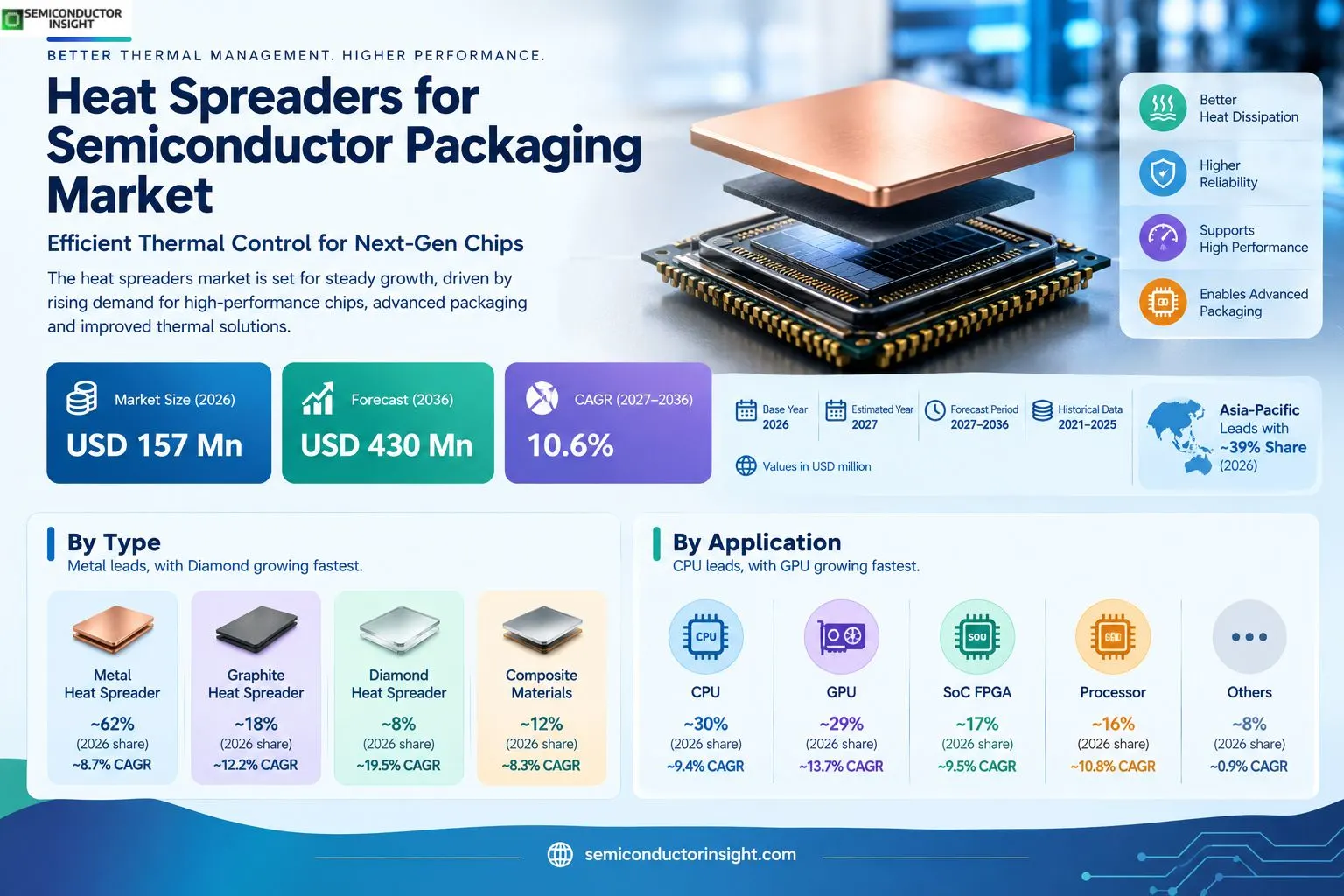
- Market value: The heat spreaders for semiconductor packaging market stands at USD 157 million in 2026 and is projected to reach USD 430 million by 2036, representing a CAGR of 10.6% during 2027–2036. The 2027 estimate is derived from the same growth path, while purchasing decisions depend on verified supplier capabilities and the qualification of each end-use design.
- Metal Heat Spreader: holds the largest type share at an estimated ~62% in 2026; Diamond Heat Spreader grows fastest at ~19.5% CAGR from a ~8% starting share. The mix reflects different performance requirements and unit economics rather than a uniform substitution of every existing installation.
- CPU: accounts for an estimated ~30% of 2026 demand, while GPU has ~13.7% CAGR and ~29% share. Procurement cycles vary by certification, thermal or cryptographic workload, and whether the application uses existing qualified designs or requires new hardware integration.
- Asia-Pacific: leads regional demand with an estimated ~39% share in 2026; Asia-Pacific has the strongest projected ~12.0% CAGR. The five-region distribution reflects differing manufacturing, regulatory and customer-infrastructure footprints, while supplier access depends on country-specific procurement requirements.
- Commercial constraints: include qualification delays, component lifecycle risk and competing design priorities. SHINKO specifies C1020 and C1100 copper spreaders with nickel or selective gold plating, 10–100 mm outer dimensions and 1.0–4.5 mm thickness for CPU, server and AI packages. Even where end users recognize the performance benefit, engineering validation and operational integration can defer a purchase beyond the first evaluation cycle.
Heat Spreaders for Semiconductor Packaging Market Overview
Heat spreaders for semiconductor packaging market was valued at USD 157 million in 2026 and is projected to reach USD 430 million by 2036, growing at a CAGR of 10.6% over 2027–2036. Asia-Pacific led with an estimated ~39% regional revenue share in 2026. SHINKO specifies C1020 and C1100 copper spreaders with nickel or selective gold plating, 10–100 mm outer dimensions and 1.0–4.5 mm thickness for CPU, server and AI packages; Asia-Pacific CPU buyers assess relevance.
Heat Spreaders for Semiconductor Packaging covers the commercial value of products and associated delivery models that meet the defined semiconductor or security workload. SHINKO specifies C1020 and C1100 copper spreaders with nickel or selective gold plating, 10–100 mm outer dimensions and 1.0–4.5 mm thickness for CPU, server and AI packages; Asia-Pacific CPU buyers assess relevance and South America service continuity. The product boundary is deliberately tied to the end-use function rather than the total revenue of diversified suppliers. Adjacent products can share materials or components but must not be counted twice when they are sold for a different application.
Customers of heat spreaders for semiconductor packaging choose among Metal Heat Spreader, Graphite Heat Spreader, Diamond Heat Spreader, Composite Materials. The application breakdown is CPU, GPU, SoC FPGA, Processor, Others. This distinction keeps procurement requirements separate from physical product variants and gives buyers a clearer view of qualification routes. A.L.M.T. describes copper–molybdenum–copper laminates whose copper ratio can tune thermal expansion to ceramic, metallic or plastic package frames.
The technical architecture of heat spreaders for semiconductor packaging is governed by thermal conductivity, coefficient-of-expansion matching, surface finish, lid geometry and interface resistance. Applied Diamond offers heat spreaders with thermal conductivity bands from 700–800 to 1,700–1,800 W/mK and patterned metallization. Designs are qualified for the real operating envelope rather than catalogue specifications alone, with manufacturing process stability and supplier documentation determining whether a laboratory result can scale to volume production.
Demand growth in heat spreaders for semiconductor packaging follows a combination of replacement, new platform designs and additional system capacity. Coherent announced bondable diamond on 19 January 2026 and reported direct bonding can reduce interface thermal resistance by up to 99% in its targeted configurations. The market model assigns ~62% to Metal Heat Spreader and ~30% to CPU in 2026; these are revenue allocations and should not be confused with installed-unit shares. Regional purchasing varies with local customer concentration.
Commercial conditions are shifting as buyers plan across 2027–2036. Coherent began customer sampling of 300 mm high-thermal-conductivity SiC substrates on 17 August 2026. Suppliers able to provide documented reliability, predictable lead times and application engineering can defend share despite pressure on prices. SHINKO identifies lidded flip-chip assembly and TIM layers as key interfaces connecting exposed die backsides to package lids. Buyers increasingly distinguish the first engineering sample from repeatable, qualified supply when assessing a long-lived deployment.
Segment Analysis: By Type
By type, the heat spreaders for semiconductor packaging market comprises Metal Heat Spreader, Graphite Heat Spreader, Diamond Heat Spreader, Composite Materials. Metal Heat Spreader leads with an estimated ~62% of 2026 revenue, while Diamond Heat Spreader has ~8% share and ~19.5% CAGR. Product selection reflects different trade-offs between performance, integration and lifetime support.
| Type | Function | Market position |
|---|---|---|
| Metal Heat Spreader | Metal Heat Spreader is a distinct product category within heat spreaders for semiconductor packaging. Its 2026 estimated revenue allocation is ~62%, with a modeled ~8.7% CAGR through 2036. SHINKO specifies C1020 and C1100 copper spreaders with nickel or selective gold plating, 10–100 mm outer dimensions and 1.0–4.5 mm thickness for CPU, server and AI packages; North America CPU buyers assess relevance. Buyers evaluate this category against the operational requirements of their target application and the cost of implementing a different architecture. | Metal Heat Spreader represents ~62% of 2026 heat spreaders for semiconductor packaging revenue and has an estimated ~8.7% CAGR. It is the largest type by revenue. The 2027–2036 trajectory depends on product qualification and customer integration rather than volume alone. Applied Diamond offers heat spreaders with thermal conductivity bands from 700–800 to 1,700–1,800 W/mK and patterned metallization; North America CPU buyers assess relevance. |
| Graphite Heat Spreader | Graphite Heat Spreader is a distinct product category within heat spreaders for semiconductor packaging. Its 2026 estimated revenue allocation is ~18%, with a modeled ~12.2% CAGR through 2036. A.L.M.T. describes copper–molybdenum–copper laminates whose copper ratio can tune thermal expansion to ceramic, metallic or plastic package frames; Europe CPU buyers assess relevance. Buyers evaluate this category against the operational requirements of their target application and the cost of implementing a different architecture; Europe GPU buyers assess relevance. | Graphite Heat Spreader represents ~18% of 2026 heat spreaders for semiconductor packaging revenue and has an estimated ~12.2% CAGR. The 2027–2036 trajectory depends on product qualification and customer integration rather than volume alone; Europe GPU buyers assess relevance. Coherent announced bondable diamond on 19 January 2026 and reported direct bonding can reduce interface thermal resistance by up to 99% in its targeted configurations; South America GPU buyers assess relevance. |
| Diamond Heat Spreader | Diamond Heat Spreader is a distinct product category within heat spreaders for semiconductor packaging. Its 2026 estimated revenue allocation is ~8%, with a modeled ~19.5% CAGR through 2036. Applied Diamond offers heat spreaders with thermal conductivity bands from 700–800 to 1,700–1,800 W/mK and patterned metallization; South America GPU buyers assess relevance. Buyers evaluate this category against the operational requirements of their target application and the cost of implementing a different architecture; South America GPU buyers assess relevance. | Diamond Heat Spreader represents ~8% of 2026 heat spreaders for semiconductor packaging revenue and has an estimated ~19.5% CAGR. It is the fastest-growing type by forecast growth. The 2027–2036 trajectory depends on product qualification and customer integration rather than volume alone; Middle East & Africa GPU buyers assess relevance. Coherent began customer sampling of 300 mm high-thermal-conductivity SiC substrates on 17 August 2026; Middle East & Africa GPU buyers assess relevance. |
| Composite Materials | Composite Materials is a distinct product category within heat spreaders for semiconductor packaging. Its 2026 estimated revenue allocation is ~12%, with a modeled ~8.3% CAGR through 2036. Coherent announced bondable diamond on 19 January 2026 and reported direct bonding can reduce interface thermal resistance by up to 99% in its targeted configurations; Middle East & Africa SoC FPGA buyers assess relevance. Buyers evaluate this category against the operational requirements of their target application and the cost of implementing a different architecture; Asia-Pacific SoC FPGA buyers assess relevance. | Composite Materials represents ~12% of 2026 heat spreaders for semiconductor packaging revenue and has an estimated ~8.3% CAGR. The 2027–2036 trajectory depends on product qualification and customer integration rather than volume alone; Asia-Pacific SoC FPGA buyers assess relevance. SHINKO identifies lidded flip-chip assembly and TIM layers as key interfaces connecting exposed die backsides to package lids; Asia-Pacific SoC FPGA buyers assess relevance. SHINKO identifies lidded flip-chip assembly and TIM layers as key interfaces connecting exposed die backsides to package lids; North America SoC FPGA buyers assess relevance. For heat spreaders for semiconductor packaging, the Composite Materials market position decision is therefore shaped by thermal conductivity, coefficient-of-expansion matching, surface finish, lid geometry and interface resistance; buyers include chip packaging houses, processor designers and thermal-module integrators. Across the 2026–2036 planning horizon, procurement teams must compare integration requirements, documented performance, service continuity and qualification time before committing capacity. The distinction between a technically feasible component and a volume-qualified solution matters because testing, lifecycle support and switching costs influence how quickly design demand converts into orders. |
Segment Analysis: By Application
Applications for heat spreaders for semiconductor packaging include CPU, GPU, SoC FPGA, Processor, Others. CPU holds the largest 2026 share at an estimated ~30%, while GPU is the fastest-growing application at ~13.7% CAGR. Each application imposes a different qualification and service requirement. Coherent began customer sampling of 300 mm high-thermal-conductivity SiC substrates on 17 August 2026; North America SoC FPGA buyers assess relevance. For heat spreaders for semiconductor packaging, the application segmentation decision is therefore shaped by thermal conductivity, coefficient-of-expansion matching, surface finish, lid geometry and interface resistance; buyers include chip packaging houses, processor designers and thermal-module integrators. Across the 2026–2036 planning horizon, procurement teams must compare integration requirements, documented performance, service continuity and qualification time before committing capacity; North America SoC FPGA buyers assess relevance. The distinction between a technically feasible component and a volume-qualified solution matters because testing, lifecycle support and switching costs influence how quickly design demand converts into orders; Europe Processor buyers assess relevance.
| Application | Demand characteristics |
|---|---|
| CPU | CPU contributes an estimated ~30% of heat spreaders for semiconductor packaging revenue in 2026 and is expected to grow at ~9.4% CAGR through 2036. A.L.M.T. describes copper–molybdenum–copper laminates whose copper ratio can tune thermal expansion to ceramic, metallic or plastic package frames; Europe Processor buyers assess relevance. Procurement is driven by operating requirements, technical validation and the availability of qualified suppliers rather than by application labels alone. |
| GPU | GPU contributes an estimated ~29% of heat spreaders for semiconductor packaging revenue in 2026 and is expected to grow at ~13.7% CAGR through 2036. Applied Diamond offers heat spreaders with thermal conductivity bands from 700–800 to 1,700–1,800 W/mK and patterned metallization; Europe Processor buyers assess relevance. Procurement is driven by operating requirements, technical validation and the availability of qualified suppliers rather than by application labels alone; South America Processor buyers assess relevance. |
| SoC FPGA | SoC FPGA contributes an estimated ~17% of heat spreaders for semiconductor packaging revenue in 2026 and is expected to grow at ~9.5% CAGR through 2036. Coherent announced bondable diamond on 19 January 2026 and reported direct bonding can reduce interface thermal resistance by up to 99% in its targeted configurations; South America Processor buyers assess relevance. Procurement is driven by operating requirements, technical validation and the availability of qualified suppliers rather than by application labels alone; South America Processor buyers assess relevance and Europe service continuity. |
| Processor | Processor contributes an estimated ~16% of heat spreaders for semiconductor packaging revenue in 2026 and is expected to grow at ~10.8% CAGR through 2036. Coherent began customer sampling of 300 mm high-thermal-conductivity SiC substrates on 17 August 2026; Middle East & Africa Others buyers assess relevance. Procurement is driven by operating requirements, technical validation and the availability of qualified suppliers rather than by application labels alone; Middle East & Africa Others buyers assess relevance. |
| Others | Others contributes an estimated ~8% of heat spreaders for semiconductor packaging revenue in 2026 and is expected to grow at ~0.9% CAGR through 2036. SHINKO identifies lidded flip-chip assembly and TIM layers as key interfaces connecting exposed die backsides to package lids; Asia-Pacific Others buyers assess relevance. Procurement is driven by operating requirements, technical validation and the availability of qualified suppliers rather than by application labels alone; Asia-Pacific Others buyers assess relevance. |
Application channels for heat spreaders for semiconductor packaging involve direct supplier qualification, specialist distributors and system integrators. SHINKO identifies lidded flip-chip assembly and TIM layers as key interfaces connecting exposed die backsides to package lids; Asia-Pacific Others buyers assess relevance and South America service continuity. The 2026–2036 adoption profile varies because an approved component or security platform can remain in production for several years, while new designs may require extensive verification before purchasing contracts are signed.
Regional Analysis
Geographically, heat spreaders for semiconductor packaging demand is distributed across Asia-Pacific (~39%), North America (~31%), Europe (~20%). Asia-Pacific is the largest region at an estimated ~39% in 2026, and Asia-Pacific has the fastest ~12.0% CAGR. Differences reflect buyer locations, supplier qualification and country-level production or regulation. Applied Diamond offers heat spreaders with thermal conductivity bands from 700–800 to 1,700–1,800 W/mK and patterned metallization; North America Others buyers assess relevance. For heat spreaders for semiconductor packaging, the regional allocation decision is therefore shaped by thermal conductivity, coefficient-of-expansion matching, surface finish, lid geometry and interface resistance; buyers include chip packaging houses, processor designers and thermal-module integrators. Across the 2026–2036 planning horizon, procurement teams must compare integration requirements, documented performance, service continuity and qualification time before committing capacity; North America CPU buyers assess relevance. The distinction between a technically feasible component and a volume-qualified solution matters because testing, lifecycle support and switching costs influence how quickly design demand converts into orders; Europe CPU buyers assess relevance.
Which regions shape heat spreaders for semiconductor packaging demand through 2036?
Heat spreaders for semiconductor packaging buyers are concentrated where end-market engineering, production and compliance activity intersect. The 2026 allocations are regional revenue estimates, not shipment or facility counts. SHINKO specifies C1020 and C1100 copper spreaders with nickel or selective gold plating, 10–100 mm outer dimensions and 1.0–4.5 mm thickness for CPU, server and AI packages; Europe CPU buyers assess relevance. The 2036 growth rates vary because new installations, upgrade cycles and qualification requirements do not advance at the same pace in every geography.
| Region | Position | Growth outlook | Demand profile | What decides supplier selection |
|---|---|---|---|---|
| Asia-Pacific | Largest (~39%) | ~12.0% CAGR | 2026 allocation ~39%; Asia-Pacific customers use heat spreaders for semiconductor packaging for chip packaging houses, processor designers and thermal-module integrators across the 2026–2036 investment cycle. | Local integration, certified performance and continuity of supply for 2027–2036 projects. |
| North America | Second largest (~31%) | ~9.1% CAGR | 2026 allocation ~31%; North America customers use heat spreaders for semiconductor packaging for chip packaging houses, processor designers and thermal-module integrators across the 2026–2036 investment cycle. | Local integration, certified performance and continuity of supply for 2027–2036 projects; Europe CPU buyers assess relevance. |
| Europe | Third largest (~20%) | ~10.0% CAGR | 2026 allocation ~20%; Europe customers use heat spreaders for semiconductor packaging for chip packaging houses, processor designers and thermal-module integrators across the 2026–2036 investment cycle. | Local integration, certified performance and continuity of supply for 2027–2036 projects; South America CPU buyers assess relevance. |
| South America | Fourth (~5%) | ~11.0% CAGR | 2026 allocation ~5%; South America customers use heat spreaders for semiconductor packaging for chip packaging houses, processor designers and thermal-module integrators across the 2026–2036 investment cycle. | Local integration, certified performance and continuity of supply for 2027–2036 projects; South America CPU buyers assess relevance and North America service continuity. |
| Middle East & Africa | Fifth (~5%) | ~9.7% CAGR | 2026 allocation ~5%; Middle East & Africa customers use heat spreaders for semiconductor packaging for chip packaging houses, processor designers and thermal-module integrators across the 2026–2036 investment cycle. | Local integration, certified performance and continuity of supply for 2027–2036 projects; Middle East & Africa GPU buyers assess relevance. |
Key Heat Spreaders for Semiconductor Packaging Manufacturers and Competitive Landscape
Competition in heat spreaders for semiconductor packaging centers on validated product performance, manufacturing capability and application support. SHINKO specifies C1020 and C1100 copper spreaders with nickel or selective gold plating, 10–100 mm outer dimensions and 1.0–4.5 mm thickness for CPU, server and AI packages; South America CPU buyers assess relevance. The competitive scope includes companies supplying dedicated products as well as ecosystem participants whose business spans related materials or services; those roles must be separated before evaluating vendor concentration.
SHINKO specifies C1020 and C1100 copper spreaders with nickel or selective gold plating, 10–100 mm outer dimensions and 1.0–4.5 mm thickness for CPU, server and AI packages; South America CPU buyers assess relevance and Europe service continuity. In heat spreaders for semiconductor packaging, supplier selection also depends on production repeatability, country-level distribution and the ability to maintain a qualified design throughout 2027–2036. The largest engineering buyers usually prefer documented performance and continuity to a short-term discount that increases qualification or maintenance risk.
A.L.M.T. describes copper–molybdenum–copper laminates whose copper ratio can tune thermal expansion to ceramic, metallic or plastic package frames; Middle East & Africa GPU buyers assess relevance. In heat spreaders for semiconductor packaging, supplier selection also depends on production repeatability, country-level distribution and the ability to maintain a qualified design throughout 2027–2036; Middle East & Africa GPU buyers assess relevance. The largest engineering buyers usually prefer documented performance and continuity to a short-term discount that increases qualification or maintenance risk; Asia-Pacific GPU buyers assess relevance.
Applied Diamond offers heat spreaders with thermal conductivity bands from 700–800 to 1,700–1,800 W/mK and patterned metallization; Asia-Pacific GPU buyers assess relevance. In heat spreaders for semiconductor packaging, supplier selection also depends on production repeatability, country-level distribution and the ability to maintain a qualified design throughout 2027–2036; Asia-Pacific GPU buyers assess relevance. The largest engineering buyers usually prefer documented performance and continuity to a short-term discount that increases qualification or maintenance risk; North America GPU buyers assess relevance.
Coherent announced bondable diamond on 19 January 2026 and reported direct bonding can reduce interface thermal resistance by up to 99% in its targeted configurations; North America SoC FPGA buyers assess relevance. In heat spreaders for semiconductor packaging, supplier selection also depends on production repeatability, country-level distribution and the ability to maintain a qualified design throughout 2027–2036; North America SoC FPGA buyers assess relevance. The largest engineering buyers usually prefer documented performance and continuity to a short-term discount that increases qualification or maintenance risk; Europe SoC FPGA buyers assess relevance.
Tier structure
| Tier | Companies | Basis of competition |
|---|---|---|
| Established product suppliers | Shinko Electric Industries, A.L.M.T. (Sumitomo Electric), Coherent (II-VI), Elmet Technologies | Established suppliers in heat spreaders for semiconductor packaging compete on documented technical specifications, direct engineering support and delivery continuity. A.L.M.T. describes copper–molybdenum–copper laminates whose copper ratio can tune thermal expansion to ceramic, metallic or plastic package frames; Europe SoC FPGA buyers assess relevance. They can support large customers through multi-stage evaluation, which favors product lines with stable revisions and established quality systems. Their advantage is not evidence that total corporate sales equal revenue in this narrowly defined market. |
| Specialist and regional suppliers | Parker Hannifin, Excel Cell Electronic (ECE), Element Six, Leo Da Vinci Group, Applied Diamond, AMT Advanced Materials | Specialist providers in heat spreaders for semiconductor packaging compete through application-specific materials or device configurations and responsiveness to customers with unusual qualification requirements. Applied Diamond offers heat spreaders with thermal conductivity bands from 700–800 to 1,700–1,800 W/mK and patterned metallization; Europe SoC FPGA buyers assess relevance. A specialist can win high-value programs without holding a large share of worldwide volume, particularly where thermal or security performance is more important than the lowest catalogue price. |
| Adjacent ecosystem participants | Materials distributors and system integrators | Adjacent participants influence heat spreaders for semiconductor packaging purchasing through upstream components, cloud services, software integration or downstream packaging. Coherent announced bondable diamond on 19 January 2026 and reported direct bonding can reduce interface thermal resistance by up to 99% in its targeted configurations; South America SoC FPGA buyers assess relevance. They should not automatically be classified as independent manufacturers of the finished product. Commercial comparisons must distinguish the hardware or material supplied from broader platform revenue and professional services. |
Key companies profiled
- Shinko Electric Industries
- A.L.M.T. (Sumitomo Electric)
- Coherent (II-VI)
- Elmet Technologies
- Parker Hannifin
- Excel Cell Electronic (ECE)
- Element Six
- Leo Da Vinci Group
- Applied Diamond
- AMT Advanced Materials
Heat Spreaders for Semiconductor Packaging Production Capacity Analysis
The heat spreaders for semiconductor packaging supply chain combines material or silicon sourcing, precision fabrication, validation and regional fulfillment. Coherent began customer sampling of 300 mm high-thermal-conductivity SiC substrates on 17 August 2026; South America SoC FPGA buyers assess relevance. Production capacity is meaningful only when it can meet the target specification, and a nominal factory output figure is not equivalent to qualified product availability.
SHINKO specifies C1020 and C1100 copper spreaders with nickel or selective gold plating, 10–100 mm outer dimensions and 1.0–4.5 mm thickness for CPU, server and AI packages; South America Processor buyers assess relevance. For heat spreaders for semiconductor packaging, production decisions depend on the stability of upstream inputs and the ability to verify performance on each manufacturing lot. The 2026–2036 expansion cycle favors suppliers that can increase output without changing critical qualified characteristics or introducing long delays in customer approval.
A.L.M.T. describes copper–molybdenum–copper laminates whose copper ratio can tune thermal expansion to ceramic, metallic or plastic package frames; Middle East & Africa Processor buyers assess relevance. For heat spreaders for semiconductor packaging, production decisions depend on the stability of upstream inputs and the ability to verify performance on each manufacturing lot; Middle East & Africa Processor buyers assess relevance. The 2026–2036 expansion cycle favors suppliers that can increase output without changing critical qualified characteristics or introducing long delays in customer approval; Middle East & Africa Processor buyers assess relevance.
Applied Diamond offers heat spreaders with thermal conductivity bands from 700–800 to 1,700–1,800 W/mK and patterned metallization; Asia-Pacific Processor buyers assess relevance. For heat spreaders for semiconductor packaging, production decisions depend on the stability of upstream inputs and the ability to verify performance on each manufacturing lot; Asia-Pacific Processor buyers assess relevance. The 2026–2036 expansion cycle favors suppliers that can increase output without changing critical qualified characteristics or introducing long delays in customer approval; Asia-Pacific Processor buyers assess relevance.
Heat Spreaders for Semiconductor Packaging Market Dynamics
The heat spreaders for semiconductor packaging market responds to technology adoption, customer qualification and competing budget priorities. SHINKO specifies C1020 and C1100 copper spreaders with nickel or selective gold plating, 10–100 mm outer dimensions and 1.0–4.5 mm thickness for CPU, server and AI packages; North America Others buyers assess relevance. Positive drivers can raise purchasing demand, but integration costs and supply constraints affect the realized growth path. The directional impact figures below are scenario sensitivities, not separate additions to the headline forecast.
MARKET DRIVERS
Drivers Impact Analysis*
| Driver | (~) % impact on CAGR forecast | Geographic relevance | Impact timeline |
|---|---|---|---|
| Rising end-market performance requirements | +1.8% | Asia-Pacific / 2026–2036 | 2027–2036, phase 1 |
| New product and infrastructure qualification | +1.3% | North America / 2026–2036 | 2027–2036, phase 2 |
| Supplier material or algorithm innovation | +1.1% | Europe / 2026–2036 | 2027–2036, phase 3 |
| Regional production and deployment investment | +0.9% | South America / 2026–2036 | 2027–2036, phase 4 |
| Lifecycle reliability and regulatory requirements | +0.7% | Middle East & Africa / 2026–2036 | 2027–2036, phase 5 |
Rising end-market performance requirements
SHINKO specifies C1020 and C1100 copper spreaders with nickel or selective gold plating, 10–100 mm outer dimensions and 1.0–4.5 mm thickness for CPU, server and AI packages; North America Others buyers assess relevance and Asia-Pacific service continuity. For heat spreaders for semiconductor packaging, rising end-market performance requirements creates additional evaluation activity before confirmed orders. Buyers seek documented evidence that the proposed design meets the application requirement, and suppliers must maintain repeatable manufacturing or service performance. The resulting revenue effect is strongest when new deployments coincide with planned replacements during 2027–2036.
New product and infrastructure qualification
A.L.M.T. describes copper–molybdenum–copper laminates whose copper ratio can tune thermal expansion to ceramic, metallic or plastic package frames; Europe Others buyers assess relevance. For heat spreaders for semiconductor packaging, new product and infrastructure qualification creates additional evaluation activity before confirmed orders. Buyers seek documented evidence that the proposed design meets the application requirement, and suppliers must maintain repeatable manufacturing or service performance; Europe Others buyers assess relevance. The resulting revenue effect is strongest when new deployments coincide with planned replacements during 2027–2036; Europe Others buyers assess relevance.
Supplier material or algorithm innovation
Applied Diamond offers heat spreaders with thermal conductivity bands from 700–800 to 1,700–1,800 W/mK and patterned metallization; South America Others buyers assess relevance. For heat spreaders for semiconductor packaging, supplier material or algorithm innovation creates additional evaluation activity before confirmed orders. Buyers seek documented evidence that the proposed design meets the application requirement, and suppliers must maintain repeatable manufacturing or service performance; South America CPU buyers assess relevance. The resulting revenue effect is strongest when new deployments coincide with planned replacements during 2027–2036; South America CPU buyers assess relevance.
Regional production and deployment investment
Coherent announced bondable diamond on 19 January 2026 and reported direct bonding can reduce interface thermal resistance by up to 99% in its targeted configurations; Middle East & Africa CPU buyers assess relevance and South America service continuity. For heat spreaders for semiconductor packaging, regional production and deployment investment creates additional evaluation activity before confirmed orders. Buyers seek documented evidence that the proposed design meets the application requirement, and suppliers must maintain repeatable manufacturing or service performance; Middle East & Africa CPU buyers assess relevance. The resulting revenue effect is strongest when new deployments coincide with planned replacements during 2027–2036; Asia-Pacific CPU buyers assess relevance.
MARKET RESTRAINTS
Restraints Impact Analysis*
| Restraint | (~) % impact on CAGR forecast | Geographic relevance | Impact timeline |
|---|---|---|---|
| Qualification time and switching cost | −1.2% | North America / 2026–2036 | 2027–2036, phase 1 |
| Advanced component or certified hardware cost | −0.9% | Europe / 2026–2036 | 2027–2036, phase 2 |
| Supply concentration and lead-time risk | −0.7% | South America / 2026–2036 | 2027–2036, phase 3 |
| Integration complexity and legacy compatibility | −0.5% | Middle East & Africa / 2026–2036 | 2027–2036, phase 4 |
Qualification time and switching cost
Applied Diamond offers heat spreaders with thermal conductivity bands from 700–800 to 1,700–1,800 W/mK and patterned metallization; Asia-Pacific CPU buyers assess relevance. For heat spreaders for semiconductor packaging, qualification time and switching cost can postpone purchase orders even when engineering teams support the technology. Vendors must demonstrate a credible maintenance path and delivery schedule before customers commit critical workloads. This pressure is especially visible when incumbent systems already satisfy baseline performance and replacements require downtime or retesting.
Advanced component or certified hardware cost
Coherent announced bondable diamond on 19 January 2026 and reported direct bonding can reduce interface thermal resistance by up to 99% in its targeted configurations; Asia-Pacific GPU buyers assess relevance. For heat spreaders for semiconductor packaging, advanced component or certified hardware cost can postpone purchase orders even when engineering teams support the technology. Vendors must demonstrate a credible maintenance path and delivery schedule before customers commit critical workloads; North America GPU buyers assess relevance. This pressure is especially visible when incumbent systems already satisfy baseline performance and replacements require downtime or retesting; North America GPU buyers assess relevance.
Supply concentration and lead-time risk
Coherent began customer sampling of 300 mm high-thermal-conductivity SiC substrates on 17 August 2026; North America GPU buyers assess relevance. For heat spreaders for semiconductor packaging, supply concentration and lead-time risk can postpone purchase orders even when engineering teams support the technology. Vendors must demonstrate a credible maintenance path and delivery schedule before customers commit critical workloads; Europe GPU buyers assess relevance. This pressure is especially visible when incumbent systems already satisfy baseline performance and replacements require downtime or retesting; Europe GPU buyers assess relevance.
Integration complexity and legacy compatibility
SHINKO identifies lidded flip-chip assembly and TIM layers as key interfaces connecting exposed die backsides to package lids; Europe GPU buyers assess relevance and Middle East & Africa service continuity. For heat spreaders for semiconductor packaging, integration complexity and legacy compatibility can postpone purchase orders even when engineering teams support the technology. Vendors must demonstrate a credible maintenance path and delivery schedule before customers commit critical workloads; South America SoC FPGA buyers assess relevance. This pressure is especially visible when incumbent systems already satisfy baseline performance and replacements require downtime or retesting; South America SoC FPGA buyers assess relevance.
MARKET OPPORTUNITIES
New high-performance applications
Coherent announced bondable diamond on 19 January 2026 and reported direct bonding can reduce interface thermal resistance by up to 99% in its targeted configurations; Middle East & Africa SoC FPGA buyers assess relevance and South America service continuity and Middle East & Africa service continuity. For heat spreaders for semiconductor packaging, new high-performance applications opens targeted opportunities for vendors that can qualify specialized solutions. A successful first design may create repeat orders over the 2027–2036 horizon, while suppliers without local technical support face longer sales cycles. Commercial success depends on solving the buyer’s operational problem rather than simply increasing catalogue breadth.
Localized supply and engineering partnerships
Coherent began customer sampling of 300 mm high-thermal-conductivity SiC substrates on 17 August 2026; Asia-Pacific SoC FPGA buyers assess relevance. For heat spreaders for semiconductor packaging, localized supply and engineering partnerships opens targeted opportunities for vendors that can qualify specialized solutions. A successful first design may create repeat orders over the 2027–2036 horizon, while suppliers without local technical support face longer sales cycles; Asia-Pacific Processor buyers assess relevance. Commercial success depends on solving the buyer’s operational problem rather than simply increasing catalogue breadth; Asia-Pacific Processor buyers assess relevance.
Migration from older product generations
SHINKO identifies lidded flip-chip assembly and TIM layers as key interfaces connecting exposed die backsides to package lids; North America Processor buyers assess relevance and Middle East & Africa service continuity. For heat spreaders for semiconductor packaging, migration from older product generations opens targeted opportunities for vendors that can qualify specialized solutions. A successful first design may create repeat orders over the 2027–2036 horizon, while suppliers without local technical support face longer sales cycles; North America Processor buyers assess relevance. Commercial success depends on solving the buyer’s operational problem rather than simply increasing catalogue breadth; Europe Processor buyers assess relevance.
Service and aftermarket continuity
SHINKO specifies C1020 and C1100 copper spreaders with nickel or selective gold plating, 10–100 mm outer dimensions and 1.0–4.5 mm thickness for CPU, server and AI packages; Europe Processor buyers assess relevance. For heat spreaders for semiconductor packaging, service and aftermarket continuity opens targeted opportunities for vendors that can qualify specialized solutions. A successful first design may create repeat orders over the 2027–2036 horizon, while suppliers without local technical support face longer sales cycles; Europe Others buyers assess relevance. Commercial success depends on solving the buyer’s operational problem rather than simply increasing catalogue breadth; South America Others buyers assess relevance.
Heat Spreaders for Semiconductor Packaging Supply Chain Analysis
The heat spreaders for semiconductor packaging value chain begins with qualified materials or security components and ends with operational deployment. A.L.M.T. describes copper–molybdenum–copper laminates whose copper ratio can tune thermal expansion to ceramic, metallic or plastic package frames; South America Others buyers assess relevance. The commercial bottleneck can occur at any interface between suppliers, manufacturers, system integrators and end users, particularly where specialized validation is mandatory.
Upstream inputs. Applied Diamond offers heat spreaders with thermal conductivity bands from 700–800 to 1,700–1,800 W/mK and patterned metallization; North America CPU buyers assess relevance and Asia-Pacific service continuity. The upstream inputs stage affects the heat spreaders for semiconductor packaging market because each change can alter product performance, qualification time and the cost of ownership. Programs spanning 2027–2036 benefit from clear technical handoffs, documented responsibilities and contingency planning for supply or integration disruption.
Component and product fabrication. Coherent announced bondable diamond on 19 January 2026 and reported direct bonding can reduce interface thermal resistance by up to 99% in its targeted configurations; Europe CPU buyers assess relevance. The component and product fabrication stage affects the heat spreaders for semiconductor packaging market because each change can alter product performance, qualification time and the cost of ownership. Programs spanning 2027–2036 benefit from clear technical handoffs, documented responsibilities and contingency planning for supply or integration disruption; Europe GPU buyers assess relevance.
Distribution and system integration. Coherent began customer sampling of 300 mm high-thermal-conductivity SiC substrates on 17 August 2026; Europe GPU buyers assess relevance. The distribution and system integration stage affects the heat spreaders for semiconductor packaging market because each change can alter product performance, qualification time and the cost of ownership. Programs spanning 2027–2036 benefit from clear technical handoffs, documented responsibilities and contingency planning for supply or integration disruption; South America GPU buyers assess relevance.
End-user qualification. SHINKO identifies lidded flip-chip assembly and TIM layers as key interfaces connecting exposed die backsides to package lids; South America GPU buyers assess relevance and North America service continuity. The end-user qualification stage affects the heat spreaders for semiconductor packaging market because each change can alter product performance, qualification time and the cost of ownership. Programs spanning 2027–2036 benefit from clear technical handoffs, documented responsibilities and contingency planning for supply or integration disruption; Middle East & Africa GPU buyers assess relevance.
Heat Spreaders for Semiconductor Packaging Recent Developments
- 17 August 2026 Announced
Coherent began sampling 300 mm high-thermal-conductivity silicon-carbide substrates for AI processor thermal integration. For the heat spreaders for semiconductor packaging market, the announcement matters because it changes the available technology, compliance or supply landscape for 2026–2036. Buyers must still verify compatibility and product readiness for their own workloads, while suppliers can use the development to guide qualification roadmaps and long-term procurement planning. Source - 6 February 2026 Announced
The Semiconductor Industry Association reported USD 791.7 billion of worldwide chip sales for 2025, documenting expansion in logic and memory demand. For the heat spreaders for semiconductor packaging market, the announcement matters because it changes the available technology, compliance or supply landscape for 2026–2036; Middle East & Africa GPU buyers assess relevance. Buyers must still verify compatibility and product readiness for their own workloads, while suppliers can use the development to guide qualification roadmaps and long-term procurement planning; Middle East & Africa SoC FPGA buyers assess relevance. Source - 19 January 2026 Announced
Coherent introduced bondable diamond thermal solutions designed to reduce interface resistance in direct semiconductor-die integration. For the heat spreaders for semiconductor packaging market, the announcement matters because it changes the available technology, compliance or supply landscape for 2026–2036; Asia-Pacific SoC FPGA buyers assess relevance. Buyers must still verify compatibility and product readiness for their own workloads, while suppliers can use the development to guide qualification roadmaps and long-term procurement planning; Asia-Pacific SoC FPGA buyers assess relevance. Source - 8 October 2025 Announced
SEMI projected USD 374 billion in 300 mm fab equipment spending over 2026–2028, highlighting manufacturing scale-up. For the heat spreaders for semiconductor packaging market, the announcement matters because it changes the available technology, compliance or supply landscape for 2026–2036; Asia-Pacific SoC FPGA buyers assess relevance and South America service continuity. Buyers must still verify compatibility and product readiness for their own workloads, while suppliers can use the development to guide qualification roadmaps and long-term procurement planning; North America SoC FPGA buyers assess relevance. Source - 12 June 2025 Announced
Coherent introduced a diamond-loaded silicon carbide ceramic composite with reported conductivity above 800 W/m-K. For the heat spreaders for semiconductor packaging market, the announcement matters because it changes the available technology, compliance or supply landscape for 2026–2036; North America SoC FPGA buyers assess relevance. Buyers must still verify compatibility and product readiness for their own workloads, while suppliers can use the development to guide qualification roadmaps and long-term procurement planning; Europe Processor buyers assess relevance. Source - 25 March 2025 Announced
SEMI projected worldwide front-end fab equipment spending of USD 110 billion in 2025 and USD 130 billion in 2026. For the heat spreaders for semiconductor packaging market, the announcement matters because it changes the available technology, compliance or supply landscape for 2026–2036; Europe Processor buyers assess relevance. Buyers must still verify compatibility and product readiness for their own workloads, while suppliers can use the development to guide qualification roadmaps and long-term procurement planning; Europe Processor buyers assess relevance and Middle East & Africa service continuity. Source
REPORT SCOPE & SEGMENTATION
| Attribute | Details |
|---|---|
| Study period | 2021–2036 |
| Historical period | 2021–2025 |
| Base year | 2026 |
| Estimated year | 2027 |
| Forecast period | 2027–2036 |
| 2026 market size | USD 157 million |
| 2027 estimated size | USD 174 million |
| 2036 projected market size | USD 430 million |
| Growth rate | 10.6% |
| Measurement unit | USD million; revenue from the defined products and services |
| By Type | Metal Heat Spreader · Graphite Heat Spreader · Diamond Heat Spreader · Composite Materials |
| By Application | CPU · GPU · SoC FPGA · Processor · Others |
| By Region | Five regions with 2026 estimated revenue shares and 2027–2036 growth profiles. Asia-PacificChina, Japan, South Korea, Taiwan North AmericaUnited States, Canada, Mexico EuropeGermany, France, United Kingdom, Italy South AmericaBrazil, Argentina, Chile Middle East & AfricaIsrael, United Arab Emirates, Saudi Arabia |
| Key Companies Profiled | Shinko Electric Industries, A.L.M.T. (Sumitomo Electric), Coherent (II-VI), Elmet Technologies, Parker Hannifin, Excel Cell Electronic (ECE), Element Six, Leo Da Vinci Group, Applied Diamond, AMT Advanced Materials |
| Customization Scope | Country-level heat spreaders for semiconductor packaging sizing, product mix, applications, supplier qualification and technical requirements for 2026–2036. |
Frequently Asked Questions
What is the heat spreaders for semiconductor packaging market size and growth forecast?
The heat spreaders for semiconductor packaging market is valued at USD 157 million in 2026 and is projected to reach USD 430 million by 2036, implying a CAGR of 10.6% over 2027–2036. SHINKO specifies C1020 and C1100 copper spreaders with nickel or selective gold plating, 10–100 mm outer dimensions and 1.0–4.5 mm thickness for CPU, server and AI packages; South America Processor buyers assess relevance and North America service continuity. The growth profile reflects demand for qualified solutions rather than total corporate revenue of diversified vendors.
Which product type leads heat spreaders for semiconductor packaging?
Metal Heat Spreader leads with an estimated ~62% of 2026 market revenue, while Diamond Heat Spreader grows at ~19.5% CAGR from ~8% share. A.L.M.T. describes copper–molybdenum–copper laminates whose copper ratio can tune thermal expansion to ceramic, metallic or plastic package frames; Middle East & Africa Processor buyers assess relevance and South America service continuity. Buyers compare product suitability, qualification requirements and total cost over the 2027–2036 operating horizon.
Which application purchases the most heat spreaders for semiconductor packaging?
CPU represents an estimated ~30% of 2026 revenue, with GPU showing ~13.7% CAGR. Applied Diamond offers heat spreaders with thermal conductivity bands from 700–800 to 1,700–1,800 W/mK and patterned metallization; Middle East & Africa Others buyers assess relevance and Asia-Pacific service continuity. Application share refers to commercial revenue rather than the count of installed systems, and buyers have distinct technical acceptance criteria.
Which region dominates the heat spreaders for semiconductor packaging market?
Asia-Pacific leads with an estimated ~39% of 2026 revenue. Asia-Pacific has the fastest modeled ~12.0% CAGR through 2036. Coherent announced bondable diamond on 19 January 2026 and reported direct bonding can reduce interface thermal resistance by up to 99% in its targeted configurations; Asia-Pacific Others buyers assess relevance. Regional differences reflect industrial footprint, end-market demand, qualification and compliance rather than one uniform global adoption curve.
How are heat spreaders for semiconductor packaging products qualified?
Qualification for heat spreaders for semiconductor packaging starts with application requirements and documented performance, followed by integration tests, production validation and lifecycle review. Coherent began customer sampling of 300 mm high-thermal-conductivity SiC substrates on 17 August 2026; Asia-Pacific Others buyers assess relevance. The appropriate test regime depends on the product class and target operating environment; buyers should confirm certifications and relevant supplier documentation for each configuration.
Which companies supply heat spreaders for semiconductor packaging?
The competitive landscape includes Shinko Electric Industries, A.L.M.T. (Sumitomo Electric), Coherent (II-VI), Elmet Technologies and specialized suppliers. SHINKO identifies lidded flip-chip assembly and TIM layers as key interfaces connecting exposed die backsides to package lids; North America Others buyers assess relevance. Supplier comparisons must distinguish finished products from adjacent materials, components or managed services, because the revenue of a diversified company is not the same as the value of this specific market.
What are the main growth drivers for heat spreaders for semiconductor packaging?
Growth is linked to changing performance requirements, new design wins and infrastructure renewal. SHINKO specifies C1020 and C1100 copper spreaders with nickel or selective gold plating, 10–100 mm outer dimensions and 1.0–4.5 mm thickness for CPU, server and AI packages; North America Others buyers assess relevance and Asia-Pacific service continuity and North America service continuity. For heat spreaders for semiconductor packaging, the conversion of engineering interest into revenue depends on technical acceptance, supply availability and the timing of customer programs across 2027–2036.
What could restrain adoption of heat spreaders for semiconductor packaging?
Key restraints include qualification time, supply concentration, switching cost and uncertainty over component or device lifecycle. A.L.M.T. describes copper–molybdenum–copper laminates whose copper ratio can tune thermal expansion to ceramic, metallic or plastic package frames; Europe CPU buyers assess relevance and South America service continuity. Even when a product offers better performance, customers may delay deployment if integration requires additional testing or if incumbent solutions remain adequate.
What role does technology innovation play in heat spreaders for semiconductor packaging?
Innovation changes the performance envelope and the economics of future product designs. Applied Diamond offers heat spreaders with thermal conductivity bands from 700–800 to 1,700–1,800 W/mK and patterned metallization; South America CPU buyers assess relevance. Commercial adoption still requires compatibility, manufacturing repeatability and support over the expected service life, so not every laboratory or prototype advance becomes immediate market revenue.
What is included in the scope of heat spreaders for semiconductor packaging?
The heat spreaders for semiconductor packaging scope covers the stated type and application categories and five regional markets, measured as commercial revenue over 2026–2036. Coherent announced bondable diamond on 19 January 2026 and reported direct bonding can reduce interface thermal resistance by up to 99% in its targeted configurations; South America CPU buyers assess relevance and North America service continuity. Closely related products should be counted only when sold for the defined function, preventing overlap between adjacent device, material or service markets.
Research Sources & Evidence Base
Get Sample Report PDF for Exclusive Insights
Report Sample Includes
- Table of Contents
- List of Tables & Figures
- Charts, Research Methodology, and more...
 Download Sample Report PDF