Heart Rate Monitor (PPG) Optical Sensor Market Insights
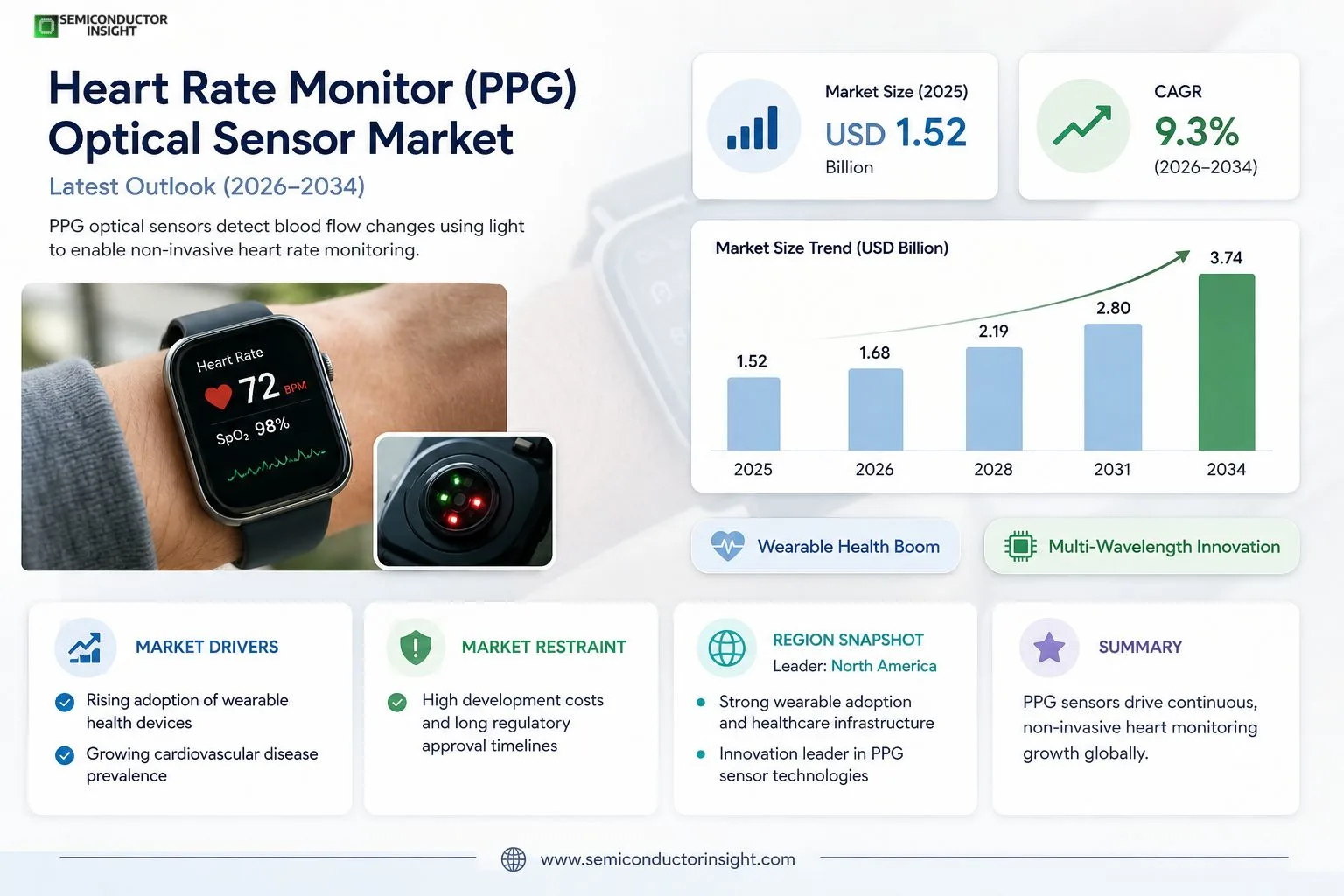
Global Heart Rate Monitor (PPG) Optical Sensor Market size was valued at USD 1.52 billion in 2025. The market is projected to grow from USD 1.68 billion in 2026 to USD 3.74 billion by 2034, exhibiting a CAGR of 9.3% during the forecast period.
Photoplethysmography (PPG) optical sensors are non-invasive biomedical devices that measure volumetric changes in blood flow by detecting light absorption variations at the skin surface. These sensors function by emitting light , typically via green, red, or infrared LEDs , into the skin and measuring the reflected or transmitted light to capture cardiovascular signals. The technology underpins a broad range of applications, including wearable fitness trackers, smartwatches, clinical-grade patient monitoring systems, and remote health monitoring platforms, making it central to both consumer electronics and medical diagnostics.
The market is witnessing robust expansion driven by the surging global adoption of wearable health technology, rising awareness of cardiovascular diseases, and growing demand for continuous, real-time biometric monitoring. Furthermore, the integration of PPG sensors with advanced algorithms for detecting atrial fibrillation (AFib), blood oxygen saturation (SpO2), and stress levels has significantly broadened their clinical relevance. Key industry players such as Apple Inc., Samsung Electronics, Valencell Inc., Maxim Integrated (now part of Analog Devices), and ams-OSRAM AG continue to invest heavily in miniaturization, power efficiency, and multi-wavelength sensing capabilities, reinforcing competitive momentum across Global Heart Rate Monitor (PPG) Optical Sensor Market.
MARKET DRIVERS
Rising Consumer Demand for Wearable Health Monitoring Devices
Global Heart Rate Monitor (PPG) Optical Sensor Market has witnessed substantial momentum driven by the accelerating consumer adoption of wearable health and fitness devices. Photoplethysmography (PPG) optical sensors serve as the core technology in smartwatches, fitness bands, and medical-grade wearables, enabling continuous, non-invasive heart rate monitoring. As awareness of preventive healthcare rises across developed and emerging economies, consumers increasingly seek real-time physiological data, creating sustained demand for advanced PPG optical sensor solutions integrated within compact wearable form factors.
Growing Prevalence of Cardiovascular Diseases Fueling Clinical and Remote Patient Monitoring
Cardiovascular diseases remain among the leading causes of mortality globally, prompting healthcare systems to prioritize continuous cardiac monitoring tools. Heart Rate Monitor (PPG) Optical Sensor Market benefits significantly from the expansion of remote patient monitoring (RPM) programs, wherein PPG-based sensors allow clinicians to track patients’ heart rate variability, arrhythmia patterns, and oxygen saturation levels outside traditional clinical settings. Healthcare digitization initiatives and government-backed telehealth programs across North America, Europe, and Asia-Pacific have further accelerated the integration of PPG optical sensor technology in both consumer and medical-grade monitoring devices.
➤ The convergence of artificial intelligence with PPG optical sensor platforms is enabling advanced cardiac event prediction capabilities, positioning Heart Rate Monitor (PPG) Optical Sensor Market at the intersection of consumer electronics and clinical diagnostics.
Technological advancements in sensor miniaturization, low-power LED design, and signal processing algorithms have substantially improved the accuracy and reliability of PPG-based heart rate monitoring. Leading semiconductor and sensor manufacturers continue to invest in next-generation PPG optical sensor architectures that deliver multi-wavelength measurement capabilities, enabling simultaneous tracking of heart rate, blood oxygen saturation (SpO2), and stress indicators. These innovations are broadening the application scope of Heart Rate Monitor (PPG) Optical Sensor Market beyond fitness tracking into clinical diagnostics, sleep monitoring, and mental wellness assessment.
MARKET CHALLENGES
Motion Artifacts and Signal Accuracy Limitations in Real-World Conditions
One of the most persistent technical challenges facing Heart Rate Monitor (PPG) Optical Sensor Market is the susceptibility of PPG-based sensors to motion artifacts. Physical movement during exercise or daily activities introduces noise into optical signals, degrading heart rate measurement accuracy. While accelerometer-based noise cancellation algorithms have improved performance, achieving clinical-grade accuracy in high-motion scenarios remains a significant engineering challenge. This limitation restricts the deployment of PPG optical sensors in demanding clinical or performance sports applications where measurement precision is non-negotiable.
Skin Tone Variability and Sensor Calibration Complexities
Research has highlighted that PPG optical sensors can demonstrate variable performance across different skin tones and pigmentation levels, raising concerns around equitable healthcare monitoring. Darker skin tones may absorb more light from LED emitters, potentially affecting signal quality and measurement reliability. Addressing this physiological diversity requires sophisticated sensor calibration methodologies and multi-wavelength optical designs, adding complexity and cost to device development within Heart Rate Monitor (PPG) Optical Sensor Market.
Other Challenges
Regulatory and Data Privacy Compliance
As PPG optical sensor-enabled devices increasingly collect sensitive biometric and health data, manufacturers face growing regulatory scrutiny under frameworks such as HIPAA in the United States and GDPR in Europe. Achieving medical device certification for clinical-grade PPG monitoring applications requires rigorous clinical validation, prolonging development timelines and increasing compliance costs for companies competing in Heart Rate Monitor (PPG) Optical Sensor Market.
Competitive Pricing Pressures
The rapid commoditization of entry-level wearable devices has intensified pricing competition among PPG optical sensor suppliers. Original equipment manufacturers (OEMs) increasingly demand cost-optimized sensor components without compromising performance benchmarks, compressing profit margins across the supply chain and challenging smaller sensor developers to sustain R&D investment in Heart Rate Monitor (PPG) Optical Sensor Market.
MARKET RESTRAINTS
High Development Costs and Extended Regulatory Approval Timelines for Medical-Grade Applications
The transition of PPG optical sensor technology from consumer wellness applications to regulated medical device categories presents a formidable restraint on market expansion. Medical-grade heart rate monitoring applications require extensive clinical trials, rigorous validation studies, and compliance with international medical device standards such as IEC 60601 and ISO 13485. These requirements substantially increase development expenditure and extend time-to-market, limiting the ability of smaller sensor manufacturers to compete in the clinical segment of Heart Rate Monitor (PPG) Optical Sensor Market.
Battery Life Constraints Limiting Continuous Monitoring Capabilities
PPG optical sensors rely on LED emitters that consume measurable power during continuous operation, creating inherent tension between monitoring frequency and device battery longevity. In wearable applications, continuous heart rate monitoring significantly reduces battery life, prompting device manufacturers to implement intermittent sampling modes that compromise real-time monitoring utility. Energy efficiency limitations constrain the adoption of always-on PPG monitoring features in compact wearable designs, representing a technical restraint that continues to challenge Heart Rate Monitor (PPG) Optical Sensor Market despite advances in low-power LED and analog front-end (AFE) chip design.
Supply Chain Vulnerabilities and Semiconductor Component Shortages
Heart Rate Monitor (PPG) Optical Sensor Market remains exposed to broader semiconductor supply chain disruptions that affect the availability and pricing of critical components including photodetectors, LED emitters, and analog front-end integrated circuits. Geopolitical tensions, manufacturing concentration risks, and capacity constraints at specialized semiconductor fabs have periodically disrupted component supply, delaying product launches and increasing bill-of-materials costs for wearable device OEMs dependent on PPG sensor technology.
MARKET OPPORTUNITIES
Expansion into Emerging Markets Driven by Increasing Smartphone and Wearable Penetration
Rapidly growing middle-class populations across Asia-Pacific, Latin America, and the Middle East and Africa represent a significant untapped opportunity for Heart Rate Monitor (PPG) Optical Sensor Market. Rising disposable incomes, expanding smartphone ecosystems, and growing health consciousness are driving wearable device adoption in these regions. Local manufacturing initiatives and government digital health programs in countries such as India, China, Brazil, and Indonesia are expected to accelerate the deployment of affordable PPG optical sensor-enabled wearables, opening substantial volume opportunities for sensor manufacturers targeting cost-sensitive market segments.
Integration of PPG Sensors in Next-Generation Continuous Health Monitoring Platforms
The convergence of PPG optical sensing with complementary biometric modalities , including electrodermal activity (EDA), skin temperature sensing, and electrocardiography (ECG) , is creating opportunities for comprehensive continuous health monitoring platforms. Multi-sensor fusion architectures that combine PPG-derived heart rate data with other physiological signals enable more holistic health insights, including stress detection, hydration monitoring, and early illness detection. This multi-modal sensing trend is expanding the addressable application scope of Heart Rate Monitor (PPG) Optical Sensor Market across consumer wellness, corporate health management, and clinical remote monitoring verticals.
AI-Powered Analytics and Digital Health Ecosystem Integration Creating New Revenue Streams
The growing integration of artificial intelligence and machine learning algorithms with PPG optical sensor data streams presents transformative opportunities for Heart Rate Monitor (PPG) Optical Sensor Market. AI-driven analytics platforms can extract clinically meaningful insights from continuous PPG data , including atrial fibrillation detection, sleep apnea screening, and blood pressure estimation , elevating PPG sensors from passive measurement components to active diagnostic enablers. Partnerships between sensor manufacturers, digital health software providers, and healthcare institutions are expected to foster new subscription-based data analytics business models, creating recurring revenue opportunities that extend beyond traditional hardware sales in the evolving Heart Rate Monitor (PPG) Optical Sensor Market landscape.
Heart Rate Monitor (PPG) Optical Sensor Market Trends
Rising Integration of PPG Sensors in Consumer Wearables Drives Market Momentum
Heart Rate Monitor (PPG) Optical Sensor Market is experiencing a significant shift as consumer wearable adoption accelerates globally. Smartwatches, fitness bands, and health-tracking devices are increasingly embedding photoplethysmography (PPG) optical sensors as standard features, moving beyond basic step counting toward continuous cardiovascular monitoring. Major consumer electronics brands have expanded their wearable portfolios to include advanced PPG-based health metrics such as blood oxygen saturation (SpO2), resting heart rate, and stress detection, driving volume demand for optical sensor components across both premium and mid-tier device segments.
Other Trends
Clinical Expansion: PPG Sensors in Remote Patient Monitoring
Healthcare providers and telehealth platforms are increasingly adopting PPG optical sensor technology for remote patient monitoring applications. The non-invasive nature of photoplethysmography makes it particularly suitable for continuous, home-based monitoring of patients with cardiovascular conditions. Integration of PPG sensors with atrial fibrillation (AFib) detection algorithms has elevated their clinical credibility, prompting regulatory interest and broader deployment within hospital-at-home care models.
Multi-Wavelength Sensing: A Key Technology Differentiator
Leading players in Heart Rate Monitor (PPG) Optical Sensor Market are investing in multi-wavelength sensing architectures that combine green, red, and infrared LEDs to improve measurement accuracy across diverse skin tones and activity states. This technological progression addresses longstanding concerns about signal reliability during motion and in varying ambient light conditions, making PPG sensors more viable for both clinical-grade diagnostics and high-intensity athletic applications.
Miniaturization and Power Efficiency Shape Competitive Landscape
As wearable form factors continue to shrink, sensor miniaturization and low-power consumption have become central engineering priorities for companies operating in Heart Rate Monitor (PPG) Optical Sensor Market. Key industry participants including ams-OSRAM AG, Valencell Inc., and Analog Devices (which absorbed Maxim Integrated) are developing highly integrated optical front-end modules that reduce board space requirements while extending battery life. This focus on power-efficient design is particularly critical for continuous health monitoring use cases, where sensors must operate around the clock without compromising device usability or user comfort.
COMPETITIVE LANDSCAPE
Key Industry Players
Heart Rate Monitor (PPG) Optical Sensor Market: Competitive Dynamics and Leading Innovators Shaping Global Landscape
Global Heart Rate Monitor (PPG) Optical Sensor Market is characterized by a dynamic and highly competitive landscape, with a blend of consumer electronics giants, semiconductor specialists, and dedicated biometric sensor companies vying for market share. Apple Inc. and Samsung Electronics dominate the consumer-facing segment, leveraging their extensive wearable ecosystems , including smartwatches and fitness bands , to drive mass adoption of PPG-based heart rate monitoring. Their continued investment in multi-wavelength sensing, algorithm refinement, and integration with health platforms has set a high benchmark for sensor accuracy and miniaturization. Alongside these titans, semiconductor leaders such as Analog Devices (which acquired Maxim Integrated) and ams-OSRAM AG have cemented their positions as critical component suppliers, delivering high-performance optical front-end solutions that power a wide array of third-party wearable and clinical devices. The competitive intensity is further amplified by the market’s projected growth from USD 1.68 billion in 2026 to USD 3.74 billion by 2034, reflecting a CAGR of 9.3%, which continues to attract new entrants and accelerate R&D spending across the value chain.
Beyond the dominant players, several specialized and niche companies are making significant inroads by addressing specific verticals such as clinical-grade monitoring, remote patient care, and advanced biometric platforms. Valencell Inc. has distinguished itself through its proprietary PerformTek biosensor technology, offering highly accurate PPG solutions tailored for medical-grade wearables. Texas Instruments and Silicon Laboratories provide robust analog front-end ICs widely adopted by OEM manufacturers developing health monitoring devices. Fitbit (now part of Google) continues to influence the consumer segment with its established wearable platform, while Huawei and Garmin maintain strong positions in fitness-focused PPG wearable devices globally. Companies such as Omron Corporation and Nonin Medical serve the clinical and homecare monitoring segment, where precision and regulatory compliance are paramount. As integration of PPG with AFib detection, SpO2 monitoring, and stress analysis becomes increasingly standard, competitive differentiation is shifting toward algorithmic intelligence, sensor fusion capabilities, and power efficiency , factors that are reshaping strategic priorities across the entire Heart Rate Monitor (PPG) Optical Sensor Market.
List of Key Heart Rate Monitor (PPG) Optical Sensor Companies Profiled
- Apple Inc.
- Samsung Electronics Co., Ltd.
- Analog Devices, Inc. (Maxim Integrated)
- ams-OSRAM AG
- Valencell, Inc.
- Texas Instruments Incorporated
- Silicon Laboratories Inc.
- Fitbit, Inc. (Google LLC)
- Huawei Technologies Co., Ltd.
- Garmin Ltd.
- Omron Corporation
- Nonin Medical, Inc.
- Philips Healthcare
- Murata Manufacturing Co., Ltd.
- ROHM Co., Ltd.
Segment Analysis:
| Segment Category | Sub-Segments | Key Insights |
| By Type |
|
Reflectance-Type PPG Sensors dominate Global market owing to their inherent design flexibility and compatibility with wrist-worn and on-body wearable devices.
|
| By Application |
|
Wearable Fitness and Wellness Devices represent the most prominent application segment, driven by the mass-market proliferation of consumer health technology and continuous biometric monitoring demand.
|
| By End User |
|
Consumer Electronics Manufacturers constitute the leading end-user segment, anchored by the intense competitive drive among global technology companies to embed advanced health monitoring capabilities into mainstream wearable products.
|
| By LED Light Source |
|
Green LED remains the most widely adopted light source in PPG optical sensors for heart rate monitoring, particularly within consumer wearable applications.
|
| By Form Factor |
|
Wrist-Worn Devices lead the form factor segment by a considerable margin, benefiting from the mainstream consumer familiarity with smartwatches and the ergonomic convenience of continuous wrist-based health tracking.
|
Regional Analysis: Heart Rate Monitor (PPG) Optical Sensor Market
North America
North America hosts a dense concentration of research institutions, university medical centers, and corporate R&D labs dedicated to advancing PPG optical sensor accuracy and miniaturization. Collaborative initiatives between technology giants and healthcare providers continue to fuel breakthroughs in signal processing algorithms, enabling more reliable heart rate data extraction from optical sensor outputs in real-world conditions.
The high penetration rate of consumer wearables across the United States and Canada has created a fertile ground for PPG optical sensor adoption. Consumers increasingly demand accurate, real-time biometric monitoring from smartwatches and fitness trackers, compelling manufacturers to integrate more sophisticated photoplethysmography sensor arrays to meet health-conscious market expectations.
North America’s well-defined regulatory environment, anchored by FDA oversight, provides a structured pathway for clinical-grade PPG optical sensor devices to achieve market clearance. This framework encourages manufacturers to invest in clinical validation, ultimately elevating product quality standards and expanding the applicability of heart rate monitoring solutions in both consumer and medical settings.
A robust network of strategic alliances between semiconductor manufacturers, software developers, and healthcare organizations defines North America’s competitive landscape in Heart Rate Monitor (PPG) Optical Sensor Market. These partnerships accelerate the integration of PPG sensors into telehealth platforms and remote patient monitoring systems, broadening market reach and clinical utility.
Europe
Europe represents a highly significant and mature market for Heart Rate Monitor (PPG) Optical Sensor technologies, underpinned by the region’s long-standing emphasis on preventive healthcare and digital health transformation. Countries such as Germany, the United Kingdom, France, and the Netherlands are at the forefront of integrating PPG optical sensor-enabled devices into both consumer wellness and clinical monitoring applications. The European Union’s strong data privacy regulations, including GDPR, shape how health data collected through PPG sensors is managed, prompting manufacturers to embed robust data governance mechanisms into their solutions. The growing prevalence of lifestyle-related cardiovascular conditions across Western and Northern Europe sustains demand for continuous and accurate heart rate monitoring. European medical device standards under the MDR framework further ensure that PPG optical sensors meet rigorous performance benchmarks. The region’s well-established network of academic research institutions also contributes to fundamental and applied advancements in photoplethysmography technology, reinforcing Europe’s position as a key innovation hub within Global Heart Rate Monitor (PPG) Optical Sensor Market.
Asia-Pacific
Asia-Pacific is the fastest-growing regional market for Heart Rate Monitor (PPG) Optical Sensor solutions, propelled by rapid urbanization, expanding middle-class populations, and increasing health awareness across major economies including China, Japan, South Korea, and India. The region’s large and tech-savvy consumer base, combined with the proliferation of affordable wearable devices, is creating unprecedented demand for integrated PPG optical sensor technologies. China has emerged as both a dominant manufacturing hub and a sizeable end-market, with domestic technology firms competing aggressively on innovation and cost efficiency. Japan’s aging demographic profile is a key demand driver, as healthcare systems increasingly adopt non-invasive remote monitoring tools equipped with PPG sensors for elderly care. South Korea’s advanced semiconductor ecosystem positions it as an important supplier of high-precision optical components for heart rate monitoring applications. Government-led digital health initiatives across Southeast Asian nations are additionally catalyzing market expansion in Heart Rate Monitor (PPG) Optical Sensor Market across the broader Asia-Pacific region.
South America
South America presents an emerging opportunity landscape for Heart Rate Monitor (PPG) Optical Sensor Market, with Brazil and Mexico serving as the primary growth engines. Rising incidence of cardiovascular diseases, combined with gradual improvements in healthcare infrastructure and increasing smartphone penetration, is fostering growing consumer interest in wearable health monitoring devices powered by PPG optical sensor technology. While economic volatility and regulatory fragmentation across South American nations pose challenges to uniform market development, the increasing availability of competitively priced consumer wearables is broadening access to PPG-based heart rate monitoring solutions. Local healthcare authorities are beginning to explore remote patient monitoring as a cost-effective strategy to manage chronic conditions at scale, which is expected to open new avenues for PPG optical sensor deployment in clinical and home-care settings. International market players are increasingly recognizing South America’s untapped potential and are adapting their go-to-market strategies to address the region’s unique socioeconomic dynamics within Heart Rate Monitor (PPG) Optical Sensor Market.
Middle East & Africa
The Middle East & Africa region occupies a nascent but progressively developing position in Global Heart Rate Monitor (PPG) Optical Sensor Market. Gulf Cooperation Council countries, particularly the UAE and Saudi Arabia, are leading regional adoption through ambitious smart health initiatives and government-backed digital transformation programs that incorporate wearable health technologies. The region’s growing awareness of non-communicable diseases, including hypertension and heart disease, is creating a meaningful demand foundation for PPG optical sensor-based monitoring solutions. In Sub-Saharan Africa, market penetration remains limited due to infrastructural constraints and affordability challenges; however, the expansion of mobile health programs is gradually introducing remote monitoring concepts to underserved populations. South Africa serves as the primary commercial hub for medical device distribution across the continent. As telehealth ecosystems mature across the Middle East & Africa and as regional healthcare spending increases, Heart Rate Monitor (PPG) Optical Sensor Market in this geography is expected to witness steady and meaningful long-term development through 2034.
Report Scope
This market research report provides a comprehensive analysis of the Heart Rate Monitor (PPG) Optical Sensor Market , covering the forecast period 2026–2034. It offers detailed insights into market dynamics, technological advancements, competitive landscape, and key trends shaping the industry.
Key focus areas of the report include:
- Market Overview: The report begins with an overview outlining its current market scenario, key growth indicators, and industry transformation drivers. It discusses macroeconomic factors, demand–supply balance, regulatory landscape, and the strategic role of semiconductors in powering advancements across industries such as automotive, telecommunications, consumer electronics, and industrial automation.
- Market Size & Forecast: Historical data and future projections for revenue, unit shipments, and market value across major regions and segments.
- Segmentation Analysis: Detailed breakdown by product type, technology, application, and end-user industry to identify high-growth segments and investment opportunities.
- Regional Insights: Insights into market performance across North America, Europe, Asia-Pacific, Latin America, and the Middle East & Africa, including country-level analysis where relevant.
- Competitive Landscape: Profiles of leading market participants, including their product offerings, R&D focus, manufacturing capacity, pricing strategies, and recent developments such as mergers, acquisitions, and partnerships.
- Technology Trends & Innovation: Assessment of emerging technologies, integration of AI/IoT, semiconductor design trends, fabrication techniques, and evolving industry standards.
- Market Drivers & Restraints: Evaluation of factors driving market growth along with challenges, supply chain constraints, regulatory issues, and market-entry barriers.
- Stakeholder Insights: Insights for component suppliers, OEMs, system integrators, investors, and policymakers regarding the evolving ecosystem and strategic opportunities.
Primary and secondary research methods are employed, including interviews with industry experts, data from verified sources, and real-time market intelligence to ensure the accuracy and reliability of the insights presented.
FREQUENTLY ASKED QUESTIONS:
What is the current market size of Heart Rate Monitor (PPG) Optical Sensor Market?
-> Global Heart Rate Monitor (PPG) Optical Sensor Market size was valued at USD 1.52 billion in 2025 and is projected to grow from USD 1.68 billion in 2026 to USD 3.74 billion by 2034, exhibiting a CAGR of 9.3% during the forecast period.
Which key companies operate in Heart Rate Monitor (PPG) Optical Sensor Market?
-> Key players include Apple Inc., Samsung Electronics, Valencell Inc., Maxim Integrated (now part of Analog Devices), and ams-OSRAM AG, among others.
What are the key growth drivers?
-> Key growth drivers include surging global adoption of wearable health technology, rising awareness of cardiovascular diseases, and growing demand for continuous, real-time biometric monitoring. Additionally, integration of PPG sensors with advanced algorithms for detecting atrial fibrillation (AFib), blood oxygen saturation (SpO2), and stress levels has significantly broadened their clinical relevance.
Which region dominates the market?
-> Asia-Pacific is the fastest-growing region, while North America remains a dominant market, driven by high adoption of wearable fitness trackers, smartwatches, and clinical-grade patient monitoring systems.
What are the emerging trends?
-> Emerging trends include miniaturization of PPG optical sensors, multi-wavelength sensing capabilities, power efficiency improvements, and integration with AI-driven algorithms for enhanced detection of cardiovascular conditions such as AFib and SpO2 monitoring across both consumer electronics and medical diagnostics platforms.

Get Sample Report PDF for Exclusive Insights
Report Sample Includes
- Table of Contents
- List of Tables & Figures
- Charts, Research Methodology, and more...
 Download Sample Report PDF